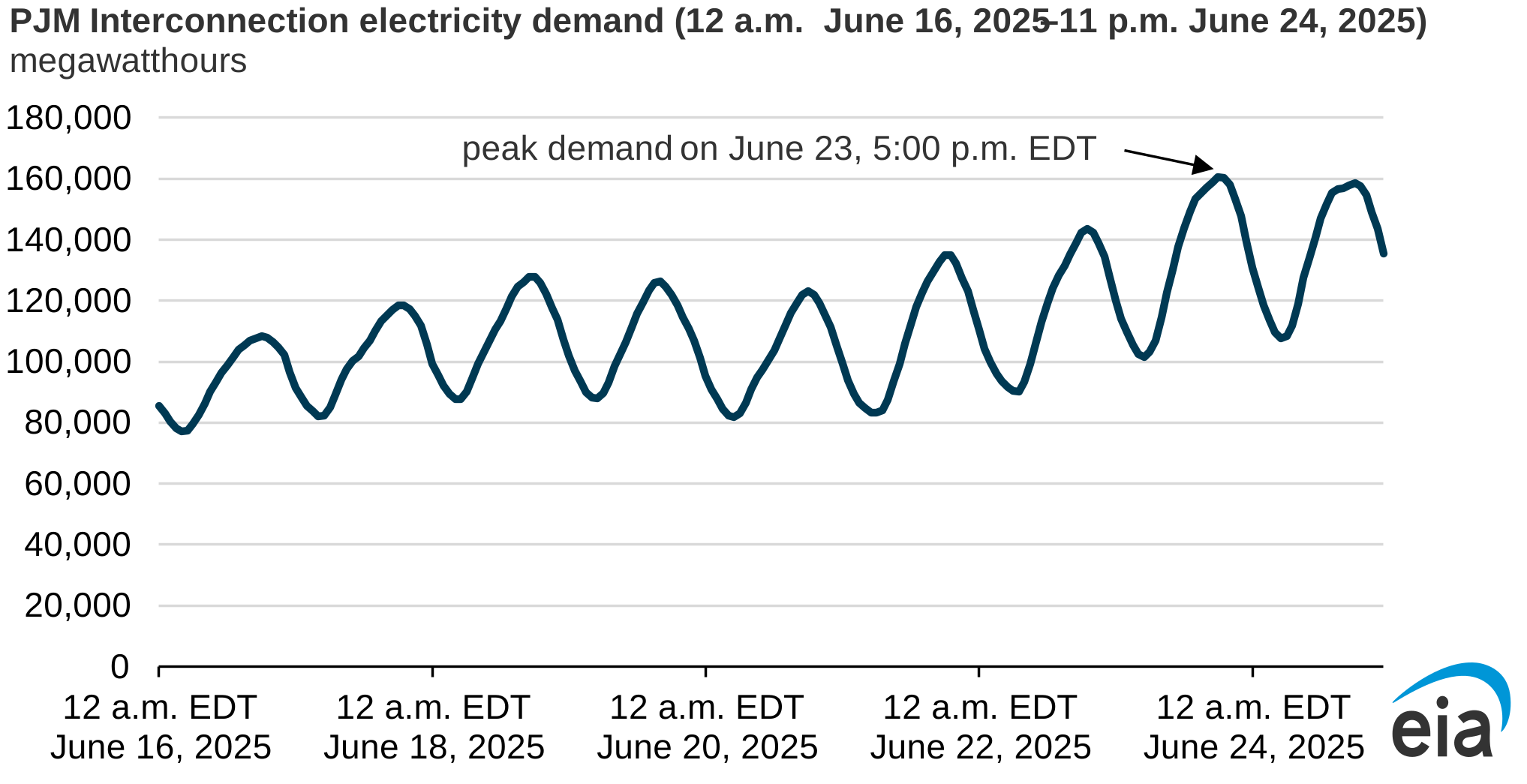
Data source: U.S. Energy Information Administration, Hourly Electric Grid Monitor Note: EDT=Eastern Daylight Time
Electricity demand in the PJM Interconnection and ISO New England (two regional grid operators covering the Northeast United States) reached multiyear highs on June 23 and June 24, respectively. Electricity demand increased significantly due to a heat wave that affected most of the Eastern United States this week.
PJM Interconnection Electricity load in the PJM Interconnection, the largest wholesale electricity market in the country, peaked at 160,560 megawatts (MW) on Monday, June 23, between 5:00 p.m. and 6:00 p.m. according to data from our Hourly Electric Grid Monitor. The load on the grid surpassed PJM’s seasonal peak load forecast of 154,000 MW but remained below the record load of 165,563 MW in 2006 (PJM has expanded numerous times, and this data point is based on PJM’s current footprint). PJM’s footprint includes 13 states and the District of Columbia.
Real-time wholesale electricity prices on June 23 peaked at $1,334 per megawatthour (MWh) at 7:00 p.m. according to PJM, compared with peak prices of $52/MWh on June 16.
At peak load on June 23, 44% of PJM’s generation came from natural gas, 20% from nuclear, 19% from coal, and 6% from solar. The remaining generation came from a mix of hydro, wind, petroleum, and other generation. Petroleum generation, which is generally the most expensive form and therefore only used to meet large demand loads, was three times greater compared with the same hour the day prior.
ISO-New England (ISO-NE)
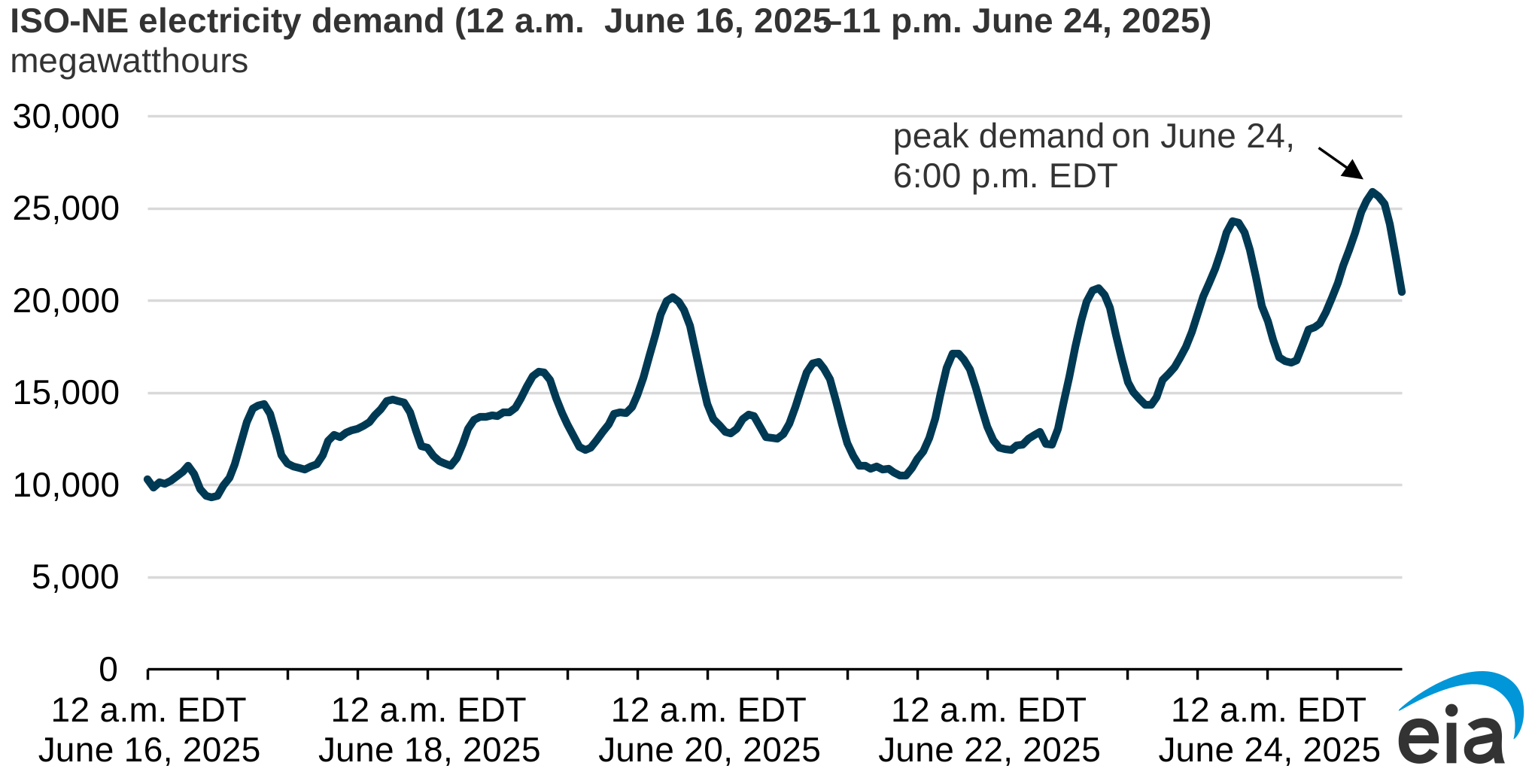
Data source: U.S. Energy Information Administration, Hourly Electric Grid Monitor Note: EDT=Eastern Daylight Time
As the hot weather moved eastward, demand peaked the following day in ISO-NE—the integrated grid operating in Maine, Vermont, New Hampshire, Massachusetts, Rhode Island, and Connecticut. Peak demand on Tuesday, June 24, between the hours of 6:00 p.m. and 7:00 p.m. eastern time was 25,898 MW, according to the data in our Hourly Electric Grid Monitor. ISO-NE reported that Tuesday’s evening peak electricity demand was the highest level seen in the region since 2013.
Real-time wholesale electricity prices on June 24 peaked at $1,110/MWh at 6:00 p.m. according to preliminary data from ISO-NE, compared with peak prices of $65/MWh the previous week on June 17.
New England’s electricity grid depended on a combination of oil-fired power plants, electricity imports from Canada, and increased natural gas power production to meet peak demand this week. At peak load on Tuesday, 47% of ISO-NE generation came from natural gas, 12% from imports, 13% from nuclear, 12% from petroleum, 1% from coal, and 4% from renewable sources including wind, batteries, and solar. The last remaining coal-fired plant in the region, the Merrimack facility in New Hampshire, supplied 280 MWh on average to the grid on Tuesday. The Merrimack facility is typically only used when demand is high.
Principal contributors: Lindsay Aramayo, Kimberly Peterson
While Pennsylvania, Ohio and West Virginia are fossil-fuel “friendly” states, New Jersey, Maryland, Delaware, Connecticut, Rhode Island, Massachusetts and Vermont are extremely hostile to fossil fuels. So, it’s always ironic to look at the electricity generation mix in these regions during periods of extremely hot and cold weather.
At peak load on June 23, 44% of PJM’s generation came from natural gas, 20% from nuclear, 19% from coal, and 6% from solar. The remaining generation came from a mix of hydro, wind, petroleum, and other generation. Petroleum generation, which is generally the most expensive form and therefore only used to meet large demand loads, was three times greater compared with the same hour the day prior.
At peak load on Tuesday, 47% of ISO-NE generation came from natural gas, 12% from imports, 13% from nuclear, 12% from petroleum, 1% from coal, and 4% from renewable sources including wind, batteries, and solar. The last remaining coal-fired plant in the region, the Merrimack facility in New Hampshire, supplied 280 MWh on average to the grid on Tuesday. The Merrimack facility is typically only used when demand is high.
Anyone else notice a pattern here? When demand ramps up, natural gas ramps up to meet the demand. When demand “really” ramps up, New England fires up its only coal-fired power plant and both regions fire up their petroleum-fired power plants. Neither ISO-NE not PJM ramp up renewables to meet demand.
I wonder how New York managed to deal with the heat wave…
Natural gas generated twice as much electricity in New York in 2023 as any other fuel source.
In 2023, natural gas-fired power plants accounted for almost three-fifths of New York’s generating capacity and provided 46% of the state’s electricity net generation, generating twice as much electricity as any other fuel source.25,26 Natural gas fuels 6 of the state’s 10 largest power plants by capacity and 5 of the 10 largest by annual generation.27 To increase reliability, especially during the winter months when natural gas pipelines are highly congested, natural gas-fired electricity generating units with dual-fuel capability can switch fuels in the event of a natural gas supply disruption.28 In 2023, about two-thirds of the state’s natural gas-fired capacity had dual-fuel capability, allowing them to also burn petroleum products.29,30
Since New York has very little natural gas production, due to its idiotic ban on hydraulic fracturing (frac’ing), it must import almost all of that natural gas.
Natural gas
New York has few natural gas reserves, but it does have some natural gas production.100,101 The state’s first commercial natural gas well was drilled in 1821.102 Annual production reached a record high of nearly 56 billion cubic feet in 2006, but has declined almost every year since then. In 2023, New York produced 8.2 billion cubic feet of natural gas, the lowest output since 1975.103 Most of the natural gas consumed in New York is produced in other states. The largest share comes through and from Pennsylvania.104 The Marcellus Shale, named for a town in central New York where the shale is visible at the surface, is a natural gas-bearing formation that extends under parts of New York, Pennsylvania, Ohio, West Virginia, and Maryland.105 It is the largest natural gas area in the United States as ranked by estimated proved reserves.106,107 Much of the Marcellus Shale gas is produced by hydraulic fracturing, commonly called fracking, a drilling technique used to produce natural gas from low permeability shales like the Marcellus. In 2014, New York’s governor banned hydraulic fracturing, and in 2020 the state legislature made the fracking ban permanent. The legislature expanded the fracking ban in 2024 by prohibiting the use of carbon dioxide as a drilling agent to extract crude oil and natural gas from shale rock.108,109,110
New York banned frac’ing, yet derives most of its energy from natural gas… Produced from frac’ed wells in Pennsylvania… From the most prolific natural gas reservoir in the United States… A reservoir that underlies New York state and was named after a town in New York state. As Ron White said:
You not only can’t fix stupid… You can’t even prevent it from getting stupider…
Empire Wind Construction Resumes on a Deal to Allow New Gas Pipelines in New York
New York Governor Kathy Hochul has been in discussions with President Trump to advance two natural gas pipelines alongside the resumption of construction on Empire Wind 1. While Hochul says there was no deal to do so, she indicated that she will approve the gas pipelines only if they meet federal and state requirements.
[…]
Empire Wind 1 has a design capacity of 810 megawatts and is expected to begin commercial operations in 2027. Offshore wind, however, is a costly technology for generating electricity, and projects have been troubled by much higher costs than alternatives. Empire Wind sought renegotiation of its contracts, settling for a fee of $150.15 per megawatt-hour, which is about three times the price of natural gas-fired generation.
President Trump believes that natural gas prices are too high for New Yorkers and New Englanders and wants to provide relief by increasing the availability of supplies through pipeline construction. He wants to revive a canceled pipeline that would carry natural gas from Pennsylvania’s shale gas fields to New York, indicating that it could cut energy prices in the Northeast by as much as 70%. The 124-mile Constitution Pipeline project was abandoned due to legal and regulatory challenges that made it economically unfeasible.
The Constitution Pipeline was proposed in 2013 at a projected cost of under $700 million, but delays and legal challenges drove up the costs by nearly 40%. After the project received Federal Energy Regulatory Commission approval in 2014, New York regulators refused to issue water quality permits, citing concerns about danger to wetlands and stream crossings. New York and other Northeast states have special water-quality certification powers granted to them under federal law to impede planned gas projects in the region. New York State lawmakers have also passed anti-gas laws and banned fracking in the state, despite enormous natural gas resources, which are an extension of the Marcellus fields in Pennsylvania. The Constitution Pipeline project was scrapped in 2020. On May 29, however, Williams Cos. announced that it is giving the Constitution pipeline and Northeast Supply Enhancement projects another try. The two projects have investments totaling about $2 billion.
Hochul might not block the construction of natural gas pipelines that could lower the cost of electricity for New Yorkers, in exchange for Equinor being allowed to resume construction of an offshore windfarm that will deliver electricity to New York City at triple the cost of natural gas-fired generation.
Doctrinaire Democrats have a lot of really stupid policies that hurt people. Climate alarmism is only one of a suite of idiotic political positions. It is amazing that the Dims have any support at all from voters — who must be so thoroughly brainwashed they can’t see their own noses.
I live a somewhat sheltered life in a rural area. I don’t know many people, but of those I do know only one is a Dim and she’s certifiably crazy in all respects, not just politically. I have no idea who votes for Hochul et al. Are they all crazy?
At some point, NY will run out of natural gas pipeline capacity at any cost. Until that happens, they will pay increasing amounts for the NG until it gets to be less expensive to burn #2 oil in those CTs that are equipped to do that. That has already happened in the PJM ISO in winter, when power plants have to share the NG with home heating.
Joe Barrows was a backup QB for Ohio State.
When it was clear approaching his senior year that he would never be the starter, he transferred to LSU. LSU won the National Championship that year.
There’s a lesson there.
Don’t dump what you have now in favor of what you might have in the future.
First his name is Joe Burrow. Second get your facts straight.
Burrow was competing with Dwayne Haskins for the OSU starting job in 2018. He lost out and transferred to LSU. In 18, Haskins had a spectacular year. He led FBS with 4,831 passing yards and 50 passing touchdowns, both of which set school records by wide margins. Haskins was named Big Ten Offensive Player of the Year. Ohio State went 13-1 that year, won the Big Ten and the Rose Bowl. A bizarre mid season loss to lowly Perdue kept them out of the playoff. But Haskins beat the brakes off Michigan to his eternal glory. Haskins flopped in the NFL and died young in a traffic accident.
Burrow started at LSU in 18. The team went 10-3 and was second in the SEC West. Burrow threw for 2,894 yards and 16 TDs. Urban Meyer did not make a mistake Haskins was better in 18. In 19 Burrow was all world, won the Heisman, the National Championship and was 1/1 in the NFL draft.
Burrow also probably did the right thing. In 18 he got all the reps as the starting QB in a big time program against tough opponents. He was good, not great. He probably would not have gotten nearly that much game time at OSU playing behind Haskins who was great. Burrow would have started in 19 because Haskins went to the NFL in the 19 draft, but he might not have done as well as he did at LSU.
Burrow was not dumped by OSU, he lost a competition fair and square, but he used that loss wisely. he transferred, gained valuable reps, and showed his ability the next year.
John Hultquist
July 2, 2025 4:13 pm
Thanks for the information. I just used a little free time to flesh out some history.
William Hart, considered the “father of natural gas” in the U.S., made the first (1821) natural gas well in America along Canadaway Creek in Fredonia, New York. [42.43815, -79.333667] The well was approximately 27 feet (8.2 m) deep. The well was actually a big hole dug with shovels. The pipeline to transport the gas was made from hollowed out logs connected together with tar and rags.
To the south near Titusville, PA, Edwin Drake drilled the first (1859) oil well. [41.610834, -79.65771] It was 69.5 feet deep (21.2m). That spot is just 31 miles from my source place, so visited as a teen. 🤠
Oil was often found as a byproduct when drilling for salt brine, leading to the development of specific drilling methods for oil.
Bob
July 2, 2025 4:27 pm
The only way New York is going to wake up is to quit enabling it. It shouldn’t receive any energy it won’t allow to be produced in its own state. Wind and solar would die and gas and nuclear would boom within a month.
It’s not all beer and skittles for thermal generation at peak demand times either- France and Switzerland shut down nuclear power plants amid scorching heatwave
Nevertheless it doesn’t help to have really fickle supply at such times as any communal grid requires peak pricing signals to keep such reserve capacity costs in check.
Erik Magnuson
July 2, 2025 7:38 pm
Can we please use Megawatts and not Megawatt-hours for demand curves???? The misuse of those two units really irritates me.
I understand your point. Too many times the wrong expressions are used.
MW is the potential of the generator.
MWh is the energy delivered and used. MWh is also Joules with scaling. 1 J = 1 W-sec.
Demand is MWh or GWh. You pay your electric bill based on energy used, KWh
That is the instantaneous demand, the potential load to match the potential of the generator. It is less informative than energy.
It is interesting that the chart is based on 1 hour sampling.
Beta Blocker
July 2, 2025 7:43 pm
If I remember correctly, the 2019 NYS Climate Act forbids state authorities from approving additions or modifications to in-state NYS energy infrastructure which would have the effect of increasing carbon emissions either inside NYS’s own borders, or outside.
For example, NYS state officials could not approve an upgrade to a cross-state power transmission system if that upgrade was made for the purpose of importing power being produced by new-build gas-fired generation located in another state.
If this is indeed so, Governor Hochul is not in a position to trade her approval of new gas pipelines for President Trump’s approval of an NYS offshore wind project. If her approval of new gas pipelines causes an increase in carbon emissions anywhere, then she is not allowed to issue that approval.
Nor could any NYS state agency issue an approval without being held to the letter of the law by those climate activists who understand the 2019 Climate Act and what kinds of restrictions it places on state officials.
Given that your analysis is correct (and I’m assuming that it is) then NYS and the Governor will find that it isn’t legal to approve the pipelines and renege on the “non” deal. They’ll get their offshore wind without having to allow the pipelines. I suspect that President Trump’s legal advisors aren’t that stupid – something else is going on here.
I too am suspicious that something is going on behind the scenes. But who knows what that something actually is.
rovingbroker
July 3, 2025 3:52 am
A rational person would look at the charts above and ask, “Why aren’t we building more nuclear? Safe, clean, reliable nuclear?” Maybe they aren’t familiar with Wikipedia.
Might find other Canadian provinces agreeable to be included in such a swap.
Bruce Cobb
July 3, 2025 10:11 am
At this point, Granite Shore Power, the owner of both the Bow coal-fired plant and Schiller Station in Portsmouth plans to close the Schiller plant (which hasn’t operated for several years) this year, and begin construction of a battery backup system. The Bow power plant, currently used as a peaker plant is set to be closed by 2028, whereupon they will be constructing a 100MW solar facility there, plus a battery facility. Now, however, with the way things have been going with the Trump administration, I wonder if those plans have been scuttled, at least for the time being. The economic incentives may no longer be there. From the beginning, when they first acquired the two plants in 2018, the plan has always been to close them and convert to solar and battery facilities. The question is, can they, or will they now pivot in the opposite direction? Should be interesting to see.
Finally a ship loaded with LNG left the port of Kitimat BC.
Clark descries the incredibly long path from her dream to that event. Government reviews, protests – including violence against workers on the pipeline to Kitimat – etc.
The current Premier of BC seems to support pipelines to export LNG, despite his environmentalist history. Two projects in the future are:
At Squamish BC north of Vancouver BC, terminal is under construction.
Proposed ‘Cedar’ project also at Kitimat with floating terminal.
The new PM of Canada claims to be eager to smooth the path to projects but kept a convicted eco-protester in Cabinet though no longer as Environment Minister.
The natural gas comes from NE BC, which has supplied natural gas to the lower mainland of BC and south into the US for 3/4 of a century. The pipeline to Kitimat is an offshoot of that, as is shorter connection to Squamish.
The big political fight will be to build an oil pipeline from Alberta to the coast near Prince Rupert BC.
The Premier of BC is rabidly against that, the Premier of Alberta will go head to head with him as she wants the revenue for Alberta. Many tribal groups want the pipeline, for jobs, that may influence the federal government to some degree but ‘hereditary’ chiefs get co-opted by eco-activists.
The expansion of the TransMountain oil pipeline to SW BC is finally complete and flowing oil from the Athabaska sands, and ships are departing the export terminal. But because of POTUS Trump’s hatchet-not-scalpel approach to trade negotiations that oil is no longer going to California but to Communist China (no future in that).
The original TMP supplies crude oil to refineries in NW WA which supply fuels to SW BC, western WA, and northern OR, and refined fuels. (Multi-use in batches, from refineries in Alberta – only one refinery in SW BC.)
(Those refineries were getting North Slope oil as well, in its heyday.)
I expect South Korea is a customer for some of the LNG.
For oil, refineries have to be modified to handle heavier crude.


Won’t end well for NY. Which is OK, since they deserve the consequences of their foolish anti-fracking and halted natgas pipeline decisions.
Doctrinaire Democrats have a lot of really stupid policies that hurt people. Climate alarmism is only one of a suite of idiotic political positions. It is amazing that the Dims have any support at all from voters — who must be so thoroughly brainwashed they can’t see their own noses.
I live a somewhat sheltered life in a rural area. I don’t know many people, but of those I do know only one is a Dim and she’s certifiably crazy in all respects, not just politically. I have no idea who votes for Hochul et al. Are they all crazy?
At some point, NY will run out of natural gas pipeline capacity at any cost. Until that happens, they will pay increasing amounts for the NG until it gets to be less expensive to burn #2 oil in those CTs that are equipped to do that. That has already happened in the PJM ISO in winter, when power plants have to share the NG with home heating.
Now do California.
Joe Barrows was a backup QB for Ohio State.
When it was clear approaching his senior year that he would never be the starter, he transferred to LSU. LSU won the National Championship that year.
There’s a lesson there.
Don’t dump what you have now in favor of what you might have in the future.
First his name is Joe Burrow. Second get your facts straight.
Burrow was competing with Dwayne Haskins for the OSU starting job in 2018. He lost out and transferred to LSU. In 18, Haskins had a spectacular year. He led FBS with 4,831 passing yards and 50 passing touchdowns, both of which set school records by wide margins. Haskins was named Big Ten Offensive Player of the Year. Ohio State went 13-1 that year, won the Big Ten and the Rose Bowl. A bizarre mid season loss to lowly Perdue kept them out of the playoff. But Haskins beat the brakes off Michigan to his eternal glory. Haskins flopped in the NFL and died young in a traffic accident.
Burrow started at LSU in 18. The team went 10-3 and was second in the SEC West. Burrow threw for 2,894 yards and 16 TDs. Urban Meyer did not make a mistake Haskins was better in 18. In 19 Burrow was all world, won the Heisman, the National Championship and was 1/1 in the NFL draft.
Burrow also probably did the right thing. In 18 he got all the reps as the starting QB in a big time program against tough opponents. He was good, not great. He probably would not have gotten nearly that much game time at OSU playing behind Haskins who was great. Burrow would have started in 19 because Haskins went to the NFL in the 19 draft, but he might not have done as well as he did at LSU.
Burrow was not dumped by OSU, he lost a competition fair and square, but he used that loss wisely. he transferred, gained valuable reps, and showed his ability the next year.
Thanks for the information. I just used a little free time to flesh out some history.
William Hart, considered the “father of natural gas” in the U.S., made the first (1821) natural gas well in America along Canadaway Creek in Fredonia, New York. [42.43815, -79.333667] The well was approximately 27 feet (8.2 m) deep. The well was actually a big hole dug with shovels. The pipeline to transport the gas was made from hollowed out logs connected together with tar and rags.
To the south near Titusville, PA, Edwin Drake drilled the first (1859) oil well. [41.610834, -79.65771] It was 69.5 feet deep (21.2m). That spot is just 31 miles from my source place, so visited as a teen. 🤠
Oil was often found as a byproduct when drilling for salt brine, leading to the development of specific drilling methods for oil.
The only way New York is going to wake up is to quit enabling it. It shouldn’t receive any energy it won’t allow to be produced in its own state. Wind and solar would die and gas and nuclear would boom within a month.
Let’s wait and see what they label white peoples energy.
Oh Look. People who own air conditioners use them when it gets hot. What a surprise!
Next, we will find out that people who own heaters will use them when it gets cold.
Remember, it’s the government that wants you to adjust your thermostats to remain uncomfortable.
It’s not all beer and skittles for thermal generation at peak demand times either-
France and Switzerland shut down nuclear power plants amid scorching heatwave
Nevertheless it doesn’t help to have really fickle supply at such times as any communal grid requires peak pricing signals to keep such reserve capacity costs in check.
Can we please use Megawatts and not Megawatt-hours for demand curves???? The misuse of those two units really irritates me.
Megawatt hours is the correct unit for generation. The graphs are of MWh/h delivered. The data can also be displayed as MWh/d.
I understand your point. Too many times the wrong expressions are used.
MW is the potential of the generator.
MWh is the energy delivered and used. MWh is also Joules with scaling. 1 J = 1 W-sec.
Demand is MWh or GWh. You pay your electric bill based on energy used, KWh
Demand can be expressed as MW. It’s often coupled with capacity like this ERCOT graph:
That is the instantaneous demand, the potential load to match the potential of the generator. It is less informative than energy.
It is interesting that the chart is based on 1 hour sampling.
If I remember correctly, the 2019 NYS Climate Act forbids state authorities from approving additions or modifications to in-state NYS energy infrastructure which would have the effect of increasing carbon emissions either inside NYS’s own borders, or outside.
For example, NYS state officials could not approve an upgrade to a cross-state power transmission system if that upgrade was made for the purpose of importing power being produced by new-build gas-fired generation located in another state.
If this is indeed so, Governor Hochul is not in a position to trade her approval of new gas pipelines for President Trump’s approval of an NYS offshore wind project. If her approval of new gas pipelines causes an increase in carbon emissions anywhere, then she is not allowed to issue that approval.
Nor could any NYS state agency issue an approval without being held to the letter of the law by those climate activists who understand the 2019 Climate Act and what kinds of restrictions it places on state officials.
Given that your analysis is correct (and I’m assuming that it is) then NYS and the Governor will find that it isn’t legal to approve the pipelines and renege on the “non” deal. They’ll get their offshore wind without having to allow the pipelines. I suspect that President Trump’s legal advisors aren’t that stupid – something else is going on here.
I too am suspicious that something is going on behind the scenes. But who knows what that something actually is.
A rational person would look at the charts above and ask, “Why aren’t we building more nuclear? Safe, clean, reliable nuclear?” Maybe they aren’t familiar with Wikipedia.
In the United States, nuclear power is provided by 94 commercial reactors with a net capacity of 97 gigawatts (GW), with 63 pressurized water reactors and 31 boiling water reactors.[1] In 2019, they produced a total of 809.41 terawatt-hours of electricity,[2] and by 2024 nuclear energy accounted for 18.6% of the nation’s total electric energy generation.[3] In 2018, nuclear comprised nearly 50 percent of US emission-free energy generation.[4][5]
https://en.wikipedia.org/wiki/Nuclear_power_in_the_United_States
My dislike of using wind and sun to power our nation is based on facts. The fear and dislike of safe, clean and reliable nuclear power is based on … ?
An irrational fear of radiation.
Jane Fonda and The China Syndrome augmented by the stupidity that led to Chernobyl.
Could a deal be struck with Canada where New York state and all of New England are traded for Alberta?
Might find other Canadian provinces agreeable to be included in such a swap.
At this point, Granite Shore Power, the owner of both the Bow coal-fired plant and Schiller Station in Portsmouth plans to close the Schiller plant (which hasn’t operated for several years) this year, and begin construction of a battery backup system. The Bow power plant, currently used as a peaker plant is set to be closed by 2028, whereupon they will be constructing a 100MW solar facility there, plus a battery facility. Now, however, with the way things have been going with the Trump administration, I wonder if those plans have been scuttled, at least for the time being. The economic incentives may no longer be there. From the beginning, when they first acquired the two plants in 2018, the plan has always been to close them and convert to solar and battery facilities. The question is, can they, or will they now pivot in the opposite direction? Should be interesting to see.
NY and New England don’t deserve any of it.
Saturday Chuckle for me is Christy Clark takes a — deserved — victory lap on LNG | Vancouver Sun.
Finally a ship loaded with LNG left the port of Kitimat BC.
Clark descries the incredibly long path from her dream to that event. Government reviews, protests – including violence against workers on the pipeline to Kitimat – etc.
The current Premier of BC seems to support pipelines to export LNG, despite his environmentalist history. Two projects in the future are:
The new PM of Canada claims to be eager to smooth the path to projects but kept a convicted eco-protester in Cabinet though no longer as Environment Minister.
The natural gas comes from NE BC, which has supplied natural gas to the lower mainland of BC and south into the US for 3/4 of a century. The pipeline to Kitimat is an offshoot of that, as is shorter connection to Squamish.
The big political fight will be to build an oil pipeline from Alberta to the coast near Prince Rupert BC.
The Premier of BC is rabidly against that, the Premier of Alberta will go head to head with him as she wants the revenue for Alberta. Many tribal groups want the pipeline, for jobs, that may influence the federal government to some degree but ‘hereditary’ chiefs get co-opted by eco-activists.
The expansion of the TransMountain oil pipeline to SW BC is finally complete and flowing oil from the Athabaska sands, and ships are departing the export terminal. But because of POTUS Trump’s hatchet-not-scalpel approach to trade negotiations that oil is no longer going to California but to Communist China (no future in that).
The original TMP supplies crude oil to refineries in NW WA which supply fuels to SW BC, western WA, and northern OR, and refined fuels. (Multi-use in batches, from refineries in Alberta – only one refinery in SW BC.)
(Those refineries were getting North Slope oil as well, in its heyday.)
I expect South Korea is a customer for some of the LNG.
For oil, refineries have to be modified to handle heavier crude.