Charles Rotter

It comes as little surprise that yet another grandiose techno-utopian vision has ended not with a triumphant march toward Net Zero, but with a flick of the off-switch. Last week, Britain’s energy secretary quietly announced that the government “has pulled the plug on a £24 billion plan to bring Moroccan wind and solar power to Britain via the world’s longest subsea electricity cable, citing concerns over security and costs” . In other words, after years of hype, headline-grabbing simulations and talk of “reliable clean power for 19 hours a day,” the reality of risk and expense finally intruded—and the dream of Sahara sun for all has been consigned to the scrapheap.
The scheme, championed by Xlinks and backed by big-name investors from Abu Dhabi’s Taqa to TotalEnergies, was unveiled in 2022 with a headline price tag of £16 billion. By the time official talks fizzled, project costs had ballooned to between £22 billion and £24 billion—and the fixed, subsidised price for UK consumers had climbed from a promising £48/MWh in 2012 terms to a sobering £70-80/MWh, on par with Hinkley Point C’s notorious £92.50/MWh deal from a decade ago . It was a textbook illustration of how techno-optimism meets political reality: grand ambitions crashing headlong into the twin walls of finance and geopolitics.
Perhaps the most telling line came when officials admitted this “first-of-a-kind mega project” carried “a high level of inherent, cumulative risk, delivery, operational, and security.” In plainer terms, nobody quite trusted a 3,800-mile subsea cable stretching from the Sahara to Devon to keep the lights on—or to fend off hostile actors, accidental damage or simple technical failure . For all the talk of homegrown power, the reality was a foreign-built supergrid running through disputed waters, vulnerable to every storm, saboteur or bureaucratic blunder.
And yet just a few years ago, this venture was presented as the ultimate win-win: millions of desert acres covered in solar panels and wind turbines, exporting 3.6 GW of “reliable” energy to 7 million homes and displacing imported gas. Xlinks even claimed it could reduce UK wholesale prices by over 9 percent in its first year of operation—implying that the very costs of this colossal scheme would pay for itself. Leave aside the challenge of storing or transmitting intermittent deserts-of-power and the gargantuan batteries needed to smooth out every dust storm, and one must ask: who was really buying into this fairy tale—investors or ideologues?
No doubt Sir Dave Lewis, Xlinks’s chairman and former Tesco boss, felt the sting of rejection when he spoke of being “hugely surprised and bitterly disappointed.” It is, after all, hard to maintain the sheen of global-scale green enthusiasm when home departments balk at underwriting your vision. One can almost hear the collective shrug from Westminster: enough with offshore daydreams—build some turbines in Yorkshire, drill holes for storage in the Midlands, train some electricians in Glasgow and call it a day. For all the vaunted “diversity of supply,” it appears domestic alternatives won the argument over exotic imports.
There is a delicious irony in the timing. As ministers tout an “accelerated path to net zero at least risk to billpayers and taxpayers,” they have effectively walked away from the single largest overseas renewable venture ever proposed . The very same people who once celebrated cross-continental cables as the crowning achievement of global cooperation now invoke security concerns and “national interest” as their exit ramp. One wonders how abruptly the narrative will shift next time a British-funded project in Kazakhstan or Canada hits a bump—will it be “not in the British interest” to proceed with those, too?
This turn of events also exposes the fundamental flaw of top-down climate technocracy: it treats citizens as passive units in a planetary control scheme, not discerning voters with budgets to balance. When the public wises up to the fact that imported Sahara sun arrives at a price rivaling home-grown nuclear—and carries with it a risk of outages, sabotage or diplomatic spats—they recoil. They learn that the cable would thread through multiple jurisdictions, remote islands and fierce currents, any one of which could jeopardize supply. At some point, scepticism ceases to be a political liability and becomes simple common sense.
Consider the broader lesson: no matter how enthusiastically globalists embrace “interconnected grids,” the strings always end back at national treasuries and war-rooms. The cable’s 1,500 square-mile solar-wind-battery complex in Morocco was to be the crown jewel of decarbonization, yet it was contingent on political goodwill in Rabat, cable-manufacturing in Asia, local security in the Sahara and stable undersea trench conditions for 3,800 miles—any of which could unravel faster than a hastily signed bilateral MoU. The government’s conclusion that “stronger alternative options” exist closer to home may be the most uncontroversial statement of 2025 .
Detach for a moment from the partisan fray and savour the schadenfreude: this megaproject was touted as the elixir to Britain’s energy woes, yet it collapsed under its own hubris. The very proponents who decried fossil-fuel inertia now cry foul when asked to stump up real money. The same voices that demand “global solidarity” balk when that solidarity requires underwriting risks in unstable deserts. And as for “green jobs” and “supply-chain opportunities”—it turns out that Asia still makes the cables and Morocco still controls the sun.
The demise of Xlinks’s Sahara venture may not end the net-zero narrative, but it does puncture a hole in the myth of techno-utopian inevitability. When a scheme promising 8 percent of Britain’s electricity—at a price echoing nuclear—and requiring unprecedented security guarantees is deemed “not in the national interest,” one must wonder: how many more exotic grand plans will be ditched before realism returns? The answer, for now, seems to be one.
Let us not pretend this was a minor failure. It represented the epitome of climate-policy excess: outsourcing critical infrastructure to distant deserts, bemoaning gas-price volatility while embracing solar-dust storms, and swapping local accountability for a vague vision of interconnected utopia. Watching it crumble offers a rare moment of clarity amid the Net Zero hysteria: true energy security still resides in domestic control, not pipelines and cables stretching half-a-continent away.
In the aftermath, expect Xlinks to regroup, rebrand and regroup again—perhaps pitching Canadian hydro next. But the core lesson stands: citizens will not subsidise fantasy-grid fantasies when they can invest in less risky generation at home. And bureaucrats will not ignore security and cost overruns when climate dogma collides with the hard calculus of budgets and ballots.
There is an understated joy in witnessing this particular techno-dream deflate. It reminds us that even the most elaborate green schemes are only as sound as their financial footings and geopolitical foundations. When those falter, the utopian narrative gives way to something far more earthy: the simple recognition that expensive, complex, and foreign-dependent projects rarely survive contact with reality. As the Sahara sun fades—quite literally—from policymakers’ agendas, one hopes the next set of proposals will be a little more modest, a bit less global, and anchored firmly within UK borders.
Flying unicorns is a good symbol for this project.
AYUP
Nothing is more expensive than Freely Fueled Wind and Solar.
No fuel source is …
less consistent
less reliable
No generation source is …
less affordable
more mineral intensive
more acreage extensive
more ecologically damaging
AND
ultra short lived compared to FF generation
Always seemed to me to be a truly idiotic idea. Where do they find these people?
Colleges and universities churn them out by the thousands.
Kind of like the Democrats new mayoral candidate who thinks that the solution to high food prices is government run grocery stores and the solution to high rent is a government mandated rent freeze.
It’s depressing how quickly the communism spreads. I used to make the argument that we don’t have public supermarkets even though food is a basic need, so why do we need public schools?
The communist supermarkets will be full of moldy turnips. Whatever else remains on the shelf after shoplifting will be the items nobody wants. City council cronies will make millions selling food to the communist supermarkets and anything that is priced below market price (as the communists promise as the whole point of this exercise) will be immediately sold out to hoarders and barter traders.
Yup. Moscow in the 1970’s.
Today’s liberalized SJW/DEI enhanced higher educmacation system
These moneyed elites have their own generators on their multiple estates
Never is there a hint regarding restrictions on yachts and private planes and estate sizes; witness the extravagant Bozos wedding; boycott Amazon.
They just want to collect never-ending streams of untaxed money, at the expense of all others, just like Royalty.
Labor Party would get less than 20% of the vote
Farage Reform Party would get over 50%, take over the Parliament and throw all the bureaucrat leeches out.
Give that man a chainsaw to cut waste, fraud and abuse.
Cut defense spending
Throw all the illegals and grooming gangs out
That would be about 60 years overdue.
Make the UK Great again.
Where there are troughs there will be pigs.
Consider that you can’t build stable turbines or panels on shifting sands and that the sands of the Sahara Run an average depth of 500′ then consider the deepest “Moving Dunes” can be 1000′ deep, you will need some gargantuan turbine masts and deeply excavated turbine footings (down to bedrock) to place turbines “Just anywhere” in the Sahara. Same for Solar Panels, their bases would also need to be set deep to “Not be Disturbed” by Saharan shifting sands.
Despite Hollywood depictions, not all of the Sahara is shifting sands, in fact, most of it is not.
Well you aren’t going to put them on Gravel plains or salt flats either. The gravel would still need to be excavated to a stable surface and the salt would prove corrosive to panel supports. So that leaves the rocky Mesa areas and I’m not sure how much of a problem the stone might pose as foundation footing installations
One sand storm puts all panels out of business
No, no, no!
The occasional sandstorm would just sandblast all the dirt of the panels.
(I’m sure they’d work just as well with etched glass.)
Sandstorms?
It’s a feature, not a bug. Repairing and rebuilding every few months will create millions and billions of good paying Green jobs, dontchaknow?
Blowing sand isn’t very good for PVA surfaces.
Let’s hope Australia’s renewables shills take note and pull the plug on their proposed dumb idea to link us to Singapore.
It has been scrapped as not viable and no subsidies from the public purse
It hasn’t been scrapped yet, but the initial attempt to raise the first amount of money has failed. And recently, two key executives have left the company. Also Singapore has setup a deal with Indonesia to supply more power.
The idea of a submarine cable was a silly one, floated as an end run around difficulties in negotiating with the EU post Brexit.
But the desert power will come, over land. There are already two interconnectors between Morocco and Spain, which can bring 900 MW into Spain. Another 700 MW should come online next year, and there will be more. And Spain exports to France and France to England, etc.
Your crystal ball must be better than mine. Does it predict race winners as well?
All your opinions, plus $5 cash, will buy you a $5 cup of coffee. Mine have the same value as yours, so I prefer mine.
Yes, Nick, I’m having a bit of a smile at your religious fanaticism. Sorry about that.
The problem with this is that Morroco’s power generation is mostly fossil fuels. –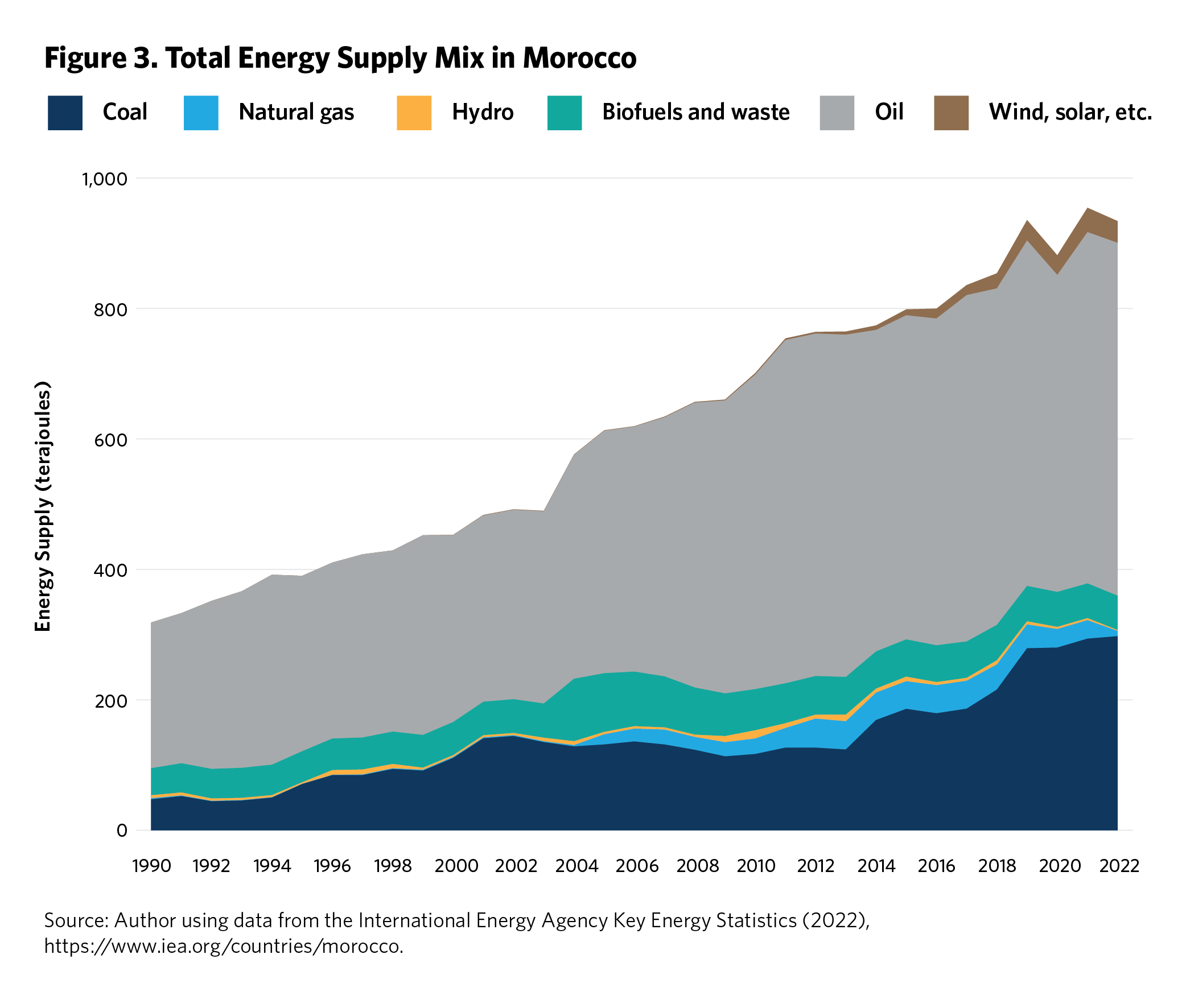
Your graph is not power generation but all primary energy, eg transport.
There’s the Nick-picker we all know and love. Points out the minor error to avoid addressing the overwhelming problem with his fantasy solution.
Wind and solar play minuscule roles.
Alright, her ya go Nick. Sorry about the mix-up –
So ignore the oil component. Unless they are using steam locomotives, coal used to produce electricity greatly exceeds the combined hydro, biofuel, and renewables power generation.
They were planning to build a 1500 square mile solar, wind and battery storage facility in Morocco at considerable expense!
Don’t understand down votes for stating the facts, plus my reply was to gilbertg who pointed out that Morocco’s energy use was based on fossil fuels.
But the desert power will come, over land….
Maybe. But this approach is the main source of the UK problem. Their issue is not how to get more solar from somewhere. Their problem is how to keep the lights on, and solar in Morocco with interconnects to Spain won’t have the slightest use in that.
I keep saying, the problem is, its January 2030, about 4pm. Assume the Government’s plans have come good.
The country now has 90GW of wind installed and 45GW of solar. Peak demand has risen from current levels of 45GW+ to 60GW or so. This is because the move to heat pumps and EVs has been successful.
The 45GW of solar is producing nothing because its dark. The 90GW of wind dropped to 10GW a few days back, and will continue for another week below 10GW, with some drops of a few hours below 5GW. This is the usual winter blocking high, its a high pressure zone over most of northwest Europe.
The gas plant has reached end of life and was not replaced, the nuclear has had to be closed on safety grounds, and the replacement builds are not ready for another few years.
Where is the 60GW going to come from? Just list it:
You can’t, and neither can anyone else, including the absurdly named UK Department for Energy Security and Net Zero. The reality is that on day one of this there would be a nationwide blackout. But it will have been preceded by lots of other regional blackouts. The only way to avoid this is build more gas now. A lot of it by UK standards. 60-70GW. You cannot build enough wind to get even a halfway reasonable amount of power during these calm spells, gas is the only thing that will get you enough, fast enough.
But with the present government and the present Minister in charge, this is not going to happen, and so when Labour is kicked out in 2027 whoever gets in will have no solution except power rationing. Of a really extreme sort.
There is still time now to stop the madness and build, but they will not do that.
How can Labour get kicked out in 2027? I thought elections didn’t need to be called until 15 August 2029?
Sorry, yes you are of course right. Though it may be, and it is getting increasingly plausible, that there will be either a financial crisis or an electricity crisis or both at once sufficient to bring about an election before its legally obligatory, though its hard to see what could force it.
Starmer seems to have capitulated to the far-left of his party and has given up controlling welfare spending. But he has also no apparent intention or ability to control Miliband. The first means an eventual invitation to the IMF. The second means blackouts. Its just a question of when.
But one can imagine both of those things happening in the next four years and this government still hanging in there. They are not going to call an early election if they can possibly avoid it, and its hard to see what could force it.
With Reform winning every local election in sight. Not sure how likely it is, but you have to imagine a situation in the last year or two of this government in which everyone at every chance they get votes them out of local office, they lose every by-election that’s held, and so you end up with a radical split between Westminister and the Mayoralties and County and District councils who are spending all their efforts resisting all the crazy Westminster schemes by every means possible. And who are generally seen to be representing the country in opposition to Westminster.
A bike, a gas hob, a Tilly lamp, a multi fuel stove, and a stockpile of anthracite…! A generator? And shares or bonds with no exposure to the UK. Its going to be rough. People do not understand what blackouts would mean today. They think their mobile phones will still work. Wrong, This will not be your usual 1970s blackout. It will be a whole different ball game.
I am a bit more sanguine about the near-term situation in the UK (not having to live there). All politicians have a prime directive- stay in power.
That dictates that unless you fear a totalitarian lockdown and suspension of democracy, (not ruled out), Labour will necessarily moderate in the next year or two at most. There can’t be enough lipstick to put on the NetZero pig to salvage it but in name only.
Fortunately for Sir Stalin, America will come to his aid, much as we did for Canada’s Liberals, with the Orange Ogre serving as the scapegoat for every failure. He pulled the US out of Paris and scuttled the whole scheme. It would have worked but he wanted to sell LNG, blah blah blah.
My expectation is first of all, Milliband will be sacrificed at an auspicious time. Most likely being fattened up for the first big nation-wide blackout.
Next, target dates will be deemed “aspirational”. We always knew that we were aiming for aggressive stretch goals. We’re more committed than ever, but we have to be more practical.
Then it will be NetZero 2075 isn’t ideal, but Rome wasn’t built in a day. We’ll delay the phase-out of ICE cars in five-year increments. Much like a temporary subsidy, the delay will be permanent. Who could have anticipated the supply chain problems with heat pumps? Yada yada yada! Mind you, this is not a U Turn, just a hairpin turn as we climb the mountain.
Well – one of the reserve powers of the Monarch is to dissolve Parliament, so Labour could get kicked out at any time. (He said hopefully.)
UK Parliament term is maximum 5 years when it must be dissolved and a General Election called. Traditionally Governments decide within the 5 years when they want to “go to the Country” and seek another term. Usually they do this around the 4 years mark because the final year is not enough time to see their proposed legislation through.
This allows them to pick a date when things are most favourable for the Government, good poll numbers, popular policies, rather than to have to call an election when the clock runs out, when things might not be so good.
Also if a Government loses a vote of no confidence, dissolution and an election likeky would follow.
Labour has a very large majority, so unless enough of its own MPs turn against it, it is unlikely to lose a vote of no confidence if tabled.
Labours popularity is in free-fall and it doesn’t seem likely it will pick up, so an early election is unlikely absent some national crisis – like the lights going out. Possible.
So it does look as if we shall have these nitwits until the bitter end, May 2029.
Nick will go to his grave believing that it’s all working, his life work helped save the planet.
Is this the same Spain where the entire 70% solar/wind supplied grid collapsed a few weeks ago from over- power which because of insufficient grid inertia destsbilised frequency? Much good its Moroccan Inreconnector.
(Note: the problem isn’t lack of supply, it’s lack of inertia only available from spinning generation. Since this means the majority of supply must be spinning generation, the alleged aim of wind/solar – battling the evil devil Siotu – cannot be achieved and its expense not warranted.)
And spread that frequency failure to part of southern France via an interconnector causing power cuts there, to the evident delight of the French. Are interconnectors une bonne idée? L’ on y pense.
Long distance interconnectors are usually DC and can provide no inertia. The French/Spain one is short distance AC which is why Spain was able to export its frequency chaos.
Without mostly spinning generation, grids are inherebtky unstable at constant risk of failure from frequency instability which can be caused by a variety of factors.
Spain exports to France and France exports to England – but this is not dispatchsble. It is heavily dependent on whether Spain and France have spare capacity available on demand. It overlooks the other energy self-harming Country Germany which relies heavily on France and Norway when dunkelflautes are about… often in Winter. Norway is threatening to restrict supplies via interconnector as extra-territorial demand is forcing prices up to – unhappy – Norwegian consumers. France meanwhile is faced with replacing its fleet of aged 59 nuclear reactors, of which recently 26 were out if action for repair/maintenance a few months ago and France had no spare juice, struggling to,meet its own requirements.
Oh – and then there’s energy loss. The further electricity travels the less comes out the other end. England might get enough Moroccan juice to power to boil the kettle for tea – well at least some consolation.
.
And sabotage to interconnectors is becoming more common
Several interconnectors in Europe have been cut in the last year not all of them by accident.
The entire project was insane from the very beginning. What would the mass of à solar and wind park covering an area about 40 miles by 40 miles have been? It must be colossal, in the millions of tonnes range. Just keeping the solar panels free of dust would have been difficult. The interconnectors are the least of the problems.
Nick to the rescue again!
And how much has this
scheme/scam cost the UK so far, anyone know ???Why not to Gibraltar & Europe? Cheap energy like Australia does with Signapore, Africa makes money and Africa/Europe have cheap energy. OH yeah, fossil industry don’t like such ideas I get it.
Just for your information: Australia is a place on planet Earth.
I’m not sure what you are on about WRT Singapore and Australia. The Sun Cable project that wanted to supply power from Australia to Singapore is going nowhere, and Australia has the most expensive electricity in Asia.
All from a country that can’t build a single rail line from London to Birmingham, or stop many hundreds of potentially hostile forces invading every day.
Britain has proven that it has zero capability to carry out projects lasting over a decade and costing > £10bn. Had this gone ahead, it could only have been possible if all the criminal grifters of the UK private sector had been excluded and all construction/project management outsourced to foreigners who CAN do these things properly (you know, horrible folks like the French, the Japanese, the Chinese).
We have 1000 years of coal under these islands and clean coal technology exists.
A 3000 km long cable carrying a gigawatt of electricity has some 50 kg of Copper per meter, hence takes 150000 metric tons of copper. Where was that supposed to have come from?
It would be cheaper just to turn all of the UK to dust with some atomic bombs.
Get it over with.
The elites would emerge from their shelters and find there would be nothing to plunder.
The PRC.
“Where was that supposed to have come from?”
From substitution. Aluminum, like most other such lines.
They’ll probably replace it with a set of geostationary satellites sending energy to London using 23,000-mile-long copper wires. When that doesn’t work out, it’ll be giant geostationary mirrors focusing sunlight directly to steam tubes covering the countryside.
I think that the objective of these things is to provide a few years of employment to failed science-fiction writers.
Do the people of England truly not know they have vast amounts of gas and oil to provide power to their country? Are they really this stupid? As for Morocco, they are perfectly capable of paying for solar and wind, they are just not so stupid as to buy into all this fantastical bullshyte.
Labour cancelled projects in the North Sea when they came into power. There are now signs that they realise it was a mistake and are considering reinstating some of them though Mad Ed is not happy about it.
Net Zero operates in a physics and economics free fantasy zone inhabited by grifters.
One drawback, overlooked, is that Morocco is on the same longitude as the UK so that it will deliver power at the same time all our solar panels and windmills are churning out power (or not). Of course, if the solar panels were in Australia, it would be a different matter…..
Not to worry, the KGB Navy has mapped out the other cables for accidental breaks.
Fire up all fossil fuel and nuclear generators. Build new fossil fuel and nuclear generators. Remove all wind and solar from the grid. Remove all subsidies, tax preferences, environmental forgiveness and mandates for wind and solar.