From NOT A LOT OF PEOPLE KNOW THAT
By Paul Homewood
h/t Hugh Sharman
OFGEM have opened an investigation into constraint payments for Moray East offshore wind farm:

Ofgem is investigating the compliance of Moray Offshore Windfarm (East) Ltd (the owner and operator of Moray East Offshore Windfarm) with the requirements of condition 20A of the Electricity Generation Standard Licence Conditions (known as the Transmission Constraint Licence Condition, or “TCLC”).
A transmission constraint is defined in the TCLC as any limit on the ability of the national electricity transmission system, or any part of it, to transmit the power supplied onto the system to the location where the demand for that power is situated. In order to manage transmission constraints, National Energy System Operator (“NESO”) routinely uses the balancing mechanism (“BM”) to increase and decrease the amount of electricity produced by different generators.
Typically, when managing a transmission constraint, NESO will only have a limited number of alternatives available to it. This creates a risk that generators could exploit their position by charging NESO excessive prices to reduce their output. The TCLC prohibits them from doing so.
Since it began operating in the BM in September 2021, Moray East Offshore Windfarm has been regularly instructed by NESO to reduce its generation to manage transmission constraints. Its bid prices since then appear expensive relative to the expected marginal cost of reducing generation for this generator. Our investigation will assess whether these bid prices were excessive during periods of constraint.
According to the Telegraph, Moray East was paid £100 million in the two years to September 2023.
The problem is the usual one we see regularly – Moray East is situated off the North East coast of Scotland. When there is too wind, the transmission system cannot cope with the flow of electricity to south where the demand is.
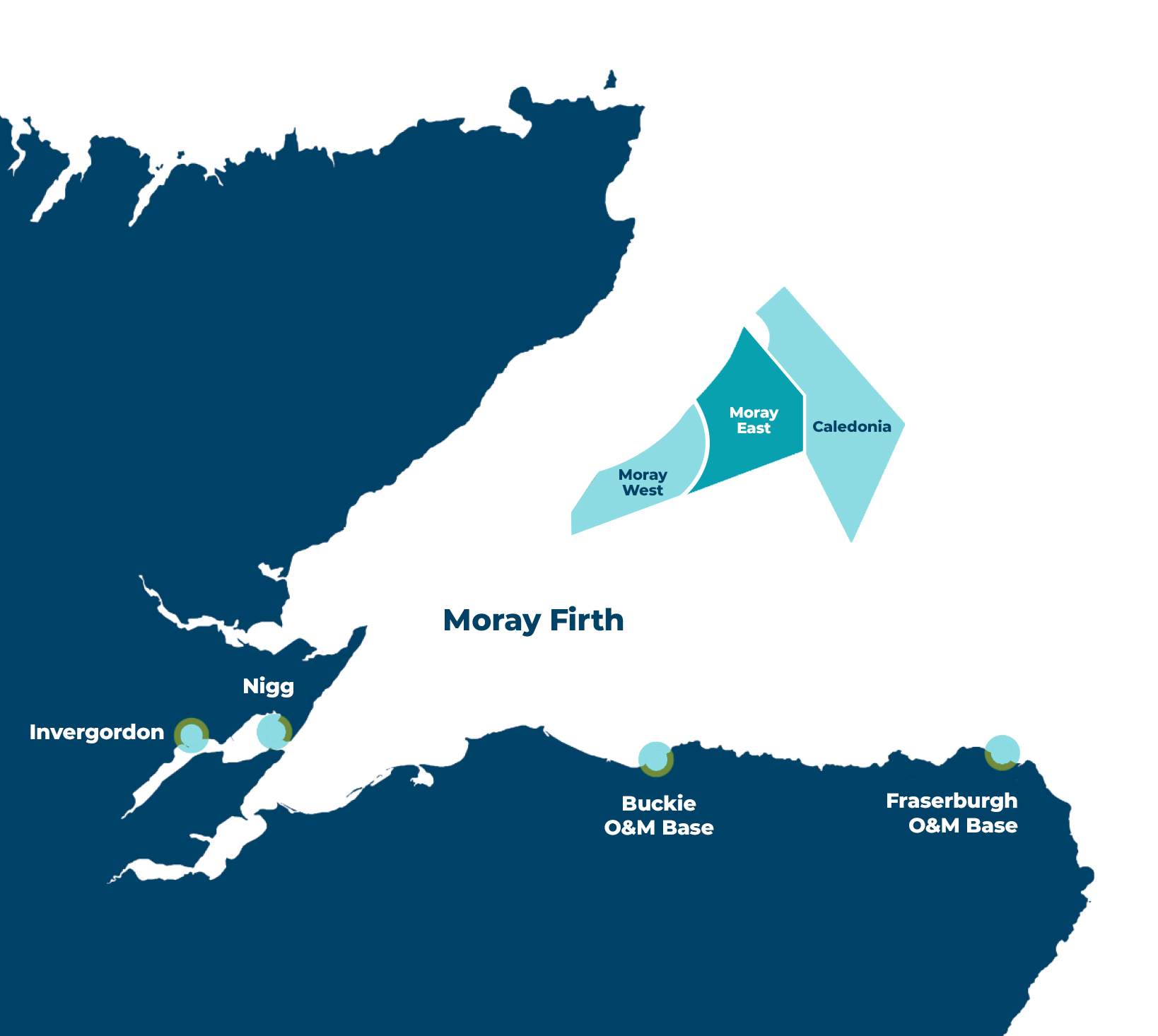
https://www.morayeast.com/project/about-moray-east
Leaving aside the question of whether Moray East has done anything wrong or not, the real guilt for this abuse of public money lies with whoever allowed this wind farm to be built in the first place in a location where it would not be possible to fully utilise its output.
Because of political decisions made over this project and many others like it in northern Scotland, we are now faced with a bill running into tens of billions, for upgrading the grid.
As we know, these decisions were made in the mad, headlong rush to decarbonise, alongside the SNP’s obsession with an “energy independent” Scotland.
But amidst all of this waste of money, maybe the biggest scandal of the lot is what has been going on up in the Shetlands, where the giant Viking onshore wind farm has begun operating.
Originally proposed in 2005, it has led to growing concerns about its environmental impact.
As long ago as 2019, the Herald reported that the project was tearing the island community apart:
It is an issue that has divided a community for more than a decade.
When plans for a giant wind farm to be built on pristine peatland on Shetland were proposed in 2005, it was presented to the islanders as a community-owned enterprise with the potential to earn them £37 million a year.
But after 14 years and growing concerns over Shetland’s fragile biodiversity being shattered by the 155 meter turbines being built on pristine peatland and the infrastructure required to construct them, hundreds of islanders are now calling for the project to be scrapped.
Frank Hay, chairman of Sustainable Shetland, an action group formed in 2009 to take on the council-owned Viking Energy Shetland (VES) and partner Scottish and Southern Energy (SSE)’s multi-million pound Viking Wind Farm, said: “It’s basically economics against the environment. The scale of the wind farm and where they are proposing to build the turbines, it’s simply not right.”
The risk of peatslides is just one of the concerns held by local meteorologist and geologist Allen Fraser. He said: “Most of the access roads are floating roads on peat more than five metres deep, which will disrupt the natural drainage into the valleys, resulting in erosion and peatslides.
“Carbon release and pollution risk was not properly investigated. It is clear from the works already begun that planning and environmental constraints placed on the developers are being circumvented or ignored.”
Mr Fraser said: “The wind farm and others granted or in the planning process will stretch in a practically unbroken line through the length of the islands for more than 70 kilometres, all on peat, on an island chain of low hills that is 110 km long and only 10 km wide at the widest point.
“Access roads and power lines, along with at least 12 super quarries, will
criss-cross and permanently scar the hills for 150 km.”
Richard Lindsay, head of Environmental and Conservation Research at the University of East London, who has visited the site, said: “The simple fact is that just 30cm of peat over one hectare contains the same amount of carbon as one hectare of tropical rainforest – around 280 tonnes.
Campaigners have argued that Shetland cannot support the £700m interconnector cable that would transmit energy from the islands to the Scottish mainland. Mr Fraser said: “Not one amp of power generated by these giant windfarms is for use in Shetland, it is all for export down the cable. There is no guarantee of any community benefit after the shareholders and owners of the windfarms have taken their cut.”
https://www.heraldscotland.com/news/17858289.green-energy-scheme-tearing-island-community-apart
The campaigners were right to complain about the interconnector. Hans Marter of Shetland News takes up the story with this new article:
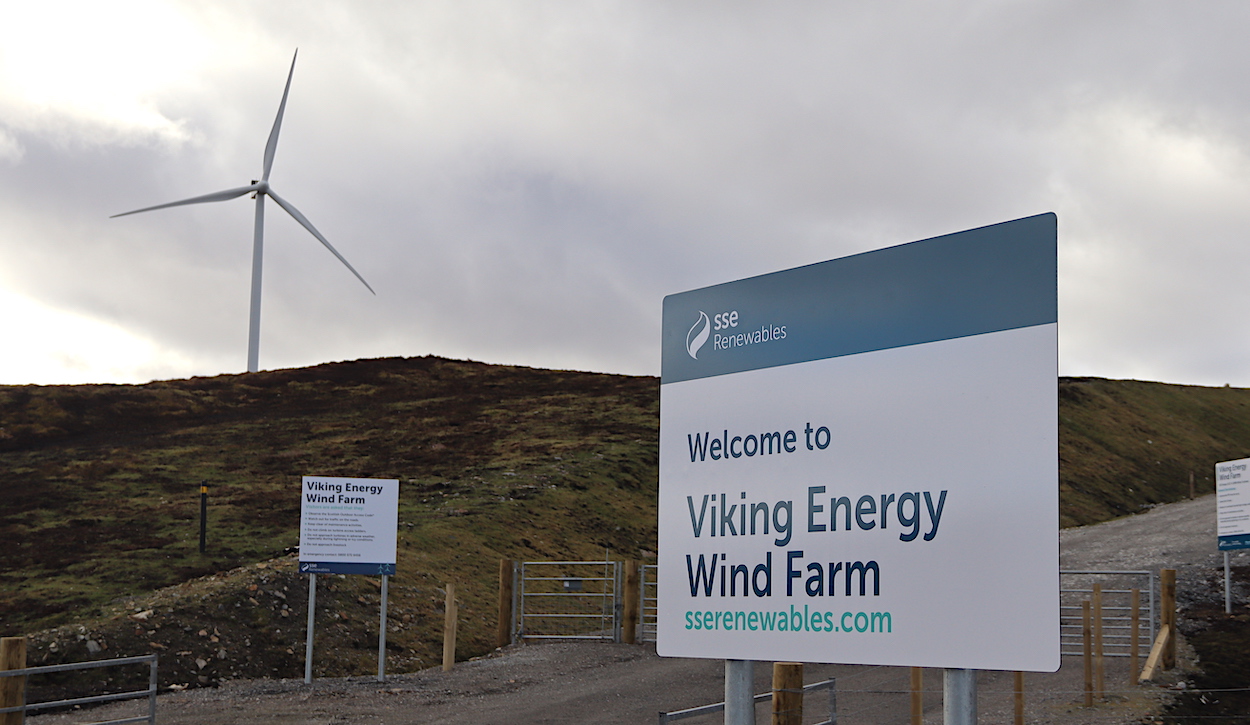
What was promoted as the UK’s “most productive onshore wind farm” is turning out to be one of the country’s most poorly performing.
Rather than producing electricity at a load factor of around 50 per cent, as forecast and promoted by owner SSE Renewables, the Viking Energy wind farm has so far been churning out electricity at a rate of just 17 per cent of what is potentially possible.
The 103-turbine project became operational in summer last year.
The average load factor for onshore wind farms in the UK currently stands at 26.34 per cent, according to Renewables UK. For offshore projects the average output rises to just over 40 per cent.
The £600 million wind farm in the central mainland of Shetland is standing idle for long periods due to constraints and bottlenecks in the national grid network.
The Viking wind farm ranked third for the highest amount of energy going unused in the UK in 2024 as reported by Shetland News in January.
The SSE-owned project saw over 464,000 MWh of energy constrained in the final five months of the year, data from the Renewable Energy Foundation (REF) shows.
Only two wind farms – Seagreen and Moray East – had higher totals, with both being offshore developments.
The 443MW wind farm was supposed to power as many as half a million households, but industry insiders have warned for a long time that any new wind farm project in the north of Scotland was in danger of becoming ‘stranded’ until the national grid is upgraded.
SSE Renewables is however cashing in on constraint payments for the time Viking is not producing any energy.
Chair of local campaign group Sustainable Shetland, Frank Hay, said he was not surprised about SSE being coy about the Viking load factor.
“As is plain to see, this wind farm is very much a part-time operator. Perversely, the Viking wind farm seems to operate mainly when the winds are light,” Hay said.
“It seems ridiculous that the grid inadequacy on mainland UK was not obvious when approval of this wind farm was being considered.
“Unfortunately, it will probably be years before the necessary grid upgrades will be completed and Shetland’s ‘world class wind’ can be fully utilised.
https://www.shetnews.co.uk/2025/04/14/viking-energys-power-output-drops
So there we have it!
£1.3 billion has been spent building Viking and its interconnector, for little apparent benefit for the Islanders or the country at large, who will one way or another end up paying the bill.
Meanwhile it is debatable whether it will actually reduce emissions of carbon dioxide, given the devastation wrought on the peatlands.
But at least its developer, SSE Renewables, can boast:
“Green energy from Viking will deliver a significant contribution to climate change targets and help Scotland’s transition to net zero emissions by 2045 and provide a vital source of economic diversification for the islands”
It’s the sort of economic diversification the Shetlanders could do without, I suspect!
Energy Secretary Ed Miliband has said the government will “double down” on its environmental agenda and accused those against the move to net zero of “making up nonsense and lies”. – The Guardian
He isn’t going to change anything.
I see Ed Milliband took a page from the Socialist Debating Handbook:
“Accuse the enemy of what you are doing to create maximum confusion”
We see you Ed, we see you
Once any Wind Farm or BESS application gets knocked back by the local authority the SNP Scot Gov pass it on to the Energy Consents Unit, when funnily enough consent is guaranteed as the name suggests.
Story tip “Climate change will make staple food item toxic, research finds”
Rising global atmospheric carbon dioxide (CO2) concentrations and surface temperatures could…
https://www.thelancet.com/journals/lanplh/article/PIIS2542-5196(25)00055-5/fulltext
Hmmm there’s a vast difference between these words…
Climate change will make staple food item toxic, research finds
Rising global atmospheric carbon dioxide (CO2) concentrations and surface temperatures could…
Arsenic uptake due to rising temperatures and CO2?
And reduce yields?
Quite a proposal to get grant money, eh?
Temperature has been mildly increasing and rice yields have been rising faster.
One has to wonder what the point of all this is.
I posted something similar in the open thread about rice containing more arsenic because microbes will create more.
The article seems to confuse chemistry with alchemy.
Arsenic has to exist before rice can uptake it into the plant.
Anyone considering following this link, don’t bother. It was a silly modelling exercise and has nothing to to do with science
The Great Greta Grid Operator commands it.
Bitcoin mining.. the solution to all excess power coming out of wind farms. Just think of data centers as far as the eye can see humming along intermittently. And since bitcoins are invisible, you can smuggle them into anywhere.
Why not feed the electricity to the people in Scotland? It is being generated there, can’t get it to England and Ireland, so use it in Scotland. Problem solved. Or do people in Scotland not use electricity? The still burning animal dung and dried peat to cook food and heat their homes? Oh, right, not about supplying electricity, it is all about sucking up vast amounts of tax subsidies and destroying the local environment. Got it.
Being intermittent and non dispatchable, It can’t really supply any load without 100+% conventional backup. That is a constant, no matter where the load is.
Because when the wind blows there is already surplus power in Scotland. You either invest in lots more transmission to try to find a market, or you curtail the output. Best, you don’t invest in the wind farm in the first place.
My point for years. Wind is, like solar, a very niche electric production system, unfit to supply power for mass utilization.
People indulging in bitcoin mining and dope growing seem to prefer ensuring a completely free supply 24×7.
https://www.theguardian.com/business/2025/apr/22/fight-against-britain-billion-pound-energy-heist
“too wind”
Too much wind?
Why are they not using this electricity in Scotland? Screw sending it to England, use it where it is generated. Why are they opposed to developing industry in Scotland? Still punishing them for defeating Longshanks effeminate offspring? Wow, talk about spite.
Too intermittent even with the excess event, when the wind does not blow the Scots import from England & Wales who also rely more and more on the interconnectors from the continent.
Because the farm is not in Scotland – it is on Shetland. The connectors need to cross a pretty decent slice of one of the roughest bits of water around the British Isles, and then another couple of hundred miles of the northern Highlands before you get to any of the cities in Scotland that might need it. The figure quoted above is GBP700 million for the interconnector to Scotland – which you can double by the time anyone gets around to building it.
You might as well call this offshore wind because that is the point – it is offshore from the grid.
So, again, this was a stupid idea pushed by hucksters in order to steal tax money. Got it.
There is an enjoyable police drama series on BBC called “Shetland”. They have used the energy sector in several story lines.
Shetland is probably one of the most law abiding communities you will find, aside from a tendency to take the wide (for single lane each way) main roads rebuilt with oil money at 90mph. Certainly when I was visiting people left their front doors and cars unlocked.
Perversely, the fact it only generates electricity when winds are light, might be its economical masterstroke, as the grid imports from abroad at eyewatering rates during these periods.
It is truly Alice in Wonderland economics.
It’s nauseating to read about the CO2 in the peat in the context of the problems with the wind farm. The whole country is clueless and deserves everything it gets.
Unsurprisingly, after pretending to listen, Rampion 2 is going ahead.
Years of thump thump thump piling 24×7 for coastal residents ahead.
Super-size turbines, looks like Rampion 1 will be in a wind shadow!
https://www.bbc.co.uk/news/articles/cj9e0wrzj94o.amp
This map shows the visual footprint all the way to the M25.
Very nice Paul. Wind and solar do not work, fossil fuel and nuclear do. Stop building solar and wind, remove all solar and wind from the grid. Fire up all fossil fuel and nuclear generators, build new fossil fuel and nuclear generators. Maintain the grid. Problem solved.
Why should they worry about warming? Their summer temperatures haven’t changed in decades and remain cold to this Aussie.
I am glad to note the focus on the access roads here – too little is made about the infrastructure needed just to get these built.
To transport tones of concrete and steel to remote areas you have to build serious roads, often through ecologically sensitive areas. Screwing around with the drainage from peatlands (which you have to do to lay a road through it) is far more damaging on a long term basis than an oil spill.
You can see from space
To put the boondoggle into further examination:
Electricity demand on Shetland is less than 200GWh per year for a population of about 20,000 and their businesses, or around 20MW on average, excluding Sullom Voe Terminal which has its own 100MW of generation that runs off gas from the separation trains, with some being exported to the local grid. Lerwick power station has several generators totalling 66MW and is the mainstay of supply aside from a handful of tiny renewables projects such as the Bluemull Sound tidal turbine.
Obviously demand is heavily winter peaked – it never gets truly dark during the Summer Din as I have seen for myself. Hence the capacity at Lerwick, built long before SVT, which also has a good safety margin against breakdowns and maintenance.
It baffles the mind to understand why they should need a 443MW £580m wind farm and a 600MW £675m HVDC interconnector that connects in to a 1.2GW £970m HVDC interconnector (known as Moray Link) that delivers power to Blackhillock substation which routes its power South either via Peterhead or the Beauly-Denny link, which will be upgraded because of all the wind connected to Blackhillock.
The claim was that they would be able to get power from Scotland when the wind doesn’t blow. How many bitcoin farms will they run with 600MW?
The wind farm is split across 2 CFDs, one from AR4 on £61.74/MWh and the other from AR5 on £74.47/MWh. Neither has yet been commenced, so the wind farm gets market prices for its output. But since the cost of connection only as far as Blackhillock triples the investment we are looking at some very costly powrrfromthe consumer point of view. OFGEM authorised it at your expense.
This is even more shocking than the above numbers indicate.
If the numbers above are accurate, then this single wind farm is responsible for over 9% of all wind curtailment in the entire UK in the last 5 months of 2024. And note that 2024 was a record 8+ million megawatt-hours of wind curtailment.
Note that there are about 100 wind farms operating in the UK, slightly higher at peak (111).