September 16, 2024
Six days after this November’s presidential election, the annual United Nations climate change talks will take place in Baku, Azerbaijan. Unlike the election, no one is holding their breath. Baku will be the twenty-ninth in the series. Climate change regularly draws gatherings of world leaders like no other. When the U.S. president shows up, everyone who is anyone turns up, too. These events often represent milestones in the upward ascent of global climate action. In the beginning, there was the 1992 Rio Earth Summit, attended by President George H. W. Bush. Then came the Kyoto Protocol, with President Bill Clinton shrewdly sending Vice President Al Gore to Japan. The 2009 Copenhagen climate summit (attended by President Barack Obama) is memory-holed; that’s when China, along with India, Brazil, and South Africa, vetoed a binding climate treaty, redeemed by the 2015 Paris climate agreement (President Obama again).
Yet the only year that matters for climate realism is 2006, the year of the great cross-over, when China’s emissions of carbon dioxide overtook those of the United States. This helps explain why China wielded its veto three years later at the Copenhagen climate summit. By 2019, America’s carbon dioxide emissions had fallen by 875 million metric tons from their 2005 peak. Over the same period, China’s rose by 3,511 million metric tons. Twelve years of falling American carbon dioxide emissions were erased by three years of rising Chinese emissions.
Source: https://ourworldindata.org/co2-and-other-greenhouse-gas-emissions
This leads to a reality check about America’s climate policy as practiced by Presidents Obama and Joe Biden. In terms of the amount of human-induced carbon dioxide going into the atmosphere, what America does or does not do is of decreasing significance. The emissions math nullifies the claim of solipsistic climate activists that unless the U.S. drives its emissions towards zero, various forms of climate catastrophe will be visited on Americans. But here’s the rub: even though America’s emissions account for a rapidly declining proportion of global emissions, the negative economic impact of climate policy on the U.S. economy, on jobs, and on Americans’ standard of living is growing.
The U.S. could learn from the example of Britain, the poster child of climate leadership. It was the world’s first major economy to adopt binding emissions reduction targets when parliament passed the Climate Change Act in 2008. Initially, the Act required an 80 percent reduction in greenhouse gas emissions by 2050. In 2019, the target was raised to 100 percent by 2050, a target that the Biden administration also adopted in 2021. As in the U.S., the prime target for decarbonization is electricity generation, to be achieved in Britain through a mix of cap-and-trade; huge subsidies for wind and solar power, funded by consumer levies rather than by the taxpayer; and anti-coal regulations, a strategy also adopted by the Obama and Biden administrations.
As a laboratory for net zero, Britain’s experiment with renewable energy provides unambiguous evidence that wind and solar increase the cost of electricity. Although the cost of coal and natural gas used in Britain’s power stations was flat between 2009 and 2020, residential electricity rates in Britain soared by 67 percent, to 17.9p (23.4¢) per kilowatt hour (kwh) – 75 percent more than the average 13.5¢ per kwh American household paid in 2020. These increases were driven by a near tripling of environmental and social levies and increased spending on the infrastructure needed to connect far-flung wind farms to where people actually live and work.
Forcing electricity customers to pay for the extra grid infrastructure and the costs of covering for the intermittency of renewables when the sun doesn’t shine and the wind doesn’t blow can make renewables stupendously profitable for investors. Over the period 2009 to 2020, Britain’s Big Six energy companies received an average price of £112.81 ($147.78) per megawatt hour (MWh) from their renewables portfolio – twice the average £56.22 ($73.65) price per MWh from their coal- and gas-fired power stations. Breathtakingly high renewable profits meant that in one year (2017), renewables’ £54.93 ($71.96) profit per MWh was higher than the £52.47 ($68.74) average price per MWh that the Big Six earned from their thermal power stations.
Aggressive use of carbon taxes to penalize fossil fuel power generation and force coal off the grid (“powering past coal”) saw the Big Six incur £1,603m ($2,100m) in losses and write-downs on their coal and gas power stations in 2014. Over-rewarding renewables led to over-investment in renewables and nearly zero investment in new power stations needed to keep the lights on. In 2009, Britain had 18.6 gigawatts (GW) of non-intermittent (i.e., reliable) generating capacity for every 1 GW of intermittent (i.e., unreliable) wind and solar. Eleven years later, that had fallen to 1.7 GW of non-intermittent capacity for every 1 GW of wind and solar, a dangerous level that will worsen unless and until Britain abandons net zero.
To try and address wind and solar intermittency, the previous government created a capacity market so that power stations get paid for making their capacity available on demand. Capacity markets turn out to be an astonishingly expensive way of generating electricity. In 2020, electricity consumers paid an average of £224.31($293.85) per MWh to German-owned Uniper for electricity from its coal-fired power stations. This illustrates one reason why a renewables-heavy grid produces more expensive electricity. It requires having two parallel generating systems – intermittent renewables and firm back-up. This is reflected in the deteriorating capital efficiency of Britain’s grid. Between 2009 and 2020, each GW of generating capacity produced 28.5 percent less electricity than it had eleven years earlier because of the influx of wind and solar capacity.
Producing less energy with more capital is the essential fact of the energy transition. This reverses the economic growth paradigm since the onset of the Industrial Revolution. Improved capital productivity – getting more from less – alongside higher labor productivity and product innovation is a key driver of long-term economic growth. In capitalist economies, capital, just like labor and other inputs, is a real cost. Yet the metric commonly used to compare renewables and non-intermittent power stations, the Levelized Cost of Electricity, excludes the negative impact of adding more renewables on the capital efficiency of the whole system – one reason why claims about renewables being cost-competitive should be treated with a pinch of salt.
Having more renewables not only pushes up costs but also has the countervailing effect of degrading the value of the electricity they generate. Because renewables have no fuel input costs, on days when there’s lots of wind or sun, wholesale electricity prices trend towards zero. The way wholesale electricity markets work is that all generators supplying electricity into the grid at the same time get the same wholesale price. The effect of renewables on electricity prices is to kill new investment in conventional capacity.
For this reason, Britain’s decision to power past coal left the country dangerously ill-prepared when Vladimir Putin began to squeeze the price of natural gas ahead of his invasion of Ukraine in February 2022. That year, the average price paid by power stations for natural gas was more than five times higher than it had been two years earlier and 72 percent higher than the cost of coal, pitching Britain into its first energy crisis since the 1970s.
The Obama administration also waged war on coal with environmental regulations. America escaped a similar fate as Britain for one reason only. In 2008, the price of natural gas for power generation had reached $9.26 per thousand cubic feet (tcf); in 2012, it had fallen to $3.54 per tcf. This had nothing to do with Obama’s foresight and was entirely due to fracking and the shale revolution. Despite this fall, coal remains the cheapest source of fuel for power generation. In addition to being cheaper, coal does not require specialized pipeline and storage infrastructure, unlike natural gas. For these reasons, coal is the energy source of choice across the Global South, including China, which has a coal-based economy.
Although American coal consumption peaked in 2005, China’s coal consumption had already surpassed that of the United States by 1985. Since its 2005 peak, U.S. annual coal consumption has fallen by 500 million tons – and China’s risen by 1,245 million tons. The coal America did not burn, China is burning instead. For every one ton of coal that America stopped burning, China burnt an additional two-and-a-half tons.
Source: https://ourworldindata.org/fossil-fuels
In terms of policy, China is energy realism on steroids. Its bureaucrats are even having second thoughts about renewable energy. Writing in the Financial Times in July, contemporary historian Adam Tooze sees a “worrying” gap between the pace of China’s investment in renewable energy in recent years and its plans for the future. “Whereas China’s solar and wind industry installed almost 300 GW of new capacity in 2023, its National Energy Agency envisions a future build-out of barely more than 100 GW a year.” One reason for the slowdown, Tooze suggests, is that China’s energy bureaucrats point to the need for “more smoothly operating pricing systems to make a renewable system reliable.” If true, it would show that China’s communist bureaucrats have a surer grasp of the damaging economics of wind and solar energy than their Western counterparts.
The current architecture of the UN climate process was designed around China’s demands. Its veto of a climate treaty with a legally binding emissions target at the Copenhagen climate conference led the Obama administration to enshrine the Sinatra doctrine of climate action in the 2015 Paris climate agreement: the signatories would do it their way. China’s nationally determined commitment under the agreement has the goal of achieving “carbon neutrality” before 2060. The evidence to date shows that China does whatever advances China’s economic and ultimately its geopolitical interests. That is a lesson for America’s political leaders: if the United States wants to prevail in the geopolitical contest with China, it, too, needs to drop the Biden-Harris goal of net zero and embrace energy realism.
Rupert Darwall is a senior fellow of the RealClearFoundation and author of The Folly of Climate Leadership: Net Zero and Britain’s Disastrous Energy Policies.
This article was originally published by RealClearEnergy and made available via RealClearWire.
All that needs to be done is to redefine your state/nation as developing – development doesn’t stop …
Well, it did in many of the steel towns in the US.
Artificially by offshoring those emissions
Living in a major deteriorating country, like the U.S., I’m afraid we will be forced to burn dollar bills.
You have an election; whereas we have already been consigned to the dustbin of history.
Harris and Starmer are birds of a feather…. say nothing. Get elected. And then…
Whatever the actual politics of the PRC is, they do not share the climate change orthodoxy of too many Western politicians.
Their best scientists have determined that a couple of degrees warmer due to CO2 doubling in the atmosphere…..results in improvement of Chinese climate and crop yields….so would actually be stupid to reduce at least until about 1000 ppm….on the other hand air quality is poor in many cities so some effort is spent on actually reducing smog by buying better quality coal, natural gas from Russia, and an active nuclear power plant program to supply soot-free electricity to cities.
Which they can point to the UN as “green” initiatives, while consuming nearly half of the entire world’s coal production compared to the US at 8%…..And of course if the “the West” wants to put itself into an energy constrained situation it is a plus for Chinese military leaders who seem foolishly bent on world domination, having learned only what they “want to” from the Egyptian empire, the Roman empire, the British empire, the Empire of the Rising Sun, etc.
Don’t kid yourself, the Chinese are smart and think long term…although like anywhere else, people in charge (think politicians and media personalities with a fan base) who believe strongly in “what ain’t so” can undo many rational and pragmatic efforts of their best thinkers (generally physicists, chemists, and engineers).
You can call the Chinese communists, you can call them socialists, you can call them capitalists, but in reality they are Confucianists and have been so for over 3000 years.
_______________________________________________________
But the US has the biggest per capita foot print. Developing nations like China are only catching up to the climate damage the US has been doing since the end of WWII. Well really! Isn’t that what’s its all about? It’s time the US were taken down a peg or two.
That should get a few down votes, just want to get that in before mywutzizname shows up.
What climate damage?
The average temperature of the Earth is below the optimum for humans.
The ambient CO2 level is below the optimum for most of the plants that make up the base of every significant food chain on the planet.
Mercury out of the smokestacks of coal plants is pollution. CO2 is not, it is a molecule critical for life on the planet.
Surely you are not so uninformed that you were referring to CO2?
The average temperature of the Earth (I assume you mean surface temp), is utterly meaningless.
I think he was being sarcastic.
I thought I put a </sarc>
I’ve started using an emoji: 😉 or any of several others.
Also, see Poe’s Law.
“Poe’s law is an adage of Internet culture which says that, without a clear indicator of the author’s intent, any parodic or sarcastic expression of extreme views can be mistaken by some readers for a sincere expression of those views”
I caught the sarc – didn’t think it was needed, but Poe’s Law is in full effect.
If you know Steve’s list of What’s NOT a problem…you know he was sarcin’ MyLuserLame…
Humor is a difficult concept.
I believe you should have included /s.
< s > < /s > strikeout
“Humor is a difficult concept.”
Funny you should say that !!
The US does not have the ‘biggest per capita footprint’. Not even close. I looked at a few countries, and Qatar (by a country mile), UAE, Bahrain, Kuwait, Brunei, Saudi Arabia all emit more CO2 per capita than the USA. If per capita is what matters most – which is what China says – then all we have to do is persuade Qatar to halve their CO2 emissions and the world is saved.
https://ourworldindata.org/grapher/co-emissions-per-capita?tab=chart&time=earliest..2022&country=USA~BHR~BRN~KWT~QAT~SAU~ARE
Of course China is the biggest user of coal, and the biggest emitter. They have a huge population. But they are also the biggest installers of renewable energy. Here, from Wiki, are the relative amounts of solar power per country in 2021:
and of wind power:
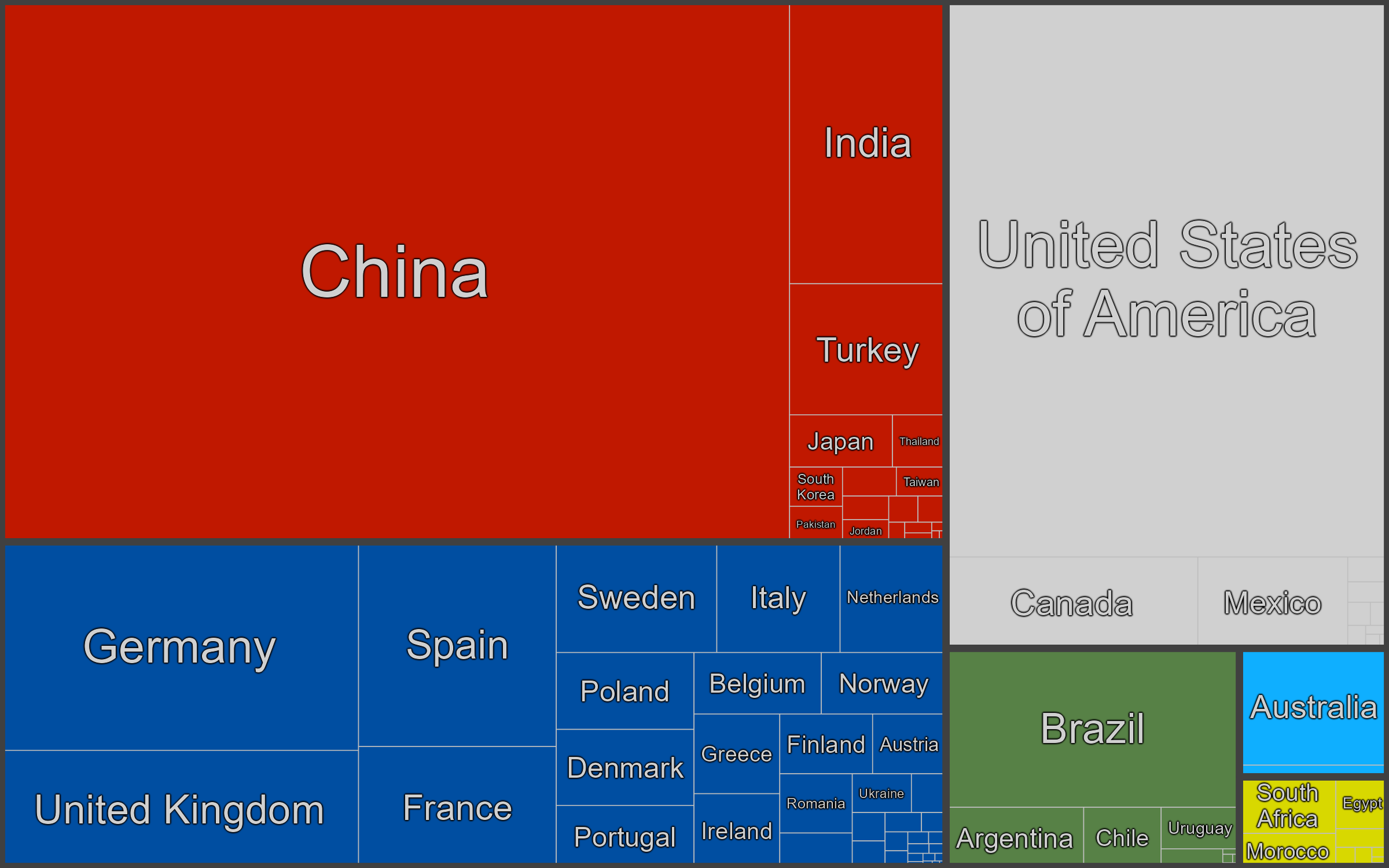
Whether they do it from idealism or economics, I don’t know. But they do it.
It’s just a virtue signal.
The claim in this article is that the West has gone with renewables, but China has not. That claim is false. China has installed lots. If it’s “virtue signalling”, still China and the West are similar.
“Lots”, but I would hardly call it a hearty embrace. And yes, everyone is virtue signalling.
Solar reached almost 21% of China’s installed generation capacity in 2023 but only produced 3% of its electricity. A lot of solar is not providing any energy at all but looks good in the yearly plan.
Meanwhile coal provided 70% of the country’s electricity during the year
In other words, China is the leader in environmental destruction and desecration of their land with solar panels
Which is why they cram their citizens into towers of highrise flats –
to make room for all the wind and solar farms.
Physics question: IF China filled all its own land>1km from water with windmills, would they stop Westerly surface winds in Italy?
No, but all the butterflies would be dead.
They have you believing, Nick.
Sold.
Does senility also increase your gullibility ?
And you believe them.
The reasons must be complicated. Such as keeping people employed and owners of the companies happy. Also, in remote locations a local grid can serve and a long intertie is not needed. They can soak up surplus production when Europe, the USA, and others drop a beat. Plays to their fan base of supporters of unreliables, such as the United Nations and many others.
WOW.. Nick and his pretty coloured boxes again. Hilarious. !!
Meaningless as usual.
Here’s another pretty pic for Nick.
Title should read:
Biden Administration Increases Funding to Destroy USA Energy Infrastructure and Kill Poor, Impoverished Citizens of USA. – The Net-Zero Program will have the added Benefit of Increasing the Net Worth of Billionaires and Politicians Worldwide.
I know it’s becoming an old point to make, but we should probably stop calling it a Biden Administration. Maybe looking for a new name would inspire news people to investigate who’s been making decisions for the past while.
Just dividing comparative “Renewables” costs by their annual productivity shows why bills will keep on going up with more and more “Renewables”. It gives a comparative cost of delivering a unit of power to the Grid.
“Renewables” policies require the replication of power generation installations with conventional generators underused but 90% efficient, dispatchably operating 24/7 and adds in inefficient, (less than 20% productivity combined Wind and Solar power).
When the last 10years of achieved European productivity is taken into account the comparative costs as opposed to Gas-fired power generation are:
Onshore Wind power is about 6 times more costly to install with 22% productivity
Offshore Wind power is about 18 times more costly to install with 31% productivity
Solar PV power is about 10 times more costly to install with 11% productivity.
As this calculation is on an annual basis, it ignores the short-term unreliability and intermittency of Renewables, which cause serious operational problems for the Grid, it thus gives a generous view of “Renewables” costs.
These are not difficult sums, except for those with an obsessive view of the Climate Catastrophe problem as in the UK Department of Energy Security and Net Zero.
https://edmhdotme.wpcomstaging.com/the-myth-of-cheap-renewable-power-in-the-uk/
Wait wait wait. Where’s the Humor tag?
NYTimes staffer David Wallace-Wells emitted “What Happens if China Stops Trying to Save the World?” dated Sept. 16, 2024. He believes that they are “transitioning”. And that the cheap solar panels are good for us. Not a word about the quantity of coal they are using to make the panels or the slave labor.
The faith is very strong with the NYTimes.
Chinese culture results in them playing the long game. If they’re talking about transitioning, it probably means by the end of this millennium.
When picking up Chinese takeout, I always check before leaving for a complete order. If you don’t, when you get home and there is a missing item, its always the shrimp.
China’s future wind and solar installations are slowing down and renewables are still a small percentage of its electricity generation. Presumably China does not plan on a contracting economy so what will fill the gap created by the slow down? Based on their last 5-year plan the answer appears to be more nuclear.
Once China has enough nuclear to provide electricity for its’ needs you can bet they, and the alarmists, will let the world know how much fossil fuels they stopped using. Right now their wind and solar installations are pure virtue signaling.
Five year plans, the NYTimes, and Marvel Comic Books.
“Nothing new under the sun”
The definition of insanity: Holding 28 COPs and achieving nothing.
Hey now, these COP events bring in hookers and blow for the local economy.
Yes, all the plans and effort have resulted in absolutely no effect. At some point someone must begin throwing virgins into volcanoes again as there will be no other ideas left to try.
So that’s why we are in such a climate crisis/emergency …
We’ve run out of virgins !!!
( They’re all moonlighting as hookers at COP events.)
Very informative and important. It goes without saying all of our problems are government created and worse they were created by non elected administrators and bureaucrats in newly created departments that have proven to be far more of a burden than a help. We need to get rid of them.
I think this short video says it all https://www.facebook.com/share/v/qKceb6FiKZJTf8my/