From the Robert Bryce Substack
Robert Bryce
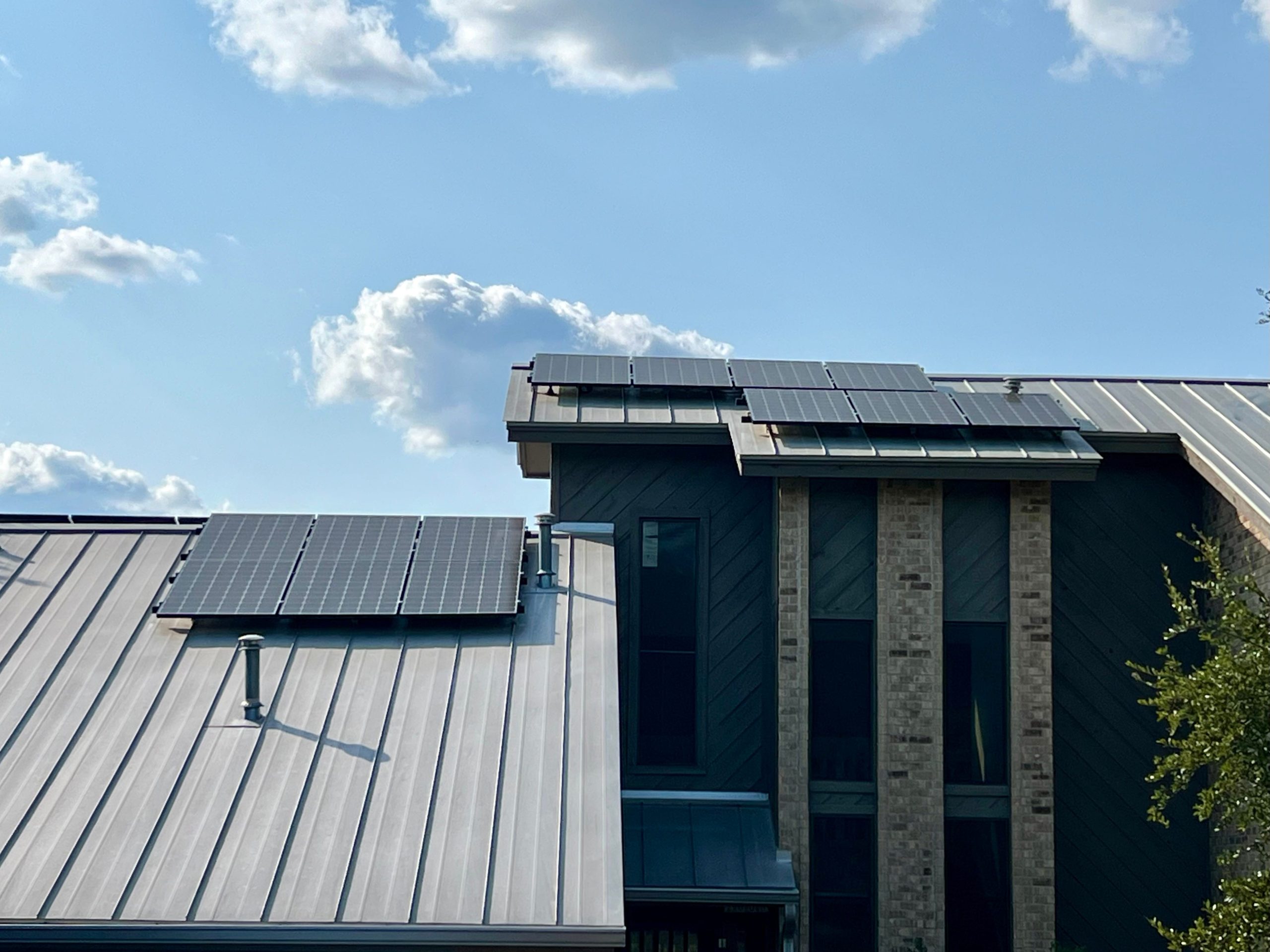
Solar panels on the roof of our house in Austin, September 13, 2024.
Hyping solar energy is one of America’s most renewable resources. For instance, in 1978, Ralph Nader declared that “everything will be solar in 30 years.” In 1979, President Jimmy Carter declared the US needed to capture more energy from the sun because of “inevitable shortages of fossil fuels.”
In 2011, in the New York Times, Paul Krugman claimed we are “on the cusp of an energy transformation driven by the rapidly falling cost of solar power.” In 2015, presidential candidate Hillary Clinton pledged that if elected president, she would oversee the installation of 500 million solar panels.
In 2021, the Department of Energy released a study that claimed solar “has the potential to power 40% of the nation’s electricity by 2035.” That’s a mighty big claim. Last year, solar accounted for about 5% of US electricity production. Furthermore, solar only provided about 2.2 exajoules of primary energy to the US economy out of 94.2 EJ used. The DOE also claimed solar could reach 45% of US electricity production by 2050. (That same year, President Joe Biden declared that climate change poses “an existential threat to our lives.”)
The solar hype continued last month in the pages of the New York Times with an article by David Wallace-Wells headlined, “What Will We Do With Our Free Power?” The nut graf of Wallace-Wells’ article appeared near the end when he claimed, “the exploding scale and disappearing cost of solar do mean that the energy game will now be played according to some pretty different ground rules.”
Before going further, a disclosure is in order. I understand the economics of solar. About eight years ago, we had 8.2 kilowatts of solar capacity installed on the roof of our house. Why? We got three different subsidies to do so. We now produce about 12 megawatt-hours of electricity per year and have cut our annual electricity bill in half. Further, that was the second solar system we installed on our home here in Austin. We got fat subsidies for the first system, too.
For the record, I’m opposed to all energy subsidies unless I’m the one getting them. But I digress.
Back to Wallace-Wells. He is correct in reporting that solar capacity is growing. Last year in the US, solar capacity grew nearly four times faster than wind capacity. Solar grew by 24.8 gigawatts, while wind capacity grew by 6.3 GW. Further, due to its higher power density, solar will continue to grow faster, both here in the US and around the world. Wallace-Wells goes on to repeat the same shopworn arguments we’ve been hearing for nearly 50 years: solar is getting cheaper, capacity is growing, sunshine is free, and therefore, it really is different this time. He writes:
Because the sun can be simply counted on to rise every day, you don’t need to pay in any ongoing way for a commodity input, like oil or gas, to keep the system humming — only to set it up initially to manage and endure the novel challenges of drawing reliable energy from the giant fireball 94 million miles away. And over the next decade, even that all-in cost is expected to fall in half again. Negative electricity prices, in which consumers are actually paid to consume electricity, are already a recurring feature in the world’s mature markets.
He continued:
Though it seems like a line from starry-eyed science fiction, the dream of electricity “too cheap to meter” arose first in the giddy early days of nuclear power, the phrase coined by the midcentury atomic advocate Lewis Strauss…And it is easy to get carried away with the gauzy utopian possibilities of energy both functionally infinite and effectively free.
But there ain’t nothing free about solar or any other form of energy, and there never will be. For as long as humans have been on this planet, our most fundamental quest hasn’t changed. We seek more energy so we can convert it into more useful power — computing power, motive power, cooking power, cooling power — so that we can do more productive work. That’s what we humans are about. Yes, we may have dubbed our species homo sapiens, but we are, in reality, homo faber. And that making and doing requires ever-increasing amounts of power.
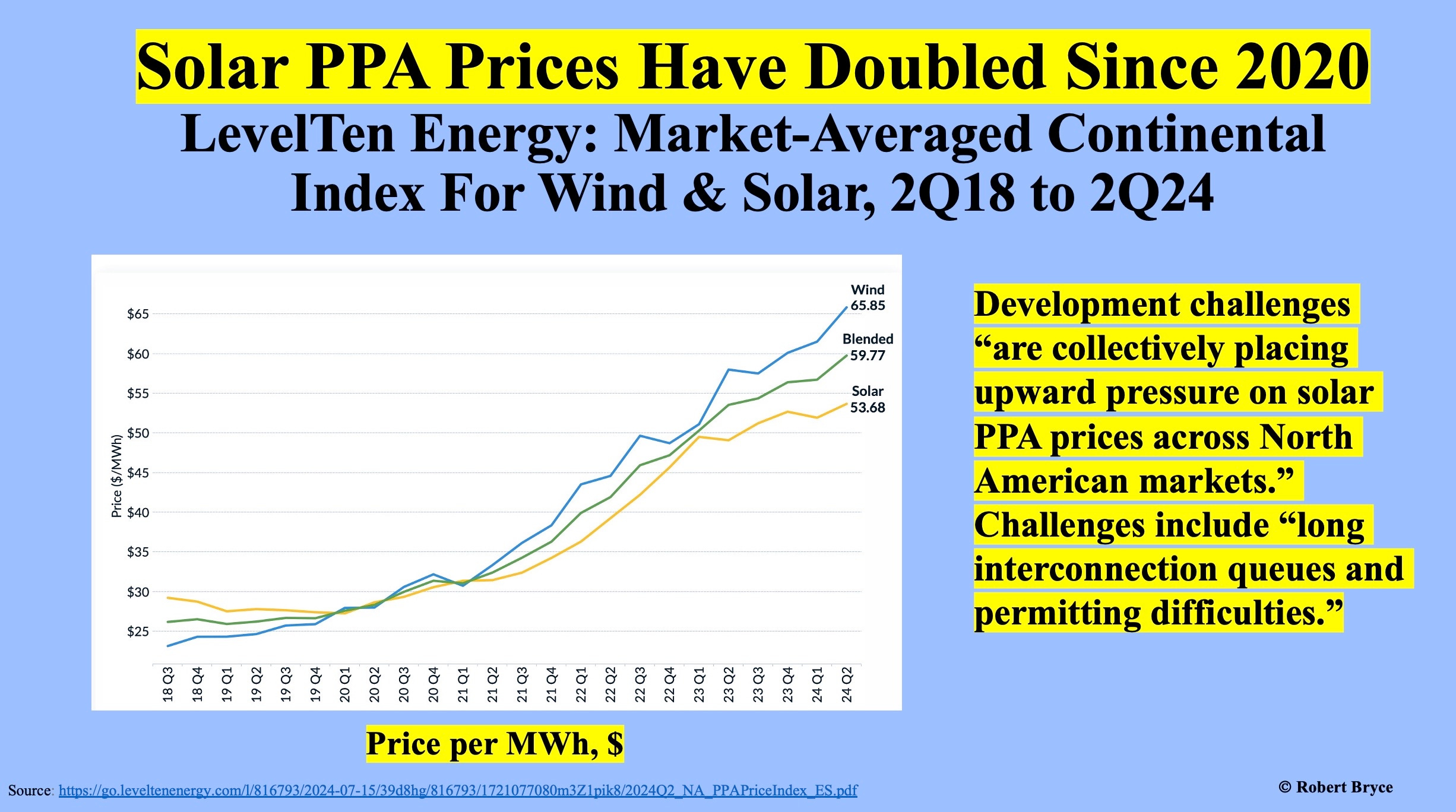
The latest figures from LevelTen Energy show that solar prices aren’t falling, they are rising.
Wallace-Wells can cheer until my PV panels are destroyed by the next hail storm, but he might consider resting on his pom poms for a moment to report on what’s happening in the marketplace. As seen above, solar prices aren’t falling. They are rising. In July, consulting firm LevelTen Energy reported that prices for solar power purchase agreements rose 3% during the second quarter and that solar prices have nearly doubled since 2020. LevelTen said the price surge reflects “the development challenges that are collectively placing upward pressure on solar PPA prices across North American markets.” It continued, saying the challenges include:
Long interconnection queues and permitting difficulties. But in recent months, additional uncertainties have been introduced through the expansion of tariffs on Chinese PV components as well as a new investigation into allegations of duty circumvention and dumping practices from PV component producers in Southwest Asia. These events illustrate a trade law environment that is growing increasingly challenging for solar developers in the United States.
Wallace-Wells barely mentions China in his article. But trade laws are casting big clouds over the solar sector. Three years ago, the Biden Administration issued sanctions against multiple Chinese companies due to their connections with Uyghur slave labor.
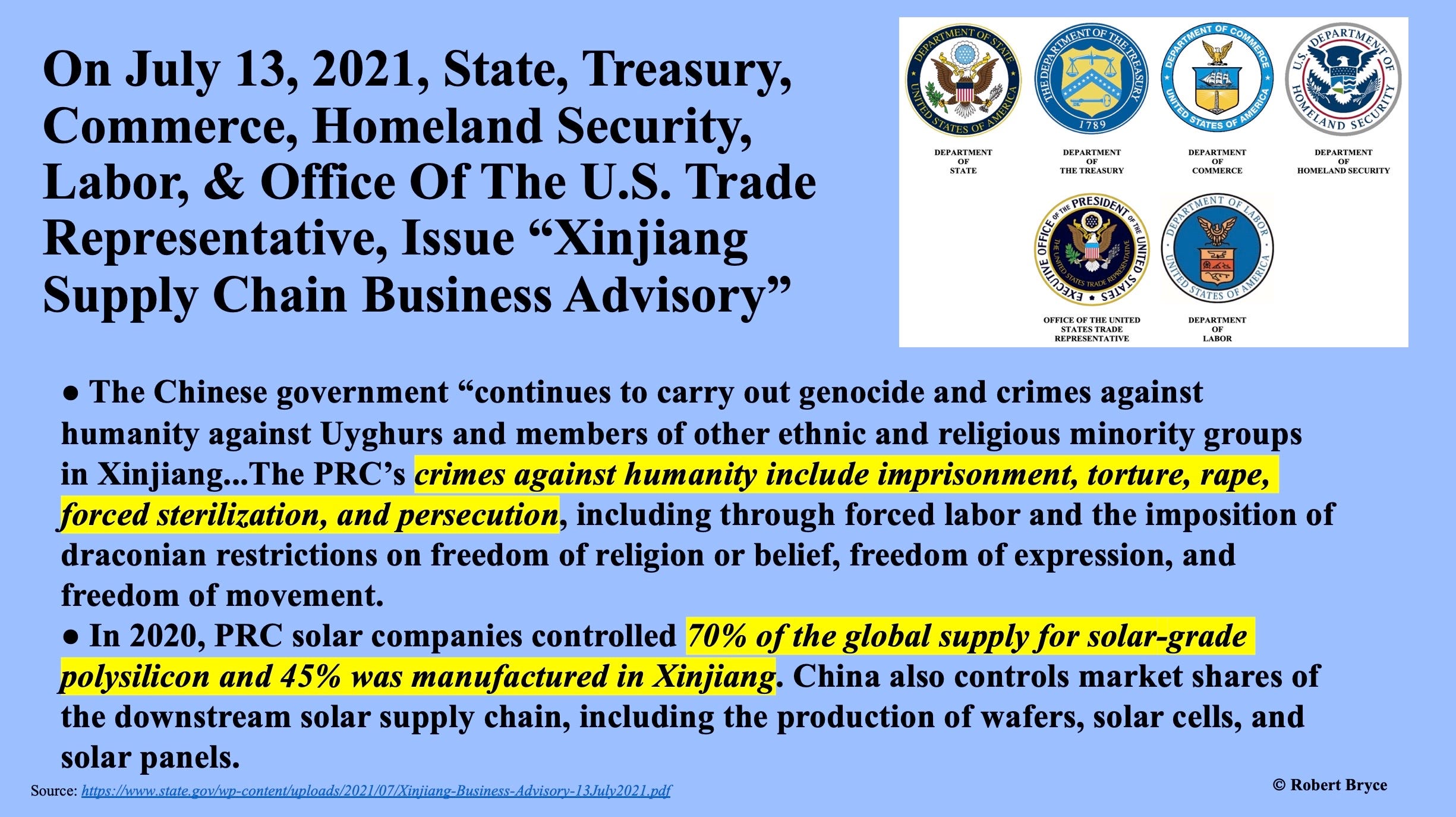
In May, in “Shanghaied,” I published the graphic above. Remarkably, six different agencies of the federal government are saying the Chinese government is carrying out genocide in Xinjiang, the province that produces some 45% of the world’s solar-grade polysilicon. Given that reality, it’s not surprising that solar cheerleaders like Wallace-Wells, Bill McKibben, and others don’t want to talk about their favorite industry’s near-total reliance on Chinese supply chains.
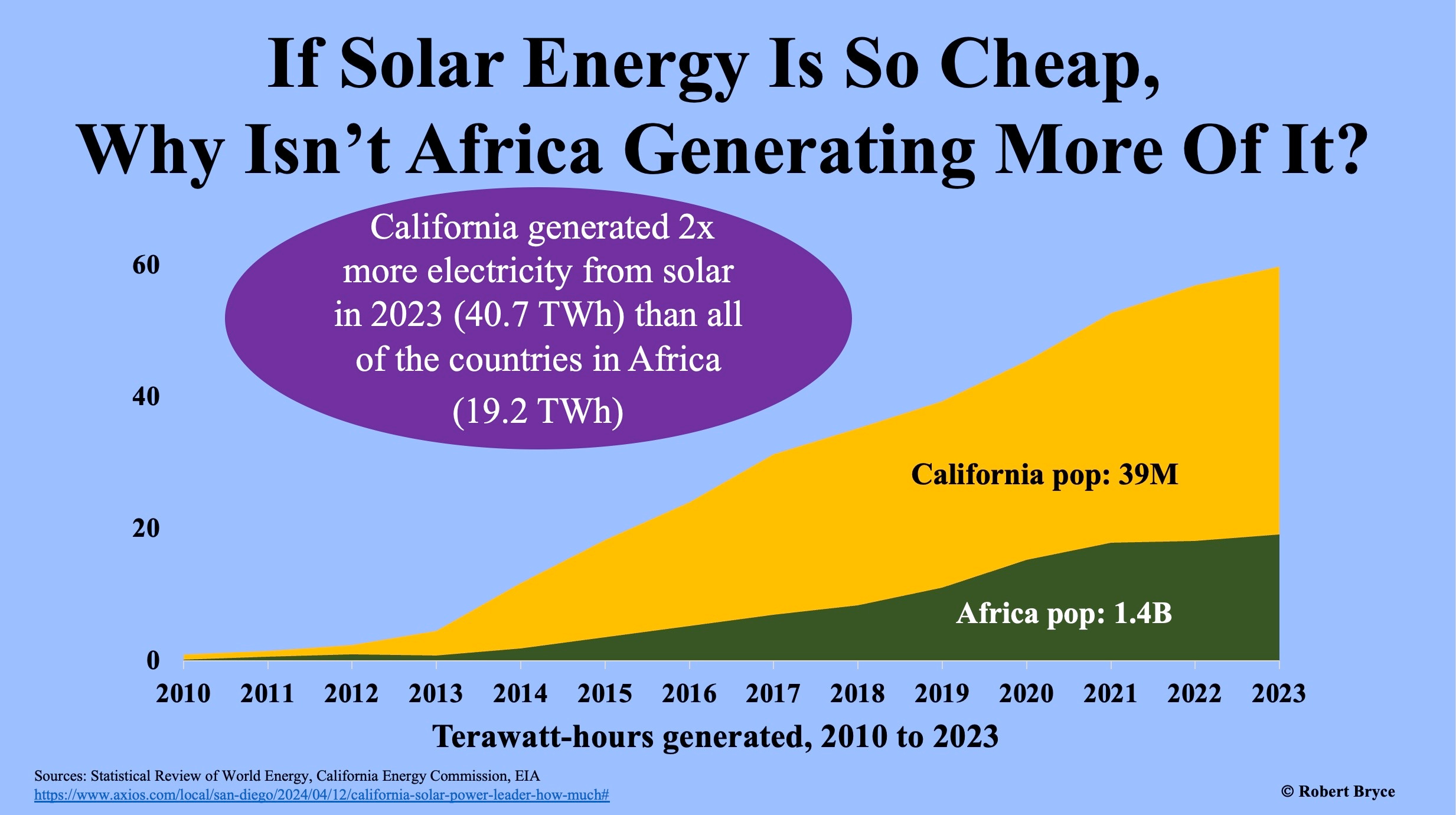
Wallace-Wells also ignores the vast disparity in solar deployment around the world. He claims, “by some ways of tabulating, solar power is already cheaper than all other new sources of electricity for something like 95 percent of the world.” And what are those ways of tabulating? He doesn’t say. That begs the question: if solar is so cheap, why isn’t Africa using more solar? As seen in the graphic above, the unfortunate answer is that solar is still mainly used in wealthy places. That helps explain why California, a state with 39 million people, is generating twice as much electricity from solar as Africa, even though the African continent has roughly 36 times more people than the Golden State.
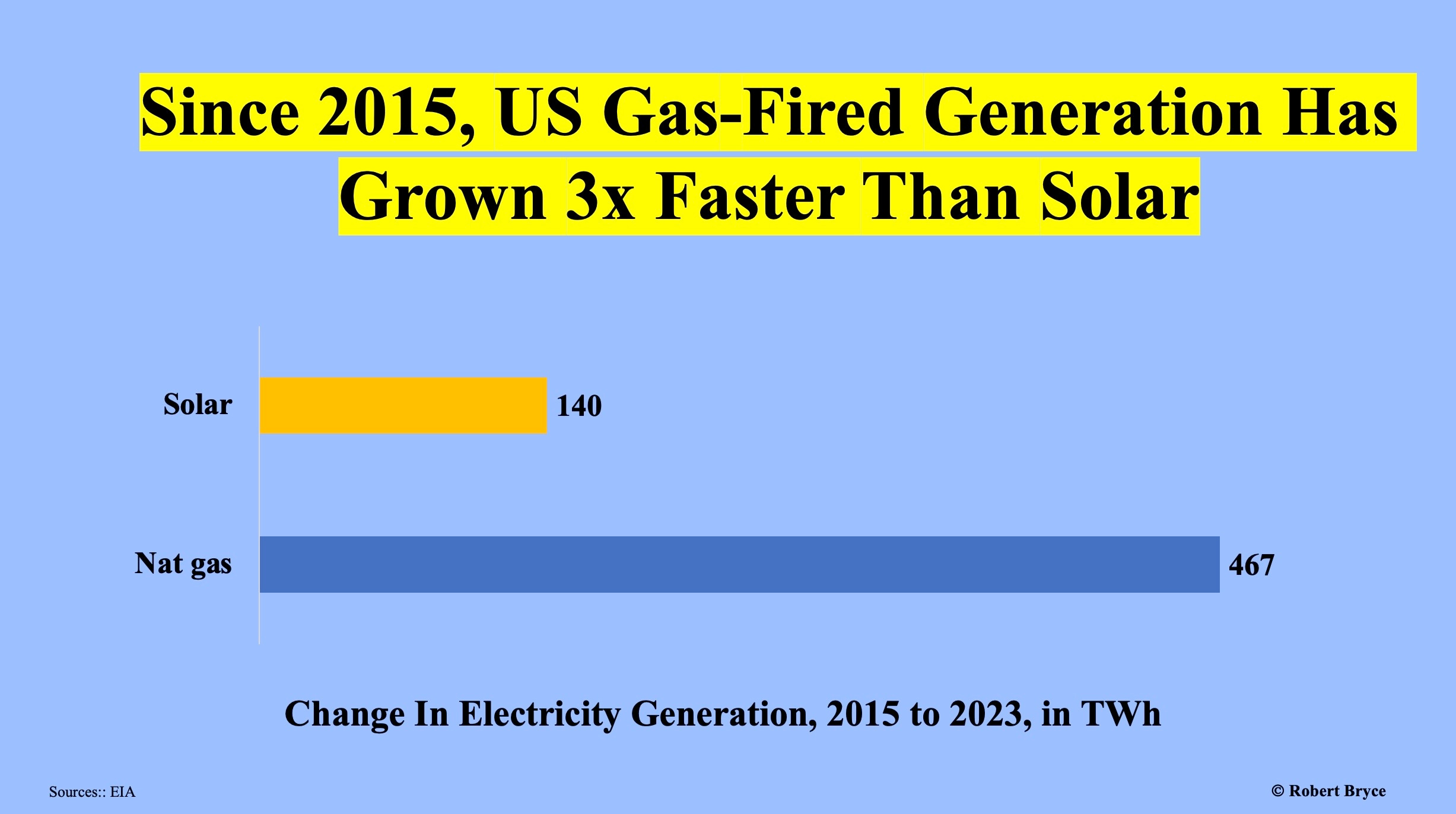
By now, it should be clear that Wallace-Wells cares more about the narrative about solar than marketplace realities. Speaking of the market, as seen above, the growth in natural gas-fired generation has swamped the increase in solar since 2015.
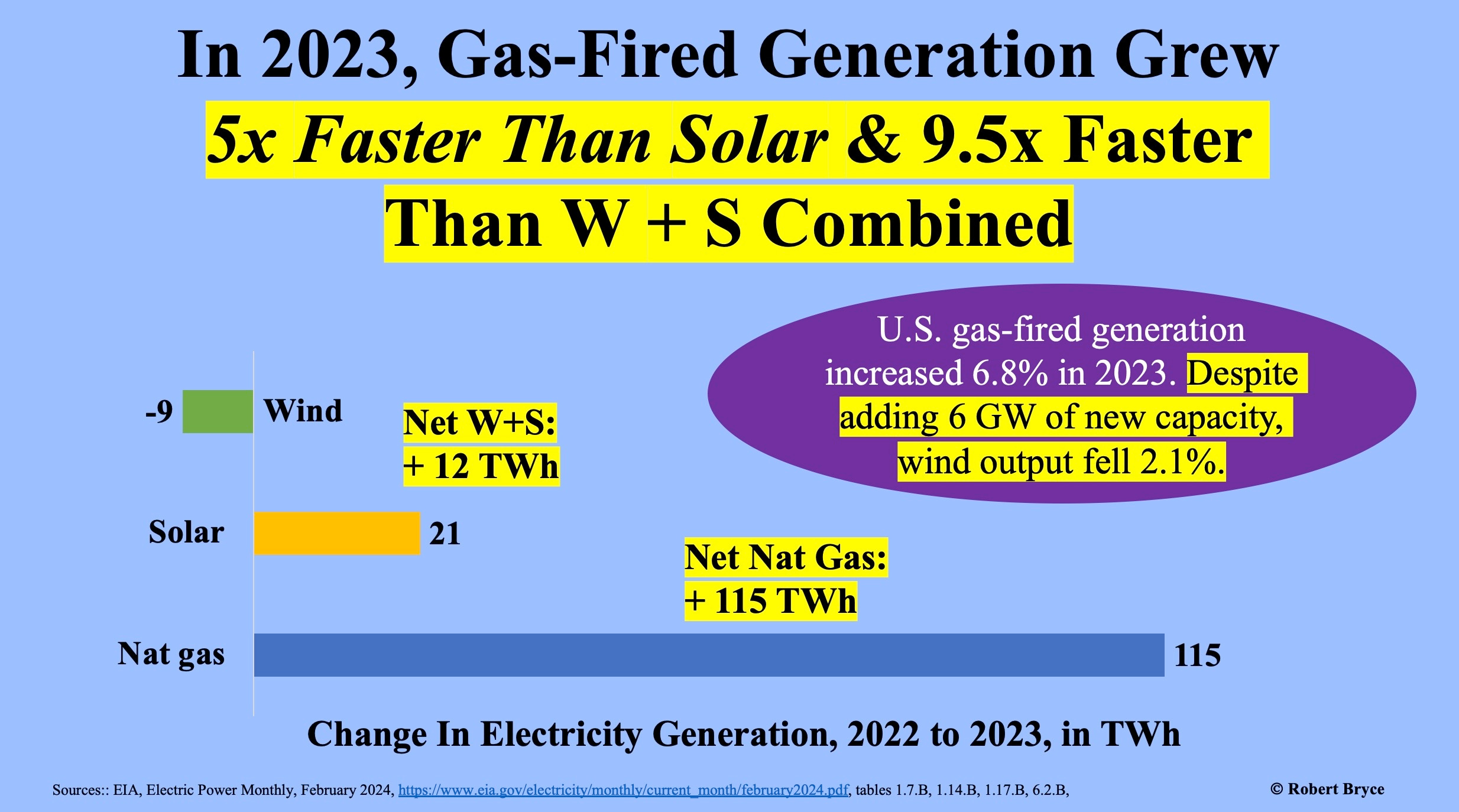
As seen above, that growth continued last year when gas-fired generation grew by 115 terawatt-hours while solar increased by 21 TWh. Put another way, gas-fired generation grew five times faster than solar last year.
A final point, and it’s one that I’ve made before. California has added more solar than any other state in the country. And as it has added more solar, electricity prices in California have increased at an alarming rate. As I pointed out last month in “Kamala America?” in absolute and percentage terms, California’s electricity prices have surged more than any other state in the country since 2008 when then-governor Arnold Schwarzenegger issued a mandate for renewable energy.
In March, my favorite Energy Bad Boys, Isaac Orr and Mitch Rolling, wrote an excellent piece here on Substack called “How to Destroy the Myth of Cheap Wind and Solar.” And destroy, they did. Orr and Rolling asked the critical question: if wind and solar are so cheap, why do they make electricity expensive? Their answer was straightforward:
We aren’t building a new electric grid from scratch, so we should be comparing the cost of new wind and solar with the cost of existing power plants that these intermittent generators would hope to replace. The truth is that we already have reliable, depreciated assets that produce electricity at low cost, and they could’ve kept doing so for decades. This means that building new wind and solar adds to the cost of providing electricity to the grid. If wind and solar were truly lower cost than other forms of energy, we would expect states like California and Minnesota, which have high penetrations of wind and solar, to see falling electricity costs. Instead, electricity prices in these states have increased much faster than the national average.
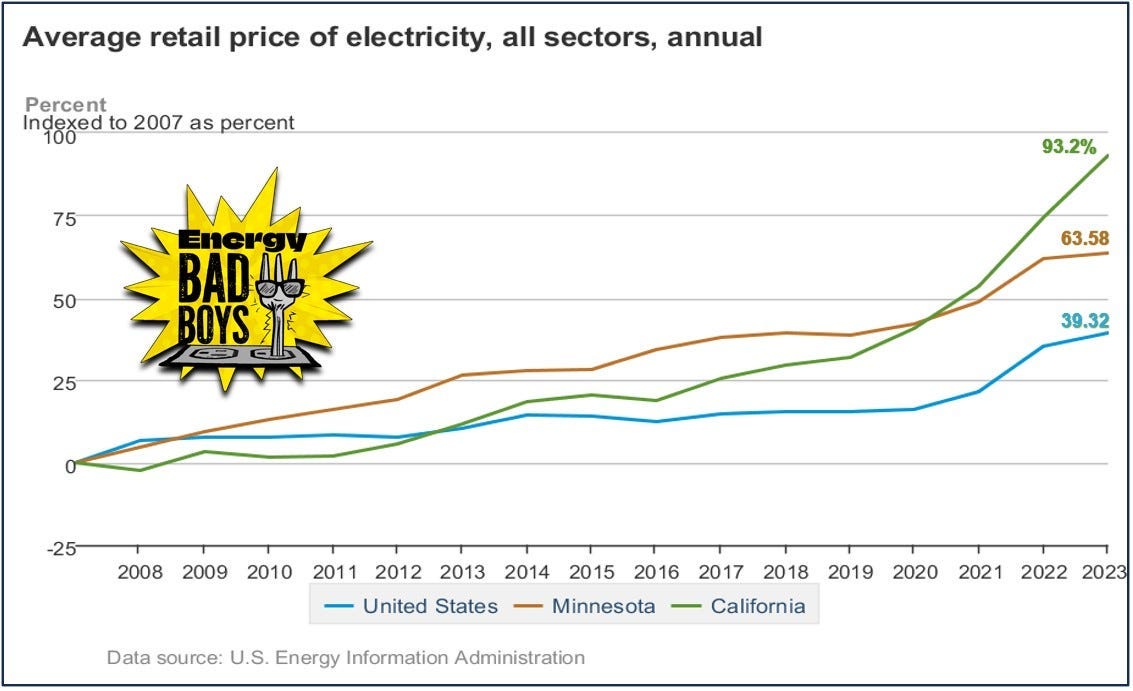
Graphic from Energy Bad Boys article: “How to Destroy the Myth of Cheap Wind and Solar.”
Orr and Rolling concluded:
The intermittency of wind and solar imposes unique expenses on the electric grid that require an evaluation of the entire electric system in order to derive meaningful cost estimates from these generators. This is difficult to do, which is why most people don’t do it.
The “unique expenses” that Orr and Rolling mention are becoming more apparent by the day. Consider California, which has more installed solar capacity than any other state, about 49.4 GW. But the state’s all-out solar push has created a regressive tax on the poor and middle class. Last month, the Public Advocates Office at the California Public Utility Commission reported that solar subsidies in the state will cost ratepayers who don’t have rooftop solar panels about $8.5 billion this year.
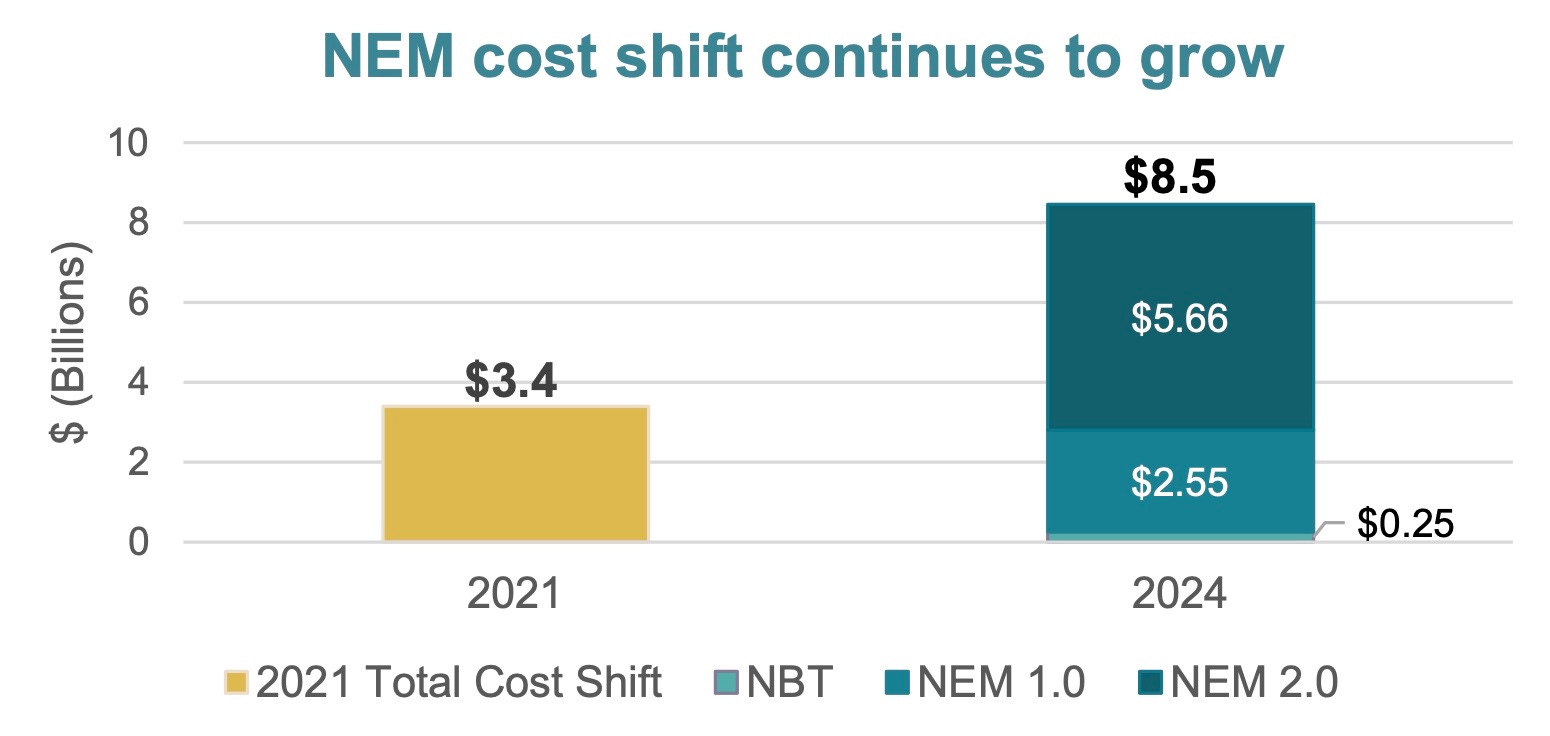
Furthermore, those costs are rising. As seen in the graphic above, pulled from the PAO’s report, the cost shift related to net energy metering, which subsidizes rooftop solar, has more than doubled since 2021. Here’s the key section from the report:
The subsidies, paid for by non-rooftop solar customers, are a contributing factor to high electricity rates. This cost burden — commonly referred to as a cost shift — to non-rooftop solar customers of Pacific Gas and Electric, Southern California Edison, and San Diego Gas & Electric has risen from $3.4 billion annually in 2021 to $8.5 billion annually by the end of 2024, and it will continue to grow in coming years.
To put this in perspective, remember that California has the dubious distinction of having the highest poverty rate in the country. And yet, in its headlong pursuit of solar energy in the name of climate change, it is imposing a regressive energy tax on the people who can least afford it. Ashley Brown, the executive director of the Harvard Electricity Policy Group, rightly calls the proliferation of rooftop solar systems and the returns they provide to lucky people like me, “a wealth transfer from less affluent ratepayers to more affluent ones.” It is, he says, “Robin Hood in reverse.”
Alas, none of these facts about solar energy made it into Wallace-Wells’ article. But they are facts.
What I’m reading
As I explained last month in “Where Are The Pro-Nuclear Democrats?” the Democratic Party can’t be taken seriously when it comes to nuclear energy. Ted Nordhaus of the Breakthrough Institute provided more proof of that in his September 4 piece about Matthew Marzano, who the Democrats have nominated for a spot on the Nuclear Regulatory Commission. Nordhaus called him the “most unqualified candidate” ever put forward for that agency. As I reported during the Democratic National Convention, top Democrats have been mouthing the right words about nuclear energy, but the party didn’t mention it in its platform. Joe Biden has never, to my knowledge, endorsed nuclear, and I will bet $100 here and now that Kamala Harris will not utter the words “nuclear energy” between now and November 5.
Yesterday, Nordhaus followed up with a review of Marzano’s testimony at his recent confirmation hearing. Nordhaus said that it was clear that if Marzano is seated at the NRC, “he will be a defender of the status quo, not an advocate for regulatory modernization.”
I’ve said many times that the US nuclear sector has enormous potential. Dozens of paper reactor designs are hoping to get licensed by the NRC, and numerous startups are filled with bright and ambitious people who want to see their reactors pump juice into the grid. The obstacles, though, are obvious: regulation, capital, and fuel. Until the Democrats get serious about the regulation part and, thus, about reforming the NRC, which includes nominating the best people for the commission, the domestic nuclear industry will continue to struggle.
No, that raises the question. Begging the question is a logical fallacy.
That’s the part that makes it look stupid. If coal is so cheap, why isn’t Africa using more coal? It’s capacity is only 25% of the US!
Coal is cheap – until you add on those Carbon taxes…
Google says South Africa has a carbon tax. I can’t find other examples in Africa.
Africa is a continent. Try looking up the individual countries… Congo, Nigeria, Botswana, Angola , Egypt…..
A coal powered power plant is expensive but you get a lot for the money. But, you need financing- and who is going to finance it?
These days mostly China.
They will finance one in China but probably not one out of China- since they know the western nations want to kill coal- so they might never get paid back.
Once again, more evidence you don’t understand what you read or what you post. Comparing the capacity of coal (whatever that means) between Africa and the US is not useful.
How much has coal electricity generation in Africa grown in the last decade, might be a useful question.
You are soooooooo close to understand the point I was making.
It hasn’t grown because in this day of fake CLIMATE HORROR SHOW, a coal power plant cannot be financed.
Gas use in Africa has growth about 4.5 times as fast as wind or solar in the last 10 years
The point you were trying to make was back ONLY by pure ignorance.
Well South Africa, for one, found it was more profitable to sell coal to Germany than to use it in South Africa.
I guess that die deutsche Energiewende turned out very well for South Africa.
I was told that Poland is busy building new dispatch-able power plants to keep the lights on in Germany. While in Germany the SPD and Greens are re-starting the coal plants that they shut down so that they do not have massive black outs.
Africa’s energy use.. can you see any wind and solar (without a magnifying glass) ??
76% fossil fuels, 17.2% Hydro.
You have just made yourself look like a completely ignorant moron.. still.
Solar is 0.34% and wind is 0.68% of the electricity produced in Africa.
If Solar and Wind were so Cheap why are renewable heavy countries like Germany and States like California charging 47¢-57¢ / kWh for their electricity?
If Solar and Wind are so productive why does it take 250% nameplate to produce 57% of demand??
Please see my post above on California’s electricity debacle.
Wallace-Wells is the biggest QUACK! And by the way, how does one get a hyphen in one’s name? Is that hyphen-abuse?
Having two dads will do that. Or a mother that prefers her own name to her husbands and wants to make sure her kids get it.
It might be old fashioned of me…… But I always wondered just how long a potential wife would stick around if she refused to marry and accept your name. In cultures where the man takes the woman’s name, the same applied but reverse the roles.
It is common in East Asia for the wife to retain her surname, however the children take the father’s surname.
Hmmm, 500M Solar Panels, that equates to 3 panels for every house. That would do exactly nothing in the grand scheme except transfer Billion$ of dollars to China, where those panels would be manufactured.
5B panels, 30 for every house would do almost nothing but perhaps produce what was used from 10am until 2pm when solar generation drops off…well before Peak Demand Time. That and grossly oversupply the grid at mid-day destabilizing it. Solar is no good without Back-up Batteries to accept the oversupply and buffer the grid demand. So Solar should ALWAYS be referred to as Solar/Battery.
“What will we do with our free power”
Nothing because it won’t be free.
30 Solar Panels
Inverter
Powerwall Batteries
Support
New Roof?? (Some existing roofs can’t support solar and would need replacement first)
All Expenses to have the “Free” solar power
All costing over $60,000 for the “Free” solar power
And sometimes those “Cheap” solar panels cause fires!
Lets not forget the Li-Ion batteries propensity to self immolate
3 modules times ~300W = ~1kW times 25% (0900 to 1500) = 250W
Not even enough to light up a microwave oven.
From https://www.marketwatch.com/guides/solar/solar-panel-wattage/ :
“Assuming you have a site with decent sunshine and no shade, each kilowatt of solar capacity can generate more than 1,400 kWh per year.”
Given that there are 8,766 hours in a year, the average yearly realized efficiency of a solar PV installation in the US is actually only about 1,400/8,776 = 16% of rated (maximum) output.
This, of course, takes into account that solar PV panels have zero output during nightime and much reduced output under clouds, and it accounts for sine/cosine losses as the Sun transits the sky at different elevations over the course of each day and throughout the year for an average PV panel mount angle and compass orientation.
Increasing these numbers requires a system designer to orient the array in the optimum direction, nearly all of them don’t even bother to try.
Or expending the energy required to automatically rotate the panels to the maximum potential angle and track the sun across the sky
Which doesn’t work so well with Rooftop installations
Motors to move the panels to be perpendicular to the sun’s rays is a major failure mode.
Ka-ching!
Ka-ching!
My 3.12 kW solar panel installation has averaged 15% realized efficiency over the past 9 years. Let’s not forget the Summer-Winter disparity. My system produces 200 – 300 kWh during the Summer months and 70 – 100 kWh during the winter months.
Thank you for the confirmation . . . there is nothing better than hard data coming from in-the-field, real world over such a long time period!!!
I’d give you 42 intergalactic credits if I could. 😉
The average square footage of a US House is 2,300 Sq ft. Approximately half of the homes will have a East=-West Roof ridge. That means Approximately 1,000 Sq ft. of the roof is suitable for a Solar panel. Efficiency of a Solar panel on a North-South Roof ridge will have more exposure but with an inferior efficiency. Two/three story homes will have a much smaller roof exposure.
Now you need to consider that a family living in Apartment, Multiply family, High-rises, etc. will have less than 1/10th to 1/4th of the ability to have a Solar panel on their roof. Worse, only the owner will have rights to this source.
Many homes have trees in the way- blocking at least some of the sun. They’d have to be cut.
I have seen a residential array mounted on the north-facing roof section, this is 40-degrees north latitude. The house is also surrounded by trees, of course.
What a waste of money.
For most traditional apartments (2-3 stories with 4-6 units per floor 18 Apts per building) you would have 54 panels on the roof.
New York (Manhattan) is hosed though with such high density housing to require a small states area worth of panels just to be ineffective. To be fairly effective Manhattan would require an area the side of Connecticut to be covered in panels for an electrified society.
Years ago I knew a guy who kept tabs on a roof system in the Bronx (I think). It was close to a chicken factory, the birds would deposit not only the white stuff on the modules but also chicken bones.
Years ago, ’90s, I toured a solar house in Door County. WI. 45°N. The first thing the owner said to our group was, “It’s not cheap” and gave all the reasons why. Everything in the house that could be run on propane was, and air conditioning was not an option. The array of panels was small, on the the roof of a two car garage size building filled with gulf cart lead acid batteries and electrical equipment inverters transformer etc. The house was open with few interior walls and heating was a wood burning stove. The auxiliary power was probably more than needed and obviously expensive. The owner said it had never been used. The house was not connected to the “Grid”.
My point? I can be done. The resident isn’t at the mercy of the grid provider. You don’t have to worry about black outs. Of course propane, natural gas and wood burners are already being banned around the country.
I lived in an “All Electric” 2,000 Sq. Ft. home for five years [before solar panels.]. I only had A Franklin style stove, and one High efficiency Fireplace insert. I had to acquire over two cords of fire wood every month November through April, to keep the electric bill below the same bill as that of neighbors that had a NG Furnace. AND, as an Electric Utility Employee I got a 20% discount.
Every person I know that has a Solar Panel for a source of electricity has More than one Franklin style stove, and more than one High efficiency Fireplace insert style stove.
Publications such as the The New York Times and The Guardian dutifully spout the day’s message as per the narrative.
And no claim is too loony:
Did you know climate change made the entire Earth wobble for nine days! What? https://www.theguardian.com/commentisfree/picture/2024/sep/16/did-you-know-climate-change-made-the-entire-earth-wobble-for-nine-days-what
You could try to read it, understand it and then google for additional sources. Or you can just post it and make fun of something you don’t understand.
You are funny. Your ‘cause’ similarly so.
What you don’t understand is propaganda & dogma when you see it. Cartoons are a tried and true medium to convey the target message.
True, what you don’t understand is looking up what the cartoon is referencing. But doing research here stops at cfact and heartland, I guess?
If you had the vaguest clue about anything, you would know the gruniad comic was basically a fact free piece of childish propaganda.
Designed for ignorant and gullible morons like you to swallow and regurgitate.
Sure beats believing the narrative spouting Lie Sheets
Who of sound mind would use google to search for anything?
Says the luser, being totally ignorant of everything, as usual, as it gets its info from the totally ignorant Guardian..
Greenland melts in the NH summer.. always has, always will, and the Greenland ice area is far higher than it has been for much of the last 8000+ years.
Everything in the Gruniad comic is twisted reality to fit their manic ignorance.
Just because the highly tuned seismic sensors in the global seismographic network detect a pattern of diminishing “echoes” from a particular non-noteworthy event, does not translate to the Earth “wobbling”.
(a “wobble” is such a scientific term, isn’t it? How many “wobbles” are there in a “wibble“, and what intervals are there in a “wibble-wobble” effect?)
Anyone would think this is the first time EVAH that a glacier (river of ice) had collapsed.
It is so moronic and twisted that is is laughable.
$8.5 Billion divided by 39 million= $218 per person, so assuming 20% have installed subsidized solar……probably around $218 x 4/family x 20% = about $160 has been “reallocated” per poor family by the author’s logic….About how much change people lose in seat cushions per year…. Still enough that it needs consideration so as to not support scammers….
I’m not following your logic.
The way I see it.
There are roughly 10 million “rate payers”, agreeing with your family count. About 2 million get subsidies from the other 8 million. The means those 8 million ratepayers are on the hook for $8.5 billion, right? That’s $1,060 per household PER YEAR. That’s a lot of lost change under the sofa cushions.
Your methodology is wrong. The $218 is how much each person must contribute to the $8.5 billion. Taking 20% of that number means only 20% of the $8.5 billion would be spent. If $8.5 billion was spent then the $218 cannot be reduced. The 20% must be subtracted from the number who paid for the subsidies given to the 20%.
Your figures should have been $85B / (80% * 39 M) = $272 or Family of 4 would pay $1,088, per year. If you have that much loose change in your seat cushions you need to ease up on the drugs and alcohol.
Great article. Robert Bryce is a national treasure. And his “about a minute” videos on X are gem quality too.
Keep up the good work!
What did socialists use before solar power?
Electricity.
The socialist left will continue to use fossil fuels.
You will be using “green renewable” power.
Tag line:
The only thing “Green” about green energy
is the money they are stealing from you.
You must be referencing the Green Paper that the Government takes from us and doles out to companies that produce nothing of value
5% of US electricity is a larger number than I was expecting. Adoption based on enormous subsidies and shifting costs. Still a dead end, but quite the political ponzi scheme.
Quote in the above article attributed to Wallace-Wells:
“Negative electricity prices, in which consumers are actually paid to consume electricity, are already a recurring feature in the world’s mature markets.”
I’ve never heard of such happening in the real world . . . got any facts to go with that?
Recurring, no less??? Where can I get some of that action?
yes, this was actually a reason some places stopped subsidizing solar
when the sun is shining utilities can’t charge half their customers
but they still have to maintain everyone’s access to the grid and keep baseload power available in case it gets cloudy
so they have to raise rates on everyone else
net savings across the system is negative
this has always been the problem with wind/solar
there’s only a very narrow window where non-baseload power is actually economically efficient
That statement has all the appearance of urban folklore unless you can cite the actual location, date and company/utility paying consumers to use electricity, which is not the same a stopping subsidies.
The utilities are paying NEM customers for excess electricity which the utility must sell to the grid at a premium. Then at the end of the day, when solar production is low, the utilities must purchase power from the grid at a premium. As a NEM customer, I benefit from this lunacy. All the non-NEM rate payers subsidize these payments.
While described incorrectly, something similar does actually happen, California regularly “pays” other states to take the excess PV power that can’t be used/stored, largely due to residential PV production across the state. This happens only at certain peak production hours and certain days/conditions, but it does happen.
Obviously, this is actually a problem, that’s why you don’t see this being widely reported. Can you imagine if the public were to broadly know that CAISO (California ISO) was selling power at negative rates (paying others to take it), but the CA residents are paying the highest price in the US?
The market disruption, in a bad way, this causes is significant, all driven by govt. regulation intended to mitigate an imaginary issue.
This was a big part of the push for Net Energy Metering (NEM) 3.0. Under NEM 2.0 the utility companies were required to pay residential PV customers the retail rate for any power they put onto the grid. Under NEM 3.0 the utility companies will only pay wholesale to the residental customer for any power put onto the grid.
This PV overproduction is a good portion of the push for energy storage in CA. Sounded great until the batteries kept, and continue, catching on fire.
I live in Southern CA, the San Diego area just had the second major battery energy storage facility fire this year, triggering evacuations, shelter in place, school closures, etc., more for the poisonous smoke than the actual fire, up to 3 miles away from the fire.
One burned for about 2 weeks before they could get it put out.
Interestingly, major fires like this get little if any national media coverage, only the local news covers them, and even they only cover it minimally.
“Interestingly, major fires like this get little if any national media coverage,”
Yes, the Media is not telling the public the truth about the problems with renewable energy and the storage it requires.
Normally, I would say the Leftwing Media is the culprit, but in this case none of the Media, Left or Right are covering these battery fires.
In some parts of Aus if you leave your solar on during the day you are about to be charged for the power you produce. NSW (starts in 2025) is the first place to do this, but it’s guaranteed to flow quickly to other locations. Think it starts out at AUD0.012/KWhr. Pretty small but its sending a very strong signal.
It also goes to show how little logic is used by these morons. How in the world do you have a sustainable business if your supplier is paying you to take their product.
If all these battery systems cannot be economic when they get the input power for free, how does the whole system pay for capital, maintenance, profits?
I posted about the California energy debacle above.
Why is free energy so darn expensive?
Ask Nick.
The fuel sources (Sun Wind) are free but the tools to harvest them are damned expensive, mineral intensive, Land extensive, low density energy sources
Nice read to start off the week. We’ve been hit by the solar bug up here in
the Northern Rockies. Panels popping up on rooftops and a few 20 acre-ish
eyesore “farms”. Winter is our biggest energy demand time by far and I noticed these
farms and rooftop units always seem to be covered with snow during this time. Completely
off line at the highest demand period. So curious..
As eye sores go they aren’t as bad as windmills for a variety of reasons.
I agree, there is a group of towers north of me that has one that the
blade has been frozen in place for years. Say a lot to me about the management
running them. Disclaimer–I have a solar powered electric fence charger
I use at remote locations, it beats packing a heavy deep cycle battery around
every week or so.
solar-annual-dni-2018-01-thumbnail.jpg (508×320) (nrel.gov)
Had they looked at this map (or one of the many others published by NREL), they may have recognized that solar is not optimized in MT. Remember, virtue signaling has a cost.
The company building these projects was Cypress Creek Renewables.
https://www.greatfallstribune.com/story/news/2015/11/12/california-company-build-solar-farm-near-helena/75646460/
Former US Senator Max Baucus’s step brother John Baucus has one on the family ranch.
https://helenair.com/news/local/county-grants-138k-tax-break-for-proposed-solar-farm/article_d17b0302-7142-5eb1-9611-c08c81aa75a6.html
It was back in 2019 we had a Alberta Clipper storm come down in January
it dumped a good bit of snow and the mercury dropped -30F below. There
was a local power outage and if you didn’t have a genset you were in danger
of freezing out. The woke NWE power company’s wind and solar were off line.
Personally I would rather see a modular nuclear or a natural gas plant in this area than these “renewable” unreliable deals.
Do Power Purchase Agreements specify a minimum and maximum guaranteed power supply and penalties for noncompliance?
Please define acronyms NEM and PPA in the text.
For others wondering: PPA = “A solar power purchase agreement (PPA) is a financial agreement where a developer arranges for the design, permitting, financing and installation of a solar energy system on a customer’s property at little to no cost.”
I don’t think that’s a correct definition. A PPA is an agreement to buy a proportion (up to 100% of the output from a facility on agreed pricing terms. These may be fixed per kWh, or inflation index linked, or related to some wholesale price marker. The term may be anything from a year to the life of the facility. PPAs often include the right of the purchaser to acquire any green certificates earned by the output, so it can virtue signal.
If a facility has one or more PPAs in place it is in a position to use these as security for bank borrowings to finance the construction and operation of the facility.
Turnkey contracts to supply, finance and manage a facility also exist. They really only differ from simply collecting rent for the land on which the facility sits by offering the landowner some of the output.
For others wondering: NEM = “Net Energy Metering (NEM) is a program that allows customers with solar or wind power systems to receive credits for excess electricity they generate and feed back into the power grid. These credits can be used to offset energy costs on the customer’s monthly bill.”
The important point to note about net energy metering is that it amounts to freeloading on the grid: drawing power when your solar array isn’t working and it costs a fair amount to produce enough to meet demand, and dumping power onto the grid in the middle of the day alongside other solar, just when demand is hit by the solar surpluses and the market value of the output is probably negative – yet getting full credit against winter peak demand after dark.
Time of use metering would end the abuse – and kill the solar economics.
Why on earth is anybody repeating the meaningless phrase “solar and wind energy is free.” So is gas, oil, coal and uranium. God charges us not one cent for any of these sources. But it takes expensive machines to collect and convert each of them to energy or fuel and to distribute it to where it is needed. We also need to pay the owner of the land involved to allow collection of any of these energy resources.
It’s all the same. It’s simply a matter of the cost involved in each of the essential steps and the suitability of the product to meet our needs. The cost of the machinery needed for utilizing fossil fuels and uranium are well established at set the floor for any competing sources. The cost of wind and solar are now becoming well established as well and it has become clear that the added costs primarily caused by their irregular energy production rates, are very high. That’s why electricity prices are rising, rapidly.
We are building solar and wind machines supposedly to reduce emission of carbon dioxide but its not at all clear that they in fact do that. Some studies find that there fabrication, installation, and use releases more carbon dioxide than is ever saved by them. Are the machines needed to backfill for the sudden decline of wind or sunshine effective? Electricity storage is very expensive, especially batteries. If cheaper ones are developed, where is the electricity needed to charge them to come from and will it be enough to meet the need? If natural gas generators are to be used for does that really reduce overall carbon dioxide emissions? Single cycle gas turbines as are required for such service are notoriously fuel inefficient, particularly at low loads. Would an all-gas electric system reduce carbon dioxide levels more than wind or solar? Experience in the USA suggests the answer is yes.
The advocates of wind and solar claim that because panels and windmills are cheap, we should build more. They don’t consider their impacts on our electricity system, a functioning system being the overall goal. And is reduction of carbon dioxide emissions even needed? There are many highly credible scientists who say no, the effects of increased levels are very small and ignorable. Prominent among these scientists are those working for the IPCC who, in their most recent report called AR6, found that the only climate impact from carbon dioxide releases may be increasing temperature, but not increasing storms, floods, droughts, winds and so forth. Read it if you don’t believe.
It is frustrating to see huge investments in carbon dioxide reduction machinery being made without a careful analysis of need and effectiveness, all supported by our politicians, both Democrats and Republicans who should know better. Energy production and use is a complex issue. Deal with it as it is, not just pieces here and there.
Receiving no mention anywhere in the above, including quotes from various authors, is the true cost of “free” solar PV-generated electricity when the price of:
— the solar panels themselves and their DC-AC inverters
— their installation
— their inspector-approved, certified-electrician connection to the household wiring/power lines
— their maintenance, and
— their impact on increasing home fire and liability insurance premiums
are all properly accounted for.
The first three of the above items, the most costly ones, are generally paid up-front (unless one also effectively pays for multi-year financing), so there is also the “imputed cost of money” to be accounted for . . ., that is, the fact that had you invested the equivalent of that up-front money sum in a low-risk investment (say, a money market fund) you would have earned compounding interest on that sum over the projected lifetime of the solar PV system.
Oh . . . did I forget to include the luxury expense of purchasing a battery storage system to go along with the PV panels? Careless of me.
If one assumes the imputed cost of money is 5%, it takes something like 10 years just to break even* starting at today’s average retail cost of electricity in the US, which is $0.177 per kWh (see https://www.bls.gov/regions/midwest/data/averageenergyprices_selectedareas_table.htm ) . . . and that’s not accounting for the other costs mentioned above.
“Free power”? I think not.
*Based on an average cost of $12,700 for a 6 kW home system (see https://www.forbes.com/home-improvement/solar/cost-of-solar-panels/ ), a rebate of 20%, an effective output of 8,400 kWh per year (see https://www.marketwatch.com/guides/solar/solar-panel-wattage/ ), and an assumed yearly 3% rise in the commercial price of electricity. Left unaccounted for is the impact (up or down) on the market price of the house having the solar PV installation.
Plus removal at the end of the life.
On September 5th, 2024, Governor Hochul of New York held a one-day energy summit in Syracuse, the Future Energy Economy Summit. A video of the one-day summit is posted on YouTube here.
Roger Caiazza, the Pragmatic Environmentalist of New York, attended the September 5th summit but has not yet finished writing up his opinions concerning what he heard there. I myself watched the summit remotely from the Middle of Nowhere, Eastern Washington State.
The morning sessions focused on the current status of wind, solar, geothermal, and hydrogen technologies and where things stand with the adoption of those technologies. Yes, much of the substance of the morning sessions was a repetition of standard AGW and RE talking points.
However, other points were offered in the morning sessions which indicate to those who understand the truth about wind, solar, and hydrogen that trouble is on the horizon. Supply chain issues are becoming a serious obstacle to the adoption of these RE technologies.
The afternoon sessions focused on the energy needs of large, middle size, and small size industrial customers for electricity, and on the role that nuclear power can play in supporting these industrial needs.
In addition, the afternoon sessions also examined the benefits of 24/7/365 nuclear power and touched upon every issue and challenge of implementing a strong nuclear new-build program in the United States.
The summit’s examination of the issues and challenges facing nuclear power went far beyond anything we’ve seen done in a state-sponsored public policy forum for wind, solar, and hydrogen. And it was done in a constructive way.
My personal opinion, based upon what was said during the summit, and by whom, is that Governor Hochul and her administration have now added nuclear power to the mix of energy options that New York State will be pursuing as part of the state’s Net Zero transition.
IMHO, the September 5th summit was one means of setting the stage for making a formal announcement of this policy change at some point early in 2025. In the meantime, I am awaiting Roger Caiazza’s detailed analysis of the summit before I post my own further comments about what was said there.
I also can’t wait for Roger’s report which I hope he will post here soon.
Since New York has snowy winters, the solar farms will be covered with snow and won’t produce any electricity.
The heavy industries, heavy transport, and emergency vehicles such as fire trucks will always large amounts of fossil fuels as will Con Ed’s five massive steam plants.
A little awhile ago, a commenter posted that 6.9% of New York’s surface area would have to be covered with solar and wind farms to supply New York’s yearly electricity.
My motto is “Fossil Fuels are forever!
Good comment!
New York going nuclear: Sounds like a winner to me. 🙂
Maybe reality is starting to sink in.
Meritocracy doesn’t work. One needs to check all the DEI boxes to get that job or any other in the Biden-Harris government syndicate.
I was driving around this unseasonably chilly windy Mojave Desert morning and got thinking about this post. I have several neighbors with rooftop solar. I have two long term friends with (had) rooftop that I have discussed their reasons for getting it. In both cases the decision was purely for a personal financial gain. That is, greed. There was zero climate ideology involved. In both cases they shrugged off the moral burden of the “cost shift”, though I called it a “tax break” so to not make the conversation too toxic.
In both cases the financial gain seemed to me a bit on the marginal side. But it was enough for them to do it. One fellow explained proudly how the solar paid for his summertime AC use – that was his profit. Over the years that might have amounted to $10k savings in electrical bills. He and his wife were a high income couple, they are now retired and living in a million dollar home up north. The other fellow is now retired and living in a million dollar home in Colorado. Now I’m a believer in the old adage that if you pay attention to the pennies, the dollars will take care of themselves. But I have enough awareness to know those solar subsidies have to come from somewhere. I know where my “pennies” come from, and I won’t go along with the “I’m opposed to subsidies unless I’m getting them” (I’m sure Mr. Bryce is just making a point).
I got to thinking about the EROEI of rooftop solar. Seeing as the gov (Kali in my case) promotes the expansion by generating *just* enough greed to motivate the decision to install, I realized the gov must know precisely what rooftop EROEI is – it’s hard for us peons to figure it out. I have “by a process of geometric logic” (HT Captain Queeg) arrived at a simple determination of rooftop solar EROEI. Taking cost as a proxy for energy, and the fact the gov knows the answer, here is how I see it.
The system install costs so much. The system would possibly generate enough to eventually pay off that cost and maybe even return a bit of money. But it will take too long so the gov throws some money on the deal to ensure a payoff, and enough extra to create the greed necessary to precipitate the install decision. So, the energy (cost) needed to mine/make/transport/install the equipment is returned – EROEI of 1. But everybody involved in that supply chain has to make a percentage, so the ERORI is 1.7, maybe up to 2. But we can’t forget the homeowner. From my friends experiences I’d say they got about 25 percent of this upstream cost as a benefit. However, the big difference here is We (the rate payers) eat it, so the EROEI remains 1.7 – 2.
A couple years back I had arrived at an EROEI of 1.7 by a different laborious process (it’s a miracle, I know). BTW, I’m not accounting for end of life – dismantling/recycle/landfill. And I’m not accounting for impacts to the grid. Probably the total EROEI is lower. The low EROEI is, of course, so low as to detrimental to society. No big surprise there. One could argue that a lot of personal choices (Freedom!) are detrimental to society – I hate Razor type buggies ripping around my neighborhood for example. But this is gov pushed for ideological goals, and it literally transfers money from the low income part of society – it’s evil. The fact the gov does it by exploiting simple unthinking human greed I guess shouldn’t be surprising.
BTW, I have an off grid mountain cabin. It has as its sole power a solar panel and Pb battery installation. It runs like a Swiss watch, and it suffices. Nobody but me paid for it, I’m so glad I don’t have to run a generator.
I hope you rolled a couple of 1″ diameter ball bearings in your hand while you applied your “process of geometric logic”.
🙂
Never go anywhere without them
Gosh, what will we do with all that “free” power? If it’s been free all this time, why are my utility bills so high? Why am I getting charged for free stuff? I noticed that all that free money handed out by the government during the COVID-19 era drove up inflation to record levels so that everything—especially basic commodities like food—cost a lot more and everyone had to pay for the free money after the fact. The poorest were hardest hit because they had to pay a larger fraction of their limited income for necessities due to steeply rising costs. But tell me more about this free power of which you speak, David Wallace-Wells, it intrigues me.
Here’s what all that free money did for us:
I think we should take Wallace-Wells and others like him at their word, wind, solar and storage are cheaper than fossil fuel and nuclear so all subsidies and tax preferences should be withdrawn immediately as well as all mandates and preferences for them. They are liars and cheats all of them.
Good article, but was wondering in the linked “How to Destroy…” article, why would utility profits only be applied to wind and solar? Why not other forms of generation? Its shown in the LCOE: Existing vs New Energy Sources chart.
i made $0.26 off my solar panels today! sux being you naysayers!
> Wallace-Wells goes on to repeat the same shopworn arguments we’ve been hearing for nearly 50 years: solar is getting cheaper, capacity is growing, sunshine is free, and therefore, it really is different this time.
Fish are also free. That is free after buying the boat, trailer, motor, tackle and tackle. Then it is a simple matter of paying for fuel, permits and that nice spa weekend for your wife.
California’s problems are based on shutting down dispatch-able power to the point that the state imports 30% of the electricity that it uses on an annual basis. In addition, California has installed a surplus of intermittent power production (mostly rooftop solar and wind). There is so much rooftop solar produced during midday, that the excess power must be sold to the grid – at a premium. At the same time that California utilities are selling excess electricity to the grid at a premium, they are paying people with rooftop solar for the electricity that they produce. During the peak usage time of 16:00 to 21:00 everyday, California is short of power production, since rooftop solar is producing a mere fraction of what produces during midday. Therefore, during peak usage periods, California utilities must buy power from the grid, again at a premium.
Consider the fact that every day during the Summer months, my roof top solar panels are producing excess electricity that I get paid for by Pacific Gas & Electric. This excess electricity can’t by used by California, since the peak usage hours do not align with the peak production hours. So after paying me for power I sell to them, the electric utilities must sell all the excess power to the grid. The grid must be paid to take this power, because it must travel a long distance to a location where it can be used.
Now at the end of the day as we get to peak electricity usage, California’s roof top solar goes from balanced to shortage. This happens after 3 PM and it varies depending on the time of year. This shortage must be made up by buying power from the grid at a premium. This peak usage shortfall is made up mostly by dispatch-able power from parts of the continent that have been wise enough not to shut down their non-intermittent power generation. Since California has an annual electricity short fall of 30%, there is no way to produce sufficient power within the state. Our current governor finally realized that he could not shut down Diablo Canyon (the last operating nuclear plant in California). Someone finally got him to understand that shuttering Diablo Canyon, would increase California’s electricity shortfall to 40%. This would have lead to rolling black outs.
Once you understand the mess that is California energy production, it is little wonder our electricity rates are sky high. Those of us with NEM electricity, are not paying for this. Businesses and people without NEM are paying for the sales to and purchases from the grid, as well as my excess electricity production, which I sell to the grid. The NYT article authors are either ignorant of the facts about solar or they are being intentionally deceptive in misstating that solar is getting cheaper. I believe that it is reasonable to state that each new solar panel installation in the Golden State, increases electricity costs for each non-NEM customer in California.