Essay by Eric Worrall
First published JoNova; If only all coal plants were forced to close, then there would be no opportunity for greed because there would be no electricity.
Generators fill their pockets again, pushing grid prices to new highs and leaving renewables to cop the blame
Giles Parkinson
Jul 31, 2024Competition, they say, is good for the market. We can but hope. Right now, it is clear there is not enough competition in the Australian wholesale electricity market, and the big players – and some new ones – are intent on making hay while the sun shines, knowing that it is their “cherished” consumers who will have to foot the bill.
Wholesale electricity prices hit a new landmark on Tuesday night when all five states that make up Australia’s main grid, the National Electricity Market, had prices pushed above $15,000 a megawatt hour (MWh) at the same time. According to market observers, this has never been seen before.
…
Renewables are supposed to challenge this and lower the price on wholesale markets by introducing competition. But as the number of fully dispatchable generators declines, competition at critical times has actually been reduced – at least for the time – and like seagulls around a box of chips, the market players dive in.
What we see here is naked greed, around an essential service, enabled by the ability to manipulate prices to unreasonable peaks, and the complete inability to keep any sense of proportion or perspective.
…
And the problem is that in a hotly partisan energy debate, and a lop-sided and populist media disinterested in actual facts, it will be renewables that get the blame. We saw it last week with the reports on the latest June quarter wholesale prices.
…
Read more: https://reneweconomy.com.au/generators-fill-their-pockets-again-pushing-grid-prices-to-new-highs-and-leaving-renewables-to-cop-the-blame/
Greens are deeply concerned that us heartless engineering types are suggesting that adding unreliable energy sources to the grid while punitively discouraging investment in reliable energy facilitated this latest round of hardball supply and demand capitalism.
The reference to “naked greed” and “essential service” in my opinion is thinly disguised call for energy assets to be re-nationalised.
Perhaps greens shouldn’t have fought so hard to stop entrepreneurs from building dispatchable zero carbon nuclear energy. Then they wouldn’t have been exposed as a bunch of incompetents.
Who could possibly have seen this coming? /sarc
You don’t see much of anything if you go through life with your head up your ass, as all “progressives” do.
“Perhaps greens shouldn’t have fought so hard to stop entrepreneurs from building dispatchable zero carbon nuclear energy.”
Complete fantasy. It didn’t happen. There have been no attempts by “entrepreneurs from building dispatchable zero carbon nuclear energy.”
Attempting to go low carbon without smr’s etc is fantasy and impossible. Why not put an order in with Rolls Royce?
RR, or if you’re in a hurry, NuScale.
or Candu pebble bed reactors from Canada.
If you’re in a hurry getting scammed? Both have delivered absolutly zero yet.
Utter nonsense. Australia has a nuclear association dedicated to repealing the nuclear ban, lots of substantial players are interested.
https://www.nuclearaustralia.org.au/
As for raising capital to build a plant, what’s the point when nuclear is banned? If you are suggesting nobody would be interested if there was bipartisan support for nuclear, or subsidised support from one party, you better provide some evidence.
“you better provide some evidence”
You said that greens had stopped entrepreneurs from building plants. Didn’t happen. Now you’re saying that no entrepreneurs are coming forward because it would be unprofitable. That’s a different claim. And as you point out, there is a long standing “ban” – predating greens. Your nuclear association etc have first to win an argument with the government, as they are well aware. They couldn’t win during many years of conservative government. Now Dutton, in opposition, is making favorable noises. That is what oppositions do – talk.
If and then they win that, they have to raise the money.
No, greens stuffed up the grid by pushing for useless renewables. The consequences, $17,000+ / MWh as last man standing dispatchables pushed the price up, were entirely predictable.
I suggested if greens had instead pushed for nuclear, they would not have exposed their incompetent grasp of energy grid reality.
I actually agree nuclear isn’t a good general solution for Australia’s energy needs, in most cases coal would be a lot cheaper – though for remote locations nuclear likely has a role to play. I’m certainly no fan of Dutton’s plan, I think building nuclear on top of coal deposits is irresponsible vandalism – even a small radiological incident would destroy the value of the coal deposit.
But the renewables greens and people like yourself have pushed for clearly aren’t working.
You can do the math Nick – how can you possibly continue to support this renewable nonsense? Surely it’s obvious by now there the amount of backup required to stabilise green energy is utterly unaffordable, or at the very least that nobody is prepared to invest the money.
The national ban does not predate the Green Party, the “Howard-led Coalition government agreed to a Greens amendment to the National Radiation and Nuclear Safety Act (1998) to gain Senate support for a new research reactor at Lucas Heights. That amendment prohibited development of other nuclear facilities.”
In other words the Greens who held the balance of power in the senate after the 1998 election blackmailed the Howard (conservative) government by making the banning of nuclear generally as a condition to support the medical research reactor at Lucas Heights.
Later in his term Howard attempted to revive the nuclear power debate.
In 1998 the Greens had just one senator (Bob Brown). He could not solo block legislation. A majority of the senate favoured this amendment; even the Liberals agreed.
“Australia’s nuclear ban was introduced via a Greens amendment in the Senate on 10 December 1998. There was less than 10 minutes of debate on the matter. The Howard Government at the time was seeking legislative support to build a new nuclear research reactor at Lucas Heights. With no immediate prospect of a nuclear power station being built, the Government accepted the amendment so it could proceed with the new research reactor” (Parliament of Australia Coalition Senators’ Report).
“Twenty-one years after the Federal Parliament banned nuclear power, one of the senators responsible would like Australia to have another look at the energy source.
In 1998, Michael Forshaw, a Labor senator, agreed to a Greens proposal to insert a clause into a proposed law on nuclear safety that prohibited using nuclear power to generate electricity” (Australian Financial Review Oct 2019 The man who helped ban nuclear has second thoughts).
Nick, caught is a LIE, yet again !! Or is it ignorance?
Only Nick knows, but I strongly suspect the former.
Mr Stokes is correct to the extent that the Australian Democrats held the balance of power in the Senate but Democrats or Greens is a distinction without a difference: “Following internal conflict over the goods and services tax and resultant leadership changes, a dramatic decline occurred in the Democrats’ membership and voting support in all states. Simultaneously, an increase was recorded in support for the Australian Greens who, by 2004, were supplanting the Democrats as a substantial third party.”
I’m sure The Greens remain proud of their pivotal part in banning nuclear power.
Another bald-faced LIE from Nick.
The whole Green/Labor far-left political agenda stop anyone from building dispatchable zero carbon nuclear energy.
They are still fighting tooth and nail again any nuclear in Australia.
At least the Liberal party have woken up to the necessity of adding NUCLEAR to the COAL and GAS mix.
Hopefully that will save much of Australia’s pristine wilderness areas from the environmental destruction by wind and solar industrial estates.
Proposed renewable energy projects across Queensland. (youtube.com)
Totally DISGUSTING. !
Even more disgusting are the people that support this environmental vandalism.
You are just exposing your lack of knowledge in electrical power plant operation. You have absorbed nothing from past threads on WUWT.
Nuclear plants are not capable of short interval start up to provide short term backup to renewables. Coal plants are not much better. Firing up boilers takes time. That basically leaves natural gas as the only alternative. I guess batteries are also an option, but they are as expensive as the costs currently being experienced.
Bottom line, get your wallet out. Pass that on to all your cohorts.
Yeah Nick no private potential financiers are going to take any interest in investing in nuclear power development In Australia while nuclear remains a legally proscribed proposition.
Let’s see if the situation changes if / when the parliament undoes the legislatively proscribed status of nuclear power development for Australia.
I mean, if you were say a car manufacturer, would you be willing to start building a factory to make a type of car that you knew couldn’t legally be registered for use on public roads?
Does the fact that nuclear is illegal in Australia have anything to do with “no attempts”?
Yes. But Eric insists that “greens shouldn’t have fought so hard to stop entrepreneurs from building dispatchable zero carbon nuclear energy.”. There were no entrepreneurs to oppose.
So they just opposed because… 😉
That’s because the political will was totally against it because of the witless green agenda..
You know that, so you are being deliberately disingenuous..
… ie lying through your teeth !
I thought that “dispatchable zero carbon nuclear energy” was the definition for an Aircraft Carrier ‘s power plant (USA at least)
That is a bald-faced LIE. !
The whole of the anti-nuclear political agenda stops anyone from building dispatchable zero carbon nuclear energy.
Giving subsidies to incentivize renewables is also disincentivizing baseload investment.
How many threads have you read where this was predicted? It should surprise no one!
The overhead of keeping non-renewables ready for immediate use is high and generates costs continually. It is no wonder that recovering those uncompensated costs when it is needed is going to be terribly expensive.
The alternatives are subsidies to non-renewables or government owned and operated fossil fuel plants that can come online when needed. Ultimately, someone is going to pay those costs when the non-renewables are not needed.
Like the Cloward-Piven scenario on social benefits, I consider that the greens want to cause a total crash of the system, as only then will The Radiant Future have a chance to prosper. If one has the basic premise that Industrial Society is evil, destroying it is a worthy goal.
Assuming they are ordinary politicians with liberal values is folly.
My interpretation they want coal and oil industry players to fund the green revolution, and are gearing up towards demanding government seizure of “essential service” assets so they can get their hands on the cash. They have no intention of deliberately crashing the entire energy sector, they understand that if the lights go out people will kick them out of office. Their problem is they are suffering from the delusion that renewables work, and more renewables will solve the problem.
Or they could just be orthodox Marxist-Leninists, and want an excuse to “seize the means of production”.
Absolutely, but the political route to Marxism requires public support for each encroachment.
Government run dispatchable power generation will end up costing even more! I guarantee it. The only change will be taxpayers funding the investment rather than just rate payers.
It’s not greed. When you have something valuable—reliable dispatchability—you sell it for whatever the market will bear when it is needed. A iron rule of the economics of supply and demand. When supply is nearly fixed so a near vertical supply slope) and demand rises, prices go up sharply.
Here in NY we are speeding toward the same outcome not many years from now, unfortunately.
To be fair some industry players who should know better appear to have encouraged politicians to make fools of themselves, while hanging on to a few strategic dispatchable assets for the right moment. But its not their job to teach politicians science and basic economics.
“its not their job to teach politicians science and basic economics”
For “politicians” read government, representing the people. It is always possible for a cartel to corner supply and skyrocket prices. And it is the job of government to prevent that. Fortunately there are enough players that someone will break ranks, as happened. Such artificial peaks can’t last long.
Why should anyone break ranks? It’s not like there is any risk of new competition entering the market.
A price of $15,000 is very easy to underbid, with great profit.
Another bald-faced LIE…
…. either deliberate or from ignorance.. who knows, except Nick.
If a supplier is only able to get income for very short periods, their costs for keeping the supply available are very high.
You would think that at that price even doing it with batteries should be able to make a profit.
The implications go beyond that, though. The problem is, the only way to deliver a usable power supply is by installing dispatchable generation equal to a very high percentage of peak demand, high as in 90%+. That basically means coal, gas or nuclear. Or hydro where the terrain permits.
You can install as much wind and solar as you want, there is no getting away from this basic problem of intermittency. The wind and solar over produce when demand is light and fail when its high. Not all the time, but enough that you have to be able to meet demand with other, dispatchable, generation when it has almost totally failed.
Seems like what is happening in Australia is that if you do not do that, prices go through the roof when you get the wind and solar failures. Same thing has happened in the UK. It will happen everywhere countries attempt to run their grids off wind and solar, without having full alternative dispatchable capacity to meet demand.
That’s fine up to a point. Install such a system and you will meet demand. The problem then is that the financial justification for installing the wind and solar becomes fuel savings, and that alone. What you end up having to claim is that a grid powered by coal and gas supplemented by wind and solar is cheaper to run than one relying solely on the coal and gas, and that the savings are due to not burning as much fuel.
If there is a business case anywhere to that effect I would really like to see it. I keep asking for proper NPV analysis showing the case, but no-one ever names any. So I think it doesn’t exist because its not true.
This is not a profiteering problem, its a whole grid design and costing problem.
One would think that the folks pushing renewables would have an actual cost study utilizing NPV to determine the most economical design of the electric supply. I’ve never seen one. The only justification is the Precautionary Principle.
Why did no one bid $14,000? A cartel I bet? /sarc
Except the green/labor governments NEVER represent the peoples needs.
“it is the job of government to prevent that”
It is governments that have CAUSED it with their moronic anti-CO2 closure of operating dispatchable supply, the idiocy of not creating more dispatchable supply.
… and worse of all, the utter incompetence of allowing unreliable suppliers like wind and solar onto the grid.
Except that is not what is occurring. What is occurring is government central planning. One only needs to study the late Soviet Union to see central planning results in for the ordinary people.
If left alone, the market would have built the best supply and offered it at the least cost. Distribution is a proper place for regulation but not supply. Once the government enters into deciding market share, all bets are off.
‘It is always possible for a cartel to corner supply and skyrocket prices. And it is the job of government to prevent that.’
Nick, did you learn this in elementary school (or whatever you call it in Oz) social studies?
The pre-regulatory history of cartels is that they almost always failed because the members ‘cheated’ and/or new competitors entered the market.
Subsequently, firms realized that they could only create cartels through the process of government regulation. The result is a pay-to-play version of socialism where some firms, e.g., renewable energy providers, ‘lobby’ for government mandates / subsidies, while other firms, e.g., conventional energy providers, ‘lobby’ to be left alone.
Think of fascism. Private ownership but government control!
“The pre-regulatory history of cartels is that they almost always failed because the members ‘cheated’”
Exactly what I said.
“ Fortunately there are enough players that someone will break ranks, as happened. Such artificial peaks can’t last long.”
This one only lasted a few hours. But it was good (for them) while it lasted.
‘This one only lasted a few hours.’
Nick, you’re missing the point. ‘This one’ wouldn’t have happened at all, but for the government’s de-facto meddling in energy markets on behalf of climate alarmists and their rent-seeking fellow travelers.
PS – I doubt anyone broke ranks – it just takes a while to bring the regulatory-impaired capacity on line.
Yep, the tensions between scarcity and abundance will always sway the price of any commodity.
Furthermore, the cost of maintaining and operating such power supply systems for short bursts when the wind and sun are not providing…
… is much more expensive than just letting them run at an optimum speed.
Without getting these high prices, they would just not operate.. period. !
Then the grid would collapse.. which would be magnitudes more expensive.
$17376.90/MWh is available to wind and solar. The problem is that wind and solar produce the most energy when prices are low and little to no energy when prices are high.This is really quite stupid design on the part of the renewables. Turn the windmills and solar off when prices are low and only run them when prices are high.
Nature has a habit of doing this all on its own.
Yep, solar should run during the evening peak when the prices are highest.
I’d like to see that, (by candle light).
Use diesel generators running a whole lot of LED lights. At $17,000/MWh you could make money. I understand exactly that was done in Spain to harvest “renewable” subsidies.
At night cover the solar panels with a bunch of glow-sticks!
Winter in Australia, (or anywhere else probably) there is basically ZERO solar available at the morning and evening peaks.
If wind fails, you need to provide 100% of electricity from COAL, GAS and HYDRO
(and diesel generators especially in “renewables” South Australia)
That means that some company , somewhere has to have generator equipment sitting ready to go, that is doing nothing at other times of the day.
To make an overall profit over time, they have to charge very high prices if the grid wants the electricity.. If they don’t make that profit, they disappear, and that supply is not available next time its needed.
The NEM desperately needs more dispatchable reliable supply.
Another big modern COAL fired plant in each state. Some Nuclear if you don’t want coal.
Some more medium acting GAS plants to carry general known fluctuations in demand (can use Hydro where available).
And some subsidised or state-owned GAS peakers for those really high demand periods.
And get rid of all the erratic, parasitic garbage wind and solar off the grid.
Yes. You basically have two high fixed cost systems operating in low usa mode. The wind and solar because of intermittency, and the coal and gas because you turn them up and down all the time to allow the use of the wind and solar.
So, yes, this means the coal and gas fixed costs are getting written off against a fraction of what they are capable of producing, and what they do produce in regimes without the added wind and solar.
And then you have the added effects of the inefficiency of running the coal and gas plant not simply part time, but also in stop-start mode, which raises variable costs.
Its a hare-brained idea, and if it were approached on the basis of, we have coal and gas, we’re meeting demand with it, now lets install a whole bunch of wind on top and save on fuel, it would never get started. But that is not how its presented, its presented as lets replace the coal and gas with wind and solar, and lets have some gas and coal as backup for dark calm periods.
Which is not what is happening at all. You either have enough coal and gas and nuclear to just about fully meet peak demand, or you have blackouts. Any wind and solar you install is supplementing the dispatchables, not replacing it.
Giles Parkinson runs the RenewEconomy website. I was banned from commenting years ago for pointing out what he is now seeing. His interpretation is so deluded he cannot think straight.
The simple fact that the term “renewable” energy still has currency anywhere in the press when referring to wind and solar energy extractors. shows there are still more believers than realists. There is nothing at all “renewable” about solar heat islands and wind stiller. They are a one shot wonder that consume more coal during their manufacture than they can possibly save over their short operating life. They are creating awful micro climates because they eliminate trees over vast tracts of land.
The term “renewable” was used without qualification in this article and the original at the JoNova site.
The only renewable source of energy currently known to humans are trees. But I doubt managed harvesting of them could support 7bn people in the current manner that about half of us enjoy.
I just checked the NEM for this week. Distillate generation did the most profiteering at $1005/MWh. Batteries were next at $553/MWh for discharging (they paid $147/MWh to charge). Hydro was next at $450/MWh.
Rooftops were lowest cost at $75/MWh. Their owners enjoyed free lunchtime power on most of the last week as did the few that use free retail energy between 11am and 2pm. The rooftops do not get paid subsidies after installation so there is no additional theft once in operation; unlike the grid scale WDGs where the mandated theft now doubles their income from the wholesale price they get.
As a Tasmanian – where we export (in winter) about 30% of our 100% renewable/hydro power generation to the Mainland – I am grateful that our government can so skillfully graft an additional $17340 per MW from Mainland electricky users.
My only compliant is that the planned Marinus Link project will allow our state government to export even more of our state’s energy competitive advantage – instead of making Tasmania an economic & employment powerhouse for Australian businesses looking for cheaper power and labor costs.
Eric W,
Thee must be oter readers who follow electricity price movements by various ways in their home countries, Australia being ours. Here is one way I show 40 years of domestic prices, compared to a wide basket of domestic goods, a method long used to display relative movements.
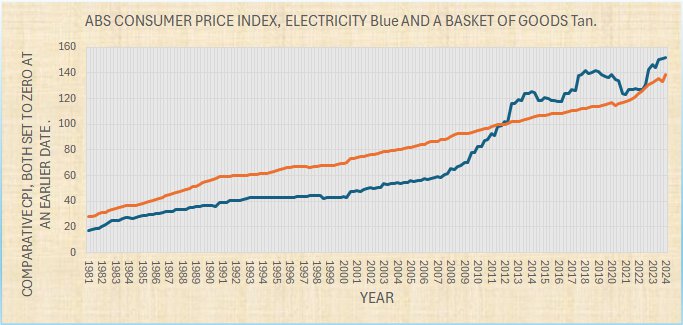
….
When it comes to your present way using $17376.90/MWh, I have to stop, think and look up precisely what is being measured. I think I know, but I might be wrong.
Can I please suggest that you spend a little more time to explain the connection between that $17376.90/MWh and what the domestic consumer is paying? In this case, it is rather more complicated than “The higher the $17376.90/MWh goes, the bigger the consumer bill goes.” How much bigger can it get, how big an effect is this, does this effect happen often, etc.?
Is there one lovely link that does all this?
(Not a criticism, merely trying to be helpful.)
Geoff S
“Right now, it is clear there is not enough competition in the Australian wholesale electricity market”
True and how exactly is the introducing of massive subsidies, incentives and regulations favouring wind, solar and battery systems going to return us to a competitive and affordable electricity market? Let’s try to recall – what was the electricity price before all this net zero/climate catastrophe bovine effluent was sprung on the unsuspecting consumer?
I have advocated since the early 1980s that energy should not be part of the future’s market.
“Zero carbon” is another expressions we must place in the rubbish heap.
Using Climate Syndicate language only gives them credibility. Words matter. Accuracy and communications are the life blood of science.
If only there were fields of study dedicated to understanding this phenomenon.