Guest Post by Willis Eschenbach (@weschenbach on Ex-Twitter)
The iconic “hockeystick” simply refuses to die. It was first created by Mann, Bradley and Hughes in their 1998 paper Global-scale temperature patterns and climate forcing over the past six centuries (hereinafter “MBH98”).

Figure 1. Original hockeystick graph
MBH98 claimed to show that after a long period with very little change, suddenly the world started warming, and warming fast.
Back a couple of decades ago, Steve McIntyre over at Climate Audit did yeoman work in discovering a host of errors in MBH98. And somewere in that time, someone, likely Steve but perhaps not, noted that the curious (and mathematically incorrect) procedure used in MBH98 could actively mine hockeysticks out of red noise.
[UPDATE]: The unstoppable Rud Istvan noted in the comments that McIntyre and McKitrick published Hockey sticks, principal components, and spurious significance in 2005..
I also find Mann, Bradley and Hughes reply to that study, Reply to McIntyre and McKitrick: Proxy-based temperature reconstructions are robust, which says in part:
McIntyre and McKitrick’s claim that the common procedure (6) of screening proxy data (used in some of our reconstructions) generates “hockey sticks” is unsupported in peer-reviewed literature and reflects an unfamiliarity with the concept of screening regression/validation.
This post will show that statement by MBH is incorrect. Read on …
Despite all of that, MBH was succeeded by various of what I call “hockalikes”, studies that purported to independently find a hockeystick in the historical record and thus were claimed to support and validate the original MBH98 hockeystick.
Of course, these repeated many of the same errors as had been exposed by McIntyre and others. Here is the money graphic from my post Kill It With Fire, which analyzed the Mann 2008 attempt to rehabilitate the hockeystick (M2008).

Figure 2. Cluster dendrogram showing similar groups in the proxies of the M2008 hockalike
Note that the hockeystick shape depends on only a few groups of proxies.
Now, what I realized a few days ago was that although I’d believed that the MBH98 incorrect math could mine hockeysticks out of red noise, I’d never tried it myself. And more to the point, I’d never tried it with simpler math, straight averages instead of the uncentered principal components method of MBH98. So this is basically my lab notebook from that investigation.
The most expansive of these hockalikes involve the PAGES dataset, which has had three incarnations—PAGES2017, PAGES2019, and PAGES2K. PAGES2K starts in the year 1AD and contains 600+ proxy records. Here are several temperature reconstructions using PAGES2K data done by different groups of investigators, from a Nature article promoting the claim that there is “Consistent multidecadal variability in global temperature reconstructions and simulations over the Common Era“

Figure 3. Several historical reconstructions using the PAGES2K dataset.
Now, as Figure 3 shows, it’s true that several different investigations done by different teams have yielded very similar hockeystick shapes. While this seems to greatly impress the scientists, this post will show why that is both true and meaningless.
To do that, first we need to understand the steps in the process of creating proxy-based historical temperature reconstructions. A “proxy” is some measurement of differences in some measurable variable that changes with the temperature. For example, in general when it is warmer, both trees and coral grow faster. Thus, we can analyze the widths of their annual rings as a proxy for the surrounding temperature. Other temperature proxies are isotopes in ice cores, sediment rates in lakes, speleothems, magnesium/calcium ratios in seashells, and the like.
The process of creating a proxy-based historical dataset goes like this:
- Gather a bunch of proxies.
- Discard the ones that are not “temperature sensitive”. Temperature-sensitive proxies can be identified by seeing if they vary in general lockstep (or anti-lockstep) with historical temperature observations (high correlation).
- They might be positively correlated (both temperature and the proxy go up/down together) or negatively correlated (when one goes up the other goes down). Either one is sensitive to the temperature and thus, is useful. So we need to simply flip over the proxies with negative correlation.
- Use some mathematical method, simple or complex, to average all or some subset of the individual proxies.
- Declare success.
Seems like a reasonable idea. Find temperature-sensitive proxies, and average them in some fashion to reconstruct the past. So … what’s not to like?
To start with, here’s the description from the paper announcing the PAGES2K dataset, entitled A global multiproxy database for temperature reconstructions of the Common Era.
Reproducible climate reconstructions of the Common Era (1 CE to present) are key to placing industrial-era warming into the context of natural climatic variability.
Here we present a community-sourced database of temperature-sensitive proxy records from the PAGES2k initiative. The database gathers 692 records from 648 locations, including all continental regions and major ocean basins. The records are from trees, ice, sediment, corals, speleothems, documentary evidence, and other archives. They range in length from 50 to 2000 years, with a median of 547 years, while temporal resolution ranges from biweekly to centennial. Nearly half of the proxy time series are significantly correlated with HadCRUT4.2 surface temperature over the period 1850–2014.
So PAGES2K has completed the first step of creating a proxy-based temperature reconstruction. They’ve gathered a host of proxies, and they’ve noted that about half of them are “temperature sensitive” based on their agreement with the HadCRUT surface temperature.
Again … what’s not to like?
To demonstrate what’s not to like, I created groups of 692 “pseudoproxies” to match the size of the PAGES2K dataset. These are randomly generated imitation “time series” starting in the Year 1, to match the length of the PAGES2K. I created them so their autocorrelation roughly matched the autocorrelation of the temperature records, which is quite high. That way they are “lifelike”, a good match for actual temperature records. Here are the first ten of a random batch.

Figure 4. Randomly generated pseudoproxies with high autocorrelation, also called “red noise”.
As you can see, all of them could reasonably represent the two-millennia temperature history of some imaginary planet. How good is their correlation with post-1850 temperature observations? Figure 4 shows that data.

Figure 5. Correlations of 692 random pseudoproxies with the Berkeley Earth modern temperature observations.
This is about what we’d expect, with approximately half of the pseudoproxies having a positive correlation with the observational temperature data, the other half with a negative correlation, and most of the proxies not having a strong correlation with the temperature.
And here’s the average of all of the pseudoproxies.

Figure 6. Average, 692 pseudoproxies. The red line shows the start of the Berkeley Earth instrumental record. Note that there is no hockeystick—to the contrary, in this case, to avoid biasing my results, I’ve chosen a batch of pseudoproxies whose average goes down at the recent end. Nor is there any significant trend in the overall data.
OK, so we have the proxies, and we’ve calculated the correlation of each one with the instrumental record. Then, following Step 3 in the procedure outlined above, I flipped over (inverted) those proxies that had a negative correlation to the instrumental record. That meant all the proxies were positively correlated with the Berkeley Earth data.
At this point, I was going to see what an average would look like if I selected only the pseudoproxies with a high correlation with the instrumental record, say 0.5 or more … but before that, for no particular reason, I thought I’d look at a bozo-simple average of the whole dataset after inverting the negatively correlated pseudoproxies. Color me gobsmacked.

Figure 7. Average of all of the pseudoproxies after simply flipping over (inverting) those with a negative correlation with the instrumental data.
YOICKS!
Here, we can see why all the different averaging methods yield the same “historical record” … because the procedure listed above actively mines for hockeysticks in random red noise.
Please note that it’s not necessary to flip (invert) those pseudoproxies which have a negative correlation to the temperature. We can get the same hockeystick result by simply discarding all the negatively correlated proxies.
One interesting detail of Figure 7 is that there is a sharp drop in the average before the start of the period used for the correlation. I assume this is because to get that large an increase, you need to first go down to a low point.
And this drop in the average starting around 1775 is of interest because you can see it in both Panel A and Panel B of the PAGES2K reconstructions shown in Figure 3 above. The same post-1775 drop is also visible in the MBH hockeystick in Figure 1, although it’s stretched horizontally by the different time scales of the MBH and PAGES2K graphs.
Another item of note is that the procedure has introduced a slight downward trend from the beginning to a sharp drop around 1775. I ascribe that to the procedure favoring “U” shaped datasets, but hey, that’s just me.
In any case, the slight downward trend is a real effect of the procedure. We know that because there’s no downward trend in the full dataset. We also know it’s a real effect for a second reason—we see the same slight downward trend in the original MBH Hockeystick in Fig.1, and also in Panel “a” of Figure 2.
Finally, why is there so little variation in the “handle” of the hockeystick? Are the temperatures of the past really that stable?
Nope. It’s another artifact. The handle of the hockeystick is just an average of some presumably large number of random red noise datasets. When you average a bunch of random red noise datasets, you get a straight line.
Moving along, my next thought was, how much do I have to disturb the pseudoproxies in order to produce a visible hockeystick?
To investigate that, I took the same original dataset. In this case, however, I inverted only 40 proxies, the ones with the greatest negative correlation. So I was flipping only the strongest negative signals, and leaving the rest of the proxies that had negative correlation as untouched red noise. Here’s that result.

Figure 8. Average of all of the pseudoproxies after flipping over those with the top forty negative correlation with the instrumental data.
Note that less than six percent (forty) of the pseudoproxies were flipped, and all four hockeystick characteristics are already visible—a straight handle, a slight downward trend to 1775, a sharp drop to 1850, and a nearly vertical hockeystick “blade” from 1850 on.
How about at the other end, where we select only the ones with the strongest correlation? Here’s the average of only the top quarter of the data (176 pseudoproxies) as measured by their correlation with the observational temperature.

Figure 9. Average of only the top quarter of the data, those with the best correlation with Berkeley Earth data.
Same thing. Straight handle on the hockeystick. Slow decline to 1775. Sharp drop. Vertical hockeystick blade after that.
Finally, after sleeping on it, I realized I’d looked at the best-case scenarios … but what about the worst-case? So here’s the half of the pseudoproxies with the worst correlation with the observational temperature.

Figure 10. Average of only the bottom half of the data, those with the worst correlation with Berkeley Earth data.
Despite using only the half of the pseudoproxies with the poorest correlation with temperatures, those with a correlation of 0.22 or less, we get the same story as before—same straight hockeystick handle, same slight drop to 1775, same sharp drop to 1850, and the same vertical hockeystick blade after 1850.
Now, there’s an interesting and easily missed point in the graphics above. While the shape stays the same, the greater the correlation, the taller the blade of the hockeystick. The different procedures changed the tip of the blade from ~0.1 with only 40 flipped, to ~1.5 using the worst-correlated pseudoproxies, to ~0.3 with all pseudoproxies flipped, to around ~0.7 using only the best correlated. So all of them showed the identical “hockeystick” form, and they only varied in the size of the blade. Curious.
Now I stated up above that this post would show why it is both true and meaningless that various studies all come up with hockeysticks. And I said above that I’d show the MBH claim wrong, where they said that the idea that the procedure “generates hockeysticks” is “unsupported”.
The reason is quite evident in the figures above—no matter what the investigators do, since they are all using some variation of the standard procedure I listed at the top of the post, they are guaranteed to get a hockeystick. Can’t escape it. That procedure definitely and very effectively mines hockeysticks out of random red noise.
Here, it’s an irenic long summer evening, with bursts of children’s laughter radiating out of the open windows. I have the great joy of living with my gorgeous ex-fiance, our daughter and her husband, a granddaughter who is “almost five, Papa!” and a grandson heading towards three.
Is there a lovelier sound than their laughter?
Best to all,
w.
The Usual: When you comment please quote the exact words you are discussing. I can defend my words, but I can’t defend your interpretation of my words. And if you want to show I’m wrong, see How To Show Willis Is Wrong.
Maybe this is a simplistic question, but here it goes. Why not just use something like a Kalman Filter (or another filtering technique) to extract a climate signal from these noisy proxies? What’s the need for all the Mannkenstein manipulations of the data? My first inclination when trying to infer a latent process or extract a signal from a set of time series is to whip out the KF.
program that manufactured hockey sticks from random time
Thanks, Craig. As I understand it, what you are talking about is some kind of weighting scheme for each individual proxy. This could be principle components (PCA), or multiple linear regression, or Kalman filtering, or subset selection as I did above, or using AIC instead of correlation, but the problem is the same.
We have a 2,000-year length of proxies and we can only compare each one to the last 150 years of the warming temperature data. So no matter what method we use, the post-1850 sections will be increasing and the rest won’t. Instant hockeystick.
Rather than “Mannkenstein manipulations”, I’ve used simple averages. This is also a weighting scheme, of course, where all the pseudoproxies have the same weight.
Let me encourage you to generate 982 instances of 2,000-year pseudodata yourself and use a Kalman Filter to select the weights. I’d be interested to see what you’d find.
Best regards,
w.
In some earth science work, correlation coefficients below about 0.8 tend to be ignored because they carry little info. Different topics have different informal cut-offs used by researchers. I have trouble using coefficients between say +/- 0.5 for mathematical analysis when they should be first removed from the analysis because they are more noise than signal. No point in math on nothingness. Geoff S
Nice work, Willis — years ago there was a LabVIEW program that manufactured hockey sticks from random time sequences, quite surprising.
morning walk is best in life
Willis,
Thank you for exposing the specific steps taken to torture climate data into hockey sticks.
Fascinating work again Willis.
I’m now at the point where I reckon that grasshoppers legs could be a serious contender as an acceptable proxy for AGW hokey schticks.
A good procedure would leave no trace. Step 3 (flip the proxy) seems to leave a permanent trace. Could this be why many authors don’t provide their data?
I am flummoxed about why one would take a negative correlation and turn it into a positive one. It would pile more and more “positive feedback” into the signal. It certainly looks like a “pole” in a response curve of an amplifier that causes a runaway response.
No. Think of a multiple regression with two independent variables, one positively and the other negatively correlated with the dependent variable. The variability of both independent variables, though negatively correlated, help ‘explain’ the variability of the dependent variable.
Which is fine if you have an expectation the physical nature of the variable is negatively correlated but not fine if you don’t have that prior expectation. You don’t get to say this tree ring data is positively correlated but that tree ring data is negatively correlated after that fact.
I wasn’t speaking about flipping any of the tree ring series, because the implicit a priori assumption is that trees respond in a consistent manner to temperature. If it turns out that some zig when the others zag, then an honest modeler will conclude that they are just noise and remove them from the analysis.
On the other hand, if you have two different negatively correlated proxies that are both reliably correlated to temperature, then yeah, you flip one of them.
I think its less about what the series does and more about what the series is expected to do.
For example selecting trees on a treeline because that’s believed to be the limit of their growth by temperature is fine if you expect them to positively correlate to temperatures but never fine if it turns out there is a negative correlation.
That’s not exactly what’s going on here. I wouldn’t take sales from two different stores, one with positive growth and one with negative growth and flip the negative one.
Negative correlation, i.e., less growth could have two causes. One, less growth with lower absolute temperatures, or two, less growth with higher absolute temperature.
Unless you know the reason for sure, the result is highly uncertain and conclusions drawn from it are questionable at best.
‘I wouldn’t take sales from two different stores, one with positive growth and one with negative growth and flip the negative one.’
Nor would I, but I would add an indicator variable(s) to account for different store(s).
Here’s my $0.02 – good modelers, unlike too many within the climate crowd, don’t just check their brains in at the door and start ‘modeling’ – they actually look at the data first, maybe even plot it out, before specifying and testing potential models.
A third variable like combined growth? That just hides pertinent information. I learned long ago that the separate piece parts matter.
I’m not really addressing modelers. I am addressing the use of data to make trends and conclusions.
Can you post your code?
I may be making this up, but I vaguely recall going the same exercise some years ago and being unhappy with the results. I can’t locate my work, and I’m not sure why I was unhappy with it. But I’m guessing though that it had to do with that sudden drop before the blade, which I didn’t see in Mann et al.
Anyway, it would be interesting to see how you went about it.
That ‘Joe’ thing is catching hey Joe?
I’ve taken to calling it a “Biden Moment.”
#metoo
Hey, Joe, your voice is always welcome. Some code is user-friendly. My code is what I might describe as “user-aggressive”. Plus I use dozens of my own functions, some of which refer to other functions in turn …
So let me break out the chunks. I generate the pseudoproxies and store them in a time series answer matrix called “ansmat”. Rows are years, columns are instances.
require(longmemo)
proxlen=2024;proxnum=692

ansmat2=ts(matrix(NA,proxlen,proxnum),0)


for (i in 1:proxnum){
	testline=simFGN0(proxlen,.95)
		if (i %% 100 ==1) print(i)
		ansmat2[,i]=testline
	# }
}

ansmat=ansmat2
dim(ansmat)
Then I calculate the correlation of the post-1850 portion of each pseudoproxy in ansmat with the Berkeley Earth temperature (“bannts”) and put it into a data frame sorted by correlation.
Berkeley Earth data below.
https://berkeley-earth-temperature.s3.us-west-1.amazonaws.com/Global/Land_and_Ocean_complete.txt
At that point I can flip (invert) any or all of the pseudoproxies with negative correlation. Here’s flipping all of the pseudoproxies with negative correlation over the time period.
Or I can leave the ansmat pseudproxy matrix untouched, and just choose to use some selected subset of them I call “maindata”. Then I take the row means, AKA each year’s averages. I use my own function “rowmeansts” to convert the means to a time series.
rowmeansts=function(tser,na.rm=T){
	ts(rowMeans(tser,na.rm = na.rm),start=start(tser),
		 frequency = frequency(tser))
}
Here’s that function in action
I surround that code with the other parts that create my graphics.
Those code chunks are copied straight from my full code. Might be missing something, but you get the picture.
Best to you and yours,
w.
Thanks a lot for the code. I haven’t gone through it all yet, but this is one of those things that have long simmered on the back burner, so I will soon.
I’ve gone through it, and, yes, it’s pretty much what I (think I) remember doing, except I’m guessing mine was more like:
plot(rowmeansts(t(thecors * t(ansmat))), xlab = “Year”, ylab = “”)
In any event, I think that I, too, came up with that sharp dip before the blade, which I don’t recall seeing in Mann et al. I can’t off the top of my head see why, say, using principal components would change that, but, then, I’ve never taken the time to mess around with principal components, so I’m no doubt missing something.
For the sake of any lurkers who don’t want to install dplyr, I’ll mention that the rest of your code will run fine if they skip the cordf calculation, at least if they’ve constructed bannts properly, i.e., as a frequency = 1 time series running from 1850 to 2023).
Again, I appreciate your taking the time to comment your code for me.
I had accepted the accounts that the particular algorithm in MBH 98 yielded “hockey sticks” from red noise, but showing other, less woo-woo methods than principle components analysis show much the same artifacts.
McIntyre first showed red noise hockey sticks in a 2005 paper. He and McKitrick published a second, more sophisticated (1000 different simulations) version in 2006. Both used Mann’s PCA.
WE here shows hockey sticks are a general red noise proxy property, not PCA centric.
And all proxies by definition have red noise—else they would not be proxies.
Ah, Rud, you’ve got it. I’m glad someone out there is keeping score.
Indeed, what made my post surprising to me is that I’m just using simple averaging. No eigenvalues, no principle components, averages.
The hockeystick is baked into the procedure outlined in the 5 steps above.
w.
If my understanding is correct, the bend in the hockey stick is at the start of Mann’s short centered interval (modern centered in Mannian parlance). Here it is at the start of the Berkeley record.
To what extent do tree ring proxies measure CO2 fertilization and not just temperature?
A clue: If temperature were the primary driver of plant growth it would be called thermosynthesis.
Your question has been asked, but researching it would not be easy.
Over the years there have been many comments, reports, and other stuff on WUWT, Climate Audit, JoNova and more. Among others, here is an idea I have seen personally. I planted 8 spruce trees in a line. Near the east end are grown poplar trees. Near the west end, the competitors are Golden Current, wild roses, and Autumn clematis. Same sunlight, same watering.
The east-end trees (competitors are grown trees) are stunted, about 3 feet tall.
The west-end trees (competitors are brush) are 15 to 20 feet tall.
I believe the competition idea was mentioned on Climate Audit sometime about 2010. (One of the Yamal papers, I think.) Perhaps, that was in the context of the dying of an older tree that was competing with a recently sprouted one.
Has anything like this been studied? I doubt it.
And, there are some plants like creosote and Amur honeysuckle that chemically, actively suppress competition. (Although Wikipedia says that honeysuckle is toxic to humans and animals, I have frequently observed White Tail Deer actively browsing on its leaves, and birds eating the berries.)
I used to eat honeysuckle flowers when I was a kid. Not many at a time, but a few. I never noticed any adverse reaction. I love the smell of honeysuckle.
It may have been a different variety of honeysuckle. I can also remember sucking nectar out of small white flowers that that I though was honeysuckle.
Yes, that’s what I did.
In particular for the Bristle cone pines Ababneh´s dissertation
https://www.geo.arizona.edu/Antevs/Theses/AbabnehDissertation.pdf
might be of interest for you. As far as I recall her thesis was delayed, because her results are ..uh.. controversial..
“These results confirm that water is the essence of life in the desert.”
Some trees might potentially be used for their growth pattern-temperature relationship, while others do not show such a clear behavior.
As I said in another post here, completely missing in the proxy reconstruction articles is how this uncertainty ()and any other) affects the temperature uncertainty!
It seems to me that some of the hockey stick results might be caused by cherry picked data!
Trees are also impacted by precipitation, cloudiness, or exceptional dustiness such as from either volcanic activity or weather that brings a lot of dust from major deserts such as the Sahara or Mongolia, all of which are also correlated with temperature.
Excellent. Brings to mind the title of the Firesign Theatre’s eighth comedy album, “Everything You Know Is Wrong.”
Everything You Know Is Wrong is the eighth comedy album by the Firesign Theatre. Released in October 1974 on Columbia Records, it satirizes UFO conspiracy theories and New Age paranormal beliefs such as Erich von Daniken’s Chariots of the Gods and claimed psychic Uri Geller, which achieved wide public attention by that time.
<a href=”https://en.wikipedia.org/wiki/Everything_You_Know_Is_Wrong>”Wikipedia</a>
<a href=”https://en.wikipedia.org/wiki/Everything_You_Know_Is_Wrong”>Wikipedia</a>
roving,
Just for interest, in my mineral exploration years, we were approached by Uri Geller to help us find more mines. His plan was to borrow our Cessna Citation,fly 30,000 feet above Australia and with the thechnology of a pencil and paper, write down the Latitide and Longitude of each place that his extraordinary sense told him there were opportunities.
And people still think he was genuine.
The letter declining Geller’s offer from our Company Secretary was a masterpiece of English language composition. Sad I don’t have a copy. Geoff S
Did it go something like this –
“Dear Uri.
Fvck off snake oil spiv.
Yours, etc, etc.”
you brought up the resolution of the paleo data but you didn’t mention the one thing that might not be picked up in the paleo data. Most of the instrumental record sees the most warming at night, in the winter in the coldest places when things aren’t growing, moving and are locked in a deep freeze. Are there paleo records that look at the dormant periods? If not, the the dormant periods in the instrumental records should never be used to provide guidance on the best records to look at correlations.
Hockysticks are one thing but here’s another thing I’ve noticed. As time goes on all children become cuter. Not necessarily any individual child, but all of them in general as you watch them interact and play.
So there are other time series of random events that produce hockysticks too.
doonman,
I postulated some years ago that increased atmospheric CO2 was making the teeth of people grow larger/faster. Without measurements, no proof until you study former New Zealand Prime Minister Jacinda Ardern. Maybe tooth weight over the years has a hockey stick shape. It you think that is silly, it is no worse than expecting trees to have growth rings of use to climate study. I speak as one who gaveinvited international lectures on horticulture and experimented with plant nutrition at CSIRO. Geoff S
“expecting trees to have growth rings of use to climate study”
Right, it’s absurd- and I speak as a forester with 50 years experience.
And are all the older children above average in all other respects also? 🙂
Yes, children getting cuter- gotta be due to climate change!
Women seem to be getting cuter too. When I was a young man, I was fussy- thinking only maybe 5% were cute enough for me- now that I’m a geezer it seems that 90% of women under 50 look very cute!
And we still think that they think we are still “hot n sexy”. lol
Willis:
Congratulations on your great family summer !!!
Am sending this ” paper” of yours everywhere I can
Un abrazo
I illustrated it in a simpler fashion 12 years ago.
Veritable prior art, well done. Took me a minute to understand it, and yes, it illustrates the problem.
w.
Original comment on climate audit. Later Lucia used the same images with the pick two inversion method and results were the same.
https://climateaudit.org/2012/06/10/more-on-screening-in-gergis-et-al-2012/#comment-337767
Nice example. Thanks for the link.
w.
Wow, a picture worth a million words of statistical analysis…
Yeah, a good deal of it seems to be the second period averaging series having the same shape as opposed to averaging series having divergent shapes. Your illustration is far clearer than the explanations I’ve tried to give people.
One of the, previous, most famous frauds in science was Piltdown Man.
Maths and statistics aside, it remains remarkably similar to the hoax of Michael Mann in the simplest explanation.
Piltdown Man involved bones from a human and another great ape(s) being ‘discovered’ together and argued that they provided evidence of an imaginary “missing link” in human evolution.
Michael Mann’s hockey stick did exactly the same thing. It tried to create something new out of different data sets that should never have been mixed.
This is astonishing.
Could you possibly provide a bit more detail about the PAGES method of flipping of proxies with a negative correlation to the instrumental record? At what level of granularity is this done? Is each individual proxy measurement with negative correlation flipped prior to averaging (as would seem the case with your pseudoproxies), or are they combined into a set, with the set flipped? Or are sets of proxy measurements (say sediments on different lakes) averaged, then flipped if they show negative correlation?
Is there any published information on their methodology and rationale for doing this? I’d heard about the Tiljander series, but if they apply this method arbitrarily, it would be plain scientific fraud.
Jeremy, there is no PAGES “method”. PAGES2K is a database consisting of 962 proxy records, plus the metadata about each proxy’s location, units, etc.
So each scientific group using the PAGES data makes their own decisions about how to extract a temperature signal from the data.
Regards,
w.
Willis,
Great article, thank you. This needed doing.
Recall that the PAGES2K people (Gergis, Karoly, Neukom) had to retract a major paper because they failed accurate description of data preparation.
https://climateaudit.org/2012/10/30/karoly-and-gergis-vs-journal-of-climate/
There are no PAGES proxies from mainland Australia, so their claim to represent all Continents is false.
These dishonesties do not encourage confidence in the standard of research.
Geoff S
Hi Willis,
Thanks for clearing that up for me. It seems like inverting proxies with a negative correlation pretty much guarantees a hockeystick. I’m just curious to know whether this practice is common to the widely publicised reconstructions following MBH, how arbitrary or dependent on the type of proxy it is, and how the authors might justify doing it?
If one is attempting to investigate whether or not temperature changed over a longish period using changes in the surviving physical characteristics of something that changes with temperature, using each alone you may find that when temperature rises, some characteristics produce a larger value over time as temperature changes, some produce a smaller value.
If you want to combine these different somethings into one record over that longish time, using them as they are would mean that the going down with temperature things would more or less cancel the going up with temperature things.
This result is wrong. Either the temperature is going up over time, going down over time, or the temperature is quite stable. If it is going up or down, all the somethings (proxies) must tell the same story or the result is false. Therefore one group must be inverted to match the temperature characteristics of the others instead of cancelling them.
This would seem superficially reasonable were it possible to have accurate a priori knowledge of proxy correlation with instrumental temperatures, but it is this process of calibration that seems to be in question. I’d like to know whether in proxy reconstructions this inversion is done on a physical basis, ie: when there is a known physical justification for doing it, or on a purely statistical basis, ie: done arbitrarily when the proxy data happens to correlate inversely with instrument records in the calibration period? On a granular enough scale the latter would seem to provide ample opportunity to tell whatever story you liked.
There seem to be a thousand potential ways to fudge calibration to present a false correlation, or at to grossly exaggerate it, as Willis seems to demonstrate. Issues with resolution, timing, bias, measurement accuracy, contamination and over-simplistic assumptions of physical processes (such as correlation between temperature and tree ring width) would be factors leading proxy data to disagree, so selecting them on the basis of correlation without physical justification would seem to constitute little more than hammering evidence into the shape of the assumptions.
Very interesting that they all suddenly drop after 1775 with a minimum at 1850 before rising. That trait gives them a false physical verisimilitude; that of reproducing the LIA minimum.
Just as a guess, if one chooses out random noise proxies that reproduce the recent temperature rise, then, being random, they’re likely to have a dip before a rise. So, the process of choosing proxies that rise at the end might also include an excess of proxies that dip before the rise. Very convenient for the PAGES folks, if true.
Willis, your 5-step proxy analytical structure pretty much confirms the criticism of proxy methodology I posted at WUWT back in 2012 (how the time flies, while nothing changes in climate so-called science). Unfortunately the graphics didn’t make the server transitions, but the message remains clear anyway.
Really wonderful dendrogram by the way. Willis. It condenses so much information, conveys it all systematically, and clarifies so well the recipes used to Cook up the proxies (C capitalized as an opportunistic pun).
Admiringly yours, … 🙂
Best laugh of the afternoon, my friend, and thanks for your kind words.
Best to you and the good lady,
w.
Pat,
I wonder if anyone has ever taken the ‘Pages’ data and performed a reconstruction without using any proxies related to tree rings. I know Craig Loehle did a non-tree ring reconstruction a while back that clearly showed the temperature influences on the MWP and LIA.
No idea, Frank, though Steve McIntyre may have done.
Very interesting, Willis.
Re. the slight negative slope in the handle of the simulated proxies, I was wondering if that is just an artifact of the simulation process. Back when I used to simulate commodity prices, P, using Monte-Carlo, the change in price for any time step, delta_t, was equal to [mu – 0.5*sigma^2]*delta_t + sigma*epsilon*delta_t^0.5. Basically, any single simulation of P would ‘look’ very random, but the average of many simulations would often display a ‘drift’, which was usually negative given the typical values of mu (‘return’) and sigma (‘volatility’) used in the simulation.
1… tree rings are really bad thermometers, suspect to all sorts of growth and constraint factors.
2… before about 1850, the constraint to growth worldwide was the lack of available CO2. This guarantees the flat handle
They are CO2-meters, far more than thermo-meters.
“by seeing if they vary in general lockstep… with historical temperature observation”
3… you can’t “choose” your proxies because you think they match what you think the temperature was for a short period of time.
bnice,
Questionable.
The trees respond to the local CO2 around them, rather than the global average like Mauna Loa purports to show. We have no idea about local CO2 levels next to trees back then. We have some info back to the 1850s that might be useful, as summarised by Beck, that includes proximity to trees. But the patient work of Beck has essentially been ignored, in my view without reason. He reported many countryside CO2 levels above 300 ppm that could be applicable to this exercise, but we have not studied it enough because ideology. Geoff S
250ppm is “stomata-full-packed”…. even 300ppm is still CO2 limited
According to Epica, basically any time during the Holocene up until around 1850/1900 is below 280ppm.
That means the tree growth in constrained by low atmospheric CO2, certainly compared to after 1900.
Tree ring data is basically meaningless as a temperature proxy before and during the LIA.
The handle of the “hockey stick” is meaningless.
Bnice,
That is what Beck’s data question. There is no firm reason to reject CO2 above 300 ppm becak to 1850. In my humble view, it is quite wrong to assume that pre-industrial CO2 was around 280 ppm. It is simply cherry picking. Again, it is the CO2 level around the trees that is available for growth, not an average like ML gives.
I tried the URL in a Beck paper for a lin to you. Google SDcholar returned
Sorry, no information is available for the URL https://doi.org/10.53234/scc202112/16
This cancel cultyre thingo is beastly and so anti-scientific.
Geoff S
Hi Geoff,
This here?:
https://scienceofclimatechange.org/wp-content/uploads/Beck-2010-Reconstruction-of-Atmospheric-CO2.pdf
That really seems to fit the definition of ‘cherry picking.’
McIntyre and McKitrick showed that the statistical methodology used by Mann “magically” produced hockey stick shapes 99% of the time with “red noise” data. After that they took a lot of heat for that conclusion but interestingly one important “silent” scientist agreed with them – Valerie Masson-Delmotte, Co-Chair of IPCC Working Group 1 – as McIntyre revealed in a Heartland interview a few years ago.
Interesting, Ollie, hadn’t heard that. Thanks.
I show something more general, that a simple average produces hockeysticks.
w.
Willis,
I’ve found that Loehle’s 2008 (pdf) reconstruction of temperature closely tracks solar activity when factoring in the earth’s response to that activity.
Here’s a lower-resolution version where it’s easier to track the frequency of the Schwabe sunspot cycle.
The solar activity shows that, like the Little Ice Age, the Medieval Warm Period was a global event.
RC, there is also temperature dependent mineral formation data from the Antarctic Penninsula near shoreline that shows the MWP and LIA were not only ‘regional European’ or NH events—as some argued supporting MBH98. I have the details somewhere on my main machine hard drive but don’t recall them now. Think used somewhere in the long climate chapter to ebook The Arts of Truth published a decade ago, when discussing Mann’s deceptive hockey stick ‘shaft’.
Thanks, Rud. The solar activity plot above is an outgrowth of a model I developed that predicts global temperature from sunspot data.
I’m surprised the graphics above haven’t generated more discussion. I guess it’s more fun to throw darts at hockey sticks.
The sunspot data is the best global climate proxy we have, and plots like this next one are easily understood by anyone. Which, in my mind, is a bit more useful in the grand scheme of things.
Earlier this month McIntyre looked at a recent Esper reconstruction
https://climateaudit.org/2024/06/02/tracing-the-esper-confidence-intervals/
(and found it lacking to say the least)
All of these reconstructions lack a discussion of the selection bias..
(Willis just made up 692 pseudo proxies, they have no relationship to real world data. Using real proxies includes the claim that the data represents temperature locally/globally, but this claim needs to be suited with an uncertainty analysis)
For example how good do these proxies represent the global temperature at that time?
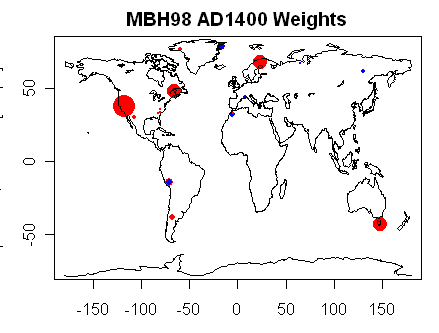
(Also from McIntyere´s webpage https://climateaudit.org/2008/03/10/mannian-pca-revisited-1/)
Any proxy reconstruction not addressing this is quite worthless and you should wonder how it could pass peer review (and there are hundreds of them)
There is a thumb on the review process scale.
If these sparse points on the globe can reveal a “global” temperature, we shouldn’t need anything more for today’s calculations either.
🤫
The process has always looked like a tortuous exercise in circular reasoning.
“Discard the ones that are not “temperature sensitive”
They are basically admitting that tree are not good thermometers…
…. unless they want them to be, and show the result they want.
This is NOT SCIENCE.
Not sure I agree with that.
It could be that the thermometer is very insensitive. Some proxies may move in perfect lockstep with the temperature but just so little that it can’t be detected.
We know that proxies that don’t vary with temperature cannot tell us anything about temperature – throw then out.
We do not know that proxies that do vary with temperature can tell us anything about temperature – but they might.
They might if all other factors remained the same- but they don’t.
Actually, proxies used here do not reveal absolute temperatures anyway. Climate science has tortured scientific language to such an extent that most people simply call anomalies temperature. They are not! They are a ΔT, that is a rate of change. There is no way to know at what absolute temperature those rates of change actually occurred.
To look at anomalies and say one place was warmer/colder than another can not be done. You can only guess that temperatures increased/decreased at different rates. One place may have changed -1F @ur momisugly 90F while another changed +1F @ur momisugly -55F.
That is the one thing that has always bothered me about declaring the MWP or RWP as warmer than now. All we can really say is that temperatures changed more radically, but we really don’t know what the base temperature was.
I just reread this post. I apologize for the link that somehow got added into the text. I did not do that. I tried to use the simple “at” sign to relate “at”90F and “at” -55F. Somehow using the @ur momisugly sign caused a link from somewhere to be added. We’ll see what happens here.
Guess what? Anyone know why this is happening?
No offence taken. But I strongly recommend a vigorous virus check.
I thought about that. I’m going to try using the @ur momisugly sign in other locations and see what happens.
Hmmm ! That was from my phone, and not my PC.
Let’s try @wuwt and see what happens.
A cooler than “normal” year, with higher rainfall- will result, for almost all trees, big growth rings. I seriously doubt there are any trees in any environment that are strongly temperature sensitive. More than temperature- water is the limiting factor for growth.
Experiments in green houses, where conditions can be controlled, have shown that most plants do have a temperature sensitivity.
The problem is that in the real world, there are so many things that impact plant growth, and for plants in the wild and none of them are known with any degree of certainty, so it’s impossible to tease out what the temperature component might have been.
Another point is that plants have an optimal temperature. A temperature that they grow the best at. If the actual temperature gets above, or below that point, growth slows down. So trees can be both positively and negatively correlated with temperature, in the same year.
Most other factors that impact plant growth have similar impacts. Too much water can be as bad as too little.
Plants don’t like too much nitrogen in the soil, nor do they like too little.
Just proclaiming that more heat, more water, more whatever is always good is both simplistic, and wrong.
Sure, but overall, the planet is greening. And the idea that a bit warmer and maybe wetter is an emergency is nuts.
Never said otherwise. I’m just trying to keep the science honest.
Something that jumped out at me was the process of comparing each proxy to the observed historical temperatures. I assume you’re talking about datasets like HadCRUT, GISS and BEST that go up over their duration (like a hockey stick blade). It only makes sense that any proxies that correlate with these are going to produce hockey sticks themselves.
My only question is whether or not this is a bug or a feature of all these supposedly independent studies.
“HadCRUT, GISS and BEST”
Do not represent reality. They are Climate Change Propaganda created to sell the narrative.
None of the unmodified, regional written surface temperature charts looks anything like the Instrument-Era Hockey Sticks. The regional charts show it was just as warm in the recent past, within the instrument-era, as it is today.
How do you get an instrument-era Hockey Stick profile out of written historic temperature data that does not have a Hockey Stick profile? Answer: Climate Change Fraud.
Totally agree.
Many would argue that the Hockey Stick has had a serious consequence of affecting policies in the US such as those about fossil fuels. Huge $$$ have been involved. Huge risks of uncetain elcricity suppllies are growing. They have to affect the national economy.
What is the legal situation in the US?
If it is correct that the Hockey Stick is false, is there any type of legal redress that would require its retraction? Can the authors be charged with a crime such as deliberate false misrepresentation for monetary gain? (Yes, I’ve read enough Steyn trial material).
Surely there are official US agencies tasked with catching and correcting false science. Surely there are some official guidelines about minimum standards of truth or uncertainty of measurement or whatever that authors are required to satisfy.
Why cannot this whole Hockey Stick matter be brought before an adjudicator to see if civil or criminal charges can be commenced.
(I am Australian, different laws).
Geoff S
It is a bizarre episode that will puzzle future science historians, Mann has certainly made a name for himself but not in a way most scientist would wish.
Unfortunately, for all of the MSM and much of the science world, he’s considered the Einstein of climate science.
I think what is needed is what is called a “paradigm shift.”
“Surely there are official US agencies tasked with catching and correcting false science.”
Probably not and I hope there are no agencies doing that. How would they know? If there were- they’d be misused to declare this site full of misinformation and shut it down.
The problem isn’t that there aren’t legal consequences. The problem is that the entire field is corrupt and there are no professional consequences.
Actually there are professional consequences.
Disagreeing with the global warming cabal can be a career ender, and has been for many.
Wilis,
Excellent work, for a side study, would you be prepared to complete a similar run of the red noise values comparing to a LONG TERM temperature curve, eg the Greenland Ice proxies.
As an example, instead of using the temperature record from HadCRUT 4.2, instead use the temperature reconstruction from the ice, ignoring any recent points as the ice is yet to be fully compacted, etc.
Using the same methodology, selecting the proxies, (random noise runs), that correlate and inverting those that are reversed, (again ignoring any that show no alignment). Complete the run and see if we get a hockeystick.
Will it be at the start of the run, will it be smoothed?
Be interesting to see.