Essay by Eric Worrall
“… seasonal lulls in wind and solar output has led to a big increase in the amount of gas being burnt to produce electricity. …”
AEMO warns of immediate gas shortfall threat as cold snap, renewable lulls and outages bite
By energy reporter Daniel Mercer
Posted Thu 20 Jun 2024 at 4:09pmThursday 20 Jun 2024 at 4:09pm, updated Thu 20 Jun 2024 at 6:41pm
- In short: The Australian Energy Market Operator has warned of immediate gas supply risks across south eastern Australian.
- The warning comes following increased demand for gas amid a cold snap, lower green power generation and supply problems.
- What’s next? AEMO says the risk of supply shortages on peak demand days is likely to stay in place until September 30.
…
The warning was sparked by a spike in gas demand following a cold spell, a lack of renewable power in recent weeks and an outage at the Longford gas plant in Victoria – the biggest source of gas in southern Australia.
Combined, the shocks to the system have led to a run on Victoria’s most biggest and most important gas storage facility at Iona, about 230km south-west of Melbourne.
They have also sent the gas market skywards, with prices trading at almost $30 a gigajoule today – levels last seen during the energy crisis two years ago.
…
A recent run of cold weather has caused a spike in demand for gas for heating across many of the southern states.
At the same time, seasonal lulls in wind and solar output has led to a big increase in the amount of gas being burnt to produce electricity.
…
Read more: https://www.abc.net.au/news/2024-06-20/aemo-warns-of-immediate-gas-shortage-risks-in-se-australia/104003166
Reliability risks are increasing according to the AEMO, though the latest report paints a rosy picture of all the investment in renewables which is going to materialise. Any day now.
Urgent investment needed for electricity reliability
21/05/2024
AEMO has today published an update to the 2023 Electricity Statement of Opportunities (ESOO) report, the 10-year reliability outlook for the National Electricity Market (NEM).
The update was triggered due to material changes impacting reliability risks since the 2023 ESOO was published last August, including new commissioning dates for Project EnergyConnect, and mothballed gas and diesel generators in South Australia.
The addition of approximately 4.6 gigawatts (GW) of new generation and storage projects that have sufficiently advanced was also considered in this ESOO update.
AEMO CEO Daniel Westerman said the report’s findings again call for timely investment in projects to generate, store and share electricity to manage reliability risks driven by retiring coal plants.
“Australia’s energy transition is well underway,” Mr Westerman said.
“Industry and governments are responding to the reliability risks from retiring coal by investing in new infrastructure to ensure a reliable and secure electricity supply going forward.
“The urgency for the timely delivery of transmission, generation and storage, and use of consumer electricity resources to support the grid, remains to meet consumers’ energy needs,” he said.
Today’s report forecasts varying reliability gaps in all mainland regions of the NEM over the ESOO outlook period in the ESOO central scenario, which only considers existing, committed1 and anticipated projects2.
However, this assessment does not include federal or state government energy programs or approximately 280 GW of proposed generation and storage projects in the development pipeline, 4.5 times today’s NEM capacity.
Compared to the 2023 ESOO central scenario, reliability risks have increased in New South Wales and Victoria from 2024-25 to 2027-28 and increased in South Australia in 2026-27. Due to newly considered generation and storage developments, reliability risks are forecast lower than the 2023 ESOO central scenario towards the end of the horizon in all mainland regions.
“While new generation and storage capacity continues to increase, project development and commissioning delays are impacting reliability throughout the horizon,” Mr Westerman said.
“Reliability improves when considering actionable transmission projects3 – those listed to proceed as soon as possible in the Draft 2024 Integrated System Plan – and when forecast grid support from consumer energy resources are applied.
“Adding new generation and storage projects through federal and state government programs4 then shows that reliability risks have the potential to be managed within relevant standards over most of the next 10 year horizon,” he said.
As a result of the reliability gaps forecast, AEMO will tender for Interim Reliability Reserves in New South Wales and Victoria to minimise reliability risks should low reserve conditions emerge over summer 2024-25.
For the first time, AEMO’s reliability report includes new information on generation and storage locations which have the potential to improve regional reliability risks.
With further transmission development, including VNI West and HumeLink, this analysis shows the locations in each mainland region that can provide the most reliability benefit through new generation and storage development.
The next ESOO will be published in August 2024 in accordance with the National Electricity Rules requirements, using further information from developers and market participant surveys, which feed into the Generation Information and Transmission Augmentation Information files.
…
Read more: https://aemo.com.au/newsroom/media-release/urgent-investment-needed-for-electricity-reliability
Oh hangon, wasn’t the current crisis precipitated by a seasonal drop in renewable output? Doesn’t that mean building more renewables wouldn’t help with a similar winter crisis in the future?
If only instead of building lots of useless renewables, our governments had expedited permits for the construction of a few extra major gas plants, instead of running the system into the ground in the name of the energy transition. That way when the first plant suffered outages, the second plant could have increased supply and covered the shortfall.
Of course there are significant political hurdles to overcome to increase gas production on the East Coast of Australia. Gas rich Victoria, one of the states most affected by the shortages, is so anti-resource exploitation that in 2021 Victoria wrote a ban on gas fracking into the state constitution.
Gas shortages starting in 2024 were predicted in 2022, when Victoria enshrined a fracking ban in the state constitution. The fireball in the picture below is gas gushing out of a test well which was drilled in Victoria in 2018, in a place where the state government assured us there was no gas. Professor Ian Plimer was called into an episode of “The Outsiders” to identify the mysterious substance gushing out of the ground.
“Oh hangon, wasn’t the current crisis precipitated by a seasonal drop in renewable output?”
No, it was precipitated by a seasonal bump in demand (winter), mainly for direct heating, which is where most domestic gas goes.
“Of course there are significant political hurdles to overcome to increase gas production on the East Coast of Australia. “
No, our gas production is huge and rising fast. The thing is, we export two-thirds of what we produce, mainly to North Asia.
What type of graph is that? It ends 4 years ago. And a quote from the story “The warning was sparked by a spike in gas demand following a cold spell, a lack of renewable power in recent weeks and an outage at the Longford gas plant in Victoria – the biggest source of gas in southern Australia.”. I guess if you think that 2020 is current usage and export data, the term “a lack of renewable power in recent weeks…” is easy to have skipped as well.
N.S. you really need to stop buying strawmen and using them in arguments. They really don’t fool anybody.
Nick shows that a seasonal bump in demand could not be catered for by wind and solar which cannot be used for anything much.
SA is lucky they have lots of gas and diesel available.
Victoria is probably wishing they had more reliable coal fired power… not as if there isn’t huge amounts of coal available
Nick also neglects to state that the Narrabri gas project, which would supply half of NSW’s gas needs, has been stalled by the green meanie.
Victoria should be allowed to wallow in its gas shortage dilema seeing as that it is self-inflicted.
As for Nick, there was a time when he could be objective in his comments, the ravages of time has reduced him to subjective commentary in a weak attempt to salvage his cognitive dissonance / decline.
Emulating Mr.10% 😉
No its not. Exports have decreased since 21/22. Coal exports of both varieties have increased since 21/22.
https://www.industry.gov.au/sites/default/files/2024-03/resources-and-energy-quarterly-march-2024.pdf
The only way Australia can afford its energy transition is to ship more coal to China so it can be tranformed into the energy extractors. That is the real transition in Australia. Sending boatloads of coal to China so they can make the stuff that incompetent Labor governments are demanding more of.
Unless China continues to play this game of converting coal to the hardware needed to make WDGs, the transition will falter. Australia has lots of coal to keep the process going so can hang in there for a long time.
ironic- but apparently the MSM in Australia doesn’t grasp that?
I’d say that Victoria’s Gas isn’t all it’s Fracked up to be
Australian gas production fell 1.6% in 2023. World Energy Statistics 2024 (used to be BP)
Kinda like Texas except the problem isn’t Winds failure due to frozen turbines. Nope. This time it’s Winds failure due to … Lack of Wind … on a cold day … with near record demand for gas … with insufficient allotted gas supplies to cover both heating and generation and still allow for exports
Most of Australia’s gas is shipped from the Northern territory and West Australia. The NT is a 3000 nautical mile shipping journey to Melbourne in Victoria, West Australia even further, vs shipping the gas to say Jakarta in Indonesia which is a 1500 nautical mile journey.
I wonder how much shipping the gas from NT to Melbourne would add to the cost, vs repealing the fracking ban and extracting the gas in Victoria, a few miles from the interstate Eastern Gas Pipeline?
Eric,
“Most of Australia’s gas is shipped from the Northern territory and West Australia.”
Here, from the ACCC, is a breakdown of East Coast gas, supply, demand, export (yellow):
Same story, more than 2/3 of East coast gas is exported. The southern cities are connected to the export terminals by pileline; in fact, exporters have often used gas from the south. The chart I showed was from the ACCC showing that even the uncontracted export gas was more than enough to solve any shortfalls.
So much more available IF ONLY there wasn’t such a moronic load of greenies in Victoria.
Why should anyone bankrupt themselves busting international contracts when all that is needed is to relax restrictions on increasing supply?
Will the government compensate companies for having to purchase gas on the international spot market to meet obligations, after the government expropriates their gas?
https://wattsupwiththat.com/2023/04/01/60-billion-investor-slams-green-australia-for-quietly-quitting-on-gas/
Last time the government threatened expropriation the industry responded with an investor strike. If the government hadn’t backed down it would have caused catastrophic economic consequences.
https://wattsupwiththat.com/2023/01/16/surprise-australias-green-transition-natural-gas-price-cap-is-crashing-supply-availability/
Eric,
“Why should anyone bankrupt themselves busting international contracts when all that is needed is to relax restrictions on increasing supply?”
The ACCC made the diagram I showed above precisely to show that exporters could amply cover any domestic shortfall from their uncontracted volumes.
But of course it isn’t true that “all that is needed is to relax restrictions”. You actually have to increase supply. For all your beating the drum about fracking, supply is actually increasing, and there is no evidence that fracking would help. There are large parts of Australia where it is not restricted, but no fracking has been done.
Ah so you think when the Japanese ambassador and large international investors accuse Australia of quiet quitting on gas, they’re just making it up?
The problem right now is a shortage of gas in Victoria and NSW, which could be alleviated by expropriation, but expropriation would have catastrophic consequences. Companies wanted to frack in Victoria but were banned from doing so – the government added a clause to the constitution, to show they really meant it. But you think they could easily just increase supply?
I guess that’s a point a view.
Cut it any way you want, but there is no doubt whatsoever that anywhere renewables are included on a grid to any scale, they cause problems and increase costs.
As much as you wish it away, this is only going to get worse as reliance on primitive technologies increase.
Nick claims that “we export two-thirds of what we produce, mainly to North Asia.”
Nick, one factor causing this is that foreign buyers have a better track record as buyers than our own various governments and agencies who buy stuff with guidelines tainted by the increasing whiff of global warming dogma, ESG, DEI and all that stupid sway. There are didactic books about The Art of the Deal, one by a well-known author. Geoff S
Sure is. China pipped Japan for coal exports from Australia in April. This is the transition underway. Shipping ever more coal to China so it can be converted into solar panels, wind turbines, batteries and all the other essentials to make weather dependent energy usable.
Current bulk carriers sitting off just Mackay is 50. So around 10Mt of shipping waiting for cargo.
https://www.marinetraffic.com/en/ais/home/centerx:149.5/centery:-21.2/zoom:11#google_vignette
This is a fantastic story for Australia coal producers because the WDGs will never extract more energy than the energy in the coal that went into making them. They would need to last 200+years to provide a net return.
We get more useful energy out of renewables than fossil fuels
https://arstechnica.com/science/2024/05/we-get-more-useful-energy-out-of-renewables-than-fossil-fuels/
Again the luser make noises from its arse-tech.
NO, luser, we get very little usable energy from renewables.
Often when we need electricity it is not there.. Then when it is there it is not needed.
Wind and solar can never be used to manufacture anything, without a totally reliable back-up.
The energy and mining for the manufacturing of wind and solar is rarely paid back.
The garbage left at end of their short life is a massive drain on land-fill and often contains multiple toxic chemical.
Wind and solar give absolutely nothing back to society…
… they are parasites of any electrical supply system.
Let’s see how much electricity the main Australian states are getting from wind and solar at the moment
NSW.. 92% Coal and gas.. 5% Hydro
Qld… 94% Coal and gas.. 3% Hydro
Victoria actually has a bit of wind.. running on 62% Coal and gas, 7% hydro.
Wind and solar are a providing basically NO USEFUL ENERGY in NSW and Qld.
And less than 1/3 in Victoria.. until the wind stops blowing.
Then it will be TOTALLY USELESS as it has been many times in the last several weeks.
The approach is apparently praying to Gaia.
Here’s screenshot from openNEM showing the recent performance of South Australia’s much vaunted wind powered grid. Note that on the cursored night for 15 hours the grid was 95% powered by gas and imported coal power.
So, if they were going to keep the power on overnight they need 15 hours times 1.5 GW, 22.5 GWh of batteries. This will cost around $45 Billion. That’s about 1/3 of annual state government expenditure and would have to be repeated every 15-20 years. It’s also about 1% of the entire global annual battery manufacturing capacity, to provide one night’s power for 2 million people. Battery production is expected to double by 2030, but then other first world countries claim to be going down the wind+solar+storage path, so they will need to buy batteries as well.
<img>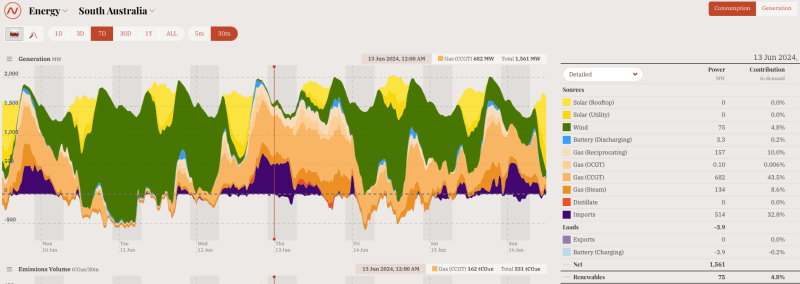 </img>
That’s a different one from what I use.. could you post the url please. 🙂
Here is the 24hr South Australia AERO graph, cursor showing how the peak usage is in the evenings when there is no solar…
… GAS is carrying the state… and diesel was producing 3 times as much as wind.
This doesn’t show the brown coal imports from Victoria, though.
If you look very, very closely, you can see the “battery” power down the bottom of the chart.
… battery, charged using gas. ! 😉
Sure https://opennem.org.au/energy/nem/?range=7d&interval=30m&view=discrete-time
Unfortunately you can’t (so far as I know) look at the 30 minute data for more than the past 7 days
Thanks 🙂
If you want to look at the history in detail you need to learn your way around nemlog.com.au
It’s possible to get downloadable 5 minute data going back a number of years including at plant level. Best to break it into chunks though!
Incidentally the claim often heard is that ‘the wind is always blowing somewhere’. Well, yes, but sometimes it is blowing a long way from here, here being the entire eastern half of Australia. That is a lump of land about 2000 miles north to south, and say 1000 miles wide.
For instance here’s a snapshot of the entire eastern seaboard. Sometimes we get 5 GW of wind from the wind, other times 1 GW, for hours at a time. Wind is the green bit in this plot
Excellent debunk of claims made by Andrew Blakers based on his models of correlations. He tried to claim that Far North Queensland was fundamentally different and could bail out the rest of NEM.
We’re on the road free camping and I need a diesel heater to find the missing heat-
Aussies warned as bitter cold snap continues (msn.com)
Have you checked the oceans?
The rule is: “Go north in winter”.
One of my former colleagues is doing The Big Lap. He did a few trial runs around Lithgow in winter a few years ago to test out the diesel heater, and survived.
It’s like Texas Feb 2021 all over again. Lessons learned??? ZERO!!!
“It’s like Texas Feb 2021 all over again”
Nothing like that. Nothing has frozen. No failures of either electricity or gas domestic supplies.
One big difference is that the problem is easily solved by persuading our gas exporters to ease up for a bit. And that seems to have happened.
Regular FAILURE of wind to supply anything, though…
… and no solar for the evening or morning peaks.
Again the lie about gas exports, which are mainly from the far NW of WA.
See Rick’s comment above
Why hasn’t the Narrabri gas system started producing yet.. Green Tape.. !
Have you contacted your local State member about getting the Victorian drilling ban lifted ??
How’s that wind turbine construction in your back yard going , Nick !!
Wrongo Mr Stokes.
Almost exactly like Texas…
Winter Time
Temperatures Drops
Demand increases
Wind Fails
Gas is insufficient to carry it all (heating and generation)
The only difference is the CAUSE of the Wind Failure
Texas Feb 2021 wind froze
Australia now Wind drops below generation requirements
Level of demand
Texas was a record demand
Texas under capacity causing blackouts
Don’t believe Australia had blackouts just warnings
There were no warnings either. Nothing actually happened. That is a rather large difference.
Just another Eric beatup.
“Nothing actually happened.”
You mean like wind and solar at peak time on a calm day. Basically NOTHING!
That means you HAVE to have enough reliable electricity available in the NEM.
And it is getting closer and closer to NOT HAVING ENOUGH.
South Australia will probably the first to feel the pinch.. but it basically insignificant.
Then NSW and Victoria.
Will they “blackout” the suburbs or the country first.?
Better get that diesel generator installed, Nick !!
Prices got a bit higher… quite a bit higher.
In Texas Feb 21 wind died all the way down to 649MW at the low point. Freezing was just icing on the
cakeblades for some of the turbines.Meanwhile in Australia’s version of Califorlorny that banned gas fracking and is going all in on fickle energy they’re busy transitioning-
Victoria’s main gas facility running low (msn.com)
It is not uncommon for the East coast of Australia to have several days on end of frosty calm days, during Winter, I find it hard to understand the reasoning, of so called “Experts and Business leaders” when they make statements that if we were to move to nuclear generation, it would be the “Renewables” which will do the heavy lifting. Nuclear could fill a niche in Australia’s energy mix, but renewables will need to do the heavy lifting, business leaders say – ABC News. Statements that Nuclear is 6 times more expensive also makes little sense when hundreds of billions of dollars of investments in renewables sit idle in calm or overcast weather during Winter. Constant base load rules!
….and I’m on my second rooftop solar system after the inverter died on the original FIT system after 14 years and it was all old hat. The nice installers took all the old rubbish away to wherever…?
The great recycling plant in the sky
Wind, solar and storage are not a substitute for fossil fuel and nuclear energy. Remove all tax preferences, subsidies and mandates and wind, solar and storage will all disappear.
But get this shivering Victorians: “New documents reveal the Department of Government Services has issued a tender for a supply of natural gas to Victorian Government departments, agencies, entities and eligible organisations from 2024 onwards …” Liberal ( conservative) Opposition Leader June 17.
“It’s grossly hypocritical that whilst Labor imposes a gas ban on Victorian households and businesses, it is more than happy to continue using gas to fuel its own operations” Liberal (conservative) Party Shadow Minister for Energy.
Victorians are a pretty committed lot – they shiver in the cold and endure armed thugs walking the streets and gangsters fighting with machetes in shopping malls, but you can get into real trouble in Victoria if you suggest voting for a conservative in public. Kind of Australia’s answer to Oregon, with Melbourne standing in as Portland.
Batteries will fix it, ask Bowen! lol…
He knows it makes sense-
Net Zero and EVs are two totally IRRECONCILABLE policies | MGUY Australia (youtube.com)
Sounds like another “advertisement” –
“20 confirmed dead in massive South Korean lithium battery factory fire.”
https://www.michaelsmithnews.com/2024/06/20-confirmed-dead-in-massive-south-korean-lithium-battery-factory-fire.html
And the AGW wants to use hydrogen? That really explodes plus it has an invisible flame. Maybe using ground up dynamite will be next.
Create a trillion dollar renewable energy disaster, then propose to spend another trillion dollars to fix the central planners f!@k up, with proposed batteries, that will never work anyway.
Government, no doubt about it, smartest guys in the room. – What a joke that Australia, one of if not the luckiest country on earth for domestic energy resources are warned about supply & demand problems in 2024 – just pathetic.
“A recent run of cold weather…”
It’s called winter! They probably didn’t expect any cold weather.
Modern society needs CONTINUOS and UNINTERUPTABLE electricity.
The problem with renewables is that they don’t work most of the time!
“The nameplate farce”:
There should be financial penalties for wind and solar power plants inability to deliver at least 90% of their permitted nameplate ratings on an ANNUAL basis, like their backup competitors of coal, natural gas, and nuclear power plants that provide continuous uninterruptable electricity.
The richest billion are intent on squandering their electricity legacy on weather-dependent generation of electricity that is intermittent and unpredictable via so-called ‘renewables’
Subsidies for wind and solar power plants are based on “nameplate ratings”, thus they should be penalized when they cannot deliver what they have been permitted for.
Practically every windmill or solar panel requires a backup from coal, natural gas, or nuclear, thus understanding electricity generation’s true cost is paramount to choosing and prioritizing our future electricity generating systems.
The percentage of actual electricity generated compared to the nameplate capacity, is about 26%.
As I prepare to study the AEMO update to ESOO 2023, my frame of mind is that AEMO is incompetent. AEMO is the logical body to warn governments of the dangers of various future electricity scenarios, yet its reports are explicit that it will recommend only scenarios that are consistent with government policies, especially “net zero carbon by 2050”.
AEMO should not place our future generation at risk when they must know that their recommendations are far from optimum. Blind Freddie can see that Australia’s pre-2005 generation mix, with little “renewables”, was among the cheapest and most reliable globally. AEMO’s failure to stress this with analysis is incompetence with a huge price tag. Geoff S
“… seasonal lulls in wind and solar output has led to a big increase in the amount of gas being burnt to produce electricity. …”
Why not just stick with what worked to begin with?
Why “backup’ what’s been proven to be unreliable with what has proven to be reliable?