This post reports on two new instances of people applying a little critical thinking to the issue of using so-called “green” hydrogen as an essential piece of a future de-carbonized energy system. This is a subject that I have previously addressed, here in a post of June 13, 2022, and here again in my energy storage Report of December 1, 2022.
The two new pieces covered in this post are (1) a February 1 Report for the Manhattan Institute by Jonathan Lesser titled “Green Hydrogen: A Multibillion-Dollar Energy Boondoggle,”, and (2) a February 13 article in the Washington Examiner by Steve Goreham titled “Can the government create a green hydrogen fuel industry?”
If you think that a “de-carbonized” energy system is some kind of urgent priority for humanity, and you put your mind to how to achieve that, it won’t take you long to realize that hydrogen is the only way to get there. OK, there’s nuclear, but environmentalists and regulators have nuclear completely blocked. That means that to be carbon-free, most electricity must come from the wind and sun, and in turn that means need for energy storage far beyond the capabilities of any batteries. Hydrogen is the one and only remaining solution.
And not just any hydrogen. Only “green” hydrogen will do — that is, hydrogen that is itself produced by some carbon-free process. The alternative is to get your hydrogen the way almost all hydrogen is produced today: you “reform” methane (CH4), separating out the hydrogen and discarding the carbon as CO2 into the atmosphere. But this process has the same CO2 emissions as if you just burned the methane (aka natural gas) in a power plant to get your energy in the first place. If the entire goal is de-carbonization, that is clearly not allowed.
Over at the government, their minds move slowly, but they have recently figured out that keeping their energy transition fantasy alive can only be accomplished with vast amounts of green hydrogen. And so they have undertaken to address the issue in the only way they know, which is to throw oodles of taxpayer funding at it. This piece from JPT on October 24, 2023 covers the government’s latest big announcement:
US President Joe Biden and Energy Secretary Jennifer Granholm announced that seven regional clean hydrogen hubs have been selected to receive $7 billion in Bipartisan Infrastructure Law funding in an effort to accelerate the domestic market for low-cost, clean hydrogen. The seven selected regional clean hydrogen hubs are expected to catalyze more than $40 billion in private investment and create tens of thousands of jobs, bringing the total public and private investment in hydrogen hubs to nearly $50 billion.
Note that the government’s big initiative came just about a year after the two Manhattan Contrarian pieces in 2022 explaining why this could never be done economically. But anyway, now that the government funds are flowing, and so-called “infrastructure” is getting built, others are starting to look at whether this makes any sense.
Of the two new pieces covered here, Lesser’s is far the longer and more detailed. He goes through a careful look at all the elements of trying to produce this green hydrogen stuff — building the electrolysis facility, operating and maintaining the facility, buying electricity from wind and solar producers, transmitting the wind/solar electricity to the site of electrolysis, and compressing the hydrogen into a form ready for transit somewhere to be used — and puts assumed cost figures on each piece of the process. He comes up with a total cost range of $2.74 to $5.35 per kg of hydrogen produced. Here is Lesser’s chart:

Note that Lesser comes up with even higher figures of $3.62 to $8.85 per kg of hydrogen if he further adds costs of battery storage of electricity to make it so that the electrolyzers can run all the time and not be dependent on the intermittency of wind and sun. Green hydrogen advocates would dispute whether this is necessary, so let’s leave it out for now. Even without this additional cost, we are at $2.74 to $5.35 per kg for the hydrogen.
Since a kg of hydrogen is good for about 33.3 kwh, that would mean something in the range of 8.3 to 16.2 cents per kwh just for the fuel, without yet considering any cost to get the fuel to a power plant to be burned.
I would comment that some of Lesser’s assumptions are very low, and by “low” I mean favorable to the economic viability of this green hydrogen. Most notably, he has an assumption of an unsubsidized cost of 4 cents per kwh for the wind/solar-generated electricity. Crazy. Here in New York, off-shore wind developers who had bid last year for contracts at about $90-100/MWH (i.e., 9 – 10 cents per kwh) have recently reneged and demanded prices in the range of $150-160/MWH, or 15-16 cents per kwh. If the recent New York demands represent the real cost of wind/solar electricity, then you can multiply Lesser’s figure for the electricity input to produce a kg of hydrogen by 4, adding about $6 per kg, bringing the total cost of a kg to around $9 – 11, instead of Lesser’s $2.74 – 5.35. In cents/kwh that would be about 18 additional cents per kwh, in either the high or low scenario; instead of a range of about 8 to 16 cents, it would be 24 to 32 cents per kwh to make the green hydrogen.
Goreham does not give us such a detailed calculation, but his bottom line is about the same (including a more realistic cost for the wind/solar electricity):
Hydrogen feedstock made from natural gas or coal is inexpensive, with a cost as low as $1 per kilogram. . . . To produce a kilogram of hydrogen by electrolysis, electricity alone costs $3 to $6 per kilogram, resulting in a total cost of at least $5 per kilogram. This makes hydrogen from electrolysis more than five times as expensive as hydrogen made from natural gas or coal.
Goreham’s “at least $5 per kg” for green hydrogen is actually well below Lesser’s figure after we adjust for the cost of electricity from wind and solar generation.
Note that, as I reported on January 12, recent bids in the UK for producing green hydrogen using electricity from off-shore wind came in at about $306/MWH, or 30.6 cents per kwh. Using the conversion factor of 33.3 kwh/kg of hydrogen would make this the equivalent of over $10 per kg of hydrogen.
We won’t really know how much this green hydrogen stuff actually costs until there are some real facilities up and running. But whether it is ten times as expensive as the stuff produced from natural gas, or only five times as expensive, doesn’t really matter. It is uneconomic, and nothing is going to change that. Nobody will ever buy it or use it without government mandates or subsidies or both.
Goreham’s conclusion:
[G]overnments now want to create a new hydrogen fuel industry using market intervention, mandates, and massive subsidies. But physics and economics strongly oppose the development of a green hydrogen fuel industry. Get ready for a spectacular failure of these government-sponsored efforts.
The seven selected regional clean hydrogen hubs are expected to catalyze more than $40 billion
I bet they are…
Methane works
Hydrogen doesn’t
As long as the dish keeps rolling in….
Dosh not dish
Hydrogen (molecular H2 Hydrogen vs atomic Hydrogen) in the hands of the ‘consumer’ – What could go wrong? Not even entertaining DIYers (Do it yourself-ers) and questionable equipment modification and repair, but just the day-in day-out use of commercially produced equipment,involving piping, storage, compressors (?) and connections/connectors, valves and the end-user ‘combustor’ (engine or a burner) which consumes said Hydrogen … As a start, we can look at the issues that occasionally crop up with natural gas when en route to, or in the hands of, ‘the consumer’ …
Oh, heck- let’s not confuse the planet saving consumers with mere engineering facts.
I’m imaging the ‘black market’ for Hydrogen components on AliEpress et al (e.g. Amazon) with the previous comments … have you seen what is available for use on air conditioning systems/compressors, for propane ‘adapters’ to fill and refill various transport cans/canisters? NOW introduce a higher working-pressure Hydrogen fuel into the mix, and all, that hydrogen does to metal, as well as some other compounds I would imagine.
WILL THERE BE an odorant added (like natural gas has) to allow leaks to be detected by human noses? Will it be as effective as a ‘signal’ indicating a leak is present, likely not given working pressures and considering the small molecule size of H2 versus an odorant molecule’s size.
My opinion on the use of odorants for hydrogen is that electronic sensors, such as those used to detect carbon monoxide, is a somewhat more practical approach because sulfur containing odorants are generally incompatible with H2 fuel cells. Certainly there are advantages and disadvantages to different technology solutions.
Or one could simply light a match.
That is easily solved. Only government personnel are allowed to handle hydrogen or, at the very least, government sworn people might be allowed to handle it under direct government supervision (i.e. political officers).
But JCB converted to hydrogen years ago and all they earth moving equipment relies on its easy use by farmers etc.
https://www.jcb.com/en-gb/news/2020/07/jcb-leads-the-way-with-first-hydrogen-fuelled-excavator
https://www.jcb.com/en-gb/news/2022/10/wraps-come-off-hydrogen-refueller-as-jcb-unveils-industry-first
Of course! That was used with town gas too.
I have worked with H2 generated as a byproduct of a chemical process. We had piped it to be burned in a boiler. H2 only displaced some of the NG and it couldn’t complete replace it.
Process Safety for the unit was part of my responsibilities. A H2 leak will ignite just from the friction coming from a pin hole leak. We had occasion leaks and fires. Air saturated with water (steam) will snuff the fire and keep it out until H2 supply is exhausted. We started having the techs walk down the unit monthly with hand held meters to find leaks at levels well below flammability. A H2 flame is colorless so before that the fires were usually found because of a burning odor.
But we tend to forget that all forms of Town Gas, as developed from coal/coke in the 1800s and widely piped into homes throughout the world was 60-70% hydrogen. It was also very poisonous (by virtue of its CO content) so the technology to use hydrogen is already known and all fittings etc are still made to this day.
The basic sums are very easy:
1) Offshore wind power, based on the latest CfD strike prices in the UK, costs £100/MWh
2) You then have to add the cost of electrolysis. During the process you probably lose 20% of the energy input. The operation will also be extremely inefficient if it can only use surpluses of wind power as and when they occur
3) You then have to add the cost of storage, big enough to last throughout the winter, when demand is highest – you are talking salt caverns here
4) Then add the cost of a distribution system to transport hydrogen around the country.
Clearly the cost will end up being much higher than the £100/MWh you started with.
And the cost of natural gas? In the UK it’s around £30/MWh, and probably much less in the US.
“The operation will also be extremely inefficient if it can only use surpluses of wind power as and when they occur”
Yes. The use of electrolytic hydrogen depends on cheap electricity. But that’s not what they have in mind for us.
“Surplus”! Over the last month or so, I’ve been regularly scanning gridwatch. The UK, apparently, has c 27GW of wind capacity. Yet, even in those strong winds, I never saw supply get to higher than c 14GWs.
But as you say Michael “as and when”, maybe never.
You forgot the cost of compression which will be huge. When you factor in the difference in cost vs a natural gas compressor and the almost 2X amount of maintenance you consider H2 compression to have an effective efficiency of about 33%.
I worked in a plant that produced hydrogen from low pressure synthesis gas. Your point on energy loss from compression is spot on, but I personally worried about air intrusion into the suction side of compressors.
Don’t forget the efficiency (loss) in conversion of the stored hydrogen back to useful work. Probably 60% or less for all applications other than fuel cells. Hydrogen energy storage would likely return less than 20% of the energy used to produce it.
FC only around 60% energy efficiency in a practical situation too.
Scratch that. Sorry now realise you were taking about % losses.
Gaza would be a natural choice for storing H2 underground 🙂
The basis for this “green hydrogen” funding is the Infrastructure Investment and Jobs Act of 2022. The Act is projected to authorize expenditure of up to One Trillion Dollars from 2022 to 2026, and the last report I found says 350 Billion Dollars of that have already been allocated. This “Bipartisan” slush fund is a classic example of how politicians tend to act: you give me this and I’ll give you that.
As the Presidential election gets closer, and the polls suggest a Presidential change, the amount of allocated funds will jump alarmingly, so the money can be re-directed only with difficulty. Voters who elect Left/Liberal/Socialist/Marxist “Presidents” around the world are getting the disaster they deserve, but here’s the catch- these types of voters pay very little (or no) taxes, they consume taxes. Where’s Jefferson and the “Landed Gentry” when you need him?
There’s trouble ahead and immigrant “workers” on welfare are the voters we do not need.
Correct me if I’m wrong, but don’t illegal aliens in the US count towards Congressional representation? The US has a national census every decade to determine the number of Congressional districts by state. Several blue states lost representation in the last census. Is it the intention to reverse that trend using illegal aliens?
Yep.
Aluminium would be far better and more sensible choice but, as this world has now completely lost its senses, that’ll be a no-no
With a modicum of craft ‘most anyone could make a primary-cell battery with Ali and get 50kWh+ per kg of material.
Me and you could do it now:
Bingo you’ve made an Aluminium battery that in this modern world makes useful power for small electronics or LED lights
## If those clowns on Martha’s Grapevine or wherever it was have any Sodium (Potassium) Hydroxide left over from their ocean-poisoning experiment, pop a little of that into the brew and just watch it go
‘primary‘ meaning non-rechargeable but at 8% of Earth’s crust Ali is slightly easier to find than Lithium, Cobalt and Nickel
For those of us really into puritanical self-flagellation, use windmills to make more when your battery goes flat as you would with Hydrogen – else nuclear
You seem like an intelligent bloke. What do you know of the EPR (Electron Paramagnetic Resonance) testing methodology?
https://pure.tudelft.nl/ws/portalfiles/portal/126823930/1_s2.0_S0360319922022406_main.pdf
That’s quite remarkable, a real scientific article from Mills that at first glance does not appear like garbage. Usually, I can find his scientific flaws within a few minutes.
Ok, it took me a few minutes. Mills is using circular reason. He assumes that there is no molecular species “faster” than H2 or He in existence, so the peak that eluted before H2 must be hydrino H2.
There are serious problems with his GC experiment. The GC system was not stable or calibrated in terms of retention times as evidenced by absence of repeatable elution times, e.g., H2 has an RT of ~13 minutes (12.87) in Fig. 2a and ~9 minutes in 2b. That shows very poor precision.
He says that hydrino hydrogen is the first component eluted, but 2a shows a peak at 0 minutes! This demonstrates that there was some pressure upset or carryover from a previous run, that, in any case, shows instability that discounts any conclusion that he has made on the basis of these runs. He apparently is unaware that H2/He mixtures can produce a “w” response on a thermal conductivity detector, meaning that depending on concentrations, sometime a positive or a negative peak can result. He should have given the MS spectra of the eluted compounds.
To me, this article is unworthy of publication for these reasons alone, without having to go into the EPR results that look to be noisy. Oxygen is paramagnetic. His GC results demonstrate O2 contamination.
It occurs to me that if the hydrino were real, there would be three “allotropes,” using Mills terminology, pure hydrino H2, pure conventional H2 and a mixed hydrino/hydrogen molecule. This is another piece of evidence against the hydrino based on Mills’ own “findings.”
Zinc-carbon batteries contain carbon electrodes that are meant to be used as electrodes. These batteries are dollar stores in the U.S. so are inexpensive.
I did sum sums..check me.
Aluminium is presently about $2,500 per tonne at the London Metal Exchange
If me/you/anyone assembled a 350kg lump (is that the weight a Tesla battery) it would come in at $900 and assuming 50kWh per kg and your EV covers 2.5 miles per kWh
that gets you 45,000 miles of motoring at 2 cents per mile.
With no range anxiety, no recharging along the way and no CO₂
And even Guy Fawkes would struggle to get a 350kg lump of Ali to catch on fire
Best make it a moon buggy….
One property of aluminum is that it oxidizes quickly to form an alumina oxide layer. There will be energy losses due to this.
Net Zero yo yo
“”Labour to reinstate petrol and diesel ban ahead of schedule in dramatic turn toward EVs””https://www.express.co.uk/life-style/cars/1867632/drivers-labour-petrol-diesel-ban-ev
Another article, whose link I don;t have, said legislation was being submitted to the UK parliament to make any repair that kept an automobile of (8 years or older?) on the road illegal, requiring instead that the vehicle be scrapped. I’m guessing that could include a new battery. I’m not sure but perhaps this was aimed only at ICE vehicles. Of course a submission doesn’t automatically mean passing but considering the general inclination of the UK parliament with anything attached to “climate” doesn’t look good for people.
Crunch these numbers, you smarmy leftist green hydrogen Nutters
The Natural Gas Henry Hub spot price fell 12.9% to $1.61 last week (down 36% in 2024 — the lowest daily spot price since 1996 … and the lowest price, based on monthly averages and adjusted for inflation, since data were first kept in 1922)
Not that record low inflation adjusted US natural gas spot prices will change green dreamers.
Anything hydrogen can do, natural gas can do better and cheaper, using existing infrastructure.
Nut Zero was never about the climate.
Nut Zero was always about the political power to control you.
Conservatives have spent years trying to prove The New Green Ordeal, now called Nut Zero, will not succeed.
They were distracted by the false belief that Nut Zero was about the climate, because that’s what a logical person would assume.
The leftist goal from the Nut Zero strategy is the Rule by Leftist “Experts”, formerly known as fascism.
The invasion of illegal aliens is to increase future votes for Democrats. It will get worse in 2024, especially if it appears that the next president will not be a Democrat.
NOTE:
On January 1, 2023, I decided to call out conservatives with bizarre climate change theories that added up to “CO2 does nothing”. That made a lot of enemies on conservative website comment threads.
On January 1, 2024, I decided to start calling Nut Zero a strategy to implement fascism. Which has finally become more obvious with the lawfare attack on Donald Trump. As if the 2020 election fraud, 2020 Covid lockdowns and 2021 mandatory Covid shots were not enough proof.
This will get me called a conspiracy nut by those conservatives blind to the “fundamental transformation”, now called an “energy transition” to hide the leftist political goals that are obvious to me.
Hear! Hear! Natural gas (CH4) is a ‘natural’ Hydrogen transport methodology!
Richard, I tend to think of those pushing net zero as NZCs. (You have to voice it…)
Here is a graph that says CO2 does nothing. Please tell why this graph is wrong.
The effect of CO2 in the atmosphere as a greenhouse gas is easily estimated with infrared gas spectroscopy in a lab, The data are in HITRAN and MODTRAN, and accepted by nearly 100% of skeptic scientists, such as Richard Lindzen abd William Happer.
CO2 is a weak greenhouse gas at the current 20ppm and is estimated to cause 0.7 degrees C, warming per CO2 x 2.
Logarithmic effect of CO2 excluding any water vapor positive feedback
CO2 x 2 from the current 420ppm to 840ppm would take 168 years at current CO2 rise rate of 2.5ppm a year.
A water vapor positive feedback is likely to increase the 0.7 degrees C., but even a doubling to +1.4 degrees C. would not be dangerous, especially over 168 years!
More CO2 benefits most plants and global warming benefits most humans and animals.
I can’t read your charts but if they say anything else, then they are claptrap
Great comment, Richard
What are the 1750, 2150 and 2300 numbers?
The present CO2 fraction is 0.0423%
WV much Better Than CO2
https://www.windtaskforce.org/profiles/blogs/hunga-tonga-volcanic-eruption
Whereas CO2 absorbs energy (gets warmer), transports that energy (convection) and distributes it by collision (conduction) and radiation, WV does all that so much more effectively by incorporating phase change, liquid-to-vapor (constant temperature), transport, collision and radiation, but then adds in condensation (constant temperature) to rain/snow/ice.
It’s not merely the molecule-count of WV vs CO2 that makes WV the dominant global warming gas.
WV is much more efficient in absorbing, transporting and distributing energy than CO2, and it is far more abundant than CO2, especially in the Major League Tropics compared to the Minor League temperate zones.
.
NOTE: At 16 C and 50% humidity, WV in air is 0.0056 lb H2O/ lb dry air, or 2.5424 g H2O/ 454 g dry air. After converting to moles, 0.009022 mole H2O/mole dry air, or 9022 ppm.
A mole of WV is 18 g, a mole dry air is 29 g
https://www.engineeringtoolbox.com/water-vapor-air-d_854.html
I looked more closely at that chart and the X axis percentage make no sense
I’ll try again with another chart
I think the numbers were ok on your original chart, it’s just that the scaling bunched up on the left hand side was too tight. Kind of pointless to plot a curve much beyond a value that could not be attained.
1750 ppm CO2 seems to be the level at which all fossil fuels are combusted, assuming the original chart is correct. Your revised chart is definitely clearer in any case.
do you just like to make graphs to whatever results suits your fancy or do they come from some actual work somewhere?
Generally reasonable comment but…
“…accepted by nearly 100% of skeptic scientists, such as … abd (sic) William Happer.”…Dr. Happer doesn’t just ‘accept’ these numbers he CALCULATED them…personally I would consider him the foremost authority on this topic…maybe a bit if a ‘nit’ but his cred shouldn’t be discounted.
“…excluding any water vapor positive feedback.” and “A water vapor positive feedback is likely to increase…”
What makes you think there will be a WV positive feedback at all? What evidence for that is there? Or that it would ‘dominate’ over negative feedback to return the climate to a stable (though different) equilibrium? Le Chatelier’s principle may or may not apply here & may or may not be ‘dominate’ but there’s hardly good reason to discount or ignore it especially as ‘positive feedback’ would tend to simply continue, something has to stop it.
Absent any evidence otherwise it is just as likely that the effect of doubling of CO2 alone (e.g. an increase of ~0.71C) will settle below that number due to negative feedback. Of course we can’t just ‘double’ CO2 so this is an ongoing continuous process.
Just to be clear, I have 0 problem with the planet warming…bring it on. AS you say it’s been beneficial to humanity & the planet. FAR better then cooling for which we have no legitimate technical response to address it when it starts to happen.
With “climate” redefined to be only 30 years of weather by the World Meteorological Organization, it is always changing.
Well, MKelly, For one thing the temperature of the atmosphere is off-scale on the left of the graph, and the partial pressure of CO2, (400 millionths of a bar at sea level times say 40 km of atmosphere converted to cm)….is off the top of the chart. And thirdly it is broad band treatment intended for furnaces where the flue gases are being cooled from about 1200 K to about 600 K (hence the broad band treatment) but the CO2 emission bands are very distinct below about 300 K (again off-chart), especially around 15 microns which is about 200 K. That little turn up in the graph at 300 K would likely go up by a whole order of magnitude or more if it carried on to 200 K on the left.
Interestingly the CO2 peak at about 4 microns, 725 K, is strong enough that it does make bit of a hump in the broadband curve.
So this chart is simply not applicable for atmospheric CO2 infrared absorption.
Net Zero is more about the millionaires and billionaires making trillion off of the $US200 trillion Bloomberg estimates it will cost to stop warming by 2050.
They own the media and control the politicians with their campaign contributions and the universities with their grants.
Having actually built a hydrogen electrolyzer plant, I guess that must make me an expert on this. I built one in 1962, as a high school non-credit home project. I used a doorbell transformer, rectifier, and a dishpan, along with some glass jars to collect the gasses. It was dangerous, dirty, and messy.
The prototype was to put a mason jar full of water upside down in the dishpan and then place a two-conductor wire from the transformer into the mason jar. The wires had bare ends that did not touch each other. This made a slow stream of bubbles that eventually filled the jar. This was AC power and made both oxygen and hydrogen gas in the jar, at the exact stochiometric ratio for perfect burning. It made quite a ‘POP’ when burned.
It also made quite a mess in the dishpan. The bare copper wires slowly eroded away, leaving only the insulation over the wire left, with very few bubbles. There was black stuff on the bottom of the pan, which I presumed was some compound of copper.
I then used a rectifier to give me DC to the wires, which produced hydrogen over one wire, and oxygen over the other. However, in order to collect the two different gases, the wires had to be separated, with a jar over each one. Tap water has low conductivity, so the separation resulted in high resistance, and resulted in very few bubbles. I tried adding salt to the water to decrease the resistance. that gave me more bubbles, but more ‘stuff’ left over in the water. I briefly considered ditching the transformer, and going to straight 110 v power. Even though I was only in high school, I was smart enough to avoid working around metal pans, salt water, and bare wires, along with house power.
The point of all this is that electrolyzers are not clean, inexpensive, simple devices you can install along with your solar panels to create and store hydrogen whenever the sun shines. I highly doubt that they can make useable hydrogen at the proper location for usage, at 80% efficiency. In fact, I would give odds that the efficiency is negative.
Today that project would probably qualify for a $100,000 Biden energy department grant
Sounds like a deal. China sells small electrolyzers with platinum/iridium membranes for under $100.
What is the contingency plan when the hydrogen research facilities and hydrogen production and distribution projects quickly prove economically unfeasible? Have there ever been such large and expensive “bridges to nowhere” constructed in any country in the past?
Whatever the reason for this madness, it must be realized that it’s official government policy all over the world, just like taxes, recognized identification, license plates, alimony, speed limits, building codes, pharmaceutical regulation and on and on. People seem to think that an election can change the course of climate change prevention or even bring it to a close. There’s no reason to believe this, except for the fact that for now the hydrocarbon energy companies don’t believe it and continue to maintain investments in the production and distribution of their products. Perhaps the petroleum industry is the last hope. After all, their grasp of science that has led to the discovery and recovery of the hydrocarbons that have made civilization possible, not only by their combustion but as feedstock for other products, dwarfs the contributions of most other industries.
general custer: “What is the contingency plan when the hydrogen research facilities and hydrogen production and distribution projects quickly prove economically unfeasible?”
The unstated but realistic contingency plan is some combination of virtual power plants plus demand management plus energy rationing plus blackouts.
Ever the optimist Beta B. declares:
“some combination of virtual power plants plus demand management plus energy rationing plus blackouts.”
How about the alternative of new politicians?
How about exclude career politicians ?
There is no contingency plan, just a series of ongoing actions to destabilize the economies of so-called ‘liberal democracies’ in order to augment the rise to power of a collectivist / coercive form of government, aka, the Left.
The contingency plan would be what would be done with the unsuccessful hydrogen infrastructure, billions of dollars of investment that could be adapted to what? The capitalists that design, build, maintain and eventually abandon these facilities won’t be doing it for free. OK, its been done before. The ICBMs whose ominous presence saved us from the godless Soviet hordes were and are a tremendous economic burden with a socio-political-ideological rather than scientific justification. See more about this subject here. The point is, can the US afford more such projects? Are solar panels, wind turbines hydrogen production and carbon sequestration the contemporary equivalent of missile silos in Montana? Projects to unite a fragmented social focus on an invisible and possibly non-existent enemy regardless of the expense? That might be what it’s all about but the contractors hired to do the work will make out fine. In a leftist-fascist world the work would be done for free.
‘The ICBMs whose ominous presence saved us from the godless Soviet hordes were and are a tremendous economic burden with a socio-political-ideological rather than scientific justification.’
I’m no expert, but the credible ability to vaporize an aggressor seems to have been a much cheaper alternative to deterrence than maintaining huge conventional forces, most of which are based around the world. Probably why the Irans of the world want nukes – other than Russia, we don’t eff with nuclear armed nations.
what is the plan? First, since the projects are so large, financially, they can’t fail. They will receive more very large taxpayer funding. Eventually the funding of trillions of very low purchasing power funds may be deemed politically impractical but perhaps by then the population should be perfectly pacified. Didn’t a WEF lecture say they could now alter human behavior at will (via mRNA injections?) Since predicting the far future is even more difficult than predicting the near future, I’ll leave that for someone else.
This sounds like one of those “I knew this was going to happen!” scenarios.
If I get this right, 1- take energy transformed into electricity, 2-use it to create hydrogen, 3-use hydrogen to create electricity… Why do we need step 2 and 3?
Use electricity to produce hydrogen
Use that hydrogen to produce electricity
Use the hydrogen produced electricity to power giant fans to spin the windmills when nature does not provide wind, and to power giant spotlights for solar panels at night
R. Greene
— Rube Goldberg Engineering School, Specializing in Compex Projects to Boost Engineering Employment
What could possibly go wrong?
blob:https://wattsupwiththat.com/e2dd6117-f840-4f44-8658-a089a79061dd
According to the IEA annual production of hydrogen could reach 38Mt by 2030 if all announced projects are realised. However only 4% of this potential production has reached a final investment decision (FID).
Hydrogen demand meanwhile remains concentrated in industry and refining with less than 0.1% coming from new applications in heavy industry, transport and power generation. 41 governments have hydrogen strategies in place but low emission hydrogen still accounts for less than 1% of global production and will need to grow more than 100 fold by 2030 to meet the Net Zero Emission scenario.
Hydrogen as a fuel in the power sector is “virtually non existent” – less than 0.2% in the global electricity generation mix and largely not pure hydrogen but mixed gases containing hydrogen from steel production, refineries and petrochemical plants.
IEA ‘Global Hydrogen Review 2023’ (Revised version December 2023)
I have a tank of hydrogen in my basement that I use for quartz glass blowing. It’s more reliable, convenient and less expensive than using an electrolytic generator.
The energy of disassociation of CH4 is more than the energy of combustion of hydrogen. No matter what you use it is a loosing proposition. Just burn the CH4 and be warm and happy.
This outfit makes the claim that hydrogen will be competitive with fossil fuels within the decade:
STARS Technology Corporation: The Hydrogen Future is Now
“We believe that the 2020s will be The Hydrogen Decade. Just as wind turbines and solar photovoltaics became economically-viable during the last decade — allowing them to compete with fossil-based electricity — we expect the costs of hydrogen and fuel cells to fall over the next several years. Clean, regional “hydrogen hubs” are being established with Federal support over the next five years; fuel cells, already in mass production for some uses, are expected to continue to fall in price as transportation applications are expanded; and distributed, load-following power generation will be enabled that offsets the variable aspects of wind and solar resources. The time is right for the creation of a hydrogen ecosystem. And that is what we are dedicated to achieving. STARS’ is ready to bring about a future where low-cost, clean hydrogen provides fuel for everyone – everywhere.”
Much like in New York state, the utilities in the US Northwest which are committed to eliminating coal-fired and gas-fired power generation are saying that our fossil fuel plants will be replaced by a combination of wind and solar backed by batteries plus dispatachable power supplied by gas-fired hydrogen burning power plants. Yeah, right.
Joke is on them. In spite of a few niche applications, wind turbines and solar photovoltaics are unsustainable economically.
Second joke, biogas is loaded with catalyst poisons.
While it is entertaining to watch governments test the limits of their own imbecility, it is hard not to wonder why we don’t just face the fact that there is no urgent reason to decarbonize other than the mythical crisis produced by incompetent computer simulations designed to produce exactly that crisis.
What has happened to raise all this fuss? A gentle and mild 1.5 degree C or so warming of our climate records over about 170 years which has been accompanied by nothing but good outcomes and an impressive greening of the biosphere. Food crops grow better the oceans become more productive and the total mass of living organisms in the biosphere is rapidly increasing. None of the reported bad effects claimed by CAGW advocates show up in global trends of concern. Let’s stop the crap and move on to dealing with issues that really matter, rather than destroying the foundations of the most successful human civilization the planet has ever seen.
an impressive greening of the biosphere.
If that’s actually occurring and its been caused by human activity, then it’s bad, humans aren’t supposed to have any effect on Gaia, only maintaining stasis is allowed.
Yes, the “Gaia” the environmental cultists believe in doesn’t want people enjoying life on Earth. Suffering and early death are the only acceptable outcomes.
“why we don’t just face the fact that there is no urgent reason to decarbonize”
I think there is an urgent need to decarbonize leftists and wish that was legal. Joe Bribe’em would be the first to go — he’s already half way there.
In fact anyone who proposes decarbonizing should lead by example. Elites of course don’t think that way. They spend all their days thinking up rules for others and all their nights dreaming of a world where they are the only survivors of the chaos they caused.
The author suggests the need for “buying electricity from wind and solar producers”. Wrong, here in Cali we have more negative value electricity every year. They won’t pay for electricity, they’ll get paid to take it.
BS
Nothing is free.
Or customers paid to take it.
Are you joking,
or just dumb?
Extra solar power can exists at mid-day but not at other hours of the day.
Not appropriate for a manufacturing process.
Any extra wind power will be sporadic and unpredictable — also not appropriate for a manufacturing process.
The idea is you just run your electrolyser when power is cheap and top up your storage at those times. The breakeven point will be when the holding cost of all the capital not being used is higher than the price of electricity.
Of course it isn’t logical but CA has been reported to spend several million per month at times to convince other states to accept its excess solar generated electricity since that isn’t produced when it is needed at home. I presume the millions are compensation for those states temporarily shutting down their own FF generation. The payout has to be larger than the loss from such stupid manipulation.
Proper energy policy
(1) Observe California
(2) Do the opposite
Half right and half wrong. And he was not joking
The same thing is happening in Australia. Batteries are paid to suck up power at lunchtime to keep the grid stable. Intermittent solar powered grids are awash with so much energy at lunchtime that they are constantly on the verge of instability. The batteries and flexible loads offer grid stability service. So they get paid to use the energy so they help stabilise the grid.
Batteries in Australia make money by getting paid for their frequency and stability control and price arbitrage on energy.
It is nuts to be using an energy cost for electrolyses. They would be paid to use the excess generating capacity to help stabilise the grid. Exactly the same as grid battery in Australia are being used.
My son uses an electricity retailer that offers zero cost energy from 1100 to 1400 every day based on the fact that the retailer can get paid by the wholesaler to suck up that power and help stabilise the grid.
Grid stability services are a large cost in a grid dominated by intermittent generation.
I’m putting Australia in the lead for my bet on the first big Nut Zeri blackout
Richard, Don’t call me dumb, DA, just because you don’t like the “plan” doesn’t mean it’s not real. Hey, I live here in Cali, I know how the idiots in Sacramento think. The perfect amount of wind and solar on the grid is zero because of firming requirements and imposed costs, it’s not complicated. Not understanding that would be dumb.
Watch for it, hydrogen will be promoted as the perfect mate for maximizing the “solar advantage” of “free” midday energy supplied to subsidized battery storage on the input side of the electrolyzer to ensure 24/7 feed, and mandated hydrogen blending into natural gas at the output to ensure a steady market. I’d love to be wrong for reasons of the economy, but I also enjoy unique experiences (chuckle).
I withdraw the “dumb”
But you get a “half dumb” ust for living in CA. The state is so bad my leftist relatives from CA all moved out to other states.
If California is paying other states to take their excess solar energy, then it must be to boost total solar output as a percentage of all fuels used for electricity. To make solar appear to be more useful than it really is.
“Curtailment of renewable energy, particularly solar generation, is steadily on the rise in California, as reported by the Energy Information Administration (EIA).”
SOURCE:
California is curtailing more solar power than ever before – pv magazine USA (pv-magazine-usa.com)
RG,I withdraw the DA, and accept the 1/2 dumb, Cali has serious issues. but It’s all about priorities. Where other than SoCal can I play golf every week year around? Even with the recent atmospheric rivers I’ve managed to get in a least one round, and typically my three.
South Carolina low country?
In Australia, negative pricing occurs almost every day of the year now. The east coast grid spans from 15N to 42S. So rooftop solar is reasonable most of the year and summer peak demand is higher than winter peak demand due to cooling demand.
Batteries mostly get paid to take power to help stabilise the grid. They also get paid for frequency stabilising services in the 5 second domain because they respond faster than coal plant governors.
The electrolyses should aim to build excess capacity and operate at low utilisation so they get paid to use energy.
Rickwill, what is the hydrogen in Australia used for? What about storage.
Investment in hydrogen will be directly related to the size of the tax break / subsidy on offer from the taxpayer slush-fund. When that dries up, so will hydrogen production … as an export commodity it has little chance against other countries’ “home grown” H2 industries.
With all of that ‘free solar’ wholesale electricity why are we paying some of the world’s highest retail prices? Batteries for grid stabilization should be made part of the solar / wind generation … what they put into the grid must be risk free and perfectly harmonised.
Since when has cost/economy been a problem with any “Green” endeavor? The usual progression is identify a solution, implement it no matter the downsides, then back out of the solution once the subsidies have been collected.
I would comment that some of Lesser’s assumptions are very low, and by “low” I mean favorable to the economic viability of this green hydrogen.
Most notably, he has an assumption of an unsubsidized cost of 4 cents per kwh for the wind/solar-generated electricity. Crazy.
Here in New York, off-shore wind developers who had bid last year for contracts at about $90-100/MWH (i.e., 9 – 10 cents per kwh) have recently reneged and demanded prices in the range of $150-160/MWH, or 15-16 cents per kwh.
If the recent New York demands represent the real cost of wind/solar electricity, then you can multiply Lesser’s figure for the electricity input to produce a kg of hydrogen by 4, adding about $6 per kg, bringing the total cost of a kg to around $9 – 11, instead of Lesser’s $2.74 – 5.35.
In cents/kwh that would be about 18 additional cents per kwh, in either the high or low scenario; instead of a range of about 8 to 16 cents, it would be 24 to 32 cents per kwh to make the green hydrogen.
Actually is closer to 100 c/kWh, because:
1) you have to STORE it, which is technically hard to do. Google
2) you cannot pipe it (too dangerous). Each user needs it own production and storage
3) and you have to use batteries
At higher wind penetration say 30%, regarding offshore wind, add 2 c/kWh for grid buildout, and 2 c/kWh for curtailments, and 2 c/kWh for counteracting the ups and downs of wind. These numbers are based on UK experience.
Regarding battery storage, at 40% throughput, cost of electricity from battery and fed to HV grid is at least 23 c/kWh, much higher at lesser throughputs
Example of Turnkey Cost of Large-Scale, Megapack Battery System, 2023 pricing
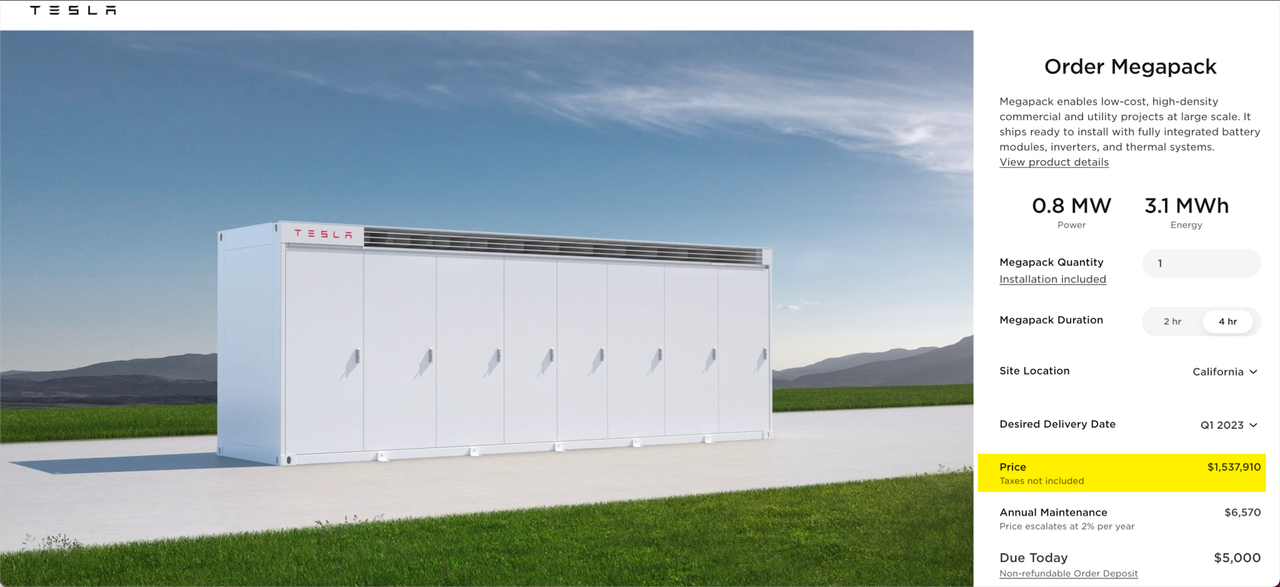 ?itok=lxTa2SlF
https://www.windtaskforce.org/profiles/blogs/battery-system-capital-costs-losses-and-aging
The system consists of 50 Megapack 2, rated 45.3 MW/181.9 MWh, 4-h energy delivery
Power = 50 Megapacks x 0.979 MW x 0.926, Tesla design factor = 45.3 MW
Energy = 50 Megapacks x 3.916 MWh x 0.929, Tesla design factor = 181.9 MWh
Estimate of supply by Tesla, $90 million, or $495/kWh. See URL
Estimate of supply by Others, $14.5 million, or $80/kWh
All-in, turnkey cost about $575/kWh; 2023 pricing
https://www.tesla.com/megapack/design
https://www.zerohedge.com/commodities/tesla-hikes-megapack-prices-commodity-inflation-soars
Annual Cost of Megapack Battery Systems; 2023 pricing
Assume a system rated 45.3 MW/181.9 MWh, and an all-in turnkey cost of $104.5 million, per Example 2
Amortize bank loan for 50% of $104.5 million at 6.5%/y for 15 years, $5.484 million/y
Pay Owner return of 50% of $104.5 million at 10%/y for 15 years, $6.765 million/y (10% due to high inflation)
Lifetime (Bank + Owner) payments 15 x (5.484 + 6.765) = $183.7 million
Assume battery daily usage for 15 years at 10%, and loss factor = 1/(0.9 *0.9)
Battery lifetime output = 15 y x 365 d/y x 181.9 MWh x 0.1, usage x 1000 kWh/MWh = 99,590,250 kWh to HV grid; 122,950,926 kWh from HV grid; 233,606,676 kWh loss
(Bank + Owner) payments, $183.7 million / 99,590,250 kWh = 184.5 c/kWh
Less 50% subsidies (ITC, depreciation in 5 years, deduction of interest on borrowed funds) is 92.3c/kWh
At 10% usage, (Bank + Owner) cost, 92.3 c/kWh
At 40% usage, (Bank + Owner) cost, 23.1 c/kWh
Excluded costs/kWh: 1) O&M; 2) system aging, 1.5%/y, 3) 19% HV grid-to-HV grid loss, 3) grid extension/reinforcement to connect battery systems, 5) downtime of parts of the system, 6) decommissioning in year 15, i.e., disassembly, reprocessing and storing at hazardous waste sites.
NOTE: The 40% throughput is close to Tesla’s recommendation of 60% maximum throughput, i.e., not charging above 80% full and not discharging below 20% full, to achieve a 15-y life, with normal aging
NOTE: Tesla’s recommendation was not heeded by the owners of the Hornsdale Power Reserve in Australia. They added Megapacks to offset rapid aging of the original system, and added more Megapacks to increase the rating of the expanded system.
http://www.windtaskforce.org/profiles/blogs/the-hornsdale-power-reserve-largest-battery-system-in-australia
COMMENTS ON CALCULATION
Regarding any project, the bank and the owner have to be paid, no matter what.
Therefore, I amortized the bank loan and the owner’s investment
If you divide the total of the payments over 15 years by the throughput during 15 years, you get the cost per kWh, as shown.
According to EIA annual reports, almost all battery systems have throughputs less than 10%. I chose 10% for calculations.
A few battery systems have higher throughputs, if they are used to absorb midday solar and discharge it during peak hour periods of late-afternoon/early-evening.
They may reach up to 40% throughput. I chose 40% for calculations
Remember, you have to draw about 50 units from the HV grid to deliver about 40 units to the HV grid, because of a-to-z system losses. That gets worse with aging.
A lot of people do not like these c/kWh numbers, because they have been repeatedly told by self-serving folks, battery Nirvana is just around the corner, which is a load of crap.
If you are making hydrogen, which you can store, why do you need batteries?
My calcs for the low estimate using 51,000 BTU/Lb for the LHV of hydrogen gives a cost of $8.91 per MMBTU. This is not a killer value, since we have already seen nat gas prices high than this. Please check my calcs.
In Australia, there is so much rooftop solar that grid batteries often get paid to take power. Some retailers charge nothing for power used between 1100 to 1400 daily. Lunchtime demand helps stabilise the grid because there is so much rooftop.
In a “renewable” grid there will be times when the energy literally costs nothing or consumers get paid to use it so the grid remains stable.
The cost of energy should be removed but the capital for the electrolysed increased because it will have a low capacity factor. And it is probably lower cost to just run the electrolyser at low capacity factor than burning hydrogen it produces to increase the capacity factor. Pilot electrolyses in Australia have demonstrated that they can be easily turned up and down in response to power availability.
Attached is South Australia’s demand curve and prices for yesterday and forecast for rest of today. The minimum demand will drop to 480MW. There is enough solar generation to exceed demand so it is backing off through overvoltage. The grid scale wind and solar are already curtailing at 0900.
Attachment.
I take that to be just the variable cost. The fixed O&M and capital cost are separate line items.
Nearest to me:
Pacific Northwest Hydrogen Hub (PNW H2; Washington, Oregon, Montana) — The Pacific Northwest Hydrogen Hub plans to leverage the region’s abundant renewable resources to produce clean hydrogen exclusively from renewable sources. It’s anticipated widescale use of electrolyzers will play a key role in driving down electrolyzer costs, making the technology more accessible to other producers, and reducing the cost of hydrogen production. The Pacific Northwest Hydrogen Hub has committed to negotiating Project Labor Agreements for all projects over $1 million and investing in joint labor-management/state-registered apprenticeship programs. This Hydrogen HUb is expected to create more than 10,000 direct jobs—8,050 in construction jobs and 350 permanent jobs. (Amount: up to $1 billion)
“ the region’s abundant renewable resources” Can you say “water”?
There is (sometimes) wind and a nuclear facility.
Where the H2 goes after it is made is not mentioned.
Do note the “labor” and “apprenticeship” parts.
The $1 billion will, to the nearest whole number, have Zero effect on the atmosphere.
These costs don’t exclude the important inherent losses taking place with hydrogen storage and transport. Hydrogen gas can even diffuse through steel making it brittle and is extremely dangerous. The best way to stock hydrogen is as hydrocarbons (e.g. methane or liquid fuels).
That is being done in Japan
i.e. storage in liquid compounds
Using nuclear for electrolysis of water is a solid solution. However, most of the climate crowd are dead set against nuclear power.
Using the cost of fuel for green hydrogen indicates a lack of understanding of intermittent sources.
Nearly every day, batteries in Australia get paid to recharge. In fact, some retailers offer power at zero cost from 1100 to 1400 hours. The grid is becoming so unstable at lunchtime that loads at that time are highly desirable.
The analysis should have zero cost for energy but work on lower utilisation of the electrolysis plant.
With current cost of battery storage and solar panels, the solar capacity factor that gives lowest cost for electricity is around 5%. The unrestrained capacity factor is up around 17% with fixed arrays. It means that there is a lot of capacity available most of the time and the energy source is free.
With currents battery storage, solar panels would need to last 200 years to recover the energy that went into making them and all the other stuff to get a working grid. But this includes the cost of storage. With hydrogen storage, that payback might be shorter.
The pilot electrolysis plants operating in Australia have demonstrated that they are happy to operate over a wide range of output. So overbuilding the electrolysis plant is not an operational constraint.
And, if the hydrogen facility needs a battery to operate efficiently then hydrogen for storage is not more economic than batteries. Plan on getting free electricity or being paid to use electricity for grid stability reasons providing you are prepared to reduce demand in line with electricity availability.
Over here on the east coast in Queensland, we have had long periods of cloud, rain, strong wind (cyclones), little wind, etc., ongoing for a few months now. My rooftop solar generation is seriously compromised.
The simplest solution to our energy problem is to remove government from energy production and transmission. Government is not the solution it is the problem.