Essay by Eric Worrall
Wild weather has pushed the Aussie State of Victoria’s fragile grid beyond breaking point during the last few days. The last thing Victoria needs is senior academics pushing non-solutions.
A major blackout left 500,000 Victorian homes without power – but it shows our energy system is resilient
Published: February 14, 2024 8.10am AEDT
Roger Dargaville
Director Monash Energy Institute, Monash UniversityHalf a million homes and businesses in Victoria were left without power late on Tuesday following a major power outage. The disruption occurred when severe winds knocked over several high-voltage electricity transmission towers, causing all four units of the Loy Yang A coal-fired power station to trip and go offline.
Victorian Energy Minister Lily D’Ambrosio described the blackout as “one of the largest outage events in the state’s history”.
The event has prompted questions about the reliability of the state’s electricity grid. But it’s important to note these extreme winds would have seriously disrupted any power system. It has little to do with the mix of renewable energy and conventional fossil fuels.
…
According to a statement from AEMO, the storm also damaged hundreds of powerlines and power poles and restoring electricity to all customers “may take days if not weeks”
…
Battery storage may have helped steady the grid. Batteries have ultra-rapid responses to these kinds of disuptions and can add or subtract power from the grid within milliseconds to keep the grid stable.
…
Read more: https://theconversation.com/a-major-blackout-left-500-000-victorian-homes-without-power-but-it-shows-our-energy-system-is-resilient-223494
The immense vulnerability of Australia’s industrial heartland to the severing of a single connection to a distant coal plant is a disgrace.
I don’t know why Professor Dargaville suggested batteries might solve the problem. Batteries could have stabilised the grid – for a few minutes. The suggestion any remotely affordable level of battery capacity could have maintained grid supply in the face of major and prolonged transmission outages is absurd.
More powerlines might have improved the odds of electricity getting to where it is needed – but more powerlines would also have been damaged by the storm. At best this would be a very expensive solution to energy resilience.
A distributed network of modular nuclear power plants could have eliminated the risk of a single point of failure bringing down the system, and could have reduced or even eliminated widespread blackouts.
If a network of modular nuclear plants was established inside Melbourne, Melbourne would not have suffered a major outage after the connection to a distant coal plant was severed.
But nobody is implementing sensible energy solutions in today’s Australia. Australia’s climate obsessed politicians only permit uselessly unreliable green energy solutions which don’t actually solve anyone’s energy problems.
Can it be that the pilons were substandard? It took a major ice storm to bring down Quebec pilons.
Green steel ? 😀
It is systemic.
They pylons were made from solar and wind electricity.
When they are too little, failure of components occurs.
Look at Germany
Used to be the paragon in Europe
Now it is a disaster all over the place, all due to having wind and solar.
Those two electricity sources create a lot of weak points in everything, not just pylons.
What?
You mean you do not get it?
It doesn’t make sense to me.
Nothing new 😀
It’s free verse poetry.
Thank you for naming me a poet
I’m fairly sure mechanical engineers could design a pilon to meet the need. No mention in the story about how strong the wind was. But I’m fairly sure there was no ice.
Hmmmm
Half a million homes and businesses in Victoria were left without power late on Tuesday following a major power outage. The disruption occurred when severe winds knocked over several high-voltage electricity transmission towers, causing all four units of the Loy Yang A coal-fired power station to trip and go offline.
Sounds like a whole lot of battery potential is needed to sustain 1/2 million homes and businesses
Victorian Energy Minister Lily D’Ambrosio described the blackout as “one of the largest outage events in the state’s history”.
The event has prompted questions about the reliability of the state’s electricity grid. But it’s important to note these extreme winds would have seriously disrupted any power system. It has little to do with the mix of renewable energy and conventional fossil fuels.
So why double down on expensive unreliable stupidity?
…
According to a statement from AEMO, the storm also damaged hundreds of powerlines and power poles and restoring electricity to all customers “may take days if not weeks
Hmmm, weeks of needed battery supply sounds like $Trillions
Sounds like the whole snafu could be avoided by simply running the transmission lines underground. No more substandard pylons to blow down in a stiff breeze, no more transmission line failure.
cost vs benefit needs to be part of any large project. Could underground be done at 10X the cost? How much of the desire for a different approach involves the extremes of the precautionary principle? If this was a really unusual event, how much benefit can there be in an extremely expensive solution? A problem that can be righted in a short time is still an inconvenience but did it kill a large number of people or cause extreme economic expenses that would have made the extra upfront costs worthwhile?
Undergrounding Transmission wires over hundreds of miles can be done for a fraction of the cost of mega-battery time-bomb installations sufficient to keep half a million services energized 24/7 for several weeks straight. And they won’t randomly explode either or require millions of tonnes of ore to be mined and processed to produce them. Nor will they require cooling systems to function properly
Remember
500,000 svcs X 12KWh day X 14 days = 84,000,000 KWh (84 GWh)
If you double usage to 24KWh day you need 168 GWh of storage.
Far cheaper to UG the Transmission Lines
Usually you are looking at close to ten times the cost of pylons though.
Undergrounding Wires (Distribution or Transmission) is definitely more expensive than building them Overhead but still far less costly than Mega-Batteries
If the green steel pylons are not capable of standing up to storms then what’s the alternative? If you have to replace the pylons every couple of years then underground soon seems like the cheaper option, in the long term.
Pylons should last many decades, and be capable of withstanding much stronger winds than this storm appears to have offered.
This is about the peak of the storm at 04:00Z: winds are gale force 35-40mph, with gusts up to 80mph. The image shows gusts. Pylons really ought to be able to survive 80mph gusts – certainly for major transmission lines. Not as if we hadn’t previously seen weakness in Australian pylon standards: the system black in South Australia happened in part because they lost the Hazlewood interconnector to downed pylons in again what ought to have been survivable winds.
The reported pylons were near Geelong. That had an 80Kmh gust. So I agree there seems to be an engineering problem. Chinese steel?
http://www.bom.gov.au/climate/dwo/202402/pdf/IDCJDW3030.202402.pdf
Cheap-cheap Chinee engineer !?
LOL, so even the “grid scale batteries” wouldn’t do a damn thing about that situation. When the transmission and distribution lines are down, nothing will be “delivered” from power sources.
No ice was reported or expected. Air temperatures just before the event were over 30C or 86F. Geoff S
I’m pretty sure that the pylons would have been designed by a structural engineer and that design would have been part and parcel of a ‘turnkey’ design and build procurement. The outcome is under-designed structural pylons to save money and boost profit. The “wild weather” wasn’t that wild.
I think that is a picture from South Australia from a few years ago. (I might be wrong)
Any pictures that are confirmed to be from this latest transmission tower failure ?
Yes, it is from SA. Here is Vic, from the ABC
Thank you.
Bit of work needed to fix them !!
Modular !
Ffames that are damaged can easily be replaced. The design even allows for doubling up where you want more strength.
These are supposed to be 500KV towers and the height alone means they should be stronger .
Bloody expensive to keep replacing though – even if it is just part of the pylon each time.
They say its 45 towers felled by wind since 1959 in that state alone . There might be 4000 of them?
Given the extensive twisted structural failure of these spindly edifices, I’d imagine that it’d be cheaper to reconstruct more solid pylons with greater member size and flange thickness. Modularized so the components can be prefabricated and quickly erected onsite.
Pretty evident that the design is flimsy and inadequate. 120kph should be easily survivable for major transmission lines. Indeed, they ought to be built to survive 120mph at least: offshore wind turbines claim to survive 75m/s which is 168mph.
The six pylons that failed were about 30-50 years old but were built to last at least 70. They were in good condition so the big question is why weren’t they able to weather this storm which should have been easily within the design parameters.
Yep, a design issue by the looks of it.
These things should be well overbuilt….. like a brick outhouse !
There should be a large margin of safety on such important infrastructure.
No storm should be able to knock down these towers. Did the same storm do any damage to wind turbines?
No, wind turbines were fine. It was coal generation that failed, caused by the system intability.
Were the wind machines producing power during the storm? Were there any near the storm?
Yes, they were, and saved us from worse blackouts. They are mostly to the W and NW of Melbourne; these pylons downed were to the East.
Nick,
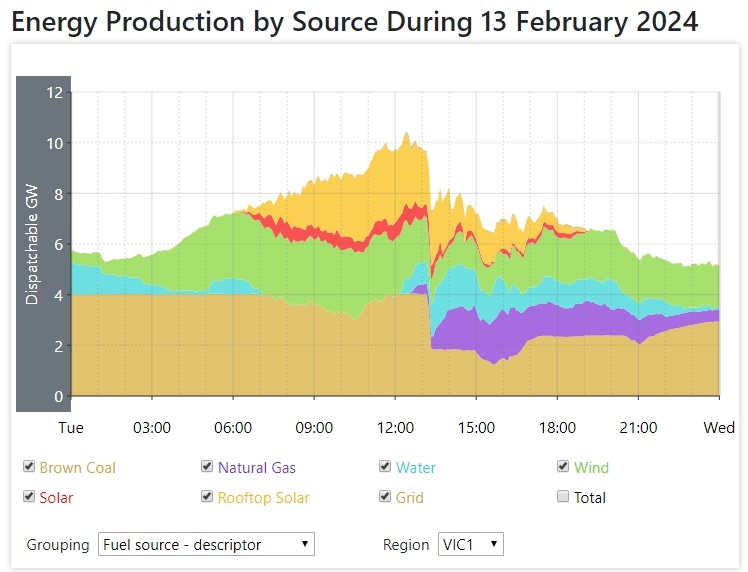
Here is the correct summary.
At about 1.10 pm, several towers failed.
All electricity that was flowing through them stopped.
This triggered sudden, large reductions in all forms of generation. Coal, bottom, light brown, shows Loy Yang being closed, nowhere for its electricity to go.
Wind, bright green, centre, showed a similar sharp drop to coal. Nowhere for wind electricity to go.
Of some importance is the recovery.
Gas, second from bottom, blue, was the only form of generation able to rise in the 2 hours after the event.
The intellectually deficient government in Victoria has a policy to diminish gas use (without even asking voters, AFAIK).
Jo Nova blog thanked for the graph.1âaââaâaâ
Geoff S
Geoff,
“Wind, bright green, centre, showed a similar sharp drop to coal. Nowhere for wind electricity to go.”
No. Not much wind energy comes over the Latrobe Valley lines. If you compare the drop in coal with the drop in the top profile (representing the total), they are similar.
“Gas, second from bottom, blue, was the only form of generation able to rise in the 2 hours after the event.”
Hydro in sky blue(Snowy) did better. But after the event, gas+coal is less than half the supply. The rest is renewables.
“Not much wind energy comes over the Latrobe Valley lines”
AC power the electrons barely move so no travelling like cars down a highway, the energy is from everywhere and to everywhere at nearly the speed of light
The downed lines were just outside Geelong , an industrial city SW of Melbourne a long way from La Trobe valley lines
Roof top solar is normally not distributed over the HVAC grid so that cant be tripped off like the larger generators can – because they cant be damaged by the big voltage spikes
There were reports of 400 incidents of downed pylons. Some of those clearly affected wind farms and solar farms. Rather more than the Latrobe Valley got affected.
Not downed “pylons’ like these . Only about 6 of those
The rest were just normal suburban street lines .
Are you sure? Do we know why e.g. Stockyard Hill WF didn’t come back after the storm abated?
Nick,
No to hydro. It was almost at a peak before the event, rose a small amount over the 2 hours after, then fell away into the night.
No to wind. Both wind and coal dropped to about 60%% of their levels before the event.
It matters not where the windmills were.
Why are you putting lipstick on this pig?
The main immediate factor that could have avoided or minimalized this event was stronger transmission towers. In the longer term, the better design would have no renewables that require extra (breakable) transmission towers. Optimum would be like the brown coal generation that we had before 2000, giving among the cheapest and most reliable electricity on the globe, attracting investment that created wealth like aluminium smelters and refineries and Holden car factories at a time when people preferred results to dreamy ambitions.
Geoff S
Geoff,
Here is the same graph with post-1.30 values aligned, ie moved up so you can see what happened. Hydro and gass went up. Wind and solar did drop somewhat. But the big one was the loss of generation at Loy Yang.
“Hydro in sky blue(Snowy) did better”
WRONG!
Seems Nick can’t even read a graph.
There was a small increase in the amount of hydro…
but a much bigger increase in gas.
wind and solar were both less than before the transmission loss.
It was GAS and the interconnects that came to the rescue.
Stokes’ looking glass filters out all coal and gas images … he can only see ruinables.
Thank you.
I’m in the US.
If the power lines are down, it doesn’t matter what the source is that powers them.
(Even a “grid scale battery” wouldn’t have helped.)
Maybe the money spent to build windmills and solar panels should have gone into strengthening the transmission towers?
It appears that the energy delivery companies are moving towards decentralization and transmission line hardening. Maybe to offset line maintenance? See Green Mountain Power (GMP) today launched its Zero Outages Initiative.
Get ready for more solar, wind, battery backup, underground electrical transmission, community microgrids and all-electric, fully storm resilient neighborhood.
Yeah, that will fix it!
Yep. My first thought on reading this was what use would the batteries be if the transmission lines were down?
Notice that wind is less afterwards than before.
Wind didn’t save anything. Same with solar
Nick is blatantly lying through his keyboard.. as per usual.
Why always the dishonesty, Nick ??
He’s not called racehorse for no reason 🙂
Not really. Several wind farms were lost before the downing of the transmission towers that forced Loy Yang offline, at which point several more tripped out. It took some hours before some of the came back. Stockyard never made it, having been one of the first to go offline. The rescue came from hydro, gas and interconnectors.
Nick,
Were they not at Anakie, near Geelong, about 25 km to the west of Melbourne?
What are you writing about in the East?
Geoff S
Yep, the tower that were downed were to the West of Melbourne.
Geoff,
Yes, I was wrong there. The downed pylons were not between Loy Yang and Melbourne. See my map below. I think many of us were barking up the wrong tree.
WRONG.. the generation did not fail.
That is a blatant lie! And I suspect you are well aware of that.
It was forced to shut down due to the fact there was nowhere to send its electricity.
It could have kept sending it straight to ground, at least until the lines melted 🙂
In fact, it seems the lines from Loy Yang to Melbourne were not the ones affected.
Indeed so. Mea culpa for jumping the gun.
Presumably windturbines were also turned off as their output had nowhere to go as well? Assuming that the wind wasn’t gusting above cut off velicity?
Wind blades were probably braked well before the peak wind speeds, so as to not overspeed and damage them.
I get your point, but don’t they feather them instead of brake them? A real question – you might be correct.
For completeness, I’m guessing that they feather them first to stop them, and then brake them.
There are 4 500 kV and 6 220 kV lines from Latrobe Valley to Melbourne. They didn’t all fail.
The 500kV lines that carry the power from Loy Yang were lost. The other lines were still carrying power from Yallourn, which is also in the Latrobe valley and closer to Melbourne.
I thought it was those lines too, but it wasn’t. The 500 kV lines were downed near Geelong, W of Melbourne. They did not carry power from Loy Yang to Melbourne. Here is a map:
And they are nowhere near GEELONG. 😉
They are right outside Geelong!. Its an industrial city so has extensive lines feeding the area
My reply was to Nick re his Loy Yang comment. Timelines rule ok?
2 x 500KV lines to an industrial city of 250,000 like Geelong is still a bite out of demand
Coal Generation didn’t fail, it acted exactly as it should have in an over current situation and disconnected from the grid to prevent more widespread cascading outages and further grid instability
Was the output from windturbines able to jump the breaks in transmission lines? Or were they turned off as well?
A coal plant had to shut down to protect itself. Wind turbines have to do that far more often.
Yes. They have brakes on them for that very reason, when wind speeds get too high. Thats when coal and natural gas are bought in – and get the blame when they trip out die to network instability with the loss of a single HVAC line
Not caused by instability. Caused by the loss of transmission to export power, as AEMO has stated.
The instability auto trips the large generators, which is what their computers detect first
With loss of load, inertia would have seen generator frequency increasing rapidly, which would have initiated a trip on RoCoF and actual frequency grounds. A sudden deload could see frequency over 51Hz inside 4 seconds. AEMO see 4 second data from all the major generators, including wind farms. That is available to industry traders. The general public can get 5 minute data, which is re-packaged by several web sites, such as anero.id openem.au nemlog.com.au etc.
It may have been due to sympathetic resonance which overcame the design parameters.
When you can’t send something it either needs to be stored or discarded.
When storage capacity is exceeded there is no other alternative
Heh. Images from the storm. Beyond wind. Plus ice. It was horrific.
https://duckduckgo.com/?q=quebec+ice+storm+towers&atb=v351-1&iax=images&ia=images
The pylons aree incidental to the issue. The ones that collapsed are hundreds of miles from the power station that went open circuit.
There was an intense cold front moving across the state that had 38C ahead of it and 17C behind it. Local gusts were at least 116kph as recorded at Fawkner Beacon.
The WEATHER DEPENDENT GENERATORS do what they always do in adverse weather. It collapsed as cloud moved over Melbourne shutting down rooftop solar and high winds caused wind turbines to go into protective mode and shut down. The grid operators had to rapidly shed load to avoid complete outage.
The notion of a couple of HV lines hundreds of kilometres from a coal fired power station causing it to trip is fantasy. The protection system would be so screwed that it would be useless. I do not rule that out because the grid becomes incredibly complex when power flows can be in any direction.
It took many decades to weatherproof power grids. In Australia, all that good work has been thrown out by socialist inspired engineering and weather dependence is now the essence of the Australian grid. Adverse weather will increasingly cause power outages – it is an inherent feature of the design.
I think the engineering report into the pylons might be interesting (I won’t hold my breath waiting for it). They were probably not sub-standard in terms of design, but there is a distinct possibility that a lack of inspection and maintenance may have resulted in some form of weakening. I’d be looking for things like significant corrosion, signs of bolts that were too loose or overtightened and fatigue cracking. The likelihood that an otherwise sound pylon of such a scale just toppled to the ground without any initiating event is very low.
The first pylon to fall is almost sure to have some sort of issue, the subsequent ones may have failed due to shock loads from the collapse of the first. Though, they should be designed such that a cascading failure would not occur, so the possibility that the other collapsed pylons had faults is still fairly high.
Given that this is Victoria, the likelihood that a competent investigation is carried out that actually gets to the bottom of the issue is done is vanishingly small.
I saw another news article that said there are 13,000 pylons across Victoria and about 1 in 7 are damaged with extensive rust and that the average age of the pylons is about 57 years. It’s a problem that’s going to get worse as the years go by – not something that a ‘quick fix’ is going to sort out.
“A major blackout left 500,000 Victorian homes without power – but it shows our energy system is resilient”
Professor Dargaville is a real expert. God save us from experts!
That’s about 20% of households.
I don’t know why academics think that they are experts. They get to know more and more about less and less until eventually they know everything about nothing. Pr. Dargaville has demonstrated this with aplomb.
Does Professor Dargaville own Tesla stock, or what? His proposal is ridiculous.
Batteries can provide some very limited back for a power source but it does nothing for transmission line failures. In fact, batteries mean you need MORE transmission lines and they are most certainly not a transmission line substitute.
He is an “expert” to teach our students
God-bless stupid Australia, because no-one else will
With such idiot professors, engineers can no longer design pylons
Distributed batteries, (lots of them), certainly would have helped. If you picture a grid where there are sufficient batteries to carry the full demand for a period of time equivalent to the time it takes to repair the transmission lines.
Also, a second se of batteries would have to be near the generators too, but they can be smaller, just enough to absorb the energy of the generators until they can be shut down using a sensible time span.
So let’s see. In the areas of demand, you need batteries that are fully charged and capable of supplying power for a period of say 3 months. At the generators you need fully discharged batteries capable of absorbing the generator output for say 2 days.
All we need now is some new chemistry for the long term storage needs and some money. A whole lot of money.
In my opinion, since no one is going to fund this, then batteries can be ignored as a solution.
Sure if money was no object. But it currently costs hundreds of millions of dollars to create enough battery capacity to last a couple of minutes. How much do you plan to spend on batteries?
As I stated above..
In my opinion, since no one is going to fund this, then batteries can be ignored as a solution.
There is NO solution in batteries SINCE they are not going to be funded. BUT if ever they are invented, created, installed and commissioned, then it is correct to say that they would have helped.
And how much would I spend on grid batteries….. None, we already have high energy storage, created when energy was plentiful and ready for use today. I call it coal.
Not forgetting, of course, that you’d need them everywhere; every city, small town or suburb would have to have it’s own battery setup as you couldn’t predict which powerlines might fail.
Cheaper to fix the whole transmission issue.
The batteries were more or less AWOL and quite useless at preventing outages. There was no response to the loss of Loy Yang at 13:10 – where you might have expected them to be at maximum discharge.
True, because these powerpoint reactors don’t exist in the real world – can’t have blackouts without energy in first place.
Never heard of a nuclear submarine? There are plenty of nuclear reactors of all shapes and sizes.
These are not SMRs.
Eric and MyUsername, my curiosity got the best of me and I searched for Russian SMR’s, and the reports are all over the place. Apparently, but not certainly, Russia has placed several ex-icebreaker small reactors on barges in Siberia, and uses them for electrical energy and desalinization. Other reports are Russia intends to do this or that, and the reports of actual, design-built, SMR’s, suggest deployment is imminent. Wait for it.
Akademik Lomonosov Floating Nuclear Co-Generation Plant
The 70MW Akademik Lomonosov floating nuclear co-generation plant is located in the town of Vilyuchinsk, in the Kamchatka region of Far East Russia.
Thre are 2 nuclear icebreakers with 75MW reactors.
“These are not SMRs.”
YES, THEY ARE !! They are small, they are modular, they are reactors.
More than once in different places, nuclear powered ships have been able to provide electricity to coastal communities.
Then why does nuscale needs massive substidies to reinvent something we already have, and still fails doing so?
Small Modular Reactor — New Nuclear Trend
Russia is the only country in the world where a small capacity nuclear power plant (SMR) has been operating for several years. At the same time, SMR is frequently named among the main trends of the global nuclear market. This expands the interest of both countries already using large capacities and newcomers. In early February, Rosatom signed an intergovernmental agreement with Myanmar on the establishment of SMR in the country. From an African perspective, “small” technologies are also more than relevant. Ryan Collyer, CEO of the Rosatom Central and South Africa Regional Center, talks about the advantages of SMR and how these solutions can be useful for African countries.
Adapting to commercial use, useless-one
Getting past regulatory road-blocks etc etc
Because the US government has never before licensed an SMR and has been unable to develop safety protocols and regulation safety tolerances for SMR’s before now. Part of the problem is that they changed the regulations, possibly several times, during development. This had a knock-on effect to the building and development time and thus to the shareholders who lost confidence in their investments.
Nuclear powerships offer clean baseload electricity at predictable prices – Rosatom
Floating nuclear reactors can provide countries with a supply shortage like South Africa with baseload electricity at a stable price without the construction risk – but the regulatory environment is complex and underdeveloped.
Predictable high
Predictable nonsense from losername.. !
No they’re Small Mobile Reactors
The US and Russia navies use several hundred nuclear reactors on their ships, already for more than 40 years.
They are small modular reactors of 10 to 50 MW
But those use highly enriched fuel, so because of proliferation risk are unsuited to civilian applications.
X-energy is developing high assay low enrichment fuels, that has > 5% enrichment.
True, but reliable energy won’t come from unreliable wind or solar
“can’t have blackouts without energy in first place.”
So you are suggesting we all become third world countries.
Typical far-leftist comment. !
Grid scale storage is not affordable, nor scalable at a sufficient capacity. Pumped hydro might work, but that requires suitable geography. Numerous small modular nuclear power plants, across regions, is the way to go.
Enviros in Wokeachusetts hate pumped hydro for storage and fight ferociously to stop the few that exist here.
Pumped hydro would probably have the same single path problem which tripped the Loy Yang A units.
If you have a single point of failure, it needs to be well and truly overbuilt. Not having a single point of failure is usually a better approach.
Isn’t this a deja vu for Australia? When will they learn that adopting a new energy system to replace a successful energy system without due diligence, or in this case ignoring it, is a recipe for failure?
This is the old technology. Loy Yang is last century, as are the transmission lines that failed. It was wind and solar that prevented even wider blackouts.
Likely because the wind and solar assets were incapable of sufficient generating capacity to create an additional overcurrent situation
Both wind and solar failed due to a combination of loss of transmission lines, shutdown on safety grounds/damage, and simply being tripped out. I’ve posted the wind detail above. Here’s utility solar – which almost drops to zero in the afternoon. Some of the early morning outage is due to curtailment. Later on the storm takes over.
Rooftop solar was also knocked offline in significant quantities as a consequence of load shedding.
And probably also as a consequence of the abrupt change from warm sunny conditions to heavy cloud?
Yes, that too.
Rooftop solar is designed to disconnect from a failed grid. It’s by design.
It’s also a consequence if load shedding is imposed.
Nick,
You are making me anxious about my last-century, 80 y o heart.
What does it matter that it is old? It works.
If you look at the graph of electricity use by source that I posted above, in round terms for most of that day “renewables” and “other fuels” contributed half of the total each over every hour of that day.
50% each before and after the event.
In what sense did wind and solar “prevent even wider blackouts?”
All I can see I that they did nothing that other fuels, in total, did not do. Geoff S
“It was wind and solar that prevented even wider blackouts.”
That is an absolute LIE.
And I’m sure you are well aware of that fact.
Wind and solar were both less afterwards than before.
It was GAS and the interconnects that saved the situation from becoming far worse.
Plus hydro. But wind tripped out at the same time, as the charts I posted show.
“Old technology” Why then are China and India massively expanding their coal powered networks and are expected by the IEA to account for more than 70% of the world’s coal consumption by 2026?
Real solutions would run the risk of making the problems and the careers of all the trough-feeding radical enviro-nuts disappear. Can’t have that.
Why not propose unicorns on treadmills? They are every bit as real as actual grid scale batteries.
“Why not propose unicorns on treadmills”
And don’t forget the unicorn fart collection apparatus. (UFCA)
As I explained the other day.. I am working on the breeding program…
Set-back… just found out my one-horned cow and my pony are both female . 🙁
I don’t think I want to know how you missed that…
🤤
New generation 100 MW or less small-scale modular reactors will be tremendously more economical. All that is required is an assembly line-based factory to pop out hundreds of cookie cutter identical, one NRC design fits all, semi-trailer delivered, assembled and up and running in two years nuclear plants to end the failed wind and solar nightmare that is so economically inefficient it destroys an economy. (For now, expensive, no doubt about it until an assembly line factory is up and running). Place your orders!!
Copy
NuScale
A supply chain was already in place, because NuScale’s low-enriched uranium fuel closely resembles Westinghouse fuel, except the assemblies are about half the height. The design had been approved (although for 50-MW modules, and NuScale is seeking an amendment to approve running them at 77 MW).
NuScale had already placed an order with Doosan Enerbility for long-lead-time parts, and Doosan has begun fabrication. Doosan is an investor in NuScale. Recently NuScale announced that it was working with Standard Power, which wants to build facilities for data processing companies, to deploy reactors. The centers would be in Ohio and Pennsylvania, but precise locations or timing have not been specified. Standard Power would supply the electricity.
https://www.datacenterdynamics.com/en/news/lawyers-circle-nuclear-startup-nuscale-over-claims-a-24-reactor-deal-will-fail/
Ok, Eeyore. I can almost hear you now: “it’ll never work”. … said people before trains exceeded 15 mph, before human powered flight, before landing on the moon. There is always some Eeyore asserting that it’ll never work.
Human ingenuity will overcome the legal, regulatory and engineering challenges. In spite of naysayers.
Exactly, see renewables.
Renewable CANNOT overcome the really big issue of being erratic, intermittent, unreliable, weather-dependant and non-dispatchable.
But they have been allowed to BYPASS rather than meet regulatory and environmental standards.
No , they have NOT met and can NOT meet the engineering standards required for solid reliable grid electricity supply.
Too bad reality is proving you wrong with each passing year.
Wrong… the more unreliable energy gets added..
… the more unreliable the grid becomes.
That is because they have NOT met and can NOT meet the engineering standards required for stable, solid, and reliable grid electricity supply.
No, they have already failed too many times because they are too variable and require a lot of land to generate power.
Get it through your thick skull they are not reliable source of power.
I would like to see the reality of a small scale experiment of a fully renewable grid before we commit to changing it nationally.
Renewables do work. It’s just nobody knows how much for how long and when, apart from those minor problems which can be overcome any day now they are perfect
“the system value of variable renewables such as wind and solar decreases as their share in the power supply increases”
IEA ‘Projected Costs of Generating Electricity” 2020 p13
Also from that report:
“The key insight from this 2020 edition is that the levelised costs of electricity generation of low- carbon generation technologies are falling and are increasingly below the costs of conventional fossil fuel generation. Renewable energy costs have continued to decrease in recent years. “
LCOE=fiction that ignores most of the costs of adding worse-than-useless wind and solar to the grid.
No, they’re not – if they were then government subsidies would not have to increase and they wouldn’t have to offer ever higher prices to get renewables companies on board. They are getting more and more expensive – as to the LCOE, just read the disclaimer at the front; they are for investment company information only, they’re not produced for policy purposes.
Events now suggest otherwise. Renewable energy costs have been increasing rapidly, especially on grids with higher penetration levels. Meanwhile we are seeing gas prices falling, with Henry Hub being now well below $2/MMBtu and European prices down below €25/MWh. Even JKM is below $10/MMBtu.
A word I never heard of.
You might have had to look it up but it was part of my childhood.
Somehow, I managed to skip Winnie-the-Poohbooks. 🙂
Ahh… “Iceberg research” stock-shorter.. A shadowy hidden firm with no place of residence..
About – Iceberg Research (iceberg-research.com)
Writes speculative reports aimed to push the stock price down so they can buy it at cheap prices.
Basically just a parasite….. probably linked to and paid by predatory hedge funds.
Iceberg Research Director Arnaud Vagner. : r/amcstock (reddit.com)
See this comment by Jonathan Lesser concerning the green hydrogen article and my response to it concerning the cancellation of the UAMPS Carbon Free Energy Project:
https://wattsupwiththat.com/2024/02/13/can-the-government-create-a-green-hydrogen-fuel-industry/#comment-3867257
We have a chicken-or-egg situation with SMRs. Controlling their costs depends in good part on building the reactors and the key safety systems in factories. But those factories have to be paid for somehow.
As it stands today, the first hardware units of an SMR design are expected to carry the costs of establishing the SMR industrial infrastructure for that particular SMR design.
If you are a power utility, do you want to be responsible for paying the additional costs of being the launch customer for the very first hardware implementation of a particular SMR design?
You as a power utility will not do this unless the capital costs for those first-launch SMR units are within what you can handle without excessive risk.
Which is why it is now likely that the first SMRs to go live on the North American continent will be those funded by the Canadian government, an organization whose deep pockets allows this kind of risk taking.
How much good is a BESS going to be in a widespread wire-down event? That 5 minutes worth of stored energy won’t have anywhere to go.
From history, we know nobody will learn from this until they experience it themselves. Experience multiple times, too. We saw what extreme cold did to the central US 3 years ago and how the Texas grid failed. But we’re still on the same path.
Here is another so-called professor of who does not know battery system economics.
Providing such large quantities of MWhs fro 500,000 houses, even for a few hours would cost tens of billions of dollars for huge capacity battery systems.
BATTERY SYSTEM CAPITAL COSTS, OPERATING COSTS, ENERGY LOSSES, AND AGING
https://www.windtaskforce.org/profiles/blogs/battery-system-capital-costs-losses-and-aging
EXCERPT
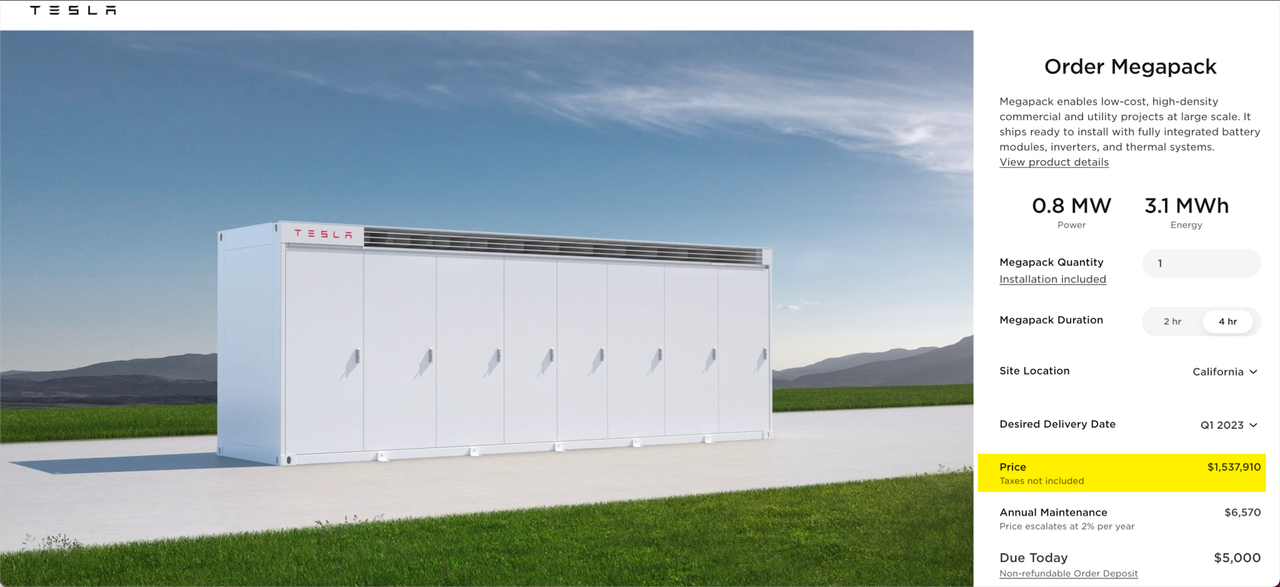
Example of Turnkey Cost of Large-Scale, Megapack Battery System, 2023 pricing
 ?itok=lxTa2SlF
The system consists of 50 Megapack 2, rated 45.3 MW/181.9 MWh, 4-h energy delivery
Power = 50 Megapacks x 0.979 MW x 0.926, Tesla design factor = 45.3 MW
Energy = 50 Megapacks x 3.916 MWh x 0.929, Tesla design factor = 181.9 MWh
Estimate of supply by Tesla, $90 million, or $495/kWh. See URL
Estimate of supply by Others, $14.5 million, or $80/kWh
All-in, turnkey cost about $575/kWh; 2023 pricing
https://www.tesla.com/megapack/design
https://www.zerohedge.com/commodities/tesla-hikes-megapack-prices-commodity-inflation-soars
Annual Cost of Megapack Battery Systems; 2023 pricing
Assume a system rated 45.3 MW/181.9 MWh, and an all-in turnkey cost of $104.5 million, per Example 2
Amortize bank loan for 50% of $104.5 million at 6.5%/y for 15 years, $5.484 million/y
Pay Owner return of 50% of $104.5 million at 10%/y for 15 years, $6.765 million/y (10% due to high inflation)
Lifetime (Bank + Owner) payments 15 x (5.484 + 6.765) = $183.7 million
Assume battery daily usage for 15 years at 10%, and loss factor = 1/(0.9 *0.9)
Battery lifetime output = 15 y x 365 d/y x 181.9 MWh x 0.1, usage x 1000 kWh/MWh = 99,590,250 kWh to HV grid; 122,950,926 kWh from HV grid; 233,606,676 kWh loss
(Bank + Owner) payments, $183.7 million / 99,590,250 kWh = 184.5 c/kWh
Less 50% subsidies (ITC, depreciation in 5 years, deduction of interest on borrowed funds) is 92.3c/kWh
At 10% usage, (Bank + Owner) cost, 92.3 c/kWh
At 40% usage, (Bank + Owner) cost, 23.1 c/kWh
Excluded costs/kWh: 1) O&M; 2) system aging, 1.5%/y, 3) 19% HV grid-to-HV grid loss, 3) grid extension/reinforcement to connect battery systems, 5) downtime of parts of the system, 6) decommissioning in year 15, i.e., disassembly, reprocessing and storing at hazardous waste sites.
NOTE: The 40% throughput is close to Tesla’s recommendation of 60% maximum throughput, i.e., not charging above 80% full and not discharging below 20% full, to achieve a 15-y life, with normal aging
NOTE: Tesla’s recommendation was not heeded by the owners of the Hornsdale Power Reserve in Australia. They added Megapacks to offset rapid aging of the original system, and added more Megapacks to increase the rating of the expanded system.
http://www.windtaskforce.org/profiles/blogs/the-hornsdale-power-reserve-largest-battery-system-in-australia
COMMENTS ON CALCULATION
Regarding any project, the bank and the owner have to be paid, no matter what.
Therefore, I amortized the bank loan and the owner’s investment
If you divide the total of the payments over 15 years by the throughput during 15 years, you get the cost per kWh, as shown.
According to EIA annual reports, almost all battery systems have throughputs less than 10%. I chose 10% for calculations.
A few battery systems have higher throughputs, if they are used to absorb midday solar and discharge it during peak hour periods of late-afternoon/early-evening.
They may reach up to 40% throughput. I chose 40% for calculations
Remember, you have to draw about 50 units from the HV grid to deliver about 40 units to the HV grid, because of a-to-z system losses. That gets worse with aging.
A lot of people do not like these c/kWh numbers, because they have been repeatedly told by self-serving folks, battery Nirvana is just around the corner, which is a load of crap.
I think you’re onto something. Build the storage battery, charge it up with Green Energy, and use the energy to build a nuclear power plant.
“Here is another so-called professor of who does not know battery system economics.
Providing such large quantities of MWhs fro 500,000 houses, even for a few hours would cost tens of billions of dollars for huge capacity battery systems.”
Here is another poster who didn’t read what the professor said. It isn’t that batteries could take over the supply for some hours. It is that it could back up the system for the few seconds, or maybe even minutes, of instability that caused the coal generators to switch off.
Your kindergarten comment is absurd.
Shutting down a coal plant for say an hour, would take several hours to get it to where it could be synchronized with the grid again.
If the shutdown is longer, it would take about 8 hours from a cold start
Any stand by plants must be on HOT standby. They are already synced with grid, but not feeding it
If the downed coal plant is big, say 500 MW or more, it is all “hands to the pumps”for the grid operator
The coal plant didn’t actually shut down, just disconnected from the grid.
If line instability caused the trip, then the batteries and associated electronics may have helped.
If a dead short in the single high voltage line from the coal plant caused the trip, then the batteries would at best reduce any cascade effect.
“Shutting down a coal plant for say an hour”
But the battery could have prevented the shutdown altogether, since it was triggered by instability.
No, batteries are for small fluctuations related to wind and solar erratic nature…
… they would not have coped with the massive instability of a major transmission loss
Loy Yang was generating 2,190MW All the batteries in Victoria could max out at 647MW. In the event, they didn’t even manage 100MW between them. How was that going to save the grid? Can you do basic arithmetic?
I can do basic reading. It’s in the headline. Prof Dargaville says that we need more big batteries.
Surely the big batteries could only help in a situation where a major load was lost by being able to replace the characteristics.of that load.
Well, they only need to do it well enough to stop the coal generator from tripping.
s/coal/bloody big/
Yep, but they need to be able to handle enough of the various loads to do so for long enough for the big generator(s) to reduce output., so would need to be sufficiently discharged to handle a very large input.
Do any of the EEs here know what’s involved, and why Loy Yang in particular was taken offline? It would seem preferable to take the lower latency sources out first rather than big rotational masses.
So you’re basically a sucker who believes the bullshit spouted by useful idiots then.
No transmission line.. No transmission. !!
Batteries really failed to help much at all. Doubtless there will be some hushed up enquiry as to why that was the case.
We only have one really Big Battery in Victoria, and that is at Moorabool, near Geelong, W of Melbourne. It was the 500 kV line from Mrroabool to Melbourne that failed.
What Prof D is saying is that more distributed batteries would have helped.
There’s a total of 647MW of discharge capacity registered in NEM. The VBB is just outside Geelong, and there’s 200MW at Hazlewood. As I have noted, these batteries really failed to help out. I charted the sum of their contributions, which were greatest when wind farms started shutting down well in advance of the loss of Loy Yang. You can access the individual performances e.g. here
https://opennem.org.au/facilities/vic1/?tech=battery_discharging&status=operating
Thanks for reading, Nick.
I’ve been looking at how some of the larger batteries in Australia have been doing economically. Here’s the original Big Battery – the Hornsdale Power Reserve. We can see that it has made most of its money out of gouging in the FCAS market where it long held almost a monopoly, and very little on energy arbitrage. It has probably paid for itself out of that big addition to consumer bills – and perhaps even the expansion/replacement in did in 2020. More recently, its earnings have been rather more subdued because there is now at least some competition from other batteries in SA. Also, its performance has once again degraded sharply, with round trip efficiency falling below 75% in the past couple of months.
The operational record for HPR:
The Victoria Big Battery has really struggled to make an income. It must compete with Loy Yang and Yallourn and hydro for FCAS revenue, so it gets slim pickings. Energy arbitrage has not been a big money spinner either. Being still young, and perhaps under used, it does still retain a round trip efficiency of over 80%.
Price volaitility is a key element in battery income: it provides the arbitrage margins, and is also an indicator of the need for grid stabilisation services. Here’s an indicator for GB
I see you have been logging my posts about Australian batteries all the way back to when HPR first started operating and I posted about it at Euan Mearns’ Energy Matters.
Another non-expert preaching about things he knows nothing about. Nothing in his bio shows the slightest undertanding of generating technology, grid management and operations. And we get this, “A distributed network of modular nuclear power plants could have eliminated the risk of a single point of failure bringing down the system, and could have reduced or even eliminated widespread blackouts.”
Note the conditionals “could”. At no point does Dargaville quantify any of these possibilities.
Does the good Roger have a physics or engineering background? No.
Does he have operating experience in large power systems like grids or generating stations? No.
Does he know anything about nuclear generation technology? No.
Does he have expertise or accreditation in meteorology? No.
So it’s a bit amusing that anyone would take him seriously seeing as he has no relevant training or knowledge. We’d be better advised to take advice from
Pogo (comic strip) – Wikipedia
“Another non-expert preaching about things he knows nothing about. Nothing in his bio shows the slightest undertanding of generating technology, grid management and operations. And we get this,”
Yes, we do. But it is Eric Worrall writing, not Prof D.
And do you have any knowledge of any of these things, Mr. Fake ID? Apparently not.
I can read. It was Eric Worrall writing, not Prof D. As to Eric’s knowledge, well…
“As to Eric’s knowledge, well…”
Well above anything you are capable of. !
No, the issues is Prof D and his apparent ignorance of how supply systems operate.
Eric is just pointing to his ineptitude and lack of knowledge..
Fire up all fossil fuel and nuclear generators. Build new fossil fuel and nuclear generators. Remove wind and solar from the grid.
Amen
Church of fossil fuels?
It was GAS that came to the rescue… because it could !!
Wind and solar, only usable when the weather suits.
You also are a member of the church of fossil fuels.
Your whole existence relies on them being always there and available.
You cannot “rely” on wind and solar for anything
“… severe winds knocked over several high-voltage electricity transmission towers…
Say what? Where they poorly designed? I wouldn’t think this should happen.
“Battery storage may have helped steady the grid.”
but it obviously didn’t
If the battery storage was on the “wrong” side of the break it would not have been of any help whatsoever.
“Australia’s climate obsessed politicians only permit uselessly unreliable green energy solutions which don’t actually solve anyone’s energy problems.”
It’ll help solve some problems for China, as Australia becomes just another backwater source of raw materials. I’m sure Chinese leaders look with envy at those millions of square kilometers with a mere 25 million people- less than it has in some cities.
Nuclear, gas, coal, lignite, whatever outcomes result from supply and demand pressures.
Incidentally Victorians has abundant lignite and gas reserves, hundreds of years at current use rate, right under their feet that are banned from use by government diktat.
“I don’t know why Professor Dargaville suggested batteries might solve the problem. Batteries could have stabilised the grid – for a few minutes.”
You need to read it more carefully. The main problem wasn’t loss of transmission. It was the jolt to the system that caused the for Loy Yang units to trip and go off-line. Just like the tripping of wind generators in SA was part of the blackout cascade. But the Loy Yang units are much bigger. Prof D is saying that batteries could have smoothed over the jolt and prevented tripping.
The “jolt” was because of the transmission tower issue.
Why always try to spin, and spin, with lies and misdirection. ??
What’s in it for you ??
If he said that, he’d be wrong.
It appears there was a single point of failure, which caused a trip at the power plant rather than just isolating a line segment.
Oh, jeez.
Isolating a TRANSMISSION line segment?
You mean rerouting the power around the failure?
That may be possible, if several other plants are told to adjust their outputs
Overloading any part of the damaged system could cause another failure
Presumably, yes. Provided the alternate paths exist.
The choices really are to have a suitably sized alternate path, or build in a massive safety factor to the single point of failure.
From what I’ve read, something along those lines happened, along with the widespread blackout.
But why would that be needed if an alternate path existed?
Yes, it would.
And all that needs to happen in a flash, to avoid a blackout after a transmission line failure.
In rural areas, people are lucky to have just ONE HV transmission line.
In urban areas, multiple HV interconnections allow feeding an HV circuit from multiple points
I know AC has a lot of additional complexity compared to DC, which may well be throwing me.
In a DC circuit with parallel wires of approximately equal resistance, losing one will just send more load over the others.
Tell me about it 🙁
That’s what I thought would happen – the downed lines blow their fuses, trip circuit breakers, whatever, and the others take over the load. Nick has confirmed that there are 4 500kV and 6 220 kV lines.
What attributes of HV AC lead to the power source going offline rather than alternate paths taking over?
Did they lose multiple lines, so the remainder would be overloaded?
Just remember that those lines are probably not sized to carry their regular load PLUS the entire load of a failed line.
The downed lines were quite a way from the power station, as per the map that Nick posted, with a number of interconnection between.
Line capacity probably wasn’t the issue so much as the various other complexities of AC.
Overall demand was ~10GW which is on the high end for Victoria. Some wind farm supply had already been lost, constraining distribution by stretching links from major power sources. Basslink connects to Loy Yang. It switched from exporting 443MW to Tasmania for much of the morning through 0 at about 12:40 and was importing about 130MW at the time of the trip at 13:10. By 13:40 it managed over 400MW of import.
Thanks for that. I take it that much of this is active management, but how about the trips? Is that purely passive, or computerised semi-active?
Would cutting the Basslink feed have been sufficient to avoid the Loy Yang units going offline?
On a vaguely related topic, what prevents the generators speeding up excessively when the units are taken offline? Is there a big resistive or inductive load to rein them in?
I’m not sure what your point is there. It’s not true that all Latrobe Valley power passes through a single pylon. There are, or were, 6 220 kV lines, and 4 500 kV lines carrying that power to Melbourne.
I don’t know the physical layout. How many of those lines share common towers?
You’d think if there was sufficient redundancy, the line segment with the collapsed towers would isolate and the others would take the load.
The picture of downed pylons you posted earlier shows twin pylons taken out, probably not far from the power station. All the 500kV transmission was lost according to AEMO. Loy Yang was producing 2190MW immediately before in stable fashion.
Why do you repeat the same lie so many times in a thread? AEMO acknowledged straight away that it was the loss of transmission that cause Loy Yang to be taken offline.
It was loss of transmission that caused instability in the grid, which then caused Loy Yang to trip (all 4 units). It wasn’t, as some have said, the fact that Loy Yang power had nowhere to go. What AEMO said was that the 500 kV line to go was the Moorabool to Sydenham line. That is on the west side of Melbourne, and does not carry power from the Latrobe Valley to Melbourne.
Or, as Prof Dargaville, writing on wattclarity, said:
“The disruption to electricity transmission caused AGL’s Loy Yang A generator to go offline. This was an automatic response known as a “fault ride-through” mechanism. It’s much like a fuse blowing if you have a short-circuit at home.
When large electricity loads are rapidly and unexpectedly removed from the system, electricity supply and demand are no longer matched. It’s a dangerous situation and means electricity generators can be badly damaged or even destroyed if they don’t disconnect from the network.
It appears that Loy Yang A was the first generator to disconnect. The effect was to reduce supply and help bring the system back into balance, preventing a system-wide outage.
All generators have protection systems that stop them from being damaged in these kinds of events. Loy Yang A tripped up to protect itself from permanent damage and in doing so actually kept the system stable. It did what the system is designed to do.”
You clearly don’t understand how any of the electrical grid works.
Incorrect Nick. The loss of Transmission capacity removed supply access to 500,000 customers on the grid. This created an over current balancing issue with too much generation on line for available customer use. This in turn triggered the shutdown of the Lou Yang generation facility to maintain stability.
You don’t know that. Are you familiar with reactive power when faults like this occur? When you send power down the line to a short or open, what do you think occurs? Just how does a battery solve deal with this?
If the problem wasn’t loss of transmission, why has gas continued to be run while cheaper coal output remained subdued, and is still not back to full strength? Why did it take until late yesterday before Stockyard Hill WF restarted?
It’s not true now. Just coal, wind and solar, with coal at 38% of total. Maybe Loy Yang is still having trouble getting all units on line.
I would be curious to know what the wind conditions were. Normally EHV transmission towers are pretty resistant to straight line winds. It’s when you throw in icing or debris from a tornado that adds weight or high velocity impacts to either the towers and/or conductors that the things fail.
Victoria has strange weather conditions and geography, sometimes destructive wind vortices briefly form which can do a lot of damage.
The wind was mainly associated with thunderstorms.
This is not an accurate reflection of the events. The line failure was incidental to the outage. It is yet to be determined it it occurred before or after the partial grid collapse and rapid load shedding.
The Victorian network has become infested with WEATHER DEPENDENT GENERATION.
The vulnerability to weather is now a key design feature and there is more in the pipeline.
A front moves over the State. When it gets to Melbourne, the rooftop solar goes to nothing. Once the wind gets above 90kph all wind turbines shut down. Remove all that capacity over a matter of a few minutes and the coal fired plants cannot take up the slack.
The Australian east coast network is rapidly becoming the Trabant of electricity grids – socialist inspired engineering.
Anyone wanting reliable power in Australia needs to be making their own. Two families I know were without power for 24 hours. One had a back-up generator for the freezer. The other has probably lost the contents of fridge and freezers.
Where we live, the temperature dropped 14C in a matter of minutes, there was 20mm of rain in 10 minutes and the grandkids trampoline walked across the back yard for the first time in 2 years. Wind gusts in the Bay were recorded up to 116kph.
With that many towers down, it will take months to repair it all
I was curious. Went to the Monash Energy Institute and checked all the employee CVs. Dr. Dargaville has a degree in civil engineering, not electrical engineering (for the grid). None of the others have any engineering degrees at all.
And it definitely shows here.
I don’t think grid batteries did a great deal: here’s the 5 minute data on charging and discharging for the 13th. Given that Loy Yang tripped out at 13:10 they seemed to ignore the event. Most of the earlier spike in output comes from Hazlewood BESS, and not the Victoria Big Battery.
Redone.