Jim Steele
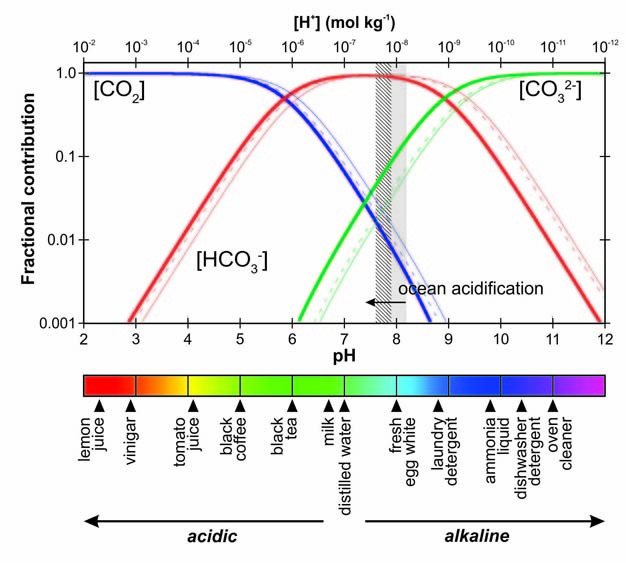
- The Undisputed Science: The illustration shows how CO2 breaks down into 3 different molecules when CO2 combines with water, collectively called Dissolved Inorganic Carbon (DIC). First one of water’s H+ ion pops off to form Bicarbonate ions. Bicarbonate ions now contribute over 90% of the oceans current DIC (red curve) . Another H+ proton pops off to form Carbonate ions which constitue ~9% of DIC (green curve). No more than 1% of invading CO2 remains as CO2 (blue curve).

The added H+ ions can make the water more acidic. The pH scale indicates H+ concentration. At pH 2 there is 1 part H+ for every 100 (102) parts water. At that low pH, there are so many H+ that they are more likely to re-join bicarbonate ions, nearly 99% of the DIC remains as CO2. At pH 10, H+ ions are rare, 1 part H+ for every 10,000,000,000 (1010) parts water. With so few H+ to re-join carbonates and bicarbonates, DIC is ~ 90+% carbonate ions.
Distilled water has pH 7. It is considered the neutral pH because the H+ ions that pop off a water molecule are balanced by the negative OH- ions (alkalinity). In comparison, ocean water at pH 8.1 is 10 times less acidic than distilled water because the Bicarbonate ions and Carbonate ions are great buffers that can re-join with H+ ions and prevent the water from becoming as acidic as distilled water.
- The Dissolving Snail Shell Hoax: This is NOAA’s insidious illustration of a dissolving shell of a dead sea butterfly in 7.8 pH water, a pH that models predict will occur from continued burning of fossil fuels.

First, consider that living sea butterflies’ shells, and virtually every mollusk shell, have a protective organic covering that prevents any shell dissolution. Likewise living coral polyps protect their reef skeleton.
Second, consider that the dead shell would have dissolved faster in the more acidic pH 7 of distilled water. Thus the addition of CO2 and its buffering molecules actually slow down any shell dissolving by maintaining ocean pH at 8.1 to 7.8.
- The Reduced Calcification Hoax: Shells and reefs are made of calcium carbonate. The hoax abuses one true scientific factoid: At a lower pH, the added H+ ions will re-join with the ocean’s buffering carbonate ions. That reduces sea water’s available carbonate ions by converting them to bicarbonate ion. So, alarmists’ falsely claim acidification will reduce seawater’s carbonate ions, making it more difficult to make calcium carbonate shells or reefs.

The truth is: not a single researcher has detected in any shell or reef making organism an ability to import carbonate ions directly from sea water to make their shells or reefs. They all only import CO2 and the abundant bicarbonate ions, which they then convert internally to a carbonate ion.
As in the illustration of the steps in coral calcification, CO2 (highlighted by blue rectangle) which has no charge, freely passes through the corals outer lipid membranes. Once inside, an enzyme converts CO2 into bicarbonate ions which traps bicarbonate ions because charged ions cannot pass freely through membranes.
Then, special bicarbonate transporters (highlighted by green rectangles) allow bicarbonate ions to pass through membranes and into the space where the reef skeleton is made. Again, no carbonate transporters have been detected to allow import of carbonate ions.
In contrast, the calcium pump imports calcium ions for reef making directly from the seawater, but because they are positively charged, they must also pump H+ ions out of the reef making space to maintain an electrical balance. Conveniently, pumping H+ ions out also raises internal pH and causes the imported bicarbonate ions to convert to the required carbonate ions. The shell-making chemistry of all mollusks is very similar.
Finally, the calcium and newly converted carbonate ions combine to form the calcium carbonate building blocks for reef skeletons and shells.
Thus, any acidification that converts sea water carbonate ions into bicarbonate ions is actually helping reefs and shell-making which only absorb the critical CO2 and bicarbonate ions. Knowing the real science, I can no longer trust the IPCC or NOAA’s acidification alarmism misinformation.
I’ve long thought that coral, mollusc and other sea life extract CO2 from water, salt and fresh, and ends up as chalk, limestone and marble. That’s why ocean acidification came across as a scam to me
Amazingly, despite what we are told, the oceans are not boiling and one can still pick up sea shells at the sea shore.
Who are you gonna believe? The “peer-reviewed” publications, or your own lying eyes?
The truth is: not a single researcher has considered water hardness, nor would it seem that Magnesium figured much in their deliberations.
Alkalinity is not all.
Are you contending that ALL of the researchers who have studied seawater hardness are married? I’m not sure you can support that argument. Can you show us your data?
Anyway, the researchers who study seawater content, no matter their marital status, have given us the following numbers, including Magnesium:
Seawater typically contains:
“Are you contending that ALL of the researchers who have studied seawater hardness are married? “
Did I say that? Er, no.
W.O.T.
Wordplay using a different meaning for “single” researchers
Some researchers, the boiling ocean types, are divorced from reality.
You can’t be divorced from someone/something you were never married to in the first place. I would submit the boiling ocean types have never even seen reality, therefore they can’t be divorced from it.
Then they are living in sin. 🙂
In rebuttal, here’s the real TRUTH:
“Seawater is considered to be very hard due to various dissolved salts. Typically seawater’s hardness is in the area of 6,630; ppm (6.63 grams per litre). In contrast, freshwater has a hardness in the range of 15 to 375 ppm.”
source: https://en.wikipedia.org/wiki/Hard_water
Investment of time to find the above: less than one minute. 🙂
Hardness and pH/alkalinity are not the same, although somewhat related. Hardness measures the amount of minerals, while alkalinity is a measure the negative ions that can neutralize H+ ions.
Dissolved salts like NaCl do not add any significant alkalinity. It dissociates to Na+ and Cl- but If Cl- joins an H+ ion forming HCl it quickly dissociates again. That’s why HCl is considered a strong acid. Bicarbonate and carbonate ions have a relatively stronger bond to H+ ions but depends on the concentration of H+. Carbonic acid is a very weak acid. That’s why bicarbonate and carbonate ions are the primary determinant of ocean alkalinity.
Mr. So: Yeah, but the topic is, was that researcher single?
Sorry, couldn’t stop my fingers.
Sure . . . I saw Roy Martin’s above post to that effect . . . darn English language!
From my earlier years, I can confidently state that most single males (and in fact quite a few single females) numbered among “researchers” are quite well acquainted with hardness . . . again, darn English language.
And to paraphrase Jim Steel’s above response to me:
“Hardness and p(-OH groups)/alcohol are not the same, although somewhat related.” 😜
Wikipedia …
https://en.wikipedia.org/wiki/PH
I guess it is technically correct to use the word “acidification” to describe this process but … neither pH 8.15 nor pH 8.05 waters are acids. pH 7.0 is neutral and anything below pH 7.0 (pH 6.99 and below) is “acidic”. Any pH value above pH 7.0 (pH 7.01 and higher) is “basic”. So, when the “average pH of the ocean surface fell from approximately 8.15 to 8.05” it became less basic.
“Acidification” garners more support for the warmanistas. “Less basic” is less scary.
The same holds true in medicine when a reduction in alkalinity of blood outside the normal range is called acidosis with the increase in alkalinity above normal is alkalinosis. The same mechanism observed in the oceans is observed in human blood.
Exactly, in chemistry increasing the H+ ion concentration is ‘acidification’. Normal blood pH is about 7.40, dropping to below 7.35 is termed ‘acidosis’ and levels below that can be critical illness, as low as 6.80 is usually fatal.
ONLY, when the pH starts at 7 and declines. If the pH starts at 14, one only reduces the pH until such time as it is neutralized.
However, the words being discussed are “ocean acidification,” not acidosis or alkalinosis, which are different processes in a different environment. The processes are analogous, but are not applicable to chemical reagents or sea water.
There is absolutely NO WAY they could have had a measurement accurate to 0.05pH in 1950 for “world’s ocean” pH !!
There is absolutely NO WAY they have measurement accuracy for the world’s oceans to 0.05pH even now.
The statement is absolute balderdash !
ps. The statement is agenda-derived from the erroneous application of increased atmospheric CO2… NOT from any measurements.
It’s models, virtually all the way.
Yes your statement is “absolute balderdash”! pH changes in seawater samples down to 0.001pH are possible. https://pubs.acs.org/doi/10.1021/acssensors.0c00031#:~:text=(8%2C9)%20Potentiometric%20seawater,10)%20or%20about%200.2%20mV.
‘
In 1950? Before transistor and FET components were in common use in instrumentation?
According to the abstract the precision of the instrument is actually +-0.067 pH units in seawater.
The assertion that the pH of seawater has fallen by 0,1 pH since 1950 is nonsense.
“According to the abstract the precision of the instrument is actually +-0.067 pH units in seawater.”
No it actually says ±67µpH
Not in 1950.
Not now in “whole of ocean” …. not even remotely possible.
Wake up to reality, if you are capable of doing so.. !!
There are many places where pH varies within a large range even on a daily basis.
Interesting that Graemethecat’s misreading of the precision of the instrument (1000x too high) gets 7 upvotes, whereas my correction of the value gets 6 downvotes!
Phil what you have mentioned is the reporting precision of modern instrumentation (but not the uncertainty), and you did not mention that if you move 2m from your sample point, you will report a pH difference of 0.5 to 1.0 in the pH encountered.
The late Prof Philip Lloyd (known on this site as The Nutty Professor) told me that it is basically impossible to tell what the pH of the ocean is because it varies a lot within a few metres.
Further, Phil, it is extremely unlikely that anyone knew what “the pH of the oceans” was with any degree of precision or accuracy in 1950. Any proper study of this metric would have to report the values encountered in the “additional data” supplements. The values will be all over the place so the STD DEV has to be censored to make reports seem precise. That is also not reported.
Note that the citation of a pH of 8.15 has no uncertainty attached to it, so it is not a proper scientific report and would fail to get published as such. Similarly, the figure of 8.05 has no reported uncertainty either, ditto for getting published. What is the Sigma 3 value?
Consider the instrument quality alone: If it is 8.15 ±0.51 (before considering measurement variability) then I could believe it. New measurements resulting in a value of 8.05 ±0.31 (slightly better precision in the modern era) I can also believe, but they are not statistically different.
All the claims for ocean acidification are reported in an unscientific manner in order to create alarm. That is obvious. When reporting thousands of measurements there has to be a standard deviation reporting the variability of what was found, and an uncertainty which is rooted in the instrument’s limitations. Absent these two qualifiers, “ocean pH” is pretty much you want it to be.
“When reporting thousands of measurements there has to be a standard deviation reporting the variability of what was found, and an uncertainty which is rooted in the instrument’s limitations.”
Thank you! I never believe anything in climate science today because standard deviation and measurement uncertainty of the data is *NEVER* addressed. The only thing that ever gets addressed is basically sampling error when calculating averages, i.e. standard deviation of the sample means. If you don’t know how accurate those sample means are then their distribution is meaningless.
You simply *never* see a measurement given as “stated value +/- uncertainty”. The meme in climate science is that the stated value is always 100% accurate. All uncertainty (be it standard deviation of the measured values or instrument uncertainty) is assumed to be random, Gaussian, and that it all cancels out!
Idiot….. we are talking of “whole of ocean”
Here is a chart of all ocean surface pH reading done since the pH measurement was possible, up to around 2010
They are very sparsely located and vary considerably..
…. if anything.. there is a slightly increasing trend.
But there is absolutely NO WAY that these represent “whole of ocean”
You have provided a good example of why the forced acceptance of the term “ocean acidification” is a bad idea and poor science. Your linked article is about achieving high precision in the measurement of changes in pH. Referring to “ocean acidification” has no added value when the topic is Delta pH. It may even be confusing by raising the question of if the approach only works with acidic solutions, or works better with them.
“pH changes in seawater samples down to 0.001pH are possible.”
According to the alarmist study that you gave in link :
” While they remain the gold standard, the precision of potentiometric pH probes is limited because potential drifts/uncertainties (up to 0.02 pH units per day) may become difficult to distinguish from the desired change in pH.”
0,02 pH unis of incertainty for the best current instruments !
Exactly, that’s what they said in their intro., which is why they introduced the modification to the design:
“Direct potentiometry has been in use for over a century for the determination of pH. While it remains the gold standard, it does not provide the precision required to assess very small pH changes in important applications such as ocean acidification. We have shown here that potentiometric pH probes can be made orders of magnitude more sensitive by imposing the potential change at the pH electrode over an electronic capacitive element placed in series while maintaining a constant cell potential. The resulting current transient required to charge the capacitor with the same potential amplitude (of opposite sign) is much easier to identify and isolate than a potential–time trace. The precision of this technique is found to be extraordinary,“
My emphasis.
Phil, combine the uncertainty of the instrument readings and the drift, then add the measurements in the chart not far above showing the large variation in the measured values, then report the pH with its ±n.nn value and a p value of 0.01. Oops, that is not nearly precise enough. It would be necessary to report the p-value at 0.001.
Here is a brief lesson on testing a hypothesis and rejecting the null hypothesis:
https://www.statology.org/p-value-less-than-0-001/
The null hypothesis in this case is that the pH of the oceans has not changed since 1950. I don’t think anyone can prove it has, with confidence.
Here is an article on statistical significance, p-Values and the reporting of uncertainty:
https://www.gsb.stanford.edu/faculty-research/publications/statistical-significance-p-values-reporting-uncertainty
In terms of interesting precision, the chemical method for determining the CO2 concentration in the atmosphere is very, very precise. It was used well into the 60’s. Measurements using this method in the 19th Century report that it was frequently above the current 420 ppm, similarly, in the 20th century. When the Hawaiian measurements started in 1957, the NDIR instrument used was not nearly as precise as the chemical methods of the day. the concentration is quite variable. Being precise is not enough to get a useable report.
In climate science precision and accuracy are the same thing. The more digits the instrument can read out the more accurate the reading. It would seem that most in climate science never took a physical science lab course at all.
You are 100% correct. The pH values are all based on computer model projections.
The trick is to use models as if they were measurements and then claim these data show that the theory is correct. They are using the output from their theory as evidence their theory is correct.
The pH scale was invented about 1919 by Soren Sorensen, a Danish chemist. The first pH meter was invented about 1935.
The idea that we have enough measurements to make meaningful statements about ocean pH is, as you say, balderdash.
More …
How Do You Measure the Acidity (pH) of the Ocean?
The short answer
Different instruments, ranging from hand-held devices to large sensors mounted on ships, measure the acidity of ocean water, by either measuring the amount of positively charged hydrogen ions in the liquid or detecting the color of a pH-sensitive indicator dye added to the solution.
https://www.nist.gov/how-do-you-measure-it/how-do-you-measure-acidity-ph-ocean
Much more at the link.
In that link, NIST appears to equate acidity and pH. At the pH of sea water, [H+] is <10E-7, i.e., virtually non-existent, as is shown on the diagram above. That is how they can claim that “0cean acidification” can change the acidy by 30% because a very small change of a very small number can be quite large on a percentage basis.
But the other thing that diagram shows is that bicarbonate ion is the dominant acid in sea water, it’s concentration being more than two orders of magnitude greater than that of [H+]. I believe the second most abundant acid in sea water is boric acid, and it’s in measurable concentrations, again much higher than [H+].
The alarmists are again being deceptive. Consider the pH of Perrier is about 5.5, so [H+] in Perrier is about 300 times greater than in sea water, 30,000% higher.
Exactly!
Why are almost all carbonated drinks acidic . . . a pH <7 is needed to be able to have any significant amount of gaseous CO2 dissolve into and remain available to “fizz out” of the carbonated liquid once the pressure in the bottle is reduced to atmospheric.
One example “to celebrate” with the upcoming season: champagne has a pH typically in the range of 2.5 to 3.0 🍾
I recall some time way back reading a paper claiming to measure acidification by the Great Barrier reef. The paper mentioned pH levels measure in 0.01 units. Curious, I looked up the specifications for the pH meter used in the study. Sure enough, the meter did indicate in 0.01 units of measurement. I then looked at the specifications for the meter and the manufacturer indicated that the error factor for the meter was +/- 0.1 units.
Far too many take the last digit displayed as the measurement uncertainty of the device. In this case the value in the hundredths digit is actually UNKNOWN if the measurement uncertainty is in the tenths digit.
It is truly dismaying that so few today know how measurements should actually be stated. It should always be “stated value +/- measurement uncertainty”, never just the stated value by itself. In this case stating the ph as 7.01 +/- 0.1 would immediately show that the hundredths digit is actually UNKNOWN.
Stated values should never have more significant digits (i.e. more decimal places) than the measurement uncertainty.
This obvious fact escapes most or all climate “scientists”, who are clearly unacquainted with Metrology.
Ocean water is not acidic. It is, by definition, alkaline. How do you measure something that is non-existent? Those advocating for the acceptance and use of the formerly unknown term “ocean acidification,” are putting their agenda before clarity in their writing. The term creates all kinds of conceptual problems. Sea water is not composed of H+ ions exclusively, which would justify such a terminology. Rather, sea water is a mixture of H+ and OH- ions that vary inversely in proportion. Furthermore, the behavior and properties of solutions with an excess of H+ ions is different from solutions with an excess of OH-. Their priorities are corrupting chemistry to advance their agenda.
http://wattsupwiththat.com/2015/09/15/are-the-oceans-becoming-more-acidic/
I agree rovingbroker. We can technically say it’s getting warmer when temperatures rise from 30F to 32F, even though its still outside. Because the word acidificationI can be used technically to show a decrease in pH, I think it is a waste of time to belabor the use of the word acidification.
The way alarmists suggest that a slightly lower pH is dissolving coral and shells and preventing calcification and alleging CO2 is catastrophically destroying marine ecosystems, it is pushing that narrative is what is so evil and what we skeptics need to counteract with the truth. That is what this article attempts to show.
I couldn’t agree more that it’s a waste of time to belabor the semantic point. ‘Acidification’ can be legitimately understood as any reduction of pH, just as ‘warming’ could include temperature rising from a frigid -80C to a still-frigid -79C, even though it doesn’t result in ‘warm’ conditions.
What is objectionable is the propaganda usage of ‘ocean acidification’ where the goal is to give the false impression that seawater is turning into something akin to battery acid. (Just as the goal of saying that Antarctica is ‘warming’ is to induce the reader to erroneously assume that Antarctica is ‘melting’).
The most successful liars make heavy use of truth. A lie that doesn’t seem true fails to deceive.
Nope
Who could argue with such brilliance? I must apparently concede!
Actually, no, the correct scientific term is “neutralization” ie bringing a solution closer to pH neutral (pH =7). A solution can only be “acidified” if it is already less than a pH of 7, because until neutral pH is reached it is still basic and neutralization is making a basic solution less basic and an acidic solution less acidic.
The use of the term “acidification” instead of “neutralization” of basic solutions is not scientific but rather is propagandistic, because “acidify” sounds a lot scarier to non- scientists than “neutralize”. It’s mere rhetoric designed to scare people.
Take a cup of the most alkaline water available. Add a half cup of concentrated hydrochloric acid. Have you not just acidified your container of water, regardless or whether or not you could detect any instantaneous point of pH 7?
Alkalinity is not basic. Alkalinity is a measure of the buffering capacity, the ability to “neutralize” both acids and bases, and thus resist pH changes. Adding acid to a basic solution can only “acidify” if it exceeds the alkalinity of a basic solution and then take it to less than pH 7. Ditto with adding acid to an acidic solution – the acid can only reduce pH (acidify) after the alkalinity or buffering capacity of the solution is used up.
You are correct to point out that the intent is to deceive. That’s the relevant point that we legitimately rail against.
Saying that there’s only one word for describing an action (‘neutralization’ rather than ‘acidification’) is not correct. If I prefer to say that the temperature going from -15° to -5° is ‘defrosting’ instead of ‘warning’, that doesn’t give me license to claim that warming only applies when the final state can be described as warm.
It’s the deceptive intent that should be our concern, not policing semantics.
Which word means melted ice? Wasser, water, eau, agua, or vann? (Natürlich darf man NUR Wasser sagen!)
As regards Wikipedia’s flat out statement: “Between 1950 and 2020, the average pH of the ocean surface fell from approximately 8.15 to 8.05”, I can’t help but wonder how much of that 0.1 absolute change in reported pH might be due to:
— a more representative sampling of Earth’s oceans over the intervening 70 years?
— improvements in the accuracy of ocean pH measuring instruments over the intervening 70 years?
— a change in the range of depth of water defined to be “surface” over the intervening 70 years?
— a change in how “averaging” pH across all the world’s oceans was made during the intervening 70 years?
As but one example, I can easily believe that there was a step-change in reported “average pH of the oceans” once the data from some 3,000 Argo floats became available (circa 2007).
Also, what uncertainties are hidden underneath the word “approximately”?
For this last question, I found this partial answer about Argo float pH measurement accuracy:
“The results point out noticeable discrepancies near the surface of > 0.01 pH units. In the context of converting surface ocean pH measurements into pCO2 data for the purpose to derive air-sea CO2 fluxes, we conclude that the minimum accuracy requirement of 0.01 pH units (equivalent to the minimum pCO2 accuracy of 10 µatm for potential future inclusion into the SOCAT database) is not systematically achieved in the upper ocean.“
source: https://bg.copernicus.org/preprints/bg-2023-76/bg-2023-76.pdf
(my bold emphasis added)
Argo floats use some of the most accurate and “stable” pH measurement instrumentation currently available, so any reporting of ocean surface pH to an assumed accuracy of 0.01 is scientifically unsupportable.
However, such assertions do fit the meme of CO2-caused ocean “acidification” as fronted by the IPCC and NOAA. It figures.
The real question to be asked and answered is, “How is the pH of the world’s oceans measured?” The answer would include the method of measurement, frequency of measurement, locations of measurement and how the many data points are reduced to a single numerical value?
Me thinks the data does not support the likelihood that any change of pH has occurred during the Argo float period.
I understand your argument for the technical correctness of the use of “acidification” in the context of seawater. Even the online Oxford dictionary supports it:
“the action or process of making or becoming acidic.
Example: the acidification of Arctic seas threatens organisms”
So, now, as an Earth Scientist, I need to argue not only against the warmists, I need to argue against the revered institution of Oxford. I’ll use the assistance of the revered institution of the Britannica Dictionary, which says:
Britannica Dictionary definition of -ATION
: the action or process of doing something
So “acidification” means ‘the action or process of’ becoming acid (from being alkaline or neutral), or increasing an existing state of acidity.
“Ocean acidification” is considered legitimate (by some) because seawater is becoming less alkaline. If it continues from ~pH 8 (alkaline) to pH 7 (neutral) and CONTINUES to < pH 7 (acid) then this is legitimate. Those who push the idea of “ocean acidification” as something real are pushing the implied assumption that the presently alkaline seawater will AT SOME TIME IN THE FUTURE become acid. There is no observed mechanism in the ocean that would allow this to happen.
That the ocean may at some time in the future become acid is not even a legitimate hypothesis. No on has seriously proposed it, or suggested any method by which it could happen. (I personally have looked in exquisite detail at miles of sedimentary drill core from the Archean to the Present, much of that rock deposited in environments with much more CO2 in the air than today, and have never seen a deposition environment caused by acid seawater.)
Ocean acidification is not real in nature, nor is it ever likely to be. The ocean will never become acid under existing conditions. Catastrophists may argue that we could be hit by a giant comet ice ball with the volume of the ocean and a pH of 1, and I’ll agree with them. We could. I’ll wait.
was the term acidification not in use as meaning any lowering of pH long before climate science was invented or ocean pH measurements were started?
As someone who used to teach chemistry about 50 years ago, I would say, “No.”
By some and not by others. This is the question of our times: are you big endian or small endian? There’s only one right answer.
The reference should have been to little endian, with apologies to the emperor of Lilliput.
Is that not a model result rather than a measurement result?
Once again, Wikipedia has published something that raises questions about their neutrality. Those working in this field have rejected all the historical ocean measurements, and the quoted claim is based on a model that advances their agenda.
Among chemists, lowering the pH of an alkaline solution, or conversely, increasing the pH of an acidic solution, is usually referred to as “neutralization.” Strictly speaking, only a neutral solution can be acidified. The exact same procedure that results in acidifying a neutral solution, by titration with an acid, will only reduce the pH of an alkaline solution; it remains alkaline!
From a grammatical viewpoint, it makes no sense to claim that alkaline solutions become ‘more’ acidic when their pH is lowered. To have “more” of something it must exist in the first place. What is critical is the ratio of H+ to OH- ions. When the ratio = 1:1, the solution is neutral. When the abundance or concentration of H+ is greater than OH-, then the solution is acidic. The calculation of pH is a shorthand for stating the relative abundance of the two species. Those advocating the use of the term “ocean acidification” are either ignorant of the implications of the definition, are purposely corrupting the term to advance their political agenda, or are just being careless in their choice of words.
“From a grammatical viewpoint, it makes no sense to claim that alkaline solutions become ‘more’ acidic when their pH is lowered. To have “more” of something it must exist in the first place.”
Exactly, and seawater does have H+ ions present, reducing the pH by 0.1 means the the H+ concentration has increased by ~30%, i.e. there is ‘more’ of it present in the new state.
Link to the research the author did? Or his sources?
Would be nice.
Yes, MyUsername. Especially the source that led him to claim “At pH 2 there is 1 part H+ for every 100 (102) parts water.”
I’m afraid I had to stop reading at that point.
The pH scale is derived from the pKa of water, which is the auto-disassociation constant into hydrated H+ ions and OH- ions. Specifically the negative log (base 10) of the H+ ion concentration.
When changing the pH of an aqueous system the concentration of the bulk water is, in fact, usually ignored because it effectively doesn’t change at all.
A few drops of a strong acid or alkali can change the pH of a bucket water from one end of the pH scale to the other. The change in total volume in the bucket is tiny because most of it was, and still is, water.
Exactly.
Michael, Sorry you stopped reading, you missed the important content.
What is really confusing is why such a trashing of the whole article when I explained the standard formula pH = −log [H+] into terms more easily understood by lay people.
So explain exactly why saying pH2 represents 1 part H+ for every 100 parts water and simply the concentration. And when you add in the pKa term when it is unneeded it simply appears as if you are grandstanding some self-perceived superior knowledge.
Michael is correct that the bulk water concentration is usually ignored because its concentration is effectively invariant.
I don’t like doing math at my age half into my coffee, but for pH = 2, [H+] = 0.01 mol/L. For 1L of water, we have (1000 g)/(18 g/mol) = 55.6 mol. So, at pH = 2 the ratio of H+ to H2O is 1 part to 5560 parts.
. . . except for the fact that the definition of pH (with respect to aqueous solutions) is based on moles of H+ per liter of water (or per kg of water), aka “hydrogen ion activity”.
The equation for determining pH is NOT based on mole of H+ ions per mole of water. See the attached screen-grab of definition and formula for calculation of pH as provided by https://en.wikipedia.org/wiki/PH
Sorry, the attached screen grab wasn’t readable. Try this one instead:
I didn’t say it was based on mol H+ per mol water. I clearly specified the units as mol/L.
Yes . . . but why then the obfuscation with your following text, verbatim here:
“For 1L of water, we have (1000 g)/(18 g/mol) = 55.6 mol. So, at pH = 2 the ratio of H+ to H2O is 1 part to 5560 parts.”?
What is so difficult about expressing concentrations in Molarity (moles per litre)?
It depends on who you are talking to and what you wish to convey. When you talk to the average person about chemistry about moles, or negative logs their eyes glaze over. Converting to grams and their lost.
So I simplified, to simply show that a higher pH means H+ concentration becomes much lower. My intent was to show as H+ concentrations increase the probability of H+ re-joining bicarbonate or carbonate ions increases. My intent was not to deep dive into pH in terms of grams or moles.
If I said pH 2 =0.01 moles/L and ph10= 0.0000000001 moles/liter we could avoid all the niggling.
I think you underestimate the numeracy and scientific understanding of the WUWT readership.
Most non-technical people are completely clueless about anything to do with numbers, especially very big or small numbers. Perhaps a simpler and better way of explaining the buffering effect of hydrogencarbonate ion in seawater would be to state that its pH is essentially insensitive to changes in atmospheric CO2.
Graeme, I think you misunderstand who I am writing for. This article was for X(twitter) which has gotten 37,000 views in 24 hours, and also sent here to WUWT.
Sadly , the technical people here have only focused on the term “acidification” and how to talk about pH, while missing the whole point of the article and I did indeed underestimate their inattention to the main issues. I expected and hoped for discussion on the 2 main points of this article:
Jim, narcissists jump on any chance to prove their superiority. Their goal is not to educate but to beat down others for their own emotional gratification. They are the enforcers of the “no good deed goes unpunished” law.
Thanks Dave. Indeed. I’ve been posting to WUWT for over a decade. Sadly it often feels as if discussions have devolved away from us skeptics exposing the alarmists’ misinformation, into a battle of egos by skeptic geeks.
Jim, thank you for all of the good work you are doing. It does have a positive impact on the climate discourse. Keep it up and maintain your sanity and obvious humor.
Good comment Dave. I usually end up getting pissed off reading the absurd comments on Jim’s articles. Truly, he casts his pearls before swine.
In other words, NOAA is deceiving the public about CO2 and the oceans.
It’s outrageous. The political partisans at NOAA, pushing their scaremongering climate crisis narrative, are harming a lot of people.
Our government agencies need serious reform and new personnel.
You remember about watering the Tree of Liberty? It is a somewhat daunting process, not undertaken lightly by most people.
Jim, I only jumped into the discussion because I was appalled that supposedly scientifically minded readers were somehow OK with pushing the term “ocean acidification” on an innocent public.
As to the points you made in your article, there wasn’t much to discuss since you made those points quite well and hammered them home with elegant simplicity. Something that a layman can understand.
I was saddened to see how much pushback you got on X from some individuals who should have known better, and somehow missed the point. But I was delighted to see you point out that the Cretaceous CaCO3 build-up of the White Cliffs of Dover occurred while the atmosphere had 50 times more CO2 than at present, quite dramatically illustrating your point. That fact alone should be enough to cause any wild-eyed, rabid warmist, raving and weeping over dying sea life boiling away in acid, to pause, drop their shoulders, and say, “Oh. Alright then. Never mind.”
Thanks Nevada,
And don’t be saddened by the X push back.One reason I now target the twitter crowd is to see what issues trigger the blind beliefs of the general alarmist crowd. The pushback lets me know I’m not just talking in an echo chamber and only preaching to the skeptic choir.
Correct.
I appreciate the need to simplify for the chosen audience, however it’s still important to be accurate. The poster’s objection was the erroneous statement that “At pH 2 there is 1 part H+ for every 100 (102) parts water”. Had you said that there were about 1 part H+ for every 5000 parts water there would be no problem.
Graem don’t you know it’s moles per LITER? Wait, I mean gallon.
What’s the matter with you? Are you some kind of damn foreigner?
There’s only one right way to express a thought. MY WAY.
For “1 part H+ for every 100 (10^2) parts water”, as understood to be on a molar basis, and using the definition of pH:
pH = – log-base-10(concentration of hydrogen ions) = – log-base-10(1/100) = 2
IOW, Jim Steele’s statement was and is correct.
One does not need to “cite a source” when using well-established scientific definitions and related equations.
It’s unfortunate that truth tripped you up and you “had to stop reading at that point”.
As for you statement: “A few drops of a strong acid or alkali can change the pH of a bucket water from one end of the pH scale to the other” . . . ROTFLMAO.
As for you statement: “A few drops of a strong acid or alkali can change the pH of a bucket water from one end of the pH scale to the other” . . . ROTFLMAO
Actually, that’s a true statement. Take 10L of water (pH 7) and add 1ml of concentrated hydrochloric acid (approximately 10M in HCl, therefore containing 0.01 moles of the latter), and the pH drops immediately to 0.01/10 = 0.001M,or pH 3.
OK . . . but “from one end of the pH scale to the other” would be a total pH span of 0 to 14, or at least a span from 7 down to 0 if you wanted to assume the bucket of water started at a pH =7.
Since we’re dealing with a logarithmic scale, a pH of 3 is still a LONG way from a pH of 0 or even 0.1. Not even close enough for grenades, as the saying goes.
It doesn’t seem like you’ve worked with acids and pH meters or done titrations. A fraction of a drop can make a huge difference in a non-buffered solution.
A few of us here have been there and done that.
Congratulations.
However, your conclusion in your first sentence is incorrect.
You’re not showing your complete work, so I can’t determine where your error is exactly, but it appears that from a statement that you made above, you think that 1 L of water = 1 mol.
1 L of water actually = 1 kg/18 g/mol = 55.6 mol. For sea water it’s actually a little less because of salinity. The molarity of pure water is 55.6 mol/L.
So, for pH = 2 we have, 0.01 mol/L [H+] : 55.6 mol/L [H2O], which is 1 to (55.6/0.01) or 1 to 5560. Again, it would be about 1 to 5360 for sea water, but still not 1 : 100.
Sorry for your difficulties in comprehension.
I clearly posted above at December 1, 2023 9:05 am:
Key phrase: “based on moles of H+ per liter of water (or per kg of water)”
MyUse, There are many sources for different dynamics so not clear what you are specifically seeking.
Regards the dissolving sea butterfly shell hoax, you can read several papers by Victoria Peck from the British Antarctic Survey. Start with her most recent paper Sea Butterflies Defend Their Homes Against an Acidic Ocean which is very informative and least technical. One point she mentions is how thin their shells are. “The homes of these pteropods are incredibly delicate shells made from calcium carbonate. Pteropod shells are about 1,000 times thinner than 1 mm—even finer than a human hair. ‘
Such a thin shell is why alarmists chose the sea butterfly to show dissolution.
Should be called “Ocean Neutralization” if we’re being scientifically accurate, but obviously not scary enough for alarmists. They are always caught between trying to stay within shouting distance of the truth while lying egregiously enough to frighten the public.
This is how the ‘experts’ at Yale describe it.
“Remember the pH scale from elementary school? There is a number 7 in the middle. Everything lower than 7 is acidic, and everything higher up the scale than 7 up to 14 is basic. Before human activity the ocean was 8.2 on that logarithmic scale, and we have now moved down by one pH unit to 8.1. The ocean is still basic, as it is still to the right of that value seven, but it has moved towards the direction of more acid – which is very serious”
I’m really worried now 🙂
https://sustainability.yale.edu/explainers/yale-experts-explain-ocean-acidification
The ocean is still basic, as it is still to the right of that value seven, but it has moved towards the direction of more acid – which is very serious”
What a fatuous statement, even if true (how do we know the pH of the oceans has dropped by 0.1 pH unit?)
“my model told me so” is the tune every one of them sings.
“Before human activity the ocean was 8.2 on that logarithmic scale, and we have now moved down by one pH unit to 8.1″
There is absolutely NO WAY that they can know this.
It is model-based FICTION based on the assumption of increased atmospheric CO2 changing ocean pH.
In fact, a compendium of all surface pH reading since the first possible until about 2010 (when graph was done) shows a slight INCREASE in pH
From what I’ve read, it is rather well know that there is a large seasonal swing in pH value, at least in many parts of the ocean and a fairly wide pH difference depending upon water temperature, i.e. higher pH towards the poles.
That is what I mean by them not having a chance in Hades of knowing what the whole-of-ocean pH is now…. or in 1950..
… or if there has been any change.
Any statement saying that they do know, is based on fabricated nonsense…
… a total fantasy.
The largest seasonal swing is up in the Arctic. The Barrow measuring station shows a fluctuation in CO2 of about 20ppm whereas the fluctuation at Mauna Loa is ~6ppm. The CO2 drops very fast once the ice breaks up in the spring as it dissolves in the cold seawater and reducing the pH. Consequently the Arctic has the lowest pH measured. Very low seasonal swing at the S Pole because it’s always over ice.
Makes a lot of sense. When the temperature of the air drops from 80 degrees to 75 degrees, my mother-in-law (91 years old) says it is freezing. Until the warmistas started talking about boiling oceans and acidic oceans I thought she was crazy. Now I get it.
First and last sentence are tongue-in-cheek.
Some may think it funny but unless one is skiing, warmer is much nicer.
And spring skiing on corn snow can be great too.
I’ve seen more than a few claims that start by reversing the truth, never coming within viewing distance.
All of the warmunist hoax is built upon fake science. They claim to be science believers and the rest of us condemned as science deniers ..when the truth is the exact opposite is what prevails today.
Typical propagandists’ trick – take your biggest weakness (in this case, lack of any scientific basis for their science claims) – and then proclaim their opponents are guilty of the same thing in order to put them on the defense.
Good write up. To me, the notion that the oceans would turn to acid based on the relative pittanceof CO2 in today’s atmosphere has never been credible. It certainly didn’t happen in the distant past when life flourished with far higher CO2 levels than now.
The mere use of the term “acidification” to describe a change that would more accurately be described as “ever so slightly more basic” shows it to be scaremongering propaganda and not science.
Excuse me that should be “ever so slightly LESS basic.”
No, a decrease in pH from 8.2 to 8.1 is an increase of about 26% in H+ concentration so more acidic.
‘Corals first appeared in the Cambrian about 535 million years ago’
Wikipedia
Very different reef makers all together in the Paleozoic. It is not known if the rugose and tabulate coral of that era had photosymbiotic zooxanthellae algae as modern corals do.They virtually all went extinct throughout the Permian. The current scleractinian coral evolved via symbiosis around the Triassic, 200-250 million years ago.
That’s still a damn long time ago.
Indeed a damn long time testifying to just how resilient our current coral reefs are, as they have adjusted to over 200 million years of climate change, from dinosaurs and palm trees covering parts of Antarctica to now Antarctica being covered by an ice cap.
“To me, the notion that the oceans would turn to acid based on the relative pittanceof CO2 in today’s atmosphere has never been credible. It certainly didn’t happen in the distant past when life flourished with far higher CO2 levels than now.”
At the time of the Paleocene-Eocene Thermal Maximum the pH of the ocean dropped by about 0.45 and about one half of benthic formanifera went extinct.
“At the time of the Paleocene-Eocene Thermal Maximum the pH of the ocean dropped by about 0.45 and about one half of benthic formanifera went extinct.”
Dropped by 0,45 pH from what ?
Benthic foraminiferal went extinct because of that drop ?
What is your source ?
There are multiple sources, here’s one: https://www.pnas.org/doi/10.1073/pnas.1518116113
Mr. Steele, this is another very nice article from you. It brought back memories of the “master variable diagram” which I learned about long ago.
As a chemist, I would suggest some terminology changes to a couple of your sentences, “The illustration shows how CO2 breaks down into 3 different molecules when CO2 combines with water, collectively called Dissolved Inorganic Carbon (DIC). First one of water’s H+ ion pops off to form Bicarbonate ions.”
First, CO2 doesn’t really “break down” in it’s reactions with water (it actually grows). I would say, “how CO2 forms” carbonic acid in sea water, which dissociates into two different ions, bicarbonate and carbonate (usually ions are distinguished from molecules). {As I recall, there is debate about the stability of carbonic acid (H2CO3). It’s pretty common in chemical reactions to have so-called “intermediates” that are transient in nature.}
For the second sentence, instead of saying “H+ ion pops off,” I would say that water transfers a hydronium ion to CO2 (or possibly call it a proton, although it is more technically a H3O+ ion). The second sentence doesn’t bother me as much because in a colloquial setting, I could hear a chemist say something like that for emphasis. In writing though, I would use more technical language.
Thank you for this article.
Scissor, I appreciate your technical adjustments. But again I was writing to lay people with little chemistry appreciation. I guarantee I would have lost most of my tweet audience if I said “transfers a hydronium ion to CO2 “. To get a general appreciation of the end results, all the intermediate reactions do not need to be stated, unless I was writing for chemists.
A simple observation should be sufficient to neutralize all this “ocean acidification by CO2” nonsense. Our ocean bottoms are riddled with volcanic vents that have been spewing huge quantities of highly acidic (pH = 1.0) liquids into our oceans for millions of years. Yet, it is easy to demonstrate /measure how quickly these vent emissions are neutralized by the surrounding waters.
Another simple observation which punctures the OA narrative is that there are plenty of shelled molluscs which live quite happily in fresh water with pH of 7 or even lower.
Plus every day fish, crabs and other marine life move from the surface to the depths and in the evening move back again and both moves involve changes of pH but it doesn’t stop them from doing it.
The important part is not the seawater chemistry. It is how living organisms build their shells or (coral) equivalents—biology.
Thanks Rud, that is indeed the important part!
The above article by Jim Steele is a nice, science-based slapdown of the “ocean acidification” misinformation being fronted by the IPCC and NASA.
The top-most graph is one version of what is known as a Bjerrum plot that shows chemical equilibrium concentrations of CO2, bicarbonate ions and carbonate ions in seawater as a function of its pH.
Two things of note in this Figure 1 for clarification of Jim’s article:
1) The dark grey vertical band for pH~7.6–7.9 represents greater vertical depths of current ocean waters than does the light grey vertical band to its immediate right, pH~7.9–8.2, which applies on average from surface to about 200 m depth. The lower (but still basic) pH seen at depths below 200 m is due to natural biological processes and pressure effects.
This free-downloadable article is excellent in presenting profiles (its Figure 2) of ocean pH variation with depth, with profiling transects of the Arctic, North Atlantic-Southern Ocean-North Pacific, and South Indian oceans going to depths as great as 5000 m:
Processes Driving Global Interior Ocean pH Distribution, S. K. Lauvset, et.al. first published 05 January 2020 (available at https://agupubs.onlinelibrary.wiley.com/doi/full/10.1029/2019GB006229 )
2) As Jim notes in bold in his first paragraph: “No more than 1% of invading CO2 remains as CO2 (blue curve).”
As long as the Earth’s oceans are in the pH range of 7.6–8.2, and they are highly buffered to remain so, it is incorrect to say that all CO2 that is “dissolved” (as a gas) in ocean water is able to readily “outgas” as ocean waters warm . . . as Jim’s Figure 1 indicates, this process would only become significant for water pH of 7 or lower.
IOW, one cannot apply Henry’s Law independent of considering chemical reactions between the gas and the liquid that is absorbing it, and the fact that chemical buffering prevents such chemical reactions from being completely reversible.
“OW, one cannot apply Henry’s Law independent of considering chemical reactions between the gas and the liquid that is absorbing it, and the fact that chemical buffering prevents such chemical reactions from being completely reversible.”
The reactions are reversible, the process is:
CO2(aq) ⇌ CO2(g) (Henry’s Law)
CO2(aq) + H2O ⇌ HCO3- + H+
HCO3- ⇌ CO2– + H+
The Bjerrum plot in the posting is the ratio of the dissolved inorganic carbon species as a function of pH, this also varies with temperature. The one shown above looks like it’s probably for 25ªC.
Here’s one which shows both 20ªC (heavy line) and 0ªC (light line)
At the temperature and pH in the Bering sea in December referred to in one of posts above CO2(aq) will about equal the CO3–.
Jim: I made a time-traveling comment on your article of today, ten years ago.
https://wattsupwiththat.com/2013/09/25/ipcc-on-acid-if-they-are-virtually-certain-about-ocean-acidification-why-does-x-prize-offer-a-reward-for-designing-a-proper-ocean-ph-meter/
My comment from September 2013 included the “orphan buffer” that is rarely included in the ocean pH discussion, the borate system (Frankignoulle (1994)):
Neil Jordan
September 25, 2013 2:00 pm
Re Sabertooth says: September 25, 2013 at 11:43 am
The pH ceiling of 8.3 is explained in Emerson & Hedges Chemical Oceanography, which also explains a pH floor of 7.6, also alkaline:
http://courses.washington.edu/pcc588/readings/EH_IV_CarbSys.pdf
This reference also includes borate buffering in addition to the carbonate and bicarbonate buffering that are customarily used to describe seawater buffering.
According to Frankignoulle (1994):
http://www.co2.ulg.ac.be/pub/frankignoulle_1994.pdf
borate buffering accounts for 30% of the global buffering effect in seawater.
This issue calls out for some basic laboratory research, something like fill a swimming pool with an airtight cover with sea water. Start coral colonies with various genetic strains. Pump in and sustain CO2 to simulate the issue at hand. See what happens to the coral
It may be necessary to turn over the sea water regularly to keep all the key chemical levels stable. Similarly, O2 may need to be added as consumed and waste products removed.
Has this research been done? If not, what standing in the science world do climate alarmists have?
Woods Hole Oceanographic did the proposed experiments over a decade ago in large aquaria for a variety of common and commercially important marine organisms for a doubling of CO2, all else held constant (light, food, salinity,…). Some did slightly better, some did slightly worse. Some were completely unaffected. The references with footnotes are in the first third of essay ‘Shell Games’ in ebook Blowing Smoke.
The killer real world (not lab) example that immediately follows Woods Hole experiments in the essay is Florida Bay. Seasonally more extreme than anything the alarmists ever imagined, yet Florida Bay thrives with marine life.
The reason the alarmists never mention these experiments is because they showed there was no cause for alarm, for the biological reasons Jim carefully explained. And the second two thirds of the essay shows two alarmist papers claiming the opposite—ALARM—both based on clearcut academic misconduct. Hence the essay title ‘Shell Games’.
Excellent post! Excellent reference.
Airtight covers over living organism is often portrayed as burying alive.
It is hard for me to believe that increasing CO2 will be hard on sea creatures. During the Devonian period, roughly 400,000,000 years ago, CO2 levels were in the high hundreds and low thousands of ppm yet shelled fishes and corals evolved and flourished along with a huge variety of various not-shelled creatures. Might not more CO2 increase the variety and number of living sea creatures by making it easier for shells and bones to form?
Denis, you asked “Might not more CO2 increase the variety and number of living sea creatures by making it easier for shells and bones to form?”
That’s a very good question! My understanding is that the answer is complex and depends on many variables and interrelationships.
Here’s just a little piece of the puzzle that indicates such:
“Through biomineralization and photosynthesis by the zooxanthellae, corals are trading platforms that are both sinks and sources of inorganic carbon. Via photosynthesis, symbiotic zooxanthellae present in corals’ tissues consume CO2 and provide corals with oxygen (Courtial et al., 2021). Regarding biomineralization, the coral captures carbon dioxide and bicarbonate ions to build its limestone skeleton.
“However, during calcification, the hydrogen ions (H+), produced in the reactions (1) and (2), react with the bicarbonate ions (HCO3–) to produce CO2, in the reverse way of reaction (1). This means that the production and liberation of CO2 is induced in the coral tissue, using the excess of H+ after the skeleton formation, in order to re-establish the equilibrium (Allemand et al., 2004). Biomineralization in corals becomes a source of carbon through the release of CO2 occurring during the transformation of hydrogen ions. In fact, in the marine environment, for each unit (mol) of CaCO3 precipitated, 0.6 units (mol) of CO2 are released (Ware, 1991).
“On the other hand, coral respiration releases carbon dioxide. Although some of it is used by zooxanthellae, another part of the carbon ends up in the sea.”
— https://www.coralguardian.org/en/do-corals-store-carbon/
(my bold emphasis added)
And that’s just for corals . . . there are many more things going on the world’s oceans that involve bicarbonate and carbonate exchanges, especially as regards ocean floor sedimentation.
Overall, though, keep in mind that atmospheric CO2 entering the ocean does not remain for very long as CO2 gas in solution . . . one of the key points from Jim Steele’s article.
Gee, does that indicate the next logical step in emission control is coral control?
Good question Denis,
Studies of the Paleozoic have reported the Great Ordovician Biodiversity Event (488-443 million years ago) during which many more new photosynthesizing algae evolved (upper panel) But such evolution dwindled as new land plants sequestered more CO2. As CO2 declined gradually extinctions outweighed new originations, resulting in the Permian Phytoplankton blackout when virtually all Phytoplankton fossils disappeared.
I discussed this in “How CO2 Starvation & Plate Tectonics Caused the Greatest Mass Extinction, the Permian Great Dying”
In this study of the of ocean pH values globally,
https://www.earth.columbia.edu/articles/view/3211,
the results indicate a range of 7.74 to 8.4 with the Bering Sea being at the very acidic end of the scale. Is the Bering Sea not one of the most productive ocean environments?
Aren’t acids very useful in the chemistry lab too?
Uhhh . . . my understanding is that the “very acidic end” of the pH scale ends at 0.0, or more than some seven orders of magnitude away from a pH of 7.74.
Alternative, if by “scale” you meant reference to a pH range of 7.74–8.4, those pH values are all considered for be “basic” or “alkaline”, not “acidic”.
That is the winter value for the Bering Sea and neutral pH for water is 7.5 at 0ªC, so very close to neutral there.
“Pure water has a pH of 7 and is considered “neutral” because it has neither acidic nor basic qualities.”
— https://www.healthline.com/health/ph-of-drinking-water
pH variation with temperature at time of measurement only applies for pH that is offset 7.0, on either the acidic side or basic side . . . see attached graph
Pure water at 25ªC has a pH of 7.0 and is considered neutral because the concentrations of H+ and OH- are equal. At 30ªC the pH is 6.92 because more water has dissociated, at 0ªC the pH is 7.47 because of less dissociation, in both cases the water is still neutral.
Terminology?
“The added H+ ions can make the water more acidic.”
“More acidic” implies that the water is already acidic. Not so.
“Less basic” doesn’t give the same ‘jolt’ to the brain (acid bad), but I can’t come up with anything better.
We could of course play their game…
… and say that the slight mythical pH drop makes it LESS CAUSTIC
G’Day bnice,
“LESS CAUSTIC”
It’s truthful, it’s accurate, and has the connotation needed. Many thanks.
Many organisms have a double line of defense. They have a layer of chitin over the calcite/aragonite frame, and also use mucous over the interior ‘Mother of Pearl.’ They can also manipulate the pH at the leading edge of the shell where growth takes place. It takes chemical energy to do so, and there is an optimum pH that minimizes the energy requirement. The fact that this minimum energy requirement varies with the pH for different calcifiers, suggests to me that they evolved at times when the dominant pH was different.