Guest Post by Willis Eschenbach.
TL;DR: Ramanathan proposed that the “greenhouse effect” could be measured as surface upwelling longwave minus top-of-atmosphere (TOA) upwelling longwave. However, this ignores the contributions to TOA upwelling longwave from 1) atmospheric absorption of solar energy, and 2) surface-to-atmosphere net energy transfer of latent heat of evaporation/condensation and sensible heat. In addition, it also ignores variation in the proportion of upwelling and downwelling energy loss from the atmosphere.
In the seminal paper “Thermodynamic regulation of ocean warming by cirrus clouds deduced from observations of the 1987 El Nino” by V. Ramanathan & W. Collins, the authors proposed that we could measure the amplitude of the poorly-named “greenhouse effect” directly. They said it was the upwelling longwave energy radiated by the surface, minus the amount leaving the top of the atmosphere. The difference, they reasoned, would be the amount of longwave radiation absorbed by the so-called “greenhouse gases” in the atmosphere, principally water vapor and carbon dioxide. And this method of measurement of the “greenhouse effect” has become the general practice.
Sounds good, and I’ve used that definition without really thinking about it … but closer examination reveals that there are two problems with Ramanathan’s method.
First, upwelling longwave radiation is not the only source of energy flowing through the atmosphere. Energy enters the atmosphere from three distinct sources.
- Upwelling longwave energy from the surface that’s absorbed by the “greenhouse” gases in the atmosphere.
- Solar energy that is absorbed by the atmosphere.
- Net of the latent (evaporation/condensation) and sensible heat transfer to-from the atmosphere.
Let me start with solar energy that’s absorbed by the atmosphere. Here’s a map of the global distribution of that energy flux.

Figure 1. Average absorption of solar energy by the atmosphere.
There are some interesting aspects of this. First, the major absorbers of solar radiation are clouds and aerosols. The cloudy areas in the deep tropics are an obvious case. Less obvious is India, eastern China, and eastern US, where aerosols increase the solar absorption.
You can also see how the clear dry air over the Antarctic and Greenland ice caps means that little solar energy is absorbed by the atmosphere in those areas.
The second source of energy flowing through the atmosphere is the sensible and latent heat loss from the surface to the atmosphere. Here’s a map of where that’s happening.

Figure 2. Latent and sensible energy loss from the surface to the atmosphere. Average of CERES data, Mar 2000 – Feb 2022.
The large red areas in the oceans south of the Equator are where there are few clouds and trade winds, so evaporative and sensible loss from the surface to the atmosphere is high.
Finally, we get to the third source of energy flow to the atmosphere. This is the absorption of upwelling radiation by “greenhouse” gases. But how much is absorbed and how much passes through?
Unfortunately, the method of Ramanathan doesn’t actually tell us. Remember that there are three sources of energy flowing to the atmosphere, not just one. So the TOA upwelling longwave flux is not a simple function of the surface upwelling longwave flux. Here’s a graph of surface and TOA upwelling longwave that demonstrates their differences.

Figure 3. Upwelling longwave radiation anomaly, surface and top-of-atmosphere (TOA).
While there are some similarities, obviously there is more going on than just the absorption of upwelling longwave from the surface.
Next, here’s a comparison of the changes in the three sources of energy flux to the atmosphere.

Figure 4. Change in sources of energy flux to the atmosphere
Now, this is curious. Upwelling longwave radiation from the surface has increased. Absorbed solar flux has increased, although only slightly. But latent/sensible surface-to-atmosphere heat transfer has dropped … go figure.
This demonstrates the first problem with Ramanathan’s method—the amount of TOA longwave is a complex function, not just of surface temperature and CO2, but also of latent/sensible heat transfer from the surface to the atmosphere, and of the atmospheric absorption of solar energy.
But that is not the only problem. Here’s the second one. The atmosphere loses energy both to the surface and to space. But the proportions of energy going up and down can change over time. Here’s a graph showing changes in atmospheric radiative energy losses to surface and to space.

Figure 5. Energy losses upwards and downwards from the atmosphere
Again, a most curious outcome. There are large swings in the energy loss to the surface and smaller swings in energy loss to space. But around 2015, there was a big shift, with much more energy going downwards to the surface. Why? No clue. I can’t even guess at what controls how much atmospheric energy flux goes out to space versus how much goes down to the surface. What would determine that?
Net result of all of this?
Well, I fear Ramanathan’s method is simply not valid. There’s no reason to assume that changes in the TOA upwelling longwave radiation are a result of changes in greenhouse gas absorption of surface radiation. They are also a function of atmospheric solar absorption and latent/sensible surface-to-atmosphere heat transfer.
In closing, I fear I don’t see any easy way around this. Seems to me that to measure it directly, we’d need a long record of spectrum-resolved gridded satellite-observed radiation data so we could tell by frequency which upwelling radiation is directly from the surface and which is from the atmosphere … and unfortunately, we don’t have that.
Settled science.
Here on our hillside, blessed rain. My very best wishes to everyone,
w.
PS—Please quote the exact words you’re discussing. It avoids endless misunderstandings.
Willis you say:
Would it be appropriate to add?:
• Geothermal processes
If I remember the number its 0.1W/M2 so would it even be visible
how did they measure that one … the 0.1 W/M2?
The geothermal flux is measured (estimated) from temperature gradient measurements in boreholes. It’s about 0.06 w/m² on continents and about 0.1 W/m² under the oceans. But this doesn’t include the heat supplied from hydrothermal vents and submarine lava flows, so those are probably underestimates of a global average.
In any event, these numbers are inconsequential when compared with solar irradiance and TOA emissions to space. They are lost inside the error bars, which I understand to be around ± 2.5 W/m².
Just for fun, what would those borehole estimates show if the earth surface temp was an average static 235 K. Would the flux be greater? Does the near earth ‘atm temp’ suppress the ‘measured’ flux?
Smart Rock, can you estimate what the Earth’s surface temperature would be if there was no volcanic or geothermal action at all.
The centre of the Earth itself has raised the temperature from 0 degrees Kelvin to whatever we measure just below the surface.
Where is that Temperature accounted for in the Radiation transfer calculations?
The Earth is NOT the moon in that respect, which is used for comparison purposes to measure the effect of an Atmosphere.
IOW, the earth has a molten core that w/o the sun would result in a constant surface temperature whereas the moon would go toward 0K!
Jim,
According to NASA –
“The Moon’s core is proportionally smaller than other terrestrial bodies’ cores. The solid, iron-rich inner core is 149 miles (240 kilometers) in radius. It is surrounded by a liquid iron shell 56 miles (90 kilometers) thick. A partially molten layer with a thickness of 93 miles (150 kilometers) surrounds the iron core.”
Does this help?
According to Diviner, measured temperatures can drop to about 25 K. Seems fair, given a molten core.
The Earth’s core is kept molten by heat from the radioactive decay of uranium and other radioactive elements. It’s little heat per unit volume, but there’s a lot of volume in the core, and thousands of miles of rock insulating it.
The Moon is also heated by radioactive elements, but it’s a smaller volume and less rock insulation. So it’s cooler, but not 0K.
Grumpy,
Based on sparse measurements, estimates of the maximum core temperature, composition, thermal properties and so, a quick calculation gives me 30 – 40 K for surface temperature without sunlight.
If energy from the Sun alone can raise the temperature to from 0 K to 255 K, then starting at say 40 K would result in a final temperature of 295 K.
An example would be that if you need to boil water, you need less energy if you start from 40 C than if you start from 0 C. Yes, I know I used C in that instance.
As far as I understand, the Sun didn’t heat the earth from 0 K, so the “calculated” temperature of 255 K or something is just nonsensical. The “calculation” gives the same temperature regardless of whether the actual surface temperature was high enough to melt rock, boil the oceans, or be what it is presently.
Anybody who agrees that the Earth’s surface was molten, should agree that the temperature has dropped – cooled if you will. What’s your view?
That is the reason for my question.
I spent a lot of time a few years back looking at Radiation transfer equations etc and the temperature of both bodies was always taken in to consideration, but appears to be ignored for the GHG calculation.
All of the field of climate science (and quite a few non-physicists here, including Willis of course) seems to have forgotten that of course you need two (differing) temperatures in order to develop radiant power from thermal energy.
Same holds true for the oceans. They started out hot, maybe even boiling. Current deep oceans temps are ~275K, already 20K above the infamous 255K.
Solar only increases the temperatures of the mixed surface layer a bit above the deep ocean temps.
Deep ocean temps are the result of geothermal warming minus cooling at very high latitudes.
(100 mW/m^2 is capable of warming the avg oceanic column 1K every 5000 year)
It’s not accounted for anywhere. All calculations are in W/m^2, while it is obvious that solar energy does not increase the surface temperature of our oceans according blackbody calculations.
https://www.pveducation.org/pvcdrom/properties-of-sunlight/isoflux-contour-plots
Sun delivers max. ~30 MJ/m^2 in a 24 hr period, capable of increasing the temperature of a ~7m column water 1K.
All these SB calculations are nonsense for oceans etc.
On the moon the regolith surface behaves reasonably well like a BB, so during daytime the surface temps are close to BB calculated values. Nighttime temps are higher than BB calculation due to some heat storage from the day and a 25-40K base temp due to the geothermal flux.
I would assume that and heat from geothermal processes would show up in the latent or sensible heat. Example, magma flows to the surface and either hits water, which turns to steam (latent heat) or hits air which heats the air through convective conduction (sensible heat). The broader category does not care whether the heat source is from underground or from the sun. So maybe the question would be, can a signal from geothermal sources be seen in the Latent/Sensible heat observations.
And don’t forget about ocean vents, they pump a lot of heat into the oceans, it is un-known what the total heat flux leaving the planet is from geothermal sources along the ocean ridges.
> “geothermal processes would show up in the latent or sensible heat…”
The Pinatubo eruption produced an undeniable spike did it not?
Another source of energy people always seem to forget…
… GRAVITY !
oh dearie me, some red thumb doesn’t think gravity provides energy.
Obviously never heard of hydro power… or potential energy.
Would one of the red thumbs please explain how gravity IS NOT a source of energy …
… harnessed often by hydro-power and lifted-mass devices?
Like any battery, this is using stored energy from within the system, not any energy added to the system.
No, gravity exists always… It is always exerting a force.
It adds energy to the atmosphere, energy that has to be overcome to do anything at all.
Yes, you can use it as a storage system.
But that really all geothermal is…. stored energy
Not if it stems from nuclear reactions.
I understand that the earth’s internal temperatures are sustained by radioactive decay, and a large number of inches of R1 insulation from soil and rocks. That would make it nuclear energy.
There is a difference between potential and kinetic energy. Where does your energy come from, working against ‘GRAVITY!’, to lift the mass to the point where it can develop kinetic energy from the potential? And, while you’re working that out, you can work out the energy losses in such a system.
Consider the energy required to maintain a surface pressure of around 100kPa on the whole of the Earth’s surface.
Eddington style equations give the true non-feedback Greenhouse effect magnitude as:
Surface air adjacent radiation equivalent temperature = tadj = OLR/2 x (1 + optical depth)
Surface (ground) radiation equivalent temperature = tground = OLR/2 x (2 + optical depth)
Atmospheric radiation equivalent temperature is simply OLR, or = tatmos = OLR/2 x (optical depth).
Fixing an optical depth = 2 as a rough approximation gives the following radiative equivalent blackbody temp units of W/m2:
tatmos = 240/2 x (2) = 240
tadj = 240/2 x (3) = 360
tground = 240/2 x (4) = 480
This is giving a non-feedback Ramanathan greenhouse effect magnitude = 480 – 240 = 240. Optical depth = 2 gives a bottom temp and top temp factor = 2.
Therefore, as commonly conceded, the feedback parameter lambda is negative. This includes primarily the non-radiative departure of the lapse rate from a dry adiabatic one.
Given a “true” tground of 400 units, compared to the non-feedback ground temp 480 units, gives a difference of 80 units.
As a first order linear feedback effect, it’s giving -80 units per 33K, or -2.4 W/m2 per K.
This gives a first order linear approximation for a doubling of CO2 as -4W/m2 / -2.4 W/m2/K = 1.7K
Notice also the 80 units non-radiative feedback strength is exactly equal to the Trenberth style latent flux, usually computed as about 80 Wm-2.
Naturally, also, the “downwelling” radiation sensed at surface is functionally related to tadj = 360 units. This gives a surface downwelling radiation = 360 compared to an “upwelling” out the top of the column = 240.
Or, an average radiative equivalent downwelling magnitude = 3/2 OLR. This is derived from an optical depth = 2.
In order to test the stability of optical depth, irrespective of feedbacks, a departure of the ratio 1.5 for downwelling anomalies vs upwelling anomalies can be tested against real data i.e. chart 5. A climatological mean ratio is the average of CERES computed values.
As a check, the EBM observational ECS estimates are all around 1.7C. And INM CM5, the only CMIP6 model that does not produce a nonexistent tropical troposphere hotspot, has a model ECS of 1.8C.
Yes, there is no evidence to date which suggests a departure from linear feedback response.
Researchers have introduced “pattern” effects to explain this within current the framework.
Most models yield quite damped or homogenized temperature response spatially, when in reality the temperature patterns are quite strong.
Models fixed with real temperature patterns (prescribed SST) yield standard EBM ECS around 1.7
Throwing this out again. Wish more would consider this as it is directly related to this subject:
Boundary Conditions
1. At iceage max, low sea level(atmospheric pressure max), sea surface area minimum, dark(dusty ice), minimum precipitation.
2. At warm epoch, higher sea level(400 m, sea level atmospheric pressure lower), sea surface area 30% greater, max precipitation, major increase in latent energy cooling of oceans( area increase, lower atmospheric pressure, higher winds) and increased fresh snow at higher elevations.
Have been noted by some in literature but never taken to full extent. My feeling(qualitative), these set limits at boundaries, every thing else affects path between limits.
The mass of the atmosphere has hardly changed in the past 50Myrs. So same mass across lower sea level is not going to alter the ocean surface pressure very much. There will be greater difference in pressure between ocean and land.
The oceans drops a maximum of 120m while the land north of 40N will gain average elevation increase of 400m. So the differential to oceans is say 520m on average. All that ice covered land will be cooler due to the lapse rate and the fact that ice is hard to get above 0C.
The ice melts when the land can no longer carry it and it begins slipping into the warm ocean at high rates, raising the sea level causing ice shelves to break under buoyancy forming icebergs that cool the ocean and reduce the amount of snowfall. De-glaciation is the result of an instability in the climate system that reduces the water cycle between ocean and land.
Earth is close to the end of the current de-glaciation cycle. Snowfall records will be a common feature of weather reporting for millenia. Anchorage set a new November record not far past the halfway point of the month:
https://scitechdaily.com/snowpocalypse-now-anchorage-smashes-snowfall-records/
the greenhouse effect is just insulation and does not keep any energy that passes thru it … it lows the energy transfer from hot to cold but it never absorbs energy and holds it in place … it absorbs and reradiates the energy … GHG give us “time” to measure the air temp as the energy aka heat moves from hot to cold but its always moving …
But unlike say roof insulation, the atmosphere has mechanisms to speed up the energy transfer too. Evaporative energy transfer. Convection. Clouds to keep out the energy in the first place.
The idea that increased CO2 means some degree of insulative warming and therefore increased water vapour meaning a positive feedback is inevitable over the long term…is just wrong IMO. It might be true but it’s a naively held belief.
Water stores heat at depth. IR can’t penetrate out of deep water. Overturning circulation may return most of the absorbed solar radiation within a short time interval but some sunlight is absorbed below that depth, some heat is carried deeper by currents.
The atmosphere stores heat at height regardless of IR. Many claims are made that most absorbed IR is transferred to other atmosphere molecules through kinetic interactions before it can be re-emitted. Rising hot air cools markedly with altitude without losing heat energy. Descending air masses increase in temperature and can markedly heat the surface.
These processes are widely know to be real but don’t seem to be considered when discussing “greenhouse effect” and surface heating from DLR. It is often speculated that the ocean can retain heat for hundreds or thousands of years. I’ve missed any estimates of how long atmospheric absorbed heat can be retained and recirculated by raising and descending air masses.
Good points, Willis. Thank you.
“Seems to me that to measure it directly, we’d need a long record of spectrum-resolved gridded satellite-observed radiation data so we could tell by frequency which upwelling radiation is directly from the surface and which is from the atmosphere … and unfortunately, we don’t have that.”
True.
But we DO have geostationary satellites monitoring Band 16 centered at a wavelength of 13.3 microns. NOAA calls this the “CO2 Longwave IR Band”. It is at the edge of the so-called “atmospheric window.” Everything the surface and the atmosphere and clouds are doing down there is included in the result. I find this helpful to dispel any fear of incremental CO2 or other non-condensing GHGs.
For GOES East, here is a link to a 2-hour animated series of full-disk images for Band 16. It’s not the whole planet, of course, but it helps us conclude we should not expect a discernable effect of incremental CO2 to be isolated for reliable attribution of surface warming.
https://www.star.nesdis.noaa.gov/GOES/fulldisk_band.php?sat=G16&band=16&length=12
And here is a link to a YouTube video I put together from the NOAA images for seven days ending August 7th, 2023.
https://youtu.be/Yarzo13_TSE
The other 15 bands from visible on up in wavelength are also available, but I find this one the best for making the point about CO2. The colorization gives good differentiation across a wide range of radiance values converted to “brightness temperature” in deg C.
For those with an account on X (fka Twitter) I posted about this here.
https://twitter.com/i/status/1690480266874105857
This highlights the significance of cloud formation over tropical oceans to regulate the energy uptake. Those clouds are the result of convective instability. They cannot be modelled using parameters because they are a function of surface temperature.
Your thoughts are echoed by the scientists that peformed this study.
https://notrickszone.com/2023/11/27/new-study-finds-the-post-1900-co2-rise-has-not-discernibly-altered-the-greenhouse-effect/
Quote “Variations in the greenhouse effect are predominantly modulated by water vapor and cloud cover. CO2’s role in the greenhouse effect is so minor it cannot be discerned.“
David, here is an IR photo. Notice icebergs (small) and no CO2 visible.
IR photos can get into the 15 micro area so we should be able to photograph CO2 emissions.
OK, but nothing about this post or earlier posts on the same topic relate to detection of CO2 itself. It’s about the observed dynamic scene of longwave emission in one portion of the spectrum in which the computed effect of incremental CO2 concentration matters to the claimed overall result… See the attached plot. Band 16 seems ideal for this.
WE, the jump in surface energy loss in your last figure is surprising. At first I thought it might be a new bird, like the problems in satalt SLR. But checked. The Ceres instrument package flies on seversl birds old and new, so that is not an explanation.
A new illustration of ‘natural variation’ on decadal time scales?
Unknown, at least by me.
w.
WE and RI,
There is no way CERES measures this directly, so perhaps it is an algorithimic problem. One way I thought of to answer whether real or computational might be an comparison of Ld products from a variety of global surface radiation stations like SURFRAD in the U.S.. Turns out, someone has already done this.
Remote Sens. 2021, 13(9), 1848; https://doi.org/10.3390/rs13091848
A liitle higher temperature and associated water vapor apparently. However, RMS error of the results in17 W/m^2. Pretty large.
In figure 4, upwelling surface energy seems to follow the Oceanic Nino Index but Latent/Sensible Energy is offset by a year. Is that real?
If the drift is not a systematic error (which is what my mate Occy reckons) I would guess choppier seas so more warming of the sea surface and less evaporation when absorbing IR at the surface. Maybe changes in Ocean currents that lead to that result.
Best to check William’s gut instinct first.
More wind = choppier sea
More wind = more evaporation
More evaporation = cooling effect
therefore, more wind = cooling effect
?
The theory is that IR warms the oceans because of the waves that churn the heat into the deeper water instead of leading to extra evaporation.
Because the data resembles the ONI, I’m suggesting a mechanism for how changes in ocean currents leads to the trends as well. I’m not confident that the drift is real nor the theory of how 90% of the back radiation warms the oceans.
Willis asked:
There is no current means of measuring earths energy balance. The reason is detailed in this paper along with a proposed method that I believe did not get off the ground,lieraly, due to a rocket failure:
https://engagedscholarship.csuohio.edu/cgi/viewcontent.cgi?article=1191&context=sciphysics_facpub
On the energy budget:
The existing CERES data is all calibrated back to the Argo data on ocean heat content. The existing surface bound and satellite instrumentation has no hope of resolving the energy budget. Collating the measurements is based on flawed understanding as Mishchenko details.
It does not matter how much massaging you do with the CERES data, it is not going to give you any insight into the energy budget because its conceptual framework is fundamentally flawed.
However all you need to realise is the earth’s energy uptake is limited by the surface temperature regulation of the oceans. Limited by convective instability to a sustainable maximum of 30C. Convective instability is the precess to nail because that is what controls the energy uptake. You only have tp look at how much energy a cycleone can rip out of an ocean to realise convection plays an important role in the surface heat and temperature. There is no “greenhouse effect” controlling the energy budget.
The shifting peak solar intensity is driving the temperature trends. The amount of ocean surface reaching 30C in September will continue to trend up and the amount of autumn snowfall will follow that trend as will the snow extent. The warming of the NH has only just started.
Rick, any thoughts on how the earth’s decreasing magnetic field strength will affect the atmospheric energy budget? The X-class flare that just popped should provide some interesting northern lights. The Earth is getting more exposed to space weather. While I have no idea how the Earth’s climate will be affected, I have to believe a drop of 5% per decade or more in the magnetic field strength will impact climate to some degree.
My focus is on understanding convective instability. It is a robust atmospheric process that is highly dependent on atmospheric water in all its phases. Not much else gets involved in the formation of convective potential for the big towers in the ITCZ that drive the atmospheric and near surface ocean currents as well as limiting the ocean temperature to a sustainable value of 30C..
There is evidence of surface temperature cycles of the order of 11, 18 and 22 years in the tropics. These have some correlation with cosmic particle measurements that might be related to magnetic field strength. That is all I have looked at.
The 11 and 22 years might be the result of the 11-year solar cycle.
I think energy from the Sun not in the form of photons is a pretty big deal, especially during the Solar active phases and with the Earth’s magnetic field weakening it becomes even more of an influence. It certainly effects weather systems and the amount of energy hitting the earth in a CME is a pretty big number.
It effects the upper atmosphere which in some way or form will effect the lower atmosphere. Ozone loss is one and stratospheric warming is another. A lot of bona fide studies are pretty much lacking in this area and could turn out to be an maybe not an elephant in the room but certainly something like a hippopotamus.
Wow the Mishchenko paper you link to is tough chewing. I was a math major as an undergrad and it is beyond my ability to work through without weeks or months of effort. I does drive home how simplistic current radiation measurement is.
Nelson
I never mastered field theory in terms of numerical solutions and I admire mathematicians who have done. However I do not consider that a prerequisite to understanding the basic concepts of field theory.
Mishchenko brings basic physics to the table. His work is conceptually sound from first principles.
The key principle is that there is only one electromagnetic field in the entire universe – all matter exists in the field and interacts at the phase velocity:
Vph = 1/(permittivity*permeability)^0.5
It follows that at any instant in time and space there is only unidirectional energy propagation. That is the basis of the Poynting vector.
My best analogy is gravity waves on a water surface so 2D energy transport rather than 3D of EM in space. The water surface can have a very confused state due to impinging waves from numerous sources and reflections but there remains one surface. The surface is defined by the particle vertical velocity and elevation relative to calm state. And it is not always easy to determine the combined wave energy flux on that surface.
There is no instrument capable of measuring the Poynting vector. The Mishchenko paper I linked to above provides a means of using a constellation of directional radiometers in space to determine Earth’s energy budget.
One can view the various changes in the definition in this video. All of them are wrong including the most recent.
https://www.youtube.com/watch?v=oqu5DjzOBF8
Almost all of the surface IR which can be absorbed is absorbed within a few meters (~10 meters). (The atmospheric window goes to space with clear skies.) Once IR is absorbed it becomes part of the bulk atmospheric temperature. Energy still moves around via radiation, conduction and convection. Energy generally moves upward through the atmosphere. The vast majority of DLR absorbed by the surface comes from very low in the atmosphere or from non-gases.
As a result the graph in this post showing DLR is mainly showing temperature as that is what drives the IR emission low in the atmosphere. If you look closely you can see the larger ups and downs are driven by ENSO.
Because the surface and low atmosphere are always looking to achieve equilibrium, the amount of energy conducted by the surface into the lower atmosphere also varies with temperature. It should look very similar to the DLR curve. One reason why looking at DLR is of little benefit. However, the one thing it should show us, along with ocean surface temperature, is changes in latent heat transfer. DLR changes increase evaporative cooling at the surface.
“Because the surface and low atmosphere are always looking to achieve equilibrium, . . . “
I don’t think so.When the surface is hotter than the atmosphere, the atmosphere gets hotter. When the atmosphere is hotter than the surface (generally at night), the surface cools anyway.
Maybe you really meant to say something else?
I am sure Mishchenko’s analysis is good, but his conclusions are crazy to me.
Classical radiometry has been tested to give very accurate results. If Mishchenko has actually developed a version of radiometry from Maxwell’s equations — which I basically believe — he should be trying to compare its accuracy to the old, simpler theory, not telling everyone they’re not allowed to use radiometry anymore!
Compare this to when Einstein discovered general relativity. He didn’t say, no one is allowed to use Newton’s gravity formula anymore because it is inaccurate. That would be crazy, because Newtonian gravity is dead simple and works incredibly well.
Instead, the first thing Einstein did is show that, in most normal situations, his theory reduces to Newtonian gravity. This actually gives more credibility to his theory, because we already knew Newton’s gravity agree with experiment, so Einstein’s must too. It also means in 99% of calculations we don’t need to bother with general relativity.
Mishchenko should have done the same thing: show how classical radiometry can be related to his newer theory, not throw it out.
That is what the whole paper boils down to. Using a constellation of double cavity hemispherical radiometers to enable a reasonable calculation of the Poynting vector for the entire globe.
The theory is not new and it is not “his”. It is theory based on fundamental principals rather than long outdated understanding of light and heat fluxes.
The existing CERES data is all calibrated back to the ocean heat data from the ARGO buoys. That alone relies on a huge assumption that the current ocean heat retention is due to an energy imbalance at the top of the atmosphere..
Mishchenko passed away in 2020. He was so highly revered at NASA that there is now the Mishchenko Asteroid:
https://www.giss.nasa.gov/research/news/20200727/
Sure, but he doesn’t provide any quantitative estimate for how inaccurate classical radiometry is. He just states that it’s unjustified.
But in fact it is justified, because experiments have shown classical radiometry is extremely accurate.
The radiative transfer equations already describe what we see with satellite radiometers very well. Mishchenko’s work is impressive, but it is so hard to derive something equivalent to the radiative transfer equations from first principals, that he didn’t manage to do so.
So we are left with two options:
1) Use classical radiometry, which agrees very well with experiment
2) Give up entirely, because there is yet to be shown a full derivation of radiative transfer type equations from Maxwell’s equations.
1 seems better to me.
Using the classic methods fail when trying to determine the global energy budget. It is a waste of effort. The current balance is based on ARGO buoys. Nothing to do with what the satellites and ground stations measure in the radiative realm.
NASA began a program to deploy instrumentation to test Mishchenko’s constellation of DCHRs but the rocket failed on take-off. As far as I know that ended the program.
There is an abundance of existing data that demonstrates that ocean surface temperature is regulated to a sustainable 30C. This is the process to observe and understand. It is the process that limits Earth’s energy uptake. There is no need to determine the energy budget because it will be whatever it takes to get some ocean surface to 30C.
All the current temperature trends can be explained by orbital cycles. The peak solar intensity is shifting north. Northern ocean surface is warming putting more moisture into the atmosphere resulting in more snowfall on any land below 0C. This last happened around 120ka ago.
The peak solar intensity in the NH bottomed 500 years ago and that aligns with observation and proxy records of being a cold period in the NH.
“Using the classic methods fail when trying to determine the global energy budget.”
What is the introduced error from using classical radiometry? 10%? 1%? 0.001%?
0.000000001%?
Mishchenko doesn’t say. But in general it has been shown to agree very well with experiment. And has even been put on reasonably good (admittedly imperfect) theoretical ground by Emil Wolf and co, see “Optical Coherence and Quantum Optics” section 5.3.
The PDO went positive in 2014. At that time there was a big decrease in clouds. I’m sure that affected many other measurements as well as more solar energy passed through to the surface. The PDO returned back into negative numbers in 2020.
BTW, how do satellites measure DLR absorbed by the surface?
“…upwelling longwave energy radiated by the surface…”
How is this measured? If it’s truly a ‘surface’ measure are those measurements done at regular temperature stations? How accurate will that be? Is it ‘calculated’ from satellite readings? How can we know that is from the surface?
Perhaps dumb questions but this concept tweaks my BS meter every time I see it.
Your BS meter is more accurate than the means of “measuring” upwelling long wave. It essentially uses a radiant temperature probe calibrate to the S-B equation to give a scale in watts. It is a meaningless number.
I provide a link above to a Mishchenko paper that offers a means of measuring earth’s energy budget using purpose designed radiometers. But it requires a constellation of such instrument and I believe the initial test program founded on the launching pad. Mishchenko has since passed away and I do not know if the program still has any legs.
In a tropical atmosphere, the surface emission to space is negligible. The satellites have difficulty getting any radiated surface information on cloudy days.
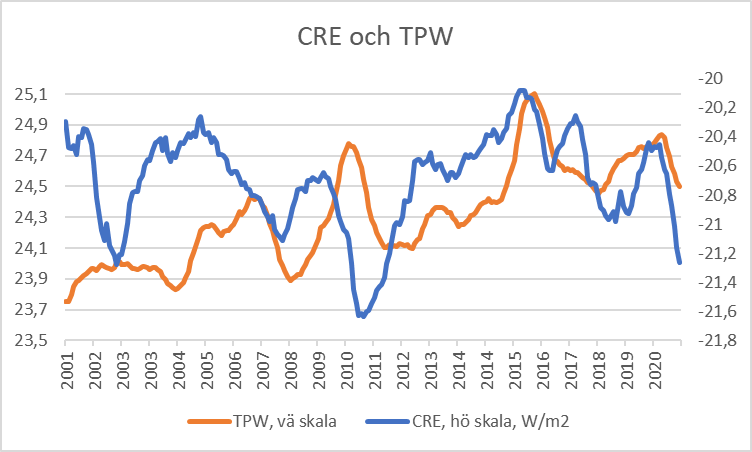
Willis: “around 2015, there was a big shift, with much more energy going downwards to the surface. Why? No clue. I can’t even guess at what controls how much atmospheric energy flux goes out to space versus how much goes down to the surface. What would determine that?#

I believe the answer to your second problem might lie in the relation btw. clouds and the ENSO, specifically the cloud radiative effect, which is highly correlated with the ENSO. See figure, with CRE calculated from Ceres data:
The TPW shows the same thing:
I’m also wondering about the definition of ‘Solar energy that is absorbed by the atmosphere.’ Is it the same definition that you have used before, “available top-of-atmosphere available solar energy”? (incoming solar minus albedo reflections.)
Changes in the TOA upwelling longwave radiation are also a function of atmospheric solar absorption. In your article from 2018 “Symmetry and Balance”, https://wattsupwiththat.com/2018/05/05/symmetry-and-balance/#comment-2347421
 ?w=640&ssl=1
you had a figure 11 with a scatterplot with monthly averages of available top-of-atmosphere available solar energy and surface upwelling longwave radiation. Showing a positive relationship:
WE
“There’s no reason to assume that changes in the TOA upwelling longwave radiation are a result of changes in greenhouse gas absorption of surface radiation.”
I think all Ramanathan is saying is a basic view of the LW IR budget only….that at TOA the radiation leaving must be the same entering from the Sun…so 1366/4 times an albedo of .7 is 240 W/m^2
A hundred Km lower at “surface”, the average temp is 288 K, so the amount leaving the “surface” by IR using SB is 392 watts…notice I’ve used your energy balance diagram numbers here to torture you 🙂
And that 392 minus 240 = 152 difference is “the greenhouse effect” by his definition.
Of course, Ramanathan’s simplified world-wide average can be made more complex, as you have graphed, mostly because albedo, evaporation, cloud cover , IR absorption by the atmosphere, are interrelated. And CERES data can display that variability over country size patches…..where TOA IR to outer space is locally NOT 240 W/m^2 due to those interrelations, for example evaporation, cloud cover, resultant albedo…..
DMacKenzie November 29, 2023 10:53 pm
Mmmm … that’s true almost nowhere almost never.
Per Ramanathan, you pick a point. But you don’t assume the TOA upwelling LW is 240 W/m2. Nor do you assume the upwelling is 288 W/m2. You use the actual values at that point. Do that for each point, and you create a map of the world.
And those individual TOA ULR values are affected by latent/sensible heat and by solar energy absorbed by the atmosphere.
In other words, TOA ULR is not a simple function of the form f(surface temperature). It’s a complex function of the form f(surface temperature, solar absorption, GHG absorption, latent/sensible, percent going up/down).
And as such, we can’t use Ramanathan’s formula. And we lack a way to separate the effects of changing GHG absorption from the effect of the other four main factors that influence the amount of TOA upwelling longwave radiation.
w.
I think we’re likely into an Avocado/Guacamole preference discussion. I do find it interesting that Ramanathan’s calculation of ECS back in 1978 hasn’t been improved on after all this time. This was at a time when climate science involved heat transfer and physics, before it morphed into tree ring and pollen-in-pond-mud speculation.
https://ramanathan.ucsd.edu/wp-content/uploads/sites/460/2017/10/pr15.pdf
Mixed news incoming, fasten seatbelt, stop reading, do something important, consume sugar/alcohol/cocaine as you feel appropriate
Good news: There is a Greenhouse = a place where thermal energy is trapped/stored
Bad News: It’s not where everybody thinks it is.
By reference to the attached – a composite of 2 images depicting current weather (30th Nov) conditions over Western Europe
The top half is showing wind-speeds and directions, also with temperature readings dotted all over it.
What to notice: Look around the coast of Europe and see which way the wind is blowing (these are the winds at 128metres of altitude to get out the way of buildings/trees/windmills etc)
Is the wind ‘offshore’ or ‘onshore’ – that’s all we need here.
Then, trace the wind back, did it come from a warm place or a cold place?
The lower half is the current precipitation radar (rain is green, snow is blue).
Compare the two – see how the rain is occurring where there are onshore winds and also that where the rain is falling is noticeably (5Celsius+) warmer than where the offshore winds originate.
OK: What causes the rain if not upwelling air, in turn caused by the buoyancy of water vapour.. A lot of which is picked up from the land that the rain is actually falling on. Reinforced obviously by more water vapour coming off the ocean and carried by the onshore winds.
Where is is not raining it is cold and very slack winds = those places are under a descending air regime and that is caused by lack of rising air, in turn caused by lack of water vapour in turn caused by lack of water in the ground.
is it beyond the bounds of possibility that the low temps observed there are because of exactly that = no soil moisture?
Now hopefully you see the Hadley Cell – where the upwelling leg is marked by the pink circle (with a dot in it) and the downwelling leg by the blue (x) circle
And there is the Greenhouse, two greenhouses in fact and actually feeding each other.
Under the pink circle there is a properly functioning( heat-trapping) greenhouse and a broken/trashed greenhouse under the blue and that greenhouse is broken because it is dry.
The Greenhouse is under our feet and NOT up in the sky. Water did it – not radiations.
For completeness and for your homework (important people needn’t bother), go verify that wet soil has about twice the specific heat capacity of dry soil…….
Put those ploughs away and get some trees into the ground.
Pronto, before that blue circle over Europe becomes a permanent feature – (notice how cold it is and where the snow is)
That German Folks yesterday were told to stay at home because of the cold and in the UK last night, folks wre being paid not to use electricity.
Ramanathan’s method is the expression in radiative terms of a very simple principle. The greenhouse effect is the difference between the emission temperature of the Earth to space that returns all the energy received from the Sun (minus albedo) and the temperature at its surface. That difference is due entirely to the greenhouse gases, water molecules, and aerosols present in its atmosphere.
Being just the expression of such a simple principle, Ramanathan’s method cannot be wrong. You are just mixing other things and confusing something that is very simple. A difference in temperature is being expressed as a difference in IR radiation.
‘A difference in temperature is being expressed as a difference in IR radiation.’
An approach, I think, that makes sense despite, or maybe because of, all the complicated and hard to isolate stuff going on between the surface and TOA.
Javier, I thought I’d made it clear, but evidently not. Mea culpa, I’ll try again.
First, you say:
Well … no. Ramanathan defined his calculations as occurring at a gridcell level. And at a gridcell level, your definition is meaningless. Ramanathan’s definition is simple, and totally unlike your claim. Ramanathan said:
GHE = Surf_ULR – TOA_ULR
This means:
Greenhouse effect = surface upwelling longwave radiation –
top of atmosphere upwelling longwave radiation
Nothing to do with how much total energy the Earth gets from the sun, or how much total energy the Earth returns from the sun.
However, unfortunately, Ramanathan’s method doesn’t measure what Ramanathan claimed. Why?
Because TOA_ULR is not a simple function of upwelling longwave radiation (ULR) and the amount of greenhouse gases (GHGs). It is also a function of three other things:
Note that if GHGs are stable and any of those three things changes, Ramanathan’s method of measurement gives a different answer as to the size of the greenhouse effect, despite the amount of greenhouse gases not having changed one bit and despite the atmospheric absorption of upwelling radiation being exactly the same … and that’s not the measurement we’re looking for.
Best regards,
w.
Exactly. the intensity of the apparent (observable) greenhouse effect can vary independently of its optical properties. The virtual optical greenhouse effect is much larger than what is observed. This is because of the heat transport mechanisms.
Turbulent mixing throughout the atmospheric column causes the temperature difference between top and bottom to be less than it otherwise would be. This means that any hindrance of heat transport increases the apparent greenhouse effect intensity.
it’s like using a spoon to stir a fluid in a container which is heated mostly from one side. This stirring motion practically eliminates temperature gradients within the volume.
The word troposphere traces to greek origins meaning “turning” or “mixing” and yet these phenomena are effectively minimized to an afterthought in the study of climates.
Note that sensible heat sourced from surface simply rises and cools according to dry adiabatic lapse rate and has no dissipative mechanism in atmosphere. No heat is manifest outside the lowest level boundary layer by sensible heat conduit.
Additionally, the normal capping inversion around 2km height really does seal the lid. That sensible heat rising from the surface is almost completely returned in the overnight stable airmasses (within error bars).
Conversely, latent flux manifests as sensible heat above the lifted condensation level and really does cause a dissipation mechanism. Latent flux is that turbulent mode which moderates the greenhouse effect intensity by providing a conduit to release sensible heat into the free troposphere.
Unlike sensible flux, the latent heat is “hidden” within boundary layer and only manifests aloft. Latent flux and Sensible Flux in surface budgets are completely opposite in how they operate. Latent flux diminishes the temperature gradient between surface and free troposphere, sensible flux does no such thing!
Any hindrance of latent flux will appear as an increasing greenhouse effect intensity. For dynamical purposes, the latent flux magnitude can be considered equal to the atmospheric heat transport.
JCM, for that to make any sense we need some definitions:
What are you defining as the “greenhouse effect”?
What are you defining as the “virtual optical greenhouse effect”?
What are you defining as the “apparent (observable) greenhouse effect”?
Without those, I fear your comment is not very useful.
w.
Ramanathan definition
That Ramanathan style greenhouse effect in the absence of heat transport. A virtual thing i.e. that which does not exist in physical reality.
That Ramanathan thing which exists in physical reality. e.g. GHE = Surf_ULR – TOA_ULR
Perhaps Ramanathan should have referred to the difference between Surf_ULR and TOA_ULR as the ‘atmospheric effect’.
Willis,
You wrote –
“Finally, we get to the third source of energy flow to the atmosphere. This is the absorption of upwelling radiation by “greenhouse” gases. But how much is absorbed and how much passes through?”
It makes no difference at all. All gases in the atmosphere absorb IR, if emitted by a hotter source, just as all gases in the air emit IT (like all matter in the universe, if above absolute zero).
All gases, if they become hotter than their environment, cool by emitting IR.
Hence, all the heat of the day is lost at night, all the heat of the summer is lost during winter, and most of the remaining remnant heat of creation has gone, and the surface is no longer molten, liquid water exists, and so on.
Even most radiogenic heat sources have gone. Even radioactive elements with four and half billion year half-lives have lost half their mass, and most radioactive isotopes have shorter half-lives.
The Earth currently continuously losing energy about 47 TW. Overall, the planet is cooling at about 1 – 4 millionths of a Kelvin per annum.
Dr Roy Spencer is researching the reasons for observed recent increases in near surface air temperature measurements (actually, hotter measuring instruments).
The GHE cannot be described in any way which reflects reality. It seems to be blamed for heat waves, cold snaps, floods, droughts and other weather events, by some people who believe that “climate” controls weather. Pretty silly, considering that climate is the statistics of historical weather observations.
Others no doubt have their own ideas.
Mike, non so called greenhouse gasses do not radiate very much in the IR bands, they radiate in the Microwave bands. Which is why satellites do not measure the atmospheric temperature in the IR band, they measure O2 Microwaves.
I still contend that it is the so called non greenhouse gases that are actually the real greenhouse gases because they absorb the IR radiation previously absorbed by H2O and CO2 through the much more prevelent kinetic means and DO NOT release it as IR to space.
Those releasing it as IR to space are assisting in cooling the atmosphere, not keeping it warm.
Grumpy,
All gases at the same temperature radiate precisely the same wavelengths. The quantity may vary.
Microwave frequencies are infrared by definition. It doesn’t make any difference, really. A sample of air at 20 C radiates precisely the same frequencies whether you remove all the “greenhouse gases” from it or not. No difference to radiated frequencies whatsoever.
Even that makes no difference to the reality that a warmer atmosphere (regardless of whether you believe it is the result of GHGs or not) cannot even warm a colder surface at night. Just look up “low level inversion”, if you like.
No GHE at all. You cannot even find a description on the internet that reflects reality. Here’s a sample from NASA, which describes the GHE as ac”process”, then says “Imagine these gases as a cozy blanket enveloping our planet,”
Give the reality that the surface cools at night and in winter, my imagination baulks at NASAs flight of fancy.
So there you go – no description, therefore no hypothesis, therefore no experiments, . . .
“All gases at the same temperature radiate precisely the same wavelengths. The quantity may vary.”
Completely untrue.
880px-Mid-infrared_absorption_spectra_of_Gases.png
I’ve just been reading some comments by a (fairly) recent geology graduate upon taking up a role as a net zero manager. Said graduate’s ‘passion’ for climate change was apparently influenced by a module in paleoclimatology – apparently the geological record provides evidence that CO2 concentration drives climate change. Hmmm. Other geologists may wish to comment…
Mike Flynn November 30, 2023 1:55 am
First, things that absorb IR absorb it pretty much REGARDLESS of the temperature of the source. We know that’s true because an IR thermometer can read the temperature of objects colder than the thermometer itself … and if your claim were true that wouldn’t be possible.
Next, oxygen (O2) and nitrogen (N2) are both very, very poor at both absorbing and emitting thermal IR. That’s why they are not called “greenhouse gases”. And the reason they are so poor is that they are symmetrical two-atom molecules.
IR is absorbed by the stretching and flexing of the interatomic bonds of the molecule absorbing the IR. As you might imagine, non-symmetrical 3-atom molecules like CO2 have a whole lot more distinct ways to stretch and flex the interatomic bonds, so they can easily absorb IR and as a result are called “greenhouse gases”.
Finally, monoatomic gases are the exception to your fake “rule” about everything absorbing/emitting IR. Your rule is the simplified, high-school version, which is probably where you got it. Because monoatomic gases like argon have no interatomic bonds, they can neither absorb nor emit IR.
But hey, keep puffing out your chest and confidently making obviously untrue statements. It’s kinda amusing.
w.
Willis,
You wrote –
“Because monoatomic gases like argon have no interatomic bonds, they can neither absorb nor emit IR.”
And yet, all matter above absolute zero emits IR – except matter declared by Willis to be an exception to normal physical laws! You certainly wouldn’t like this extract from the first reference that came up, would you –
“The infrared absorption spectrum of both neutral and cationic toluene–argon has been measured in the range from 400 to 1700 cm . . . “
Now Willis, your knowledge of physics may have been gleaned by talking to yourself, but you are a complete idiot if you believe that argon does not emit infrared. Everything above absolute zero does. I suppose that you are dim enough to believe that the other noble gases refuse to have a temperature likewise?
Compress any of them rapidly, and tell yourself that they are not emitting IR!
Here’s a safety tip “Please don’t leave balloons in a hot car – helium expands in the heat and this could cause your balloons to pop!” Gee, a monoatomic gas absorbing heat. How can this be?
Keep on with your imaginary “fizzix”.
Here’s a statement for Wikipedia (lots of people refer to Wikipedia) –
“All matter with a temperature greater than absolute zeroemits thermal radiation.”
You really don’t want to accept reality, do you?
Willis is correct, solid and liquid matter emits over all wavelengths but gases do not. Gases emit via either electronic, vibrational or rotational transitions. Monoatomic gases can only emit via electronic transitions since they have no bonds which can be excited to vibrational or rotational energy levels. The electronic spectrum of argon is mostly in the visible range in a glow discharge tube.
“And yet, all matter above absolute zero emits IR – except matter declared by Willis to be an exception to normal physical laws! You certainly wouldn’t like this extract from the first reference that came up, would you –
“The infrared absorption spectrum of both neutral and cationic toluene–argon has been measured in the range from 400 to 1700 cm . . . “”
Interestingly you omitted a crucial part of that paper’s title “Infrared gas phase absorption spectra of neutral and cationic toluene–argon complexes.
So it’s not discussing the spectrum of monatomic argon but the spectrum of toluene-argon complexes.
Phil,
What part of “All matter with a temperature greater than absolute zero emits thermal radiation.” do you not understand?
OK, you are unable to search the internet for yourself, so I’ll help you –
“The Atomic Spectroscopy Data Center of the National Institute of Standards and Technology (NIST) is currently compiling spectra and energy levels of the noble gases. A review of the literature has shown that there is no comprehensive experimental description of the infrared spectrum for any of the neutral gases. In response, we have made high-resolution observations of the spectra of Ne, Kr, and Xe in the region 0.7 μm to 5.0 μm with the 2 m NIST Fourier transform spectrometer. The observations provide precise new wavelengths and relative intensities and resolve questions concerning lines that were previously multiply classified.”
Yes, I know, only Ne, Kr, and Xe – monoatomic nevertheless.
You don’t need that, even. What do you think you are measuring when you measure “air temperature”? If you remove CO2 and H20 from the air, the temperature changes not at all.
When the compressed air in a diesel engine reaches 500 C, it gets very, very, hot. No thermal radiation?
Are you quite delusional? All matter (gases, liquids, solids) above absolute zero emits Infrared radiation. Change your medication – you are not connected to reality.
Monatomic gases emit negligible thermal radiation.
The paper you linked, “Infrared Spectra of the Noble Gases”, involves noble gases _in a discharge lamp_, where they are ionized by extreme strong electromagnetic fields. In such cases they may emit infrared radiation, in addition to the bright visible light you are used to from a neon lamp.
But neon sitting at room temperature will not emit infrared radiation any more than it emits orange “neon light”.
The reason is that these infrared transitions are multiply excited (look at Figure 4 in the paper, which is a transition from 3p to 3d orbitals in neon, which in its ground state only has electrons up to 2p). Thermal emission requires both
1. A set of two levels separated by infrared frequency
2. The upper level must be populated at a given temperature
2 is not true for neon at room temp. These levels are only populated because of the ionization in the discharge lamp.
These gases emit IR at room temperature. Neon at room temperature emits precisely the same wavelengths of IR as any other gas at the same temperature. It can be compressed to quite high temperatures (say 500 C) using appropriate means.
No doubt you are going to tell me that you can distinguish gases by the radiation they emit in the dark, with monoatomic gases being distinguished by a complete absence of IR radiation, emitting none at all!
Maybe you think “The amount of radiation emitted at each wavelength depends only on the object’s temperature and not on any other property of the object, such as its chemical composition. This was described mathematically by German physicist Max Planck in 1900. Scientists usually refer to this as thermal radiation.” – European Space Agency, doesn’t apply to gases.
Good for you! Unfortunately, you can’t back up your assertion about noble gases (or even O2, N2 and all the rest) neither absorbing nor emitting IR!
You even said “ In such cases they may emit infrared radiation”.
I linked to a paper using spectroscopic analysis because GHE cultists use similar methods to ascribe magical properties to GHGs.
Maybe you prefer “Different gases were tested, not only air and carbon-dioxide but also the noble gases argon, helium and neon. In each case, a temperature increase was detected up to a limiting value. While the warming-up rate was independent of the gas type, the limiting temperature turned out to be gas-specific. Surprisingly and contrary to the expectation of the greenhouse theory, the limiting temperatures of air, pure carbon-dioxide and argon were nearly equal while the light gases neon, and particularly helium, exhibited significant lower limiting temperatures. Applying the kinetic gas theory, and assuming a direct correlation between limiting temperature and radiative emission power, a stringent dependency of the product on mean kinetic energy and collision frequency could be deduced.[. . . ]Since sunlight as well as IR-bulbs were employed as radiation sources, near-IR was expected to be predominant and not medium-IR as it is commonly assumed.”
How to heat gases using sunlight and IR bulbs. And of course, what absorbs IR, emits IR, unless your cultist fizzix doesn’t admit that either.
Still convinced that “All matter above absolute zero emits infrared radiation” is nonsense?
Here are some gas emission spectra from gases heated sufficiently to become incandescent, you’ll see that they all have different spectra!
E8_vYQaXEAo1Bk2
Of course at room temperature all the gases will emit no radiation.
The one ‘not connected to reality’ is you! I don’t need to ‘search the internet’ on this subject, several decades of research in the area of laser diagnostics and authoring over 50 papers on the subject have given me a very good understanding of it. As I stated the spectra of the monatomic gases you are referring to are the results of electrical discharges through the gas. The emission spectra are the results of transitions from excited electronic energy levels down the the ground state, those levels are not populated at atmospheric temperatures. Argon at room temperature does not emit radiation. I have actually conducted spectral measurements inside diesel engines, there is no thermal radiation from the N2 and O2.
That’s news to diesel engines. The compression temperature is around 500 – 600 C. No IR emission? What do think temperature is?
Even easier, put your hand on the casing of a running piston compressor – tell me it isn’t hot! Try a bicycle pump. The cylinder gets hotter the harder you pump.
Appealing to your own authority makes you look quite delusional. Others can believe what they wish of course. The facts don’t change at all, do they?
“That’s news to diesel engines. The compression temperature is around 500 – 600 C. No IR emission? What do think temperature is?”
Correct, as stated no IR emission from N2 and O2 in that case.
Temperature is related to the kinetic energy of the gas molecules. The first electronic energy level of O2 is about 1eV above the ground state, takes rather high temperature to excite that level.
In the case of adiabatic compression the gas temperature increases and heats the cylinder by conduction/convection not by radiation.
Willis,
The greenhouse effect metric under discussion is G = outgoing IR flux at surface – outgoing IR flux at TOA.
I agree that a change in G does not necessarily arise from a change in greenhouse gas concentration.
However, the strength of the definition is that, if there were no greenhouse gases, G would go to 0. This is simply because if nothing in the atmosphere absorbed or emitted IR, all IR from the surface would be passed directly through TOA.
So G is a useful metric because, while it also depends on other things, it is guaranteed to be zero without greenhouse gases, and this is truly a measure of the strength of the greenhouse effect.
Thanks, Nepal. You say:
The problem is that the outgoing IR flux at TOA is not simply surface upwelling minus what’s absorbed, as you and Ramanathan claim.
Outgoing IR flux at TOA is surface upwelling minus what’s absorbed, plus latent/sensible loss surface-to-atmosphere, plus directly absorbed solar energy, times the fraction that’s headed up vs. down this month.
And if any of those three factors change, which they do constantly, then Ramanathan’s method is not measuring what it’s claimed to measure—the amount of upwelling surface energy absorbed by the greenhouse gases in the atmosphere.
Regards,
w.
“Outgoing IR flux at TOA is surface upwelling minus what’s absorbed, plus latent/sensible loss surface-to-atmosphere, plus directly absorbed solar energy, times the fraction that’s headed up vs. down this month.“
Those factors only result in outgoing IR at TOA if the atmosphere is able to emit radiation. Greenhouse gases are defined as the gases that absorb thermal radiation, but by Kirchhoff’s law that means they are also the only gases that emit radiation.
So without greenhouse gases, there may be heat transport mechanisms to and from the surface, but 100% of outgoing IR would come from the surface, and 0% of it would be absorbed between surface and TOA.
“Greenhouse gases are defined as the gases that absorb thermal radiation, but by Kirchhoff’s law that means they are also the only gases that emit radiation.”
Oh dear, well that puts paid to Willis’ notion about monoatomic gases being the only gases unable to absorb and emit thermal radiation. We now have to accept that the air in hot air balloons is not hot, that air has no temperature, and that removing the greenhouse gases from a sample of air will result in the oxygen hydrogen, argon, etc, falling to absolute zero and becoming solid!
Willis will no doubt complain about what he didn’t say. I don’t blame him.
No, Willis is right that monatomic gases (and many other gases too) emit negligible thermal radiation.
Not sure why you think removing radiative heat transfer would cause air to go to absolute zero… thermal energy wouldn’t just disappear. And there would still be heat exchange by conduction and convection.
Nepal,
“Not sure why you think removing radiative heat transfer would cause air to go to absolute zero… thermal energy wouldn’t just disappear.”
I suppose you can’t figure out why allowing gases to cool by radiation produces things like liquid oxygen, nitrogen etc. Keep going, they solidify – except for helium, which remains liquid at atmospheric pressure. It boils at around 4.15 K.
All gases emit IR, even gaseous helium at 4.2 K. Willis is off with the fairies, living in a fantasy world.
At least you say you are “not sure”, although you go on to surmise that “thermal energy wouldn’t just disappear”.
Well, the Earth’s surface is no longer molten. It cooled. If the “thermal energy” didn’t disappear, where did it go? You tell me. I claim it did – the surface cooled, and the energy seems to have gone away – vanished, disappeared, nowhere to be found or measured.
Willis, just a thought on one of your questions. LWD surface being high vs TOA not changing as much. The difference may have something to do with the layers of the atmosphere. The increase in surface LWU is captured very close to the surface, thus increasing the near surface atmospheric temperature to a greater degree than would be seen in upper atmosphere where TOA originates. This effect increases surface temperature which shifts the BB curve to the left, thus increasing the amount of energy in the water vapor spectrums while not necessarily having a drastic effect on the TOA spectrum that’s primarily driven by CO2.
In my uninformed opinion, Ramanathan has it wrong because water vapor only exists in relevant concentrations in the lower troposphere. Such results in internal variation in the lower troposphere. The better metric would be to assess the LWD to surface and LWU to the Stratosphere, not TOA. ALSO, the D&V paper notes a decrease in clouds. Cloud top temperatures as well determine TOA LWU. Less clouds equals a cooler upper troposphere, and a cooler upper troposphere equals less LWU from the upper cloud layers. So, it’s possible to see an increase in LWD at the surface while not necessarily seeing an equivalent increase in TOA.
There simply is no physical explanation for the huge increase in LWD or even increases in LWU in such a short period of time that can be connected to CO2. It would be consistent to believe that the increase in Surface Temperature resulting from a decrease in Clouds (D&V) and increase in SWD and absorption equals an increase in LWU from the surface, thus increasing energy to the lower atmosphere that would in a perfect world result in the ratio of the GHG effect being applied to the system.
Hopefully you can make sense of my word salad and get the jist. IMO, the 2014-2016 El Nino changed the Surface Temp, and that changes the entire equation, so Ramanathan can’t just subtract OLR from SLWU.
“You can also see how the clear dry air over the Antarctic and Greenland ice caps means that little solar energy is absorbed by the atmosphere in those areas.”
And their high altitude? Antarctic is over 2500m and Greenland 1800m.
“You can also see how the clear dry air over the Antarctic and Greenland ice caps means that little solar energy is absorbed by the atmosphere in those areas.”
And their high latitude? Not a lot of sunlight to be absorbed by anything much – particularly during six months of darkness. I assumed everybody realised that the polar regions were cold. Temperatures down to -90 C or so. Nothing to do with any GHE, unless you believe papers which claim a negative GHE in the Antarctic.
NASA/ADS – “The Peculiar Negative Greenhouse Effect Over Antarctica”
Surely not!
In the summer with 24 hr days there’s plenty of sunlight.
660px-InsolationTopOfAtmosphere.png
Phil,
From a NSF expedition report “The incoming solar radiation had a mean value of 217 watts per square meter (W m-2)”
Of course, when the sun is below the horizon for 6 months – nothing. Yearly average? 217/2? 108.5 W/m2?
Nah, “plenty of sunlight” doesn’t sound all that convincing. Even at the relatively low latitude of the ship.
At the South Pole, you can look at NASA daily monitoring, if you like. Doesn’t look like”plenty of sunlight” there, either, and the summer solstice approaches – the height of summer. High of -33 C expected.
Which part of “in summer” didn’t you understand? Reaches ~500W/m^2.
86786-433×640.jpg
South Pole temperature in December -14ªF, of course that’s at an altitude of 9200′ so applying the lapse rate that’s equivalent to 18ªF at sea level.
Phil,
“What part of ‘in summer’ didn’t you understand?” None of it? All of it? I understand what summer is, I believe.
“South Pole temperature in December -14ªF, of course that’s at an altitude of 9200′ so applying the lapse rate that’s equivalent to 18ªF at sea level.”
-14 F at the height of summer? That’s due to a lot of sunlight, you reckon? Obviously, my definition of a lot of sunlight, and yours, are markedly different.
Temperatures are what they are. Not what they “should be” or “would be”.
The South Pole doesn’t get a “lot of sunlight”. Nor does Antarctica in general. That’s why it is cold. Don’t you know anything?
So you attempted to rebut a comment about summer sunlight by quoting a number which includes the winter!
A daily average of 500W/m^2 is ‘a lot of sunlight’
“The atmosphere loses energy both to the surface and to space.”
No, Willis, it doesn’t, if the surface is hotter than the atmosphere. No amount of imaginary nonsense will make it so. Space, fine. The energy is then gone, vanished, never to be seen again. Go on, tell me about how that is impossible – conservation of energy, perhaps?
But even where the atmosphere is actually hotter than the surface, the surface still cools. Amazing, isn’t it? A cooler body continuing to cool – even when exposed to the more energetic radiation from the hotter body!
A miraculous thing this GHE – cools the planet for four and a half billion years (you’ll notice the surface is no longer molten), cools it every night (even when the atmosphere is hotter than the surface), and cools it during winter.
Maybe the GHE doesn’t exist, and the above observations can be explained by known physical laws? If you can’t do so, I can understand why you need to rely on a GHE which you can’t even describe. Cultism is a powerful thing.
Awwww, you aren’t going to complain your “feelings” have been hurt, are you? Maybe you can imitate Michael Mann (described as a faker, fraud, scofflaw and deadbeat) and print yourself a Nobel Prize certificate. Then you could appeal to your own authority!
Excuse me if I laugh – you. really don’t understand physics, do you?
There is no “energy loss to the surface”, cause energy can not get lost in(to) a closed system. “Back radiation” however is OF COURSE a function of temperature, and so this erroneous “energy loss to the surface” just reflects the changes in temperature (note the peaks in 2010, 2016, 2019/20)…
It is not clear from the terminology used whether or not “sensible” includes heating of the surface followed by convection to the air (even if totally dry). The chart of the latent and sensible energy transferred to the atmosphere shows a cool spot over the Sahara where I expect convection heat transfer from the surface to be highest. Instead, the highest is over clear sky oceans as you note.
Is the intent of that moniker to refer only to the warming and evaporation of water?
By contract, the surface is heated by the atmosphere when the air is warmer than the clear sky radiating surface – for example the Sahara at night. During the day the surface heats the air by contact – convection – and, depending on the time of day, in both directions, a tiny amount by conduction (air is a very good insulator – so ignore it for a sec).
When the air is convectively heated at the bottom of the column, it creates thermals, whether there are more or less condensing gases involved. The same would happen if there were no GHG’s at all. As I have pointed out before, if there were no GHG’s the air would be perfectly clear and all incoming energy would strike the surface, creating about twice as much heating of the air by convection (depending on the emissivity of the surface). Over land, this would be the hottest points on that chart.
The atmosphere cools by radiation and convection back to the surface (at night, at least). Without GHG’s the result would be a very hot, non-radiative atmosphere, not a freezing -18C as claimed by the IPCC, like the average temperature of the airless moon. The “33 degrees of warming” by GHG’s is nonsense. We don’t live on the moon.
If convective heating by the surface is not included in your definition of “sensible heat” then there are 4 “distinct sources.” Because there is a calculable amount of conduction from the surface, technically there are 5 paths but I’d settle for the 4 majors.
The pedantically full list is:
Before anyone jumps up to say conduction is only a form of convection, please take a look at standard engineering calculations of heat loss from a hot surface in contact with gases. When the gases include radiative one(s) radiation is included with convection and conduction. Convective heat transfer from a mountain slope is considerably more than a flat plane so the total is probably more than is modeled at present for the flat earth.
“By contract, the surface is heated by the atmosphere when the air is warmer than the clear sky radiating surface – for example the Sahara at night.”
Silly me. I thought the temperature in the Sahara dropped at night.
Oh well.
As to your list, the Moon’s surface seems to heat to more than 398 K, and drop to around 25 K. Not much convection or conduction there.
Why do think this happens?
Sensible heat transfer surface to atmosphere is convection. Convective heat transfer involves the combined processes of conduction (heat diffusion) and advection/convection (heat transfer by bulk fluid flow). Convection is usually the dominant form of heat transfer in liquids and gases. Conduction (in gases or at an gas/surface interface) is negligible relative to convection and is not considered as such. It’s included in convection.
https://en.m.wikipedia.org/wiki/Convection_(heat_transfer)
edim,
“Convection is usually the dominant form of heat transfer in liquids and gases.”
Gases? This would seem to imply that solar radiation cannot warm the atmosphere, which it definitely seems to. A low level nighttime inversion is most certainly not due to convection or advection. The air seems to be still.
In any case “usually the dominant form” is about as worrying as your pilot announcing “We usually don’t crash.”
Yes, the “greenhouse effect” as described by the consensus is not even wrong. You’re gettin’ closer Willis, just another thing:
“Energy enters the atmosphere from three distinct sources.
-Upwelling longwave energy from the surface that’s absorbed by the “greenhouse” gases in the atmosphere.
…”
This energy input is actually upwelling LW from the surface minus downwelling LW from the atmosphere. It’s the net radiative surface->atmosphere heat flux.
Explanation:
Those percentages in the image are the percentages of the incoming solar energy at the TOA (100% = ~340 W/m²).
You can see in your graphs that the surface upwelling LW radiation anomaly and the the atmospheric downwelling LW radiation anomaly (at the surface) look almost the same. The former is just greater than the latter because it’s a bit warmer and that’s actually the direction of the radiative heat transfer.
Again, radiative heat transfer (loss) from the surface to atmosphere is surface upwelling LW minus atmospheric downwelling LW minus direct surface LW to space (window). Radiative heat transfer is always the net heat transfer – the radiation leaving the first surface for the other minus that arriving from the second surface.
Also:
“But around 2015, there was a big shift, with much more energy going downwards to the surface. Why? No clue”
Temperature. Radiation fluxes are function of temperature. The same reason for the surface upwelling LW radiation.
Willis, I have questions about the definitions for the fluxes, in terms of the variables used by CERES.
Thanks.
Some clues to my question are in another recent article by Willis:
https://wattsupwiththat.com/2023/09/28/an-unsettling-insight/
Still, it’d be much appreciated if we could get the exact definitions in terms of which CERES data series that are used.