Upon hearing about the federal government’s decision to roll back the carbon tax on heating oil, I rolled up my sleeves. The point of writing about energy at all is to try to illuminate some aspect of an energy topic from a viewpoint inside the energy sector; to explain some energy nuance that the general population, which cares little for the nuances of energy, may find valuable. Energy is not simple, and there are a lot of loud storytellers out there, selling magical beans and wishful thinking.
To me, the carbon tax rollback was an annoyingly flagrant bit of vote-buying, yet another irritant from the federal government but one that, on centre-stage, seemed to have far less potential for cross-country histrionics than, for example, the time the prime minister threw his talented and principled First Nations minister under the bus. Now that was a shockwave.
This carbon tax vote grab? Ha. SNC Lavalin, Jody Wilson-Raybould, the WE Charity scandal, foreign interference… a heating oil subsidy doesn’t even crack an annual top-ten list of federal governance dirty diapers.
Or so I thought. Hoo boy. The Hail Mary scheme has blown up, blown up real good. Critics are everywhere, from across the political and environmental spectrum. Liberal heavyweights are attacking Trudeau; economists that love the carbon tax for its ‘efficiency’ are declaring the carbon tax dead. Incredulously, premiers have voiced a unanimous opinion that the entire country needs to be treated consistently.
Upon further thought, it shouldn’t be a big surprise that even the hard core climate crowd is displeased. The federal government has been lavish with announcements and proclamations about eliminating fossil fuel subsidies, that they would do so faster than imaginable, that, well, read their words for yourself: “Canada is the only G20 country to phase out inefficient fossil fuel subsidies ahead of the 2025 deadline. We are the first country to release a rigorous analytical guide that both fulfills our commitment and transparently supports action.”
“What the hell is this?” appears to be the consensus among a disparate group of voices that reaches consensus on nothing.
Be very clear why there is outrage: this is a shallow, obvious vote grab that crumbles the pillars of this government, and it most definitely is a creation of a brand new fossil fuel subsidy – so much for international credibility after all the hectoring this government has done globally. (If you have any doubts that this is anything but a political maneuver, consider that almost exactly a year before, in October 2022, the Conservatives tried to pass a motion to exempt home heating oil from the carbon tax, and all Liberal MPs save one brave Newfoundlander voted against it.)
Since the whole topic of the carbon tax has now come up though, here is a critical point that warrants some thought.
Canada and the US have chosen two different strategies to reduce emissions. Canada has, of course, the carbon tax – if you use or burn hydrocarbons, you’re going to pay (certain rural maritimers temporarily notwithstanding). Governmental, and government friendly, economists contort themselves into pretzels to demonstrate that the rebates handed back by the federal government “more than compensate” for the carbon tax, but every citizen that goes to a grocery store and realizes that every item in the industrial chain that handled any of those products in this country paid their own carbon tax, and that all that is rolled into the end product, has a very strong real-world suspicion that the government’s equation is laughable.
Beyond that, there is a big problem with Canada’s ‘stick’ approach to carbon reduction. Canadians can choose to limit the impact of the carbon tax by switching to something less carbon intensive, or spending to otherwise limit emissions. You don’t want to pay the carbon tax, you or your business? “No problem!” Says the federal government; just spend some exorbitant amount of capital, based on frameworks and guidelines that are not yet even ready.
In the US, the government long ago (2008) introduced something called 45Q, a carbon credit which was recently beefed up significantly under the Biden Inflation Reduction Act energy policy. 45Q is a carrot. If you are a carbon emitter, well, no one likes the emissions, but go ahead and carry on with your business.
If you choose to reduce your carbon emissions however, the government will hand you a cheque (sorry, check) for doing so – $85 per tonne CO2e, to be precise. You can start a new business that generates emissions credits, and if you can do it for less than $85/tonne, you have a new profit centre. There is a companion credit called 45X; credit revenue can be generated from it by manufacturing components that go into various energy technologies including structural fasteners, steel tubing, critical minerals, pretty much any battery component, etc.
In short, an existing business can carry on as before, or embark on a new venture with a guaranteed revenue stream from carbon credits generated.29dk2902lhttps://boereport.com/29dk2902l.html
In Canada, the stick is, like, really big, and for real. If you exist and consume conventional energy, you will pay, and pay dearly, and the amount will go up every year until either 2030 or until you cry uncle, whichever comes first.
Want to avoid paying the tax? Again, you will pay dearly, but differently; you will pay for capital expenditures on whatever means are available to you, using whatever policies are worked out by governments at all levels (Not a secret: a great many of the regulatory bugs are not yet worked as to potential solutions to limit emissions, capture/store carbon, etc.).
In Canada, either way, you pay through the nose. In the US, you have options to go into another line of business, or to find potentially unrelated ways to reduce emissions, with a ‘guaranteed revenue stream’ in the form of credits.
Guess in which direction businesses will thunder?
Economists love Canada’s carbon tax because it is ‘efficient’. Well, yes, that is true in an oddball sort of way, just as I can guarantee you that I can ‘efficiently’ reduce local vehicular traffic by blowing up every bridge and overpass. How’s that for efficient? I could cut traffic levels by greater than 50 percent within hours of delivery of the ACME Dynamite.
At the end of the day, the federal government’s backpedaling on the carbon tax is symptomatic of a cornerstone of the entire movement failing, because it was made of styrofoam and the building upon which it was constructed will only work with carefully engineered cement.
Europe is no different, celebrating emissions reduction successes while not wanting to talk much about how the industrial sector has been hollowed out. “Stick” taxes force companies to shut down and/or leave, and just plain punish citizens for things like heating their homes.
The carbon tax is a solution to the extent that there is readily-trimmable fat in the system. But it has to be designed to go after that fat, not after everything that moves. Autos are a perfect example. The federal government could have mandated a switch to hybrids, and banned sales of 500-hp SUVs and whatever (don’t yell at me free marketers; I’m pointing out real-world pathways that are possible). They could have mandated a rise in corporate average fuel economy in one way or another.
That is trimmable fat. Attacking home heating fuels is not.
This isn’t to say the US’ program is sheer genius. However, it is worth noting that 45Q has been around for fifteen years; what has happened recently is that it has been beefed up in a way that makes sense. (The US is also doing nonsensical things like forcing companies into carbon capture and sequestration, at the same time that, as US Senator Joe Manchin points out, “CCUS and DAC developers have submitted more than 120 applications to EPA [Environmental Protection Agency] for Class VI well permits to sequester carbon since the IRA passed, and there are 169 total pending applications, and not one approval has been made by the Biden Administration.”)
The energy transition as envisioned by the ‘climate emergency’ crowd was doomed to fail because it was based on a ‘too fast, too soon’ transition game plan – which was actually not a plan at all, more of a command – and, equally as relevant, was based on the tenuous fear instilled in citizens by bad weather (an entire generation is now being raised to 1) be terrified of the weather, and 2) be convinced that their actions can influence it. Stop it.).
Our entire world is built on oil, natural gas, coal (in some parts of the world) and hydrocarbon energy systems in general. Sue ‘Big Oil’ all you want; that won’t change anytime soon.
Energy illiteracy is the slow-moving black plague of our time.
Canada’s efficient carbon tax pits citizens against their heating needs, against their business interests, and against inescapable realities.
Here’s the sad part: All the federal government is doing here is facing reality, or starting to. Europe did the same last year, spending hundreds of billions in brand new fossil fuel subsidies to shield consumers from rocketing energy prices. When push comes to shove, governments will wilt under pressured voter pocketbooks.
Boneheads will at this point insert the oft-heard refrain “So you’re saying we should just do nothing.” I’ve heard that so often it sounds like mosquitoes in summer. It’s the only attack some people have.
It is actually an amazing time to see new energy technologies take shape, with the best minds in the entire energy industry pushing in that way. We are seeing the creation of hydrogen hubs, development of new technology like fuel cells, greater use of methane capture from landfills, etc. A great many great minds are making significant progress.
But even those geniuses can’t change the laws of reality. Eight billion people are now alive at the same time due to a certain system, and it will take a very long time to change that system if all of those people stay alive and try to live like the west does.
Energy wise, we need better, much better. Canada’s government is paying the price for heedlessly listening to ideological cheerleaders. Just like Canada’s citizens have been.
Energy conversations should be positive and, most of all, grounded in reality. Life depends on it. Find out more in “The End of Fossil Fuel Insanity” at Amazon.ca, Indigo.ca, or Amazon.com. Thanks!

Read more insightful analysis from Terry Etam here, or email Terry here.
If you are going to be taxed on carbon, the first step should be to PROVE that carbon is an issue. Otherwise the gates are open to any item that “Consensus” says is a problem.
Kinda like, the consensus that Covid was an organic bat virus and was dropping kids in the street on contact therefore authorizing “Consensus” to lockdown everyone “2 wee…ahh years, to lower the curve,” dictate outerwear fashion choices, and mandate untested vaccine without proof of efficacy nor clear understanding of unintended consequences (like a vaccine that’s more dangerous to the poked than the Man Made Virus itself?
Once we acquiesce to central authoritarian mandates on a sneeze and media fright tales we hand over our freedom not unlike our reliable fossil fuel energy. The world needs to be very afraid of the World Economic Forum. VERY AFRAID. Because it is beginning to look less and less like a conspiracy theory that they cook up viruses and release them on purpose along with their nightmare about a 400 part per million trace element in the atmosphere burning down the globe.
Well millions did die. Respiratory viruses are not unusual , just the variants that are novel and go onto kill way above the normal yearly flu deaths.
You are just full of the usual illusionary nonsense, a virus can kill inside 2-4 weeks . While the climate nonsense required 20-40 year timeframes which is their weakness and its barely perceptible above the existing temperature variations
I was willing to play along for the first couple of months, because it was an new virus and we didn’t have any good data. BUT after the first six months it became obvious that the people most at risk were the frail (pre-existing conditions) and the very elderly – surprise, surprise, surprise – same group that is almost ALWAYS at risk for any virus. Instead of focusing on those individuals, bureaucrats did nothing to protect them and in fact introduced the virus into care homes. All of those bureaucrats should be charged and convicted of at least manslaughter.
Putting people on respirators and pumping them full of Remdesivir killed them.
Very few were on respirators at all.
Various studies found that the populace was willing to pay a “little bit more tax for the good of the environment”…..Ergo, slap ‘em taxes until elected reps are getting threats in the streets…..is the policy of most revenue departments….
CO2 is currently around 420 parts per million, ( https://www.co2.earth/daily-co2 ) increased, they tell us, from 280 ppm in 1850. That’s a difference of 140 ppm, or in terms more readily understood by the layman, the composition of the atmosphere has changed by 0.014% in the last 170 years. Less than 1 thousandth of 1% per decade. And they justify taxing this rate of change how?
The rate of increase was not linear. Up until around 1950, there was little increase in CO2 concentrations. Most of that 140ppm happened since 1950.
Of course about half of the warming occurred prior to this big rise in CO2.
If you are taxed on a beer does that mean beer is a problem? If you are taxed on a new hammer for your tool box does that mean hammers or toolboxes are the problem? A tax, however it it sold, is raising revenue. Any other idea is propaganda.
Taxes lower economic activity.
That’s the purpose of the carbon tax. It’s a Pigou Tax which is intended to internalise the cost of enjoying a good whilst not paying its full cost, because part of the cost is borne externally by others – in the case of the climate change boondoggle, supposedly future generations.
The tax is intended to be incident on the end user to modify behaviour, to consume less or be pushed towards alternatives.
The carbon tax then is intended to reduce consumption of anything associated with fossil fuels in any part of its production, transportation, sale, use.
By reducing consumption, this reduces carbon dioxide emissions. Reduced consumption = reduced production = reduced employment = reduced wealth and prosperity.
That is the purpose of the carbon tax, the immiseration and impoverishment of the Human race.
Those so concerned about ‘our children’s future’, show no hesitation in dumping trillions of debt on ‘our children’ so they can use the money now to bribe idiot populations to vote for them.
100% agree. To date no one has proven that rising CO2 in the atmosphere has negative consequences, nor can we be sure, given considerable uncertainties in our understanding of the carbon cycle, if all or most of that increase is directly due to human activities, although I am happy to accept that it may well be. The issue is that with a 1-1.5 degree C gentle rise in global temperatures and a modest rise in atmospheric CO2, even the IPCC concludes they can detect no negative trends in global climate while, at the same time, we see greening of the biosphere and an overall increase in the abundance and health of life on planet Earth.
Where is all the bad news coming from? Well from climate and other models that have never been validated and from tabloid-style reporting of every bad weather event as if it was something that never happened before when, in fact, many of those events are decreasing in frequency, consequence and risk to human society.
With regard to the uncertainties about how much human activities have contributed to the rise of atmospheric CO2 since the “Little Ice-Age”. Has anyone attempted to estimate the amount of CO2 outgassed from the oceans for every incremental increase in ocean temperature? My internet searches are probably not smart enough.
It takes almost 1000 years for an increase in temperature to heat the entire ocean. It’s only been about 150 years since temperatures started warming from the end of the Little Ice Age. 1000 years ago was the top of the Medieval Warm Spell, after which temperatures fell until about 150 years ago. In other words, for the bulk of the last 1000 years, temperatures have been falling, not increasing.
The amount of fossil fuels known to have been burned over the last 70 years, is more than enough to explain the increase in CO2 levels.
MarkW
Just because a guess at the fossil carbon released could account for the atmospheric rise doesn’t mean it actual did. It is highly complex.
The oceans definitely warmed slightly after cooling slightly for centuries. They absorbed an enormous amount of CO2 in the cooling.
The biosphere absorbs CO2 at an unsteady rate that is seasonal, but rising pretty rapidly. Forests and water plants are growing 30% faster than they did only 40 years ago, approximately.
The Great Eastern Forest of the USA is regrowing so quickly it absorbs something like 80% of their national emissions.
The Sahara Desert is shrinking. All biomass gain is sequestration. The net output of people and oceans warming is much greater than the amount in the atmosphere. Maybe double. Where is it going? Is it a problem if it continues? Historically the concentration is about 2000 ppm. What’s wrong with that?
If there are no really strong negative feedbacks a rise to 2000 ppm would raise “average” global temperatures 3 degrees. Nil in the tropics and six in the Arctic/Antarctic, from -40 to -34. That is hardly the end of polar ice. Where’s the emergency? People wanna play God.
The oceans emit or absorb far more than puny humans could ever get their hands on.
Consider this: if only half of what we emit remains in the atmosphere then reducing atmospheric concentration means cutting two tons per one ton removed. It has to be the same amount in both directions. If we emit two, it rises one, so to drop one we have to cut two.
Nothing we can collectively do can kick up the concentration to 1000 ppm, let alone 2000 or drop it to 350. We cannot get our hands on enough, or cut enough, to achieve that on any believable time scale.
If CO2 concentration were to increase from its current 420ppm to 840ppm – a doubling, this would result in an increase in average global temperature of 0.71C. Being an average, it would vary over the globe and its effect would be mostly on night time temperatures in the northern hemisphere in Winter – that is slightly milder temperatures. This produces a benefit. Daytime temperatures would hardly be affected.
The doubling would also reduce the water intake of most leafy plants by about half, thereby encouraging plant growth to expand in arid and semi-arid areas, and for cultivated crops to be more resistant to drought conditions, and require much less irrigation.
Because of this, and the near doubling since the pre-industrial era, over the last 20 odd years an area the size of the USA has greened, mostly around desert or low rainfall areas. And with that comes lots of habitat for fauna. Crop yields have also increased globally.
I can’t remember how long it might take to get from 420ppm to 840ppm, but probably 7 to 8 centuries.
The climatists have invented ‘positive feedback’ mechanism which allegedly would act as a multiplier of the 0.71C increase to give scary numbers up to 6 times, but observation doesn’t support their ‘science’ and their ‘positive feedback’ appears not to exist outside their computer models.
Please listen to Canadian analyst Robert Lyman:
https://friendsofscience.org/library/events/friends-of-science-twentieth-annual-event,-with-dr.-ian-clark-and-robert-lyman.html
He suggests that the governments’ policies will become “cumulatively intolerable’. He’s done the work of a responsible auditor general and foresees the results of this government’s failure and the “boneheads” who elected them who failed to recognize their incompetence.
CBC just declared that the next election will be a climate change election, because now all of them will be. Written by the biggest JT bootlicker.
One of the most “liked” comment is that will be between the science believers and the science deniers. CBC comments is where they told me that CO2 is pollution because soon it will be too excessive.
Yep, there’s nothing else more important in life than climate. Canada is doomed.
I wonder about the sanity of Canadians. Today they could very well be shovelling snow from a driveway to move a car to go to church or visit grandparents or just a day out. And they are worried about “Global Warming”. That’s more than paradoxical.
Northern Hemisphere approaching record snow extent for early November:
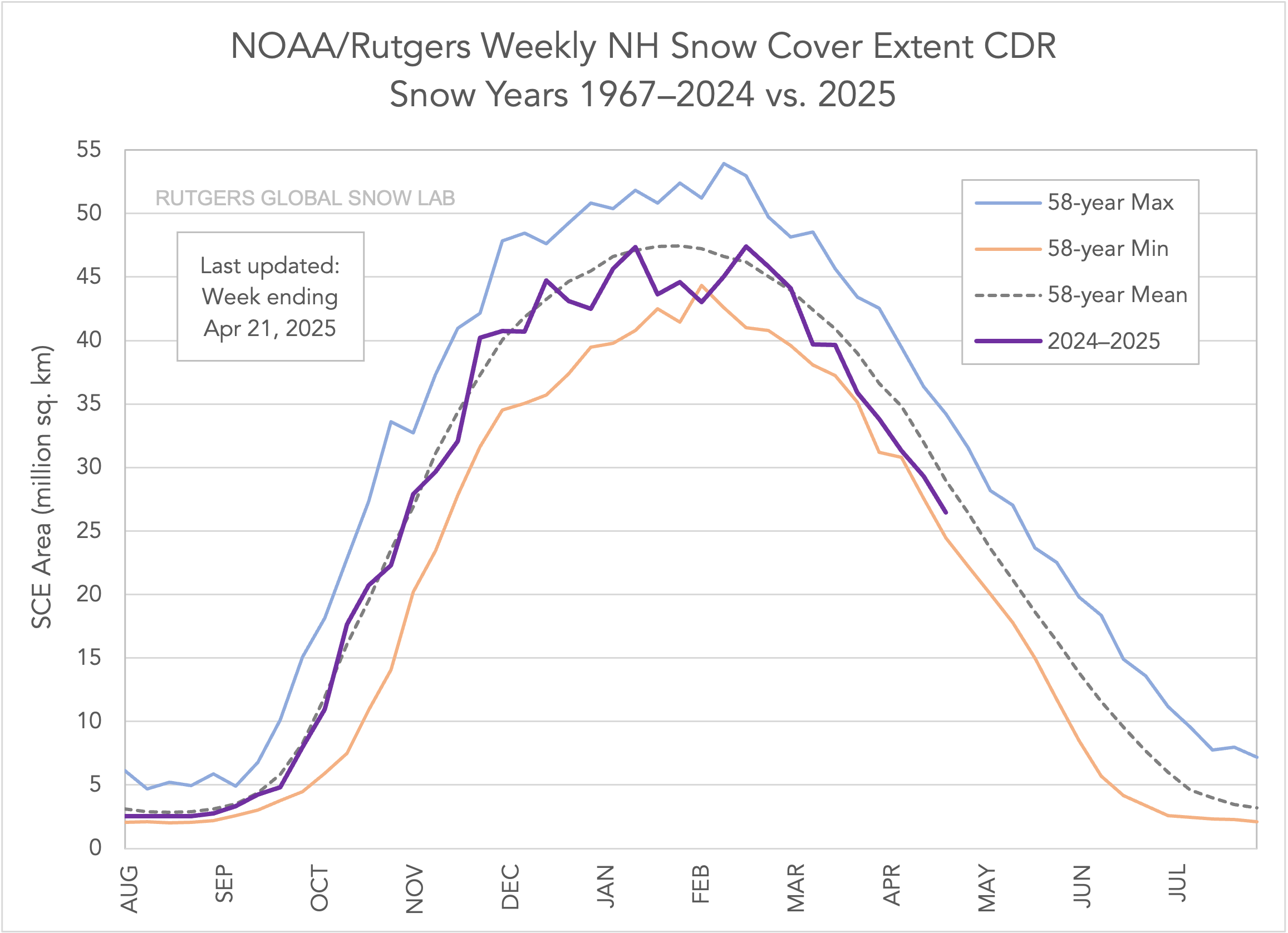
Look up all the most ‘liked’ comments. Many are not buying the CC nonsense, fortunately. The CBC’s views do not represent the majority of Canadians.
Why is so much still written about Net Zero and “carbon” taxes when it has been conclusively proved that man made carbon dioxide has a negligible effect on the climate, Atmospheric carbon dioxide levels have always risen after global warming and therefore cannot be the cause. Water vapour and clouds are the predominant greenhouse gases.90% as opposed to 0.04% for CO2. Doubling of the present CO2 level of 450 ppm will hardly alter its effect. What more proof is needed? By all means scrub the emissions to reduce pollution, but continue to supply reasonably priced energy using our fossil fuel reserves while we develop a mix of sustainable alternatives. There is no panic we have many years to do this.
Latest CO2 = 418.84 ppm. First, is CO2 a problem at all? The question has not been conclusively answered. Second, H2O must be the real villain? Stop H2O now! Panic! Crisis! Danger! Doom!
Ban DiHydrogenMonOxide!
It is deadly after all! It kills 460 Canadians every year! OMG!
It’s deadly if breathed in.
It can be deadly if you overdose on it.
Now crises are raining in us!
Terry Etam catches most of it, but here’s the real kicker. Over the past eight years they’ve been in government, the federal Liberals have betrayed every single political principle they ever had except one. Only global warming they held to firmly as something politically untouchable.
Not now. They have shown that they were prepared to sell out even this for political convenience. In Canada, the vote of the maritime provinces is generally strongly Liberal because of the maritime dependency on flows of federal funding into Atlantic Canada.
Not now. The federal Liberals are truly in a state of panic as to how badly their popular support has slipped in an area that was largely Liberal rotten boroughs. In large part, this is because of the abject disgrace that Prime Minister Justin Trudeau has become. Right now, if there was another election, it would be as bad a wipeout as they suffered under the dismal leadership in the Zeroes under Stephan Dion and George Ignatief.
So they caved on home heating by furnace oil. Now they are reaping the rewards of their faithlessness to every principle they ever pretended to hold.
Quebec is the real beneficiary ($1500 per capita) both because its bigger than the little maritimes and manitoba as the provinces needing equalisation. Newfoundland is ‘nuetral’
Prince Edward Island ( yah) gets $3000 pc.
Quebec gets $13.2 bill pa in equalisation payments
NB $2.2 bill
NS $2.1 bill
Manitoba $2.5 bill
Actually, yes, we should “just be doing nothing”. That is, nothing out of the ordinary. The “alternatives” to fossil fuels need to be able to compete with fossil fuels on a level playing field, and not because fossil fuels are “bad”, but simply because at some point, perhaps in 50 years, we may be needing alternatives.
Closer to 500 years. By that time, even fusion may be ready.
Thorium Liquid Salts Cooled Reactors are available now. Elon sez we will all live on Mars in 5oo years…it is much cooler there.
My thought on TLSCRs and similar projects is a “10, 100, 1,000” rule™.
Get 10 operating and connected to the grid.
Have 100 under construction with full financing in the bank.
Have 1,000 permitted by location with financing committed.
By the way, I’ll pass on the move to Mars.
Yeah, too much carbon dioxide.
We have 420 ppm.
Mars has 953,000 ppm.
Mars must be boiling!
70 F (20 C) to -225F (-153 C)
It is, actually, but because of the low air pressure.
Hee hee! Good point.
But NASA had the data that said Mars was warming too when this planet was warming approaching the end of he 20th century.
I think they said that about several planets.
The sun affects the weather on Pluto. I wonder what Pluto’s temperature profile looks like?
Pluto has an orbit that is a lot more elliptical than most of the other planets. In recent years Pluto was at it’s closest approach, so it has been moving away from the sun lately. As a result it’s been cooling.
Through in nuclear, and 5000 years is more reasonable.
Rolling back a tax targeted at fossil fuels, is not a subsidy.
Anyone who says it is knows nothing about economics, or reality.
From a microeconomic perspective, these two things are indeed the same. Leaving aside niggling complications around relative elasticities and intermediate responses, the outcome is the same: if you subsidize something or tax it at a lower rate, then you get more of it at a lesser price. That said, the framing of the back-peddling as a subsidy is so cynical that it makes a guy cringe. That reporters would do so is to their shame; that people believe it is to their ignorance. With a democracy, you often get what you ask for, and get it good and hard. Of course, in that sense, Canada has it better than the US — we aren’t even a democracy.
I don’t know about Canada, but the US isn’t supposed to be a ‘democracy’. All the support of democracy by the Left is simply a means of implementing Marxism through mob rule.
Marxism is the State owns the means of production. We have capitalism where individuals or corporations own the means of production
‘We have capitalism where individuals or corporations own the means of production’
Socialism has many forms, the common attribute being State direction of economic activity. After this, each form differs in terms of ownership (public or private), degree of intervention, type and amount of coercion applied, civil liberties allowed, etc.
You may consider the US to be ‘capitalist’ (ironically using Marx’s term for a market economy), but that ignores the vast amount of government intervention that has occurred since even before the onset of the Progressive era.
Suffice it to say that we now have a ‘mixed economy’, which has currently piled up a gazillion regulations, $34T in Federal debt, not to mention an even greater amount of unfunded liabilities that are currently being ignored.
A mixed economy is inherently unstable – it either moves towards free market liberalism or devolves towards one of the more totalitarian forms of socialism, e.g., communism or facism.
And it is the adherents of Marx. not Mussolini, who have been successfully ‘marching through the institutions’.
Funny then that the worlds richest- and staying that way- broadbased economys are ‘mixed’
Funnier still – just think how much richer everyone would have been absent government interventions. Or are you one of those Keynesian clowns that believe that governments can create prosperity by burying cash in bottles and then paying people to dig them up?
Funny how Cambodia is dirt poor with little government intervention.
For instance in the US , the wealthiest states are mostly liberal and Democratic party supporting.
If you think Cambodia doesn’t have much government intervention, then you haven’t been paying attention.
Been there, seen that.
‘Funny how Cambodia is dirt poor with little government intervention.’
Does the name Pol Pot ring a bell with you? He and his Marxist pals killed about a fourth of Cambodia’s people over a 2-3 year period in a failed attempt to implement an agrarian utopia there. The usual executions, but mostly by disease, starvation and physical overwork.
In this he was highly influenced, as are many of today’s climate warriors, by none other than Jean-Jacques Rousseau.
Stable is in the eye of the beholder.
Regardless, the more government, the slower the rate of growth.
Government is a drag on wealth creation.
Those countries with mixed economies and are wealthy, became wealthy before they became mixed economies. THey have all been losing ground since then.
We have socialism, where individuals own the means of production, but the state tells them what to do with it.
The difference between state ownership and state control, is a meaningless piece of paper.
US agriculture is mostly where the losses are socialised and the profits privatised
Crop insurance being one, price support when products arent wanted, tarriffs to keep prices high, the list is endless
While there is some socialization in farming, it’s far from the only place where the government seeks to control the output.
Marxism is a state which does not recognize the rights of Capital.
Capitalism is a state which does not recognize the rights of labour. Both are inherently unjust; both embed strife and conflict in their ideologies.
Climatism is a state which does not recognize the rights of Labour or Capital, worshipping Nature as its godhead. That core belief defines it as a syncretic religion.
Frank
Marx advocated a partocracy with only one party. The populace does not choose its leaders, the party members do. They can only be members of they agree to do what the party says.
Even a mob is vaguely democratic. Examined at the technical level, Marxism is a religion of irreligion. Such a thing has never existed before in the history of mankind. That makes it interesting, but not democratic.
No, it’s not. “Tax at a lower rate” can only be considered a subsidy if the new tax rate is lower than other alternatives’ taxes.
If I tax brown shoes at 30% and white shoes at 20%, I am not ‘subsidizing’ brown shoes by reducing its taxes to 25%. I am merely reducing its additional tax from 10% to 5%. In order to be called a subsidy (colloquially), I would have to reduce the rate of taxation of brown shoes to below 20%. And technically, from a strict definition point of view, it would have to be a negative tax rate to actually be subsidized.
Once the carbon tax reaches the appropriate level of 0, then we can start talking about whether or not ‘subsidizing fossil fuels’ is appropriate or not.
Speaking of which – we all know that ‘green’ energy is heavily, heavily subsidized – so fossil fuels have a long way to go before they reach the threshold of being a relative subsidy to the alternatives.
In Australia the biggest “subsidy” claimed by activists is the diesel fuel rebate. This is a giant tax on diesel fuel which can be claimed back if that fuel is used on farm and mining vehicles that don’t use the roads.
Strangely when I propose giving EVs a giant “subsidy” by imposing a large tax on them and allowing people to claim back some of the tax for off road use the same activist start abusing me. I must be missing something …
In Canada the fuel tax is not rebates, it is not charged at the pump. I have a UFA card that will only turn on gas pumps for taxed fuel. Farmers have a different card.
A democracy means that whatever the mob wants, the mob gets.
A republic means that no matter what the majority wants, the minority still has rights.
The US was never intended to be a democracy. Thank God.
Canada and the USA are partocracies, not democracies. Both have universal franchise but are not democratic.
Independents are parties of one, according to their constitutions. If there was a party with 3 members and all the rest were independents, the party of three would be asked to “form a government” and control the power, not the hundreds of other members.
From the outset there is no reasonable explanation for having parties other than the system demands them. IMV all votes should be free votes and “party membership” should not give preference to anyone for any position. A party is just a faction and there is not need for factions in governance.
Canada has no parties at the municipal government level. Anyone can be nominated and voted for. They should copy that up to the top. Parties are usually controlled by unelected back room hacks. The public did not vote for this system.
Exactly. The belief that rolling back a tax is a subsidy implicitly assumes that all property belongs to the State.
I agree with you about cuts in taxes not being subsidies, not *ever*. While it’s true that a penny saved is similar to a penny earned, on *balance*, the difference between receiving extra cash (a subsidy), versus being robbed of less cash than before (a tax break), is still *important*!
As someone once said, it feels ever so good, thr sensation when someone stops being one about the head? What madness attaches to economic ideology these days?
Oil companies get the same deductions as other businiesses, but have a far greater scale. In order to make it seem like the oil industry is recieving special treatment, Democrats in the U.S. have redefined subsidies to include both ‘disbursements’ (cash from the government) and tax deductions in the code. Even by that definition, Canada is not giving a new subsidy, just reducing a special punishment.
Sounds like BigOleBob…
Amendment XXVIII
Congress shall make no law to regulate, tax or license atmospheric carbon dioxide.
The right of the people to freely emit carbon dioxide into the atmosphere from any
source, from any place at any time in any amount shall not be interfered with.
Or something like that.
Yep, and I love the way the Quebec MPs voted against lifting the tax on heating oil because as far as carbon taxes go, their province says –
“we already got one”.
“And so, meester liberals mans, we fart in your general direction!”
I’d say Canada is really awkward.
It can’t be our genes.
Tip
Arghl
Tip story
“””Onshore wind projects in England stall as no new applications are received
Fears grow that Rishi Sunak’s anti-green policy shift is driving investment in renewable energy abroad”””
https://www.theguardian.com/environment/2023/nov/11/onshore-wind-projects-england-stall-no-new-applications-are-received
“Fears grow that Rishi Sunak’s anti-green policy shift is driving investment in renewable energy abroad”
Heh. That’s like saying a particular policy is driving out rats and cockroaches. What it means is “harder, faster, and more of it.” But then if you do the opposite of what the Groaniad wants is rarely a bad idea.
Terry,
I agree with you 98% and that energy illiteracy is the black plague (perhaps black death works better) of our time is a great line. However, right here I disagree
Energy prices were doing it far more efficiently in the latre 17970s to early 1980s. The gimmickery of the fuel economy standard helped begin a slow death of the automobile industry (I said “helped” as the industry executive helped too) that proceeds to the present day. It let politicians and regulators begin running an industry. Everyone sees “trimmable fat” in whatever they don’t like. Remember how people hated the “phone company”? There were movies made about it. Insurance, utilities, banks and so forth; full of trimmable fat from someone’s vantage.
45Q and 45X have spawned rent seekers all over the natural gas industry. There is trimmable fat if ever I’ve seen some. They provide pieces of paper, not disguishable from the indulgences of the middle ages.
Oh do I wish the edit feature would reappear.
So Terry believes that increasing the CAFE standard is just eliminating fat?
I’m guessing that Terry believes that setting the CAFE standard is just a matter of dialing n a number.
In his “mind”, there is no negative impacts to higher CAFE numbers.
With friends like Terry, do we really need climate alarmists?
Trudeau’s buddy, Gerald Butts, used to run the country as Principal secretary to the PM. He had left his job as CEO of the World Wildlife Fund where he hobnobbed with the likes of Prince Phillip and Claus Schwab to enable Trudeau’s ascendancy….mostly on an enviro virtue signalling basis, which the Canadian electorate lapped up…at least until their per-capita income dropped by 20% and a few countries worth.
Unfortunately Trudeau’s vanity decisions forced Butts to become chief spin doctor for explaining away Trudeau’s mis-steps but after many, Butts main goal became avoiding “stuff” sticking to him. He now consults to politicians in Washington. Beware US, the track record of Butts indicates that Joseph Goebbels would be an amateur understudy.
My intermittent dyslexia just kicked in for a bit at the start of your comment, which I read as “Trudeau’s Butts buddy, Gerald”.
I have to get fixed this dyslexia.
Quite right. Butts has already arranged his own getway by becoming Vice-Chair of the Eurasia Group. The next thing to watch for is the getaway of Katie Telford before Der Fuhrer Bunker is entirely overrun during the next election.
Carbon credits are for fools that believe it limits anything and does nothing more than push the so called “savings” down the block. Carbon tax has already been covered by the Beatles.
The great left coast State of Washington began a program — the word “tax” is not used by politicians in WA — to reduce emissions on Jan 1, 2023.
See:
Cap-and-invest – Washington State Department of Ecology
Everything in the State is now more costly than it otherwise would be.
Saving the World, or the Climate™, is very expensive.
“decision to roll back the carbon tax on heating oil, ”
Terry, I may have missed seeing it in your report, but JT is much more cynical (and idiotic) than you even think. Almost all of the Maritimes (Atlantic Provinces) is heated by oil, whereas the rest of Canada uses natural gas. JT is looking to buy votes from Maritimers who are drifting away from the Libs .
I’m subscribed to the Green Party newsletter here in Canada (just so I can bask in the ridiculousness) and they are furious about the NDP supporting the Liberals in this minor carbon tax break.
We can see what all this green BS has done to our country – we are now not even in the top 20 in the world in PPP GDP-per-capita anymore. Even among English-speaking countries, we are behind Ireland, USA, Singapore, and Australia (as well as the tax-haven islands).
I’d move to Australia, Ireland, or Alaska/Oregon/Washington (not ready for a Red state), but my wife wants to stay near her family here.
Oregon, Washington and Australia is out of the frying pan and into the fire. Better off staying near the wife’s folks.
“… and it most definitely is a creation of a brand new fossil fuel subsidy.”
“Not taxing” something is not “subsidizing” it.
story tip
Exclusive: Over 60 countries back deal to triple renewable energy this decade
https://www.reuters.com/sustainability/climate-energy/over-60-countries-back-deal-triple-renewable-energy-this-decade-officials-2023-11-10/
Renewables peaked in Europe in 2017. Oh cumulative investment has been added, but 47MW was decommissioned in 2019 (they aren’t reporting such things anymore!). Secondly, when a new windmill is installed, each year its capacity declines ~1.5 to 2% a year – blades get dull and pitted and coated with rough resin made up of juices and bodies of millions of insects.
The mills often need replacement in 15yrs (they advertise 25yrs and they only report those that reach or exceed 25 yr life And guess what? The ones that exceed 25 year have been idle the most!
Finally, did you know that since 2018 a raft of bankruptcies among companies that manufacture and build these “farms” has scared investors away from the sector. Most recently the largest installers are now backing out of major signed contracts. Google ‘problems for Siemens of Germany, Oerstead of Denmark, and others. Research all this, but not in the mass media if you want to impress on this, the world’s largest go-to site on all things climate.
How about finally delivering some sources for your 2017 claims?
I’ve seen it from multiple sources. If you believe it is wrong, it should be easy to find some numbers proving it.
Wind Europe press release 31 May 2023 ‘Electricity market design: European Parliament mustn’t undermine climate or energy security’
“But Europe invested only €17b in new wind farms in 2022 down from € 41bn in 2021...and orders for wind turbines were down 47% year on year”
“But only 10GW of new wind projects reached Final Investment Decisions (FID) in 2022 – one third of what Europe needs to build each year”
“Not a single offshore wind farm reached FID in 2022”
https://windeurope.org/newsroom/
The sad thing is that our clueless troll actually believes that any of these countries have any intention of actually fulfilling the details of this deal.
BTW, how are the Paris accords doing these days? Is there any country that even pretends to be trying to follow them anymore?
If you are taxed on a beer does that mean beer is a problem? If you are taxed on a new hammer for your tool box does that mean hammers or toolboxes are the problem? A tax, however it it sold, is raising revenue. Any other idea is propaganda.
Liquor and cigarettes are highly taxed, ostensibly to reduce health effects and pay for recovery programs, and other effects on society caused by those bad habits….but actually those taxes become part of a government revenue maximization program. The Revenue department hawks simply calculate how many many years of income tax they lose to health related issues, and charge enough tax on those products to cover it (or come out ahead). Individuals are just a minor component to a statistic as far as Revenue departments are concerned. Your death is irrelevant to them….that’s just when inheritance tax kicks in.
Tax increases can also lose revenue. When the U.S. imposed a tax on big budget luxury items, Dems claimed it would just raise revenue from the rich. It killed the largest high end boat builder in the US (Chris Craft) and several others as the rich just bought boats from overseas. So not only was there no new revenue, there was a revenue loss and more people out of work. The U.S. reached all time highs in tax total revenues after the Bush and Trump tax cuts went into effect (mixture of economic growth and less money going overseas), showing that the sweet spot is for any tax is usually much lower than expected.
“So you’re saying we should just do nothing.” I’ve heard that so often it sounds like mosquitoes in summer. It’s the only attack some people have.”
The clear answer to this question is no we should do something that works. Build more efficient and clean fossil fuel plants, build more nuclear plants, remove wind and solar from the grid, do better planning to move traffic through congested areas more smoothly and efficiently and on and on.
But the number one thing that must be done is to make government prove that the programs they want and except us to accept are needed, beneficial and affordable. That we will positively be better off with the changes. My guess is that the vast majority of government programs couldn’t meet these requirements, so they go in the trash can until they can. The country would be better off, we could reduce our deficit and we could address things that are actually beneficial and work.
Burning hydrogen releases water vapor which is a stronger greenhouse gas than CO2.
https://youtu.be/8wxRrUKHglI?si=urDFq1Kwn0tQcD6L
This is another example of Canada talking a good game on climate change action while supporting energy sources that it knows are reliable. This is after the federal Climate Commissioner’s office claimed that there’s no way the country will be able to meet its emission reduction goals either for 2030 nor probably for 2050. Programs already in place aren’t working as advertised and others that are planned are far from being implemented. So this will make it nine times in a row since 1988 that Canada’s climate plans have come up short. And guess what: citizens aren’t particularly concerned, as usual.
What kills me with all of this nonsense (and to some extent the information in this article) is that it does nothing to actually help the environment. I have four pillars that I use –
All this other stuff about carbon taxes etc doesn’t achieve anything other than make us all poorer – not the elites and multi billionaires who will wrangle the system to their benefit and swan around at international conferences bragging about their accomplishments (which now includes the Mayor of Regina who is hustling off to Dubai to be seen), but just us regular people who would like a BBQ on a weekend with our friends/family without paying enormous costs for the food, propane etc.