
The Maui fire would have devastated Lahaina in a colder or warmer climate. It would have devastated Lahaina in high or low CO2 concentrations. The key is managing the dead grasses that become flammable in just hours. Climate change was irrelevant. Declaring a climate emergency to reduce fossil fuels is a useless remedy that only misdirects funds that will be needed to better manage a fire-prone landscape.
The massive destruction and loss of life in Lahaina, Hawaii due to the recent wildfire has evoked tremendous compassion and concern from around the world for the people of Lahaina. I can’t comprehend the intense pain now being felt by the people who have lost loved ones, lost homes, and lost all their belongings. So how can such a tragedy be prevented from ever happening again?
First, according to meteorologist Cliff Mass, Hawaii is one of the most fire-prone states in the U.S. (see Figure 1 for some historical fires).
Lightning is rare on Maui. Fewer than thirty thunderstorms rattle across the Hawaiian Islands each year, and most occur during January and February. Accordingly, there have been no reports of an August lightning strike, so it seems doubtful this tragic fire was started naturally.
According to Hawaii Wildfire Management Organization, 98% of all Hawaiian fires are started by people, of which 75% are due to carelessness. Thus, a Smokey-the-Bear type campaign that “only you can prevent forest fires” would help raise people’s consciousness, especially newcomers. As retirees flock to Hawaii seeking the health benefits of a warmer climate, the population has tripled since 1980, which only increases the probability of a careless fire being started.
If started by an electrical spark, efforts to secure a vulnerable electrical grid is required. Sadly, the remaining fires have been suspiciously ignited by arsonists, and arson is nearly impossible to prevent.
However, there are other precautions that Hawaiians can take to prevent the rapid spread of fire that caught so many people in Lahaina by surprise. Dr. Clay Trauernicht, a professor of natural resources and environmental management at the University of Hawaii, notes wildfires have quadrupled in Hawaii in recent decades. We agree with his assessment that unmanaged, nonnative grasslands that have flourished in Hawaii after decades of declining agriculture have provided the fuel for more rapidly spreading and extensive wildfires.
As Maui’s pineapple and sugar cane plantations were abandoned, they became dominated by invasive annual grasses that flourish in disturbed soils. Fire experts categorize such small diameter grasses as 1-hour lag fuels, meaning that within half a day of dry weather, these grasses become highly flammable, allowing fires to rapidly spread in even moderate winds. Annual grasses typically die during the dry seasons. Maui’s rainless period typically lasts from about May 25 to July 15.
Furthermore, Lahaina is situated on the leeward side of Maui’s mountains. These highlands wring out the moisture carried by the trade winds, with only 15” of rain falling in Lahaina compared to 300” on the mountains to the east. Thus, Lahaina’s surrounding grassland vegetation is primed each summer to rapidly burn once ignited.

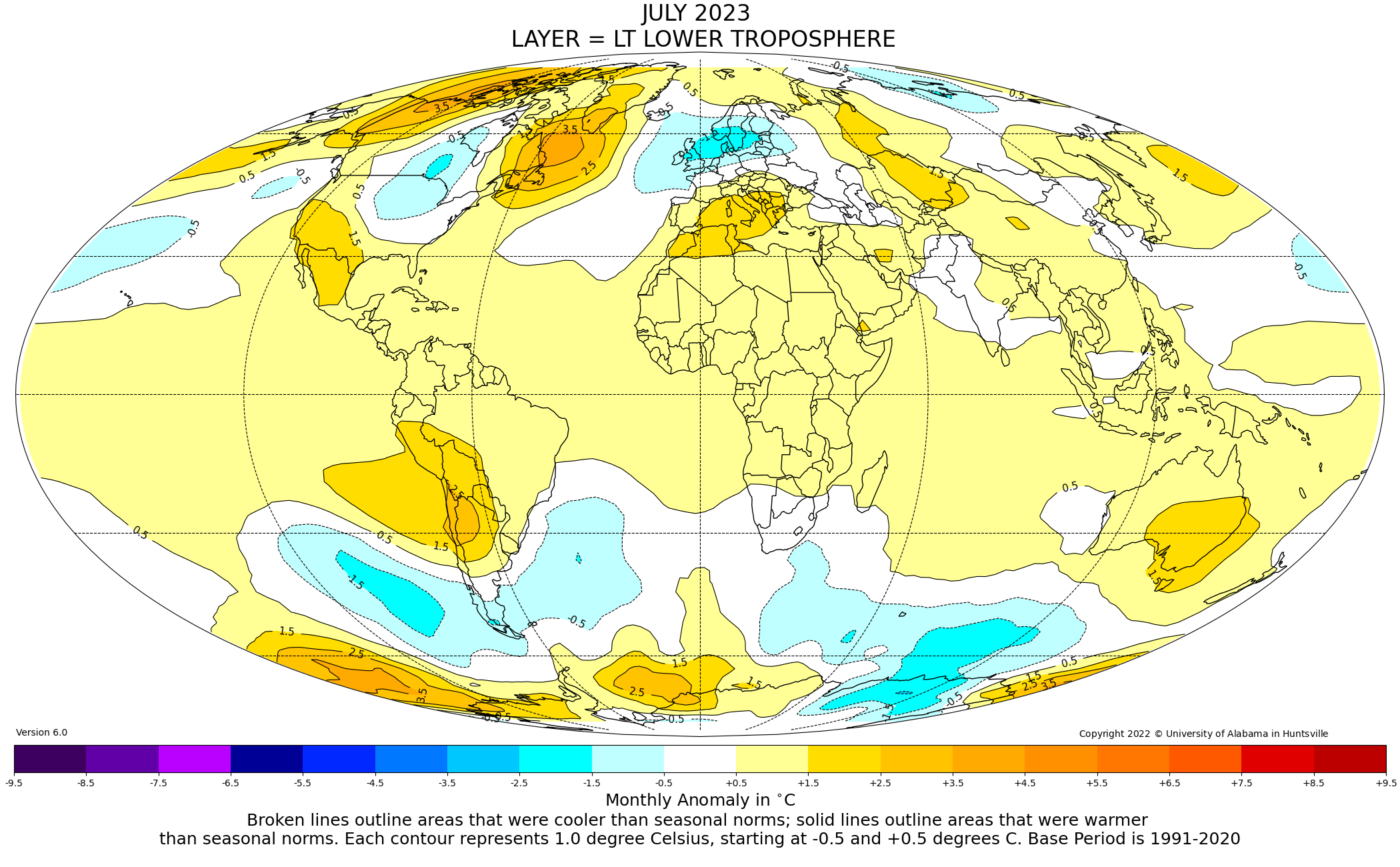
Counterintuitively, wet seasons create higher fire danger by increasing the abundance of dead grasses for the dry season. Spring of 2023 was cooler and wetter than normal (Figure 2), leading to high grass fuel load.
In contrast, dry seasons have little impact, as the dead invasive grasses become highly flammable quickly every season. Thus, the only protective measure for Lahaina’s future requires managing the grasslands as well as creating firebreaks that suppress a grass fire’s rapid invasion into the town.
Firebreaks protecting the whole town are especially important. If a grassfire reaches just one house in a densely packed neighborhood, such as much of Lahaina, that one house will radiate enough heat to ignite its neighboring house, which then sets off a cascading conflagration that can destroy a whole town.
The CO2 Coalition’s scientists caution against adopting useless remedies such as that proposed by the national director of the Green New Deal Network, who demanded that “President Biden declare a climate emergency and activate politicians to take further climate action.”
James Steele is a biologist, author and former director of San Francisco State University’s Sierra Nevada Field Campus. He is a proud member of the CO2 Coalition.
I spent 4 hours today at my Texas ranch on my JD 60 hp tractor mowing deep, but dry grass and brush from this past spring’s rain. Grass and brush that is now brown and tinder dry, … except for the damn pesky mesquite saplings trying to grow. Saturday and Sunday I’ll put in another 10-12 hours on the tractor, just droning to some podcasts, to finish it off. It’ll be good until maybe mid-Sept when I do some more trimming on the remainders and other parts.
When you have land that is tinder dry, you must, must, must, must think about the consequences of a wildfire. A grass fire could easily sweep through all this tinder dry stuff now in Texas with the lack of rain and high heat for the past 7 weeks. Too many people have gone utterly oblivious to this danger, and think Nature can take care of herself without fires with “conservation and fire suppression.” Well, fires are the natural state every 10-20 years in all grassland ecosystems.
Absolutely nothing to do with the Climate Scam.
A rancher hard at work, doing what needs to be done, will seldom be lionized. The disasters that did NOT happen, thanks to prudent land management, won’t be noted, either.
An a FF tractor!!!
Except for uber wealthy pious virtue signalers, the only functional tractors available are FF.
Much the same here on my place Joel, except I did my shredding about 6 weeks ago. Left strips since there were still some wildflowers yet to go to seed, (an amazing bloom this spring, eh?) The cows have pretty much tromped down any high stuff I didn’t mow. Now that it is this dry, I’d be a bit leery of running the shredder since the blades hitting against the sandstone that covers my place can throw sparks and ignite the real dry stuff—been known to happen. 12 inches rain in May, 4 inches in June and less than an inch since then. Live in Texas.
Your actions illustrate a major aspect of the situation: control/prevention is expensive. In your case the major expenses would seem to be equipment, fuel, and opportunity costs. Possibly you could not put your time to something more productive if the problem did not exist. so the missed opportunities may be relatively minor, but a general, public effort would also involve considerable labor costs and probably high administrative overhead.
For your own property, the cost-benefits is probably so clear as to need no extensive analysis. What would be interesting is a good cost-benefit analysis of a general solution with the $ cost/savings broken out from the human suffering aspect. That is, there are clearly large economic costs when large fires occur, even aside from the fire-fighting costs. Would the costs of real preventive action be larger or smaller than the inevitable costs of doing nothing until the danger materializes in flame and smoke?
Isn’t this Biden’s ‘Build Back Better’ strategy. But you first need capital destruction (burning down a town) before you can rebuild it (better?) with a huge cost. Same goes for energy. They first have to close down all existing (reliable) energy providers (capital destruction) to replace them with unreliable wind and solar (more capital destruction). Same for the economy where printing dollars like there is no tomorrow is capital destruction by destroying your savings.
Does that have anything to do with a cost-benefit analysis?
Lahaina’s rainfall is more like 13″. Not quite a desert, but close. The leeward side of the Big Island is also dry, such as the west side Kona.Coast, with an average of 20 days of rain per year.
Maui had a wet winter and dry summer, with high winds caused by a high pressure cell north of the islands and a cyclone, ie low pressure storm, to their south.
When I lived in HI, my house in a valley above Honolulu often rattled. Its single wall construction didn’t need to provide warmth, so was a toy to the frequent high winds.
So am I correct to understand that most of the housing in Lahaina would have been out of wood?
As for the Maui firefighters running through the smoke, I can imagine there was a certain hint of “Maui Wowie” wafting in all that smoke. Maybe almost enough to get high.
A large increase in the temperature of the troposphere in the tropics is evident. This may have been influenced by the eruption of an underwater volcano, supplying large amounts of water vapor to the troposphere (in the tropics). This coincided with a weak El Niño. The effect of increased water vapor in the troposphere will be offset by a strong monsoon in India and the western Pacific.
http://tropic.ssec.wisc.edu/real-time/mtpw2/webAnims/tpw_nrl_colors/global2/mimictpw_global2_latest.gif
Ireneusz Palmowski August 12, 2023 12:11 am
Say what? The map shows an anomaly of ~0.5°C. On what planet is half a degree a “large increase”?
Not only that, but Hawaii isn’t even in the +0.5°C area. It’s in the “no change” area.
Finally, your link goes to an entirely different map.
Regards,
w.
I mean the large increase in the area of the warm troposphere in the tropics as opposed to La Niña.
The increase in tropospheric temperature in the tropics is perhaps about 0.5 C, but the area significantly increased. At the same time, the current sea surface temperature indicates an easterly circulation in the central Pacific.

This shows that the increase in tropospheric temperature in the tropics is not identical to the increase in sea surface temperature.
What about the more active sun we have had the last 2 years?Isn’t the sun the main controller of the ocean’s surface temperature?
Story tip
“”…a recent study that I co-authored alongside colleagues from the University of Bristol. We found that bat activity is reduced at solar farms compared to neighbouring sites without solar panels.
This discovery is concerning. Bats are top predators of nighttime insects and are sensitive to changes in their habitats, so they are important indicators of ecosystem health. Bats also provide valuable services such as suppressing populations of insect pests.
Nonetheless, our results should not hinder the transition to renewable energy. “”
https://besjournals.onlinelibrary.wiley.com/doi/10.1111/1365-2664.14474
From The Conversation
“””re important indicators of ecosystem health
I told everyone here exactly that not long ago = solar panels destroy the soil underneath them.
They dry it out, nothing grows there in the shade, soil organics evaporate away and the ground turns to rock.
(Most nocturnal insects, notably mosquitoes of course, require standing/stagnant water, Such is The Very Last Thing to ever occur at a solar farm)
Solar Farms are = Soil erosion
Then various muppets really actually do think that installing sheep (to eat the ‘weeds’ under there) is a double whammy of ‘goodness’
This is fast track suicidal madness going on here
There’s definitely a problem but they’re going to ignore it…
They note that solar panels are damaging the ecology, but they conclude that this shouldn’t slow down the introduction of more solar panels.
I can’t think of any other form or economic activity that these hypocrites would give such a pass to.
Increased mining comes to mind/
What ‘annual grasses’
Only humans cultivate annual grasses.
Wild grass is always perennial grass.
See also the attached.
You stupid stupid people. You will rot in hell for this.
Just like the Easter Islanders did.
And on a volcanic island to boot. That is THE most fertile rock comprising that entire place and you STILL destroyed it.
what are the words for such stupidity and greed
You are on the right track – invasive economics. I have seen comment by kama’aina (Ohana?) faulting capitalist imperialist haole. I disbelieve. The aborigines have lived off the sale of their lands for generations, and returned little, invested little,
I enjoyed Maui (anyone know how Makawao fared) at the height of its decline. It was worn to a frazzle of its glory during the reign of the Royals.
Someone commented “firebreaks”. Highways make fine firebreaks, but are expensive of the last penny that can be squeezed out of the land.
Of the six Maui fires, four were near Makawao and two neighboring towns. Dunno if they’re out yet.
The Upcountry Maui Fire is largely contained.
Again Peta you rant about something you are very wrong about. Wild grasses aare definitely not always perennials. In the western USA invasive but wild cheatgrass has been a huge fire hazard. Annual grasses are adapted to colonizing disturbed soil,
https://www.usgs.gov/faqs/what-cheatgrass-and-how-it-harmful
I don’t know anyone that intentionally cultivates crabgrass. The plant dies with the first couple of frost. It comes back in the spring when the ground reaches about 55*F from seed. It is not a perennial.
https://www.pennington.com/all-products/fertilizer/resources/how-to-kill-crabgrass-and-prevent-it-from-returning
I sometimes wonder if there’s anything that Peta “knows” that’s actually true.
It may depend which way the wind is blowing. If Peta is downwind of the British Sugar plant at Newark, he could start hallucinating ☺
Um, no Peta. Wrong again.
The Hawaiian pineapple and sugar cane plantations are in decline because of economics, not soil erosion. The value of the land for tourism-related facilities coupled with high labor costs has resulted in shifting production to Costa Rica and Caribbean islands.
https://www.hawaiimagazine.com/end-of-an-era-maui-land-pineapple-closing-its-pineapple-operations/#:~:text=Hawaii%20pineapple%20production%20declined%20in,U.S.%20labor%20and%20land%20costs.
I would guess that the trees don’t grow back because the wildfires keep killing them. It take a number of years for trees to get big enough to survive a wildfile.
When young, the trees also have to compete with the grasses for light and nutrients.
Your belief that the soil has been destroyed is refuted by the speed at which the grasses grow.
Vesicular (i.e. full of gas bubbles) basalt is what the Hawaiian islands are made of. It weathers easily and is a rich source of mineral nutrients.
Dead trees like this are a common sight on the Big Island.
Is that a native species? Why did it die?
Mark – that’s exactly the mechanism that William Bond has been proposing since 2000 – transition between forest and grassland (and back) is determined in his hypothesis by whether trees can grow fast enough to be able to survive the next fire:
https://onlinelibrary.wiley.com/doi/abs/10.1046/j.1365-2486.2000.00365.x
This feeds into the well-established phenomenon observed from satellite of “global greening” and reforestation, in Africa and everywhere else. CO2 makes saplings grow faster so trees regrow into grasslands.
Funny how the alarmist crowd paint reforestation as a bad thing, “disrupting” ecological status quo. There is no status quo in the biosphere – or climate for that matter.
Tell that to the annual winter grass which is the bane of my existence. Utter bullshit. There are many annual grass species.
I’d like to know if cutting a firebreak to the north of the highway was proposed, and if so, who was responsible for keeping it from being done?
That large, grassy area to the north of Lahaina should have been kept mowed, or had livestock grazing it, along with a firebreak, or two, cut across it.
I live in a part of Idaho where there are a lot of parts that are natural grassland, dotted with sagebrush. In the spring it’s all green but that flush of color dries up as the rains stop.
Part of the defense against the spread of fire through the dry grass is a firebreak alongside major roads, sometimes on both sides of the road. Once made, maintaining the firebreak is done by dragging a harrow along it periodically to knock down vegetation and plow it into the soil.
Another area to look at is building codes. Metal roofs and brick veneer might not stop a fire, but they would certainly slow its spread in neighborhoods, giving people time to evacuate. Fire smart landscaping helps, too.
Cities made primarily out of wood burn easy. We know that from many big cities burning down to the ground in the past. Fire prevention was one of the most important tasks for the local governance. But even the fire in the Notre Dame in Paris could not be stopped. It is just waiting for the right conditions. Now think of parking an EV inside a building.
The CO2 Coalition’s scientists caution against adopting useless remedies such as that proposed by the national director of the Green New Deal Network, who demanded that “President Biden declare a climate emergency and activate politicians to take further climate action.”
They don’t seem to realize, or will not admit, that this is hopeless. The US does around 5 billion tons a year of emissions, and falling, out of a world total of 37+ billion and rising.
Say it took five years to get US emissions down to about 2 billion tons. In that time the world will have probably got to 40+ even with that US 3 billion reduction.
The idea that unilateral action on its own emissions by the US can have any effect on the US climate is absurd.
But I guess no more absurd than the idea which you often hear from UK activists, that in lowering its emissions the UK is making a rational and effective response which will have an effect on its own climate.
As I have said before, its like Tuvalu lowering its emissions as a response to sea level rise. To save the island. Completely disconnected from reality.
Brandon declaring a “climate emergency” has nothing to do with the climate. It has everything to do with gaining additional Executive powers. (And bypassing Congress.)
But what have CO2 emissions have to do with climate?
Thanks for posting this. I had already found this information before seeing this post. I found the first figure you have here explaining that 98% of Hawaiian fires are due to human causes such as accidents, irresponsibility and plants that don’t belong there. The information I found is dated from 2014 here: https://www.hawaiiwildfire.org/home
A very good assessment by Jim.
When will those responsible realise that Conservation is all about land management?
Land cannot be abandoned and “left to nature”. Degraded land must be managed and if grass fires are inevitable on a lee slope, in a rain shadow environment then mitigations must be made and regularly applied. The mitigation needed is a matter of judgement, e.g controlled grazing, controlled cutting, controlled burning, to name but a few of the possible strategies.
Land abandonment never works.
I was just with some people evaluating a return of a once-thought extinct tidal marsh plant. It was rediscovered in a preserve in a SF Bay marshland and abandoned ranch and duck club.. Paradoxically because “preserves” are established to preserve everything by preventing any disturbances. the lack of disturbance is that plants biggest threat.
Jim,
There is a distinction between Preservation and Conservation.
In the UK we have tree preservation orders that clearly do not keep the tree alive indefinitely, time always takes its toll.
Conservation seeks to maintain a dynamic system that in the case of a forest ecosystem that I studied may well cycle through distinct phases lasting hundreds of years per species. (e.g. Birch -> Oak -> Beech -> Birch cycles in Epping Forest).
The trick is to apply disturbance in a controlled manner so that the reserve under management is a mosaic of different time phases. By this means optimal opportunity exist for animal and plant populations to move to their preferred niche within the conserved area.
When the only objective is fulfillment of ideology, other factors are irrelevant.
“Sadly, the remaining fires have been suspiciously ignited by arsonists, and arson is nearly impossible to prevent.” Very harsh punishment for intentional arson (life sentences) would be a good start, and heavy fines if it’s accidental. Prosecution of organizations that promote such activities as something beneficial or heroic …
“Very harsh punishment” is not life sentences (which only enrich lawyers) – it’s death.
HI abolished the death penalty in 1957, before statehood.
But Maui arsonists richly deserve it.
Might that be why there has been a push for decades to remove the death sentence? If a potential client dies, there is no prospect of future income. Who is better qualified to work the system to insure future income?
Wildfires aren’t new, no matter what blinkered media imply. On October 8, 1871, after a dry late summer and early fall, wildfires consumed over 1.2 million acres in northeastern Wisconsin, an area about 2/3rds the size of Delaware. The town of Peshtigo was obliterated; at least 800 people’s lives were snuffed. At least 500 more were lost in the burned area. In all about fifteen times more people died that day in Wisconsin than in Maui a couple of days ago.
Other large wildfires occurred in the Michigan mitten the same day. History still remembers the 10/8/1871 date as “The Chicago Fire.” Chicago lost fewer lives than either Wisconsin or Michigan, but Chicago has more media.
… and I am still afraid to light a useful fire on Washington Island. Only our lush green wet ecology saved us then and protects us now. The woods are so overgrown, so much standing deadwood, so many acres upon acres of down and rotting trees …
Some people believe meteors may have ignited the fires which were very hot and fast burning in Wisconsin…Michigan.
Except there are instances in which meteorites that were recovered immediately after impact had frost on their surface. The outside is ablated because of the extreme heat, but the meteor is exposed to that surficial heat for such a short time that there is little opportunity for the interior to heat up.
It is a myth that meteorites that hit the ground are hot. Many of them are actually cold, as the heat of re-entry is mostly dissipated by burning off the outer layers, and they aren’t hot for long enough for that heat to penetrate to the interior of the asteroid.
The glowing streaks that you see in the night sky are caused by the air ahead of the meteorite. It is moving at many times the speed of sound, and the air ahead of it gets compressed and as a result heats up. Some of this heat gets transferred to the meteorite. This time of maximum heating is short. It’s intense enough that in the short time it occurs, it can be enough to melt the surface layers of the rock. but there isn’t enough time for the heat to penetrate to the center of the larger rocks. By the time the rock reaches the ground, the outer layer has cooled off and is no longer hot.
Thanks Jim for your usual well balanced assessment.
In the U.K. the BBC and Sky News are promoting the catastrophe as “the worst natural disaster to hit the State”, which conveniently allows them to ignore the, far worse, tsunami of 1946
All over the world the media is promoting this fire like that. You would think all the island burned down when is was only a small town (what is bad enough).
Why are people looking to MSM for the truth about this horrific tragedy? There are far too many anomalies now being reported and evidence is coming out through independent investigators.
Also, how is it that this book written by Dr. Miles Stone was published and available on Amazon just a couple of days after this tragic event? Was it AI generated?
https://www.amazon.com/Fire-Fury-Implications-Climate-Change-ebook/dp/B0CFCTLXJJ
Maui has learned a very expensive lesson….the local fire department and government were not prepared….some people will try to link it to climate change.
Governments will do whatever is necessary to divert attention away from their failure to be prepared.
Sparking power lines occurring as a consequence of the strong winds was the most likely source of ignition. The lessons of the 2018 fire which destroyed Paradise in California should have been plainly evident to anyone in authority on the island who was assigned responsibility for being proactive in dealing with the threat of wildfires wherever these might occur.
It has been clear for at least a day now that local civil authorities in Hawaii are fully culpable for not recognizing that a seriously dangerous situation was developing on Maui before the fire ignited, and for not taking immediate action to deal proactively with the danger of a wildfire by shutting off power to the island’s transmission lines well before strong winds could take them down.
So, if there evidence that wind damaged transmission lines were responsible?
Abnormal, very rare wind forces might be very difficult to compensate for but surely there is adequate data by now as to whether transmission lines are a real danger within the normal variation of winds. A genuine cost-benefit analysis is then required to determine the best actions. Cannot transmission lines be built to withstand wind damage beyond normal variations, plus some reasonable safety margin, much like the engineering specifications for a bridge?
“Hawaiian Electric, which operates the Maui Electric utility, has come under criticism for not turning off power despite warnings of critical fire conditions due to predicted dry, gale-force winds. The utility earlier this week said strong winds downed electric power lines and snapped power poles ahead of the blazes.”
Who controls 30+ year old poles ? And how many bridges are in a deplorable state these days because of a lack of maintenance ? Building is one thing but without the correct maintenance everything will fall to pieces ? And maintenance is expensive.
There are reports of winds over 100 mph, and that will take down any overhead lines. It doesn’t matter how strong the poles and lines are when the wind is uprooting bushes or picking up other large objects and hurling them into the lines. I expect power companies don’t try to overbuild for hurricane-force winds, but instead make sure they can replace the lines afterwards. Buried power lines would be much safer, but I don’t know if the ground conditions make these practical here.
Renee, there are pictures on the internet of lines down and sparking. If the grass was tall and tinder-dry, that will start wildfires.
Hurricanes would not cause fires like this – the lines would be down and sparking from wind damage, but hurricanes also drop huge amounts of rain so nothing will burn. It’s the dry winds that come over the mountains that cause wild fires.
Turning off the power may also shut down several things essential for emergency response. Lahaina apparently lost water pressure for fire fighting when power was lost due to broken wires; it would have lost the water even earlier if they’d proactively shut off the power. Warning sirens, emergency communications, and cell towers might be lost when power is down.
OTOH, all of these _should_ have had backups. The best backup for a water system is a water tank in an elevated location for gravity feed to the city water systems, big enough to keep the water flowing throughout an emergency, but there should be backup generators or diesel pumps also. Batteries can keep sirens and communications going. I also hope fire stations have battery-backed lights so the emergency personnel don’t have to get dressed in the dark when an emergency knocks out the power…
So disgusting!!The NY Times headlines exemplified the complete dishonesty that click bait media engages in to push climate change
NY Times wrote “How Climate Change Turned Lush Hawaii Into a Tinderbox” The habitat around Lahaina is far from “lush” . Mountains block moisture transport so the leeward habitats are very dry. And even drier during the natural dry season. Flammable invasive grasses have nothing to do with climate.
NY Times’ total dishonesty deserve legal action for defrauding the public.
The New York Times has staff of around 20 full time “reporters” dedicated to pushing the climate change agenda / narrative. None have background in science so they cannot understand that pushing a politically motivated movement is “not science.” They are paid – based on number of articles and length. None have ever heard of Karl Popper. Popper’s Falsification Principle provides a way to distinguish science from non-science. For for a theory to be considered scientific, it must be able to be tested and proven false, we should work at disproving a theory rather than continue to support unproven, untestable hypotheses. Liberal politicians love climate change because it provides them with talking point positions to control independent thinking and government spending to control citizens’ lives.
And if your objections had always been followed, what would have have happened to the career of shamans, priests, and war cheifs?
I have not visited Maui but I have been to Tenerife. The climatic similarities are striking. Both are volcanic ocean islands, located in the Trade Wind belt with a marked lee side rain shadow and in the case of Tenerife, desert conditions on the island’s south coast.
“Mountains block moisture transport so the leeward habitats are very dry.”
Same with Tasmania.
Soaking wet in the west, with deep lakes and usually a lot of rainfall.
Can get very dry in the east, and fires are a regular occurrence along the east coast.
(Have a friend near Bicheno, had really bad bushfires around 10 years ago)
Even the wet west can burn… loss of many Huon pine logs at one time not that long ago..
It can vary even on the same block. We once had a parcel of land in the hills. It was part of a valley. The shady (south) side had top soil 4 feet deep and had lush growth with tall trees and ferns etc. The sunny (north facing) side had zero top soil. Just rocky barren ground with no ground cover plants and just a few stunted trees. You would not believe it unless you saw it.
I remember attending a geology conference in Waikiki Beach, in July or August, about 1976. I signed up for a trip to visit Haleakala Crater on Maui. While driving up the volcano, looking out the bus window at the cows in a fenced field of dry grass, with eucalyptus trees next to the fence line, that I could just as easily be in California.
Thanks Clyde for this ground truth confirmation. I had been wondering if the fire prone alien gum tree was present somewhere in the mix of this tragedy.
Many (not all) Eucalypts suck every bit of moisture out of the ground and actually exude toxins so as to exclude any competition. They are trees born of fire.
I heard Clay Trauernicht on a PBS Youtube video,”What fueled the Hawaiian wildfires that killed dozens and leveled historic Lahaina town” saying the authorities had long been warned about poorly managed farmland causing high fireload risk. He has a Twitter account linking to some articles. ( however wouldn’t an unluckily placed house fire in those winds be enough to cause the same calamity ?)
From AMS Journals,”Fire and Rain: The Legacy of Hurricane Lane in HawaiʻiAlison D. Nugent, Ryan J. Longman, Clay Trauernicht, Matthew P. Lucas, Henry F. Diaz, and Thomas W. Giambelluca
Over the last 60 years, Hawaiʻi has seen >60% decline statewide in the land areas under agricultural production, including cultivated crops and ranching (Trauernicht et al. 2015; Perroy et al. 2016). These abandoned agricultural lands are now covered with the same nonnative fire-prone grasses and shrubs that burned during Lane, which currently comprise nearly 25% of state land. With rising costs of labor and the increasing value of real estate in Hawaiʻi, continued declines in agricultural production are replaced by increased residential development (Suryanata 2002). These land-use changes are compounded by an observed trend of drying in the area (Frazier and Giambelluca 2017), both of which are expected to further increase the risk of fire in Hawaiʻi in the future (Trauernicht 2019). As for the connection of fire and hurricanes, we note that hurricane season in the central Pacific (1 June–30 November) coincides with the dry season (May–October) and the climatological peak in KBDI, illustrating an ongoing connection between hurricanes and fire risk in Hawaiʻi that requires further investigation.
Jim, thanks as always for being a voice on sanity in a sea of hysteria. Well explained, well written.
Best regards,
w.
Thanks Willis, I feel the way about you!
Thus, unfortunately, a voice heard by almost none of the population at large.
Nature is thus weaponized for political gain.
The atmosphere is still not responding to El Niño and the easterly circulation is concentrating water vapor in typhoons in the western Pacific.

Eastern Circulation in the Central Pacific. Still high over Hawaii.
http://tropic.ssec.wisc.edu/real-time/mtpw2/product.php?color_type=tpw_nrl_colors&prod=epac×pan=24hrs&anim=anigf
This an awefull tragedy and we here in Australia have experienced similar fire disasters.
From my experience living in Australia I believe that these fires could be better managed with improved planning and forethought.
One of the singular, biggest issues is inappropriate location of residential properties built from flammable materials and with no escape routes.
Why wasn’t wind mentioned in this otherwise illuminating article? It is by far the most significant factor in turning a dangerous fire into a deadly one. Even if there is abundant dry vegetation for fuel, if there’s hardly any wind there’s plenty of time to get out of its way or get it under control. When you have high winds, there’s nothing you can do except warn people to flee as fast as possible. Preventive burns and firebreaks can help but you can’t reasonably do that in a town of wooden structures. Once the first one catches fire, all the ones downwind will burn. Streets aren’t wide enough to prevent that.
stinkerp, Winds were indeed mentioned, “grasses become highly flammable, allowing fires to rapidly spread in even moderate winds“. Furthermore the focus of the article was “guidance” (which was in the original title of the article) and looking at what can be done to prevent such a fire storm. Nothing can be done about the wind, and the wind is a non-factor if there is no ignition and no flammable fuels. For example, gusts were up to 67 mph over Maui which was minor compared to Hurricane Iniki in 1992 with recorded wind gusts of 225 mph, but no firestorm. Furthermore hurricanes in the central Pacific increase during El Nino-like conditions. So the issue is how to ensure that we do not create conditions that allow natural occurring winds to spread an un-natural fire.
Yeah, but in 1992 there was no fire so the wind gusts didn’t fuel a devastating conflagration. You make good points about prevention but it’s not clear that the destruction of Lahaina could have been prevented and I think your presumption is premature. What could have been prevented is the loss of life if communication hadn’t failed. The Santa Rosa, California fire of 2017 propagated by 60 mph winds destroyed 2,800 buildings and 22 lives despite much better communication and rapid evacuation. It’s not certain that it could have been prevented either. When you have wind speeds that high, embers can carry long distances. You can’t reasonably thin neighboring forests enough to prevent the spread of a fire with such high velocity winds. What can reasonably be done should be, but not every devastating wildfire can be prevented. We’ll have to see what the assessment is after this is thoroughly investigated. Every year nature throws us random and unique combinations of factors that result in devastation that is difficult to prevent: earthquakes, tsunamis, hurricanes, tornadoes, wildfires, floods, droughts, etc. Prevention matters, but sometimes it’s not enough.
I toured the town of Paradise right after the Camp Fire with a science reporter from a local radio station. It was heart wrenching to see total destruction of neighborhoods with closely packed houses, yet neighborhood trees were only scorched at their base, It was also amazing to see that less than 100 yards away single houses totally untouched. We stopped at a church in Paradise that was handing out water and food. The church was surrounded by a grassy lawn and a parking lot. The church was totally untouched. The fire came right up to the lawn and stopped, and again only the base of the trees were scorched. Such patterns made the value of fire breaks very obvious. I saw similar patterns in Santa Rosa’s Tubbs fire.
Its a great mystery to me why you are so insistent on downplaying the immense value of fire breaks.
Better communications would have helped people flee but the the problem is you dont want the roads to get blocked and prevent firefighting equipment to pass. Sadly the shelter in place communication ended up being a death sentence.
Quite an interesting article from “The Maui News” of 2022 about the conflicting ideas about land use around Lahaina. One side had bought 257 acres to try to build houses but community groups wanted to keep it as open space maintained as a firebreak to stop repeats of previous wildfires: “Since 2020, the association has pushed for full public ownership of the land and joined other Maui community groups to gather support for purchasing the property to keep it in open space, Britton said.
Its predecessor, Maalaea Community Association, along with Sierra Club, Maui Tomorrow and other community groups, also advocated years ago to keep the lands in open space.
The Maalaea Village Association has described the 257 acres as “prime ag,” an alluvial plain, with some of Maui’s deepest soil deposits. The Lahaina Pali Trail terminus is on the site, and with the lands in preservation there could be on-site firebreaks and brush control. The association also said that the property is a “key area” to mitigate runoff and sediment into Maalaea Bay and a crucial area to mitigate the spread of wildfires from the slopes of Mauna Kahalawai.”
“Maalaea land that sat undeveloped for years is back in the hot seat
Private company buys 257 acres that county, nonprofit had eyed for conservation”
Maalaea land that sat undeveloped for years is back in the hot seat | News, Sports, Jobs – Maui News
The allure of “open space” is a siren song that captivates environmentalists and the city officials and developers who promote their interests. In my opinion, an uncompromising “open space mindset” was fodder for the December 2021 Marshall Fire near Boulder and it seems they have yet to learn their lesson.
Until the recent Laheina fire, the Lafayette / Louisville / Superior wildfire had the dubious distinction of being America’s most catastrophic wildfire fire, causing 2 billion dollars in damage to the Boulder suburbs. More than a thousand homes burned, though thankfully only a few deaths were reported. But after Colorado’s wettest May and June on record, the area is once again flush with grasses and we’re fixin’ for a reprise this fall. Such has been the centuries-old natural order of things along the Colorado front range until the 19th century when the first European settlers moved in and brought their livestock. Heavy grazing subdued the wildfire risks, townships sprang up and the nature lovers moved in. Open space restrictions followed for the pleasure of the day hikers.
I’m a nature lover too, but Boulder’s fabled Chinook winds that roar down off the flatirons and across the city of Boulder haven’t gone away. And the grass is back. Let’s think ahead shall we?
The Chinooks obviously have their counterparts in dozens of locales: the shaboobs of Phoenix, Santa Ana winds in California, and these rain shadowed areas of Hawaii. We can mitigate the fire risks where towns and cities are in lethal proximity to open space grassland, but advocates need to put aside their cherished attachment to “untouched wild lands”. They must manage these natural resources. In my humble opinion, the answer is goats.
The open space grasslands west of Boulder where the fires began and spread was mainly native grasses according to its Open Space Director and the plant ecologists in charge of maintaining them.
In an email to Boulder Open Space Mountain Parks I asked about invasive species of grasses and whether grazing (and specifically goats) could be employed to keep the heavy growth of grasses in check.
It seems to me bird flywayws, native species and green sensibilities could all be preserved, and fuel loads reduced to safe levels, by a watchful goat herder and her dog moving animals across the most dangerous grasslands at an acre a day. They work for free and fertilize as they go, not a PhD among them.
Targeted goat herding is not a new idea, but apparently the strategy would die the death of a thousand bureaucratic paper cuts if proposed in Boulder, even in the wake of a catastrophe that a few herds of goats could have averted.
shaboobs? Merriam Websters says “haboobs”.
Another tropical storm will pass Hawaii from the south. The winds will pick up again. Fire danger will increase.
