Volcanic estimate 🌋📈
Initial scientific estimates were 50-million metric tons of water injected into the stratosphere by Hunga Tonga-Hunga Ha’apai submarine volcano.
Likely off by a factor of 3.
New research suggests 150-million metric tons or almost 40 Trillion gallons of… https://t.co/BEnfFL2bEr twitter.com/i/web/status/1…


The 40 Trillion gallons of water vapor in the stratosphere represents an unprecedented amount injected in the stratosphere.
Volcanic eruptions like Pinatubo blast SO2 into the stratosphere creating a cooling climate shroud for 1-2 years.
But, Hunga Tonga had only 2% of the SO2 as Pinatubo but a gargantuan amount of water vapor, which is well known to WARM the Earth. The question is how much?

Credits: NASA Earth Observatory image by Joshua Stevens using GOES imagery courtesy of NOAA and NESDIS
Global warming caused by Hunga-Tonga is significant.
The eruption of Hunga-Tonga increased the water vapor mass in the stratosphere by 13%, and it will remain there for many years to come.
“The unique nature and magnitude of the global stratospheric perturbation by the Hunga eruption ranks it among the most remarkable climatic events in the modern observation era.”


Earlier in March 2023, scientists reported likelihood of warming from the volcanic injection of water vapor into the stratosphere pushing Earth closer to 1.5°C Paris Agreement threshold.
Based upon the last few months, it seems the effect of 🌋 on global temperatures may have been greatly underestimated. It’s straightforward how to run a radiative transfer model to determine the impacts of adding 150M metric tons of water to the stratosphere. But, detailed climate model simulations are needed to disentangle the atmospheric circulation changes that lead to non-linear feedbacks. The climate is “abnormal” right now, aside from the developing El Niño and background climate change. https://eos.org/articles/tonga

I wanted to know if tropical storms etc reach the stratosphere. apparently they do.
“The tropical cyclones with deep convective synoptic scale systems persisting for a few days to week, play an important role on the mass exchange between the troposphere and the stratosphere, and vice versa”
Leading to:
“Even very small changes in lower stratospheric water vapor could affect the surface climate”
From https://acp.copernicus.org/preprints/acp-2015-988/acp-2015-988-manuscript-version7.pdf
So there are clear paths between the layers in the atmosphere.
This paper suggests the effects of the Hunga eruption may last for a few years.
https://www.nature.com/articles/s43247-022-00652-x
Yeah, but climate models do NOT correctly model any part of the water cycle which determines Earth’s climate so what the hell point is there in trying ?
We do not understand, evaporation, advection, nucleation, cloud formation or precipitation in a cell by cell mathematical equation.
Interesting thought, but no data to back it up. When the Enso state changes to El-Nino it generally gets hotter and that is probably what this is. There is no data showing a change in atmospheric water vapor that looks anomalous compared to the last few decades.
The 9 km water vapor did show an increase almost exactly at the time of the eruption. Nothing outside normal levels though.
Yes I saw that, I guess the next question is what should a 10% bump in stratospheric water vapor look like on the available data.
It looks like this.
Interesting, it would appear that the data that I showed does not show such a dramatic increase, or 9Km is not the correct altitude to see it.
Actually, I am not sure what is being plotted, could you provide the link?
https://acd-ext.gsfc.nasa.gov/Data_services/met/qbo/qbo.html
It is the ppm anomaly at 10 mb. The stratosphere has about 5 ppm of H2O through most of it’s depth for reference.
Hunga-Tonga injected the water vapor into the upper part of the stratosphere and lower part of the mesosphere beyond 25 km.
The graph you posted is at 300 mb (~9 km) within the troposphere.
Because all that water vapor just stays up there forever, right?
Someone smarter than me explain why that water vapor won’t simply condense or freeze?
https://qph.cf2.quoracdn.net/main-qimg-6a60082f18be995a9a551464ef74f81b.webp
Because at the pressures and temperatures of the stratosphere water is a gas, takes temperatures below -50ºC to freeze.
Try to interpret the H2O phase diagram.
At the temps and pressures in the Stratosphere, it will be borderline vapour/solid
No, that’s the pH2O not the atmospheric pressure. Polar stratospheric clouds require temperatures below -78ºC to form.
Not a question of smartness. The stratosphere is extremely dry. There is not enough water vapor to condense or freeze. Only under the extremely cold conditions of the polar stratosphere (-80ºC) can clouds form. These polar stratospheric clouds usually contain nitric and sulphuric acid and include supercooled water (type I). Type II polar stratospheric clouds are made only of water ice and are very rare. Perhaps they’ll become more common after Hunga Tonga.
Whoa. I had to do a double-take to make sure I was actually on the WUWT site reading this.
BTW…Here’s what Hunga Tonga did to the stratosphere.
https://acd-ext.gsfc.nasa.gov/Data_services/met/qbo/qbo.html
While the graphic you presented is nice and appears quite alarming on first glance w.r.t. beginning-2022 onward, it suffers from the following problems:
1) the legend only shows relative (“anomaly”) H2O concentrations in ppm against some undefined baseline absolute value of total H2O at the 10 hPa equivalent altitude . . . note the negative values (brown shadings) in the color code legend. Therefore, there’s no way from this graphic to know the % change in the absolute concentration of H2O vapor at this altitude.
2) If just considering the relative change from January 2022 onward, the graph show perhaps as much as a 1.25 ppm increase above the global average from mid-2004 thru end-2021. 1.25 ppm is equivalent to 0.000125% . . . does this incremental change really merit concern?
1) The general rule is about 5 ppm in the stratosphere. There is some variability both in terms of height, latitude, and time of year. But generally speaking 5 ppm is the baseline.
2) Yeah, so about a 20% increase in water vapor at this level. At the tropopause there is almost no change. Rough average through the depth of the stratosphere is about +10% give or take. This is probably good for about +0.1 to +0.2 W/m2 of radiative force. To put that into perspective the CERES Earth energy imbalance as of 2023/04 came in at +1.8 W/m2.
I believe 10 pascals is the very top of the stratosphere.
Way up there.
It is a wide payer.
From the initial reports of the height of the eruptive column, this volcano reached well into the mesosphere.
Thunderstorms routinely poke well into the lower stratosphere, to 80,000 feet or so.
But rarely does any event put stuff up to the top of the stratosphere, let alone the mesosphere.
I see very little in the way of anyone pointing out that “the stratosphere” is a very large and, on the bottom end, not a particularly well defined layer.
1 hPa = 100 Pa = 1 mb. The top of the stratosphere is about 1 mb or 100 Pa. 10 mb is roughly in the middle or maybe slightly higher in the stratosphere.
Like you say though the upper and bottom boundaries are not well defined at least in terms of height or pressure levels.
The injection of SEAWATER into the stratosphere and even the mesosphere during the Tonga Hunga Tonga Haa’apai volcanic eruption on January 15, 2022 means that numerous elements and compounds were also expelled, among them: sodium, chlorine, magnesium, calcium, potassium, phosphorus, iron, mercury, uranium, iodine, bromine, fluorine, sulfur, nitrogen, oxygen and silica to name but a few. Also bear in mind that the entrained CO2, chlorine & fluorine along with high blast temperature & pressure must have formed ozone-destroying CFC’s. What effect all this will have on global weather is anybody’s guess.
One direct effect, which doesn’t require a GCM climate model to ascertain, is the injection of a HUGE amount of cloud condensation nuclei—in addition to the noted injection of water vapor—into the troposphere and stratosphere. Overall result of such will be an increase in percentage cloud coverage over Earth.
But you’re right: “What effect all this will have on global weather is anybody’s guess.”
AFAIK, nobody, including the modelers of CC for the IPCC, knows how to properly assess the impact of various type of clouds on Earth’s climate. I’ve read of debates that cirrus clouds clouds cause global cooling but lower clouds (e.g., cumulus and stratus) produce global warming . . . some of this is captured in Richard Lindzen’s “Iris hypothesis” concerning climate (ref: https://en.wikipedia.org/wiki/Iris_hypothesis ) and in Willis Eschenbach’s many excellent articles posted to WUWT concerning global cloud formation, evolution and possible direct impacts and feed-back couplings (ref: https://wattsupwiththat.com/2021/03/15/clouds-from-both-sides-now/ and many others).
But the scientific community “jury” is still out . . . NOBODY KNOWS!
However, I do believe it is logical to ask if the hot weather experienced this summer in the Northern Hemisphere, could possible be associated with the Hunga Tonga-Hunga Ha’apai Submarine Volcano, even though I personally do not buy into MSM claims that it is “record breaking” or “unprecedented”.
Note in particular this from the author of the above article (third- and second-to-last sentences of his/her text:
“It’s straightforward how to run a radiative transfer model to determine the impacts of adding 150M metric tons of water to the stratosphere. But, detailed climate model simulations are needed to disentangle the atmospheric circulation changes that lead to non-linear feedbacks.”
(my bold emphasis added)
It’s models all the way down . . .
If there is one useful thing the IPCC has produced, it is definitive proof that atmospheric climate models are far and wide (possible exception for one Russian model) USELESS in predicting climate, disagreeing with each other by a factor of at least eight as well as over-predicting incremental global warming by an average factor of 3 compared to actual measurements taken for the duration of such predictions.
Consequently, IMHO, one should take the above article with a grain of salt water.
There is no sign of a temperature rise in the lower stratosphere.

Even the ~month-long bumps in the plotted lines representing “max” and the 70% statistical values for Jan-Feb 2022 (volcano eruption time) and Jan-Feb 2023 (no volcano) appear to be similar . . . what’s up with that???
Greenhouse gases in the stratosphere radiate into space and cannot raise the global temperature in the troposphere. The temperature in the tropopause is constant and lowest. Ozone radiation in the higher layers is radiation into space.
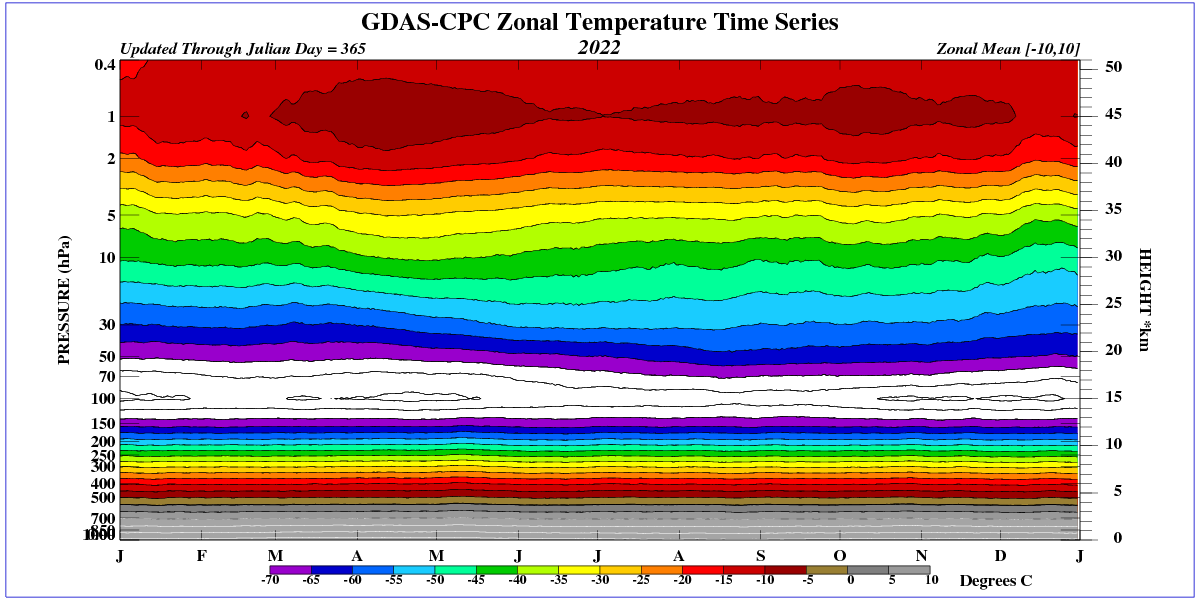
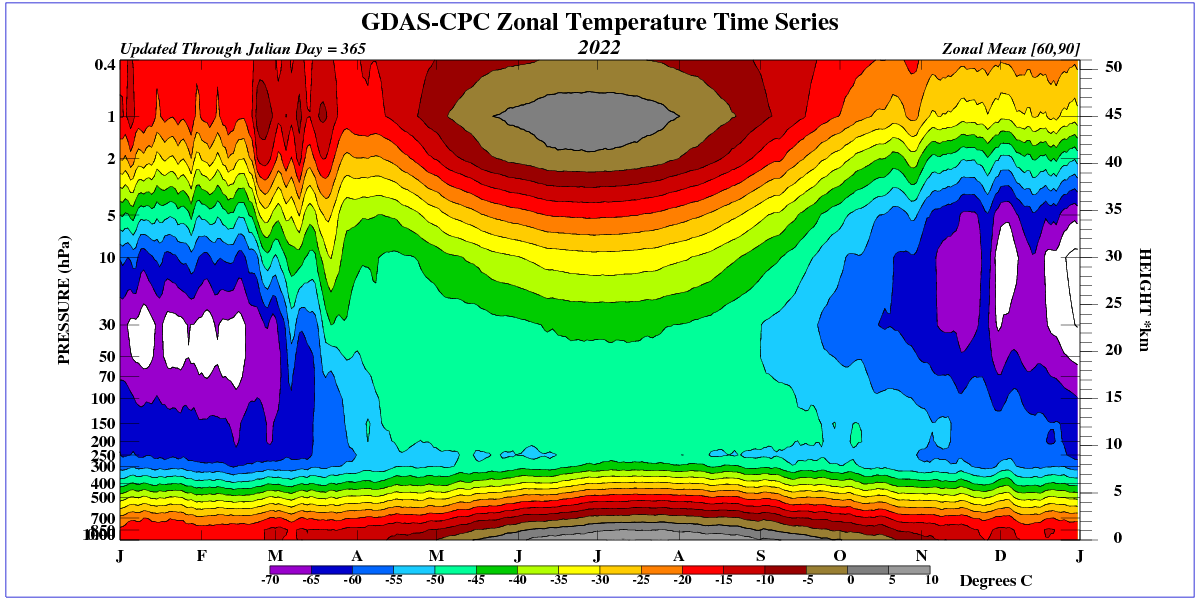
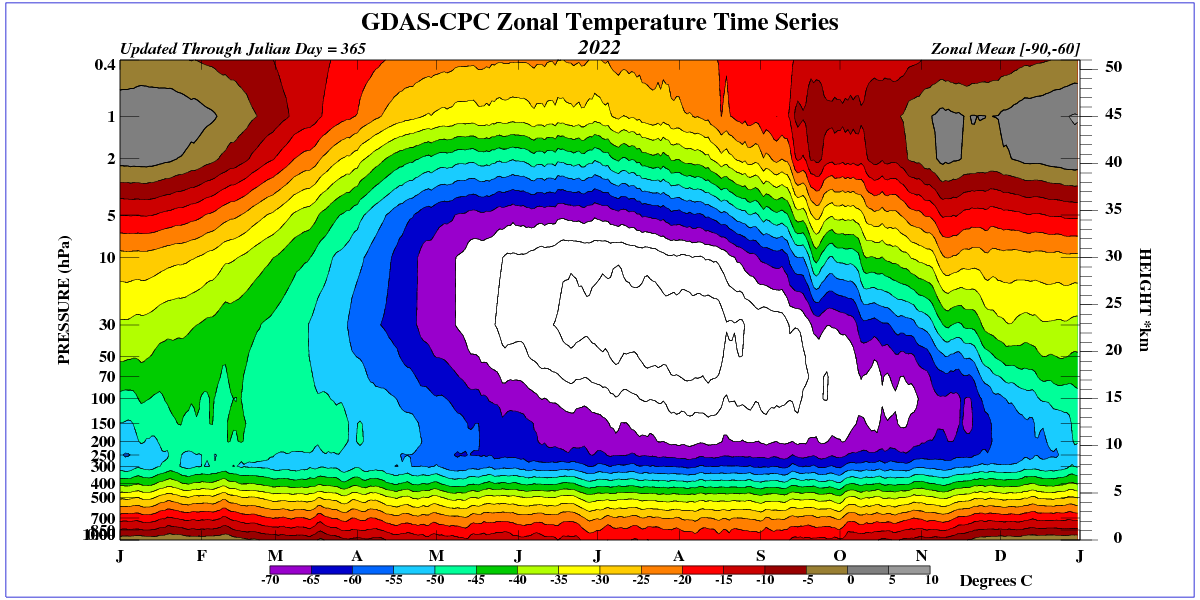
Greenhouse gases anywhere in the atmosphere, on a collective basis, radiate isotropically . . . meaning in ALL directions, including toward Earth’s surface.
Water vapor that enters the stratosphere loses energy in space and contributes to energy loss in lower layers. A glaring example is hurricanes, which lower the sea surface temperature in an area.
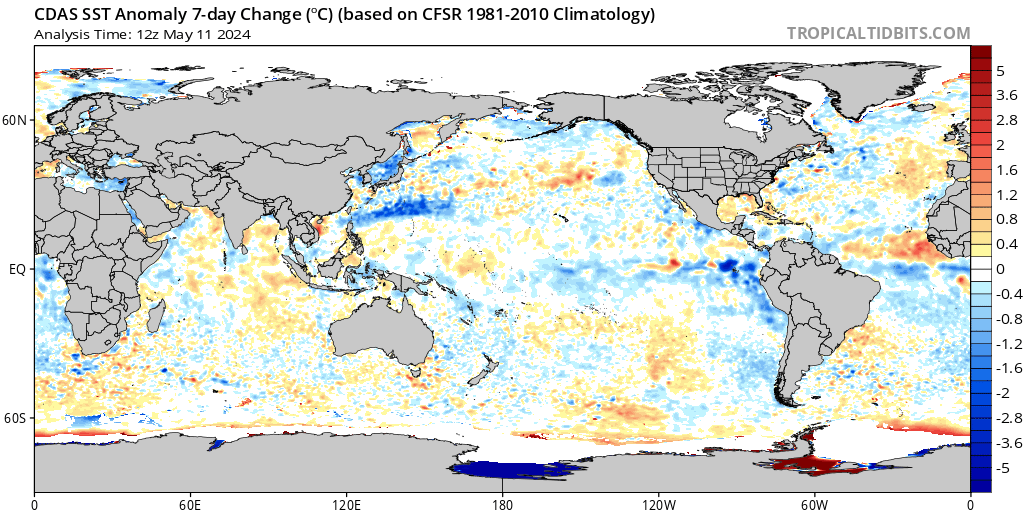

Observe the changes in surface temperature in the western Pacific, you will soon see a large patch of cooling after the passage of a typhoon.
A dangerous typhoon in the Philippine Sea will head toward Taiwan.
“The 40 Trillion gallons of water vapor in the stratosphere represents an unprecedented amount injected in the stratosphere.”
How do we know it’s unprecedented? Or are we still talking about the incredibly myopic timeframe of modern civilization?
An atmosphere without water vapor and aerosols is virtually transparent to solar radiation. Dry deserts are the best example.
Therefore, highs in the middle latitudes can bring extreme temperatures in both summer and winter. Water vapor is a mitigating factor for the impact on the surface of direct solar radiation. Stationary highs are created by the corresponding course of the jet stream.
In two days, a cold front from the northwest will reach Greece.
https://i.ibb.co/HBkWPmB/hgt300.webp
The Doomsters will be so disappointed.
Correction – could cool earth for years.
Is it possible that this was the cause of the record amounts of snow falling in the western USA and Japan this last winter?