By Christopher Monckton of Brenchley
Just in time for the latest UN Assembly of Private Jets at a swank resort in Egypt, the New Pause has lengthened again. It is now 8 years 1 month, calculated as the longest period for which there is a zero least-squares linear-regression trend up to the most recent month for which the UAH global mean surface temperature anomaly is available:

The trend on the entire dataset during the 527 months from December 1978 to October 2022 is 0.59 C°, equivalent to a modest and beneficial 1.34 C°/century:

If global warming were to continue at 0.134 C°/decade for 77 years to the turn of the next century, there would be just 1 C° more global warming this century. Is that a crisis, emergency, catastrophe, cataclysm or apocalypse? No. It is a good thing.
Why, then, the continuing worldwide pandemic of panic about the mildly warmer weather we are enjoying? In Britain this summer, for instance, we had a proper heatwave for a few days. Where’s the net harm in that?
The reason for the hand-wringing and bed-wetting is that policy continues to be made on the basis of computer predictions which have long been proven wildly exaggerated by mere events. In 1990, for instance, IPCC predicted that by now the warming rate should have been not 0.134 but 0.338 C°/decade:

At the same time, IPCC predicted that midrange equilibrium sensitivity to doubled CO2 would be 3 C°. Corrected for the reality/prediction ratio 0.134 / 0.338, that long-falsified prediction should have been reduced to 1.2 C°. But that is below the already-harmless 2 C° lower bound in IPCC (2021), and even below the 1.5 C° lower bound in IPCC (1990).
If the global classe politique were not innumerate, someone would have asked IPCC how it justified increasing the lower bound of its prediction by a third even though observed warming has proven to be only 40% of the original midrange prediction.
There are some who argue that IPCC (1990) had very greatly overstated the trajectory of business-as-usual emissions compared with subsequently-observed reality. That being so, why has IPCC not revised its business-as-usual trajectory to bring it somewhat into conformity with observation, and why has IPCC not consequently reduced its medium-term warming predictions?
But let us pretend that all the snorting and honking, whining and whinnying, twittering and twattling at Sharm-al-Shaikh will lead to anything other than the continuing bankruptcy of the Western economies as unaffordable energy drives our staple businesses into the willing arms of Communist China.
Let us pretend that the world will continue to ignore the observed reality that global warming is and will continue to be small, slow, harmless and net-beneficial, and that all nations will move together to attain net zero emissions by 2050 (the British Government’s fatuous and economically suicidal policy).
That won’t happen, of course, because 70% of new emissions these days are in nations wholly exempt from any obligation, legal, moral, religious or other, to forswear their sins of emission:

But let us yet again ignore mere reality, just as the private-jetsetters of Sharm al-Shaikh will do, and pretend that by 2050 the whole world will have fallen to its knees, craved Gaia’s forgiveness for its sins of emission, and abandoned entirely the use of coal, oil and gas for static and electricity generation.
In that event, a startling fact must be – but has not hitherto been – taken into account. We have plentiful iron and steel, for there is a lot of it about. And when we build good, solid coal-fired power stations or gasoline-fired autos, they go on running for up to half a century. When I was a lad I used to roar through the countryside on a Triton motorcycle that was then 20 years old. There are hundreds of examples still on the roads 70 years after they were built, even though they are ridden hard and fast by hoons and hooligans like me. They endure.
However, in the Brave New World of net-zero emissions, iron and steel will play a far smaller role. Instead, we shall be dependent upon what are known to geometallurgists as the techno-metals, the rarer, fancier, very much costlier, less-recyclable metals needed to make onshore and offshore windmills, solar panels, electric buggies and their batteries, and, above all, static batteries to provide backup power at sundown when the wind drops.
Quietly, for several years, a leading geometallurgist at a national geological survey somewhere in the West has been working out how much of each techno-metal would be needed to attain net-zero emissions.
I must not say who he or she is, for the blanket of the dark is descending, and those who are quietly doing serious work that questions the official narrative the climate question are persecuted beyond endurance if they put their heads above the parapet. Indeed, a leading conference on climate change from a skeptical perspective has just written to tell me that its next session will be held in secret because the Government in question would otherwise be likely to ban it.
The geometallurgist has produced a 1000-page paper setting out, with detailed calculations, just how many megatonnes of techno-metals will be needed to attain net zero. Based on those calculations, I have looked up the prices of just seven of the techno-metals in question – lithium, copper, nickel, cobalt, vanadium, graphite and germanium:

Just to get to the first ten-year generation of net zero energy infrastructure, we shall need almost a billion tonnes of lithium, which, at today’s prices, would cost nearly $60 trillion. But a billion tonnes is more than 9000 times the total global output of lithium carbonate and lithium hydroxide in 2019. Known reserves are a tiny fraction of the billion tonnes we need every ten years.
Indeed, according to the Global Warming Policy Foundation, if Britain were to abandon real autos and continue with the present government’s heroically stupid policy of replacing all new autos with electric buggies by 2030, some three-quarters of existing annual lithium production would be required. The rest of the world will have to go without.
China is responsible for some 95% of lithium mining and production. Peking supported the Taliban by ordering Mr Biden to withdraw all troops precipitately from Afghanistan. He readily consented not even to retain hard-point defence at Kabul and Baghram air bases, even though the cost of such focal strongpoints would be minimal and the Taliban, with covert Chinese support, had previously tried and failed to capture Baghram.
In return for Peking’s assistance in getting Western troops simply to pull out, and to retreat so precipitately that $85 billion in valuable military materiel was left behind as a gift to the People’s Liberation Army/Navy, China was rewarded with control of the vast lithium deposits in Afghanistan, by far the world’s largest.
China has also been quietly buying up lithium mines and processing plants all over the world. When I recently pointed this out at a dinner given by a U.S. news channel at London’s Savoy Hotel, a bloviating commentator who was present said that Britain would be all right because we had a large deposit of lithium in Cornwall. “Yes,” I snapped back, “and China owns 75% of that mine.” The bloviator had no idea.
Recently, this time at the Dorchester, another swank London hotel, I met the guy who gives strategic advice to the UN Framework Convention on Climate Change. He too must remain nameless to protect him from the Rufmord – Goebbels’ word for deliberate reputational assassination – directed at all of us who have come to realize that climate Communism is a (for “a” read “the”) clear and present danger to the West.
He told me he had recently negotiated a deal on behalf of the Chinese to acquire control in perpetuity of all minerals, including large deposits of rare earths, in a certain African country for a mere $300 million. The ruler had promptly spent the money on three private jets. China would like us to call such bilateral deals “the belt and road initiative”. Internally, however, the Communist Party calls this “wolf-warrior diplomacy”. We call it debt-trap diplomacy.
In south-western Greenland, where large lithium deposits have been discovered, the Chinese have a placeholder stake. But if Greenland fails to make even a single loan repayment to China on time, the entire deposits become China’s exclusive property in perpetuity.
And that is just lithium. Much more could be said about it. However, after persistent importuning by the likes of me, the Western intelligence services have at last begun to wake up to the strategic threat posed not by net-zero emissions but by the insane policies, targeted exclusively against the West, that are supposed in theory to address it. Therefore, the Five Eyes – the five leading Western nations – have now joined forces at long and very belated last to try to find new deposits beyond the influence or reach of China. Australia and Arizona are both proving to be useful here.
The other six listed metals are also in grossly short supply to allow global or even regional net zero. China knows this full well, which is why Peking announced a month or two back that it would build 43 new, large, coal-fired power stations. And China is the nation praised to the skies by the Communists who control the conferences of the parties, for its supposed commitment to net zero. It is indeed committed to net zero, but only in the hated West.

As anyone who knows anything about finance will at once understand, now that the former free market in energy has been replaced by a managed market, the consequent sudden dash for net zero, even confined (as it is) solely to Western countries, will cause a dramatic surge in the prices of all metals, including the seven listed above. For the law of supply and demand is not up for repeal.
In short, as we skewer our economies in the name of Saving The Planet, the commodities economy of Russia will make an even larger fortune from the inevitable and dangerous increases in the cost of the techno-metals necessary to the new energy infrastructure than the Kremlin is already raking in from the increases its economic advisers know would result from its special military massacre in Ukraine.
China, too, will make an even larger fortune from the rampant coming increases in the prices of lithium and the other techno-metals that Peking substantially controls than it already makes from the transfer of Western heavy industries to the East as they are driven to closure here by the ever-increasing cost of electricity whose sole cause is the strategically dangerous, climatically pointless and economically nonsensical pursuit of net zero emissions.
Such weak, insubstantial figures as Sunak, Biden, Trudeau, Scholz, Macron, Ardern and Albanese, who strut the corridors of impotence, are handing over the economic and political hegemony of the world from democratic hands in the West to dictatorial hands in the East: from freedom to tyranny, from constitutionalism to Communism.
It may be said of the West in general what the Spanish-American philosopher George Santayana said of England: “The world never had sweeter masters.” When the now-failing West, fooled by climate Communism, is at last laid to rest, the world will not be a happier place for our passing.
The matter is far outside my sandbox, but the timelines associated with the Critical Transition to Renewables needs too be investigated. That is, you cannot simply willy-nilly assume that a finished part that’s needed to build-out a finished product will be available at the time it is required. Generally that time-dependent logistics is a highly-studied aspect of manufacturing.
A raw material firstly must be determined to potentially be available somewhere that is useful. Then the steps required to get to a state of a finished raw material, say Copper that is refined and then processed to a state ready to make wires for generators or motors. [Note that here in the USA, even after approval to mine, and to process the raw ores, the approval can be withdrawn and the whole ball of wax shut down.] Then make the wires, then get the wires to where the generators are built, b build the generators, transport to assembly location and then transport to final installations.
Note that enormous amounts of capital costs, and fossil-fueled transportation are currently required to carry out these steps. The fossil-fuel consumption of some of those massive machines is measured in liters/hr. Including possibly significant expansion of capabilities, or creating new plants and equipments, to handle the significantly increased rate of consumption. Permitting construction of new plants is itself frequently an iffy undertaking.
In addition to the significantly increased amount of capital that will be necessary to obtain for funding, it is possible that human labor might prove to be a limiting aspect, especially when the time requirements are considered, both with the amount that is available, with the experience that is necessary, and at the location(s) where it is needed.
It’s a very, very long list of steps, and applies to each and every aspect of the Critical Transition. The Work Breakdown Structure (WBS) would fill enormous number of pages in Project Planning studies.
It is not clear to me that intense, structured Project Planning has yet been considered. That’s a huge mistake. Failure will follow.
Dan Hughes: “It is not clear to me that intense, structured Project Planning has yet been considered. That’s a huge mistake. Failure will follow.”
–
–
It’s not a mistake. Failure is the plan.
CMoB said: “In 1990, for instance, IPCC predicted that by now the warming rate should have been not 0.134 but 0.338 C°/decade:”
You’re still misrepresenting the IPCC and proliferating disinformation I see. You cited page xxiv as your source.
Notice that the 1.8 C figure is for scenario A (Business-as-Usual).
Here are all the scenarios the IPCC considered on page xix figure 5 with the progress through 2020 highlighted by red lines.
Here is the same scenarios presented in terms of radiative as shown on page xx figure 6 with the progress through 2020 highlighted by red lines from the NOAA AGGI.
Furthermore, on page xi the IPCC says:
It is abundantly clear that the IPCC presented not 1 prediction but 4 based on the emission pathway humans might choose. You selected scenario A (Business-as-Usual) as the basis of your criticism.
Here are the predictions for each scenario with the warming from 1990 to 2020 for scenario C highlighted in red. Unlike you I chose to highlight scenario C because it is a better fit to the actual emissions pathway humans choose.
And here is the link to the actual IPCC First Assessment Report (FAR) from 1990. I encourage everyone to download and read it for themselves.
https://www.ipcc.ch/report/ar1/wg1/
I’ve downloaded it and printed it out. It’s nailed to the wall in my toilet.
That’s dedication!
outhouse?
So, they lied in the business-as-usual scenario, then. Because no effort has been made to curb emissions, and their projections were equally false.
Why do you believe their new projections, if you do? And if you don’t, why do you defend their evident dishonesty?
Javier said: “So, they lied in the business-as-usual scenario, then. Because no effort has been made to curb emissions, and their projections were equally false.”
There were efforts to curb emissions…the Montreal and Kyoto protocols. The Montreal Protocol in particular was extremely effective.
Javier said: “Why do you believe their new projections, if you do? And if you don’t, why do you defend their evident dishonesty?”
These 4 scenarios are not new. They are from 1990 and were actually the first ones analyzed. This is the first ever assessment report issued by the IPCC. I accept the scenarios because they are documented in the report and I’ve not seen any evidence that the documents linked here have been forged.
Anyway, you said the IPCC lied about scenario A (Business-as-Usual). Can you post a graph of the scenario A emissions and temperature prediction you believe is correct?
1987 Montreal Protocol is about ozone-depleating substances only. I have to think that you are very ignorant about CO2 emissions because the alternative is that you are also lying. And I say that because up to 2014 emissions followed (or were even more aggressive than) RCP8.5, while warming clearly did not accelerate and was half of the warming projected for such emissions in 1990.
This figure has been updated in my book as figure 13.2 with 2021 data:
It remains painfully obvious that emissions followed the business-as-usual scenario all the way to 2014 while atmospheric CO2 and warming did not. The problem was one of ignorance on the part of the IPCC about natural sinks and natural forcings. Predictions based on ignorance are only believed by fools.
Since emissions are no longer following RCP8.5 and are falling toward RCP4.5 and who knows what they will be in 10 years, all the scary scenarios based on RCP8.5 are off the table.
If you bother to read the IEA World Energy Outlook 2022 from October you will see they have already shaved 1ºC to their temperature predictions for 2100.
The climate emergency is being called off because projections were too pessimistic.
Javier said: “1987 Montreal Protocol is about ozone-depleating substances only.”
Yeah. I know. Everybody knows that. That does not change the fact that IPCC FAR considered CFC11 in scenarios A, B, C, and D. It’s right there on pg xix figure 5 from the SPM.
Javier said: “It remains painfully obvious that emissions followed the business-as-usual scenario”
You think it is obvious that CO2 was 440 ppm in 2020?
You think it is obvious that CH4 was 2500 ppb in 2020?
You think it is obvious that CFC11 was 325 ppt in 2020?
Javier said: “Since emissions are no longer following RCP8.5 and are falling toward RCP4.5 and who knows what they will be in 10 years, all the scary scenarios based on RCP8.5 are off the table.”
That’s irrelevant. Representative climate pathways are not mentioned in the IPCC FAR from 1990.
If emissions followed the business-as-usual scenario, and atmospheric levels did not it is a tremendous failure that demonstrates IPCC scientists do not even understand the basics of how emissions affect atmospheric levels. There is no way around that FACT that demonstrates the IPCC does not know what it talks about.
It’s just a scenario; nothing more.
Nope. It is a scenario that using the models results in projections, that go into the summaries for policymakers full of recommendations.
They believed that if emissions continued increasing as before (business as usual) atmospheric levels and warming would be much higher than they finally were. They were wrong.
Don’t you see the faulty logic behind developing scenarios, models, and projections based on poor knowledge of how the climate works? This ain’t science and developing policies based on such poor thought processes is sure to lead to bad results.
I don’t think you’re getting it so let me see if I can explain it this way. You present 4 different scenarios of energy input into a vessel of 1 kg of water. Scenario A is 16000 j. Scenario B is 12000 j. Scenario C is 8000 j. And scenario D is 4000 j. You then present the model ΔT = ΔE/m*c. and tell me that A leads to 4 C of warming, B leads to 3 C of warming, C leads to 2 C of warming, and D leads to 1 C. But I decide to put 10000 j into the system and observe 2.5 C of warming. Would I be justified in calling your model invalid? Would I be justified in calling your predictions wrong? Would I be justified in calling you a liar?
CO2 is not energy. It certainly doesn’t have a direct relationship with the energy (i.e. temperature) in the atmosphere as you are trying to portray.
As Javier keeps trying to point out and you keep denying – the scenarios are wrong and the models are wrong. There just isn’t any way to get around that fact.
*Some* people seem to be waking up to that fact. When are you going to do the same?
What is the optimum concentration of carbon dioxide in the earth’s atmosphere?
I fully get it, but your example is not valid.
They said: “If CO2 emissions grow by 2.5% per year, then atmospheric CO2 will rise to 440 ppm and temperature will increase by 1ºC.”
Emissions grew by 2.5% per year but neither atmospheric CO2 nor temperature raised what they predicted.
So yes, the models were invalid, the predictions were wrong, and when they don’t recognize it, yes, they lie about it.
First, CO2 emissions in 1990 were 20.5 GtCO2 and 33.0 GtCO2 in 2021. That is a growth rate of (33.0/20.5)^(1/31) = 1.55% which is far less than 2.5%.
Second, even if you disagree the IPCC’s scenario that does not grant Monckton justification for misrepresenting the IPCC.
BTW…had emissions grown by 2.5% we would have injected 987 GtCO2 into the atmosphere instead of the 841 GtCO2 that was actually emitted. That is a difference of 68 ppm. And using a 50% sink rate that leave 34 ppm extra CO2 in the atmosphere. That means a 2.5% growth rate would yield 414 ppm + 34 ppm = 448 ppm for 2020.
Enough with the whining already.
I should point out that is only energy related emissions. If we include all emissions we could probably get a growth rate closer to (41/23)^(1/31) = 1.8% if we’re being generous on the later emissions and conservative on the earlier emissions. That is obviously still well below the 2.5% figure you mentioned.
Apologies both for jumping into your “private bun fight” and the delay, but I ended up with a very similar conclusion using GCP (Global Carbon Project) data rather than your “DoE + BP” version.
The CMIP6 / SSP pathways have common “Historical Data” inputs up to 2014, and by 2015/6 it was already clear that RCP8.5’s (FF&I, at least) CO2 emissions “projections” were becoming more and more “counterfactual”.
The AR6, WG-I, report admits that both SSP5-8.5 and SSP3-7.0 are unrealistic, effectively ruing out RCP8.5 as well.
I actually agree with the IPCC that the most likely “no additional GHG emission reduction treaties” options are SSP2-4.5 / RCP4.5.
There were efforts to curb emissions…the Montreal and Kyoto protocols. The Montreal Protocol in particular was extremely effective.
Really? How? Where is the reduction in the rate of increase in atmospheric CO2? Because THAT was supposed to be the primary objective!
As you can see the growth rate of concentration increase of CO2 dropped ever so slightly. LINEST tells me the 1960-1990 value is 0.020 ppm/yr^2 whereas 1990-2020 is 0.019 ppm/yr^2. It’s not a big change, but the growth did not accelerate like the business-as-usual (BaU) scenario proposed. The IPCC was expecting 440 ppm in a BaU scenario and we ended up with 420 ppm. But, the real emissions reductions came in the form of CH4 and CFCs. Instead of 2500 ppb of CH4 we only have 1900 ppb. And instead of 325 ppt of CFC11 we only have 225 ppt. Humans choose a near BaU scenario of CO2, but made significant choices below BaU for CH4 and CFC11. As a result the radiative force of 3.2 W/m2 is well below the 4.2 W/m2 for the BaU scenario. Note that methane and chlorofluorocarbons are more potent GHGs than CO2.
“It’s not a big change, but the growth did not accelerate like the business-as-usual (BaU) scenario proposed.”
Yet the models apparently just kept right on predicting the same global temperature growth. Meaning there is something wrong with the models. Just like with the scenarios.
LOL! Your so FOS!
As Hansen’s model predictions (1988) showed the reduction in trace gases such as CH4 and CFCs would have the larger effect on temperature than CO2 by now.
Are you claiming that the difference is statistically significant?
What would the trend be if you used 1960 to 1995?
With a couple of notable exceptions, which were probably weather driven, the extent of the so-called Antarctic “ozone hole” appears to me to have essentially plateaued since the early ’90s.
See the “Annual Records” here:
https://ozonewatch.gsfc.nasa.gov/
A sufficiently dense troposphere, thanks to the force of gravity, is not transparent to infrared radiation. Gravity in the dense troposphere contributes to countless particle collisions that transfer kinetic energy to each other. There is a continuous transformation of kinetic energy of particles into potential energy and vice versa. In other words, radiation in the troposphere takes place in all directions, not just in the direction of the surface. This is not taken into account in the Earth’s energy budget, yet on Venus almost all solar radiation is trapped in the atmosphere and only a small percentage of the radiation reaches the planet’s surface. Of course, the Earth’s troposphere is much thinner, so temperatures near the surface show large fluctuations. This is especially evident in winter above the 60th parallel.
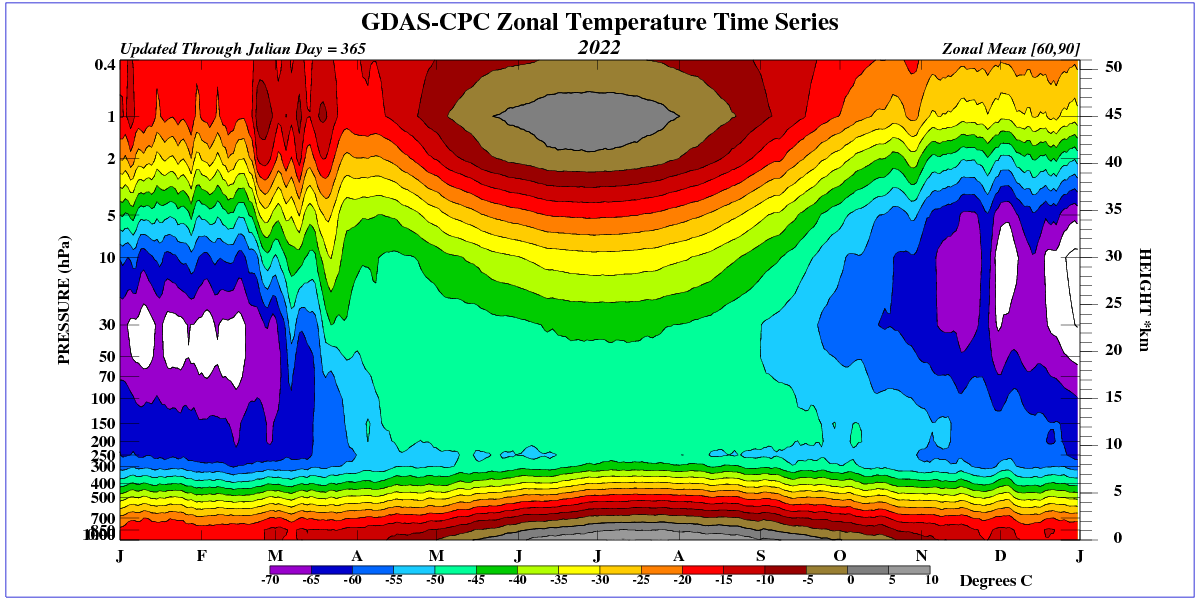
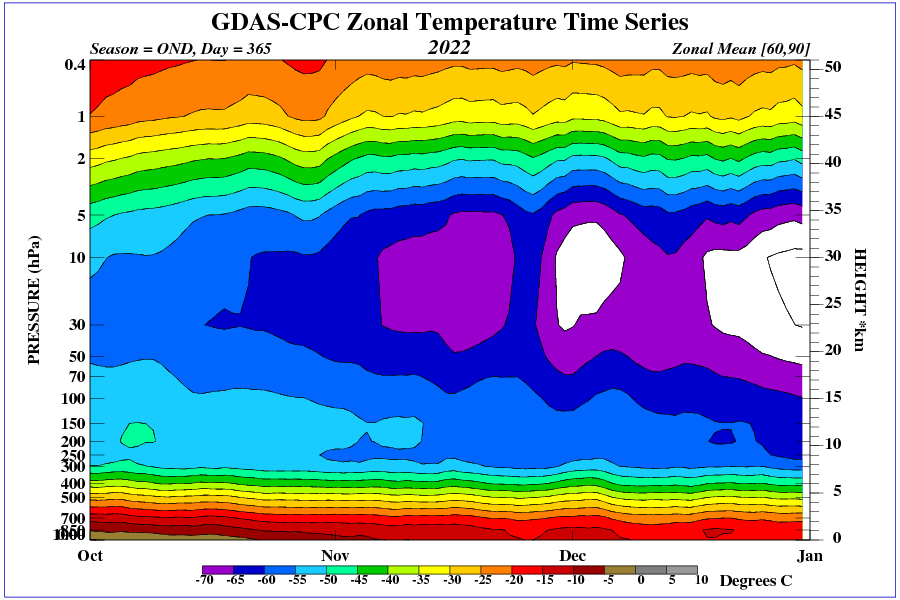
The troposphere in winter at high latitudes is so thin that when blocking the stratospheric polar vortex, stratospheric intrusions fall far to the south. These are dry air masses with very low temperatures and lots of stratospheric ozone. It is important to remember that this ozone passes through the tropopause, where the temperature is about -60 degrees C.

No Observed Warming for 8 years means that there is no “pipeline” that “global warming” is already in. So when you hear again about the “Warming that is already in the pipeline”, you already know the argument is bunk. Of course, people who have followed this argument for decades already knew it was bunk when there was no observable warming for 17 years in the late 20th century.
But people born in the 21st century and now entering adulthood don’t know this because they were not around to know it. So the charade continues.
“Dictatorial ” hmm… me thinks that US involvement in Ukraine was to eventually gain control of energy in Russia. Underestimating Russia this has backfired and now the west is in self-destruct mode.
China now has a stake in the Port of Hamburg as German companies head to China for cheap energy-
One company alone in Germany, Verbund , uses the same amount of energy as Denmark annually. It uses 4% of Germany’s gas supply. It’s so bad that they are moving parts of the company to China along with BASF and other industrial companies.
Hell is coming to town in Europe- https://principia-scientific.com/green-europe-self-destructs-as-energy-crisis-decimates-key-industries/
Back around 2010 after the last financial crisis, Russia started to pivot away from Europe to Asia as it felt it was sclerotic. Gonna get really bad- is this the end of the EU?
I think RSS pause is now over 9 years
Quotes of Chairman Monckton, from his comments:
I used to read your comments, even the rational ones. Now I just skip right past them all.
If you want to refute anything I’ve said, please quote at least one sentence and explain why I was wrong. A generic character attack is not a debate, except for leftists, who do consider character attacks to be an acceptable form of “debate”.
Yer obsessed, just like the trendologists are obsessed.
My comment originally included about ten direct quotes of Mr. Monckton from his replies to comments that he did not agree with. All of the quotes were insults. The moderator deleted every one of the Monckton quotes in my comment, making my introduction (above) meaningless, but all the insults remain in Monckton’s comments. A dual system of justice? Why is it that Monckton can ridicule other commenters, but if we point out that he is character attacking us, then we are censored? I expect this complaint about moderation dual standards will be deleted too.
Why don’t you write an article that pertains to the subject? It should be easy for you to show that the UAH least squares fit that Monckton’s article is about is incorrect. After all, everyone you disagree with is incorrect, aren’t they?
Don’t whine.
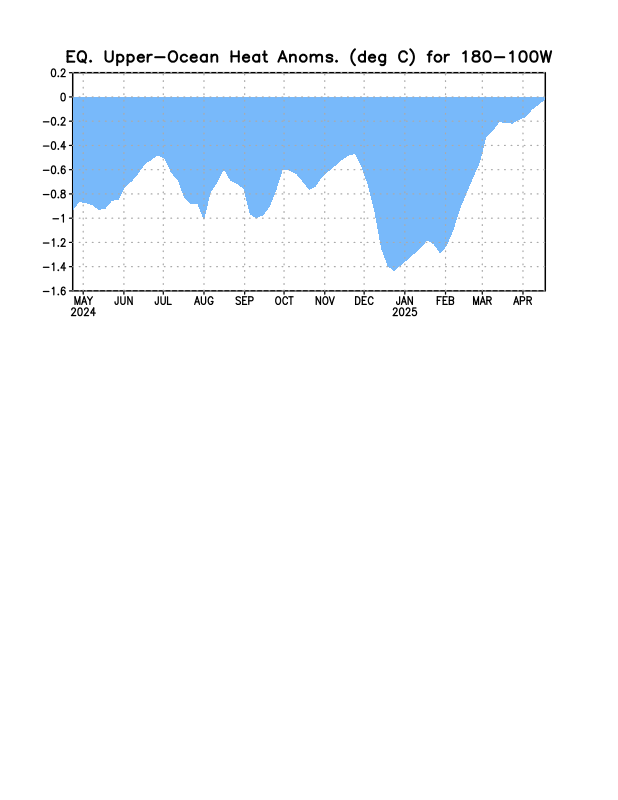
Central and Eastern Pacific Upper-Ocean (0-300 m)
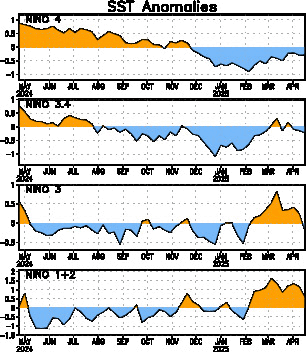
Weekly Average Temperature Anomalies
During February 2022 through mid-March, subsurface temperature anomalies decreased
and were negative. From mid-March to mid-June, subsurface temperature anomalies
increased from negative to positive. Anomalies rapidly decreased from mid-June through
July, and since then have generally persisted.
Concerning the ongoing Monckton vs Greene kerfuffle here on WUWT over predictions of where global mean temperature will be eighty years from now in the year 2100 ……
Political leaders and corporate managers often have to make important decisions on the basis of incomplete and/or imperfect information. Often because there isn’t enough time or enough money or enough expertise to develop a near perfect set of information given the exigencies of a particular situation.
Sometimes that information which is actually available is only somewhat imperfect and only somewhat incomplete. Other times it is very imperfect even if it appears to be somewhat complete, volume wise. And sometimes the available information is somewhere in between, and is useful for its intended purpose with appropriate and explicitly-stated caveats.
Those who make important decisions with less than perfect information in hand must be careful. Very imperfect information is sometimes being falsely sold as reasonably reliable information. And sometimes reasonably reliable information is being labeled as very imperfect or even false information (a.k.a. ‘mis-information’) because although reliable, it interferes with someone’s political or economic agenda.
So when faced with a need to make a reasonably good decision within a reasonably appropriate time frame relative to a given situation, an effective political leader or corporate manager will accept the responsibility for making a tough decision, even with imperfect and/or incomplete information, doing so under the assumption that some level of risk is involved.
OK ….
Suppose someone in a leadership position who needs to make a decision on the basis of imperfect information concerning the causes and extent of future climate change, someone who is willing to accept the risk of making a decision based on imperfect and/or incomplete information, comes to you and says, ‘Give me a prediction for where you think global mean temperature (GMT) will be going over the next 80 years between now and the year 2100.’
If that person came to me, a professional in the nuclear industry who has a background in project risk management and who has watched these endless debates over the validity of the mainstream climate models for more than fifteen years, and that person asked me for a range of GMT predictions — a prediction envelope for the Year 2100 — then I would say to that person, “No problem. I’ll get back to you next week.”
Most of you have already seen my graphical analysis from April, 2020, of where I think GMT will be going over the next 80 years. It took roughly 30 man-hours of work spread over five days to produce.
Beta Blocker’s Year 2100 GMT Prediction Envelope
My graphical analysis contains the analytical basis data, the key analytical assumptions, the analytical methods, and the analytical results — all of it shown on just one page.
IMHO, the most likely outcome by the year 2100 is a + 2C rise in GMT over 1850 pre-industrial; roughly a one degree rise over today’s global mean temperature. Other outcomes are possible, some higher some lower, but are are less likely to occur — in my humble opinion, for what that is worth to anyone who asks.
Note that my graphical analysis doesn’t include GHG concentration scenarios. It doesn’t include error bands. Given the many uncertainties large and small concerning the true physics of the earth’s atmospheric dynamics in the presence of carbon GHG’s, and the actual effects of carbon dioxide on those dynamics, showing GHG concentration scenarios and error bands simply wouldn’t add any more useful information to the analysis above and beyond what it already contains.
Truth be told, Beta Blocker’s Year 2100 GMT Prediction Envelope is as much a commentary on the state of the current debate over today’s climate science as it is a prediction for where GMT might be headed over the next eighty years.
Alright …. For those who believe that even a +2C increase in GMT over 1850 pre-industrial is a serious issue, and that the issue can be solved by reducing mankind’s carbon emissions to Net Zero levels, my colleagues in the nuclear industry will be more than happy to sell you some number nuclear reactors between now and the year 2100.
But if my colleagues in nuclear are honest about it, they will include this important caveat:
Even under the most favorable economic, regulatory, and state-of-the-industrial base conditions, it would be impossible to build enough nuclear power plants between now and the year 2100 to make a serious dent in the world’s carbon emissions. The only realistic way for the world to reach Net Zero is to drastically reduce mankind’s total consumption of energy, possibly to as low as 20% or less of what the world consumes today in the year 2022.
“an effective political leader or corporate manager will accept the responsibility for making a tough decision”
You are assuming a decision is required or needed. That is not the case with the climate. It may be a “perceived” need but that is when the old adage “first do no harm” needs to be given high priority.
Don’t ignore the full context in which my opinion is being stated. The tough decision which now faces leaders of the political opposition to the Biden administration’s anti-carbon energy policies is to decide just how far they will go in saying explicitly and publicly that today’s climate science has numerous problems with both its scientific credibility and also its reliability for use in making important energy policy decisions.
For the administration’s political opposition, it is both their obligation and their responsibility to make this decision. Will they, or will they not, accept that responsibility and make a clear statement concerning the state of today’s mainstream climate science? This remains to be seen.
Deciding to criticize those in power doesn’t and their rationales doesn’t cause harm to anyone, by definition.
By definition, when those in a position of power refuse to take responsibility for making tough decisions, when those tough decisions need to be made, people are harmed.
More often than not, a good decision made a week from now after having an appropriately informed discussion gets a lot more accomplished than does a theoretically perfect decision made a year from now after endless wrangling over the details.
In my humble opinion, the mainstream climate models are running too hot, for some number of scientific and methodological reasons.
For myself, a project analyst with primary interest in how and why energy policy is being made and implemented, I’m not so concerned with the lowest level scientific details of why the models are running too hot as I am concerned with the consequences of not making the tough decisions which need to be made, when those decisions need to be made.
Do the endless scientific debates over the lowest level details of why the climate models are running too hot have value for decision makers and those who advise them?
Lord Monckton has a firm scientific opinion as to why the models are running too hot. Others with equally credible scientific credentials who also think the models are running too hot dispute Monckton’s opinion as to exactly why the models are running too hot.
And still others, mainly those in the mainstream climate science community, claim that the models are not running too hot at all and are perfectly credible, even the ones which predict a rise in GMT of 4C or more.
I would argue that all these very low level details have value only in a tactical sense as backup for the larger strategic decisions which must now be made in a timely manner for implementing an effective environmental and energy policy.
As I define it, an ‘effective environmental and energy policy’ is one which does not destroy the world’s economy in the name of pursuing thoroughly illusory gains in human health and environmental protection.
I have some sympathy for Beta-Blocker’s well-made argument. The midrange rate of medium-term global warming predicted by IPCC in 1990 has proven to be a 100-140% exaggeration; therefore, those who swear by the models have some explaining to do. For it is necessary to dispel the catastrophist notions founded upon those undeniably exaggerated predictions, not only by pointing out that the medium-term predictions themselves were wrong (and yet that the longer-term predictions made by IPCC in 1990 are the same now as they were then), but also that even global net zero would not reduce global temperature by more than about 1/6 C by 2050, and that each $1 billion of the $800 trillion spent on attempting to attain net zero emissions will prevent just 1/2,000,000 to 1/5,000,000 C future global warming – the worst value for money in the history of economics.
The “low-level details” of which Beta Blocker speaks cannot, unfortunately, be ignored altogether. As I once explained when talking to Republicans who had likewise suggested caving in on “the science” on the ground that they could win on the economics, unless it is made clear that “the science” is wrong it is easy for the climate Communists to say, “We have to save the world, regardless of the cost” – and, without a scientific argument against that nonsense, that nonsense will prevail. There are, alas, no short cuts.
Lord Monckton, I would not argue that the low-level scientific details be ignored altogether. What I would argue is that the existence of differing but plausible alternative science-based explanations for why the climate models are running too hot shouldn’t be used by politicians as an excuse not to move forward in strongly opposing Net Zero on both scientific and economic grounds.
The difficult task for anyone acting as a science advisor who assists the decision makers concerning what policy options they have available to them is to synthesize the science details into a persuasive body of argument which is both digestible to the non-science listener but is also true to the science details as best a summarized explanation can be — knowing that any synthesized argument can never be 100% true to the lowest level details.
Political leaders and corporate managers who are effective at their jobs know that all summarized arguments lose something in the translation process of moving from the lowest level detail into a synthesized analysis product. They accept this fact in the interests of making a good decision in a reasonable amount of time as the situation demands.
And as the public debate evolves, what happens if more detail is needed as a means of solidifying the larger argument in the minds of those who are still open to persuasion? That’s when you call upon the science advisors to produce a more detailed explanation, one that is persuasive in both its style and in its substance.
“the ongoing Monckton vs Greene kerfuffle here on WUWT “
I’m not sure what a kerfuffle is but I want to make it clear I am not criticizing Mr. Monckton’s science or energy facts. His prior article with two charts showing the UAH eight year pause was short, and brilliant. He made one important point. No politics. No side subjects to distract from the message such as climate models, CAGW predictions, energy, Nut Zero and climate politics. Each related subject deserves it’s own concise article. And skip the politics for now — a lot of people whose minds we want to change don’t want to hear that.
What I criticize about Monckton’s articles when he eventually moves into politics, such as calling Climate Howlers “communists”. That is no way to change opinions. Then there are the insults to me and others who make comments criticizing his approach. That may be amusing, but many people would see that as puzzling behavior from a scientist. Character attacks should remain a favorite of leftists, with their usual “science denier” claims.
I also wonder if it is necessary to post a new pause article every month? Perhaps post just a new Monckton UAH “pause chart” every month of the pause. Not a long article covering many subjects including the word “communist”. Should we make a big deal about the pause every month, knowing it could soon end, making our argument look weak?
Don’t whine. Mr Greene began his gratuitously offensive comments by calling me names. When in reply I pointed out that, time and time again, his attempts at making scientific points contained one embarrassing inaccuracy after another, he whined and whined and whined.
Pot, kettle. If Mr Greene wants to be treated civilly, he must first learn to be civil himself, and not to attempt to be snide on the basis of inaccurate science, economics and politics.
Several commenters here, Mr Greene among them, are lifelong Communists who describe themselves as libertarians in the hope that their dopey science will somehow appear less absurd, and in the hope of diverting attention away from the extent to which the agents first of Russian and now also of Chinese Communism are pushing the global-warming narrative and silencing all who dare to dissent. Well, it won’t wash. The techniques Mr Greene uses are all too wearily familiar. No libertarian would be likely to descend to them.
In future, if Mr Greene wishes to comment here, he had better keep a civil tongue in his head and make rather more effort to be constructive than to mount childishly snide assaults on the basis of a spectacular series of elementary scientific inaccuracies.
“Several commenters here, Mr Greene among them, are lifelong Communists who describe themselves as libertarians”
There he goes again with the communist insult. Nothing could be more offensive for a libertarian like me, a small government and maximum personal freedom politics person, since 1973. You can check out the conservative and libertarian article links on my three blogs to confirm my politics, and see how wrong you are:
Honest global warming chart Blog (elonionbloggle.blogspot.com)
ECONOMIC LOGIC (el2017.blogspot.com)
Election Circus
And now the point you don’t seem to get”: Calling people communists will cause other people to stop reading your articles. Is that what you want? To offend people, few of whom are actually communists? In fact, of all the communist nations in the world — China, Cuba, Laos, North Korea, and Vietnam — none of them support Nut Zero. So you call people communists when actual communists are NOT climate alarmists.
If Mr Greene is a communist why is he so adamantly opposed to net zero and CAGW.
I’ve been criticizing Nut Zero since first heard the idea, but never thought of the demand side changing. You have opened my mind to a scary furure with this statement: “The only realistic way for the world to reach Net Zero is to drastically reduce mankind’s total consumption of energy, possibly to as low as 20% or less of what the world consumes today in the year 2022.”
When we examine the studies now being done for estimating the enormous increases in the production of basic material resources needed to achieve Net Zero, the picture which emerges is so self-evident and so painfully obvious that it is easy to make a statement as bold as this one:
“The only realistic way for the world to reach Net Zero is to drastically reduce mankind’s total consumption of energy, possibly to as low as 20% or less of what the world consumes today in the year 2022.”
It is impossible to reach Net Zero without imposing drastic energy resource conservation measures on the world economy, up to and including direct rationing of energy.
It is impossible even to attempt Net Zero without redirecting massive human and material resources away from the betterment of mankind’s basic human condition and into the production of carbonless energy systems — wind, solar, batteries, and power transmission & distribution infrastructure.
If the world did in fact redirect the great bulk of mankind’s material resources into the production of renewable energy systems, what then would be left for everything else which betters the human condition? Not a whole lot.
We who live in the Cultural West are facing an immediate and existential threat to our way of life, and even to our sustained existence as the human species: The politicians in charge of most western nations are now shutting down reliable sources of energy while steadfastly refusing to acknowledge what it will actually take to achieve their utopian vision for a Net Zero future.
So the big question we face today, right here, right now, is this: who among our current crop of politicians and their political advisors have the basic knowledge of the issues, the strength of will, and the courage of their convictions needed to lead the charge in opposing Net Zero?
It was obvious the supply of unreliable electricity would not meet the demand. It was not obvious that the demand would be forced down to meet the supply. That makes Nut Zero a lot more frightening than it was previously in my mind.
Net zero is an insane target. The western governments (or politicians dictating the policy) that subscribe to it firmly believe the UN IPCC represent the majority of scientific opinion on CO2 as the main and only cause of global warming.
….and don’t forget net zero means net zero CO2!
The question is how carbon dioxide is “well-mixed” in the atmosphere when it depends so strongly on the growing season. Looking at the distribution of CO2 in high latitudes, it seems that CO2 radiates more strongly into space than it does toward the Earth’s surface.
https://earth.nullschool.net/#current/chem/surface/level/overlay=co2sc/equirectangular/loc=-112.360,53.920
The CO2 at high altitudes must reabsorb some of the IR reradiated from H2O molecules at lower altitudes since most of the absorbable IR from the surface is accounted for by moisture leaving very little left for CO2.
From the ECONOMIST today (7th Nov):
The Earth’s temperatures over the past eight years were the hottest on record, according to a new report presented in Egypt at the opening session of COP27, the UN’s annual climate summit. The World Meteorological Organisation also said sea levels are rising twice as fast as 30 years ago. After 48 hours of wrangling, delegates finalised the talks’ agenda. For the first time, it includes “loss-and-damage” financing, which calls on rich countries, including those most responsible for historical emissions of greenhouse gases, to compensate poor countries for the consequences of climate change.
Who do we believe?
Why will the stratospheric polar vortex in the north always be weaker than the polar vortex in the south?
This is due to the distribution of the geomagnetic field over the Arctic and Antarctic.
http://www.geomag.bgs.ac.uk/images/charts/jpg/polar_n_f.jpg
http://www.geomag.bgs.ac.uk/images/charts/jpg/polar_s_f.jpg