From NASA Jet Propulsion Laboratory
Aug. 2, 2022
Credit: NASA Earth Observatory image by Joshua Stevens using GOES imagery courtesy of NOAA and NESDIS
The huge amount of water vapor hurled into the atmosphere, as detected by NASA’s Microwave Limb Sounder, could end up temporarily warming Earth’s surface.
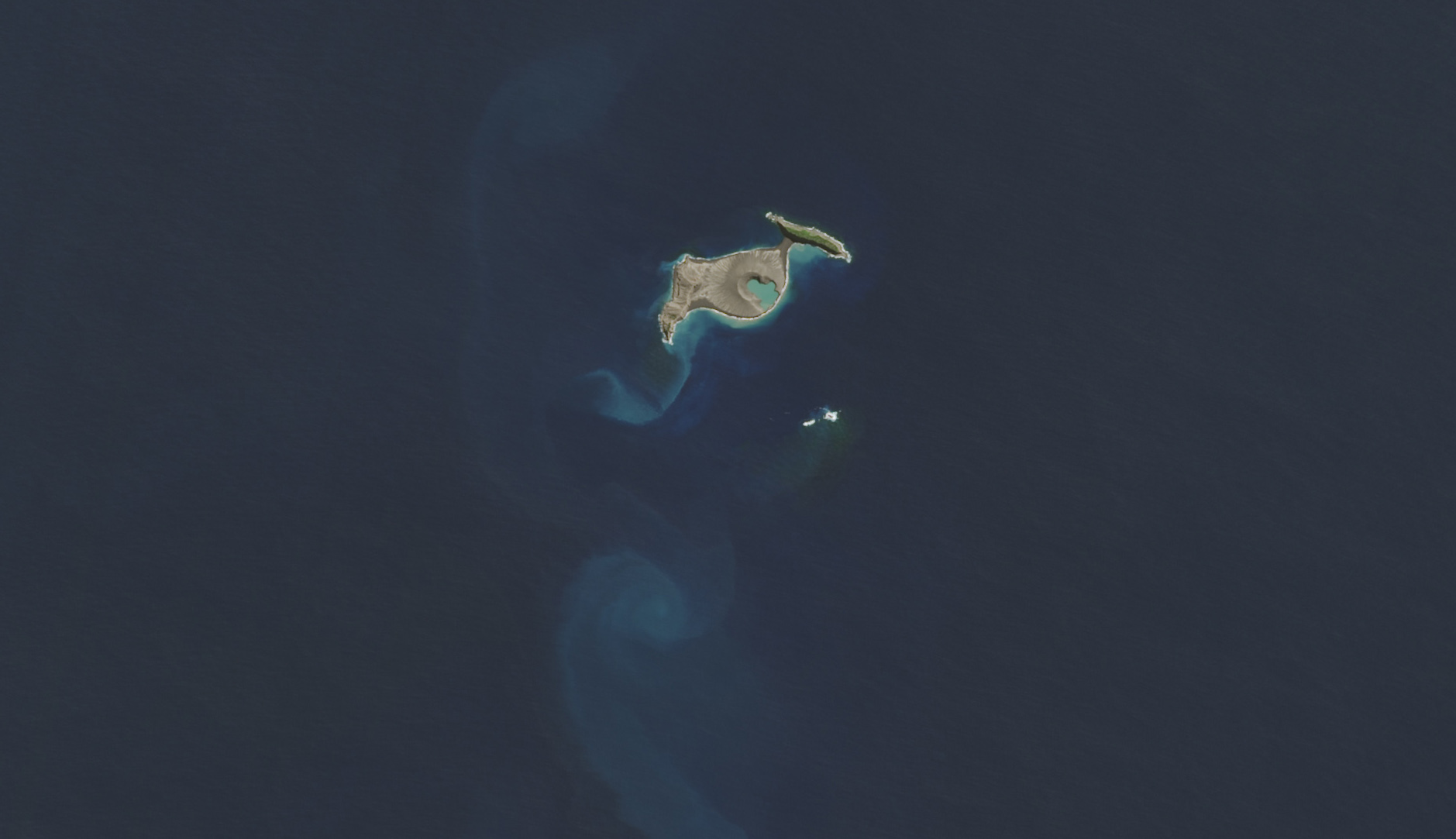
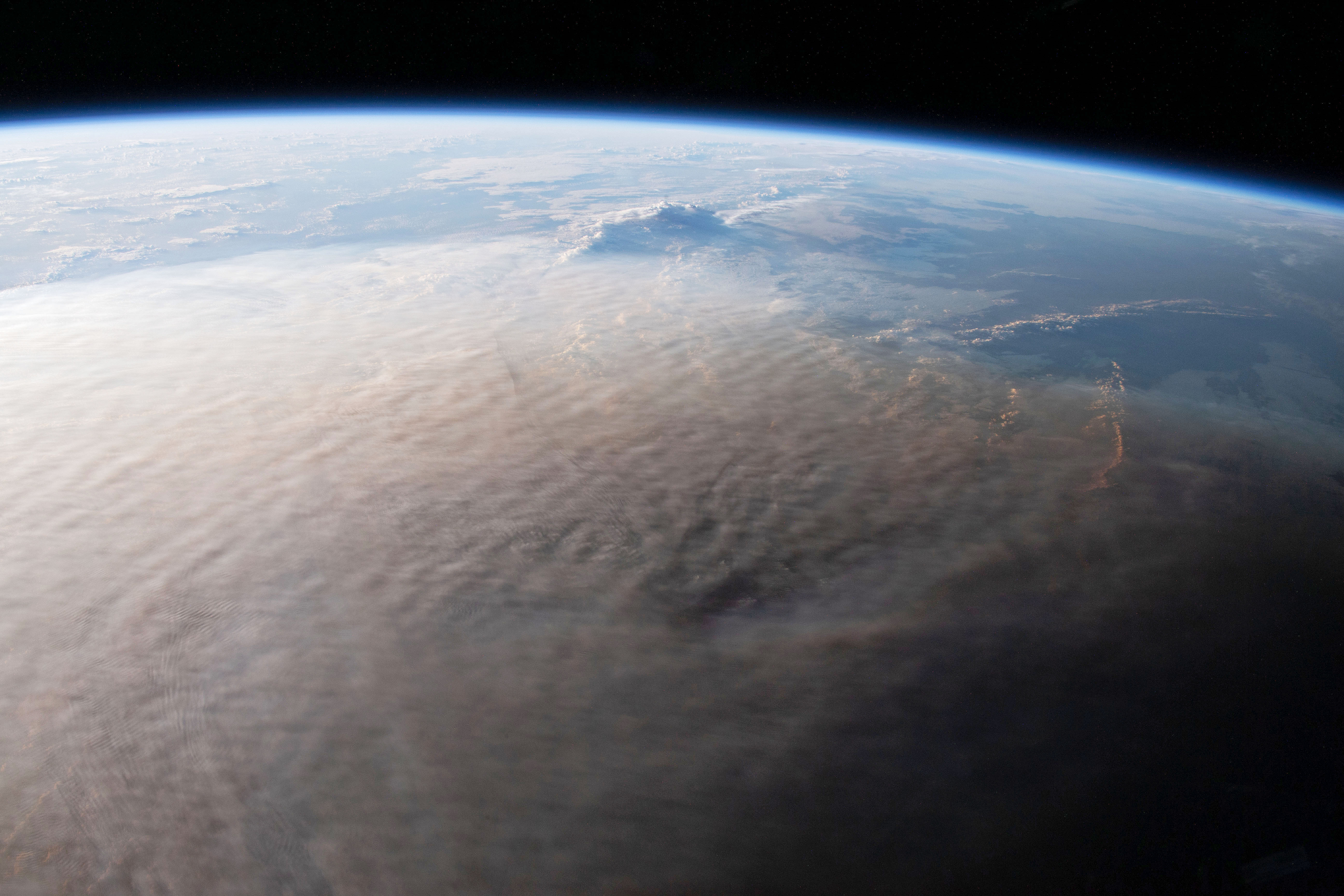
When the Hunga Tonga-Hunga Ha’apai volcano erupted on Jan. 15, it sent a tsunami racing around the world and set off a sonic boom that circled the globe twice. The underwater eruption in the South Pacific Ocean also blasted an enormous plume of water vapor into Earth’s stratosphere – enough to fill more than 58,000 Olympic-size swimming pools. The sheer amount of water vapor could be enough to temporarily affect Earth’s global average temperature.
“We’ve never seen anything like it,” said Luis Millán, an atmospheric scientist at NASA’s Jet Propulsion Laboratory in Southern California. He led a new study examining the amount of water vapor that the Tonga volcano injected into the stratosphere, the layer of the atmosphere between about 8 and 33 miles (12 and 53 kilometers) above Earth’s surface.

Credit: NASA Earth Observatory image by Jesse Allen, using Landsat data from the U.S. Geological Survey
In the study, published in Geophysical Research Letters, Millán and his colleagues estimate that the Tonga eruption sent around 146 teragrams (1 teragram equals a trillion grams) of water vapor into Earth’s stratosphere – equal to 10% of the water already present in that atmospheric layer. That’s nearly four times the amount of water vapor that scientists estimate the 1991 Mount Pinatubo eruption in the Philippines lofted into the stratosphere.
Millán analyzed data from the Microwave Limb Sounder (MLS) instrument on NASA’s Aura satellite, which measures atmospheric gases, including water vapor and ozone. After the Tonga volcano erupted, the MLS team started seeing water vapor readings that were off the charts. “We had to carefully inspect all the measurements in the plume to make sure they were trustworthy,” said Millán.

Credit: NASA
A Lasting Impression
Volcanic eruptions rarely inject much water into the stratosphere. In the 18 years that NASA has been taking measurements, only two other eruptions – the 2008 Kasatochi event in Alaska and the 2015 Calbuco eruption in Chile – sent appreciable amounts of water vapor to such high altitudes. But those were mere blips compared to the Tonga event, and the water vapor from both previous eruptions dissipated quickly. The excess water vapor injected by the Tonga volcano, on the other hand, could remain in the stratosphere for several years.
This extra water vapor could influence atmospheric chemistry, boosting certain chemical reactions that could temporarily worsen depletion of the ozone layer. It could also influence surface temperatures. Massive volcanic eruptions like Krakatoa and Mount Pinatubo typically cool Earth’s surface by ejecting gases, dust, and ash that reflect sunlight back into space. In contrast, the Tonga volcano didn’t inject large amounts of aerosols into the stratosphere, and the huge amounts of water vapor from the eruption may have a small, temporary warming effect, since water vapor traps heat. The effect would dissipate when the extra water vapor cycles out of the stratosphere and would not be enough to noticeably exacerbate climate change effects.
The sheer amount of water injected into the stratosphere was likely only possible because the underwater volcano’s caldera – a basin-shaped depression usually formed after magma erupts or drains from a shallow chamber beneath the volcano – was at just the right depth in the ocean: about 490 feet (150 meters) down. Any shallower, and there wouldn’t have been enough seawater superheated by the erupting magma to account for the stratospheric water vapor values Millán and his colleagues saw. Any deeper, and the immense pressures in the ocean’s depths could have muted the eruption.
The MLS instrument was well situated to detect this water vapor plume because it observes natural microwave signals emitted from Earth’s atmosphere. Measuring these signals enables MLS to “see” through obstacles like ash clouds that can blind other instruments measuring water vapor in the stratosphere. “MLS was the only instrument with dense enough coverage to capture the water vapor plume as it happened, and the only one that wasn’t affected by the ash that the volcano released,” said Millán.
The MLS instrument was designed and built by JPL, which is managed for NASA by Caltech in Pasadena. NASA’s Goddard Space Flight Center manages the Aura mission.
From the article: “enough to fill more than 58,000 Olympic-size swimming pools.”
I’m trying to visualize 58,000 Olympic-size swimming pools.
I think describing a volume of water using Olympic-size swimming pools is fine in certain circumstances, but when you get to a certain amount of water, one should move to another way of descibing the situation, imo.
Yes, if one is looking for a source of water to fill 58,000 pools.
From the article: ““We’ve never seen anything like it,” said Luis Millán, an atmospheric scientist at NASA’s Jet Propulsion Laboratory in Southern California.”
Perhaps that’s because you haven’t been around that long.
From the article: “That’s nearly four times the amount of water vapor that scientists estimate the 1991 Mount Pinatubo eruption in the Philippines lofted into the stratosphere.”
Yes, but Pinatubo was not an underwater volcano. It stands to reason that an underwater volcano would produce more water vapor.
It stands to reason
I think your expectations are too high, Tom 🙂
From the article: “Volcanic eruptions rarely inject much water into the stratosphere. In the 18 years that NASA has been taking measurements, only two other eruptions – the 2008 Kasatochi event in Alaska and the 2015 Calbuco eruption in Chile – sent appreciable amounts of water vapor to such high altitudes.”
In other words, NASA Climate doesn’t know much about the history of water vapor and volcanoes.
This article gives the impression something unprecedented is going on here. How do they know? Answer: They don’t know.
We could ask griff. He knows all about ‘unprecedented.’ He may have even trade marked the word.
From the article: “and the huge amounts of water vapor from the eruption may have a small, temporary warming effect, since water vapor traps heat.
The effect would dissipate when the extra water vapor cycles out of the stratosphere and would not be enough to noticeably exacerbate climate change effects.”
What [human-caused] climate change effects?
You’re assuming too much and presenting your assumptions as facts. That’s sad, or outrageous, depending on whether you are climate change confused, or a climate change conniver.
From the article: “The sheer amount of water injected into the stratosphere was likely only possible because the underwater volcano’s caldera – a basin-shaped depression usually formed after magma erupts or drains from a shallow chamber beneath the volcano – was at just the right depth in the ocean: about 490 feet (150 meters) down. Any shallower, and there wouldn’t have been enough seawater superheated by the erupting magma to account for the stratospheric water vapor values Millán and his colleagues saw. Any deeper, and the immense pressures in the ocean’s depths could have muted the eruption.”
That’s interesting. I learned something.
From the above article:
“The excess water vapor injected by the Tonga volcano, on the other hand, could remain in the stratosphere for several years.”
Really, NASA JPL? I’m just wondering exactly how that works.
The range of gas temperatures in the stratosphere ranges from an average of −51 °C (−60 °F) near the tropopause to an average of −15 °C (5.0 °F) near the mesosphere. These temperatures are significantly below the melting point of water ice, so wouldn’t that mean that water vapor injected in the troposphere rapidly converts to ice crystals?
The injected water vapor will NOT remain as such beyond several weeks, if not days!
Ice crystals in the troposphere would reflect more incoming solar energy than they would absorb IR energy radiated by Earth’s surface, thus leading to a cooling of Earth instead of the article’s asserted warming.
It is amazing that the so-called “scientists” at JPL don’t understand such simple physics and thermodynamics of the phases of water in Earth’s atmosphere.
I’m sure that every one of those JPL scientists have received bona fide participation trophies — sometimes called “sheep skins.”
“The injected water vapor will NOT remain as such beyond several weeks, if not days!”
Maybe so but here’s a somewhat related query from me:
Some months ago here at Stargazers Astronomy Tours in the North Island of New Zealand I received a 34g rock that was reported to have landed recently in a carpark with considerable noise and was extremely cold and covered in frost when it landed. This dissipated over a few minutes and this was also our summer so about 24C. The rock had fragments of green paint on it, the same colour as surrounding buildings.
Could it be from the Tonga eruption? I think it’s very unlikely given that it would have to have attained close to 8km/sec to get into orbit, albeit a short lived one, as it came down about 3 weeks after the eruption. But, as I said uptread, it was a big eruption as we clearly heard it at home 2000km from Tonga.
The rock is rounded and has no fusion crust (but not 100% of meteroites do) and looks somewhat more like an eartly andesite (volcanic rock) than an extraterrestrial meteorite.
Other options I can think of include rocks falling from planes coming in to land (unlikely at this site) and rocks falling from weather balloons when they go pop.
I’ve spoken to the NZ scientist who did the work on the Tonga eruption and he thinks it’s unlikely that it could have been blasted into space. But I wonder if it could have made into a very low orbit, maybe 100km, which took 3 weeks to decay??
Does anyone have any other ideas?
Next step is to get a thin section of the rock to try and elucidate its origin and affinity.
Very interesting observation.
First off, I would not think that the subject rock came from the underwater Tonga eruption . . . its ejection from the ocean floor would had to have first cleared the depth of the water/gas eruption mix to reach the surface of the ocean (with associated drag forces), and then to also have enough kinetic velocity to make it into an approximate 3 week-long elliptical orbit.
You state that it was covered in frost, which is indicative an object having “cold soaked” in space, and this is consistent with rare reports of meteorites recovered almost immediately after hitting the ground.
Lack of a “fusion crust” (actually an aerodynamically heated surface layer) is not at all surprising (if such indeed occurred) because an orbital decay atmospheric reentry velocity would be much less (maybe an order-of-magnitude less) than that associated with typical meteorites entering Earth’s atmosphere from deep space that are on parabolic or hyperbolic orbital paths.
The green paint that you reference could be explained by first impact on, or a ricochet off, one of the nearby buildings that you mentioned. Was there any mention of an impact depression near where the meteorite was discovered?
My predominate conclusion from so little data is that you are looking at the recovery of a normal “stony” meteorite.
Good fortune with your further investigations.
Yes, you’re right…an entry from low earth orbit would be about an order of magnitude less, so maybe no fusion crust although returning spacecraft do have heat shield ablation. But a low altitude breakup of a bigger piece could also explain that.
We looked for damage to the surrounding buildings but could not see anything obvious but could not get onto the similarly painted roof.
Good point about it having to come up through water. However there were a couple of islands there before the eruptions so maybe it could have come from there somehow…maybe two simultaneous eruptive plumes squeezing it upwards at escape velocity?? Unlikely…but so is every other possible explanation!
The rock is porous and has vugs which is unusual for a meteorite, but not for a terrestrial rock. However, the thin section should help. It’s a nice little mystery I’d like to solve…
Alastair,
Here is an outrageously low probability event that you might want to consider due to its potential high science value:
you may have a meteorite from Mars!
Such meteorites have been recovered, many from the top of ice sheets in Antarctica.
Here is what Wikipedia (https://en.wikipedia.org/wiki/Martian_meteorite ) summarizes:
“A Martian meteorite is a rock that formed on Mars, was ejected from the planet by an impact event, and traversed interplanetary space before landing on Earth as a meteorite. As of September 2020, 277 meteorites had been classified as Martian, less than half a percent of the 72,000 meteorites that have been classified. The largest complete, uncut Martian meteorite, Taoudenni 002,[3] was recovered in Mali in early 2021. It weighs 14.5 kilograms (32 pounds) and is on display at the Maine Mineral & Gem Museum.
“There are three groups of Martian meteorite: shergottites, nakhlites and chassignites, collectively known as SNC meteorites. Several other Martian meteorites are ungrouped.”
The Wiki article has some nice photos of cross-sections of different Martian meteorites. If you have access to a good university-level planetary scientist or astronomy center, they may offer a free sectioning and analysis of your recovery to determine its possible meteorite category and origin.
In any event, due to its currently curious morphology as you describe it, I would suggest handling your recovery with great care until it can be established as being “normal”, “Martian” or “new/unknown category”.
If it is only ~34 gram mass, as you stated previously, then yes, atmospheric breakup of a larger parent meteor would be suspected . . . with the associated importance of searching the area near the recovery site if indeed this recovery (fragment) turns out to be from Mars.
Hoping for the best for you and Stargazers Astronomy Tours and for the person that recovered that strange object that seems most likely to be a meteorite of some type.
Hi Gordon,
No, it’s not an outrageous idea at all…in fact it was my first thought when I saw the original very low resolution photos of it. It then looked like a eucrite either from Mars or maybe an asteroid (Vesta?). However on closer personal examination it appears to be more andesitiec in composition and I believe that most Martian meteorites are pretty basaltic. I’ve seen a few Martian meteorites and this doesn’t look like any of them.
Dr. Shane Cronin of Auckland University who has spent months in Tonga on the volcano there, both before and after the latest eruption, has agreed to get it thin sectioned at their expense. I will be delivering it to him next week. He has already examined it under a better microscope than mine and says it looks more terrestrial than extraterrestrial.
If you would like to have more information or see some photos please contact me via the email on our Stargazers B&B website…it would be good to discuss it more offline. We need all the ideas we can get…no matter how outrageous!
https://en.wikipedia.org/wiki/Trebuchet
Forget the metric system, or for that matter the imperial system we seem to have a new measure of volume that is becoming more and more common: The Olympic Sized Swimming Pool”. Personally I find it much easier to visualise 1cubic kilometre than x Olympic swimming pools.
Part and parcel of humans forsaking science and devolving back into belief in the gods, including the ancient Olympians such as Dioxygenius Carbonus.
Another defect in equating a volume of water to “Olympic Sized Swimming Pools” is that while the length of the pools is defined, some builder may opt for a narrower than standard pool if they don’t have large competitions. However, the biggest problem is that there is a minimum depth decreed for Olympic pools, but no requirement for the shape of the bottom. That is, the shallow end may be deeper than the minimum, and there is no specification for the slope between the deep and shallow ends. Thus, different pools can have different volumes. Pool dimensions were specified for swimming, not for water volume equivalences.
seems unlikely excess stratospheric water vapor would persist very long at all
would be surprised if any excess vapor is even detected in Feb readings
I understood this water condensed and fell on the east coast of Australia a week later, adding significant damage to already flooded regions. Not that the BOM would have mentioned it, as it would have diluted the climate change narrative. Geothermal activity can create serious weather events; that might sew doubt amongst the flock.
“since water vapor traps heat”
We should see it in the observational records.
I’ll wait…