From NASA Jet Propulsion Laboratory
Aug. 2, 2022
Credit: NASA Earth Observatory image by Joshua Stevens using GOES imagery courtesy of NOAA and NESDIS
The huge amount of water vapor hurled into the atmosphere, as detected by NASA’s Microwave Limb Sounder, could end up temporarily warming Earth’s surface.
When the Hunga Tonga-Hunga Ha’apai volcano erupted on Jan. 15, it sent a tsunami racing around the world and set off a sonic boom that circled the globe twice. The underwater eruption in the South Pacific Ocean also blasted an enormous plume of water vapor into Earth’s stratosphere – enough to fill more than 58,000 Olympic-size swimming pools. The sheer amount of water vapor could be enough to temporarily affect Earth’s global average temperature.
“We’ve never seen anything like it,” said Luis Millán, an atmospheric scientist at NASA’s Jet Propulsion Laboratory in Southern California. He led a new study examining the amount of water vapor that the Tonga volcano injected into the stratosphere, the layer of the atmosphere between about 8 and 33 miles (12 and 53 kilometers) above Earth’s surface.
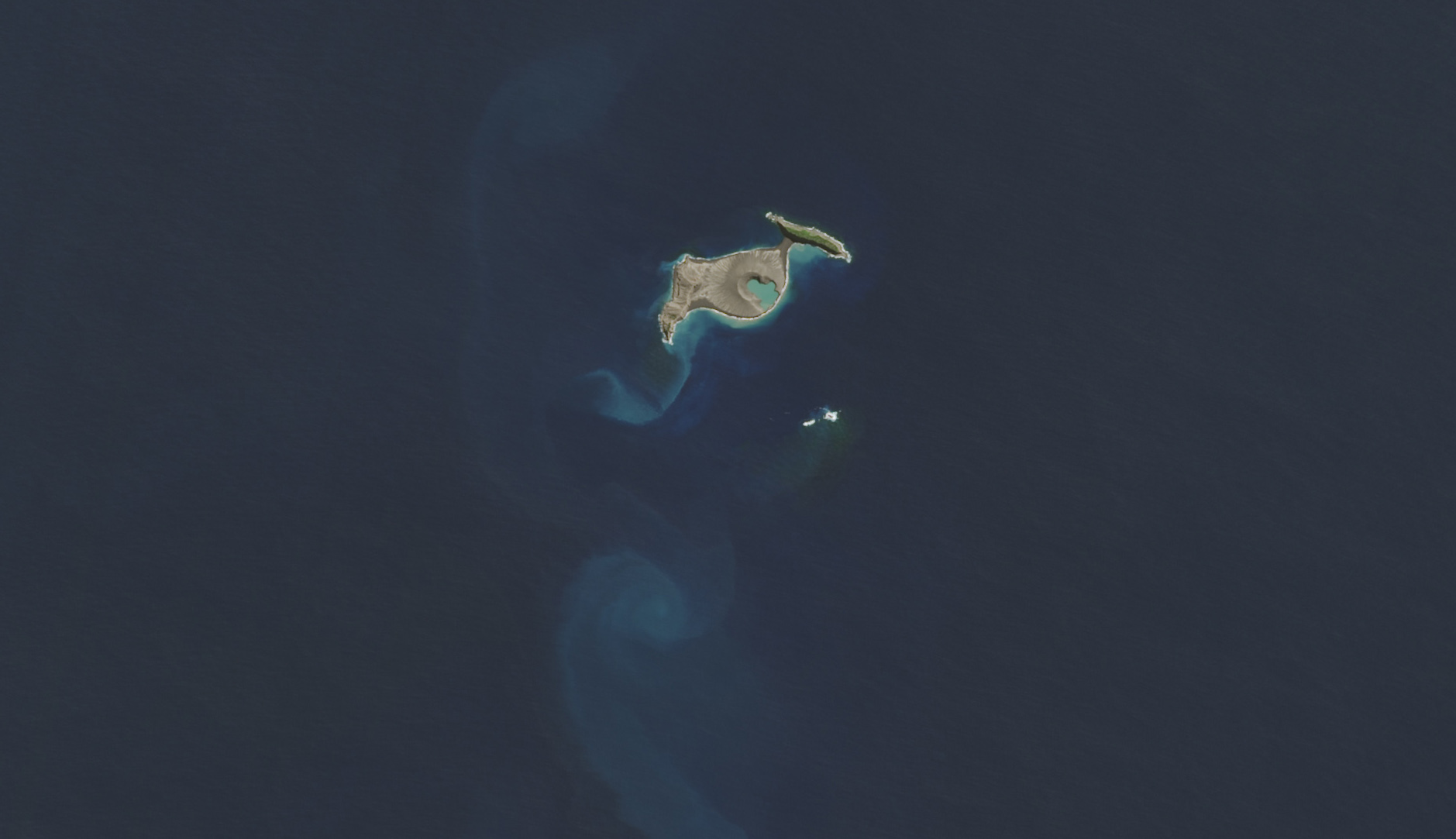
Credit: NASA Earth Observatory image by Jesse Allen, using Landsat data from the U.S. Geological Survey
In the study, published in Geophysical Research Letters, Millán and his colleagues estimate that the Tonga eruption sent around 146 teragrams (1 teragram equals a trillion grams) of water vapor into Earth’s stratosphere – equal to 10% of the water already present in that atmospheric layer. That’s nearly four times the amount of water vapor that scientists estimate the 1991 Mount Pinatubo eruption in the Philippines lofted into the stratosphere.
Millán analyzed data from the Microwave Limb Sounder (MLS) instrument on NASA’s Aura satellite, which measures atmospheric gases, including water vapor and ozone. After the Tonga volcano erupted, the MLS team started seeing water vapor readings that were off the charts. “We had to carefully inspect all the measurements in the plume to make sure they were trustworthy,” said Millán.
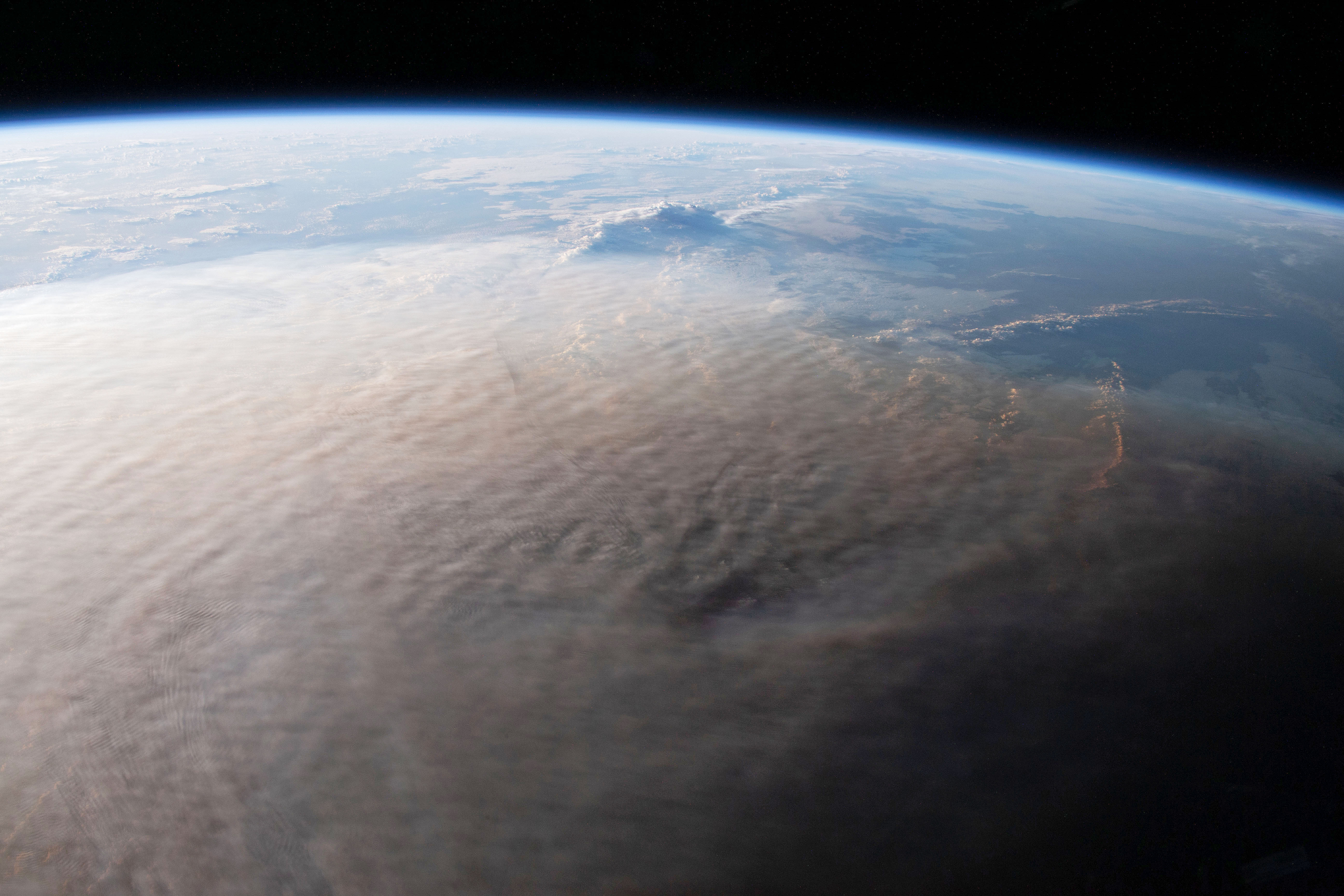
Credit: NASA
A Lasting Impression
Volcanic eruptions rarely inject much water into the stratosphere. In the 18 years that NASA has been taking measurements, only two other eruptions – the 2008 Kasatochi event in Alaska and the 2015 Calbuco eruption in Chile – sent appreciable amounts of water vapor to such high altitudes. But those were mere blips compared to the Tonga event, and the water vapor from both previous eruptions dissipated quickly. The excess water vapor injected by the Tonga volcano, on the other hand, could remain in the stratosphere for several years.
This extra water vapor could influence atmospheric chemistry, boosting certain chemical reactions that could temporarily worsen depletion of the ozone layer. It could also influence surface temperatures. Massive volcanic eruptions like Krakatoa and Mount Pinatubo typically cool Earth’s surface by ejecting gases, dust, and ash that reflect sunlight back into space. In contrast, the Tonga volcano didn’t inject large amounts of aerosols into the stratosphere, and the huge amounts of water vapor from the eruption may have a small, temporary warming effect, since water vapor traps heat. The effect would dissipate when the extra water vapor cycles out of the stratosphere and would not be enough to noticeably exacerbate climate change effects.
The sheer amount of water injected into the stratosphere was likely only possible because the underwater volcano’s caldera – a basin-shaped depression usually formed after magma erupts or drains from a shallow chamber beneath the volcano – was at just the right depth in the ocean: about 490 feet (150 meters) down. Any shallower, and there wouldn’t have been enough seawater superheated by the erupting magma to account for the stratospheric water vapor values Millán and his colleagues saw. Any deeper, and the immense pressures in the ocean’s depths could have muted the eruption.
The MLS instrument was well situated to detect this water vapor plume because it observes natural microwave signals emitted from Earth’s atmosphere. Measuring these signals enables MLS to “see” through obstacles like ash clouds that can blind other instruments measuring water vapor in the stratosphere. “MLS was the only instrument with dense enough coverage to capture the water vapor plume as it happened, and the only one that wasn’t affected by the ash that the volcano released,” said Millán.
The MLS instrument was designed and built by JPL, which is managed for NASA by Caltech in Pasadena. NASA’s Goddard Space Flight Center manages the Aura mission.
A lot of maybes. Has anyone noticed a spike in regional temperatures since January?
Lots of maybes and could do this or that. I guess they wanted to spice up the report.
I did experience a localized temperature spike when I saw a sweet young thing in a bikini but, it went away.
Don’t get to see bikinis in Tasmania. It’s mainly older, corpulent women with saggy upper arms. Zero warmth involved.
Alexy, you have no idea of what you are talking about. It is the older, corpulent women who cook your food, take care of your children and household, soothe your brow when you are distressed and provide great, warm cuddling and sex when you need it, especially on cold, lonely nights.
Bikini clad hotties are just eye candy, sweet but unnourishing and transitory. And they cost more than most men can afford in both money and heartache. Brad had it right when he said “it went away.” Take it from this old dude who has had them all.
Yes, lots of maybes and no relevant numbers. The numbers they do give do look rather puny. They would surely have estimated just how much warming it would create, and they must have estimated it at zero or they would be only too happy to tell us the number. What a shower. And the water vapour presumably will eventually also come down as a shower.
The actual measurement was a 10% increase in stratospheric H2O. Measurements are real science.
Now let’s see what happens and then we can say what effects stratospheric H2O may have and what effects it certainly doesn’t have.
6 months and still waiting. Monckton’s post didn’t show anything unusual in his temperature graph. Something should have shown up by now.
Water in the stratosphere is different than water in the troposphere. Stratospheric water vapor would be chemically active, breaking down quickly and reacting with other molecules. Ozone depletion seems like a reasonable outcome, temporarily.
Actually, measurements are FACTS and NOT science. Science is an explanation of the cause using the scientific method.
M Courtney,
Indeed,
“Measurements are real science.”
Absolutely correct.
The 146 Teragrams is 146 GigaKilograms [if I am allowed that unit] or 146 MegaTonnes [ditto].
That is, very roughly, one tonne for every square mile of water surface globally.
There’s a lot of Ocean on Planet Earth.
Auto
Shows how much they don’t know, is all that extra water in the atmosphere just going to absorb more heat and warm the planet more?
Or is it going to form clouds, and reflect more sunlight, and then cool the planet?
Or will it all come out in the wash, with no measurable change either way?
Using global consumption of ±6 million barrels of jet fuel per day, and assuming that 50 percent of that is burned while cruising in the stratosphere, it’s simple to calculate that jet aircraft add about 250 teragrams of water to the stratosphere every year.
Plus about 175 teragrams of CO2.
Fossil fuels emit more water than CO2 (by weight)
why, literally no “climate bill” ever has
not in aus if anything its cooler and a damn sight more rainy la nina isnt the entire cause of that
I’ve lived in Australia most of my life, I’m 70+. Lake Eyre has filled several times. Northwest NSW has had many floods. Nothing much unusual about it.
UAH no warming trend over Australia for 10 years now. Geoff S
http://www.geoffstuff.com/uahaug2022
Olympic-size swimming pools has minimum of 2.5ML each, so 58’000 x 2.5ML = 145’000ML. An area of Sydney & surrounding area 100km x 200km x 300mm rain = 6’000’000 ML ie ~41x the volcano mentioned above. The other issue is certain emissions (mostly particles from volcanoes, fires & tree oils) can increase the seeding of clouds & increases rainfall of existing moisture.
Strange… 50m x 8 lanes at 2.25m each, depth average 1.5m gives a volume of 1.35Ml. And I was being very generous with the lane width and depth.
Olympic standard (minimum height) 10 lane wide but use 8 lanes. 50m x 25m x 2m = 2500kL = 2.5ML.
Let’s stick to something simpler, shall we?
146 Tetragrams=146 billion kilograms = 146 million tons = 12m x 12m block of water = bugger-all to worry about?
They must be getting really, really desperate, if they are expressing tons as grams, that’s over-reporting by a factor of one million.
Pathetic. Desperate and pathetic. Just like their insistence we all partake in their sexual perversions.
Pathetiiiiiiic!
Oh, sorry, that “block of 12×12″will be less than four feet deep, it is not even a cube of water, just a slice!
I calculate 526 meter cube of water. 12 meter cube of water is 1728 cubic meters = 1728 metric tons of water.
Just a slice then?
…and to be fair, that will be 12 kilometers! Still only slightly more than 40 inches deep, though. Which is actually a lot, come to think of it, so I would love to know how they actually measured it. Telling me how you rechecked your data values does not mean you actually validated that data.
I thought CO2 in the stratosphere was a coolant. Wouldn’t H2O be as well?
Normally it would, but the extra H2O is hidden in the deep oceans.
During the Kyoto Conference in Japan the warming problem was “greenhouse gases”, apparently CO2 became the problem during the Paris Conference in France.
/sarc.
I don’t profess to understand all that stuff, but I’ve heard that high thin clouds tend to have a net warming effect: they raise the effective emission altitude and thereby reduce the effective emission temperature and thus the radiation to space.
As I (perhaps mistakenly) understand the “iris effect” once proposed by Richard Lindzen, for example, the thunderstorms that result from higher surface temperatures tend to be better at wringing moisture out of the air and thereby leave less for such clouds’ production. So it’s a negative-feedback effect: a warmer surface temperature reduces the warming by high thin clouds.
Anyway, maybe it’s thought that the greater stratospheric water vapor will increase such warming-effect clouds.
Or maybe not.
There are two types of “iris”. Lindzen’s and Prof Lu from the University of Waterloo. Lu’s is based on the presence or absence of ozone over Antarctica, and is strongly dependent on natural chemistry cycles in the upper layers of the atmosphere.
Antarctica has a huge capacity to radiate energy away from the earth. Presumably this past record cold winter saw the iris in action, again. As Svensmark did, Prof Lu replicated his proposed chemistry in his lab, and points to satellite measurements to support his theory. Eli Rabbit, desperate to prove his theory did not stand up to scrutiny, selected a satellite that didn’t pass over the effective region and claimed “no effect found”, and laughed. Prof Lu pointed out his error and laughed last. It is all on line.
There are (at least) two irises. (irii? irides?)
Thanks a lot. I hadn’t heard of that effect.
Nice pseudonym….. 😉
Thanks for the good laugh, Buck!
I mean about your name, not your observations. 🙂
Why Teragrams and swimmingpools? They tell me nothing. Why not Tons or cubic kilometers?
Teragram is technically correct as gram is the base unit, tonne is a derived unit.
10^12 grams = 10^6 tonnes (1 tonne = 2200 lbs or 55/56 tons)
However, the purpose of having prefixes such as tera or mega is so that the measurement can be presented as just the significant figures without having a long string of zeros or appending a multiplier such as “x 10^12” or “E12.” The “correct” way to display a measurement is with just the significant figures and without the non-significant zeros; a decimal-point standard notation such as 1.46 x 10^14 seems to have become passe with the demise of slide rules.
The purpose of units like teragrams and petagrams is to impress readers with the overwhelming magnitude of whatever it is they are wittering about.
Since much of the water ejected is likely to be seawater, I’m surprised they aren’t concerned about the amount of salt added to the stratosphere.
“We’ve never seen anything like it”
And now they have. There’s probably a lot of things they haven’t seen. That’s settled science
They haven’t seen a gamma ray burster in the local group either. If they had, they wouldn’t be able to tell you that they did.
fretslider
It’s also a line from the film Dr Dolittle from the 1970’s
We are still getting bright sunsets here in New Zealand. Could the water vapour do that or can they only come from the aerosols?
Well, we certainly have a lot of aerosols in our government in Oz…
I see what you did there, yes more than 6 mths ago
good play on that word Zig. Love it !
dust I think very high altitude
While the Gulf Stream, as it passes Newfoundland, is moving 150 MegaTonnes of water per second – 4 more than this puny effort.
Every second of every day of every year.
But, from the world’s leading agency of squirrel spotters, did we hear about all the:
that that volcano released?
Things that cause Global Greening, things that improve all aspects of plant-life & health, things that improve the mental, as well as physical, health of all sentient critters.
us included
No.
We get a mega-dose of trivia, irrelevance & big-numberism with mutual & self-administered knob-polishing.
Accompanied by a blizzard of coulds and maybes on how this this is going to waste the world. From a group of self-important nobodies.
See now what The Real Problem is? That deep-seated depression and the paranoid belief that ‘everything is bad‘ and out to get us.
Now that CO2 has come along, CO2 is imagined to do ‘bad things’ and CO2 is ’emitted’ by people, we get: Inside the green lentil that each has for a brain: People = Bad
Climate is not the problem.
A quick back of the envelope is the water was approx 2.5 times tasmanias annual rainfall, or about half of what recently dumped over Queensland and New South Wales in Oz during the recent floods. Theres plenty of other water in the atmosphere during the monsoon at various locations. Not quite sure how it reacts with the stratosphere but I would have thought temperature and density would make it respond similarly to previous eruptions with short lived effect. To me it sounds like more of the same, nothing to see here, move along.
I live in New Zealand a long way south of Tonga .
We heard the sonic booms on the 15th of January and wondered what it was .
We have had excess rain since May but it was very dry from February to April .
Australia has had floods in different parts since the eruption .
I was talking to my brother yesterday who is a geothermal scientist and he tells me that as a physicist he believes that increasing CO2 will cause more water to be absorbed into the atmosphere and will warm the world .
I know that a warmer atmosphere will hold more water vapour but with this eruption the extra water vapour in the atmosphere should show up as a temperature spike if this theory is correct .
Frankly I do not think that is correct and I wondered if any one here can shine some light on this .
Hi Graham,
I currently collating/digitising my 40+ years of rainfall records at our property in NZ…if you would like this info please email me at the Stargazers B&B address you should already have as I seem to have lost yours.
I think there’s an increasing rainfall trend over 4 decades but should be able to confirm this in the next day or two. I’m sure we also are having less severe frosts on the Coromandel in recent years.
I too heard the eruption from over 2000km away from inside the house with windows closed and TV blaring!
From a horse racing point of view, horses that should win, often don’t
Ice crystals anyone
Just the one for my glass of Scotch, please!
Advice to make a better experience from The MacAllan
https://www.themacallan.com/en/knowledge/education/mastering-whisky-ice-or-no-ice
I live in hot places. A little frozen spring water is essential sometimes.
might help explain the larger than normal iridescent clouds?
that and a lot of meteors dust too?
Well. I was just finished writing an opinion.
https://breadonthewater.co.za/2022/08/02/global-warming-how-and-where/
This story fits in well. Thanks.
Hmmm…. The volcano erupted just before Southern Hemisphere Winter so the winter ‘down there” should be/have been mild. But, this winter has been exceptionally harsh/cold. Maybe the idea of that H2O trapping heat is correct and it’s keeping it from reaching the surface?
We’ve had huge rain events repeatedly along the eastern seaboard of Australia this year. Particularly in Queensland, which does not get a great amount of winter rain. Brisbane has had 1800mm to this day this year, compared to 900 to the same day last year. One event dumped 900mm in 3 days! And it’s been bloody freezing. Jennifer Marohasy made the comment in one of her blogs that these rain events are coinciding with the ash cloud circumnavigating the earth – though I could not find where to track the ash cloud. I’m a geologist and would expect a massive load of aerosols, particulates, and H20 to cause cooling and rain. Never heard of a volcanic event causing warming before.
According to the UAH anomaly report, only February 2022 was colder than usual (-0.50). The Australian Winter (July) is supposedly warmer than typical (0.65). Your perception of “exceptionally harsh/cold” is at odds with what Roy Spencer is reporting.
Just repeating what I’d read, like this from Electroverse:
Even according to the data-tampering, UHI-ignoring ‘Bureau of Meteorology,’ July 2022 across Australia was a cold month.
The country as a whole, according to the official data, closed with an average July reading some -0.8C BELOW the 1991-2020 average. The month was also -0.16C BELOW the 1961-1990 baseline — a historically cold era.
146 teragrams = 1.46E14 grams = 1.46E11 kilograms. This is equal to 0.146 cubic kilometers of water. My thought on global warming/cooling is that this moisture will freeze and reflect incoming solar radiation more than it will absorb and return it.
These people just unknowingly disproved the whole CAGW theory. They admitted that water vapor is a big greenhouse gas.
“The huge amount of water vapor hurled into the atmosphere, as detected by NASA’s Microwave Limb Sounder, could end up temporarily warming Earth’s surface.”
And what happens during every El Nino? Large amounts of water vapor is released into the atmosphere, causing the temperature to increase. And what causes El Nino? Natural forces, not humans. Therefore, capitalism and liberty is not hurting the earth like the CAGW theory claims.
Wade:
“And what causes El Nino? Natural forces, not humans”
Not true!
Most are caused by VEI4 and larger volcanic eruptions,about 24-30 months after an eruption when their SO2 aerosols settle out of the atmosphere, and the less polluted air causes temperatures to rise, and NOT because of large amounts of water vapor being released into atmosphere.
ENSO does not cause temperatures to rise. The whole Earth is temporarily warmed in the aftermath of a large volcanic eruption.
And humans have caused a few, such as 1997-98, and 2015-16, due to global “Clean Air” efforts that greatly reduced the amount of SO2 aerosols in the atmosphere.
To get back to the real world, the clouds created by this eruption are more likely to cool the climate. As greenhouse gases are a fantasy and the cool water gas in the upper atmosphere CANNOT cool the warmer surface, this is a tempest in a teapot. Yawn.
Common sense would dictate that more water vapor in the stratosphere would lead to a higher albedo, lowering earth’s temperature. But no matter the cause, everything causes global warming. As soon as you read those words, you should be questioning the author’s motives.
Water vapor concentration in the stratosphere is measured to be 4-10 parts per million. An additional 10% of 4-10 ppm would be 4.4 to 11 ppm. That does not seem to be a cause for alarm to me, being saddled with common sense as I am. After all, earth has been doing this (injecting water vapor into the stratosphere) for billions of years, and all is well except for the hot air from Co2 believers, which is thought to contribute to global warming.
“Unprecedented”? What, within their insufficient memory or understanding?
What is the Total Precipitable Water before and after this event, as mm of water in the atmosphere spread around the globe?
Geoff S
As much water vapor as El Nino puts into the atmosphere? Or a front of thunderstorms?
On the other hand, look at the MASSIVE increase in surface area of water compared to the patch of ocean from whence it came. Now radiating heat to space. Sounds like a cooling event to me.
Doesn’t the H2O cloud also cause a cooling effect by reflecting solar light back into space?
For sure! A battle between reflective cooling and greenhouse warming. The effects of water in its liquid phase (droplets) versus gas phase water (greenhouse effect). And resorption of the water (by rainfall, chemical reaction, coadsorption by CO2, nitrous oxides, sulfurous acid and other hydrophilic compounds). Short wave, high energy UV energy effects.
Too many variables for mouseheads to handle, Too many, actually, for good scientists to handle. The earth has so many buffer systems operating it just results in blatant, idle speculation, like the statements do in this Tonga paper.
For most scientists, “It’s a Living”.
Exactly… The IPCC has not figured out the atmospheric water cycle and its affects on net warming/cooling. However, they go ahead and use it to show a practically impossible net positive runaway warming evil gas.
Water vapor is essentially transparent to sunlight. The “cloud” was transitory and it is water vapor in the stratosphere that is postulated to be the putative warming in the atmosphere.
Pigs must be flying!
NPR reports a study suggesting there might actually be such a thing as naturally occurring atmospheric warming.
Headline:
(NPR) Tonga’s volcano sent tons of water into the stratosphere. That could warm the Earth
Another Chicken Little issue. Another “Lack of Perspective” issue.
Here is another CL issue currently populating the media:
In the USA and globally, there has become a huge political issue regarding methane belching ruminants (The Great Cow Problem), Farmers in Netherlands and elsewhere are rebelling against the taxes imposed because of this HUGE (Cows are bigger than us, for sure except for some politicians i have seen) problem. This has been promulgated by the Greenies who purport themselves to be vegetarians, and they hang (I wish) on this issue.
Methane is short lived as a greenhouse gas, I remember some time ago on WUWT (years ago?) regarding methane, and the fact that the termites (Order Isoptera, with 7 Families therein!) amount to the largest biomass of any multicellular organism kind on the planet, belching many times the methane of all of the ruminants and humans combined living on earth. I wonder if that excellent article can be redone.
Assuming the premise, that methane is very bad, Should we eat the termites? Spray DDT all over the rainforests? Employ armies of termite hunters? Tax them?
Lack of persepctive and lack of scientific knowledge is the problem here. Making a mountain out of a termite mound, and a water catastrophe out of a simple volcanic eruption.
“You Cain’t fix Shtoopid” is the main problem!
Even if ruminants contribute to methane, a NASA site says that 2/3rds of all methane comes from wetlands. With a significant contribution from termites, that doesn’t leave much to be reduced by eliminating domesticated ruminants when methane is measured as parts per trillion.
Obviously Trump was right…we need to drain the swamp(s)!
This idea about killing termites:
We would only have to eliminate 10% of the termite population to offset all human emissions. Then there would be no need to eat them. All we have to do is breed friendly anteaters and keep more chickens, which lo-o-ove termites.
The :greens” seem not interested in simply solutions. There are no global leadership positions in the tree planting and termite reducing industries.
Bubba, IIRC the wavelengths of methane IR adsorption are covered by water vapor. Maybe CliSciFi will clarify this sometime in the future. From what I see in the UN IPCC report charts it is not considered in their radiative forcing calculations.
So they only started measuring water vapor in the stratosphere the day before yesterday, and they’re surprised they’re seeing a record amount.
The usual unprecedented measurements.
Can someone help me? These people are concerned that the equivalent of 58,000 size swimming pools of water vapor were blasted into the stratosphere. How does the volume of 58,000 Olympic sized swimming pools compare to the volume of the stratosphere? My understanding is that basically all of earth’s weather occurs in the troposphere, so what’s the problem? My understanding is that the higher you go in the troposphere the colder it gets, upper troposphere being -60 degrees. My understanding is that the stratosphere increases in temperature as you go higher in altitude. If that is true then wouldn’t the heating caused by the extra water in the stratosphere move higher up, since heat rises. These guys sound like a bunch of crack pots to me.
Yet this may be another of the myriad of variables “goosing” these cycles. And they really variables in the truest sense, because each may be altered by the other variables “nearby”. Remember DiffyQ? I hardly do, except knowing that each variable changes in magnitude or direction according to other variables. Differential Calculus.
I actually got to apply partial DiffyQs in my first engineering job out of college. Since then, who gives a shit: Computers do it now.
“enough to fill more than 58,000 Olympic-size swimming pools” – isn’t that just a drop in the ocean?
It is a 10% increase in stratospheric absolute humidity.
I doubt water vapor in the Stratosphere would have a warming effect, but it might take several months to settle into the upper Troposphere where it could have a warming effect. Maybe this is the reason for the UAH July anomaly outlier.
“Maybe this is the reason for the UAH July anomaly outlier.”
I was wondering about that myself.
It appears that Pinatubo warmed the Earth for a year after it erupted.