Just over six months ago, in December 2021, I asked the question that was on the tip of the tongue of everybody who follows the subject of the ongoing massive “green” transition to fossil-fuel-free energy. Actually, that’s a lie. The question I asked was not on the tip of the tongue of everybody who follows the subject, or even of most of the people who follow the subject, for reasons that to me are completely inexplicable. The question was : “Which Country Or U.S. State Will Be The First To Hit The Green Energy Wall?”
The candidates that I nominated in that post as potentially the first to hit the “green energy wall” were California, New York, the UK and Germany. At the time, I thought it was obvious that one of those jurisdictions would hit the wall sooner than almost anybody expected. Indeed, I was quite bold in the short time frame that I predicted:
A prolonged period of unfavorable weather (calm and overcast) could cause a serious energy crunch to hit one or both of Germany or the UK as soon as this winter. Or they could get lucky and go another year or two.
Now here we are in June 2022, and I think it’s hard to deny that Germany has in fact hit the “green energy wall.” Let’s consider.
First, here is the definition of the “green energy wall” that I gave in the post:
[O]ne or another of [those states or countries] is highly likely to hit a “wall” — that is, a situation where the electricity system stops functioning, or the price goes through the roof, or both, forcing a drastic alteration or even abandonment of the whole scheme.
And here’s the reason I gave why one or another (or all) of the nominated jurisdictions would soon be hitting the “wall”:
All these places, despite their wealth and seeming sophistication, are embarking on their ambitious plans without ever having conducted any kind of detailed engineering study of how their new proposed energy systems will work or how much they will cost. Sure, a wind/solar electric grid can function with 100% natural gas backup, if you’re willing to have the ratepayers foot the bill for two overlapping and redundant generation systems when you could have had just one. But “net zero” emissions means no more fossil fuel backup. What’s the plan to keep the grid operating 24/7 when the coal and natural gas are gone?
As is (or should be) obvious to everyone, a predominantly wind/solar electricity generation system needs full backup from some source to keep the lights on 24/7. The options are few: fossil fuels plants (coal, oil or natural gas), nuclear, or storage (i.e., batteries). Germany has ruled out the fossil fuel and nuclear options. It never had much in the way of oil-fired electricity generation, and it spent the last ten-plus years phasing out its coal and nuclear plants. So, that leaves storage. Surely, you might think, having embarked on a multi-trillion dollar transition to a predominantly wind/solar electricity system, and having ruled out both fossil fuels and nuclear for backup, Germany must have been focused like a laser beam on the storage issues to make the whole thing work.
You would be wrong. It is truly unbelievable the extent to which Germany — seemingly the country with the most sophisticated engineering in the world — put its head in the sand and ignored the storage problem until it just ran its energy system into the wall.
Let’s compare how much energy storage Germany would need to back up its wind/solar electricity system to the amount of storage actually developed to date or in the pipeline. At this website, I have followed the energy storage question closely, and have discussed and linked to the most competent calculations of how much storage would be needed to back up a predominantly or fully wind/solar electricity system for various jurisdictions, including Germany. In this post in November 2018 I linked to and extensively discussed work by a man named Roger Andrews, who calculated the storage requirement for Germany to back up a fully wind/solar system as approximately 25,000 GWH. In that post, I also examined some reasons why Andrews’s calculation might be low — for example, Andrews assumed a 100% return from energy put into storage (which is unrealistic), and also based his calculations on actual generation and weather data for a particular year (2016), which could prove more favorable than another year. But that said, Andrews’s calculation appeared to me to be in the right ballpark. More recently, in a post in March 2022, I discussed and linked to work of two German scientists named Oliver Ruhnau and Staffan Qvist. Ruhnau and Qvist calculated a storage requirement for Germany to back up a fully wind/solar system as 56,000 GWH.
If you figure that Andrews may be on the low side, and Ruhnau/Qvist on the high side, that would put a good rough estimate of Germany’s need for grid-scale energy storage to back up a wind/solar system somewhere in the range of about 40,000 – 50,000 GWH.
So how much storage does Germany have currently existing or in the pipeline? Here is an April 11, 2022 piece from consultancy Wood Mackenzie reporting excitedly about Europe’s plans to solve the wind/solar intermittency problem with storage, “Europe’s grid-scale energy storage capacity will expand 20-fold by 2031.”:
Europe has set out some of the world’s most ambitious decarbonisation targets. And the pace of change is accelerating. . . . [T]he region’s nascent grid-scale energy storage segment is growing fast. We forecast that total capacity will expand 20-fold between now and 2031.
Here’s their chart showing what that “20-fold expansion” will mean by 2031:

For Germany, this enormous expansion will supposedly mean all of 8.81 GWH of grid-scale energy storage. Is there a decimal place error here? Unfortunately no. Against a requirement of 45,000 GWH +/- of grid-scale storage, they’re not planning on 9000 GWH, or even 900 GWH or 90 GWH, but 9. They’re off by a factor of around 5000 against what they would need.
In other words, they haven’t even begun to solve the storage problem that would need to be solved to make their wind/solar system work, and they will barely if at all have begun to solve it by 2031. Indeed, the problem may not be solvable at all, and as yet they haven’t really put any meaningful effort into trying to figure that out. The result, as we all know, is that they left themselves completely dependent on natural gas from Russia. Now the Russian gas is effectively unavailable, and other potential sources have seen insufficient supply and massive price spikes. Here are a few observations on Germany’s current energy predicament. From Walter Russell Mead in the Wall Street Journal, June 27, “End of the German Idyll”:
As recently as 2020, almost the entire world agreed with the smug German self-assessment that Germany had the world’s most successful economic model, [and] was embarking on the most ambitious—and largely successful—climate initiative in the world. . . . [Now we understand that] German energy policy is a chaotic mess, a shining example to the rest of the world of what not to do. . . . Green energy, despite massive German investment, will be unable to supply German industry with reliable and cheap power for a long time.
From Energy Intelligence Group, June 28, “King Coal Makes Comeback in Europe”:
[German] officials are working on emergency laws that would allow roughly 9-10 gigawatts of idle coal and lignite capacity to return to service until 2024, replacing some of the 16% market share now held by gas. The country is home to seven of the EU’s 10 most polluting power stations, according to NGO Ember. . . . Economy Minister Robert Habeck said laws allowing more coal use and less gas-fired generation should pass the Bundesrat — upper house of parliament — in early July. . . . The government says there are no plans to change the coal phase-out date, with the last units still earmarked for closure by 2030.
It’s a complete reversal of the prior policy of shutting down the coal plants. Economy Minister Habeck says that the reversal is temporary, and that they are still on track to close all the coal plants by 2030. And how exactly are they going to accomplish that, with all of 9 GWH of grid-scale energy storage? There is only one possible method, which is to go back to natural gas, either using alternative suppliers (U.S.?), or because Russia re-enters the good graces of the world. But using natural gas for backup is just as much a complete abandonment of the “net zero” fantasy as is using coal.
So I say that Germany has in fact hit the “green energy wall,” and will not be going back, no matter what they are saying at the moment.
Germany failed the renewables test a while ago, it’s the Norwegian Blue of energy systems.
Here in Alberta we have ~14GW of reliable generation with an average load of 11GW
Call it 1.3x
We also have 3GW of renewables but those are zero much of the time
Because that’s what they do.
Germany already has 2x grid load of installed renewables, mostly wind and widely dispersed across the country, and yet that still only provided 40% of electricity used in Germany last year.
Doubling the amount installed won’t change anything except make the momentary unusable oversupply even worse. Same amount of wind.
There is also almost 2x installed reliable generation that keeps the lights on.
So they have ~4x load installed vs our ~1.6, and yet their cost and reliability are magnitudes worse.
Failed
Good comparisons there. Germany will keep trying to export their way out the problem though with that 50-year trade model and EU tariff walls while holding down the other EU fringe mob with currency control. They will let Ukraine burn and make Americans pay for defense in the process of forging ahead with renewables defending against climate monster myths.
I never could understand the emotional abhorance of nuclear. The only explanation is a primeval fear of things you cannot see – goolies and ghousties and things that go bump in the night of the old Anglican prayer book.
There’s peasants that never left the surrounding Chernobyl area and they’re just fine and you could take all the nuclear waste in the world and put it in the end zone of a football field and it only be six or 8 feet tall it’s propaganda very successful propaganda. And no Fukhashimo is not ruining the Pacific Ocean LOL.
They will blame it on unavoidable, circumstances, blame it on others and attempt to justify it with a cause. They can tell the population their suffering is for a good cause and must be shared with those whom we have no interest. Then do a quick fix with a time when the fix will expire.
They can pretend to worry about pubic but behind the scene they are secure because the election is predetermined with the public there for show.
Aka Let the Americans pay for Ukraine and NATO…..
EU prepares emergency plan to do without Russian energy – ABC News (go.com)
“It is truly unbelievable the extent to which Germany — seemingly the country with the most sophisticated engineering in the world — put its head in the sand and ignored the storage problem until it just ran its energy system into the wall”.
A German company was selected to build Ottawa’s subway system several years ago. The system still doesn’t work as advertised! The city turned down a bid from Bombardier in Montreal who have built premier rail equipment since beginning of the 20th Century from steam to diesel-electric to light rail transport, the latter over 50yrs.
They even built a light rail system in Karlsruhe, Germany! They built a driverless system in Singapore and subway systems in Minneapolis and other North American and European countries. They built systems in Japan and China, including the system connecting Beijing’s airport terminals.
Because of Ottawa and other Canadian cities going elsewhere for the tech, they sold off their rail division and now manufacture the biggest and fastest private jets (mach 0.945)! Yeah, Germany’s old reputation is no more!
With the self-created energy crisis and the windfall of being able to blame Russia for everything, I’ve confidentally predicted the end of the socialist putsch meme, Paris Accord, renewables, Great Reset, consensus climate crisis science, and all its accoutrements, the die-back of dysfunctional ‘elite’ universities an impoverishment of the lefty billionaire- welfare set and NGO swamp and a remaking or death of the Democrat/liberal/lefty establishment.
The swiftness of politicos’ jumping back into fossil fuels is a ‘tell’ that they already knew they were in deep trouble and the opportunity to get out was seized upon with glee. Of course, they say it’s only temporary but, trust me, this thing is dead.
I hope that is not merely wishful thinking. I really do!
It’s time Germany had a win!
a situation where the electricity system stops functioning, or the price goes through the roof, or both, forcing a drastic alteration or even abandonment of the whole scheme.
Well Australia would be well in the mix here with rocketing wholesale power prices and the AEMO regulator having to suspend the market and order generation with the NEM and having to reimburse generators’ costs to do so.
As a result the AEMO has been cobbling together an Integrated Service Plan going forward. That largely commits to more and faster renewables rollout and their interconnection and mumbles about a capacity mechanism (code for storage dispatchability) but any reasonable look at what’s required with storage is extremely problematic-
Seasons of low wind and solar output will influence the shape of the NEM – WattClarity
Nothing’s impossible and we can harvest icebergs from Antarctica and grow fields of tulips around Ayers Rock with them too so howsabout a glossy prospectus to get in on the ground floor with?
In 2018 during his speech to the UN General Assembly President Donald Trump lodged a warning to Germany about their country’s reliance on Russian energy.
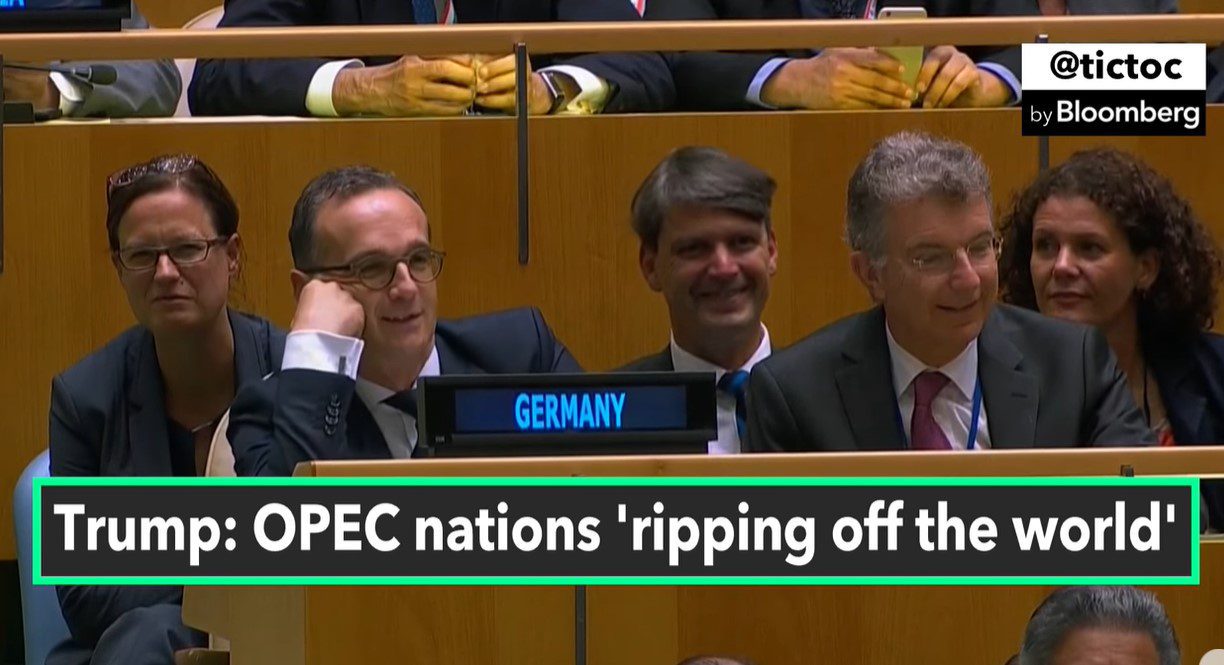
The German delegation ironically laughed on camera at the remarks.