Cold era, lasting from early 15th to mid-19th centuries, triggered by unusually warm conditionsPeer-Reviewed Publication
UNIVERSITY OF MASSACHUSETTS AMHERST
AMHERST, Mass. – New research from the University of Massachusetts Amherst provides a novel answer to one of the persistent questions in historical climatology, environmental history and the earth sciences: what caused the Little Ice Age? The answer, we now know, is a paradox: warming.
The Little Ice Age was one of the coldest periods of the past 10,000 years, a period of cooling that was particularly pronounced in the North Atlantic region. This cold spell, whose precise timeline scholars debate, but which seems to have set in around 600 years ago, was responsible for crop failures, famines and pandemics throughout Europe, resulting in misery and death for millions. To date, the mechanisms that led to this harsh climate state have remained inconclusive. However, a new paper published recently in Science Advances gives an up-to-date picture of the events that brought about the Little Ice Age. Surprisingly, the cooling appears to have been triggered by an unusually warm episode.
When lead author Francois Lapointe, postdoctoral researcher and lecturer in geosciences at UMass Amherst and Raymond Bradley, distinguished professor in geosciences at UMass Amherst began carefully examining their 3,000-year reconstruction of North Atlantic sea surface temperatures, results of which were published in the Proceedings of the National Academy of Sciences in 2020, they noticed something surprising: a sudden change from very warm conditions in the late 1300s to unprecedented cold conditions in the early 1400s, only 20 years later.
Using many detailed marine records, Lapointe and Bradley discovered that there was an abnormally strong northward transfer of warm water in the late 1300s which peaked around 1380. As a result, the waters south of Greenland and the Nordic Seas became much warmer than usual. “No one has recognized this before,” notes Lapointe.
Normally, there is always a transfer of warm water from the tropics to the arctic. It’s a well-known process called the Atlantic Meridional Overturning Circulation (AMOC), which is like a planetary conveyor belt. Typically, warm water from the tropics flows north along the coast of Northern Europe, and when it reaches higher latitudes and meets colder arctic waters, it loses heat and becomes denser, causing the water to sink at the bottom of the ocean. This deep-water formation then flows south along the coast of North America and continues on to circulate around the world.
But in the late 1300s, AMOC strengthened significantly, which meant that far more warm water than usual was moving north, which in turn cause rapid arctic ice loss. Over the course of a few decades in the late 1300s and 1400s, vast amounts of ice were flushed out into the North Atlantic, which not only cooled the North Atlantic waters, but also diluted their saltiness, ultimately causing AMOC to collapse. It is this collapse that then triggered a substantial cooling.
Fast-forward to our own time: between the 1960s and 1980s, we have also seen a rapid strengthening of AMOC, which has been linked with persistently high pressure in the atmosphere over Greenland. Lapointe and Bradley think the same atmospheric situation occurred just prior to the Little Ice Age—but what could have set off that persistent high-pressure event in the 1380s?
The answer, Lapointe discovered, is to be found in trees. Once the researchers compared their findings to a new record of solar activity revealed by radiocarbon isotopes preserved in tree rings, they discovered that unusually high solar activity was recorded in the late 1300s. Such solar activity tends to lead to high atmospheric pressure over Greenland.
At the same time, fewer volcanic eruptions were happening on earth, which means that there was less ash in the air. A “cleaner” atmosphere meant that the planet was more responsive to changes in solar output. “Hence the effect of high solar activity on the atmospheric circulation in the North-Atlantic was particularly strong,” said Lapointe.
Lapointe and Bradley have been wondering whether such an abrupt cooling event could happen again in our age of global climate change. They note that there is now much less arctic sea ice due to global warming, so an event like that in the early 1400s, involving sea ice transport, is unlikely. “However, we do have to keep an eye on the build-up of freshwater in the Beaufort Sea (north of Alaska) which has increased by 40% in the past two decades. Its export to the subpolar North Atlantic could have a strong impact on oceanic circulation”, said Lapointe. “Also, persistent periods of high pressure over Greenland in summer have been much more frequent over the past decade and are linked with record-breaking ice melt. Climate models do not capture these events reliably and so we may be underestimating future ice loss from the ice sheet, with more freshwater entering the North Atlantic, potentially leading to a weakening or collapse of the AMOC.” The authors conclude that there is an urgent need to address these uncertainties.
This research was supported by funding from the National Science Foundation.
JOURNAL
Science Advances
DOI
ARTICLE TITLE
Little Ice Age abruptly triggered by intrusion of Atlantic waters into the Nordic Seas
ARTICLE PUBLICATION DATE
15-Dec-2021
“Typically, warm water from the tropics flows north along the coast of Northern Europe, and when it reaches higher latitudes and meets colder arctic waters, it loses heat and becomes denser, causing the water to sink at the bottom of the ocean. This deep-water formation then flows south along the coast of North America and continues on to circulate around the world.”
Um,…I was taught in elementary school that the Gulf Stream flowed north along the eastern North American coast to the arctic, where it cooled, then south along the coast of Northern Europe.
Hate to put in simple term, all ice-ages start when the planet is at the warmest for that period and all ice-ages begin to end when it is at its coldest…. Simple maths really……
When the model started with the decreased solar energy and returned temperatures that matched the paleoclimate record, Shindell and his colleagues knew that the model was showing how the Maunder Minimum could have caused the extreme drop in temperatures. The model showed that the drop in temperature was related to ozone in the stratosphere, the layer of the atmosphere that is between 10 and 50 kilometers from the Earth’s surface. Ozone is created when high-energy ultraviolet light from the Sun interacts with oxygen. During the Maunder Minimum, the Sun emitted less strong ultraviolet light, and so less ozone formed. The decrease in ozone affected planetary waves, the giant wiggles in the jet stream that we are used to seeing on television weather reports.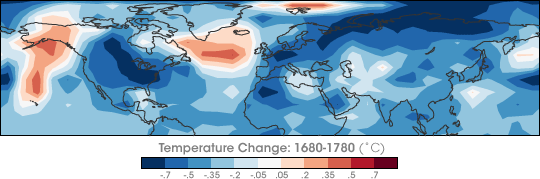
The change to the planetary waves kicked the North Atlantic Oscillation (NAO)—the balance between a permanent low-pressure system near Greenland and a permanent high-pressure system to its south—into a negative phase. When the NAO is negative, both pressure systems are relatively weak. Under these conditions, winter storms crossing the Atlantic generally head eastward toward Europe, which experiences a more severe winter. (When the NAO is positive, winter storms track farther north, making winters in Europe milder.) The model results, shown above, illustrate that the NAO was more negative on average during the Maunder Minimum, and Europe remained unusually cold. These results matched the paleoclimate record.
https://earthobservatory.nasa.gov/images/7122/chilly-temperatures-during-the-maunder-minimum
Quote:”Researchers Claim to Uncover the Surprising Cause of the Little Ice Age
no
“Researchers uncover mountain of contrivance and dodgy data and, unsurprisingly, go on wild flights of speculation.
During this winter, we can expect to see tremendous turbulence in the jet stream.

The animation shows how the jet stream is moving far north, bypassing the ozone patch over Europe where a large high is developing.
Here you can see in real time the effect of ozone distribution on the circulation in the upper troposphere in North America.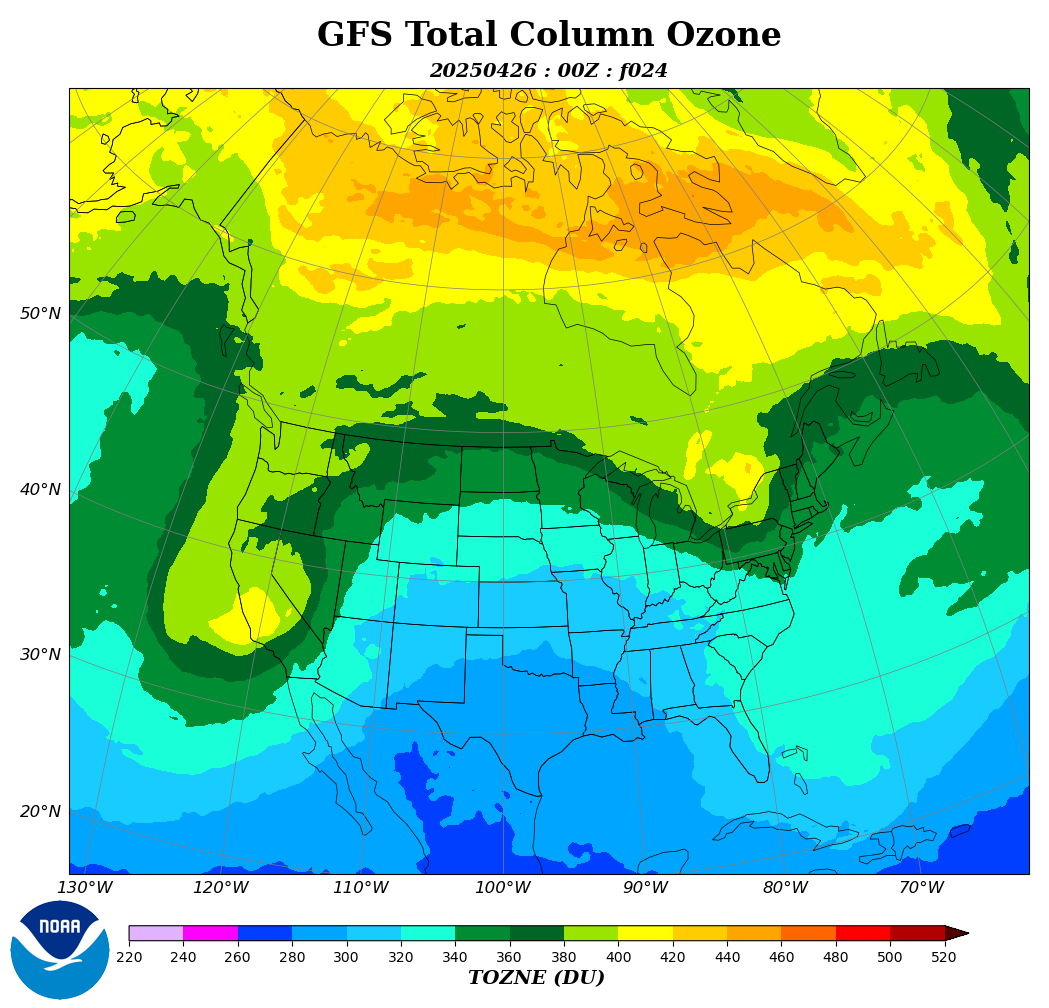
https://www.cpc.ncep.noaa.gov/products/stratosphere/strat_int/
Bradley (yes, that Bradley) tells us the MWP gave way to the LIA because of warm Atlantic water.
So, if the warm Atlantic water hadn’t happened, the LIA wouldn’t have existed, therefore the recovery from the LIA wouldn’t have existed, and today’s warming would merely have been an extension of the MWP, ergo CO2 is not the villain in Global Warming.
Am I reading something too much into this?
(Griff, if you respond, don’t just say “yes”, give reasons, please)
Wait, did I miss read? CO2 not mentioned at all?
“Fast-forward to our own time: between the 1960s and 1980s, we have also seen a rapid strengthening of AMOC, which has been linked with persistently high pressure in the atmosphere over Greenland.”
The cold AMO phase is in fact driven by positive North Atlantic Oscillation conditions, as in the mid 1970’s and mid 1980’s, with a lower pressure over Greenland.
https://www.climate.gov/news-features/understanding-climate/climate-variability-north-atlantic-oscillation
Negative NAO produces the Greenland high pressure, which is normal during a centennial solar minimum, as is the warmer AMO and Arctic.
There is so much junk science to climatology that I feel sorry for anyone trying to do real science.
Here my challenge. What to expect for Chicago this (or next) winter? Global warming (AGW) predicts a mild winter for Chicago. However, if get an EXTREEMLY cold winter, it will be explained (if not predicted) as climate change (CC). So what is the prediction for this and upcoming winters?
Global warming and climate change are usually treated as different names for the same theory. However sometimes they make different predictions! I think it is time to recognize that these are two different theories. We should challenge the Chicken Littles of the world to choose one theory and repudiate the other. What do you believe in, Global Warming OR Climate Change? You can’t have it both ways.
Well, so-called “climate change” causes everything “bad” about the weather, regardless of what the direction of temperature change is, so they’re already having it both ways, for those who uncritically accept the bullshit they are being fed.
Remember, these are the same people who brought you bald faced contradictions like “The children aren’t going to know what snow is” AND “Heavier snowfall is ‘consistent with’ global warming.” So-called “climate change” is chameleon-like; it explains whatever is happening outside your windows (when it is “bad” at least), even things in direct contradiction of one another.
“Surprisingly, the cooling appears to have been triggered by an unusually warm episode.”
I’ve been seeing quite a few “studies” suggesting global cold (ice age) caused by warming lately. Almost like they’re hedging their bets so that no matter what happens they can continue to blame “climate change”
You got it!
So if Man Made Global Warming doesn’t fry us all, it will freeze us all.
As I have said all along, we’re doomed.
How odd. William Rosen wrote the outstanding book “The Third Horseman”, A treatise on the 1300 hundreds. How a cycle of cold, disease, and warfare created the worst famine in European history. It starts in May of 1315 and continues for the rest of the century, it is in fact a story of cold. All the rest, famine and disease and armies in dissaray were a result of the cold.
So where did these people get the warmth from?
Wouldn’t it chuck a spanner in the werke if the primary net cooling mechanism came from above, and primarily in the tropics and not from the direction of the poles?
Earth can do more tricks than the ones we know about.
Wasn’t something like this proposed maybe 10+ years?
If the key to climate variability is variable solar activity (prevailing economic cycle theory for two centuries) what can we possibly be doing about it? Best spread the world food producion over as many areas as possible? Build a dam between Greenland and Baffin Island? Better hope greenhouse gasses are up to level to keep us from freezing.
In my view what the authors are describing here is just a powerful excursion of the AMO. This is an excitability driven oscillation in a dissipative open system.
– more warm water transport to the Arctic via the AMOC first increases downwelling of cooled high density saline water in the Norwegian Sea, self-reinforcing the AMOC.
– but the warming of the Arctic leads to melted freshwater which chokes off the Norwegian Sea downwelling.
– so eventually the AMOC slows down and the Arctic cools down again
– rinse and repeat for as long as an Atlantic Ocean exists.
https://ptolemy2.wordpress.com/2020/07/26/from-chaos-to-pattern-in-ocean-driven-climate/
The AMO is a chaotic-emergent oscillation which is not a uniform sine wave (very little in nature is). It’s time period is not 60 years but varies from about 30-100 years, as shown by palaeo reconstructions.
https://agupubs.onlinelibrary.wiley.com/doi/full/10.1029/2004GL019932
https://link.springer.com/article/10.1007/s00367-009-0154-6
The unspoken implication?
That we are right now at the crest of a rollercoaster ride, just about to descend into a sharp cooling trend for a few decades?
Time will tell.