Cold era, lasting from early 15th to mid-19th centuries, triggered by unusually warm conditionsPeer-Reviewed Publication
UNIVERSITY OF MASSACHUSETTS AMHERST
AMHERST, Mass. – New research from the University of Massachusetts Amherst provides a novel answer to one of the persistent questions in historical climatology, environmental history and the earth sciences: what caused the Little Ice Age? The answer, we now know, is a paradox: warming.
The Little Ice Age was one of the coldest periods of the past 10,000 years, a period of cooling that was particularly pronounced in the North Atlantic region. This cold spell, whose precise timeline scholars debate, but which seems to have set in around 600 years ago, was responsible for crop failures, famines and pandemics throughout Europe, resulting in misery and death for millions. To date, the mechanisms that led to this harsh climate state have remained inconclusive. However, a new paper published recently in Science Advances gives an up-to-date picture of the events that brought about the Little Ice Age. Surprisingly, the cooling appears to have been triggered by an unusually warm episode.
When lead author Francois Lapointe, postdoctoral researcher and lecturer in geosciences at UMass Amherst and Raymond Bradley, distinguished professor in geosciences at UMass Amherst began carefully examining their 3,000-year reconstruction of North Atlantic sea surface temperatures, results of which were published in the Proceedings of the National Academy of Sciences in 2020, they noticed something surprising: a sudden change from very warm conditions in the late 1300s to unprecedented cold conditions in the early 1400s, only 20 years later.
Using many detailed marine records, Lapointe and Bradley discovered that there was an abnormally strong northward transfer of warm water in the late 1300s which peaked around 1380. As a result, the waters south of Greenland and the Nordic Seas became much warmer than usual. “No one has recognized this before,” notes Lapointe.
Normally, there is always a transfer of warm water from the tropics to the arctic. It’s a well-known process called the Atlantic Meridional Overturning Circulation (AMOC), which is like a planetary conveyor belt. Typically, warm water from the tropics flows north along the coast of Northern Europe, and when it reaches higher latitudes and meets colder arctic waters, it loses heat and becomes denser, causing the water to sink at the bottom of the ocean. This deep-water formation then flows south along the coast of North America and continues on to circulate around the world.
But in the late 1300s, AMOC strengthened significantly, which meant that far more warm water than usual was moving north, which in turn cause rapid arctic ice loss. Over the course of a few decades in the late 1300s and 1400s, vast amounts of ice were flushed out into the North Atlantic, which not only cooled the North Atlantic waters, but also diluted their saltiness, ultimately causing AMOC to collapse. It is this collapse that then triggered a substantial cooling.
Fast-forward to our own time: between the 1960s and 1980s, we have also seen a rapid strengthening of AMOC, which has been linked with persistently high pressure in the atmosphere over Greenland. Lapointe and Bradley think the same atmospheric situation occurred just prior to the Little Ice Age—but what could have set off that persistent high-pressure event in the 1380s?
The answer, Lapointe discovered, is to be found in trees. Once the researchers compared their findings to a new record of solar activity revealed by radiocarbon isotopes preserved in tree rings, they discovered that unusually high solar activity was recorded in the late 1300s. Such solar activity tends to lead to high atmospheric pressure over Greenland.
At the same time, fewer volcanic eruptions were happening on earth, which means that there was less ash in the air. A “cleaner” atmosphere meant that the planet was more responsive to changes in solar output. “Hence the effect of high solar activity on the atmospheric circulation in the North-Atlantic was particularly strong,” said Lapointe.
Lapointe and Bradley have been wondering whether such an abrupt cooling event could happen again in our age of global climate change. They note that there is now much less arctic sea ice due to global warming, so an event like that in the early 1400s, involving sea ice transport, is unlikely. “However, we do have to keep an eye on the build-up of freshwater in the Beaufort Sea (north of Alaska) which has increased by 40% in the past two decades. Its export to the subpolar North Atlantic could have a strong impact on oceanic circulation”, said Lapointe. “Also, persistent periods of high pressure over Greenland in summer have been much more frequent over the past decade and are linked with record-breaking ice melt. Climate models do not capture these events reliably and so we may be underestimating future ice loss from the ice sheet, with more freshwater entering the North Atlantic, potentially leading to a weakening or collapse of the AMOC.” The authors conclude that there is an urgent need to address these uncertainties.
This research was supported by funding from the National Science Foundation.
JOURNAL
Science Advances
DOI
ARTICLE TITLE
Little Ice Age abruptly triggered by intrusion of Atlantic waters into the Nordic Seas
ARTICLE PUBLICATION DATE
15-Dec-2021
What caused Ice Age – creation.com
http://creation.com/what-caused-ice-age
page missing
Remove the “ ” from the URL.
science missing, but the page is there if the URL is corrected. More effort than it is worth.
They lost me at creation. But now I’m found.
It is good to doubt…
Wrong ice age – while the link is bad, most writing on creation.com is about the ice age as in when glaciers came down over much of the northern USA.
“Secular scientists really can’t explain how an Ice Age happened, but can creation scientists? Yes, but first it needs to be placed within biblical earth history. The glacial features lie on top of sedimentary rock. This is a good indication that the Ice Age happened after the Flood.”
dk_ is right, science missing.
It’s your science that is missing. Modern geology was written entirely and specifically to throw off the chains of Moses, so it simply presupposes the eyewitness testimony recorded in the biblical documents is wrong. Long ages for the Earth and universe are supported only by the enormous number of “just so” stories the atheists make up to allow them to maintain their beliefs.
I’m as militant a Christian as any you will find around here, If you doubt me, just ask any of the atheists I have crossed words with. All I can say about your claims, is that you have no knowledge of science.
Long ages for the Earth and the universe are based on many different lines of evidence, all of which are backed by solid science.
If you are a Christian, how do you understand the words of Peter (2 Pet 3:4-6), Paul (Rom 1:20), and Jesus himself (Mk 10:6)? None of these make sense if the appearance of the earth and humans was separated by billions of years and not days.
Long ages for the Earth and universe are supported only by the enormous number of methods of radiometric dating of rocks such as potassium-argon and uranium-lead.
Corrected for you.
“Eyewitness testimony”? If God had shown Moses the equivalent of a BBC/PBS documentary on the creation/formation of the universe, say as a vision while in prayer, and it covered the Big Bang, Earth formation, evolution of species and the first intelligent people – he would have wrote exactly what you see in Genesis.
Now that I’ve spent time reading that nonsense, I want my 10 minutes back.
No science, just unsupported assertions and claims that contradict basic science.
Here was me thinking it was absence of heat.
Wait.. what? Global Warming will ultimately do us in by freezing us to death? I know there have been quite a few articles on WUWT over the years pointing to this, but these researchers slipped their paper in under the covers.
Global warming has wreaked havoc the past few decades according to the doomsayers but the ultimate result will be catastrophic global cooling. What a paradox.
That’s the problem with periodic cycles, they tend to recur periodically.
Rocketscientist, you’re ready to blast off. Their report, albeit with other intentions, has claimed both rapid warming and rapid cooling as normal. Sure, solar, ocean currents, volcanos, but earth temperature lurching around is normal. Next.
So well said. ….may I use it ?
Actually, the author doesn’t think the same conditions prevail now.
He has it that a huge amount of ice flushed out of the arctic, cooled the Atlantic as well as transporting fresh water there. That stopped the circulation.
He doesn’t think there’s enough ice in the arctic to do that now.
But wait. When the Thwaite glacier in Antarctica busts loose and sails north, things might get very dicey.
Are you sure your fingers didn’t slip and insert an extra “d” into your message?
Right now we have more Arctic Ice than we’ve had in 2020, 2019, 2018, 2017, 2016, 2015, so possibly when this ice flushes into the North Atlantic due to warming, there will be skating on the Thames again….whoooaa, that doesn’t seem to make sense…..
Wait – you can’t do that. What will the polar bears live on if the ice is gone?????
Haven’t you seen the movie (and/or subsequent show) Snowpiercer? The Earth is a frozen wasteland due to man’s meddling…
Global warming causing an ice age was also the premise of the 2004 movie “The Day After Tomorrow”. And I’ve been reading about this theory since long before that.
Not saying it’s not true, just that it’s not new.
In “The Day After Tomorrow”, global warming causes super massive thunderstorms that pull the super cold air in the stratosphere down to the surface and froze everything.
It appears that the brilliant Hollywood writers have never heard of compressional heating.
Are there any global warming disaster movies where the disaster is actually due to warmer temperatures?
MAYBE WaterWorld? (But I said disaster movie, not disaster of a movie)
That train is real believable.
This is just setting the stage for claiming that any cooling coming in the next couple of decades can be explained as the consequence of warming.
Reading this tripe, it feels like an article in Pravda with all of its bold assertions of facts not in evidence.
What a bunch of blarney science
To be fair they are only pointing out that there are uncertainties which need to be further investigated.
I know what caused it–It was Amherst.
Interesting, but if this is correct then why is there evidence of the MWP and LIA even on the opposite side of the planet? The LIA and MWP show up in Antarctic ice core CO2 level measurements. The decline in temperature from MWP peak to the bottom of the LIA reduced atmospheric CO2 level in Antarctic ice cores by about 9 ppmv, in 450 years.
Here are Law Dome (Antarctic) ice core data, back to year 1010. Scroll down to “CO2, 75 Year Smoothed,” then keep scrolling. Watch CO2 levels climb to their peak of 284.1 ppmv circa 1170 (MWP), and fall to their lowest level of 275.3 ppmv circa 1615 (LIA):
https://www1.ncdc.noaa.gov/pub/data/paleo/icecore/antarctica/law/law_co2.txt
BTW, those 284.1 ppmv circa 1170 and 275.3 ppmv circa 1615 “text-fragment links” work in Chromium-based browsers, like Chrome, Opera, Brave, Vivaldi and Edge, but not in Firefox-based browsers, like Firefox, Waterfox & PaleMoon. In those browsers you can type Ctrl-F (or ⌘F) and search for the year.
Yes, the MWP and LIA were global, as were prior such warmer and cooler intervals. The overturning circulation circles the globe, but it takes time.
Shhhh, you aren’t supposed to bring up actual science.
So, they don’t really understand, or even know, all of the important phenomena associated with the behavior and interactions of the sun, the oceans, and the atmosphere.But they say that they can project the average temperature of the entire planet for the next 100 years, with an accuracy on the order of 0.1C?
I am a bit skeptical
Only a bit?
All public funded research on climate should be shut down. There are only 3% of the science community who do not understand the science of CO2 causing every adverse weather event. In modern science you only need 51% to be convinced to know you are right. With 97% convinced there is simply no debate so why keep asking dumb questions and looking for new answers when 97% know the answer already.
Lay off the 97% consensus BS pullease!
We all know that is sham info. Plus, science is not about consensus. Just ask Galileo and Einstein.
You don’t understand sarcasm? Or was it tongue-in-cheek irony?
Prove that was sarcasm. Until you prove it, it is direct speech.
The first sentence should be sufficient proof.
Tom I plussed you back up to zero because I guess you’re a newbie who doesn’t know that most comments here are sarcasm. You’re right of course, but you missed the implied sarc tag.
You’re right to be skeptical. more than a bit.
Consider that any UN sponsored research wasn’t looking for actual results but something “human caused” and if possible something that could be exaggerated.
None of it ever was intended to be scientific, as a Mann so cleverly designed.
First it warmed, then it cooled. Now it’s warming again. I’ll bet there’s a pattern here somewhere.
Pattern?

It’s been going on for a lot more than the last 2000 years.
https://holoceneclimate.com/
If you scale your graph just right, you can make the .18 deg C difference between the 900 peak and the 2000 peak look a lot more scary. Or just cut it off at 1000 so it is even scarier.
Or just flatten the handle and you get a hockey stick.
One can’t just append the HadCRUT anomalies to the Ljungqvist reconstruction. The reconstructions are averages over decadal time periods. If one takes a two- or three-decade average of the HadCRUT, you don’t get the spike at the end of the chart.
+infinity. I’m so sick of seeing the “modern” temperatures taken from real-time thermometer readings (and then bastardized to something that’s no longer even “data” to make the temperature rise seem like more than it really is) compared with proxy reconstructions as if they are apples to apples.
The trees used to grow at higher elevations than they can today because it was warmer in the past, not colder.
First it warmed, then it cooled. Now it’s warming again. I’ll bet there’s a pattern here somewhere.
A kind of IQ test – look for pattern and predict what comes next. You passed; surprisingly few do.
The MWP was real and powerful? Who knew?
Interesting how Wikipedia describes (minimizes) it along with showing the hockey stick.
The Medieval Warm Period (MWP), also known as the Medieval Climate Optimum or the Medieval Climatic Anomaly, was a time of warm climate in the North Atlantic region that lasted from c. 950 to c. 1250.[2] It was likely[3] related to temperature increases elsewhere,[4][5][6] but other regions meanwhile got colder, such as the tropical Pacific. Average global mean temperatures have been calculated to be similar to the early-mid-20th-century warming. Possible causes of the Medieval Warm Period include increased solar activity, decreased volcanic activity, and changes in ocean circulation.[7
That kind of cr.p caused me to ignore wikipedia’s never ending pleas for donations.
Ditto. It also made me notice that their pleas are for money only, not suggestions on how to improve, or reasons why I might not be interested in donating.
Yes, I’ve the done the same for the past decade or two.
Try everpedia .org
https://infogalactic.com/info/Main_Page
Shiver my timbers, but those boats with full sail, iced in, will not get very far.
And the ice for sure shivered the keels.
Those are not boats with full sail iced in, they are ice boats cruising up and down the Thames.https://external-content.duckduckgo.com/iu/?u=https%3A%2F%2Ftse1.mm.bing.net%2Fth%3Fid%3DOIP.xhZM5WBSGKtAvh9Ok-sqfgHaEr%26pid%3DApi%26h%3D160&f=1
Details, details!
Aren’t we currently in a protracted period of low solar activity? What then can we say about the correlation between high pressure and high solar activity posited in the article?
The last solar cycle was relatively low, but the three before it were pretty strong. Taking into consideration the thermal inertia of the oceans, it takes time to readjust.
https://helioforecast.space/solarcycle
From 21stcenturywire.com “NOAA is predicting a ‘full-blown’ GrandSolarMinimum (GSM) GSM’s have the potential to hold sunspots at ZERO for multiple decades. The most famous example is the Maunder Minimum (1645-1715) which brought plummeting temperatures, crop loss, famine, and the deaths of hundreds of millions of people ACROSS the planet.”
This Grand Minimum was forecast during the last minimum. It’s behaving on schedule for a cold spell at least to 2050-60. I can’t handily find the paper, though.
¨Once the researchers compared their findings to a new record of solar activity revealed by radiocarbon isotopes preserved in tree rings, they discovered that unusually high solar activity was recorded in the late 1300s.¨
Anybody know what the new record is? Has someone been adjusting again?
They reference this paper:
Eleven-year solar cycles over the last millennium revealed by radiocarbon in tree rings
11 year cycles, who knew?
One of the authors of this article is Ilya Usoskin, whom I recall occasionally locked horns with Leif Svalgaard on topics relating to solar science. Professor Usoskin was the PI of the Oulu Neutron Monitor and got his nose bent out of joint, a decade ago, when Leif pointed out an anomalous statistical drift in the Oulu neutron counts:
https://tallbloke.wordpress.com/2012/11/21/ilya-usoskin-vs-leif-svalgaard-oulu-neutron-monitor-data-quality/
They should have read more. From 2012
And the Russians have seen it and been measuring it for awhile.
<i>Drastic cooling all over the Northern Hemisphere. The thing is that according to their calculations, “a great salinity anomaly” is coming, which will cause the fall of average temperature and bring about frosty winters in the coming years. The oceanologist and doctor of physical and mathematical sciences Nikolai Diansky has for years compared data about change of salinity of waters of the Arctic regions with weather changes on the planet. He took reference data from his colleagues in every corner of the globe. The scientist’s diagram prove that the <b>global warming leads to massive melting of glaciers and increase in spillover of the Siberian rivers. As a result the Arctic Ocean has collected a lot of fresh water, which is will soon start pouring out through the Canadian and Greenland straits to the Northern Atlantic. This is where Gulf Stream, the main “bed warmer” of Europe flows. Its warm salty water is going to be covered with cold fresh water. Thus, the heat will not be let out and thus the climate in Europe and entire Northern hemisphere is going to cool down.</b></i> – Read at: //russia-ic (dot) com/news/show/13458#.Vo15ZkOBqPw
Sounds interesting…changed (dot) to “.” but link won’t connect…
http://russia-ic.com/news/show/13458#.Ybvwl2hRhPZ
Worked for me:
Russian Scientists Predict Anomalous Cold
6.01.2012 17:25
Russian Scientists Predict Anomalous Cold
Scientists from the Oceanographic Institute and Institute of Calculus Mathematics, RAS, predict drastic cooling all over the Northern Hemisphere.
The thing is that according to their calculations, “a great salinity anomaly” is coming, which will cause the fall of average temperature and bring about frosty winters in the coming years.
G’Day OK S,
“… frosty winters in the coming years.”
Not just ‘frosty’, but icy. The Russians are building nuclear ice-breaking ships. What do they know that we don’t?
I sometimes wonder. After the International Geophysical Year (IGY 1957/’58) ended did the Russians shut down all their research stations in the artic, or did they continue to gather data? Their climate model projections aren’t all that far above what has actually occurred – compared to almost all the other models.
I would doubt the timing of the start of the LIA. From my reading of history, consistently bad weather had set in, at least in Britain, from the 1320’s onwards, not some eighty years later.
Of course, the precision of the proxies is not stated.
https://en.wikipedia.org/wiki/Great_Famine_of_1315%E2%80%931317
There was a spell of bad weather early in the terrible 14th century, but then it warmed up again until late in the century. Some climatologists date the LIA from the early downturn, but others use c. AD 1400.
Which period to assign the Wolf Minimum?
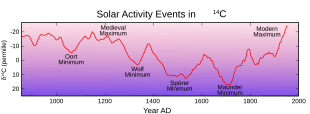
Lamb recognised that there were large icebergs in the North Atlantic around 1250 AD and in the latter part of the 13th century large volcanic eruptions may have cooled things down a bit.
Nothing untoward, but in 1300 AD sea level fell dramatically, which is a fair indication the LIA had begun.
The Wolf Minimum was around 1280 – 1350 and there were a series of large volcanic eruptions that compounded the cooling temperatures .leading up to 1300 which marks the true beginning of the Little Ice Age . Or the off the scale 1257 Samalas eruption ..Certainly not 1380 – 1400…If one looks at the expanse of the LIA what catches the eye are the clustered volcanic eruptions of the early 19th century situated in the Dalton Minimum at one end of the spectrum and another clustered series of volcanic sulphate peaks bracketed in the Wolf Minimum in the later decades of the 13th century .The cold weather really set in around 1314 – 22 and despite the warming interregnum, temperatures turned cold again during the Sporer Minimum Its apparent in the chart above . This is just another version of the ‘warming will cause catastrophic cooling : ” Cli – Fi : ” Lapointe and Bradley have been wondering whether such an abrupt cooling event could happen again in our age of global climate change ……with more freshwater entering the North Atlantic potentially leading to a collapse of the AMOC ” . You can see the subtle angling for more funding at the close of the report ….
Thanks Hamish, solar forcing seems the most likely culprit.
There was a volcanic eruption in 1257 AD which, being the largest in 10,000 years, may have tipped the world into the LIA.
That’s the same Bradley (Raymond S.) as the “B” in MBH98 and MBH99 (origin of the infamous Mann-made “Hockey Stick”).
I can’t help but wonder who peer(pal)-reviewed this latest wild speculation.
Good catch, John….at least he is accepting that the Little Ice Age happened….although his “ice-cubes-in-the-Atlantic” explanation is weak at best….
And the whole premise is still built around the (unproven) assumption that the AMOC will be affected by fresh water. Seems like they found a correlation and have been desperately searching for anything to use as causation – unfortunately they’ve chosen some modern climate change misinformation and are trying to make it fit the past. Sceptical.
For more ice to be flushed out of the arctic, there is going to have to be more ice forming in the arctic first.
1) Less ice means the water in the arctic will cool more easily, since ice is an insulator.
2) Less ice means that more water will be evaporating as there is more ice exposed to the air. (This will both cool the water and make it saltier.)
3) Formation of more ice will pull fresh water out of the arctic in order to make that ice.
Net result, while portions of the North Atlantic might be getting fresher, water in the Arctic itself will be getting colder and saltier, which would have the affect of intensifying the AMOC.
The period of elevated solar activity is now over, however, without having caused a (statistically significant) loss of Greenland Ice. I’m blaming the reduced level of Arctic Ice (notice I didn’t say continuing decline, the data to me looks more like a step adjustment around 2007, and the ice levels since have nearly flat-lined, though with a fairly wide significant difference) on a change in storminess and possibly warmer water within the Arctic, and I see no research on what could have caused either of those shifts. My first guess is not elevated atmospheric CO2 levels.
Yes, it is so far-fetched as to be laughable.
Yes, good point. I look at this as secondary … chicken or the egg? … while the causation mechanism is in place elsewhere.
Someone mentioned the simultaneous cooling of the tropical Pacific … and I think that was secondary process too, but also important to increase variability in the direction of net cooling, overprinted with the typical decadal-scale warming and cooling to complicate.
Yeah, I’m sensing a lot like HARKing in this paper. I do admire their data collection and analysis, however, if we could just stop there before they got into their wild-ass “Conclusions”.
Oh no – not the “warming causes cooling” meme again. The Earth may cycle between warming and cooling, but let’s not be so simple-minded to think that one is the cause of the other.
At least some pittance of logic and reason is on display here…
Imagine that! COLD climate is bad…one might reasonably conclude that warm climate is better! Maybe that’s why previous warm climate periods are called climate OPTIMUMS.
Did you get that?! Solar activity and clouds which modulate solar inputs to the Earth’s surface have a sizable climate influence! Who’d have thought?!
Now that we’ve gleaned some kernels of reality out of this “warming causes cooling” idiocy, the rest can be ignored as “getting their story straight so they can blame temperature change in ANY direction on human activities.”
exactly
At the same time, fewer volcanic eruptions were happening on earth, which means that there was less ash in the air. A “cleaner” atmosphere meant that the planet was more responsive to changes in solar output.
Until the last decade, or so, climatologists explained much of climate as being from volcanic activity. Now we “learn” it’s from the lack of such activity. I’ve been inclined to believe volcanism is more of a weather thing (temporary, months, not years). So I guess, it does follow that the absence of volcanic activity is a fundamental climate driver /sarc
Who knew that volcanic ash would both cool and warm the planet at the same time.
Whichever was needed to make the models work.
It is remarkable how slow the climate modelers sometimes are to incorporate the influence of measured reality into their models. It took about thirty years (counting from this 1991 paper about the measurements) for the modelers to discover that warmer temperatures increase snowfall accumulation on Antarctic ice sheets, offsetting ice loss from melting and iceberg calving, and incorporate that fact into their “new generation of climate models.”
To be blunt, climate modelers typically are not the brightest bulbs on the scientific Christmas tree.
I get it: playing with computer programs is fun! But sometimes it helps to know what you’re doing, and when you’re so seduced by the beautify of your software creations that you lose site of reality, it’s time to take a step back.
The “year without Summer” was a result of a volcanic eruption in Indonesia in 1815 or 1816. Once the dust and aerosols in the atmosphere settled out, I think the weather returned to a more usual range.
https://www.smithsonianmag.com/history/blast-from-the-past-65102374/
“The most destructive explosion on earth in the past 10,000 years was the eruption of an obscure volcano in Indonesia called Mount Tambora. More than 13,000 feet high, Tambora blew up in 1815 and blasted 12 cubic miles of gases, dust and rock into the atmosphere and onto the island of Sumbawa and the surrounding area. Rivers of incandescent ash poured down the mountain’s flanks and burned grasslands and forests. The ground shook, sending tsunamis racing across the JavaSea. An estimated 10,000 of the island’s inhabitants died instantly.
It’s the eruption’s far-flung consequences, however, that have most intrigued scholars and scientists. They have studied how debris from the volcano shrouded and chilled parts of the planet for many months, contributing to crop failure and famine in North America and epidemics in Europe. Climate experts believe that Tambora was partly responsible for the unseasonable chill that afflicted much of the Northern Hemisphere in 1816, known as the “year without a summer.”
end excerpt
Help me here. If memory serves, there was a supervolcanic explosion in the Mediterranean/.Aegean sea region around the time of the Exodus in the Bible, one effect of which is hypothesized to have been a rapid drawdown of water in the Red Sea, allowing Moses to lead the Israelites out of Egypt. I believe the town of Santorini is actually built on the remains of a slope on the side of the caldera involved. Is so, this may rank up with Tambora in 1815 and possibly Krakatoa in 1883 (which was legendary in the memories of the maternal side of my family).
In any case, having delivered the mail to Jan Mayen, I’m just glad Beerenberg has been relatively quiet since the 70s.
Or it was the Reed Sea and not the Red Sea.
There is simply no way a volcanic eruption in the Mediterranean could have an impact on water levels in the Red Sea. Even a tsunami would have to travel all the way around Africa before it can get to the Red Sea. Tambora was orders of magnitude larger than the Santorini eruption.
I’d agree – was pointing more to the admission in that quote that clouds or lack thereof have a climate impact.
Temperature is not the only thing affected by volcanoes. In the short term, very large volcanic eruptions also lower atmospheric CO2 level. The effect of the June, 1991 Mt. Pinatubo eruption on CO2 level was very noticeable for 2-3 years:
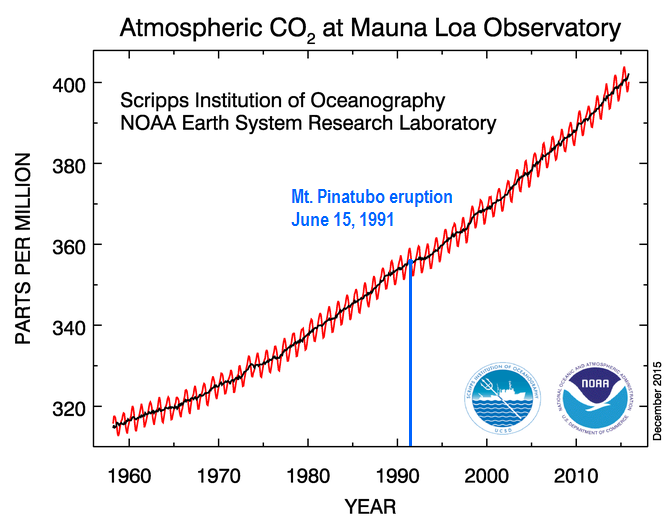
Dr. Roy Spencer found that, with careful analysis, the effect of Pinatubo on atmospheric CO2 levels (lowering them very slightly) was (barely) detectable in Mauna Loa CO2 measurements for about eleven years. The effect of El Chichon on atmospheric CO2 levels was detectable for about six years. These graphs are from his article:
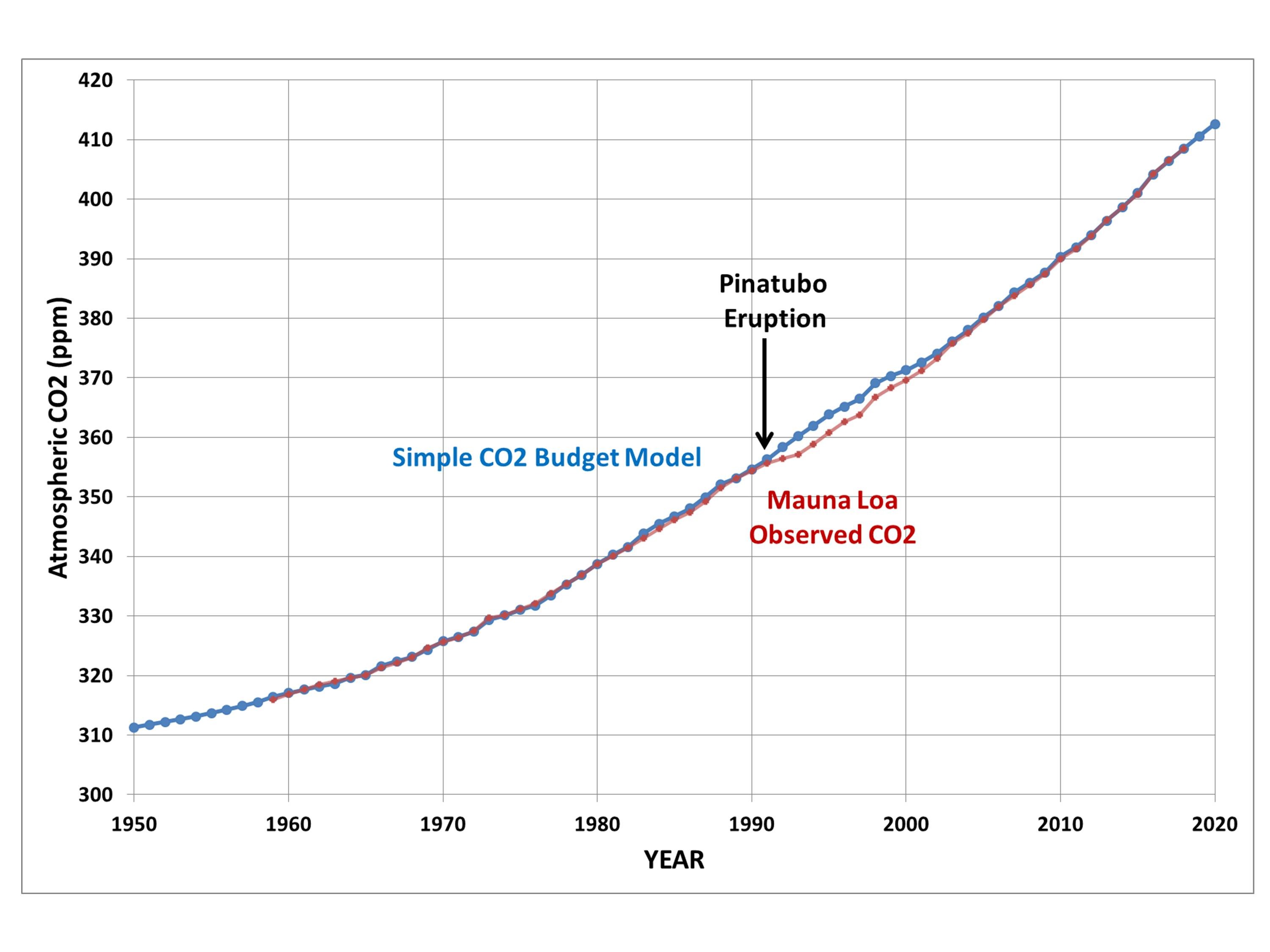
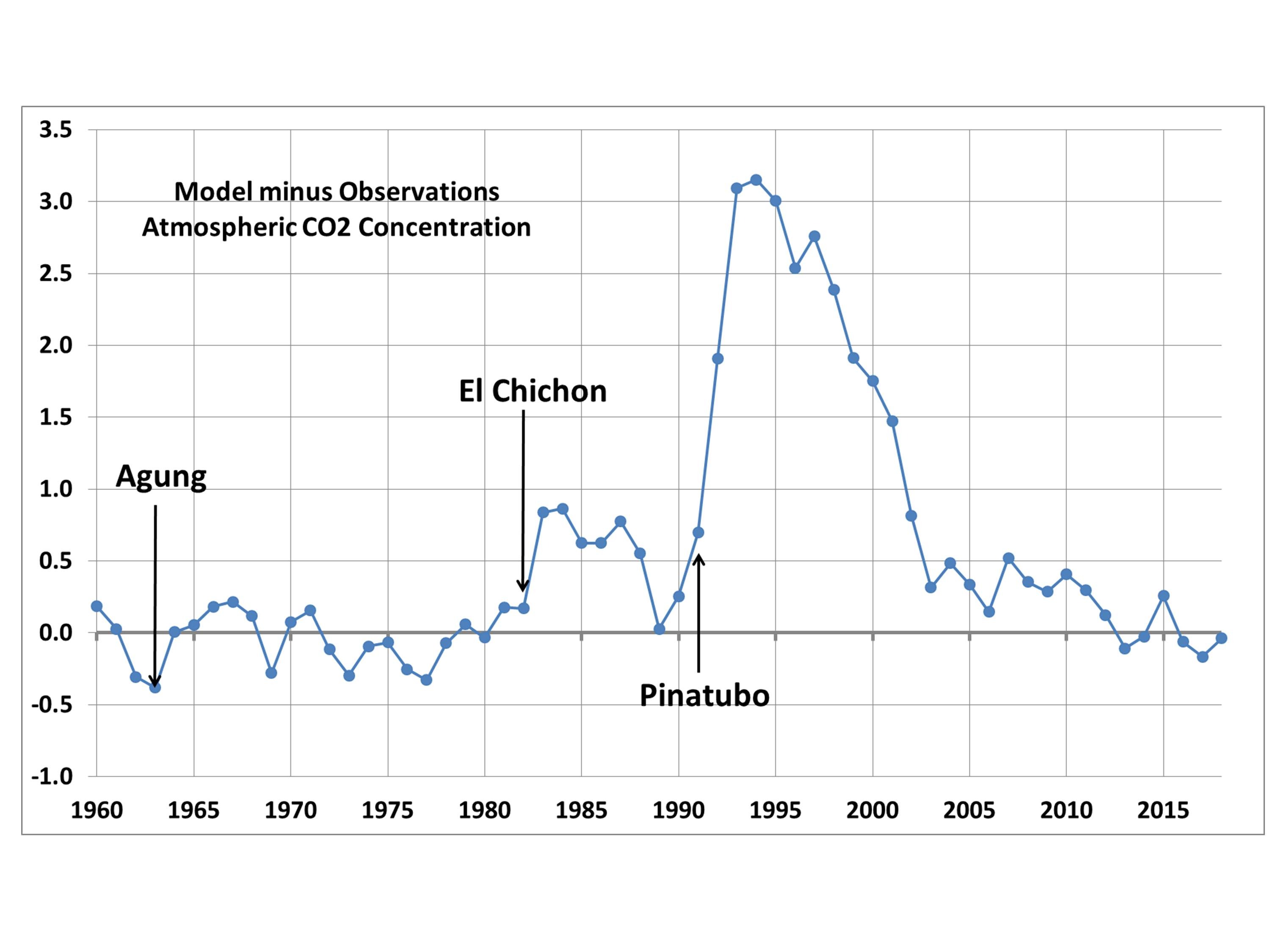
I know of three competing theories which attempt to explain why large volcanoes lower atmospheric CO2 level:
1. The most obvious plausible cause is because particulates ejected by the eruption cool the Earth, which temporarily increases CO2 absorption by the oceans (because gases like CO2 dissolve more readily in cooler water, (per the temperature dependence of Henry’s law).
2. Another explanation is that iron and other minerals in the volcanic ash fertilize the ocean and thereby increase CO2 uptake by ocean biota (Sarmiento, 1993 [pdf]),
3. Another possible explanation is that sunlight scattering from atmospheric particulates affects vegetation growth (Farquhar & Roderick, 2003 [pdf]).
Shouldn’t it be “…climate OPTIMA…”? There, do I win the nit-picker award for the day?
Here’s your prize
🧐⭐️
A ‘collapsing’ AMOC, ‘unusual warming’, even strong solar activity. Someone is softening us up to expect a cooling period. But hey, there is now less ice than in the 14th century because of global warming caused by us. (How do they know? How do you measure that 6 centuries ago). So whatever happens, warmer, colder, it will be our fault.
You win the cool water sandwich of the thread.
And a Sunday-go-to-meeting-bun.
Bow, bow, bow!
R-r-r-r-ubber biscuit?
Frenchie likes it.
“A ‘collapsing’ AMOC, ‘unusual warming’, even strong solar activity. Someone is softening us up to expect a cooling period.”
That’s what I was thinking.
This appears to be a case of using personal biases to interpret the data. High AMOC flow followed presumably by lower AMOC flow. The high flow causing warmth in North Atlantic and the low flow associated with cold. So far so good. Then they assume the loss of ice in the arctic caused the low flow and the cold, Based on what??? Could it be they simply haven’t figured out what causes high and low flow in the AMOC. Could it be anything to do with solar cycles, ocean cycles in the tropics, altered cloud cover, or a host of other natural phenomenon? Oh no! It has to be something that we can use today to explain away why the catastrophic warming they keep predicting is associated with cold, snow, ice and a massive increase in deaths among elderly who can’t afford a carbon tax or renewable unreliable energy.
Yup. They are ignorant about more of what drives the Earth’s climate than the “knowns,” and they are fixated on one hypothetical effect that drives absolutely nothing (CO2, the magic molecule).
Any yup, they are angling to keep the CO2-causes-warming-causes-everything bullshit breathing long enough to codify the “climate” bullshit into law.
This is what you get when you design a conclusion and then fish around for any evidence you can bend to support the conclusion. It is what “academics”
do when they can’t
remember how of simply refuse to do science.
Always a negative in there somewhere—Warming is predicted to indirectly slow the Gulf of Mexico Loop Current due to the slowing Atlantic Meridional Overturning which would cool the Gulf, negatively impacting warm water species as in spawning bluefin tuna. It is based entirely on models, some “experimental.” Liu, Y., et al.,. 2012. Significant reduction of the Loop Current in the 21st century and its impact on the Gulf of Mexico. J. Geophys. Res. 17(C5) https://doi.org/10.1029/2011JC007555
More BS from the so-called scientist of “Climate Change”. Just shut up & go away. You all have NO credibility.
CliSciFi keeps the paychecks coming.
Where is all the data? This is old news. Just hedge betting a cold era is coming and trying to keep a toe in the climate change threat narrative.
They say that the warm temperatures of the 1300s were caused by the sun. What happened to the notion that solar activity doesn’t change by enough to make much difference????? Then they implicitly indicate that the sun weakened before the cooling of the LIA. They don’t find that the warming caused the cooling, they simply identify that one happened before the other, and everything else is speculation. Properly analysed (which isn’t unfortunately going to be allowed in any journal) the paper supports Henrik Svensmark’s cosmic ray / cloud theory and destroys the mainstream position.
Post hoc ergo propter hoc. The paper is full of contradictions dancing around the obvious fact they have shown the climate fundamentally relates to factors of solar effects.
Sounds like a nice summation to me.
Was it solar heating alone that caused the strengthening of the AMOC during the Medieval warming period?
My Logic
1. Medieval warm period, (600 to 1300 AD) has a strong warm AMOC
a. Coincides with period of strong solar output
b. Coincides with low volcanism and reduced volcanic solar filter
i. Strong sun and optimal solar heating strengthen and warms the AMOC.
ii. Question: This implies there is a relationship between solar output and Volcanism. Volcanism implies regional ambient core heating of oceans.
iii. If this is so, then regional core heating does not likely play a role in the warming and strengthening of the AMOC at this point in history.
2. A period of decreased solar output begins in the 14th c. with the Wolf Minimum, then the Sporer and Maunder minimum.
3. The AMOC begins to weaken in a descending cycle of Grand Solar minimums.
a. Question is it low solar irradiance and cosmic radiation increasing clouds alone that weakens the AMOC?
b. If the relationship that the paper implies between solar output and volcanism exists, then there would be an increase in filter further reducing solar warming of the oceans
c. But there would also be increased regional ambient heating of the oceans.
d. During the Minimum of he 23rd cycle 2007-2009, GRACE and GOCE identified strong + gravitational variance anomalies in the North Atlantic.
i. Both programs are defunct now so there is no current data.
ii. Both programs demonstrated the dynamic nature of gravitational variance positing that the positive variance anomalies were caused in the dynamic cases by magma being forced into the crust possibly by subcrustal vortexes. It was suggested by in WUWT 10 years ago that these vortexes wee perhaps more focused due to the weak solar output of the minimum of the 23rd cycle.
4. This is my problem; the paper suggests a variable it ignores. It states a relationship but goes no further.
a. Given the relationship between weak volcanism and strong solar output it would follow:
i. There would be an increase in volcanic filter in the atmosphere further reducing solar heating
ii. And potentially strong +gravitational variances under the North Atlantic feeding more heat into the AMOC during those deep solar minimums.
iii. Strong AMOC and more heat means massive ice melt.
iv. Massive ice melt means desalination that eventually shuts down the AMOC regardless of the heat the solar minimum induced regional core ambient heat is adding to it.
5. Weak AMOC, regardless of the ambient core heating, paired with increased volcanic filter and cosmic radiation is what the little ice age is.
6. Current concern
a. Even after a 13–14-year period of relatively weak sun since 2007 we still have a strong AMOC. Today’s SST is identical to the STT of the North Atlantic used in the post above.
i. Could the AMOC having been further heated by regional ambient core heating during the deep solar minimums of the 23rd and 24th cycles, now be on its last leg or will it take several more week solar cycles to melt enough Arctic sea ice to desalinize the North Atlantic to shut down the AMOC.
ii. The Gulf of Alaska is weirdly cold… like it was in 2010… is this caused cold fresh water from ice? Or has the +gravitational variance that had been there moved ending the heating that had been there.?
iii.
Was it solar heating alone that caused the strengthening of the AMOC during the Medieval warming period?
My Logic
1. Medieval warm period, (600 to 1300 AD) has a strong warm AMOC
a. Coincides with period of strong solar output
b. Coincides with low volcanism and reduced volcanic solar filter
i. Strong sun and optimal solar heating strengthen and warms the AMOC.
ii. Question: This implies there is a relationship between solar output and Volcanism. Volcanism implies regional ambient core heating of oceans.
iii. If this is so, then regional core heating does not likely play a role in the warming and strengthening of the AMOC at this point in history.
2. A period of decreased solar output begins in the 14th c. with the Wolf Minimum, then the Sporer and Maunder minimum.
3. The AMOC begins to weaken in a descending cycle of Grand Solar minimums.
a. Question is it low solar irradiance and cosmic radiation increasing clouds alone that weakens the AMOC?
b. If the relationship that the paper implies between solar output and volcanism exists, then there would be an increase in filter further reducing solar warming of the oceans
c. But there would also be increased regional ambient heating of the oceans.
d. During the Minimum of he 23rd cycle 2007-2009, GRACE and GOCE identified strong + gravitational variance anomalies in the North Atlantic.
i. Both programs are defunct now so there is no current data.
ii. Both programs demonstrated the dynamic nature of gravitational variance positing that the positive variance anomalies were caused in the dynamic cases by magma being forced into the crust possibly by subcrustal vortexes. It was suggested by in WUWT 10 years ago that these vortexes wee perhaps more focused due to the weak solar output of the minimum of the 23rd cycle.
4. This is my problem; the paper suggests a variable it ignores. It states a relationship but goes no further.
a. Given the relationship between weak volcanism and strong solar output it would follow:
i. There would be an increase in volcanic filter in the atmosphere further reducing solar heating
ii. And potentially strong +gravitational variances under the North Atlantic feeding more heat into the AMOC during those deep solar minimums.
iii. Strong AMOC and more heat means massive ice melt.
iv. Massive ice melt means desalination that eventually shuts down the AMOC regardless of the heat the solar minimum induced regional core ambient heat is adding to it.
5. Weak AMOC, regardless of the ambient core heating, paired with increased volcanic filter and cosmic radiation is what the little ice age is.
6. Current concern
a. Even after a 13–14-year period of relatively weak sun since 2007 we still have a strong AMOC. Today’s SST is identical to the STT of the North Atlantic used in the post above.
i. Could the AMOC having been further heated by regional ambient core heating during the deep solar minimums of the 23rd and 24th cycles, now be on its last leg or will it take several more week solar cycles to melt enough Arctic sea ice to desalinize the North Atlantic to shut down the AMOC.
ii. The Gulf of Alaska is weirdly cold… like it was in 2010… is this caused cold fresh water from ice? Or has the +gravitational variance that had been there moved ending the heating that had been there.?
Has anyone noticed that the premise of this paper is based on a sudden change in SST, which is based on a dodgy reconstruction of Atlantic multi-decadal variability from Titanium levels in sedimentary cores off Ellesmere Island in Canada?
See Annually resolved Altlantic sea surface temperature variability over the past 2,900 y
So they’re assuming the surface temperature of the North Atlantic based on a proxy taken from a single location? I think we need to call this insufficient data to support the conclusion.
“Fast forward to our own time…rapid strengthening between 1960-1980”
NOT according to Rahmstorf and Mann at meteo.psu.edu. Their paper claims there was a reduction in AMOC from about 1970 to about 1990, followed by a partial recovery.
Bradley says stronger, Mann says weaker for the period in question. Guess that is why they don’t publish together any more.
FWIW, since 2004 the AMOC has been monitored at 26N by the RAPID anchored buoy system. It shows surprisingly high year to year variability, but no trend either stronger or weaker. Climate models predicted stronger—ampnother way they have been wrong.
tom rossby at uri has been measuring gulf stream velocity since at least the eighties . he says the “ slowing amoc “is pure junk science .
So, like so-called “climate science” in general, then.
Ever see one of those demonstrations of chaotic systems involving a trickle over a water wheel? For a while, the stronger the “trickle” the faster the wheel spins, in the original direction. But at a point, the trickle gets strong enough the wheel briefly comes to a “pause” — so to speak — and reverses the direction of spin. Faster than ever, but in the opposite direction.
This is chaos.
Weather is proven to be a chaotic system. Climate very likely is also.
EVEN IF the “greenhouse gas” theory is correct, the prediction that increasing the concentrations of CO2 in our atmosphere will resulting in general global WARMING is a bit of an unproven stretch. It could be that we are, as predicted int the 1970s headed for an ice age. An anthropogenic, catastrophic, global, ice age.
Hoo, boy.
If there is a better argument for quickly building a bunch of nuclear power stations that run summer and winter without need of pipelines or rail deliveries or steady wind or sunny days, I can’t think of one. IF it’s true we are trickling change factors into a climate equation, we must be prepared for ice all over as well as slightly warmer tropical summers.
Utter nonsense. While this can appear to happen when the water wheel is being filmed, it is merely an artifact of the rate of spin of the wheel and the rate at which the camera is taking pictures.
No it is not I just looked at youtube chaos water wheel and refute your statement
So your are saying that a mass of water hitting an object will cause that object to move in the opposite direction as the water?
Nonsense.
I could see a scenario where a water wheel changes direction based on flow changes. If at first the water is hitting the part of the wheel closest to the “waterfall,” that would move the wheel towards to “waterfall;” if the flow then got so powerful that the “waterfall” was hitting the far side of the water wheel, the wheel would then turn away from the “waterfall.”
Disclaimer: I did not watch the “video”
And of course, none of this has anything to do with “chaos,” or any other supposed support for the notion of climate “tipping points.” Which in any event will never be related to CO2, which “drives” absolutely nothing.
Have a look: https://www.youtube.com/watch?v=Lx8gMBJBlP8
I can assure you it is nonsense.
Atmospheric water has an average residence time of a little over a week. The amount of water in the atmosphere varies by about 25% each year. Every year, water transfer from ocean to land is in excess of four times the atmospheric water mass. When atmospheric water is at its minimum, the net ocean radiated heat uptake is at its maximum and the surface is at its coolest. When atmospheric water is at its maximum, the ocean heat uptake is at its minimum and the surface temperature at its maximum. This is the opposite of what GHE nonsense prescribes.
The ocean surface temperature is a function of the net water cycle, ocean to land, that alters the upwelling velocity of the deep oceans. The more heat uptake at the surface, the greater the evaporation and the cooler the surface as net evaporation increases.
The surface energy balance is a function of water dependent temperature limiting processes in the atmosphere and on the ocean surface. The GHE is a fairy tale for people of limited analytical ability.
I would have to argue with you on that. I am certain that the temperature of this planet with an atmosphere is different, probably dramatically different, than it would be without an atmosphere (without an atmosphere, you couldn’t even talk about an “air temperature near the surface”, the temperature near the surface would register pretty close to absolute zero at all times). You could talk about a surface temperature, I’m sure that would also be different. The day-time/night-time differential would be far greater, for reasons of mass of the atmosphere alone, if nothing else. However, calling this phenomenon the “greenhouse effect” may be a misnomer.
In general, I agree that the weather is going to do what the weather is going to do, and there’s not a lot we can do about it. And even if we could do something about it, we probably should not, due to the theory(?) of Unintended Consequences (could I rework that into the 4th Law of Thermodynamics?).
I take it you mean the average temperature; the daylight side of the Moon is a lot hotter than the Earth with an atmosphere, there’s just not anything to slow the heat loss on the “dark side.”
Whatever climate change occurs, it will not be “anthropogenic” in nature (no pun intended). Humans have a grossly overinflated sense of self importance. The forces that drive the Earth’s climate are orders of magnitude more powerful than any minute human “contributions” be they “greenhouse gases” or otherwise.
so, in other words, we should be pumping as much CO2 as we can to ensure it stays warm if the AMO collapses…
except that doesn’t even work according to the CERES data, which does not show any increased trapping of LWR
I apologize to future historians for the compounding idiocies of my age.
Actually, we should be pumping as much CO2 as we can in order to ensure the survival of the human race during the coming ice age, caused by the Milankovitch cycle. The increasing ice and cold will adversely affect our ability to grow sufficient food and continue to feed our population.
THIS. I remember reading (here, some time back) that at the peak of the last glaciation, atmospheric CO2 went down to about 180ppm. I also remember reading (here) that 150ppm is when photosynthesis begins to fail. To me, that’s way too close for comfort. I’ve read (not sure where) that with each ice age minimum, the CO2 in the atmosphere ratchets down a little. So maybe we’ve saved our bacon for the next ice age. The one after that, though…
So what happens to all the heat that does not get transported north? Do the equatorial regions get hotter?
No
Convection out of atmosphere
From what I’ve read here