UNIVERSITY OF CAMBRIDGE
CREDIT: SARA GIANSIRACUSA
The Arctic Ocean has been getting warmer since the beginning of the 20th century – decades earlier than records suggest – due to warmer water flowing into the delicate polar ecosystem from the Atlantic Ocean.
An international group of researchers reconstructed the recent history of ocean warming at the gateway to the Arctic Ocean in a region called the Fram Strait, between Greenland and Svalbard.
Using the chemical signatures found in marine microorganisms, the researchers found that the Arctic Ocean began warming rapidly at the beginning of the last century as warmer and saltier waters flowed in from the Atlantic – a phenomenon called Atlantification – and that this change likely preceeded the warming documented by modern instrumental measurements. Since 1900, the ocean temperature has risen by approximately 2 degrees Celsius, while sea ice has retreated and salinity has increased.
The results, reported in the journal Science Advances, provide the first historical perspective on Atlantification of the Arctic Ocean and reveal a connection with the North Atlantic that is much stronger than previously thought. The connection is capable of shaping Arctic climate variability, which could have important implications for sea-ice retreat and global sea level rise as the polar ice sheets continue to melt.
All of the world’s oceans are warming due to climate change, but the Arctic Ocean, the smallest and shallowest of the world’s oceans, is warming fastest of all.
“The rate of warming in the Arctic is more than double the global average, due to feedback mechanisms,” said co-lead author Dr Francesco Muschitiello from Cambridge’s Department of Geography. “Based on satellite measurements, we know that the Arctic Ocean has been steadily warming, in particular over the past 20 years, but we wanted to place the recent warming into a longer context.”
Atlantification is one of the causes of warming in the Arctic, however instrumental records capable of monitoring this process, such as satellites, only go back about 40 years.
As the Arctic Ocean gets warmer, it causes the ice in the polar region to melt, which in turn affects global sea levels. As the ice melts, it exposes more of the ocean’s surface to the sun, releasing heat and raising air temperatures. As the Arctic continues to warm, it will melt the permafrost, which stores huge amounts of methane, a far more damaging greenhouse gas than carbon dioxide.
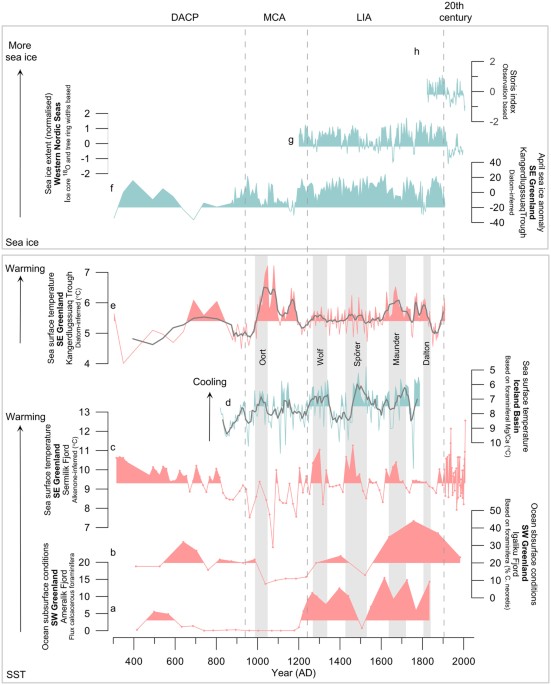
The researchers used geochemical and ecological data from ocean sediments to reconstruct the change in water column properties over the past 800 years. They precisely dated sediments using a combination of methods and looked for diagnostic signs of Atlantification, like change in temperature and salinity.
“When we looked at the whole 800-year timescale, our temperature and salinity records look pretty constant,” said co-lead author Dr Tesi Tommaso from the Institute of Polar Sciences of the National Research Council in Bologna. “But all of a sudden at the start of the 20th century, you get this marked change in temperature and salinity – it really sticks out.”
“The reason for this rapid Atlantification of at the gate of the Arctic Ocean is intriguing,” said Muschitiello. “We compared our results with the ocean circulation at lower latitudes and found there is a strong correlation with the slowdown of dense water formation in the Labrador Sea. In a future warming scenario, the deep circulation in this subpolar region is expected to further decrease because of the thawing of the Greenland ice sheet. Our results imply that we might expect further Arctic Atlantification in the future because of climate change.”
The researchers say that their results also expose a possible flaw in climate models, because they do not reproduce this early Atlantification at the beginning of the last century.
“Climate simulations generally do not reproduce this kind of warming in the Arctic Ocean, meaning there’s an incomplete understanding of the mechanisms driving Atlantification,” said Tommaso. “We rely on these simulations to project future climate change, but the lack of any signs of an early warming in the Arctic Ocean is a missing piece of the puzzle.”
Francesco Muschitiello is a Fellow of Sidney Sussex College, Cambridge.
JOURNAL
Science Advances
DOI
METHOD OF RESEARCH
Observational study
SUBJECT OF RESEARCH
Not applicable
ARTICLE TITLE
Rapid Atlantification along the Fram Strait at the beginning of the 20th century
ARTICLE PUBLICATION DATE
24-Nov-2021
“Accounts from 19th-century Canadian Arctic Explorers’ Logs Reflect Present Climate Conditions”
https://seagrant.uaf.edu/nosb/2005/resources/arctic-explorers.pdf
I have it on very good authority (facts, they call them) that Earth’s oceans began warming up from the last glacial interval on Earth approximately 12,000 years ago, at the beginning of the Holocene Epoch.
The average depth of the Arctic Ocean is 1,040 m (3,400 ft). If someone wants to assert something about the Arctic Ocean recently “warming”, say, since the beginning of the 20th century as in the above article, they will have to provide data showing they accurately know how the temperature profiles to that depth, over the areal extent of that ocean, have changed since that time.
Sorry, Argo floats don’t work under floating ice.
“All of the world’s oceans are warming due to climate change, but the Arctic Ocean, the smallest and shallowest of the world’s oceans, is warming fastest of all.”
The AMO and Arctic are normally warmer at least during each centennial solar minimum.
The Arctic Oceans are fed through the Baring Straights, which are part of the Ring of Fire. The Arctic Ocean isn’t warming due to CO2, it is warming because warm oceans are feeding the Arctic warm water. Warm the Pacific, warm the Arctic. What is warming the Pacific? More visible radiation reaching the oceans.
Bering Strait.
The Arctic Ocean gets much more warm feed from the North Atlantic,
https://en.wikipedia.org/wiki/Atlantification_of_the_Arctic
There is also an 8 month lagged teleconnection between El Nino events and major warm pulses to the AMO.
The study shows: 1) The Arctic Ocean responds strongly to Atlantic Ocean intrusions (duh … look at the map.); 2) the Arctic Ocean has warmed over the last few centuries (denied by the various Hockey Sticks used in CliSciFi) as we are recovering from the disastrous Little Ice Age (also duh); 3) UN IPCC CliSciFi models didn’t predict such early warming (also duh); and 4) Arctic ocean temperature has increased by about 2 C in the 120 years since 1900 (unstated if proxy or instrument- based), without discussing its cyclical nature.
The study fails to show the significant variations of Arctic Ocean and sea ice over the past 120 years. It also unnecessarily and unscientifically speculates that the world will continue to warm significantly because, as they said, they believe the UN IPCC CliSciFi models accurately predict future global warming).
I wonder why they limited the study to 800 years, specifically. Other paleo studies I’m aware of cover time periods of 1,000, 2,000, Holocene, glacial period (with approximately 42,000 and 100,000 glacial periods) and deep geological timeframes, with nothing at precisely 800 years. As one of the CliSciFi practitioners once said “you have to pick cherries to make cherry pie.”
How inconvenient for their anthropogenic warming theories. Will they torture the data to prove that it was? Can’t have their pet theories contradicted can we?
There was an anomalous warming peak at the end of the previous, Eemian interglacial too. Looks like it might be a thing about interglacials – a last fling of warming before decent into glacial inception.
hearty 2007 global sea-level – Google Scholar
GlobalSeauow045009.pdf (350.me.uk)
In two places, the author says that melting ice in the Arctic will cause a change in sea levels. But Arctic is floating so there is no change in sea levels when it melts unlike Antarctic ice which is mostly on land and will raise sea levels when it melts.
Last time I looked Greenland is in the Arctic, 3.5 trillion tonnes of its icesheet has melted during the last decade which has caused raising of the sea level.
Last time I looked, rise of the level of the actual sea was as non-existent as ever.
All those trillions of tons of hubris and I’m yet to see a single coastline with sea level different to a corresponding photo 100 years ago.
I guess I’m not an emperor so I just can’t see it.
Suggest checking out Virginia Key in Florida
OK and the result was a rise in global sea level of ONE CENTIMETRE. Take to the boats!
Check this NOAA tide data out.
pensacola.jpg
Yes a 19th century start to current ocean-driven warming is bad optics for the creed of anthropogenic CO2 driven warming.
But we already know how this goes and what to expect.
Out come the revisionist editors.
In a few weeks time another paper will appear contradicting this, hammering the temperature record back onto the CO2 timeline.
“As the Arctic Ocean gets warmer, it causes the ice in the polar region to melt, which in turn affects global sea levels.”
When a “scientist” says this how are we supposed to take them seriously?
Why would you not take them seriously?
bwx has finally outed himself as a dyed-in-the-wool IPCC climastrologer.
I have no affiliation with the IPCC.
To be honest, the sum of all your ‘thoughts’ on this blog could lead me to suspect that you are being funded by Heartland and the GWPF .
More open water results in more heat lost to space the following cold, dark season as well. That , in turn causes the ocean surface to cool. The open water of the Arctic Ocean must also result in more moisture in the winter air which will fall as snow in Russia and on the top of the Greenland Ice Sheet. Funny how they can only ever identify the factors that don’t offset the warming and make it temporary.
Also, if intrusion from the Atlantic caused this warming, what is happening now? Is that water no longer intruding? Has it reversed and we are just awaiting the resultant and delayed cooling? Inquiring minds want to know!
” Has it reversed and we are just awaiting the resultant and delayed cooling? ”
Just because the Arctic sea ice stops declining for the first time since years, you think the great cooling started this year?
Wow!
(downloaded Nov 22)
Some yearly averages:
81-10: 11.55
2013: 10.92
2014: 10.81
2021: 10.61 with Nov and Dec taken from the worst since 2011 (2014)
2015: 10.59
2017: 10.30
2012: 10.30
2018: 10.22
16-20: 10.15
2016: 10.13
2020: 10.06
2019: 10.05
Source
ftp://sidads.colorado.edu/DATASETS/NOAA/G02135/north/
See? CO2 operates retroactively. We’re doomed.