Guest Post by Wim Röst
Abstract
It is said that the Earth’s surface temperature variations are controlled by [human-induced] greenhouse gases1. This is not the case. When cooling systems dominate, surface temperatures are set by the cooling system and not by the system that is warming the surface. On Earth the surface cooling system dominates; temperatures are set by the natural cooling system. The strength of natural surface cooling is set by temperature. Adding greenhouse gases to the atmosphere does not make any difference for surface temperatures. Their initial warming effect is neutralized by extra surface cooling and by a diminished uptake of solar energy. The cooling system dominates.
Introduction
The Earth was assembled from ‘space debris’ orbiting the Sun. Gravity made objects like ‘space rocks’ and ice comets coalesce. When accretion took place, gravity melted all assembled objects and a big ‘snooker ball’ of molten material was built. The proto-Earth was also warmed by the Sun, but eventually it cooled down until ‘energy in’ equaled ‘energy out.’ Currently, the surface of the Earth is at balance at around 15 degrees Celsius. A similar planet, with no oceans or atmosphere would have stopped cooling at around 5.3 degrees Celsius, if it reflected no sunlight. Why did the surface of the Earth stop cooling at 15 degrees? And why didn’t the Earth’s surface stop cooling at, for example, 50 degrees Celsius?
Answering those questions reveals that it is not greenhouse warming that sets the level of the Earth’s surface temperatures but the mechanisms cooling the surface. The Earth’s additional cooling systems determine surface temperatures: evaporation, convection, and cloud cooling. All are H2O related.
And the main reason the Earth stayed about ten degrees warmer than its 5.3°C ‘rock temperature? ‘ As will be argued, it is the existence of large oceans in combination with their self-produced water vapor greenhouse effect.
5.3°C
The temperature an Earth-like object in space would have if the planet did not have an atmosphere while receiving the same amount of solar radiation as the Earth is 5.3°C. Only radiation would warm and cool the object. This Stefan-Boltzmann calculator shows that such a planet would have a surface temperature of 5.3 degrees Celsius or 278.5K. But our Earth has a higher global surface temperature, 15 degrees Celsius. The atmospheric greenhouse effect partly accounts for this.
Greenhouse effects
On Earth greenhouse effects are huge, but that does not mean they are decisive in setting the final temperature of the surface of the Earth. There is not just one greenhouse effect, there are two, and each have their own surface warming effect. The first greenhouse effect is back radiation. After surface radiation is absorbed by greenhouse gases the atmosphere is warmed. A warmer atmosphere radiates more energy back to the surface: back radiation. Back radiation adds 333 W/m2 to the 161 W/m2 of surface absorbed solar energy. Back radiation is a strong surface warming force.
The second greenhouse effect warms Earth because of the diminished efficiency of radiative surface cooling. When effective cooling is diminished, more energy remains at/near the surface and both the surface and Earth warm. On Earth only about 40 W/m2 out of 396 W/m2 surface radiation directly reaches space: an efficiency of about 10% or a direct emissivity of only 0.1.
Both greenhouse effects each have their own surface warming effect. For each greenhouse effect its consequence for surface temperatures can be calculated. Separately and together the two greenhouse effects result in huge initial surface warming effects.
Without additional cooling: 270.1°C

Figure 1 shows the surface temperature of an Earth-equivalent ‘rock planet’ with greenhouse effects added, but only warmed and cooled by radiation. Our real Earth has additional systems cooling the surface: cooling by evaporation, convection, and clouds. These additional surface cooling systems cool the surface much further than ‘by radiative cooling only.’ From the initial greenhouse temperature of 270.1°C to the actual surface temperature of 15°C. The additional cooling sets the final surface temperatures. Of decisive importance: the strength of Earth’s additional cooling depends upon water and temperature.
Temperature dependency of additional cooling
The Earth’s additional cooling is predominantly H2O related. Surface temperatures determine the quantity of water vapor in the air. And the quantity of atmospheric water vapor determines the total cooling effect. In this way, surface temperatures determine the strength and the dynamics of H2O related cooling.

Figure 2 shows the equilibrium vapor pressure and temperature according to the Clausius-Clapeyron relation. As shown in the graphic a rise in temperature from zero to 30 degrees Celsius multiplies the equilibrium vapor pressure of water vapor by six times.
When surface temperatures go down by one degree Celsius/K, the quantity of water vapor goes down by about 7% and by consequence all water vapor related cooling processes diminish in strength. At a certain temperature level, ‘energy in’ will equal ‘energy out’. When surface temperatures don’t change, H2O related surface cooling will remain constant. But the small rise in temperature by only one degree Celsius (or one K, a 0.3% rise in temperature) will result in about 7% more water vapor. That huge rise in water vapor content empowers all H2O related cooling processes, often with a more than a proportional cooling result (tropical convection, tropical clouds). As shown by figure 2, H2O related cooling is very dynamic, especially in the higher temperature range. Dynamic additional cooling even limits the temperature of open oceans.
Limitation
Open tropical oceans have a maximum average yearly temperature of 30°C to 32°C. Richard Willoughby reports that less than one percent of the ocean surface exceeds 32 °C for more than a few days at a time. Additional cooling factors limit ocean temperatures to this temperature level. Oceans comprise 71% of the Earth’s surface.
Redistribution of tropical energy
Tropical oceans distribute warm water to the poles in quantities varying over time. The higher the inflow of warm tropical water at higher latitudes, the higher the local quantity of atmospheric water vapor, the main greenhouse gas. Rising water vapor over high latitudes results in a diminished efficiency of local surface radiation in reaching space. Less radiative cooling means that these high latitudes will warm and also that the Earth as a whole will warm. Over time, countervailing processes at the surface (adapting oceans and weather systems) will restore the previous equilibrium temperature (if all other things, like the Milankovitch orbital parameters remain the same). The time frame involved is decades and/or centuries.
Why not 50°C?
Why didn’t the surface of the Earth stop cooling at a temperature level of 50°C? At a surface temperature of 50°C, upward convection of surface energy is huge. High convection will be present over large surface areas. At 50 degrees Celsius oceans will actively be cooled day and night and during the day clouds will reflect most of incident sunlight back to space before it can warm the oceans. Under these circumstances, oceans cool quickly. At the current global temperature of 15°C cooling by evaporation and associated cooling processes diminish enough to balance ‘surface energy in’ and ‘surface energy out’.
Why 15°C?
Why are oceans at a global temperature of 15°C evaporating exactly the quantity of water vapor needed to equal ‘surface energy in’ and ‘surface energy out’? This temperature level is determined by the intrinsic properties of the H2O molecule. The H2O molecule is very hygroscopic; there is a strong bond between molecules, and it is not easy for an individual molecule to escape from the water surface to the atmosphere. To escape a molecule needs to have a very high kinetic energy. To have enough energy, the surface temperatures has to be high enough and at a global average surface temperature of 15°C enough water vapor molecules can escape to achieve thermal equilibrium.
Intrinsic properties of the H2O molecule set the general global level for surface temperatures. Is there still some role left for greenhouse gases? Well, there is.
Oceans create their own greenhouse
Water vapor is the main greenhouse gas, responsible for about half of the greenhouse effect while clouds (also H2O) count for another 25%. Are oceans able to create a greenhouse effect strong enough to raise their own temperatures? Sure, they are.
At the equator insolation is intense and no ice is possible over the oceans: solar uptake of energy is large and when oceans are still at low temperatures, effective radiative and evaporative surface heat loss is low. Therefore, tropical oceans have to heat up. The small quantity of water vapor released at temperatures just above zero Celsius is high enough to get a strong greenhouse warming effect: the first water vapor molecules are most effective in absorbing spaceward surface radiation. When oceans cannot lose 100% of the solar energy absorbed, they will warm. By the evaporation of water vapor, oceans create their own greenhouse effect: not all surface radiated energy disappears to space and oceans need an additional way to lose their accumulated solar energy. Oceans must warm to the point that rising evaporation and enhanced tropical clouds fully compensate for the strongly diminished efficiency of ocean surface emission. If started at low temperatures, oceans will warm till the Earth has an average surface temperature (for present orbital and continental configuration) of 15 degrees Celsius and ‘energy in’ equals ‘energy out’.
Why surface temperatures are not sensitive to greenhouse gases, except for water vapor
Adding an extra 3.7 W/m2 (for a doubling of CO2) to the calculator only increases the initial surface temperature one degree Celsius/K, from 270.1°C to 271.1°C. Additional cooling then must rise by 1/270.1 or 0.37% to compensate for the extra warming force. What would happen with surface cooling when surface temperatures rise by that one degree Celsius?
- Evaporative cooling (responsible for 78 W/m2 of surface cooling) would speed up by some 7% (Clausius-Clapeyron)
- Convection would speed up to a large degree because of both the higher surface temperature and the higher content of water vapor (+7%) in the warmest and most humid air columns
- As result of higher convection, more tropical clouds will form over larger surface areas and earlier in the day and more sunlight will be reflected to space before it can reach and warm the surface, thus solar absorption diminishes.
Because all surface cooling occurs in concert, the slight 0.37% initial warming following CO2 doubling is potentially more than compensated by the huge cooling resulting from the H2O-related processes. Additional surface cooling easily compensates for any greenhouse warming caused by ‘CO2 doubling’. Whatever the level of greenhouse warming, additional cooling dominates surface temperatures and surface temperatures regulate additional H2O based surface cooling in order to have surface temperatures remaining at the level prescribed by the intrinsic properties of the H2O molecule.
Only a change in orbital and/or continental configuration will change the general temperature level upward or downward. Under unchanged circumstances surface temperatures have a very strong tendency to remain at the same general level because of ‘built-in’ physical properties of H2O molecules involved in additional cooling.
Reserve capacity
At current temperatures, Earth’s H2O related cooling processes operate at a low level. Strong convective updraft of surface energy is visible above 25°C. Thus, at the surface of the Earth a large capacity to cool is currently dormant. A slight rise in temperature is sufficient to activate multiple powerful cooling systems in a very dynamic way. Most of the time (nights, mornings) and over most locations (all locations below 25°C) H2O related surface cooling is dormant but easy to activate. Any rise in temperatures activates many forms of surface cooling, while at diminishing temperatures H2O surface cooling activities diminish accordingly. The system seems to be made to keep surface temperatures at about the same level.
How to understand present warming?
A change in the distribution of tropical ocean absorbed energy to the North Pacific (El Niño effect) and/or to the Arctic (by warm subsurface inflows into the Arctic Ocean that cause ice melt) enhances atmospheric water vapor over large surface areas at higher latitudes. As argued before, a warming of higher latitudes results in a diminished radiative cooling of the Earth and so in warming. But, on the Earth’s time scale those (and other) changes are only temporary: they can last decades, a century or a bit more. Although not always easy to recognize, warming and cooling periods alternate in cyclic patterns. Those cyclic patterns are irregular by the ever-changing chaotic interactions of the many components of the ocean/atmosphere temperature system. Cooling always follows warming, like the night always follows the day. Sometimes we need more patience to discover how nature regulates and stabilizes surface temperatures – as it has always done.
Conclusions
The Earth cooled from a hot molten mass just after its formation to the present Earth with its solid crust and its lower surface temperatures. Two greenhouse effects (back radiation and blocking surface radiation) were not able to maintain the surface temperature at 270 degrees Celsius. This is the temperature Earth would have if it were only cooled by surface-emitted radiation. Earth’s additional surface cooling systems, all dominated by the various phases of water, kicked in to cool the surface to its average 15 degrees Celsius.
The additional surface cooling systems of the Earth depend on the H2O molecule. H2O related cooling processes are progressively temperature dependent: the warmer the surface, the stronger the cooling. Temperature itself regulates and limits surface temperatures. For a given configuration the level of surface temperatures is set by the intrinsic properties of the H2O molecule and not by the strength of greenhouse warming; additional H2O based surface cooling compensates for any radiative warming. Cooling is dominant. The immediately available H2O related surface cooling is huge, and its reserve capacity is as endless as the oceans.
Decadal and centennial temperature variations around the current global average of 15°C result from a changed distribution of tropical ocean absorbed energy over the latitudes. Natural warming events are temporary, because over time enhanced surface cooling cancels extra surface warming. Cooling always follows warming, but cooling the Earth takes time, often more time than warming. We need to think in timescales of the Earth to see the changes in surface temperatures in the right way. Earth’s warming and cooling periods happen over decades, centuries and sometimes over millennia.
With regards to commenting, please adhere to the rules known for this site: quote and react, not personal. And when commenting, please don’t use abbreviations but words.
About the author: Wim Röst studied human geography in Utrecht, the Netherlands. The above is his personal view. He is not connected to firms or NGOs or funded by government(s).
Andy May was so kind to correct and improve the English text where necessary or helpful. Thanks!
Footnote
1Lacis, A., Schmidt, G., Rind, D., & Ruedy, R. (2010, October 15). Atmospheric CO2: Principal Control Knob Governing Earth’s Temperature. Science, 356-359. Retrieved from https://science.sciencemag.org/content/330/6002/356.abstract
This is an excellent posting by Wim Röst.
Wim, a very compelling and easy to understand article. It also explains the rapid warming coming out of a glacial maximum. Clearly at that point, all cooling mechanisms are close to dormant and the warming side of the equation has free rein: sun’s insolation, greenhouse effects, clear skies, minor evaporation and convection.
It would be very interesting to plot pure smooth curves of the Milankovic orbital contributions to cooling and warming and subtract the residuals from the “sawtooth” glacial cycles to get the magnitude and variations in the on-earth mechanisms.
 &ko=-1&atb=v276-1&t=ddg_android
Certainly it wasn’t orbital mechanics that gave the jagged graph. Hopefully, Whiten, whom you had some conversation with earlier gets to read this.
Oops, image
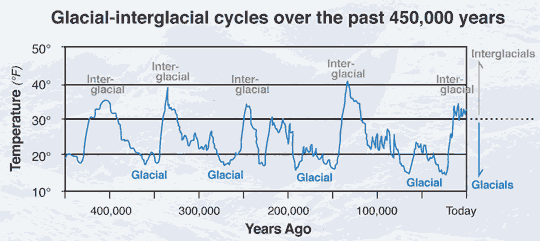
Gary Pearse: “It also explains the rapid warming coming out of a glacial maximum.”
WR: An interesting thought. Another idea is that the diminishing of the equator to pole temperature gradient diminishes the mixing of the upper layers of the oceans. Less wind causes less mixing and surface absorbed heat can remain close to the surface: rapid warming will result, causing a lower gradient etc.
A negative feedback. Wow. Who would have thought of this!
The radiative theory shows large amounts of forward and back radiation in the lower atmosphere, but this seems impossible because the atmosphere is opaque to IR. It is like shining a light on a wall 5000+ meters thick.
Energy is tranfered up to 5000+ meters by convection. Then it can be radiated away. This is the first greenhouse effect.
Then the air falls back to earth and the PE is converted to KE, warming the air. This is the second greenhouse effect.
Ed Fox: “The radiative theory shows large amounts of forward and back radiation in the lower atmosphere, but this seems impossible because the atmosphere is opaque to IR. It is like shining a light on a wall 5000+ meters thick.”
WR: Indeed, the atmosphere is 90% opaque to IR. Only 10% of surface emission directly reaches space.
Ed: “Energy is tranfered up to 5000+ meters by convection. Then it can be radiated away. This is the first greenhouse effect.”
WR: Latent and sensible heat has to be transported from the surface to higher elevations lacking water vapor. From there it can be radiated more effectively to space, as those elevations lack most water vapor (that condensed and rained out). So far OK. But although this is merely a result of absorption close to the surface, this is not the first greenhouse effect as identified in the post. To avoid confusion this term should be reserved for warming by back radiation.
Ed: “Then the air falls back to earth and the PE is converted to KE, warming the air. This is the second greenhouse effect.”
WR: No, not really. First, the second greenhouse effect is the lack of surface cooling because surface radiation cannot cool the surface and cannot cool the Earth as a whole, simply because the emitted energy does not reach space. When energy is not lost, it adds up: 24 hours per day somewhere on Earth new Sun energy is absorbed. The surface and the Earth warms.
When air descends it is compressed. This results in a rise in temperature at your thermometer but in fact, no energy is added to the molecules. What was rising is the number of molecules in a certain volume: the rising number of molecules made the quantity of kinetic energy in that volume rise. And your thermometer received more encounters with molecules on the same surface area: you measured a higher kinetic energy/temperature.
Don’t think I can agree with this.
ΔU = Q + W
ΔU change of internal energy of a system
Q net heat transfer into the system
W net work done on the system
Work is force * distance
So gravity (the force) acting on a molecule thus displacing it (distance) meets the definition of work. That net work does increase the internal energy of the molecule.
For a gas we also have the relationship of PV ∝ T
If the volume is held constant (including the number of molecules in the volume) the temperature will go up just from the increased pressure as the volume moves down toward the surface.
TG is right. The vertical movement of air is an adiabatic process. An adiabatic process is one in which there is no exchange of heat (Q) with the environment, but the internal energy (U) of the parcel of air still changes via work (W). Mathematically this is equivalent to ΔU = 0 + W.
I am speechless at the science level at WUWT, more by the comments than by an obviously incorrect article as some of them are published at WUWT from time to time. It is surprising that Leif and Willis, so quick to come to the fray to pooh-pooh any solar article are so silent when such obviously wrong radiation articles are published.
It does.
The planet didn’t get to its Holocene temperature through cooling, but through warming. Surface temperature just 20 ka was c. 5° cooler.
Both contribute obviously.
The main temperature of the Earth for the past 540 Ma has been c. 19°C, during which oceans were even larger and there was no shortage of water vapor, more plentiful than now.
Only radiation warms and cools the Earth, as the surrounding space does not allow other means of exchanging energy, with the exception of particles and meteorites whose contribution is negligible.
This is obviously not correct. Downward longwave radiation (DLR) is a fraction of absorbed shortwave radiation (SWR). Most of the energy is lost through direct OLR through the atmospheric window from the surface and from atmospheric upward radiation.
There is only one GHE which is due to the presence of GHG in the atmosphere.
You have a curious view of the planet energetics. A 1m2 column from the bottom of the ocean to the top of the atmosphere (ToA) can only exchange temperature at the ToA through radiation, or at the sides through energy transport. Integrated over the entire planet horizontal transfer is zero as the climate system can only gain or loss energy through radiative transfer at the ToA. Energy lost by evaporation is regained by condensation somewhere else.
Obviously not correct. You get a one time cooling due to more latent energy going to the atmosphere at the time of the temperature increase. Then you get an increased GHE from more water vapor and an increased cloud effect of uncertain net radiative effect. But we know that the Eocene was a lot warmer and a lot wetter, so your empowered H2O cooling is not real.
Nope. Ocean heat transport is only important in the tropics. Outside the tropics the bulk of the heat transport is done by the atmosphere. The oceans don’t warm the poles. The South pole is unreachable to the ocean, and it only reaches the North pole below the ice, so it cannot warm it as the ice is a great thermal insulator.
You get it backwards. During the cold season (Oct-Mar) more heat and moisture transport to high latitudes means more radiative cooling, not less. During the warm season (Apr-Sep) more heat transported to high latitudes is used to melt more ice, so temperatures don’t rise much and radiative cooling increases but not as much.
Obviously incorrect. The ocean surface temperature has been different to current for c. 95% of the past 540 Ma. It is clear that it has absolutely nothing to do with the intrinsic properties of the H2O molecule.
Meaningless.
Water surface evaporation has a lot more to do with wind speed than it does with surface water temperature. If you bother enough to check it.
“the most important parameters which determine evaporation rate Revap are ea (the vapor pressure at air temperature in kPa) and U10 (wind speed at 10-m height). Also other parameters affect the final results but they are only responsible for small corrections and in this first analysis they can be safely neglected.
https://www.sciencedirect.com/topics/engineering/evaporation-rate”
Wrong. Oceans transfer energy to the atmosphere through evaporation, conduction and radiation nearly everywhere, even at high latitudes. When the Earth is cooling more energy is being transfered by the ocean to the atmosphere that it receives from the Sun, and when the Earth is warming the opposite happens.
Obviously wrong too. At very similar orbital configuration and identical continental configuration, towards the end of the Eemian the oceans started cooling and obviously energy in did not equal energy out.
Completely undemonstrated and clearly impossible since surface processes do not alter the energetics of the planet without altering first the radiative balance.
The chemical composition of the atmosphere, the Earth’s rotation speed, and the mass of the atmosphere and pressure near the surface have certainly changed over millions of years. It is likely that these changes may have been drastic at the time of the Earth’s pole swap.
Javier, I always read your comments, you always have good points. But I don’t always agree. Good critics always improve the level, if not for now, then for later. So I am happy with your reaction. I will split my reaction into several parts.
1.
Adding greenhouse gases to the atmosphere does not make any difference for surface temperatures.
J: It does.
WR: Initially there is surface warming. But when the thermostat is working the initial surface warming will be nearly completely transported away. Why not completely? Because a bit of warming is necessary to get the H2O cooling in ‘a higher gear’.
The proto-Earth was also warmed by the Sun, but eventually it cooled down until ‘energy in’ equaled ‘energy out.’ Currently, the surface of the Earth is at balance at around 15 degrees Celsius. A similar planet, with no oceans or atmosphere would have stopped cooling at around 5.3 degrees Celsius
J: The planet didn’t get to its Holocene temperature through cooling, but through warming. Surface temperature just 20 ka was c. 5° cooler.
WR: sorry Javier, between the proto-Earth and the Holocene are some 4 billion years. And yes, the Pleistocene was 5 degrees colder: orbit was different and orbital changes resulted in relatively higher insolation of the tropics and lower insolation of the higher latitudes.
The higher insolation in the tropics did not result in real warming because the deep oceans were cooling (colder upwelling in the tropics) and because the Hadley cell would still transport all heat above 30 degrees to the upper atmosphere. So no net warming although there was more insolation over the tropics/subtropics. Higher latitudes cooled. Total effect of the changing orbit: 5 degrees of cooling
(to be continued)
2.
Answering those questions reveals that it is not greenhouse warming that sets the level of the Earth’s surface temperatures but the mechanisms cooling the surface.
J: Both contribute obviously.
WR: when initial greenhouse warming results in a surface temperature of 270.1 degrees Celsius and final warming is 9.7 degrees higher than the 5.3 degrees for an object without oceans and atmosphere. Indeed, both contributed. But cooling was (270.1-15 =) 255.1 degrees while all possible warming (including greenhouse warming) resulted in the final warming of (15 – 5.3 =) 9.7 degrees. I say: cooling dominates.
An interesting thought experiment: replace all seawater by vodka 50%: vodka oceans. What is the temperature effect? The alcohol evaporates more easily than water. At lower temperatures you get the same energy loss as for seawater at some higher temperature. Final result: cooling oceans. While the greenhouse effect could have remained the same, surface temperatures will go down. What is dominant? Cooling.
Another thought experiment: oily oceans. Replace one meter of sea water by a transparent oil. The Sun can shine through, but evaporation is halted. Ocean temperatures will rise until 100˚C and then boiling water will break through the oil layer. New surface temperature over large parts of the oceans: probably near 100˚C. Greenhouse effect: probably. But of main importance: like in real greenhouses, the ocean got a roof (oil) that remained closed until the oceans heated up to 100 degrees. Only when you open the roof of a greenhouse the heat can escape. The atmosphere normally has no roof, greenhouse gases form a barrier but convection is able to break through the barrier.
All you need for normal seawater oceans is a temperature high enough to produce enough water vapor to have convection (and cloud cooling) sufficiently activated. Globally: 15 degrees.
P.S. I am living in between greenhouses and already as a young child I was visiting them. As a high school pupil, I worked in greenhouses during holidays. I learned the function of a roof and I experienced how fast warm and very humid air could escape when the windows were opened. The Earth’s atmosphere does not have a roof but greenhouse gases form a barrier for radiative cooling and the atmosphere itself is a kind of flexible barrier for upward air transport, to be broken by low density warm and moist air.
3.
And the main reason the Earth stayed about ten degrees warmer than its 5.3°C ‘rock temperature? ‘ As will be argued, it is the existence of large oceans in combination with their self-produced water vapor greenhouse effect.
J: The main temperature of the Earth for the past 540 Ma has been c. 19°C, during which oceans were even larger and there was no shortage of water vapor, more plentiful than now.
WR: During the last 100 million years of this period a North-South Atlantic Ocean developed in between continents that drifted apart. This resulted in the most saline ocean basins on Earth (the both Atlantic gyres, north and south) and in combination with Coriolis effect warm currents developed that directed the very saline water to high latitude regions where it cooled and could sink. The last 50 million years warm deep water in the oceans became more and more replaced by cold deep water. Oceans cooled down. The situation of the last 3 million years is rather unique and in a warm interval, global temperatures are about 15 degrees.
When oceans first were formed on a snooker ball-like Earth, hardly any Land existed: oceans nearly covered all surface area. In this All Ocean World, maximum redistribution (by ocean and atmosphere) over latitudes was possible. I wonder what the global temperature of that maximal greenhouse Earth has been. My guess: some 22-23 degrees. Why? Because I see convective (cauliflower) clouds start forming at that temperature, reflecting convection. Tropical oceans are limited to 30 degrees max, poles are colder but probably received large quantities of upwelling warm deep water, so my guess is some 22-23 degrees of global surface temperature for that all ocean world.
Four billion years ago, the sun was 36% less radiant than now. However, Earth’s internal heat was higher, and oceans and air different.
Estimates vary, but Archean seas were likely much hotter than now:
https://astrobiology.nasa.gov/news/how-hot-were-the-oceans-when-life-first-evolved/
PS: I previously commented on the range in temperatures of the Proterozoic and Phanerozoic Eons, without reference to hot global Archean water ocean or the molten lava ocean of the Hadean.
Interesting link and an interesting image of a possible Early Archean world: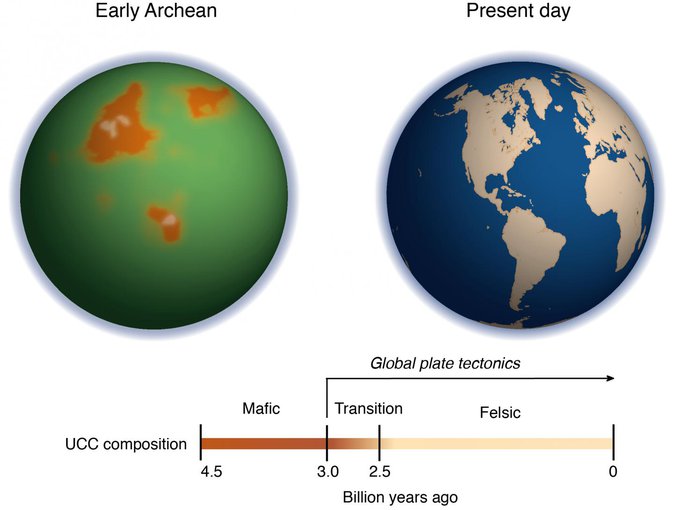
The authors did not consider H2O cooling mechanisms as far as I can see. My take: probably H2O cooling is that powerful that Archean oceans already very soon after their creation must have cooled to temperatures near an average of 20-25 degrees. A boiling ocean must have cooled at full speed and a steamy ocean (below 100˚C) as well: large and powerful convective movements must have dominated the atmosphere and cooled the surface in a powerful way. Above 30 degrees a lot of clouds must have prevented a high uptake of solar energy. Only at surface temperatures around 25 degrees, solar uptake is large because of the low cloud fraction at those temperatures.
Higher atmospheric pressure meant that ocean T could exceed 100 C, but probably didn’t.
4.
The temperature an Earth-like object in space would have if the planet did not have an atmosphere while receiving the same amount of solar radiation as the Earth is 5.3°C. Only radiation would warm and cool the object.
J: Only radiation warms and cools the Earth, as the surrounding space does not allow other means of exchanging energy, with the exception of particles and meteorites whose contribution is negligible.
WR: as stated elsewhere in the comments, the Earth is not the same as the surface of the Earth. Without an atmosphere, surface temperatures and ‘planet temperatures’ are the same. But as soon as there is an atmosphere with greenhouse gases, surface temperatures diverge from average emission temperature. Because our Earth has a greenhouse atmosphere, I always want to know whether you mean the surface or something else like ‘average emission level’ of the planet or something else.
Indeed, the Earth is cooled by radiation but the surface of the Earth is mainly cooled by evaporation (78 W/m2), a bit by conduction (17 W/m2) and the rest of the 161 W/m2 of absorbed solar energy is lost by net radiation: 66 W/m2. (Kiehl – Trenberth 2009). To get the latent and sensible heat from near the surface to the ‘average emission level’, convection is needed. The right quantity of evaporation needed for enough convection and enough cloud cooling (for this orbital and continental configuration) is at 15 degrees global. The surface of the Earth warms until those cooling conditions are reached.
Wilm Rost::
“The surface of the Earth is mainly cooled by evaporation, a bit by conduction…,…. and the rest by radiation”,
Nonsense!
The Earth’s surface is warmed by direct solar radiation, and cooled by decreases in the amount of solar radiation reaching the Earth’s surface, which is modulated by changing levels of SO2 aerosols in the atmosphere, from industrial activities and volcanic eruptions.
First study the data:
5.
Back radiation adds 333 W/m2 to the 161 W/m2 of surface absorbed solar energy.
J: This is obviously not correct. Downward longwave radiation (DLR) is a fraction of absorbed shortwave radiation (SWR). Most of the energy is lost through direct OLR through the atmospheric window from the surface and from atmospheric upward radiation.
WR: I followed Kiehl-Trenberth 2009:
Downwelling radiation is 333 W/m2. If compared to other sources (for example Wild et al.) there is not too much difference. As I understood, temperature sets the level of emission: at the surface the temperature of the surface / of the atmosphere just above the surface.
Kiehl-Trenberth gives 40 W/m2 out of 396 W/m2 of surface radiation as radiation that disappears through the atmospheric window. The rest, about 90%, is absorbed. All other radiation reaching space originates from atmospheric levels above the surface.
6.
The second greenhouse effect warms Earth because of the diminished efficiency of radiative surface cooling.
J: There is only one GHE which is due to the presence of GHG in the atmosphere.
WR: to be honest, this was a difficult point. But that there is a surface warming effect by greenhouse gases is sure. That warming effect can be measured. That apart from surface warming there also is a diminished cooling (caused by the same greenhouse molecules), because surface radiation gets ‘disabled’ for 90% because surface radiation becomes absorbed and cannot reach space. So the surface warms and radiates more, but less of that radiation reaches space.
Fortunately, surface warming has been quantified and the diminished efficiency of surface radiation even so. Using the calculator gave a clear result: without additional surface cooling the Earth’s surface would rise in temperature to 270.1 degrees Celsius (all other things remaining the same) until the surface would radiate that intense that ‘energy in’ would equal ‘energy out’.
By this calculation, the level of the initial greenhouse warming effect is determined. Greenhouse warming is huge.
Both greenhouse effects (if calculated separately) have a different temperature effect. For me, this was one of the reasons to accept the fact that there are two different effects that should be discerned as such. And both effects should be used in the calculation. Warming must be used and the [lower] effectivity of emissivity also.
The result showed that the total (initial) greenhouse effect (270.1 – 5.3 = ) 264.8K is far larger than the greenhouse effect assumed so far: 33K. This also means that the Earth’s additional surface cooling must have an enormous (if not decisive) role. Fortunately, people like Willis Eschenbach (Thermostat) and Roy Spencer and Richard Lindzen (Clouds) already pointed at the dynamics in the cooling system.
H2O-related additional cooling is temperature regulated. And water vapor plays the main role: evaporation, convection, clouds. For every orbital and continental configuration, there is a specific ‘equilibrium temperature’ around which the ‘fluids’ (oceans, atmosphere) cause some fluctuations.
7.
Our real Earth has additional systems cooling the surface: cooling by evaporation, convection, and clouds. These additional surface cooling systems cool the surface much further than ‘by radiative cooling only.’
J: You have a curious view of the planet energetics. A 1m2 column from the bottom of the ocean to the top of the atmosphere (ToA) can only exchange temperature at the ToA through radiation, or at the sides through energy transport. Integrated over the entire planet horizontal transfer is zero as the climate system can only gain or loss energy through radiative transfer at the ToA. Energy lost by evaporation is regained by condensation somewhere else.
WR: I have a geographic view of what happens in climate. I want to know what happens, where it happens, and why it happens there. A geographer is a generalist: we know a bit about everything and try to understand the whole by using all kinds of information from all other disciplines. That was exactly why I liked geography: everything is interesting. Maps have always been super interesting for me: I could endlessly put layers with info (maps) above each other and learn to understand what happened where and why. Combining everything.
And then there was the climate.
I realized that we don’t live at TOA but at the surface. That is where we measure our temperatures and that is the level where we (I mean ‘they’) are worried about when it is about climate. So the main level to understand was ‘the surface’.
I became confused by the way in climate all elevations were used ‘as people liked to use them at that moment’. No definition of a standard level. So I decided to look at climate ‘with my feet on the ground’ which means: at ground level.
Yes, the Earth loses its radiative energy from higher elevations. I read from 5200 meters on average. Not interesting. I wanted to know how temperatures at ground level were set.
It became clear that when the quantity of greenhouse gases rose the share of radiative surface cooling diminished: a planet without an atmosphere is 100% cooled by radiation from the surface, our present Earth only for some 35%. The rest of surface cooling is realized by additional forms of cooling.
Piece by piece the system of surface cooling became clear: the warmer, the more greenhouse gases (water vapor H2O but also more CO2 from outgassing oceans), the smaller the role of radiation in surface cooling, and the larger the share in cooling by main greenhouse gas water vapor (evaporation, convection, clouds).
And then I found the calculator and combined the data of the Earth’s energy budget with the calculator. And then I started wondering whether I was right. I informed myself here and there, by asking the opinion of some specialists.
And finally, I decided to write this post. In case I am not fully right, at least a fruitful discussion could be started. When all of us will land with our feet on the ground (yes, also outside of the inner circle of WUWT) I will be happy, whatever the outcome.
But first I want to see proven whether my way of reasoning is right or not.
Yes Javier, I have a curious view. And I take the risk that I am wrong or not fully right. But so far I still think that I see climate in the way it is: but I did not finish all of your comment(s). I will continue.
I am impressed by the ability of two non-native speakers so cogently to discuss technical scientific issues in English. I could not do so in any of my non-English languages, even when I spoke them at my best. My Spanish is now at its best in the 55 years I’ve spoken it, but no way, Jose!
8.
But the small rise in temperature by only one degree Celsius (or one K, a 0.3% rise in temperature) will result in about 7% more water vapor. That huge rise in water vapor content empowers all H2O related cooling processes
J: Obviously not correct. You get a one time cooling due to more latent energy going to the atmosphere at the time of the temperature increase. Then you get an increased GHE from more water vapor and an increased cloud effect of uncertain net radiative effect. But we know that the Eocene was a lot warmer and a lot wetter, so your empowered H2O cooling is not real.
J: “You get a one time cooling…. at the time of the temperature increase.”
WR: No, I don’t think so. The water cycle speeds up. We find larger areas with the highest quantity of water vapor. All that extra water vapor rains out when convection is stimulated and is replenished by newly evaporating water vapor as long as temperatures remain that high. Before raining out, surface energy (latent and sensible heat) became transported upward by convection: the surface cooled (extra). But when something continuously has a warming effect, the evaporation of extra water vapor is not a one-time event but an event that will continue as long as the extra surface warming is not canceled.
J: But we know that the Eocene was a lot warmer and a lot wetter, so your empowered H2O cooling is not real.
WR: Cold places lack a lot of water vapor. When all of the Earth is warmer like in the Eocene, the Earth also is wetter. When the oceanic circulation is such that more tropical energy is redistributed to higher latitudes, more water vapor will be present over larger surface areas and the efficiency of spaceward radiation will be diminished further. A warmer Earth keeps itself warmer (by the diminishing effectivity of radiative surface cooling) until something cools the Earth.
Several events could be mentioned here, but I will take one: the collapse of India on Asia, around 35 million years ago. Before the collapse, humid winds from warm oceans could easily enter Asia from the south. By the collapse, the Himalayas, Tibet, and the mountain ranges to the West (Iran, Turkey) were formed. Large surface areas of Asia became deprived of southern warm and humid winds: much of Asia cooled, dried and the lack of water vapor especially during winter time cooled the continent. Furthermore, the warm deep water producing Paratethys sea disappeared: the deep oceans received less warm deep water and continued firmly the cooling process they already started some 50 million years ago.
Some more about the way cooling oceans cooled the Earth in the last 50 million years (a hypothesis) can be found here: https://wattsupwiththat.com/2018/06/15/how-the-earth-became-a-hothouse-by-h2o/
9.
Tropical oceans distribute warm water to the poles in quantities varying over time.
J: Nope. Ocean heat transport is only important in the tropics. Outside the tropics the bulk of the heat transport is done by the atmosphere. The oceans don’t warm the poles. The South pole is unreachable to the ocean, and it only reaches the North pole below the ice, so it cannot warm it as the ice is a great thermal insulator.
WR: At the western parts of the oceans all subtropical gyres transport huge quantities of tropical heat poleward. It is that tropical absorbed energy that is further taken poleward by warm currents (in all oceans) and warm winds over the warm waters take up enormous quantities of latent and sensible heat that they transport further to the poles. The whole system (including large low pressure areas in the mid latitudes) transports energy poleward. The poles absorb much less solar energy than they emit energy spaceward.
A relatively small extra quantity of warm (subsurface) North Atlantic ocean water is able to change the sea ice coverage of the Arctic by melting parts of the ice and by this, changing the weather systems over large parts of the northern hemisphere. Ice-free oceans evaporate more water vapor and the diminished effectivity of spaceward surface radiation warms the surface at the highest latitudes. Other weather systems (low-pressure areas) develop and/or enter the Arctic more easily.
The South Pole is different. Although the Earth’s most intense low-pressure areas continuously circle around Antarctica mixing air and water masses, the Antarctic is characterized by a year-round strong high-pressure area over its 14 million square kilometers of deeply frozen ice. At its surface descending air masses flow northward on all sides. It is not easy to change temperatures over the Antarctic, especially not when more stratospheric CO2 and some extra injected H2O cool the lowest layers of the stratosphere, the origin of the descending air masses of the Antarctic. Colder air flows down, slowly enhancing sea ice over the oceans surrounding the Antarctic.
Rising water vapor over high latitudes results in a diminished efficiency of local surface radiation in reaching space. Less radiative cooling means that these high latitudes will warm and also that the Earth as a whole will warm.
J: You get it backwards. During the cold season (Oct-Mar) more heat and moisture transport to high latitudes means more radiative cooling, not less. During the warm season (Apr-Sep) more heat transported to high latitudes is used to melt more ice, so temperatures don’t rise much and radiative cooling increases but not as much.
WR: More poleward heat and moisture transport results in a higher water vapor content over the Arctic and so in less effective surface radiation. But more latent and sensible heat will be convected upward and that energy can be radiated to space from those higher elevations.
(to be continued)
10.
Why are oceans at a global temperature of 15°C evaporating exactly the quantity of water vapor needed to equal ‘surface energy in’ and ‘surface energy out’? This temperature level is determined by the intrinsic properties of the H2O molecule.
J: Obviously incorrect. The ocean surface temperature has been different to current for c. 95% of the past 540 Ma. It is clear that it has absolutely nothing to do with the intrinsic properties of the H2O molecule.
WR: Global ocean temperatures are somewhat different from year to year, but not at all with any certainty measurable over separate years. Over longer time frames (centuries, millennia) they are more reliable but from there, we get the problem of the proxies. I have been in big doubt about proxies since I read about a proxy that was ‘very promising’, I thought it was about Tex86.
We have a general view of how ocean temperatures developed. You are right that over most of the last 540 million years ocean temperatures had a different temperature level compared with the one of today. As far as I could find out, mainly two factors play a role in the change of the circumstances that influence bulk temperatures of the oceans. You described well the influence of orbit in the Pleistocene/Holocene and I spend a lot of time in discovering the meaning of the following figure you showed in one of your posts:

Here the insolation over latitudes is shown in the colors of the figure. Combining higher tropical insolation with the fact that tropical oceans cannot warm above 30 degrees Celsius tells, that higher insolation over the tropics will not result in a rise of average global temperatures. But higher insolation over high latitudes results in rising temperatures (with a firm delay as you showed).
Knowing that global temperatures fluctuate much more in periods with ice and snow than when it is warm means that the Pleistocene is extremely variable in temperatures, showing very well the more subtle influences of orbit. I suppose over warm periods there is an influence on temperatures (that must be so) but less clear. Perhaps more effects are visible on the functioning of the monsoon systems over the different continents.
Then there is the second big influence: continents. The growth in surface area over geological periods by continents, their displacements, and changes in form and topography (mountain ranges, the direction of off flow, underwater topography, etc.) and the huge influence they have had and must have had on the location and functioning of oceans. In my mentioned hothouse article I point at the enormous influence of continents on the formation of warm deep ocean water and/or cold deep water. Right now we think it is normal to have ice-cold oceans (3.9 degrees Celsius bulk temperature) but that must have been very different over periods that we found big enclosed seas in the subtropics and large surfaces of subtropical shallow seas when lowlands submerged. Young oceans are less deep: the ocean bottom is still warm and expanded. The formation of new oceans resulted in the submerging of lowlands, still visible by the existence of continental shelves. When we found nearly enclosed oceans (Parathetys and in our days the Mediterranean) over large surface areas in the subtropics, oceans where very saline surface water was produced and sunk when it was still relatively warm just because of its high salinity, the Earth’s oceans were warm, also at depth: at least a lot warmer than present oceans. My guess: about 6-10 degrees Celsius warmer. Upwelling waters everywhere (even at the poles) were warm: ice and snow could not play the role we know from the Pleistocene.
The displacement of extensive shallow seas (by displacing continents) has had its influence at well. When extensive shallow seas are present in the subtropics, warm deep water is formed. When in the Arctic: not. In our present time frame (Pleistocene/Holocene) the formation of deep cold water is by far dominant over the present formation of warm deep water in the Mediterranean and the Red Sea. We live in an Ice House state which is very variable in temperature: Milankovitch cycles have a large influence. We might be happy to live still in a warm interglacial, the Holocene. When ocean surfaces are warmer they produce more water vapor and diminish the effectivity of surface radiation, especially over the higher latitudes. When oceans are warm the cooling rate will be low: water vapor prevents efficient cooling by surface radiation. Cooling happens slower than warming, visible in the graphics of Pleistocene temperatures. Changes in water vapor content are slower from warm to cold. The same pattern is visible on shorter time scales (decades, centuries) in our Holocene: quick warming, slower cooling.
Now my remark you were referring to:
“Why are oceans at a global temperature of 15°C evaporating exactly the quantity of water vapor needed to equal ‘surface energy in’ and ‘surface energy out’? This temperature level is determined by the intrinsic properties of the H2O molecule.”
As just argued, [deep] ocean temperatures have a main influence on surface temperatures, and surface temperatures result in a specific quantity of water vapor and so in a specific heat loss by radiation (effectivity of surface radiation). When surface temperatures are high (when oceans are warm) all ocean and weather systems are rather different from cooler periods – and still have their range of dynamic changes around their basic temperature level.
Back to ‘orbital and continental configurations. When over longer time frames continental configurations are set and oceans cooled down a lot, small orbital changes still weigh a lot. But over warmer periods the changes in the functioning of oceans (formation of more or less deep warm water) are of main influence for changes in global temperatures. My remark above (15°C) is meant for the shortest time frame, think about decades, a century or so. For that specific orbital and continental configuration, the changing ocean currents and changing weather patterns form chaotic patterns of changing surface temperatures, but always around a specific ‘base temperature’ – as well noticed by Willis Eschenbach who speaks about the incredible stability of the climate system if measured over a century. He is right. The reason is that the efficiency of surface radiation does not change a lot over a century because of oceanic behavior and so the average quantity of water vapor over latitudes does not differ that much on centennial time frames. Not like during a glacial (Dansgaard-Oescher events). Changes over high latitudes (actual ice melt in the Arctic as caused by the subsurface inflow of warmer than normal Atlantic water) probably is an event on decadal time scales, occurring against the background of over millennia cooling oceans. A cooling that happens because of orbital reasons. And the colder, the more variability.
Those Arctic changes mentioned, influence the quantity of high latitude water vapor and so result in warming and cooling periods (warming: thirties forties, cooling: fifties sixties, warming 80,90’s and 2000’s, cooling:??). And to make it a bit more complicated: associated changing weather patterns change the behavior of the Pacific Oceans, resulting in El Nino/La Nina effects.
As said by others: “Prediction is difficult, especially when it is about the future”.
To summarize: each orbital and continental configuration has its ‘basic ocean temperature’ with a ‘basic quantity of water vapor over latitudes’. Any short-term change is corrected by the system of evaporation, convection and clouds. But corrective cooling can take decades or more. On a time scale of say a century climate normally is extremely stable.
One extra remark about orbital changes. What no one realizes, is, that the half-yearly change in orbit (the change in Sun angle by 47 degrees over six months twice a year), results in an enormous adaptation of weather systems and oceans. We are that used to that big changes (winter, summer, monsoons), that we regard those changes as ‘normal’. But they are not. In fact, they are a big laboratory for studying the effect of orbital changes. Furthermore, they explain why the weather on our birthday never is [exactly] the same as last year: all fluids (oceans, atmosphere) continuously adapt to extremely changing circumstances but come back every year to about the same situation (temperatures, weather systems) as the year before. But still never exactly the same.
Somewhere I have a photo of signs that show the exact latitude where the Sun still reaches 90 degrees during one day a year. Every year an extra sign is placed on that location but about 15 meters closer to the equator, reflecting the change in the Earth’s axis. This means that all latitudes will experience next year a (small) change in insolation: the reason that next year’s weather and next year’s oceanic circulation will be slightly different from this year’s. ‘Climate change’ as it is called nowadays, exists since there are changes in the angle of the Earth’s axis: climate change has never been absent. Changes are normally very moderate over years. As long as orbit or continental configurations (and oceans for the shorter time scale of decades) don’t change a lot.
To close this part: for every period there is something like a basic temperature resulting in a specific latitudinal quantity of water vapor restraining to some extent effective surface radiation. The quantity of water vapor adapts to temperature and is basically set by the intrinsic properties of the H2O molecule. A certain quantity of water vapor in the air results in a certain behavior of other cooling agents (convection, tropical clouds) for that location. If water vapor would have had the intrinsic properties of ethanol alcohol, this would have changed all and everything. And the H2O molecule did not change its intrinsic properties over billions of years. What changed were continents, orbit, the behavior of oceans, and resulting quantities of water vapor over latitudes. And so: the local greenhouse effect as this is mainly dependent on the main greenhouse gas water vapor.
By accident, the main greenhouse gas water vapor is also the main cooler of the surface: greenhouse cooling.
11.
The H2O molecule is very hygroscopic
J: Meaningless.
WR: An ethanol molecule is less hygroscopic. Ethanol oceans (evaporating easily) would have changed global temperatures and all climates. More or less evaporation by the oceans changes the cooling system. And the cooling system [nearly completely] sets surface temperatures.
it is not easy for an individual molecule to escape from the water surface to the atmosphere. To escape a molecule needs to have a very high kinetic energy. To have enough energy, the surface temperatures has to be high enough and at a global average surface temperature of 15°C enough water vapor molecules can escape to achieve thermal equilibrium.
J: Water surface evaporation has a lot more to do with wind speed than it does with surface water temperature. If you bother enough to check it.
“the most important parameters which determine evaporation rate Revap are ea (the vapor pressure at air temperature in kPa) and U10 (wind speed at 10-m height). Also other parameters affect the final results but they are only responsible for small corrections and in this first analysis they can be safely neglected.
https://www.sciencedirect.com/topics/engineering/evaporation-rate”
WR: You are right, wind has an enormous influence on evaporation. But what is causing wind? Wind is caused by the gradient existing between nearby pressure systems: a high pressure gradient causes a high wind strength. Moreover, the position of pressure systems determines the direction of the wind, important as well. And the main factor that determines whether an air mass has low or high density (forming low or high pressure areas) is water vapor, together with temperature. And a higher temperature results in more water vapor, causing lower pressure etc. etc.
In a specific period, ocean and air mass’s are arranged in patterns that (although switching over seasons) have yearly patterns. Average air pressure and oceanic patterns for present period are known, but always show some variation. The chaotic behavior of fluids. But the whole arrangement of oceans and atmospheric patterns results in a rather stable average global temperature. That global temperature changes when oceans change their behavior and the quantity of water vapor over latitudes (and so: weather patterns and the effectivity of surface radiation) change as result.
For present period all systems result in a global surface temperature of 15 degrees and the 15 degrees result in present systems. A lot of countervailing systems prevent large fluctuations, both upward and downward. We should know all countervailing systems, they would reveal the strong stability of the system.
not all surface radiated energy disappears to space and oceans need an additional way to lose their accumulated solar energy. Oceans must warm to the point that rising evaporation and enhanced tropical clouds fully compensate for the strongly diminished efficiency of ocean surface emission.
J: Wrong. Oceans transfer energy to the atmosphere through evaporation, conduction and radiation nearly everywhere, even at high latitudes. When the Earth is cooling more energy is being transfered by the ocean to the atmosphere that it receives from the Sun, and when the Earth is warming the opposite happens.
WR: Complicated. Why? Systems function differently depending on latitude. We could also say: function differently depending on temperature. I will show two extremes.
Imagine two drawn lines: one horizontal and one vertical line. When you see the vertical line: think about the Inter Tropical Convergence Zone where all excess heat of the Hadley Cells is transported upward to be radiated to space (simply said). High-rising thunderstorm clouds are vertical in shape as high rising warm humid air columns and descending dry air columns are even so. ‘Vertical’ reflects surface cooling.
‘Horizontal’ reflects insulation. Fourier ever thought insulation was the reason for the higher than expected surface temperatures on Earth. At least partly he was right: for the lower temperature range.
We know that ocean temperatures don’t rise above a yearly thirty degrees Celsius. They also don’t fall below minus 1.8 degrees Celsius, the temperature horizontal sea-ice forms. At low temperatures we find horizontal fog, horizontal low clouds (effectively capturing nearly all surface radiation), we find horizontal snow, horizontal freshwater below the sea-ice, horizontal warmer deeper subsurface water in polar areas, and horizontal deep ice cold water at the bottoms of polar oceans. The horizontal line.
What we know from the horizontal blankets on our bed is that they are insulating. The more thin layers there are above us, the more our loss of heat is delayed and the warmer we will stay. For oceans the same. Horizontal layers insulate for a wide variety of reasons.
Who knows the different functions of ‘horizontal’ and ‘vertical’ understands why sometimes clouds are insulating the oceans (warming by horizontal clouds) and when they are cooling the oceans (vertical high rising tropical thunderstorms). Here we see why trying to find an average for ‘the cloud effect’ is useless: the main function of clouds switches at certain temperatures. Temperature switches the cooling/warming role of clouds somewhere between very low (-1.8˚C) and very high (30˚C) temperatures, the exact temperature partly dependent on local/regional situations.
Last summer, riding many kilometers on my e-bike through the flat treeless Dutch polder landscapes I had a beautiful view on clouds. I took pictures and noticed the temperatures at which I saw high rising clouds forming, and (later on the day) saw disappearing. For the Dutch summer situation (wind often from the cooler North Sea), that temperature was about 22, 23 degrees. From about 22, 23 degrees cumulus clouds were formed (vertical), below that temperature they dissipated until flat horizontal clouds remained. This is why I think that the ‘switching point’ between insulation (horizontal) and ‘cooling’ (vertical) is at about that temperature (although local circumstances will have their influence). The Dutch polders have a lot of canals, surfaces areas are rather wet and the sea is never more than some 50 or 60 kilometers away. Therefore I think that oceans (100% wet) have about the same 23 or 22 degrees as switching point between ‘insulating’ and ‘cooling’.
An interesting graphic of Willis showed that at 25 degrees cloud coverage is lowest. Above that temperature (my take) high clouds are formed, below that temperature more and more insulating clouds are formed. The whole system seems to be built to keep surface temperatures close to what we call ‘room temperature’, our favorite temperature, also the temperature at which Life on Earth thrives. Not by accident: the dominance of oceans over surface temperature and all H2O stabilization mechanisms seem to be made to keep surface temperatures around that ‘average average’ temperature, already since there are oceans.
Temperature stabilizing oceans, at their first formation covering more surface area than at present, always have had large surface areas with temperatures around 20-25 degrees. From the very beginning. The most stable part was the tropics/subtropical area: temperatures change more when going poleward. During hundreds of millions of years, Life could develop around the most frequent and most stable temperatures: room temperature or 20-25 degrees. We still prefer those temperatures, because we could evolve at those temperatures. And in case of some climate change? All life forms know well to migrate, whether as an individual (man, animals) or by seeds etc. We know how to adapt.
H2O cooling rises strongly above some 25 degrees. H2O insulation (diminishing cooling) rises strongly below 20 degrees. The H2O system dominates, whether by cooling, or by insulating (diminishing cooling). Starring: the main greenhouse gas water vapor H2O. Sufficiently present in oceans.
12.
If started at low temperatures, oceans will warm till the Earth has an average surface temperature (for present orbital and continental configuration) of 15 degrees Celsius and ‘energy in’ equals ‘energy out’.
J: Obviously wrong too. At very similar orbital configuration and identical continental configuration, towards the end of the Eemian the oceans started cooling and obviously energy in did not equal energy out.
WR: Oceans have been cooling for about 5000 years (Rosenthal et al.), from about the moment the green Sahara also disappeared. As you have shown, precession played an important role. Cold enhances variability: we have ‘recently’ seen the Little Ice Age and now experience our Modern Warming. Arctic ice mainly melts from below: when Arctic oceans have ventilated their excess heat, cooling weather patterns will probably return. But I don’t know when exactly, I don’t know whether we are going to get some more warm subsurface inflow(s) into the Arctic or not.
While we know that ‘warm’ comes quickly and ‘cold’ arrives more slowly, we need some patience. In the meantime, we can enjoy the small and favorable rise in temperatures. Personally, I think it would be great when present warming would remain some centuries, but because I see the warm water flow in the Arctic having displaced itself to East Siberia (the normal route), I would not be surprised by a return of colder weather.
the slight 0.37% initial warming following CO2 doubling is potentially more than compensated by the huge cooling resulting from the H2O-related processes.
J: Completely undemonstrated and clearly impossible since surface processes do not alter the energetics of the planet without altering first the radiative balance.
WR: Some nuance would be good. Locally (in the wet tropics) any radiative warming results in strong cooling. As Willis demonstrated (TAO buoys at the equator) a warmer start of the day results in more clouds on the same day and a colder start of the next day: overcompensation.
Generally, we need a little bit of warming to get the strong H2O cooling machine continuously in a somewhat higher gear. But not so much, I guess. From any initial greenhouse warming (of about 1.1 degrees Celsius for double CO2) only a very little bit will remain. From the 270 degrees of initial greenhouse warming on Earth, only some 9.7 degrees remained. Less than four percent of the initial greenhouse warming.
Most observed real warming must be caused by natural variation: a changing oceanic behavior (the Arctic, El Nino’s) resulted in more water vapor over high latitudes that has been changing weather patterns and diminished the direct loss of surface radiated energy.
==
Javier, let me finish by saying: “Thank you” for creating the opportunity for me to give some more background information. A post itself may not be too long and neither complicated. Still, my info given is rudimentary I realize, and more explanation and ‘proof’ is needed. Perhaps a book would be suited. But so far this post and comments reflect the general view developed by me during some eight to ten years of intense study of weather and climate. To me all seems consistent, coherent, logical, and as far as I know according to the data. Plus geographically correct.
Thank you also for your posts in the past, I think I read all of them and with great interest.
Wim Rost:
You have clearly given much thought to the cause of Earth’s changing temperatures, but, as I have posted earlier, you have completely overlooked the overwhelming role that dimming SO2 aerosols circulating in our atmosphere have upon our climate.
You need to rethink your conclusions!
Wim: Thank you for the very interesting article, for taking the time to continue to explain your concepts, and for being a consummate gentleman throughout.
It was a pleasure!
Javier — thanks so much for your inputs — they are always appreciated. I especially enjoyed reading your climate-change discussions (Nature Unbound) on Curry’s site.
This is how the specific humidity at the top of the troposphere (300 hPa) has changed globally since the 1950s. You can see a very strong decrease in the year 2000. Now an increase to the level of the 70s. Everything points to a decrease in wind strength during weak solar cycles, hence less water vapor gets to such a high altitude.
Lack of water vapor at the top of the troposphere means less surface cooling in the tropics and winter cooling in the mid latitudes.
Wim Röst ==> Can you comment on how Willis Eschenbach‘s Tropical Thunderstorm Cooling hypothesis might fit in with your exposition above?
Dear Kip, I can recommend everyone to read about Willis’ Thunderstorm and Thermostat Hypothesis. Many features of the H2O system controlling climate are well described and researched. I found a nice overview by him of applicable posts which I will post below.
https://wattsupwiththat.com/2018/11/17/the-picasso-problem/
FURTHER READING: These are some of my posts explaining my hypothesis regarding why the global temperature is so stable, and providing evidence for the hypothesis
The Thermostat Hypothesis 2009-06-14
Abstract: The Thermostat Hypothesis is that tropical clouds and thunderstorms actively regulate the temperature of the earth. This keeps the earth at a equilibrium temperature.
Which way to the feedback? 2010-12-11
There is an interesting new study by Lauer et al. entitled “The Impact of Global Warming on Marine Boundary Layer Clouds over the Eastern Pacific—A Regional Model Study” [hereinafter Lauer10]. Anthony Watts has discussed some early issues with the paper here. The Lauer10 study has been controversial because it found that…
The Details Are In The Devil 2010-12-13
I love thought experiments. They allow us to understand complex systems that don’t fit into the laboratory. They have been an invaluable tool in the scientific inventory for centuries. Here’s my thought experiment for today. Imagine a room. In a room dirt collects, as you might imagine. In my household…
Further Evidence for my Thunderstorm Thermostat Hypothesis 2011-06-07
For some time now I’ve been wondering what kind of new evidence I could come up with to add support to my Thunderstorm Thermostat hypothesis (q.v.). This is the idea that cumulus clouds and thunderstorms combine to cap the rise of tropical temperatures. In particular, thunderstorms are able to drive…
It’s Not About Feedback 2011-08-14
The current climate paradigm believed by most scientists in the field can be likened to the movement of balls on a pool table. Figure 1. Pool balls on a level table. Response is directly proportional to applied force (double the force, double the distance). There are no “preferred” positions—every position…
Estimating Cloud Feedback From Observations 2011-10-08
I had an idea a couple days ago about how to estimate cloud feedback from observations, and it appears to have panned out well. You tell me. Figure 1. Month-to-month change in 5° gridcell actual temperature ∆T, versus gridcell change in net cloud forcing ∆F. Curved green lines are for…
Sun and Clouds are Sufficient 2012-06-04
In my previous post, A Longer Look at Climate Sensitivity, I showed that the match between lagged net sunshine (the solar energy remaining after albedo reflections) and the observational temperature record is quite good. However, there was still a discrepancy between the trends, with the observational trends being slightly larger…
Forcing or Feedback? 2012-06-07
I read a Reviewer’s Comment on one of Richard Lindzen’s papers today, a paper about the tropics from 20°N to 20°S, and I came across this curiosity (emphasis mine): Lastly, the authors go through convoluted arguments between forcing and feed backs. For the authors’ analyses to be valid, clouds should…
A Demonstration of Negative Climate Sensitivity 2012-06-19
Well, after my brief digression to some other topics, I’ve finally been able to get back to the reason that I got the CERES albedo and radiation data in the first place. This was to look at the relationship between the top of atmosphere (TOA) radiation imbalance and the surface…
The Tao of El Nino 2013-01-28
I was wandering through the graphics section of the TAO buoy data this evening. I noted that they have an outstanding animation of the most recent sixty months of tropical sea temperatures and surface heights. Go to their graphics page, click on “Animation”. Then click on “Animate”. When the new…
Emergent Climate Phenomena 2013-02-07
In a recent post, I described how the El Nino/La Nina alteration operates as a giant pump. Whenever the Pacific Ocean gets too warm across its surface, the Nino/Nina pump kicks in and removes the warm water from the Pacific, pumping it first west and thence poleward. I also wrote…
Slow Drift in Thermoregulated Emergent Systems 2013-02-08
In my last post, “Emergent Climate Phenomena“, I gave a different paradigm for the climate. The current paradigm is that climate is a system in which temperature slavishly follows the changes in inputs. Under my paradigm, on the other hand, natural thermoregulatory systems constrain the temperature to vary within a…
Air Conditioning Nairobi, Refrigerating The Planet 2013-03-11
I’ve mentioned before that a thunderstorm functions as a natural refrigeration system. I’d like to explain in a bit more detail what I mean by that. However, let me start by explaining my credentials as regards my knowledge of refrigeration. The simplest explanation of my refrigeration credentials is that I…
Dehumidifying the Tropics 2013-04-21
I once had the good fortune to fly over an amazing spectacle, where I saw all of the various stages of emergent phenomena involving thunderstorms. It happened on a flight over the Coral Sea from the Solomon Islands, which are near the Equator, south to Brisbane. Brisbane is at 27°…
Decadal Oscillations Of The Pacific Kind 2013-06-08
The recent post here on WUWT about the Pacific Decadal Oscillation (PDO) has a lot of folks claiming that the PDO is useful for predicting the future of the climate … I don’t think so myself, and this post is about why I don’t think the PDO predicts the climate…
The Magnificent Climate Heat Engine 2013-12-21
I’ve been reflecting over the last few days about how the climate system of the earth functions as a giant natural heat engine. A “heat engine”, whether natural or man-made, is a mechanism that converts heat into mechanical energy of some kind. In the case of the climate system, the…
The Thermostatic Throttle 2013-12-28
I have theorized that the reflective nature of the tropical clouds, in particular those of the inter-tropical convergence zone (ITCZ) just above the equator, functions as the “throttle” on the global climate engine. We’re all familiar with what a throttle does, because the gas pedal on your car controls the…
On The Stability and Symmetry Of The Climate System 2014-01-06
The CERES data has its problems, because the three datasets (incoming solar, outgoing longwave, and reflected shortwave) don’t add up to anything near zero. So the keepers of the keys adjusted them to an artificial imbalance of +0.85 W/m2 (warming). Despite that lack of accuracy, however, the CERES data is…
Dust In My Eyes 2014-02-13
I was thinking about “dust devils”, the little whirlwinds of dust that you see on a hot day, and they reminded me that we get dulled by familiarity with the wonders of our planet. Suppose, for example, you that “back in the olden days” your family lived for generations in…
The Power Stroke 2014-02-27
I got to thinking about the well-known correlation of El Ninos and global temperature. I knew that the Pacific temperatures lead the global temperatures, and the tropics lead the Pacific, but I’d never looked at the actual physical
Albedic Meanderings 2015-06-03
I’ve been considering the nature of the relationship between the albedo and temperature. I have hypothesized elsewhere that variations in tropical cloud albedo are one of the main mechanisms that maintain the global surface temperature within a fairly narrow range (e.g. within ± 0.3°C during the entire 20th Century). To…
An Inherently Stable System 2015-06-04
At the end of my last post , I said that the climate seems to be an inherently stable system. The graphic below shows ~2,000 climate simulations run by climateprediction.net. Unlike the other modelers, whose failures end up on the cutting room floor, they’ve shown all of the runs ……
The Daily Albedo Cycle 2015-06-08
I discussed the role of tropical albedo in regulating the temperature in two previous posts entitled Albedic Meanderings and An Inherently Stable System. This post builds on that foundation. I said in the latter post that I would discuss the diurnal changes in tropical cloud albedo. For this I use…
Problems With Analyzing Governed Systems 2015-08-02
I’ve been ruminating on the continuing misunderstanding of my position that a governor is fundamentally different from simple feedback. People say things like “A governor is just a kind of feedback”. Well, yes, that’s true, and it is also true that a human being is “just…
Cooling And Warming Clouds And Thunderstorms 2015-08-18
Following up on a suggestion made to me by one of my long-time scientific heroes, Dr. Fred Singer, I’ve been looking at the rainfall dataset from the Tropical Rainfall Measuring Mission (TRMM) satellite. Here’s s the TRMM average rainfall data for the entire mission to d…
Tropical Evaporative Cooling 2015-11-11
I’ve been looking again into the satellite rainfall measurements from the Tropical Rainfall Measurement Mission (TRMM). I discussed my first look at this rainfall data in a post called Cooling and Warming, Clouds and Thunderstorms. There I showed that the cooling from th…
How Thunderstorms Beat The Heat 2016-01-08
I got to thinking again about the thunderstorms, and how much heat they remove from the surface by means of evaporation. We have good data on this from the Tropical Rainfall Measuring Mission (TRMM) satellites. Here is the distribution and strength of rainfall, and thus …
Where the Temperature Rules The Sun
I’ve held for a long time that there is a regulatory mechanism in the tropics that keeps the earth’s temperature within very narrow bounds on average (e.g. ± 0.3°C over the 20th Century). This mechanism is the timing and amount of the daily emergence of the cumulus cloud field, and the timing and emergence of thunderstorms.
Where the Temperature Rules The Total Surface Absorption
Reflecting upon my previous post, Where The Temperature Rules The Sun, I realized that while it was valid, it was just about temperature controlling downwelling solar energy via cloud variations. However, it didn’t cover total energy input …
===
Wim ==> Thank you for the very thorough and complete answer to my question and the extensive list of informative links on the topic.
Exceptional article, Wim. Very Important. I think you just basically described the process we live with.
Thank you Tom!
@Wim Röst
It might help if you understood the GHE. You name two GHEs!?, and both are wrong.
The GHE is simply an elevation of the emission level, while temperatures decline with altitude (as a rule). Accordingly at these altitudes less emissions go into space, thus providing a surface temperature which will be higher than they were, if it was emitting right into space on its own. Essentially the GHE is provided by two factors. That is a) the lapse rate and b) some agents providing an elevated emission level (GHGs, clouds, aerosols).
“Back radiation” has nothing to do with it. Neither is the absorption of radiation by GHGs emitted by the surface related to the GHE, except for a perfectly transparent atmosphere could not elevate the emission layer. I think it is pretty simple and should not cause so much confusion.
“A similar planet, with no oceans or atmosphere would have stopped cooling at around 5.3 degrees Celsius”
The Moon is much colder than that.
DOES THE ATMOSPHERIC GREENHOUSE EFFECT REALLY WARM EARTH’S SURFACE BY 33°C?
The standard method calculates the equivalent black-body temperature for Earth, by imagining that the solar irradiance is spread evenly over the whole sphere. Which gives a black-body temperature of 278.6K, and minus 30% albedo is 254.83K. An additional 33K of proposed greenhouse effect raises that to 287.83K, or 14.68°C
For the Moon with 11% albedo the figure is 270.6K, which is 73.3K higher than the real global mean surface temperature of the Moon, at 197.3K. So what’s gone wrong?
Calculating the Lunar surface temperature for the sunlit side only, and averaging that with the mean temperature of the dark side, gives a far more sensible value.
394*0.5^0.25 = 331.31K
minus 11% albedo
331.31*0.89^0.25 = 321.8
and averaged with a dark side mean temperature of 90K
(321.8+90)/2 = 205.9K
Note that the Lunar dark side temperature is dependent on the regolith heat capacity, which if higher would raise the dark side temperature but make little difference to maximum temperatures on the sunlit side.
Earth’s sunlit side (at any given time), is cooler than the sunlit surface of the Moon, mainly due to clouds and water vapour, but Earth’s global mean surface temperature is far higher than on the Moon, primarily because of the oceans keeping its dark side so warm.
The standard model removes the night cycle, and falsely attributes all of the influence of heat capacity on mean global surface temperature to the atmospheric greenhouse effect, and treats heat capacity merely as zero sum thermal dampening.
Earth’s black-body temperature for the sunlit side only, after 30% albedo, 6% Rayleigh scattering, and 16% solar near infrared absorption by water vapour, is 12.5°C. As opposed to 48.65°C for the mean temperature of the Lunar sunlit side.
There are additional losses on Earth from non-radiative surface cooling, and gains from poleward heat transport, and from longwave back radiation.
The oceans do create their own greenhouse effect, convection sets in a night and sinking colder water is replaced by warmer water from below so that the surface temperature barely drops at night.
If the moon was at 5.3C how would you find frozen water on the moon?
Accumulation of ozone over the Bering Sea causes a tropopause surge that brings Arctic air along the entire west coast of North America.
The cold patch in the northeastern Pacific shows how persistent the current tropopause circulation is and how strong the ozone accumulation is over the Bering Sea.
In my opinion, during weak solar cycles the ozone distribution associated with the geomagnetic field will have a very large impact on the weather, especially in winter at mid-latitudes.
It seems wrong to introduce a surface temperature at 270 degrees Celsius. This figure in the SB calculation (fig 1) comes from setting the emissivity to 0.1 but then you make a change for a physical dimension that actually works as “1”. Then, with the actual emissivity, 161 reaching the surface directly and the 333 from the green house effect adding up to 494, all W/s, will give you a surface temperature of 32.6 degrees Celsius. I think you must settle with that. If you should count for the atmospheric window you must subtract another 40, which will give 454 W/s and a surface temperature of 26 degrees Celsius. Still much warmer than the actual 15 degrees. Besides that the rest, and the main arguments are interesting.
WR: First, the calculation was and is about the theoretical warming effect of greenhouse gases for a default situation. The default situation (a perfect blackbody) has been changed only on one point: greenhouse effects have been added. One of the effects of [the Earth’s) greenhouse gases is, that the efficiency of surface radiation diminishes – by some 90%. A default object that is cooled by [effective] surface radiation of 40 W/m2 (and has been warmed extra by back radiation) rises to a temperature of 270.1 degrees Celsius. Only at that temperature, the intensity of surface emission becomes high enough to equal ‘surface energy in’ and ‘surface energy out’. Only radiation cools the default object.
After that, it was concluded that, when the surface of the Earth (with a variety of surface warming and surface cooling systems) does not rise to that 270.1˚C (default) temperature, additional surface cooling mechanisms present on/near the surface of the Earth must have been dominating initial greenhouse warming (and other surface warming effects possibly present). Additional cooling brought initial greenhouse warming (and other eventual surface warming) back to a final surface temperature of only 15 degrees Celsius. The strength of additional H2O cooling must be immense, especially in the higher range of surface temperatures (Clausius-Clapeyron).
After some 35+ years of theorizing about the role of greenhouse gases, nobody exactly knew the total initial warming effect by greenhouse gases (and clouds) for the default situation for the surface. And therefore nobody realized the strength of the additional surface cooling found on the surface of the Earth. To show both was the purpose of this post.
I’ve sat and pondered this for a very long time over the last year. I’ve even tried to compute how this happens.
If the earth’s absorption/emission is about the same, then 161 W/m2 should be radiated by the earth either directly to space or absorbed by GHG’s in the atmosphere. Since GHG’s only absorb part of this, not all of the energy would be available to the GHG’s.
If the atmosphere’s GHG’s radiates 333 W/m2 toward the earth these gases would have to be hotter by a long way, than the surface of the earth.
These numbers have never made sense to me in a thermodynamic system. The only way I can make it work is for the atmosphere to be an almost perfect insulator and have enough mass to store much of the radiated energy from the earth. But with SB you still end up a temperature much hotter than the earth’s surface.
Much of GHG water vapor has its energy stored away as latent heat so it doesn’t contribute to a higher temperature. CO2 and methane simply do not have the mass to store and re-radiate that much energy.
I would like to see some thermodynamic math that adequately describes what this whole process is.
Jim Gorman:
“If the atmosphere’s GHG’s radiates 333 W/m2 toward the earth these gases would have to be hotter by a long way, than the surface of the earth.”
WR: According to the calculator 333 W/m2 is radiated at a blackbody temperature of 3.677˚C
https://www.omnicalculator.com/physics/stefan-boltzmann-law
As I said, it would have to hotter than the surface to radiate more energy.
The other thing is that GHG’s don’t exactly radiate as black bodies. They have certain bands whose distribution matches a black body curve, but be careful about assuming the whole power is emitted by one kind of molecule.
Our nearest neighbour in space is the Moon. In fact, since the Moon orbits the Earth, it’s average distance from the Sun is the same as the Earth’s. People have been to the Moon, so, we know what it looks like. The surface is rock, covered by a thin layer of rock dust. Overhead, the Sun blazes out of a clear black sky. ( It doesn’t help that daylight hours on the Moon last 14 of our 24 hour days.) The temperature of the rocks at the Lunar equator at noon reach 130C. Eventually, the Sun sets below the lunar horizon, and the rocks can radiate their heat directly to space, without the intervention of an atmosphere. Rock temperatures at the lunar equator drop to -170C. That gives a daily excursion of 300C! So, the lunar average surface temperature is -20C. That would apply to the Earth also if it were not for the Earth’s two oceans, one of air covering the entire planet to a depth of about 100 kilometres, and the other of water covering 71% of the surface to an average depth of 4 kilometres. These reduce the range of temperatures and bring Earth’s average temperature to 15C, not 5.3C as stated in the essay.
Thanks Wim!
Presumably the continental configuration over deep time determines global “temperature” to a large extent. By setting the pathway of ocean circulation. It’s interesting to envision the interaction between the tectonic landscape with the chaotic-nonlinear attractor landscape.
Still unproven.
Explains why; Gavinator has major stake in the faux CO₂ control knob silliness. Conflict of interest that prevent neutral position.
Wim, I am afraid that you have forgotten about the albedo, 0.3, which allows 0.7 of the Sun’s radiation to reach the surface.
F = 0.7*1367/4
e=1.00
s=5.67e-8
t=(F/e/s)^0.25 is 254.9K, as Vincent Causey stated
Please can you correct your head posting?
See – owe to Rich: “I am afraid that you have forgotten about the albedo”
WR: No, there has been chosen for the default situation because only then, the strength of greenhouse gases and the strength of additional cooling become clear. See also: https://wattsupwiththat.com/2021/11/06/temperature-regulated-cooling-dominates-warming-and-why-the-earth-stopped-cooling-at-15c/#comment-3384482
An additional problem is, that when a lower absorptivity would be included in the reasoning, a lower effective emissivity (than ‘1’) also must be taken into account. When for example clouds would reflect 30% of incident radiation, it is very probable that they absorb 30% or more of surface emissions, to be supplemented by absorption by main greenhouse gas water vapor which produces the clouds: without water vapor no clouds and no reflection by clouds. Clouds are near-perfect absorbers and cover some 60% of the Earth’s surface. Effective surface emissivity must also be put on what is observed. Observed by Kiehl-Trenberth: only about 10% of surface radiation reaches space. When a factor like reflection (by clouds and atmosphere) plays a role, the diminished efficiency of surface radiation must also be taken into account.
As stated above, only the default situation gives a clear result: both the greenhouse effect and the additional (H2O-based) surface cooling are huge. And dynamic additional surface cooling appears to dominate, especially in the higher temperature range (Clausius Clapeyron). Initial greenhouse warming effects are by additional H2O surface cooling brought back to a very small percentage of the initial warming effect.
Clouds reflect visible light, but ice, water, and water vapour absorb solar near infrared.
Robert Stevenson
Only 40 W/m^2 radiative cooling reaches outer space? How was the absorption of the majority infra red radiation by water vapour bands computed?
Data from Kiehl-Trenberth 2009: https://journals.ametsoc.org/view/journals/bams/90/3/2008bams2634_1.xml?tab_body=pdf
Thanks for will have to study Trenberth’s energy audit again and see if I can locate is missing radiation.
I estimate that 167W/m^2 reaches outer space starting with 392W/m^2 surface radiation. Most of the of the absorbed radiation of 225W/m^2 occuring close to the surface.
Assuming a dry rocky planet surface temperature 20 C with no moisture (arid desert); I estimate that 335 W/m^2 reaches outer space starting with 420W/m^2 surface radiation. Absorbed radiation after 4000m of traverse through 400ppm of CO2 is 85W/m^2. Clearly no moisture no vegetation, no animals no humans problem solved. There would probably be bags of CO2 without photosynthesis and no O2 without microorganisms.
The high energy loss of 335W/m^2 would explain the sharp ground frosts experienced on clear cloudless starry nights this time of year in the northern hemisphere
There is considerable spectral overlap between CO2 and water vapour and even if they were additive which they certainly are not; there would still be considerable loss to outer space.
“The Earth was assembled from ‘space debris’ orbiting the Sun. Gravity made objects like ‘space rocks’ and ice comets coalesce”
So you start with what would a surface of individual black bodies have a mean temperature of, not a black body.
I did a rough estimate and the mean temperature of a surface of infinite number of individual black bodies should be about 2.8 times less than a real black body. Most of this is due to half the body being in darkness so at 0 K, while a real object like the Moon gets down to only 90 K. The Earth, even with its oceans and atmosphere is still not a black body that would be a constant surface temperature regardless of where it was illuminated.
.
Can you explain how only 10% of the surface radiation goes out?
The atmospheric window (8 to 12um) slips around 25% of the ground radiation directly out. In addition to that the TOA radiates too by itself according to its temperature and CO2′ ability to radiate.
Earth’s energy budget tend to say about 40 watts of 240 watts, or close to 17%.
My guess would allow that the tropics has the most of the amount sunlight reaching earth surface {tropics, 40% area of total surface area of earth gets more sunlight than outside tropics of 60% of entire earth surface, and 80% of tropics is ocean. And 70% of total surface is ocean surface and ocean surface being sea level [or zero elevation}. Ocean surface have water droplets and aerosols above the surface, and has waves. The tropics also has higher troposphere. Tropical ocean does have hot surface like land surfaces- the ground surface can reach 70 C, though mostly peaks at around 60 C {one needs a fairly warm surface air temperature over land [over 35 C and clear skies to get close to 70 C, and low wind speed {wind unless it’s hot air, increases convection heat loss- and the cooler air increase convectional heat less from the surface of the ground- or if insulated box, or parked car with windows rolled, one get an 80 C surface and air above 50 C. Ocean water rarely gets to 30 C and air above it, isn’t warmer or cooler- unlike land- and such higher warmer ocean surface tends create clouds- making it cooler and blocking IR from reaching space.
High elevation [mountains} radiate more percentage to space, but mountains are small part of total Earth surface- as any elevation about above 2000 feet {600 meters}.
Though tropical ocean has heat pull up to high elevation and dumped into space- and one is “choosing” not call that loss from surface, though it’s bypassing the lower atmosphere, and as I said, dumping into space- but even allowing for this convectional or evaporative heat loss at higher elevation, the constantly warm tropics, generally isn’t directly radiating much to Space. Though also part of this is the tropical ocean being engine of world and distributing heat via global conventional cell, or Hadley cell: