From the Cliff Mass Weather Blog
There have been a lot of stories about heatwave deaths this summer and the latest Washington State Department of Health (DOH) statistics indicate that the June 2021 heatwave contributed to 91 deaths.
The DOH also noted that 39 individuals died from heat-related complications from 2015-2020. Nearly all of those who lost their lives were either elderly or suffered from serious pre-existing conditions.
Heatwave deaths are all tragic losses and we should do all we can to prevent them, including expanded use of air conditioning, cooling centers, and more.
But it is also important to understand the other “side of the coin”, about deaths resulting from cold waves, both in the Northwest and the rest of the nation.


And the facts may surprise you. Far more people die from cold than heat.
Furthermore, cold waves sometimes kill young people, often on icy roads.
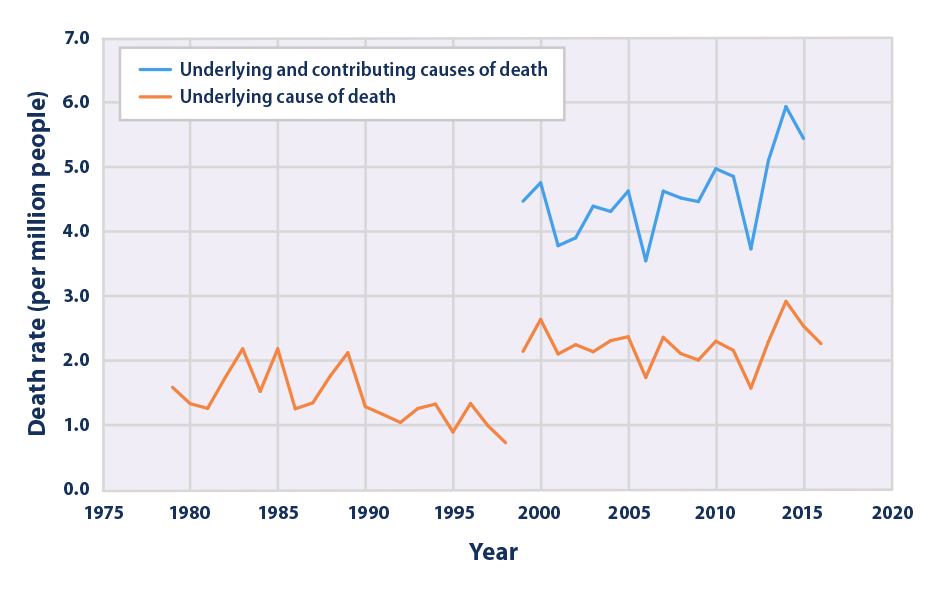
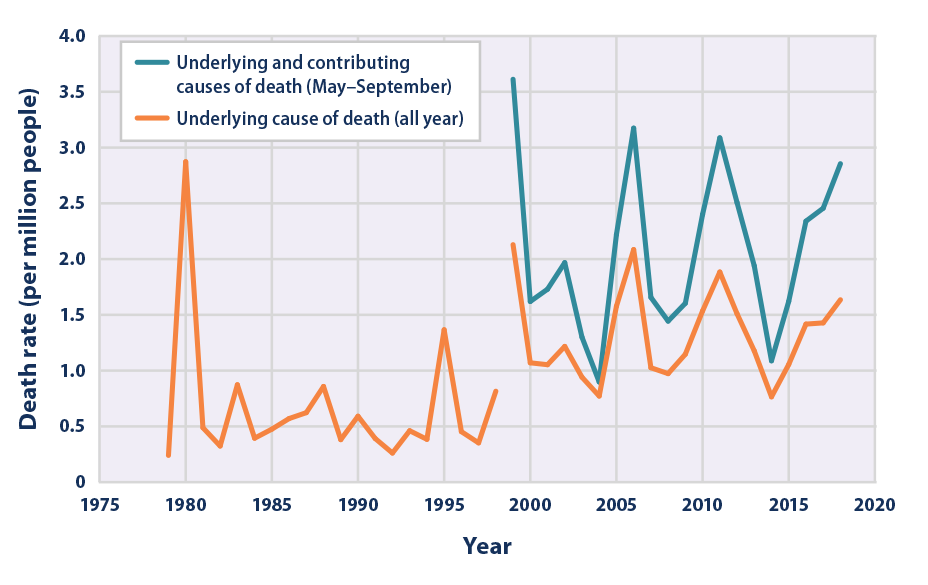
Consider the national statistics provided by the U.S. Environmental Prediction Agency. Based on hospital records, the death rate of coldwaves (top) is at least TWICE that of heatwaves (bottom)


Heatwaves
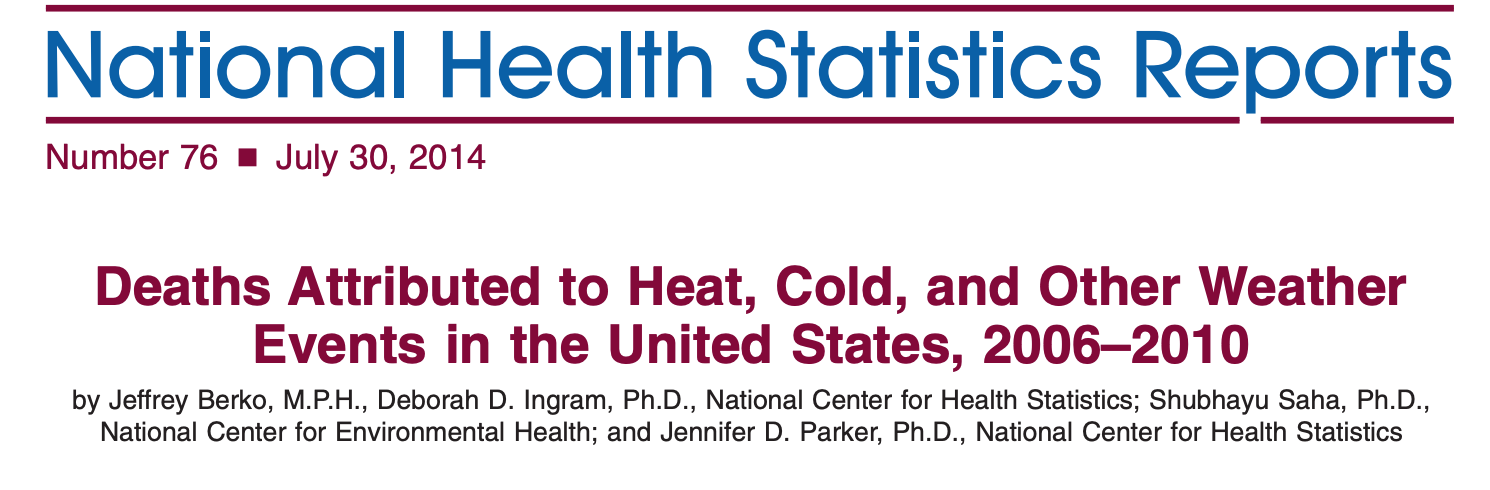
A 2014 study by the U.S. Department of Health and Human Services found that from 2006–2010 about 2,000 U.S. residents died each year from weather-related causes About 31% of these deaths were attributed to exposure to excessive natural heat, heatstroke, sunstroke, or all; 63% were attributed to exposure to excessive natural cold, hypothermia, or both.
Cold was twice the threat of heat, consistent with the findings of the EPA.

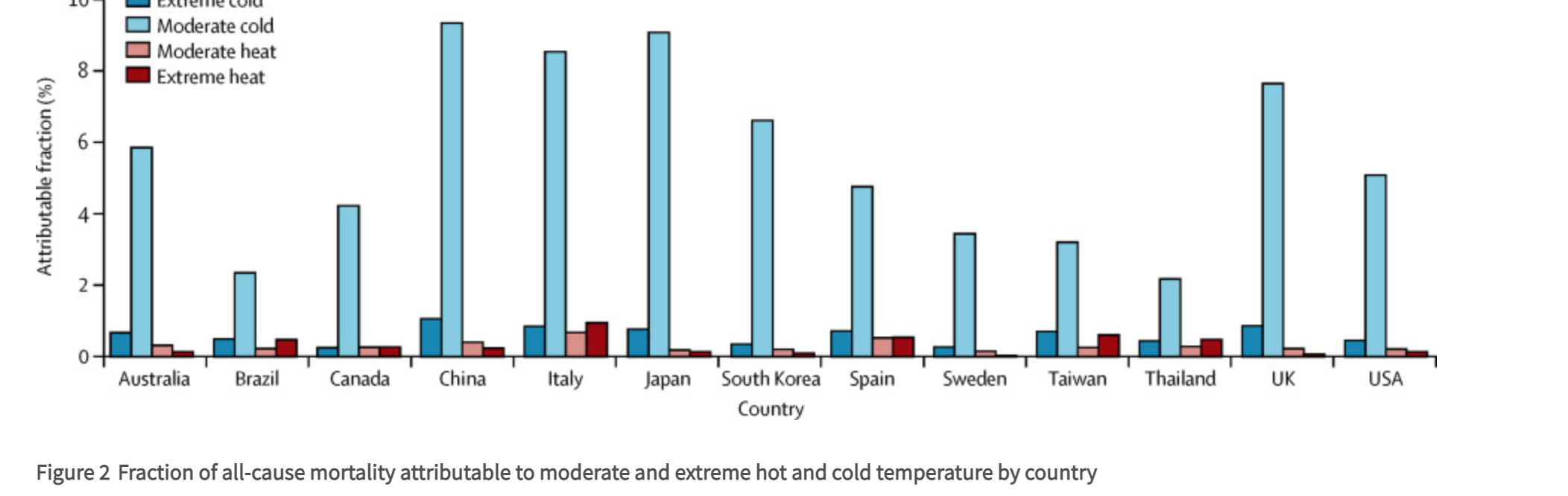
And an article in the well-known medical journal, The Lancet (Gasparinni et al. 2015), took a more international perspective examining data from 384 locations in Australia, Brazil, Canada, China, Italy, Japan, South Korea, Spain, Sweden, Taiwan, Thailand, UK, and the U.S. found that cold was MUCH more of threat….by a ratio of roughly 15 to 1.

Imagine courtesy of the Lance.
I could provide more publications, but the message is clear and consistent:
Coldwaves kill many more people than heatwaves.
The recent Texas cold wave provides a stark example, with at least 210 losing their lives. And here in Washington exposure under cold conditions frequently kill the homeless and even folks inside unheated homes. I found several dozen of such deaths in the Northwest media during the past ten years alone. And there is a proven relationship of cold contributing to cardiac deaths in our area (see here for one study)

It is clear that the threat of cold is vastly underplayed by these statistics. Cold waves are associated with icy roadways and ice on roads is a major cause of accidents, particularly in our state.
A few years ago I checked the WA State Patrol database, finding that one to two dozen WA citizens lost their lives each year through accidents on icy roads, with hundreds being injured. Washington DOT statistics were consistent with this.
As a young professor, I started doing forensic meteorology research, and the number one reason lawyers called me was to aid in cases with deaths on icy roads. And for those interested in social justice issues, such icy deaths fell predominantly on more vulnerable groups, who often traveled in the early morning hours to agricultural, construction, or service jobs.

Icy road accidents, often associated with western WA snow events, often hurt the young and healthy.Global Warming Implications
Now let me say something that is true, but unfortunately will get some folks upset.
Since cold waves kill more people than heatwaves, global warming might well cause fewer deaths overall. Ok, I said it. And it is true, unfortunately, that the media, such as the Seattle Times and National Public Radio (e.g., KNKX) never mention this fact. Heatwaves are discussed endlessly, but the harm of cold waves is ignored. And you know why.
This is NOT to say we should ignore global warming because warming might save lives and lessen injury. We should take prudent and economically reasonable steps to minimize warming because of other issues. That is why I support a carbon tax, nuclear power, and the realistic use of renewables. And we need to ensure we talk prudent adaptation steps.
But let us at least acknowledge the truth of temperature extremes and human harm.

______________________________________________The Second Edition of My Northwest Weather Book is Now Available!
Finally, the supply chain issues have been overcome. My new book is immensely improved over the first edition, with new chapters on the meteorology of Northwest wildfires and the weather of British Columbia. A completely revamped chapter on the effects of global warming on our region. And it has been brought up to date with recent weather events and the imagery is improved greatly.

Where can you get it?
Local bookstores, such as the University of Washington bookstore. The UW Bookstore has just got several dozen copies.
Or Third Place Books in Lake Forest Park or Seattle.
And yes, there are online sellers like Barnes and Noble and Amazon, which I understand has acquired two thousand of the books.
Gee … The text formatting tools have suddenly appeared ….. Fancy that ……
EDIT: Now that the tools are back, I’m sure not going to complain about their temporary absence.
.
The Supply Side Carbon Emission Control Plan (SSCECP)
A fast track approach for reaching President Biden’s greenhouse gas reduction targets
————————————————————————————————
September 28th, 2021 Update:
— Added a provision that by presidential decree, all current government-mandated GHG reduction plans, initiatives, and agreements — federal, regional, state, intra-state, county, and city — are subsumed by the SSCECP and are placed under direct federal authority and control.
— Clarified that the Climate Emergency Declaration and the Carbon Pollution Emergency Declaration are two separate declarations which are coordinated by the Climate Crisis Response Plan.
— Clarified that the National Ambient Air Quality Standard (NAAQS) for carbon pollution is established only after carbon GHG’s have been classified as ‘criteria pollutants’ under the Clean Air Act.
————————————————————————————————
* President Biden’s Ambitious Plans for Decarbonizing the American Economy *
The Biden administration wants a 50% reduction in America’s greenhouse gas (GHG) emissions by 2030. In addition, America’s power generation sector is to achieve net-zero emissions by 2035. America must be fully net zero by 2050.
These are highly ambitious targets. But can these targets actually be met?
The means by which these targets are to be achieved is the rapid electrification of America’s entire energy infrastructure. The transition is being funded in large part by the Green New Deal and will be implemented through a massive commitment to wind and solar energy backed by grid-scale batteries and by a greatly expanded power transmission network.
But regardless of how much money is being spent by the Green New Deal on a renewable energy power grid, can enough wind turbines, enough solar panels, enough storage batteries, and enough new-build power transmission lines be manufactured, sited, and installed in time to fully replace America’s legacy electricity resources by the year 2035?
What about transportation? Can enough electric vehicles be manufactured and sold by 2050 to largely eliminate gasoline and diesel powered transportation in America? Can our airliners and our airports be replaced with high speed trains powered by an electrified intercity rail system? Will enough renewable electricity be available to power our cars, our trucks, and our trains and at the same time power our homes, our municipal services, and our factories?
Can all this be done on Biden’s schedule? Or is it really the case that government-enforced rationing of fossil fuels is the only way we can be certain of achieving his reduction targets?
* A Credible Greenhouse Gas Reduction Plan Requires Mandatory Energy Conservation *
Climate activists argue that America’s leadership in quickly reducing our own carbon emissions is essential for convincing China and India to quickly reduce theirs. If convincing China and India to follow our lead is the goal, simply spending money isn’t enough. A credible GHG reduction plan is one which actually achieves Biden’s emission reduction targets on the aggressive schedule he has announced.
Resetting America’s economic, cultural, and social order in accordance with President Biden’s social justice agenda is as much of an objective, if not more of an objective, of the Green New Deal as is the quick reduction of our GHG emissions. However, if the goal is to quickly reduce our emissions in order to demonstrate that it can be done, then technology innovation alone can’t do it. Building enough wind and solar to replace even half of our fossil electricity resources by 2030 is impossible.
Only through a policy of mandatory energy conservation measures can Biden’s targets be met. In other words, government enforced energy rationing. If we are to reach the 2035 net zero target for the electric power sector, Americans must do with the Green New Deal what the Germans have done with their Energiewende: double the cost of energy for the average consumer and reduce the average person’s energy consumption to half of what we consume today.
* The Goals of a Fast Track GHG Reduction Strategy *
America’s legacy energy infrastructure is the product of more than a hundred years of economic, technical, and industrial evolution. If America’s energy infrastructure is to be replaced on President Biden’s schedule, then a process which historically took a hundred years must be compressed into a timeframe of no more than thirty years. Any fast-track greenhouse gas reduction strategy must achieve these goals:
1 — Be highly effective in quickly reducing America’s GHG emissions.
2 — Be conceptually and operationally simple to implement, relatively speaking.
3 — Be in alignment with past regulatory practice and past legal precedent.
4 — Be constitutionally and legally defensible in the courts.
5 — Be formulated and written in a way which discourages lawsuits.
6 — Motivate all energy consumers to quickly reduce their energy consumption.
7 — Incentivize the participation of the fifty state governments in controlling our GHG emissions.
8 — Incentivize private sector corporations to cooperate in reducing our GHG emissions.
* The Supply Side Carbon Emission Control Plan (SSCECP) – a General Overview *
The Executive Branch of the US Government already has all the legal authority it needs to unilaterally impose a fossil fuel lockdown on the American economy. That authority can be enabled in practice by combining elements of the Clean Air Act with elements of national security law as it applies to the declaration of a national emergency.
The Supply Side Carbon Emission Control Plan (SSCECP) is a means for guaranteeing that the Biden administration’s ambitious GHG reduction targets can be met.
The initial starting point for the SSCECP is the declaration of a Climate Emergency under the president’s national security authorities, a declaration of a Carbon Pollution Emergency under his Clean Air Act authorities, and the publication of a Climate Crisis Response Plan (CCRP) which coordinates the individual actions taken under the president’s national security and environmental law authorities.
By presidential decree, all current government-mandated GHG reduction plans, initiatives, and agreements — federal, regional, state, intra-state, county, and city — are subsumed by the SSCECP and are placed under direct federal authority and control.
A series of Executive Orders is then issued which further define and enable the implementing actions to be taken under the overall SSCECP.
The SSCECP incentivizes energy conservation by imposing higher prices on all forms of energy and by placing direct constraints on energy production and consumption. Higher energy prices will in turn attract greater levels of investment in zero carbon energy technologies and will also allow the higher costs of wind, solar, and nuclear — assuming we choose to use nuclear — to be spread more evenly among all energy consumers.
Under the SSCECP, Americans will be consuming half as much energy per capita in 2035 as we do today in 2021, and one-third as much by 2050.
In order to expedite environmental reviews and other permitting reviews of new-build wind, solar, nuclear, energy storage, and energy transmission facilities — portions of the National Environmental Policy Act (NEPA), along with portions of other project permitting requirements, are either partially suspended or else are bypassed altogether, as specifically directed by the President for each eligible new-build energy facility.
Moreover, the president is empowered to assert federal eminent domain over all lands, waters, and properties, either publicly owned or privately owned, which are to be reserved by the federal government for wind, solar, nuclear, energy storage, and/or power transmission development.
A hard target schedule is established for the phased shutdown of America’s fossil fuel support infrastructure.
This master schedule includes the closure of coal-fired and natural gas-fired power plants, oil fields and refineries, fracked natural gas fields, LNG production facilities and terminals, and the majority of our petroleum product pipelines and distribution terminals. Each legacy fossil fuel power plant and each fossil energy support facility being targeted for shutdown is listed individually on this master closure schedule.
* The Eight Elements of the Supply Side Carbon Emission Control Plan (SSCECP) *
These are the eight major elements of the SSCECP:
I: Establish the legal basis for regulating all of America’s carbon emissions (1941-2021. Status ‘Complete’)
II: Declare a Climate Emergency, declare a Carbon Pollution Emergency, and publish a Climate Crisis Response Plan (2021-2022)
III: Expand and extend federal regulation and control of all carbon emissions (2022)
IV: Establish an expanded carbon emission regulation program managed by the EPA (2022)
V: Establish a carbon fuel rationing program managed by the Department of Energy (2022)
VI: Establish a process for expedited energy project siting, permitting, and approval. (2022)
VII: Publish and implement a National Energy Infrastructure Transition Plan (2022)
VIII: Perform ongoing GHG reduction monitoring & control activities (2023 through 2050)
These are the lower-level implementation details of the SSCECP:
I: Establish the legal basis for regulating all of America’s carbon emissions (1941-2021. Status ‘Complete’)
I-a: Impose government-mandated energy rationing in response to a declared national emergency, World War II. (1941-1945)
I-b: Pass legislation establishing the regulation of harmful atmospheric pollutants under the Clean Air Act. (1970)
I-c: Establish the Environmental Protection Agency and further define and implement the process for controlling and reducing pollutants. (1970-2020)
I-d: File and win lawsuits to allow regulation of carbon dioxide and other carbon GHG’s as pollutants under the Clean Air Act. (2007)
I-e: Publish a CAA Section 202 Endangerment Finding as a prototype test case for regulation of carbon GHG’s. (2009)
I-f: Successfully defend the CAA Section 202 Endangerment Finding in the courts. (2010-2012)
I-g: Establish a recent precedent, the COVID-19 pandemic, for taking strong government action in response to a declared national emergency. (2020-2021)
II: Declare a Climate Emergency, declare a Carbon Pollution Emergency, and publish a Climate Crisis Response Plan (2021-2022)
II-a: Issue an Executive Order declaring a Climate Emergency under the president’s national security authorities.
II-b: Issue an Executive Order declaring a Carbon Pollution Emergency under the president’s Clean Air Act (CAA) authorities.
II-c: Issue an Executive Order placing all current regional, state, intra-state, and local GHG reduction plans and agreements under federal authority and control.
II-d: Publish a Climate Crisis Response Plan (CCRP) which establishes a defined strategic mix among three major policy directions covering: a) zero-carbon energy production; b) energy conservation technology; and c) mandated energy conservation measures.
II-e: Establish a comprehensive list of carbon emission reduction targets and a detailed strategy and plan for reducing each category of carbon emissions.
II-f: Establish a formal process for coordinating and reconciling America’s GHG reduction goals with its environmental justice, climate justice, and social justice goals.
II-g: Assign a joint task force comprised of all cabinet level departments, plus the National Security Agency, to manage the climate crisis and carbon pollution emergencies.
II-h: Create a joint interagency control board to manage a phased systematic reduction in the production and distribution of all carbon fuels.
II-i: Place this control board under the direct supervision of the president and his national security staff.
II-j: Defend the president’s emergency actions as needed in response to specific lawsuits filed in the courts.
III: Expand and extend federal regulation and control of all carbon emissions (2022)
III-a: Issue an Executive Order further defining the scopes of the Climate Emergency Declaration and the Carbon Pollution Emergency Declaration.
III-b: Issue an Executive Order further defining the scope and objectives of the Climate Crisis Response Plan (CCRP).
III-c: Issue an Executive Order integrating all current regional, state, intra-state, and local GHG reduction plans and agreements into the CCRP.
III-d: Issue an Executive Order establishing an expanded carbon emission regulation program to be managed by the EPA.
III-e: Issue an Executive Order establishing a carbon fuel rationing program to be managed by the Department of Energy.
III-f: Issue an Executive Order establishing an ongoing program for continuous monitoring and control of carbon emission reduction activities.
III-g: Issue an Executive Order suspending the application of anti-trust regulations in the energy marketplace.
III-h: Issue an Executive Order allowing for the suspension of portions of the National Environmental Policy Act (NEPA) in order to expedite environmental reviews of new-build wind, solar, and nuclear facilities.
III-i: Issue an Executive Order granting authority to the President to reverse the final decisions of federal, state, and local permitting agencies if those decisions are deemed to be ‘not in the national interest’ as that stipulation is defined within the Climate Crisis Response Plan.
III-j: Issue an Executive Order granting authority to the President to assert federal eminent domain over all lands, waters, and properties, either publicly owned or privately owned, identified as being necessary for the siting of new-build energy facilities.
III-k: Defend the president’s expansion of federal authority as needed in response to specific lawsuits filed in the courts.
IV: Establish an expanded carbon emission regulation program managed by the EPA (2022)
IV-a: Publish a Clean Air Act Section 108 Endangerment Finding which complements 2009’s Section 202 finding.
IV-b: Classify carbon emissions as ‘criteria pollutants’ under the Clean Air Act.
IV-c: Establish a National Ambient Air Quality Standard (NAAQS) for carbon pollution.
IV-d: Declare carbon emissions as Hazardous Air Pollutants (HAPs) under CAA Section 112.
IV-e: Use the NAAQS for carbon pollution as America’s tie-in to international climate change agreements.
IV-f: Defend the Section 108 Endangerment Finding, the NAAQS, and the Section 112 HAP Declaration in the courts.
IV-g: Publish a regulatory framework for carbon pollution under Clean Air Act sections 108, 111, 112, 202, and other CAA sections as applicable.
IV-h: Establish cooperative agreements with the states to enforce the EPA’s anti-carbon regulations.
IV-i: Establish a system of carbon pollution fines which is the functional equivalent of a legislated tax on carbon.
IV-j: Establish the legal basis for sharing the revenues collected from these carbon pollution fines among the federal and state governments.
IV-k: Defend the comprehensive system of carbon pollution regulations in the courts.
V: Establish a carbon fuel rationing program managed by the Department of Energy (2022)
V-a: Research and publish a system for government-enforced carbon fuel rationing managed by the Department of Energy.
V-b: Establish a time-phased, hard-target schedule for reducing the production and distribution of all carbon fuels.
V-c: Establish cooperative agreements with the state governments to enforce the federal government’s system of carbon fuel rationing.
V-d: Establish production control agreements with private sector fossil fuel producers and distributors.
V-e: Establish a guaranteed profit schedule for the carbon fuels industry in return for production & distribution cutbacks.
V-f: Defend the government’s system of carbon fuel rationing in the courts.
VI: Establish a process for expedited energy project siting, permitting, and approval. (2022)
VI-a: Research and publish a system and process for expedited governmental review and permitting for the siting and construction of new-build wind, solar, nuclear, energy storage, and power transmission facilities.
VI-b: Establish cooperative agreements with federal and state agencies for expedited reviews and approvals of energy infrastructure projects.
VI-c: Establish a register of new-build wind, solar, nuclear, energy storage, and power transmission projects eligible for an expedited permitting review and approval process.
VI-d: For those projects listed on the expedited review register, establish a process and a procedure to be followed if the President reverses the final decisions of federal, state, and local permitting agencies, if those decisions are deemed ‘not in the national interest’.
VI-e: Establish a register of lands, waters, and properties, both publicly owned and privately owned, which may become the targets of federal reservation actions for the siting of new-build energy infrastructure.
VI-f: For those lands, waters, and properties listed in the reservation action register, establish a process and a procedure to be followed if the President asserts federal eminent domain over those lands, waters, and properties.
VI-g: Defend the government’s expedited siting, permitting, and environmental review processes in the courts.
VII: Publish and implement a National Energy Infrastructure Transition Plan (2022)
VII-a: Research and publish a National Energy Infrastructure Transition Plan (NEITP) for the siting and construction of new-build wind, solar, nuclear, energy storage, and power transmission facilities.
VII-b: Publish and implement a hard-target schedule for deployment of new-build wind and solar facilities, new-build nuclear facilities, new-build grid-scale energy storage facilities, and new-build energy transmission capacity.
VII-c: Publish and implement a technology implementation plan which specifically identifies those energy technologies to be prioritized for near term investment, development, production, and deployment.
VII-d: Publish and implement a US Treasury policy plan for redirecting energy market financial investments as needed to support the federal government’s GHG reduction goals.
VII-e: Publish and implement an Energy Infrastructure Land Use Plan (EILUP) which identifies those lands, waters, and properties, either publicly owned or privately owned, which are to be reserved by the federal government for wind, solar, nuclear, energy storage, and/or power transmission development.
VII-f: Publish and implement an Energy Facility Closure Plan (EFCP) which specifically identifies which fossil energy facilities and their supporting infrastructures are to be permanently retired, including a specific target date for each facility and infrastructure component.
VII-g: Defend the government’s national energy infrastructure transition plan in the courts.
VIII: Perform ongoing GHG reduction monitoring & control activities (2023 through 2050)
VIII-a: Issue a further series of Executive Orders, as needed, to further define and further implement America’s carbon emissions regulatory framework, America’s carbon fuel rationing program, the federal government’s expedited energy facility permitting process, and the government’s energy infrastructure transition plan.
VIII-b: Monitor the effectiveness of the EPA’s carbon regulation framework in reducing America’s GHG emissions.
VIII-c: Monitor the effectiveness of renewable energy projects in reducing America’s GHG emissions.
VIII-d: Monitor the effectiveness of energy conservation programs in reducing America’s GHG emissions.
VIII-e: Monitor the effectiveness of carbon fuel rationing programs in reducing America’s GHG emissions.
VIII-f: Monitor the progress of the energy infrastructure transition plan in closing legacy fossil fuel energy facilities.
VIII-g: Adjust the schedule of carbon pollution fines upward if progress in reducing America’s GHG emissions lags.
VIII-h: Adjust the carbon fuel rationing targets upward if progress in reducing America’s GHG emissions lags.
VIII-i: Continue to defend the comprehensive system of carbon pollution regulations and the government-mandated energy rationing programs in the courts.
VIII-j: Continue to assess the need for enforcing the government’s GHG reduction programs beyond the year 2050.
* REMARKS *
President Biden says that climate change is the most serious problem the world now faces. Biden’s climate czar John Kerry says that America’s leadership in quickly reducing our own carbon emissions is vital for convincing other nations, especially China and India, to do the same.
The plan described above, the SSCECP, is a highly coercive approach for quickly reducing America’s GHG emissions. However, it is also completely legal and constitutional under current law, both our national security law and our environmental protection law.
The SSCECP can be implemented unilaterally by the Executive Branch using its existing environmental protection and national security authorities. Not another word of new legislation is needed from Congress either to enable the plan legally or to fund its operation.
Nor does the plan require a separate line of funding in the federal government’s budget. The planning activities and regulation roll-out activities are easily accomplished within the existing spending authorities of the US-EPA, the US-DOE, the USDT, and the US-DHS.
A plan like the SSCECP will generate many lawsuits. But if the plan is applied with equal force against all major sources of America’s carbon emissions, and with equal impact upon all affected economic sectors and demographic groups, those lawsuits will go nowhere. It is specifically designed to survive any lawsuits brought against it.
Even if the House of Representatives and the Senate were both in Republican hands in January, 2023, and passed legislation forbidding the adoption of a plan like the SSCECP, a presidential veto can kill that legislation with the stroke of a pen.
So the big question remains. How far will President Biden and his climate czar John Kerry go in acting upon their stated convictions? Will they, or won’t they, do all that is in their power as our Chief Executive and our climate czar to reduce America’s carbon emissions just as far and as fast as climate activists say is necessary?
————————————————————————————————
Disclosure: I’ve spent thirty-five years in nuclear construction and operations. Because the bulk of my occupational radiation exposure has come from beta-gamma sources, my internet handle is Beta Blocker.
“Added a provision that by presidential decree”
So more Federal / Presidential overreach… Who’s the dictator?
Afraid of dying from heat? Fill the tub with cold water and get in it.