From the Cliff Mass Weather Blog
There have been a lot of stories about heatwave deaths this summer and the latest Washington State Department of Health (DOH) statistics indicate that the June 2021 heatwave contributed to 91 deaths.
The DOH also noted that 39 individuals died from heat-related complications from 2015-2020. Nearly all of those who lost their lives were either elderly or suffered from serious pre-existing conditions.
Heatwave deaths are all tragic losses and we should do all we can to prevent them, including expanded use of air conditioning, cooling centers, and more.
But it is also important to understand the other “side of the coin”, about deaths resulting from cold waves, both in the Northwest and the rest of the nation.


And the facts may surprise you. Far more people die from cold than heat.
Furthermore, cold waves sometimes kill young people, often on icy roads.
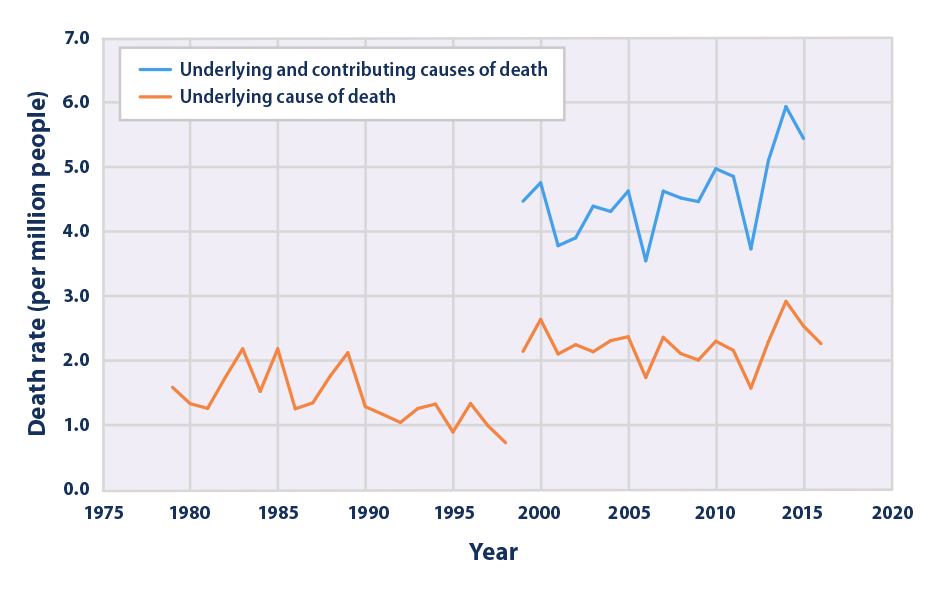
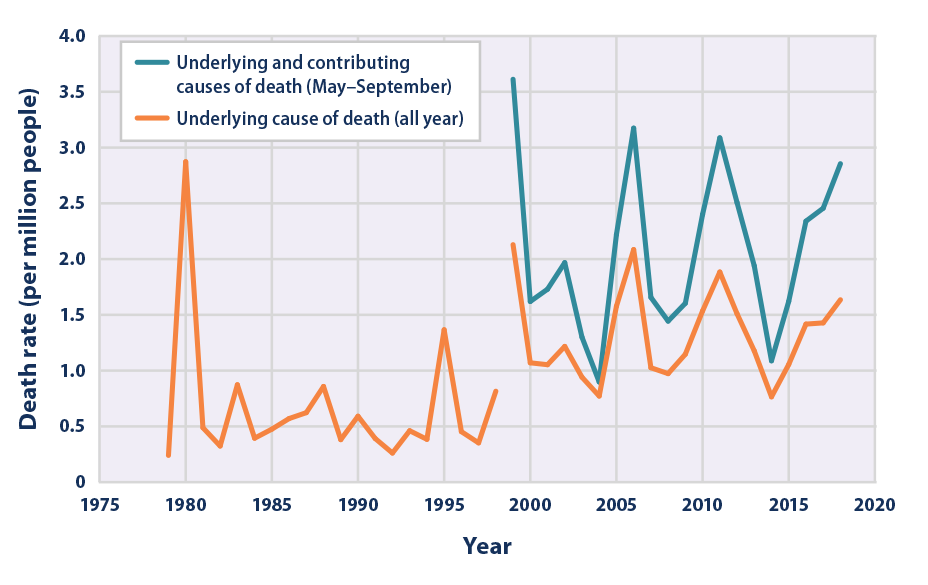
Consider the national statistics provided by the U.S. Environmental Prediction Agency. Based on hospital records, the death rate of coldwaves (top) is at least TWICE that of heatwaves (bottom)


Heatwaves
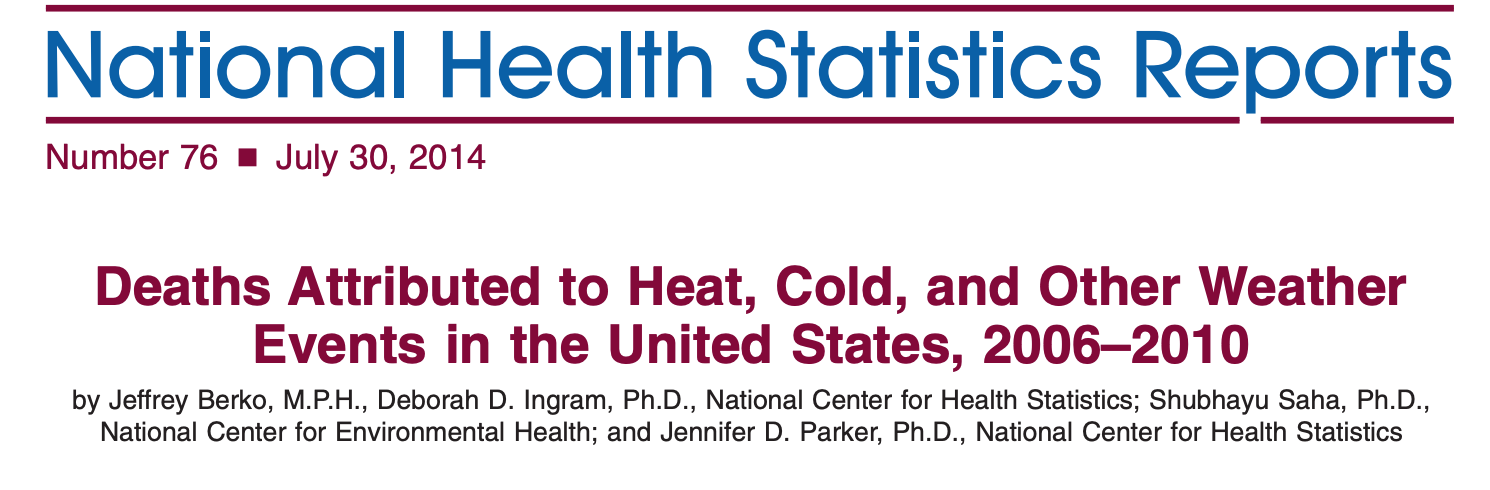
A 2014 study by the U.S. Department of Health and Human Services found that from 2006–2010 about 2,000 U.S. residents died each year from weather-related causes About 31% of these deaths were attributed to exposure to excessive natural heat, heatstroke, sunstroke, or all; 63% were attributed to exposure to excessive natural cold, hypothermia, or both.
Cold was twice the threat of heat, consistent with the findings of the EPA.

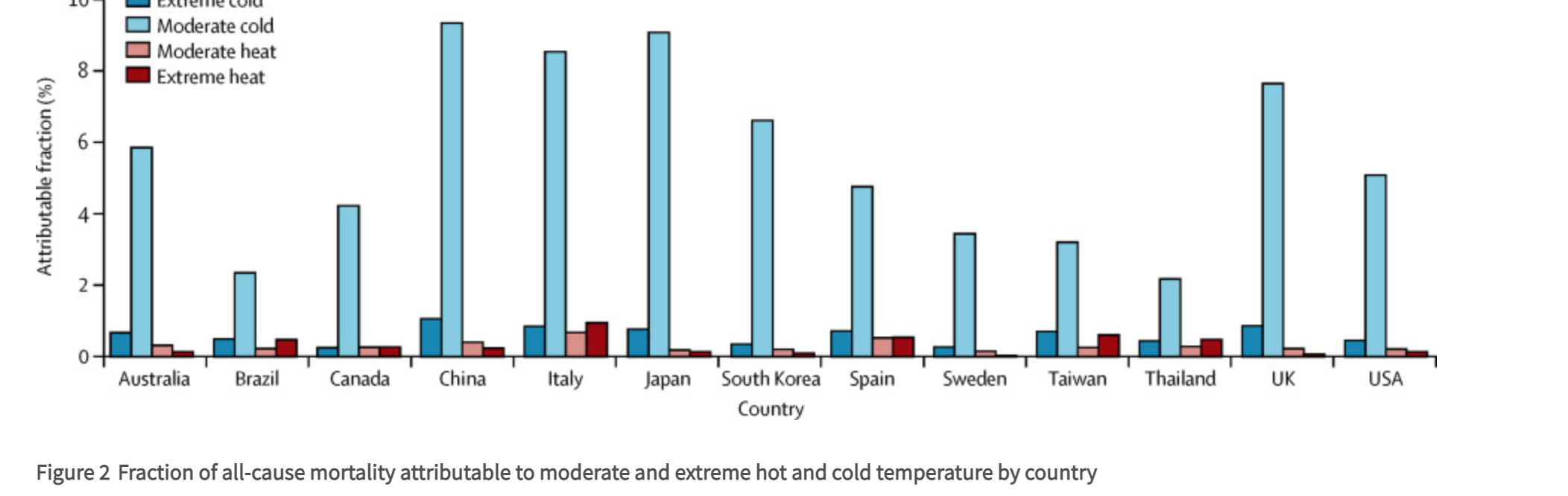
And an article in the well-known medical journal, The Lancet (Gasparinni et al. 2015), took a more international perspective examining data from 384 locations in Australia, Brazil, Canada, China, Italy, Japan, South Korea, Spain, Sweden, Taiwan, Thailand, UK, and the U.S. found that cold was MUCH more of threat….by a ratio of roughly 15 to 1.

Imagine courtesy of the Lance.
I could provide more publications, but the message is clear and consistent:
Coldwaves kill many more people than heatwaves.
The recent Texas cold wave provides a stark example, with at least 210 losing their lives. And here in Washington exposure under cold conditions frequently kill the homeless and even folks inside unheated homes. I found several dozen of such deaths in the Northwest media during the past ten years alone. And there is a proven relationship of cold contributing to cardiac deaths in our area (see here for one study)

It is clear that the threat of cold is vastly underplayed by these statistics. Cold waves are associated with icy roadways and ice on roads is a major cause of accidents, particularly in our state.
A few years ago I checked the WA State Patrol database, finding that one to two dozen WA citizens lost their lives each year through accidents on icy roads, with hundreds being injured. Washington DOT statistics were consistent with this.
As a young professor, I started doing forensic meteorology research, and the number one reason lawyers called me was to aid in cases with deaths on icy roads. And for those interested in social justice issues, such icy deaths fell predominantly on more vulnerable groups, who often traveled in the early morning hours to agricultural, construction, or service jobs.

Icy road accidents, often associated with western WA snow events, often hurt the young and healthy.Global Warming Implications
Now let me say something that is true, but unfortunately will get some folks upset.
Since cold waves kill more people than heatwaves, global warming might well cause fewer deaths overall. Ok, I said it. And it is true, unfortunately, that the media, such as the Seattle Times and National Public Radio (e.g., KNKX) never mention this fact. Heatwaves are discussed endlessly, but the harm of cold waves is ignored. And you know why.
This is NOT to say we should ignore global warming because warming might save lives and lessen injury. We should take prudent and economically reasonable steps to minimize warming because of other issues. That is why I support a carbon tax, nuclear power, and the realistic use of renewables. And we need to ensure we talk prudent adaptation steps.
But let us at least acknowledge the truth of temperature extremes and human harm.

______________________________________________The Second Edition of My Northwest Weather Book is Now Available!
Finally, the supply chain issues have been overcome. My new book is immensely improved over the first edition, with new chapters on the meteorology of Northwest wildfires and the weather of British Columbia. A completely revamped chapter on the effects of global warming on our region. And it has been brought up to date with recent weather events and the imagery is improved greatly.

Where can you get it?
Local bookstores, such as the University of Washington bookstore. The UW Bookstore has just got several dozen copies.
Or Third Place Books in Lake Forest Park or Seattle.
And yes, there are online sellers like Barnes and Noble and Amazon, which I understand has acquired two thousand of the books.
Good report of real information. Here’s another outlook: do more people go to beaches in the summer for vacations or do more go to snowy mountains to ski, etc, in the winter? I will soon be on my way to Miami Beach, so you know my preference.
Surely if you’re a climate fascist you will shun holidays for the sake of the children?
(Not you Ron)
The Lancet data are likely much more reliable than the EPA data, because the EPA has a dog in the fight, i.e., they are promoting warmunism.
If you think about this for just one moment, it is obvious that cold kills far more than heat.
Simple experiment:
In January in the northern US states or Canada, go outside, strip off all your clothes, and see how long you survive – most likely well under an hour.
Then in July, in the southern US states, go outside, strip off all your clothes, and see how long you survived. Most likely indefinitely, as long as you have some kind of shade and stay hydrated.
Human beings are creatures of the subtropical savannahs of Africa – that’s where we evolved from the pre-human hominids. No fur, no thick layers of blubber under the skin, no physical adaptations whatsoever to cold or even cool temperatures. Our only adaptation to the cold is above the shoulders – we are able to make tools and clothe ourselves to survive all but the coldest Arctic conditions. Yet, we easily adapt to heat.
….no thick layers of blubber under the skin,…
Not thick, but we have, one reason for the idea of the Aquatic ape hypothesis.Not that I’m a follower of the idea, but I remeber to have read about.
Not to forget, I just remind it, babys short after birth are able to swim and to dive under water. If not forced further, they lose the ability.
Humans lost fur, right, but there are atavistic fall-backs babies are born with a fur or even a tail.
I would have a word with the mailman.
Should there be a screening test before stripping off clothes? There are some folks who might be too literal and follow the satire as instructed. Some of those folks should never be seen without clothes. Nancy Pelosi comes to mind…
Nanci Piglosi dyes her hair…botoxes her skin…and is rumored to have had horn removal…she is the daughter of Satan.
Hmm. Seems to me that you can only perform half of that experiment…
Or you need to at least reverse the order.
Have the warmunists conduct the January experiment … the rest of us can do the July experiment.
I am not sure where I read it, nor whether it is accurate (but it seems so) – an unclothed human can survive so long as the average temperature remains above 84 degrees F. This would mean a daily range of perhaps 72 to 96 degrees? Sounds about right to me, but no way am I going to try it…
https://archive.is/cwZuL
In January in the northern US states or Canada, go outside, strip off all your clothes, and see how long you survive – most likely well under an hour.
Less than that probably. My neighbor has a shotgun and she knows how to use it.
“…see how long you survive – most likely well under an hour.”
In the coastal waters … maybe 15 minutes, depending. Although I’ve only been in Penobscott Bay and off the coast of Carpenteria. Didn’t like either. Some people like the feeling of their bodies going into overdrive. I get that from getting up during commercials.
https://wattsupwiththat.com/2017/07/17/alarm-about-alarmism/#comment-2104459
Joe d’Aleo and I had written a paper on Excess Winter Mortality based on other evidence when the major Lancet study was published, so we revised our paper to include that excellent study. Our summary reads:
“Cold weather kills. Throughout history and in modern times, many more people succumb to cold exposure than to hot weather, as evidenced in a wide range of cold and warm climates.
Evidence is provided from a study of 74 million deaths in thirteen cold and warm countries including Thailand and Brazil, and studies of the United Kingdom, Europe, the USA, Australia and Canada.
Contrary to popular belief, Earth is colder-than-optimum for human survival. A warmer world, such as was experienced during the Roman Warm Period and the Medieval Warm Period, is expected to lower winter deaths and a colder world like the Little Ice Age will increase winter mortality, absent adaptive measures.
These conclusions have been known for many decades, based on national mortality statistics.”
COLD WEATHER KILLS 20 TIMES AS MANY PEOPLE AS HOT WEATHER September 4, 2015
by Joseph D’Aleo and Allan MacRae
https://friendsofsciencecalgary.files.wordpress.com/2015/09/cold-weather-kills-macrae-daleo-4sept2015-final.pdf
____________________
https://wattsupwiththat.com/2017/09/23/the-evils-of-climate-enthusiasm/#comment-2164819
[excerpts]
The elderly and the poor in the United Kingdom, Germany and other countries are suffering increased winter deaths due to high energy costs. In the UK, this human disaster is called “Heat or Eat”.
The Excess Winter Mortality Rate in Britain is much higher than that in Canada. Canada has a population of about 35 million and the UK about 65 million, but Excess Winter Mortality in Canada is about 5000 to 10,000 per year, and in the UK it is 25,000 to 50,000 per year.
Canada and the UK have genetically similar populations and similar health care systems. Canada tends to be colder but mostly drier than the UK. However, Canada generally has much lower energy costs and better-insulated housing and probably better central heating systems, on average. This suggests that adaptation to winter and low energy costs are significant drivers of lower Winter Mortality rates.
Imagine IF the UK had competent politicians in the past several decades instead of warmist imbeciles. Instead of spending billions on green energy debacles, they could have spent the funds on improving home insulation and central heating, and encouraged fracking of shales to reduce natural gas prices, and a whole lot of grannies and grandpa’s would still be alive for their grandchildren.
Cheap, abundant, reliable energy is the lifeblood of society – it IS that simple.
When politicians fool with energy systems, real people suffer and die.
Regards, Allan
Heat is not a problem when there is a good source of water available. Having grown up in a semi-desert area where we would have months in the summer with the max temperature not below 90°F and many days over 100°F I cannot recall a single instance of anyone dying of the heat. We knew how to cope with the heat without air conditioners. Various deciduous fruits flourished and did not have the same problem with insects that occur in wetter climates.
Humans have survived and thrived in hot climates for many thousands of years without air conditioning or GatorAid. Just a bit of shade and something to drink – water, or as the Egyptians did, beer (works for me!).
Sure, it is more comfortable to be cool, in the 60s or 70s, inside or out, than it is to be hot. But it is not life threatening.
As a veteran navyman as well as airman, the number one risk of death should you survive your ship sinking or your aircraft ditching in the ocean is exposure – i.e., dying from hypothermia. Ditto with vehicle accidents in the north country in winter. Even relatively warm ocean waters (low 80s) will literally suck the life out of you if you stay in them more than a few hours. That’s why professional divers, surfers, etc. wear wetsuits, and modern ships are equipped with drysuits.
Although I agree with you, this is not relevant. Immersed in water the human body cannot regulate its temperature in the way it is used to in the air, and sea water is always significantly lower than our body temperature. This is probably why fish are cold blooded, although I haven’t investigated the issue.
The human body regulates its temperature exactly the same in water or air. Water has a higher specific heat content per degree F or C, so it more quickly transfers heat in or out from a creature immersed in water.
Duane, that is what I meant. Because of the greater ability of water to remove body heat we can’t regulate our body temperature in water. We’re not built for it.
I take it none of the cold deaths in back years were caused by moratoriums on gas hookups that are now starting in CA,NY, and the UK. Better start a new death forensic category.
Every year from shoveling snow. Much of that is necessary because the snow plow heaps up a huge pile of the stuff in front of the driveway. You can’t get out in a timely manner if you don’t shovel.
Clearly the powers that be think a few heart attacks is a good tradeoff for cheaper snow plowing.
I’m glad to read that this problem doesn’t just happen in my town.
I once counted the number of times the accumulated snow in our street was moved from street to driveways, then back to street, then back to driveways, and so on until a warm spell moved it all down into the stormwater drains.
I stopped counting at 9 cycles.
Now, if anyone thinks I just have too much time on my hands to do such an exercise, it was to inform a consideration of ways to reduce the costs of snow removal services from our driveways.
(I could also have been a smartass and factored in all that lethal CO2 being emitted from the diesel powered ploughs)
A healthy dose of rationality again from Cliff Mass to start the week.
If only universities everywhere were staffed by Cliffs, the world would be far better placed to deal rationally with its ever-present need to contend with the ever-changing forces of nature.
Coming to NJ and NY also…..
PennEast Gas Project Halted in Latest U.S. Pipeline Casualty (yahoo.com)
The norm for Excess Winter Deaths in the UK is around 25,000. It’s casually accepted by the authorities and government, as they bang on about warmer winters being dangerous for people.
Astonishingly, the UK’s winters rarely fall below -5ºC other than in isolated cases and specific locations, and that’s only in a short spell from the end of January to, perhaps the end of February.
Meanwhile, in other news, the UK Shadow Chancellor announced that Labour would spend £28 billion a year until 2030 to ensure Britain reaches net zero. Labour are not likely to get into power for at least another 6 years but it just shows the kind of figure getting to Net Zero would cost. And what she has committed to is probably well below the real cost. She didn’t, of course say where the money was coming from.
Wonderful article using authentic data.
But that’s just for humans. If you took the rest of the creatures on the planet and calculated the deaths from heat, then compared that to the death caused by cold the disparity would be at least a couple of orders of magnitude.
Every Autumn in the mid/high latitudes life begins to prepare for the brutal cold. Plants go dormant or die. Creatures that can, escape with migration south to wonderful warmth. Creature that can’t, prepare for the long harsh Winter without food. Some hibernate.
Others tough it out…..with the death from cold adversity(that includes starvation because most plants are dormant or dead) elevated higher by several categories compared to death from heat……a totally different, much more harsh situation.
Finally, in early Spring, glorious life triggering warmth returns. Plants flourish again and food is plentiful for all creatures under typical conditions.
Then Summer heat waves hit in “some” places. Unlike Winter always that clobbers life across the entire planet at the mid/high latitudes because of the suns lower angle……………heat waves DON’T affect the entire planet, from west to east. Even when the sun hits it highest point on June 21st in the Northern Hemisphere, heat waves will be limited to just small regions and the death to most creatures from the heat will be limited…..but there are exceptions.
However on December 21st, 6 months later, the life killing cold will be well entrenched almost everywhere in the mid/high latitudes…….no matter the climate or the weather. Very few exceptions for most land masses.
Every single year, without exception life pays a price for that cold…….. but has still managed to adapt well.
As the Beatles famously sang:
“Here comes the Sun…”
And from another Beatles song:
…
If you get too cold, I’ll tax the heat
If you take a walk, I’ll tax your feet
‘Cause I’m the taxman
Yeah, I’m the taxman…
The UK top income rate was I believe 19 shillings 6 pence in the pound when they wrote that song.
(there were 20 shillings in a pound)
No wonder The Beatles took a climate change to a more habitable financial climate.
The only thing they didn’t mention in that song is taxing the air you breathe. That was a sadly missed opportunity. It would have been a great talking point these days!
Warm is good
Yes we are fortunate to have Cliff Mass speaking for some of the science. He mentions sea level rise as a result of climate change though. So that’s weird to me, as he follows data on other things. Isn’t PSMSL the place to go for that data?
On another note, I heard that a radio announcer isn’t supposed to say 72 degrees, sunny, nice day on the radio b/c listeners complained about climate change. And not to say anything negative about rain, b/c of horrible drought.
“Nearly all those were elderly or suffered from pre-existing serious conditions” Similar to the corona virus hype
Yup!
These people want Big Government ™ to save the lives of the vulnerable few, while destroying many more lives of the young and productive. It’s utter insanity.
Sadly, the author of this article also wants this.
Zig zag wanderer, you are right concerning Cliff’s support for a carbon tax. It is insanity. My analogy would be: a friend finds you being threatened by a crowd who believes you have done some bad things. The friend knows you didn’t do the bad things and explains to the crowd why you did not do the bad things. Then the friend kicks you in the cajones and explains it was to keep you from doing bad things in the future. It’s just stupid.
You state that cold causes far more deaths than heat. But you advocate reducing warming (leaving aside the dubious assumption that CO2 causes warming), and therefore preventing the saving of many lives by allowing the climate to warm slightly.
That seems callous and cruel to me. What are these other issues that are more important than saving lives?
Heatwave or Santa Ana?
I’m amazed that no obvious mention is made of the Lancet graphs for some countries.
You’ll notice that MODERATE COLD kills more people than SEVERE COLD+ SEVERE HEAT + MODERATE HEAT COMBINED.
No contest and yet we still have L W loonies yapping about the so called dangers of global warming.
This is the safest time to be alive and an incredible increase in Human health and wealth over last 200 years or 100 years or 50 years or 10 years. Look it up or watch Dr Rosling’s 200 countries BBC video 1810 – 2010.
And Matt Ridley also checked out the data over the last decade and the improvement continues, although CV-19 is a pain in the a-se for now. Certainly deaths from extreme weather events have fallen by at least 95% over the last 100 years. See Goklany, Christy, Eshenbach, Pielke jr etc.
Whenever cooling cycles take hold, for a season or decades or hundreds of years, human mortality increases exponentially. Cooling climate means less agricultural production which means malnutrition if not starvation, which naturally reduces the resistance to disease, and then of course freezing to death.
Cooling is bad, warming is good
I was looking for the conclusion you provided, from the Lancet study. I was just about to write the same thing as your post.
The AGW loonies, warmunists and true believers never fail to start clamoring the second temperatures get into the 90s. We hear about “deadly heatwaves”, yet the Lancet study clearly shows that it isn’t the extremes of heat that do the damage. Getting warm is far less available than cooling off.
A pertinent sentence from “Exploring 167 years of vulnerability: An examination of extreme heat events in Australia 1844–2010” published in 2014 (https://www.sciencedirect.com/science/article/pii/S1462901114000999) …
“The decadal death rate has fallen from 1.69 deaths per 100,000 population in the 1910s to 0.26 in the 2000s. The decrease can be attributed to a variety of factors, but mainly to reduced numbers of people working outside, a better-informed public, greater freedom of dress and improvement in utilities and services, such as home cooling, access and breadth of health services including aged care services, warning systems and rescue services.”
It can also be attributed to the fact that the average temperature of Australian hot days has cooled a bit since the 1910s.
I’ve collated every daily observation at the 58 weather stations that were open in 1910 within the Australian Climate Observation Reference Network, using extreme temp parameters as defined in “Trends in annual frequencies of extreme temperature events in Australia” published in 2000 by Collins, Della-Marta, Plummer and Trewin – essentially the architects of the ACORN adjustment process to calculate temperature trends over the past 111 years (http://citeseerx.ist.psu.edu/viewdoc/download?doi=10.1.1.222.5932&rep=rep1&type=pdf) …
“Maximum temperatures above 35°C and below 15°C were chosen to define hot and cold days respectively, while minimum temperatures above 20°C and below 5°C were chosen to define hot and cold nights.”
Yes, there has been an increase in the frequency of 35C+ days with the shift apparent since 1977, albeit having started several years earlier due to 1972 metrication but masked by several years of record rainfall levels across Australia.
From 1910-1976 to 1977-2019, there were an average 5.1 more extreme 35C+ days per year at each of the 58 long-term ACORN stations. It could be climate change or it could be a combination of metrication, UHI and one second extreme heat sensitivity of automatic weather stations introduced since the 1990s.
However and although 35C+ days are more frequent at the 58 stations, their 1910-1976 average temperature was 37.57C and their 1977-2019 average temperature was 37.53C.
So it seems residents at the 58 long-term ACORN locations (which include capital cities) are suffering hot days that average 0.04C cooler than in the olden days. If I wanted to exaggerate I could round those averages to a reduction from 37.6C to 37.5C. Alternatively, compare the first and second halves of the record, with 1910-1964 hot days averaging 37.60C and 1965-2019 hot days averaging 37.51C. And that’s regardless of UHI, metrication and AWS.
All of above is from original RAW observations. The tens of thousands of daily observations adjusted by ACORN 2.1, on the other hand, show that from 1910-1976 to 1977-2019 there were an average 7.2 more 35C+ days per year at each of the 58 stations and their average temperature was 0.7C warmer.
At the other end of the scale with nights of minima less than 5C in RAW at the 58 stations, there were 1,904 in 1910-1919 and 1,971 in 2010-2019. The average temperature of these extreme cold nights was 2.83C in 1910-1919 and 2.67C in 2010-2019.
So the number of <5C cold nights has increased since 1910 and they're 0.16C colder (and if you're reading this in a place where 5C isn't a cold night – this is Australia).
Again ACORN 2.1 adjusts almost every observation since 1910 so that there were 2,533 cold nights of <5C in 1910-1919 and 1,975 in 2010-2019. ACORN homogenisation means the average temperature of these extreme cold nights was 2.56C in 1910-1919 and 2.69C in 2010-2019.
So the increase of 67 in RAW extreme cold nights flips to a 558 decrease in A2.1, and their 0.16C RAW cooling flips to a 0.13C warming.
Extreme heat-related deaths in Australia have plummeted since the 1910s partly because hot days are a little cooler, even though there's an average five more such days each year. I've no idea about deaths from more <5C cold nights that are colder than they used to be, but maybe we should thank ACORN for generously rewriting the history books so that fewer Australians have to shiver through colder nights than did their grandparents.
There's a comprehensive analysis of historic Australian climate trends at http://www.waclimate.net/year-book-csir.html that's worth reading – e.g. mean temperatures at 225 weather stations increased by 0.6C from before 1931 to 2000-2021, less than half the 1.4C increase claimed by ACORN at 104 weather stations.
You cannot draw reliable conclusions from raw data, in my experience early raw data is generally abnormally warm relative to current raw data, here is an example from the Perth area for daily maximum temperatures:
It is either getting cooler or the data is consistantly wrong.
“That is why I support a carbon tax…”
Why would I , a shivering Canadian, buy a book from someone who supports a carbon tax? Sorry Cliff; what I would have spent on your book has been taxed away.
It is astonishing how “global warming” is so feared in Canada, a land of -20C average winter nights … in the South!
A paper in the July 2021 issue of The Lancet (Zhao et al.) concluded that the warming of the last two decades is reducing losses from extreme temperatures by about 166,000 lives per year.
Deaths due to extreme heat are increasing, according to the paper, but are much more than offset by reductions in deaths due to extreme cold. Of course, the media reports on the paper only talk about the increase in extreme heat deaths.
I really don’t understand death by temperatures. Cold or hot.
Unless you have no idea you’re burning up (very few affected) you just change your environment. It’s like sitting in a hot car in the sun, no AC, windows up, and you just… sit there to die?
Me thinks a lot of these “extreme weather” deaths are erroneously labelled, a la “shot in the head, dead from Covid”. We all know how corrupt the healthcare system is…
The point here is heatwaves are now presenting an additional cause of death, one not present before in some (northerly) regions or intensifying where heatwaves have previously occurred.
There is no increase in or increased prevalence of cold deaths.
climate is having a new, additional impact.
It is also impacting on cold deaths … reducing them, probably by more than the increase in hot deaths.
If this becomes an issue someone will fund a study showing global warming increases the risk of cold-related deaths. Find a target; Do a study; Publish — it’s Science on Demand.
So how often do you see a radar with no rain in theses states
This is a test of HTML formatting codes because the usual text formatting tools don’t appear in the comment box for this article.
U.S. Environmental Prediction Agency? Is this an error or a tongue-in-cheek joke?
IMPORTANT note about the Cause of Death graphs: according to the CDC “Between 1998 and 1999, the World Health Organization revised the international codes used to classify causes of death. As a result, data from earlier than 1999 cannot easily be compared with data from 1999 and later.”
There is NO JUMP in deaths from 1998 to 2000 — that is an artifact of the changed definitions (ICD codes).