
This post comes from an email I received from Joe. He has no changes from yesterday’s forecast.
In snowstorm forecasts, until it starts snowing, there is always some kind of negative sentiment. and rightly so. So many forecasts have not panned out and until the snow is on the ground, it does not verify.
By Joe Bastardi
I have been getting texts and emails, and rightly so, many with great points, since Henri has not yet done what I expect it to do, as to why it will not. Yesterday, sentiment was the opposite since we were so far ahead on this.
But let me be clear as to why this is the storm I have always feared. A lot of it has to do with its end game in the forecasting.
Most hurricanes that hit the NE are hugging land, drawing dry air into them. Henri is plainly not doing that. Carol and 38 went well east of Hatteras and did not weaken as much. 44, Donna, Belle, and Gloria hugged the coast more and weakened, as did Irene
Henri is in its own world. It is nowhere near as strong as those storms were at 35 north, But it is further out over the water. and it’s coming into an area with improving outflow. Gerda in 1969 shocked the daylights out of forecasters going from a minimal hurricane to a major over water colder than currently in 12 hours It went over Nantucket lightship with 120 mph winds.
But this storm, this is the storm my father always used to talk about. Dad got his degree in 1965 when he was 35 and I was 10. But even before that he would often talk about the idea that there was no reason a storm could not hit New England moving west of north. In fact, and this likely, because of his observations from the big hit years of the 30s, 40s, and 50s, he would say that it was only a matter of time,
In 1903 a hurricane hit Atlantic City from the southeast. We saw Sandy in 2012, (don’t get me started on the Post Tropical designation). 1933 hit Virginia Beach from the southeast, Fran was still moving west of north over Pennsylvania back in 1996.
So until tomorrow morning, the potential tightening parameter and the angle of attack is a big problem., A minimal hurricane weakening to TS has a 3-5 toot surge. However, the stronger scenario can increase that.
Finally, while this season’s Fred did not make hurricane, it did go from 1009mb to 993.6mb. Henri was 991mb on the morning recon. but at 6:30 pm had dropped to 989 MB. If it falls under 975 MB it would indeed be on top of the Cat 2 we have.
Grace just exploded coming to the coast. Feedback is a wild thing. You have 2 attitudes on that, You have me, biased toward the extreme, always looking for it because I understand the power of nature and like Neil Frank used to say, the ability to make the forecaster look like a fool and be humbled, vs today when we see people express shock or blame climate change. The 931mb on the hurricane model was never going to be reached but it did tell us that the parameters are there for deepening. The weather loves just as much to go to extremes as it does to go the opposite way.
Years ago I would get on the late Rush Limbaugh’s case when he claimed the National Hurricane Center overhyped storms, That was total nonsense and I did my best to communicate via backchannels, suggesting he go over to NHC and meet the forecasters. Part of this was my beef thru the years that storms in close were underplayed more than overplayed.
My point is there is no bias toward hype at NHC. right or wrong they are straight shooters. I am more biased toward the extreme because the weather loves to go to the extreme, though it does not do it all the time, when it does it’s not because of climate change or whatever. Is Henri going to be an example?, All the players are there, and so is my concern. But it would not be climate change. just nature doing what it is capable of doing

“ability to make the forecaster look like a fool”
Nobody wants to do a Michael Fish.(UKMO)
He assured us that the hurricane wouldn’t come close… and then it flattened Southern England
Even now they will only refer to it as the great storm
That’s because it wasn’t a Hurricane.
Ask Bastardi if you think otherwise.
They require SSTs upwards of 27C.
If that happens on this side of the Atlantic, then we are in trouble.
To anyone in the UKold enough to remember it, it will always remain Michael Fish’s Hurricane.
Yes I recall that Seven Oaks in Kent, south-east England, became Two Oaks over night!!! Fish never apologised but did allow himself to be ridiculed on TV in a comedy show regularly!!!
Michael Fish never gets the credit he deserves for that forecast. You need to listen carefully to what he said 5 days earlier. Someone here has already said it wasn’t a hurricane and he and Fish were absolutely correct. Imagine talking to a physicist and calling a quark an atom.
On the sunday before he said that severe gales were possible if not likely on the thursday. The depression exploded in a many that, even now, would be unpredictable. The press just love to lie sensationally. Stop believing them for the sake of your future and your children.
Hurricane Henry is skirting New York City and being pulled by the jet stream into the Atlantic.
https://www.accuweather.com/en/us/new-york/10007/weather-radar/349727
“ pulled by the jet stream into the Atlantic.”
Into?
That doesn’t mean the New York City subway system won’t get flooded by rain.
http://tropic.ssec.wisc.edu/real-time/mtpw2/product.php?color_type=tpw_nrl_colors&prod=natl×pan=24hrs&anim=html5
Depends…is it High Tide?
My point is that the next hurricane could be the one Joe Bastardi writes about.
It certainly missed NYC an its close environs directly but I don’t see it moving, or being moved, east into the Atlantic just yet:

I’m not complaining, but this has so far been a non-event in north-central Connecticut. We’ve seen much more violent winds during July-August thunderstorms than anything that has passed through today.
Steady rain and occasional gusts of wind swaying the trees. Radar looks like it has moved off to the northwest into western Massachusetts.
Around 30k customers with power out, mostly along the southeastern coast near landfall. A little over 2% of the population.
Joe Bastardi is absolutely right. La Niña is developing in the Pacific and hurricane season is underway in the Atlantic. Dangerous tropical waves are developing in the eastern Atlantic and temperatures remain high in the western Atlantic.
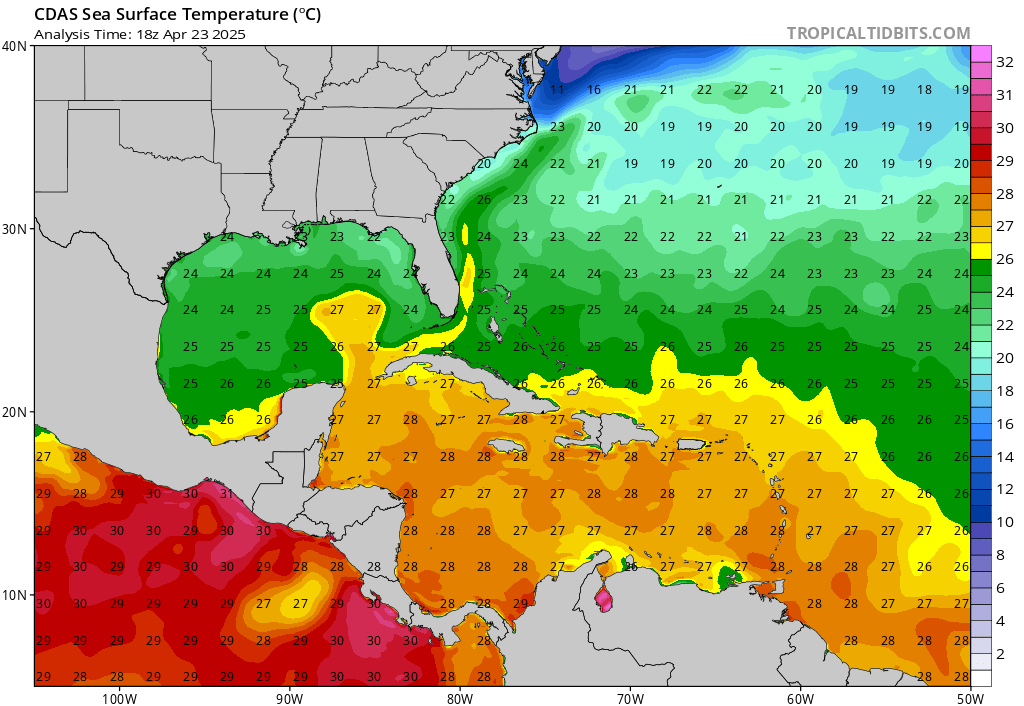
So what does this have to do with Joe’s Email here? He’s not the only one noting that we may be heading into another La Niña. Bad news for California this winter’s rainy season, but essentially no impact on the forecast for Henri. Joe was predicting a central pressure of 780 mb at landfall (only Cat 1!) and this morning near landfall reports are 786 mb and downgraded to a tropical storm.
Low temperatures on the eastern Pacific mean high pressure, which directs hurricanes into the Gulf of Mexico.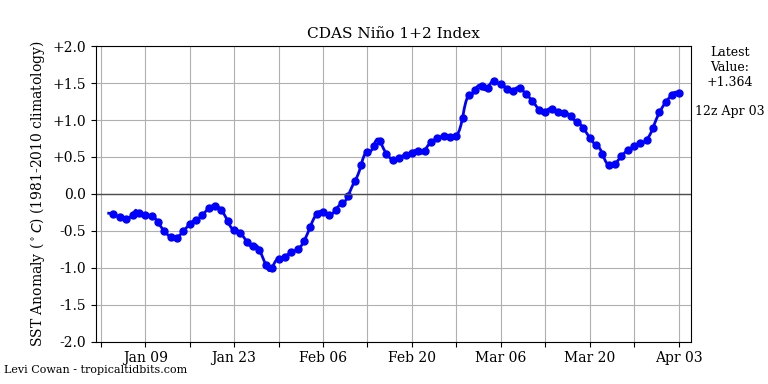
My point is that the next hurricane could be the one Joe Bastardi writes about.
Maybe the next hurricane is the one you write about 🤔
780 mb?? 786 mb??
ya mean 980. 986?
Oops. How’d I screw that up? I guess I tripped over 760 mm Hg being the average sea level pressure.
Thank you for catching that.
The PGA has suspended the Sunday finish of the first FEDEX playoff golf tournament, from Sunday until Monday, due to Hurricane/Tropical Storm Henri. The tournament is being played at Liberty National, named due to the view of the Statue of Liberty, so the PGA is listening and acting out of an abundance of caution. Joe B is correct about the nature of weather predicting, but he is doing good to hang in there and make a prediction based on the facts mixed with experience.
Even a tropical storm is sufficient reason to cancel outdoor events.
Henri is certainly capable of causing a whole lot of upset to Long Island and New England. It has happened in the past and can happen again. Hopefully, everyone in the potentially affected areas has taken precautions and are prepared to handle a protracted time of power outages. This means a good supply of drinking water, lots of batteries for flashlights and a supply of candles and matches. It never hurts to have food on hand that does not have to be refrigerated. Generators are a great idea too.
Make sure your candles are in certified green hydrogen candle holders from the Volvo Group.
A generator in an apartment seems not to be a good idea. We have one in our garden, a 2 kW synchron benzine. good for outside, not for an apartmernt. 😀
At the moment, Henry is dealed as an TS
https://kachelmannwetter.com/de/sat/5c6d065a27b7be0442cc97befd747246/top-alarm-superhd-15min.html#play-0-42-5
Current GOES-16 visible loop. My favorite dashboard for viewing GOES images
https://weather.cod.edu/satrad/?parms=subregional-New_England-truecolor-12-1-100-1&checked=map&colorbar=undefined
I’ve always liked NHC’s satellite loops, in this case the Atlantic Coast one, because of the wider coverage which shows what is influencing it’s shape and direction, particularly the latter over time. (I linked it elsewhere here.)
NHC used to have better product, java based IIRC, which allowed manipulation of the video — length of run, add/remove grid, low, medium, high wind directions, and a couple others, but they canned that for these pitiable ones.
I’d stay out of the subways when this dude hits.
Yeah, me too, but we don’t have any subways in New Hampshire.
BTW, did you see Saturday’s 2300 (EDT) forecast track?
Dear Joe
We love your passion, and respect your comments.
Thanks for sharing them.
Hurricanes have been hitting the USA for thousands of years.
Regards
Yes, many thousands of years going all the way back to 1776.
He’s right folks. 1776 is when those darn uppety colonials staged their bloody rebellion. Before that it wasn’t called the USA. 🙂
On the other hand, Mother Nature doesn’t care what we call that particular land mass. Given the slow movement of the tectonic plates, hurricanes have been landing there for millions of years.
Ah, 1776, the year everything started going downhill for you chaps & chapesses from the Virginian Colonies, we Brits may have been coming but you colonists were revolting!!! 😉 (Love the USA I really do!!!)
Well if we’re really going to get all pedantic about it, it wasn’t specifically the United States of America until the constitution was ratified in 1789.
I’ll double down on pendantic to note it was ratified when New Hampshire became the ninth state to vote to ratify it, the minimum number of existing states necessary for it to become binding. That vote took place on June 21, 1788.
September 17, 1787
That’s the current Constitution, but we’ve been called the united States of America since Thomas Jefferson penned the Declaration of Independence.
“In Congress, July 4, 1776
The unanimous Declaration of the thirteen united States of America, …”
Rich Davis is correct.
You’re both simply wrong. That’s no less wrong than to say that the United States of America didn’t exist until the 27th Amendment was ratified in 1992.
Even if you ignore the Declaration of Independence (signed on July 4, 1776), and the Articles of Confederation (approved on November 15, 1777), France signed the Treaty of Amity and Commerce with the United States of America on February 6, 1778, and Great Britain recognized the United States of America in the Treaty of Paris, signed on September 3, 1783.
The easterly storm force winds driving water between Long Island and Connecticut could cause funnelling and a severe storm surge, so I’d stay well back from the coast on northern Long Island. How quickly does the land slope upwards there?
Quickly enough. See https://www.topozone.com/connecticut/
Welp, if Henri brings us cooler air (which showed up last night), will we poor souls here in the Midwest benefit by having more rain? Kind of need it, even if it is time for the corn to ripen.
Joe says:
Is it too much to wish that we could find some way to talk rationally about the extreme ends of a forecast about tropical storms, blizzard, pandemics, and climate change and leave the hype out of the discussion?
Note to self: “Hey, you hate rhetorical questions so much that you answer them!”
Oh yeah, sorry. It’s way to much to ask.
Meanwhile WUWT permanently has a post titled “Henri is the storm we have feared for decades”
No wonder I don’t spend as much time here as I used to.
And yet you are listed as an editor.
I don’t quite understand your comment about talking rationally. Is not JB’s comment you quoted showing his transparency? I read it as NHC are straight shooters whereas I (JB) like to look at the extreme. He’s qualifying his perspective. After all it is his Blog/email.
And as for your WUWT permanently posted title issue: :Henri is the storm…”. That is the title of the Web page
https://www.cfact.org/2021/08/20/henri-is-the-storm-we-have-feared-for-decades/#
It is standard practice for WUWT to post the article in question’s Headline right into WUWT. Is it not?
I would love to hear your rational talk about the extremes. I would learn from it.
For extremes around the Hurricane of ’38, see https://wattsupwiththat.com/2013/09/21/weather-before-and-after-the-hurricane-of-1938/
My best post (largely thanks to the great comments from several people) is https://wattsupwiththat.com/2010/11/10/35-years-ago-the-witch-of-november-come-stealin/
It looks like TS Henri is heading straight for Block Island. Doesn’t Block Island have a lot of windmills?
Water is cool (24C) , This does not favour a hurricane.
Seams like a good rule: Water with heat over 27 C favors hurricans, below it does not.
Willis E has a good graph.
They did
they have failed
There are five, offshore to the east a bit. Power line problems have things pretty well messed up this summer, maybe longer. The turbines should be able to handle Henri’s winds.
https://www.ecori.org/renewable-energy/2021/8/9/block-island-wind-turbines-motionless-due-to-routine-summer-maintenance
Snow on the ground isn’t enough to justify the hysteria that closes schools and empties grocery stores for what turns out to be less than an inch of snow.
Due caution and trying to be safe rather than sorry are appreciated. Especially since we can’t really be sure where a hurricane will hit nor how strong it will be, just a few days in advance.
But once those predictions are picked up by the hype masters, fear is used to glue eyeballs to TV stations. Makes a lot of money.
And, since it is very important to give advance warning regarding hurricanes, the uncertainty requires warning many more people than will be normally affected.
Getting warned but not seeing the predictions come true coupled with the fearmongering builds significant doubt and distrust.
An inch of snow for those places who only see snow once every 2 to 4 years is enough to paralyze a city until it melts. Such cities do not have any snow removal equipment and nobody in the city has experience driving on snow or ice.
For places that get 2 or 3 feet every year, one inch is nothing. That’s not the case everywhere.
I have lived in southern Florida and Massachusetts, Texas and Alaska, and many points in between. There is truth in what you say, but it is still a lame rationalization.
And where I live now, a point in between, has snow removal equipment, and experience each year with snow, but still freaks out every time snow is predicted. And gives the same excuse.
Valid only in places as described. Say Austin Texas or Tampa Florida or Los Angeles. But go up to Dallas or Atlanta there is ice and/or snow each year.
Also, in Fairbanks AK, where snow is on the ground from October to April, there are always people who forget how to drive on the snow and have accidents in early snowfalls. So five months without snow may be too long to remember how to drive in snow.
A few inches of first snow tends to weed out the forgetful. Body shop owners love it.
Dallas, Atlanta, and even Birmingham, AL, are not far enough north to see snow every year, nor to have snow-handling equipment beyond grit spreaders. The first 10 years I lived here (Birmingham, AL) we saw snow about every other year. The last 3 years we have seen some snowfall, but no snow on the ground. And yet, Birmingham had become blase about the possibility and effects of snowfall, until January 19, 2014. There was a chance of snow, but not a large one, none of the schools closed. I waited until I actually saw snow falling before I left work, and that was almost too late. I couldn’t make it over the biggest hill on my route home and had to seek an alternate route. It brought me out on the peak of that ridge, and I headed down the other side. In just a little bit I decided I needed to slow down, but when I touched the brakes all 4 tires locked up. I was not in control. I got to a flatter spot without hitting anything or anyone. I got to my driveway and it was a downhill entry so I made sure I was good and slow before I turned into it. That slowed down the person behind me to where they didn’t have enough speed to make it up the next hill. By the time I got to my door to go inside there were 6 cars stopped in the road in front of my house. One poor girl was hanging onto the door of her car. My wife suggested she just leave, she replied that when she lets go it starts sliding. Tell me that’s a normal snowfall? We called the grandkids’ school, they reported they had tried to send them home, but the busses never made it out of the parking lot. They were all back inside having peanut butter sandwiches. The B’ham metroplex remained shut down for about 4 days, until the last of the ice had melted. Now, everytime there’s a chance of snow school is cancelled. It likely will remain that way for at least another 10 years.
Surfs up! check out the webcams along the Hamptons beaches, pretty cool.
Oh, the horror!
I know, it’s all gone a bit damp squib…. at least everyone gets to keep their roof tiles.
Joe – looks like this is going to be a strong tropical storm coming ashore and degrading fast. I think we can all be happy it isn’t worse. But thanks for your reasoned and reasonable concerns. Overhyped storms is a huge problem and we have all seen the devastating results of that. But there’s a big difference between overhyped and cautious warning. Thanks for your service.
ventusky.com shows stronger winds over northern Hudson bay at this moment than TS Henry shows, off Long Island
My point is there is no bias toward hype at NHC. right or wrong they are straight shooters.
Query; with no intent to judge: Is there anything in today’s world that is not politically influenced?
Hurricane Harvey was not overhyped. It did exactly what the forecasters said it was going to do, and then some.
I said nothing about “overhyped”. Perhaps your comment was misdirected?
Joe, it is TV/cable/satellite “news” who overhype every storm and cause people to doubt every report. Strip out the sensationalistic, flashy graphics and overly dramatic music and just simply report THE WEATHER, accurately, and stop trying to drive people into a continuous state of terror over simple weather events. Oh, and perhaps someone can tell me when NYC was moved to Rhode Island, news has been screeching two days about “America’s biggest city to be hit by HURRICANE Henri.” and I kinda figured a more northerly land fall. Just curious how professionals can continuously get everything so wrong.
Yeah, I agree with you. I also agree with Joe B., hurricanes and even tropical storms (T.S. Allison anyone, and what it did to the Houston Medical Center) can do significant damage, and I agree also with presenting the worst possible case when forecasting. But giving a name to every cold front that moves through in the winter? Planting feet and leaning while delivering a tropical storm report even after photo-bombers showed you could still stroll through the weather? That’s just 2 examples of over-hype! I think we need to inject more realism, maybe do some studies and see what that radar-indicated top windspeed at X,000 feet above wavetops actually means when it comes to real-life impacts at ground level on land. I would appreciate that kind of realism.
Weather can do terrible things, always has and always will. These parasites in “news” media are personally profiting off all that misery, more dead means more money for them, causing panic creates more bodies/maximizes profits. It is that simple. All along they are pushing their leftist ideology whilst destroying the credibility of real science and filling their pockets.
I see no reference to the infamous 1938 hurricane that battered New England. It caught the weather people by surprise https://en.wikipedia.org/wiki/1938_New_England_hurricane
I was 13 months old when the 1938 hurricane hit. We lived in a small house just one block from the ocean front in Quincy, Mass, just below Boston. My father commuted to Boston every day for his job. It was Wednesday morning, September 21 when my Dad left for work in Boston as usual on what looked to be a beautiful and sunny early fall day. Many people had gone to the beach that day to take advantage of one of the last days of fine weather since there had been so much rain that summer. This was in the days before weather satellites so weather forecasters had to depend on reports from ships at sea to track hurricanes as best they could.
This hurricane had been tracked from off the Florida Keys and was thought to be heading out to the Atlantic Ocean as storms that didn’t make landfall on the southern coast of the U.S. had historically done. There actually had been a radio report from a ship at sea indicating the storm was turning to the mainland, but higher-ups in the U.S. weather service dismissed it because they thought it was non-typical storm behavior. They, and the rest of the population of New England had no idea this monster storm was barreling up the east coast just off Long Island and had started to turn inland. It caught everyone in that region totally off guard, which is one of the reasons it was so devastating.
By mid-afternoon the skies suddenly darkened in the Boston area and the winds began to pick up. By the time my father would have normally started to head home, the hurricane was pounding Boston in full force. A few miles east of Quincy was the suburb of Milton, MA where the Blue Hill observatory was located. At around 6:00PM instruments recorded wind gusts of 186 mph before all but one of the wind instruments broke. This remains the 2nd highest recorded wind ever recorded on earth! Boston itself recorded prolonged winds of about 100 mph, breaking windows and toppling church steeples!
The speed of the wind also created a huge storm surge, which coupled with astronomically high tides at the autumnal equinox, created huge walls of ocean water that inundated coastal areas. In addition to the wind devastation that downed hundreds of thousands of large old trees in the region that blocked roads in and out of Boston, streams and rivers that were already swollen from the previous rains began to overflow their banks flooding roads not already blocked by trees. One can imagine what my father must have faced trying to get back home to Quincy!
Meanwhile the power, telephones and all forms of communication were gone in Quincy where my mother was at home with a 13 month old (me!) with hurricane force winds howling outside from the Atlantic ocean a block away having no idea what had happened to my father and having no way to know what was going on. She didn’t talk about it much, but did say it was one of the worst days of her life. I never did hear the story from my father, nor did I ever hear any details of how he did it, but somehow he managed to get home that night or early morning nearly eight or ten hours after the worst of the storm had passed. It was traveling so fast that by 9pm the storm had moved into Canada where it still had enough force to do significant damage.
There are literally hundreds of stories you can find coming out of this hurricane, some fascinating, some heroic and many tragic as I’m sure is the case with Sandy and other large storms. Almost 700 people died in 1938 and many parts of the coastal region were changed forever. Thousands of CCP work camp men, the WPA having just been put into place because of the Great Depression, were sent in to New England by President Roosevelt to help with the clean-up marking the first time the Federal Government got involved in emergency relief effort.
No one mentioned “global warming” back then!
I like the work Mr Bastardi and appreciate his take on Henri whether it pans out or not.
I also respect his opinion on the science but I’ll disagree all day long on his assertion the NHC never hypes their storms and meeting them ain’t gonna change that ’cause they’re going to do what they do.
I provide some back up but see as I’m stuck with phone instead of computer right now I’ll beg off on that.
Here was the NHC forecast at the time JB made his original comment.

Again, I agree with Joe B.’s caution, but one thing I want to point out: Both the 1938 “Long Island Express” and the 1944 “Great Atlantic Hurricane” were swept up in fronts moving off the east coast and had forward speeds of ~60 mph for some time before landfall, which probably should be added to the already significant top wind speeds, created much larger storm surge, and also left little time over cooler waters to sap their strength. Henri, according to the previous graphic, has a forward speed of only 6 mph. So while this may not be “The” storm, Joe is correct, it has happened before and it will happen again.
Looks like the MSM has expelled a collective sigh of despair, now that Henri has been downgraded from a Cat 1 hurricane to a tropical storm.
Well they’d like a hurricane to fill the news broadcast so they won’t have time to cover the fiasco in Afghanistan.
Or lose any of their budget! The far more important consideration compared to the lives & properties of the great unwashed.
Sorry, Henri now at landfall with sustained winds in the 30 knot range.
Yesterday the offshore buoys were showing sustained winds in the 30 knot range.
Now the offshore buoys and the land based anemometers are showing maximum sustained winds just over 30 knots. Not just some, all of them.
Yesterday, the NHC was saying the winds were Category 1, and now 60 mph.
This has been going on with every TS for years. The NHC does not state winds that match the surface based anemometers. The Saffir-Simpson scale correlates surface damage to maximum sustained winds. Thats it. Don’t tell people that the winds are stronger than reality.
The Saffir-Simpson scale
https://www.nhc.noaa.gov/aboutsshws.php
For years, photos of storm damage have shown that the NHC has been exagerating the wind speeds. Not just a little, but a lot, 20 plus knots. That’s consistently dis-honest, which is why people are saying that the NHC is dishonest. It’s deliberate lying to get media attention, which is justified by the “just being overy careful” attitude that people are in danger, so must be provoked into action.
The NHC knows the real wind speeds from the aircraft measurements, but then the “modeled” winds speed is generated. They know how to correlate aircraft measurements into realistic wind speeds at the surface, but they don’t want to tell the world that the surface winds are 30 knots.
If and when the NHC starts to show accurate sustained wind speeds in their declarations, then people will stop saying the NHC over-hypes the forecast and developes some credibility.
Yup. Watched it in real time when Harvey hit in 2017. The instruments were telling a different story NHC, Weather Channel, local news were reporting.
Trump Impersonator with Henri Update
Hilarious
RE: My Geomagnetic Ap/Kp Atlantic Basin hurricane intensification hypothesis
For background see my comment here:
https://wattsupwiththat.com/2021/08/20/henri-is-the-storm-we-have-feared-for-decades/#comment-3322579
Update: On Why Henri did not undergo an Rapid Intensification (RI) strengthening as forecast.
In my comment yesterday (link above) to JB’s original post on Henri I concluded:
“As such, my hypothesis together with the geomagnetic forecast does NOT indicate Henri will have an RI before its landfall on Sunday afternoon.”
The floor fell out the solar wind yesterday. Solar wind went dead calm here at the 3rd Rock from the Sun, calm conditions as can be as solar wind goes. See Attached image is the Real time Solar Wind observations for the past 7 days.
Last weekend solar wind speeds were between 400 to 500 km/sec, and particle temps were above 1E+05 K. Starting 18 August speeds began falling. by 19 August (blue arrow) solar wind speeds were below 400 km/sec and temps began a rapid cycling lower. But then around noon Saturday (Eastern daylight time) (red arrow), the floor absolutely fell out the solar wind. It flat lined at a near 330 km/sec and temps down to ~1.2E+04 K. In the last 12 hours, the solar wind speed has fallen further, under 300 km/sec. So even calmer. This is a solar minimum type wind speed. Surprising. But my hypothesis says this does not favor a TC to undergo an RI event.
But those very calm geomagnetic conditions kept Henri from utilizing the Gulf Stream warmer waters and improved wind shearing conditions for the last 24 hours. No RI.
One of the problems with current modern hurricane forecasters and hurricane forecasting IMO too much focus on what is happening at the surface (surface is SSTs, central pressure at surface, and wind field diameter) and to about 20,000 feet where the hurricane hunter aircraft flies.
One has to remember the tropical cyclone (TC) is a heat engine that can thermodynamically be understood as a Carnot Heat cycle to get an efficiency number. The efficiency of the Carnot cycle TC heat engine is determined by just two temps, T1 and the surface (usually sea surface temp) and T2, the temperature of the top where the heat engine dumps its heat. T2 is the tropopause-stratosphere interface. Not enough attention is paid to what is happening at T2, as the level (height) of tropopause -stratosphere boundary can fluctuate day and night and in response to solar wind changes pushing on the thermosphere above the stratosphere.
This may be what’s happening mechanistically to understand way calm solar geomagnetic conditions can keep the tropopause-stratosphere boundary elevated and make it harder for the TC eyewall cumulo-nimbus heatpipe towers to teleconnect with the coldest temps at the bottom of the stratosphere. It is the cumulo-nimbus towers that act as convective heat pipes through which massive amounts of latent heat is moved vertically to dump as sensible heat (to radiate to space) upon condensation at the tropopause interface. Remember, temps increase in stratosphere with height, so the coldest temps is right at the tropopause-stratosphere boundary. This boundary height I suspect is being affected by solar wind fluctuations in real time response to solar wind speed, temp, and particle density changes.
This is maybe tangential… I think the Saphir-Simpson scale is inadequate to describe the total force of a hurricane, since it only shows top wind speeds. For example, Hurricane Andrew was a Category 5 hurricane at landfall, but it had a radius of <50 miles, I think, certainly <70. Whereas Hurricane Allen and Hurricane Rita both filled the entire Gulf of Mexico at one time on their journey. Hurricane Allen might not have attained top wind speeds to rate a Cat V designation, but the total amount of energy dissipated probably far exceeded the amount of energy dissipated by Hurricane Andrew or even Hurricane Camille.
Long lived La Nina (1954-57) and bad hurricane seasons 1954/55 along the East Coast….during modest global cooling.
Worst hurricane in history there: Great Colonial Hurricane of 1635…….during the Little Ice Age.
https://www.marketforum.com/forum/topic/73966/#74028