Guest “That’s not how I would have phrased it” by David Middleton
JUL 28, 2021
Renewables became the second-most prevalent U.S. electricity source in 2020In 2020, renewable energy sources (including wind, hydroelectric, solar, biomass, and geothermal energy) generated a record 834 billion kilowatthours (kWh) of electricity, or about 21% of all the electricity generated in the United States. Only natural gas (1,617 billion kWh) produced more electricity than renewables in the United States in 2020. Renewables surpassed both nuclear (790 billion kWh) and coal (774 billion kWh) for the first time on record. This outcome in 2020 was due mostly to significantly less coal use in U.S. electricity generation and steadily increased use of wind and solar.
[…]
Principal contributor: Mickey Francis
EIA
In reality, if you combine five different energy sources (wind, hydroelectric, solar, biomass, and geothermal energy), they are now basically tied for second place with coal and nuclear power.
The eye-catching thing on this graph, is that natural gas is pulling ahead faster than unreliables are catching up.
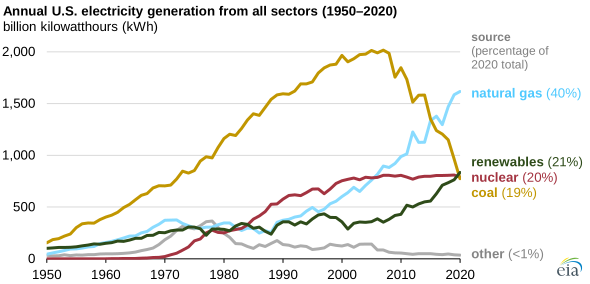
Note: This graph shows electricity net generation in all sectors (electric power, industrial, commercial, and residential) and includes both utility-scale and small-scale (customer-sited, less than 1 megawatt) solar.
| Billion (kWh) | |
| Natural Gas | 1,617 |
| Unreliables | 834 |
| Nuclear | 790 |
| Coal | 774 |
Here’s how this would look, if you posted it like baseball standings:
| W | L | GB | |
| Natural Gas | 162 | 0 | – |
| Unreliables | 83 | 79 | 79 |
| Nuclear | 79 | 83 | 83 |
| Coal | 77 | 85 | 85 |
Don’t like the math? Take it up with Yogi Berra…

However, for coal, “it ain’t over till it’s over”!
Coal Production. We forecast U.S. coal production will increase by 78 million short tons (MMst) (15%) in 2021 to total 617 MMst for the year. The expected increase in production reflects greater electric power sector demand for coal. Higher natural gas prices make coal more economically competitive relative to natural gas for electricity generation dispatch. In the forecast, coal production increases by 13 MMst (9%) in the Appalachia region, 14 MMst (16%) in the Interior region, and 51 MMst (17%) in the Western region
EIA

You don’t believe Yogi said those things?

“It’s deja vu all over again.”
It always is… 😎
“Other”? What would “other” be?
Largely oil and diesel. It also includes some waste from industrial processes that will be fed into combined heat and power generators.
So just another bald faced lie from the same lie spewing liars who constantly lie.
most of what Yogi said was very deep……”nobody goes there anymore its too crowded” sound contradictory nobody goes there but it is too crowded, that was his point, people in the know dont go there now because it is too crowded…..and it aint over til its over is 100% accurate about a baseball game……
Yep… But Yogi studied under the master, Casey Stengel…

This was Casey’s answer when asked why the Mets’ first three choices in the 1962 expansion draft were catchers… 😆
They’ve done a heckuva job on coal since January 2009.
Good thing fracking came along over their dead bodies. Looks to me like they can’t build wind turbines fast enough to do the replacements if they get that far.
The eye catching thing is how much coal has lost. Is coal up vs 2020? Yes, but still down quite a bit vs 2019. Coal capacity factor in 2019 (latest year I have data for) was ~31%, meaning most of the plants are sitting idle at least half the time.
Renewables will do what they do, and you should expect that once they are installed they will churn out power for decades while gas will scale up and down since its highest cost is the fuel. Personally I expect the current decline in coal to continue for the next 5 years bringing it to roughly the same level as oil. Gas continues to grow over that time frame, but after that each new wind turbine or solar panel will pull a chunk out of gas generation.
Personally I don’t care where my power comes from since I have no emotional attachment to wind turbines, solar panels, natural gas, or coal briquettes. This is just my expectation based on historic trends and planned installations as reported by EIA.