Gavin D. Madakumbura, University of California, Los Angeles; Alex Hall, University of California, Los Angeles; Chad Thackeray, University of California, Los Angeles, and Jesse Norris, University of California, Los Angeles
The Research Brief is a short take about interesting academic work.
The big idea
Human activities, such as burning fossil fuels for transportation and electricity, have worsened the intensity of extreme rainfall and snowfall over land in recent decades, not just in a few areas but on a global scale, new research shows.
Past studies were able to attribute individual extreme events and long-term changes in some regions to climate change, but global assessments have been more difficult. We used a new technique to analyze precipitation records from around the world and found conclusive evidence of human influence on extreme precipitation in every one.
Scientists have been warning that rising global temperatures will lead to more extreme precipitation in the future, mainly because warm air “holds” more water vapor in the atmosphere, fueling storms.
With Earth already about 1 degree Celsius (1.8 F) warmer since the start of the industrial era, we wanted to find out if that change had already started.
Past attempts to detect the human influence in historical precipitation records typically required long time series with many consecutive years of data. But precipitation is difficult to monitor over long periods from land or space, so those records are rare. We found another way.
We used artificial neural networks, a type of machine learning, to find patterns of extreme precipitation in weather records. Once those neural networks understood what to look for, we could analyze shorter and more disparate observational records.
The result is multiple lines of evidence that human activity has intensified extreme precipitation during recent decades. Even when the data sets were widely different, we were able to see the human influence.
The findings were published July 6, 2021, in the journal Nature Communications.
Why it matters
Understanding how humans influence extreme precipitation is important for interpreting climate events today and for preparing cities and protective infrastructure for the changing world ahead.
In recent years, devastating flooding has made headlines after extraordinary rainfall that historically would have been extremely rare. The 2017 hurricane season in Texas, Florida and Puerto Rico and the extreme monsoon rains over India and Bangladesh in 2017 are two examples. Our results indicate that, as a general rule, precipitation has become more extreme around the world in recent decades.
Perhaps more importantly, our results indicate that further warming of the planet through the 21st century is likely to continue to intensify the most extreme precipitation events. Climate models project such an intensification will happen this century, and they suggest that a similar but less-rapid intensification occurred in the 20th Century, based on how much the planet has already warmed. Our results validate that finding.
With greenhouse gas levels in the atmosphere still increasing, the planet is projected to continue warming through the 21st century. How much it warms will depend on choices made today about fossil fuel use and other major contributors to climate change. That 1 degree of warming could be 4 degrees by the end of the century if emissions continue at a high rate.
What’s next
While we clearly identified the influence of humans on extreme precipitation in the past, we haven’t yet isolated how much each type of human activity has contributed. Greenhouse gas emissions, aerosols and changes in land use can all have an influence. We plan to modify our machine learning method in the future to home in on those sources.
The machine learning method we used is also currently learning from data alone. We can take this up a notch by bringing climate physics into the algorithm. By doing that, the machine would learn the physical processes that lead to intensifying extreme precipitation. Other climate variables could be included, such as winds, clouds and radiation, helping to answer not just whether extreme precipitation is intensifying, but why.
Gavin D. Madakumbura, Ph.D. candidate in Atmospheric and Oceanic Sciences, University of California, Los Angeles; Alex Hall, Professor and Director, UCLA Center for Climate Science, University of California, Los Angeles; Chad Thackeray, Assistant Researcher, UCLA Center for Climate Science, University of California, Los Angeles, and Jesse Norris, Project Scientist, Atmospheric and Oceanic Sciences, University of California, Los Angeles
This article is republished from The Conversation under a Creative Commons license. Read the original article.
Rain comes from the atmosphere.
They should be using atmospheric temperatures not sparse, fudged and tortured, UHI affected surface mal-constructions.
UAH shows El Ninos are responsible for all warming in the satellite measured data.
No human causation whatsoever.
And seriously, artificial neural networks !!
They can be programmed to produce any outcome you want them to produce..
(Banned again for using unverifiable e-mail, for eluding a previous ban) SUNMOD
Mr. t: Well, sure it can be programmed that way, but it’s comforting that it’s in the hands of scientists who won’t use their neural network to prove, say, that AGW’s severe weather is a result of white privilege. Not until they are told to do so.
Don’t give them any ideas.
AKA “data mining”, very popular nowadays when you don’t understand something.
The turbo-charged rain claim just doesn’t hold water.
The atmosphere can hold more water vapor when it’s warm, that’s true. The key word is “hold”. It doesn’t rain because it’s warmer as a warm atmosphere can hold more water vapor. However, the atmosphere has always warmed from winter temperatures through spring and into the summer.
With global warming running at a small 1 degree C per CENTURY, whatever temperatures that occurred in the early 1900s will still happen, but mostly the warm temperatures just occur a few days earlier in spring and last a few days longer into the fall. It’s not the temperature averaged over the year over the entire globe that matters to extreme rainfall events, it’s the local temperature and humidity GRADIENT (change over distance) at the time of the rainfall that matters and how the different air masses interact with each other and the topography.
The only way for global warming to cause heavier rainfalls is if the slight warming somehow creates a greater temperature gradient so warm, moist air runs into cold air masses more often – but that is most definitely not happening. The small amount of global warming we’ve seen over the last century has decreased temperature gradients as the Arctic is warming faster than lower latitudes.
That big rainstorm that would have happened on June 15 in the year 1900 will now happen on June 11, a few days earlier. The only possibility for more intense rainstorms is only those that occur on the few hottest days of the year and that only if weather conditions set up a rapid cooling of the hot, humid air mass. Global Warming Alarmists will claim that ANY intense rainstorm or flood was caused by Global Warming and that’s almost always a lie.
“Our results indicate that, as a general rule, precipitation has become more extreme around the world in recent decades.” Except here. It is good to know that we are the ones that “prove” the rule./s
“In recent years, devastating flooding has made headlines after extraordinary rainfall that historically would have been extremely rare. The 2017 hurricane season in Texas, Florida and Puerto Rico and the extreme monsoon rains over India and Bangladesh in 2017 are two examples.” So rare they couldn’t even look up historical data.
“We plan to modify our machine learning method in the future to home in on those sources.” Yet another model that doesn’t factor in climate physics.
In an 1980 report on a century of Texas weather data 34 stations reported over 25″ and 59 over 20″ in a month. 27 reported over 15″ in 24 hours. 1899 flood, not tropical, may still be the worst, not many records, but two stations [Hearne, Turnersville, ] had over 30″ in three days on the Brazos around Waco and counties to the south. As of 1980 the flood was called the “severest” in Texas 100 year recorded history, still listed as the top in 1995. Older Spanish reports suggest similar ones.
Griffiths, J. F. And G. Ainsworth. 1981. One hundred years of Texas weather. Office State Climatologist. Tex. A & M. Univ. Monograph Series 1:1-205.
In Texas the color charts for drought and precipitation often act like a slow flashing neon sign. They should have waited, Rockport of Harvey fame just had over 20 inches in 96 hours, stalled upper level low. Flooded areas never seen before, suspect is careless development.
Of course it is a new millennium, but their “Fig. 4: Metrics of the forced signal in observation-based estimates of precipitation during 1982–2015” did go back a little, HOWEVER, “Several caveats of the machine learning-based detection method should be noted.”
Another non-sequitur was this –
As I understood their article, they had already told us the WHETHER and the WHY of their posited extra precipitation.
They said it was definitely happening, and caused by manmade GHGs.
So why the need to bring in winds, clouds & radiation?
It’s always deluge or drought. There’s no such thing as “normal” because the average is a mathematical concept that doesn’t exist in the real world. So when it rains it’s deluge, when it doesn’t it’s drought.
I blame the neural machines, aka SkyNet. They’re actually quite stupid, even when their colors are updated. My new engineering method for dealing with the problem involves hammers, but I don’t want to get into the technical details at this time.
Mike, we should talk. I’ve recently been working on a method that utilizes “bigger hammers.”
I always start with the biggest f-ing rock I can find.
As I read the post it basically said, We don’t find increased severe weather in historical records, so we looked short term and found what we wanted in some areas.
As it was hard to find we used computers.
Surely you aren’t claiming that Goldie Locks is a fairy tale and that mid-range values don’t always exist! If you try to convince me that unicorns survived the Great Flood I’ll know that you are pulling my leg.
Mike D., are you crazy? Taking a hammer to such a delicate instrument? Try duct tape.
“It’s always deluge or drought.”
That’s the official “make them fear” line but reality is that its almost always “just more rain” and that’s a good thing. I’ll take more rain on average benefiting us all the time with the occasional flood that is even bigger than it might have otherwise been …every day of the week.
So will the farmers.
” We used a new technique to analyze”
” We used artificial neural networks, a type of machine learning”
Oh well then it must be right. I mean machine lernin and everything…..what’s not to love!?
A type of machine dumbing down.
Are the machines being taught CRT? Might as well make sure everything they learn is wrong.
The machines will win the war and re-write history. All humans will be demonized.
And chip lives will matter.
Signs of being right do appear.
Humidity follows temperature in laboratory tests only. Samples of 1 litre. Even wikipedia says you throw out all results when dealing with multi- litre samples. Open atmosphere does not follow laboratory stuff.
But… correlation is not causation.
There is no historical or theoretical basis for assuming that CO2 at these levels is in control of temperature, and thereby of precipitation. And since man’s production of CO2 went down by 30% in 1929-1931 with no change in CO2’s languid rise, there is no reason to assume that we are in control of CO2 levels.
And, anthropogenic CO2 went down 6-18% in 2020 “with no change in CO2’s languid rise.”
The Climate Change Scam has all the bases covered:
Floods, deluges, droughts, heat waves, cold spells, hotter, colder. More storms, less storms.More intense storms, less intense sotrms. Climate Change “predicts” them all.
But always after the fact of course.
It’s always Climate Change, 24/7/365.
Which is how the rational, scientific mind knows climate change is a religion to its followers. But also a dangerous socialist scam on the capitalist democracies of the developed world.
It has been found an even more reliable method is … the meticulous scrutiny of chicken entrails exposed to extremes of cold and heat, then left to putrefy in the Sun for exactly four days. Best results are found with a pure white pullet.
It is difficult to overstate how big a stinking pile of bovine effluent this is. Nature should be embarrassed that they published this. Who did the
peer“pal” review?Because accurately recording data over a long time to identify meaningful trends is so tedious and boring. And analyzing it might yield inconvenient truths that contradict their foregone conclusions. Luckily, they “found another way”!
Gosh, they used real data. Wait a minute…The “data” was churned out by several different model runs of the computer-generated global climate models. The “data” is completely artificial. They measured the computer-generated precipitation projections from several different models!!! They measured all the biases that humans programmed into the models.
It doesn’t occur to them that the models are not the real world, nor have they noticed that numerous attempts to validate the GCM projections against measurements have demonstrated that they predict far more warming than is measured.
I guess if you grew up thinking immersive computer games were just as good as the real world, you might believe that the computer simulation is the real world. Bizarre.
From the article, “Anthropogenic influence on extreme precipitation over global land areas seen in multiple observational datasets” in Nature Communications:
The intensification of extreme precipitation under anthropogenic forcing is robustly projected by global climate models, but highly challenging to detect in the observational record.
IPCC AR5 (2013) pointed out the difficulty of identifying trends in extreme precipitation, much less identifying any human influence causing it.
Regional trends in precipitation extremes since the middle of the 20th century are varied (Table 2.13). In most continents confidence in trends is not higher than medium except in North America and Europe where there have been likely increases in either the frequency or intensity of heavy precipitation.
Medium confidence means “we’re not sure”. But what if they use machine learning to tease out an anthropogenic signal? Yeah, that could work. But lets not use that troublesome and inconsistent observational data from weather reports. Just use “clean” artificial data generated by climate models programmed with the assumption that CO2 is the main cause of warming over the last 50 to 100 years.
An artificial neural network (ANN) is trained to predict a proxy of external forcing (e.g., the year of the data) based on the spatial maps of the target variable from an ensemble of GCM simulations.
And to show that they have no bias whatsoever (except the bias of choosing artificial data over observations) they tell us:
Thus, we are agnostic about which GCM is correct, and which gridded dataset is a true representation of the observed record.
I’m agnostic about the GCMs too. They’re all wrong, some more than others, as was shown in IPCC AR5 (2013) here:
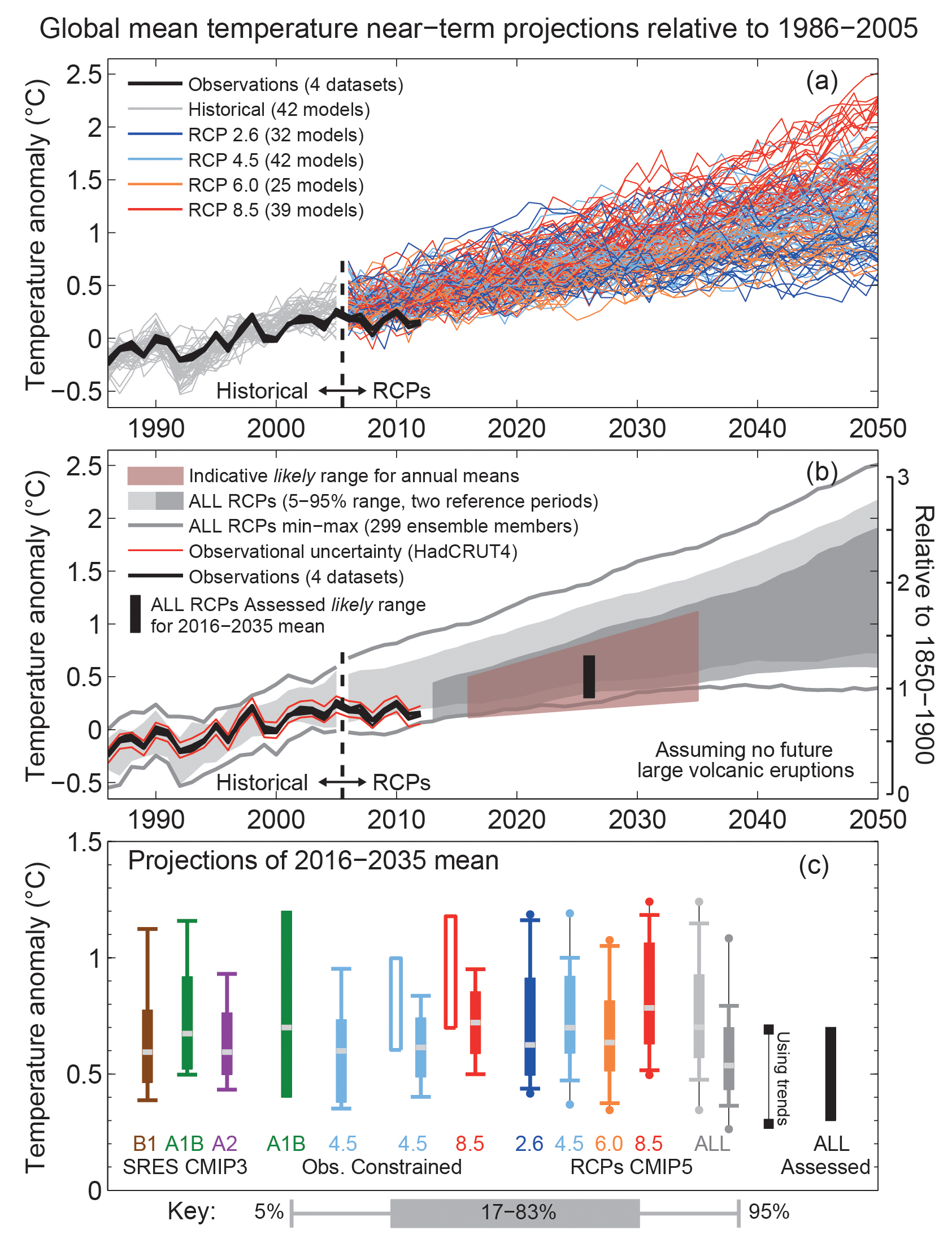
Being sanctimoniously “agnostic” about which GCM is correct, demonstrating their scientific neutrality, they conclude:
In this way, we efficiently generate multiple lines of evidence as to the presence of an anthropogenic signal in the various instantiations of the observed record.
Multiple lines of “evidence” from garbage data still produces garbage. Just saying…
Temperature observations in your chart only go up to 2012. Ed Hawkins has updated that chart every year as new full year data comes in. It now looks like this:
HadCrut adjusted data reconstruction from sparse, unfit-for-purpose, urban surface stations..
Yawn !
Good to see you back, there just wasn’t quite enough gratuitous malice at WUWT with you exiled.
It’s also HadCRUT data that’s used in the 2013 IPCC chart posted by stinkerp. Wonder why you didn’t complain about that?
”Other observational data sets”?
Amazing how EXACTLY the same they are!
Not really, they all use similar methods and much of the same data sources. It would be more surprising if they varied greatly.
Models are starting to look terminally sick and diseased,
Just like the AGW cult religion.
But you’ve just seen that the models are now in much better agreement with observations than they seemed they would be even 10 years ago. That’s far from looking “terminally sick and diseased”.
It only took a Super El Nino and arbitrary AR5 downward adjustments of the UN IPCC CliSciFi models.
I love the term “in better agreement” … err no the output is running between some very large bounds is about the best you could claim.
Thought I’d complete it for ya..
By drawing a line on it with a crayon?
You included the UAH baseline change in April 2021…..so only 1/10 on your mid-term….
These are surface observations, as stated. The base period on Ed Hawkins’s updated chart is the same as the one used in the 2013 IPCC report, 1986-2005. It has to be, otherwise it wouldn’t be a valid comparison to the chart published in the report.
Nope…surface observations would be in degrees C…so somebody had to subtract a historic record of their choice from the surface observations. This gives a pretty big artistic licence to graph maker.
These are degrees C; just expressed as anomalies. You mentioned UAH. They also publish anomalies of degrees C. What’s the difference?
FNail,
Today we are about .1 degrees higher than 2012 according to UAH, so your end point is about 0.3 C too low.
These are not lower troposphere temperatures.
If M’lord had posted that – Denizens would have believed it
Ending on a Super El Nino, much? I’ll wait for the next few years’ data.
Quite right. We should be judging the models over their forecast period, which for CMIP5 is 2006, I think.
CMIP5 forecasts begin 2005. Outside the late 20th Century training period individual model results are all over the place in hindcast as well as forecasts. There is no tropical tropospheric hot spot as predicted by the models. Additionally, the average global temperatures of the individual models vary by 3 C.
The question is about the model range versus observations featured in the 2013 report. It’s not about the performance of individual models, none of which are expected to exactly replicate future temperature variations. That’s the point of using a large range of projections. So long as observations remain inside the range, the model ensemble has predictive skill. That’s what we’re seeing, like it or not.
High ECS models have no predictive “skill.” Low ECS models are the only reason observations are in the “range.” UN IPCC CliSciFi 2013 AR5 had to arbitrarily reduce mid-range modeled temperatures because models were obviously running uncomfortably hot (pun intended). Because CliSciFi practitioners have no honor, they didn’t reduce the outyear temperatures and, additionally, allowed alarmists to call the unphysical RCP8.5 “business as usual.”
Having read AR5 WG1, the physical basis, I noticed that the body of WG1 had no material of an alarming nature. But the section authors allowed the political-types to exaggerate, misquote and lie about the science in the SPM. High ECS CMIP5 models using RCP8.5 were the basis of hysterical fearmongering by NGOs, politicians and the media. I also note that CliSciFi CMIP6 models are running even hotter than the risible CMIP5 models.
Some models run higher than others because they make different assumptions, even those produced by the same teams. So portraying this as some kind of mistake is misleading. All the models are ‘wrong’; that is known from the outset. Hence you have the same team producing models with quite different results; so they already know they are ‘wrong’. The question is, are they helpful?
From what I can see, the CMIP5 model range is doing a reasonable job. Observations have been constrained within it and temperatures have risen over the forecast period, as expected. Only if you don’t include data after 2012 does the multi-model average look on the cool side. The multi-model average of RCP 4.5 in particular is a good fit to the suface observations.
When most of the models run hotter than observations (all but a few) you simply can’t say the observations are “within the range”. That carries the unspoken implication that as many run higher than observations as run lower. It is far more instructive to say “observations match the models at the lower end of the range”.
Yeah but that is honest and there is scant amounts of that in climate science.
But “Final Nails” comment: “All the models are ‘wrong’; that is known from the outset,” is the more accutate summary.
“Wrong” is always the opposite of “helpful”. Or is this more 2021 Newspeak?
So your argument is that the climate models accurately depict global temperatures and precipitation? Interesting choice, given the numerous documented problems with resolution in the models and their inability to represent clouds and water vapor which have a far greater impact on warming (and cooling) than CO2.
I’ll see your “updated” graph that excludes any time series that shows the global warming “pause” between 1998 and 2016 and raise you with Dr. Roy Spencer’s updated graph which includes all the major temperature datasets. Dr. Spencer’s analysis is illuminating.
http://www.drroyspencer.com/wp-content/uploads/ICCC13-DC-Spencer-25-July-2019-Global-LT-scaled.jpg
The blue line which represents the UAH data falls well below the range of the CMIP runs, as expected. RSS touches the lower range. UAH has factored in orbital precession (satellites arriving over the same spot at different times of day) but RSS has not, which introduces artificial warming in their signal.
That graph goes through 2018. In 2021, we’re at essentially the same temperature but there’s a big difference. The model projections continue to warm over the last 3 years, further diverging from observations.
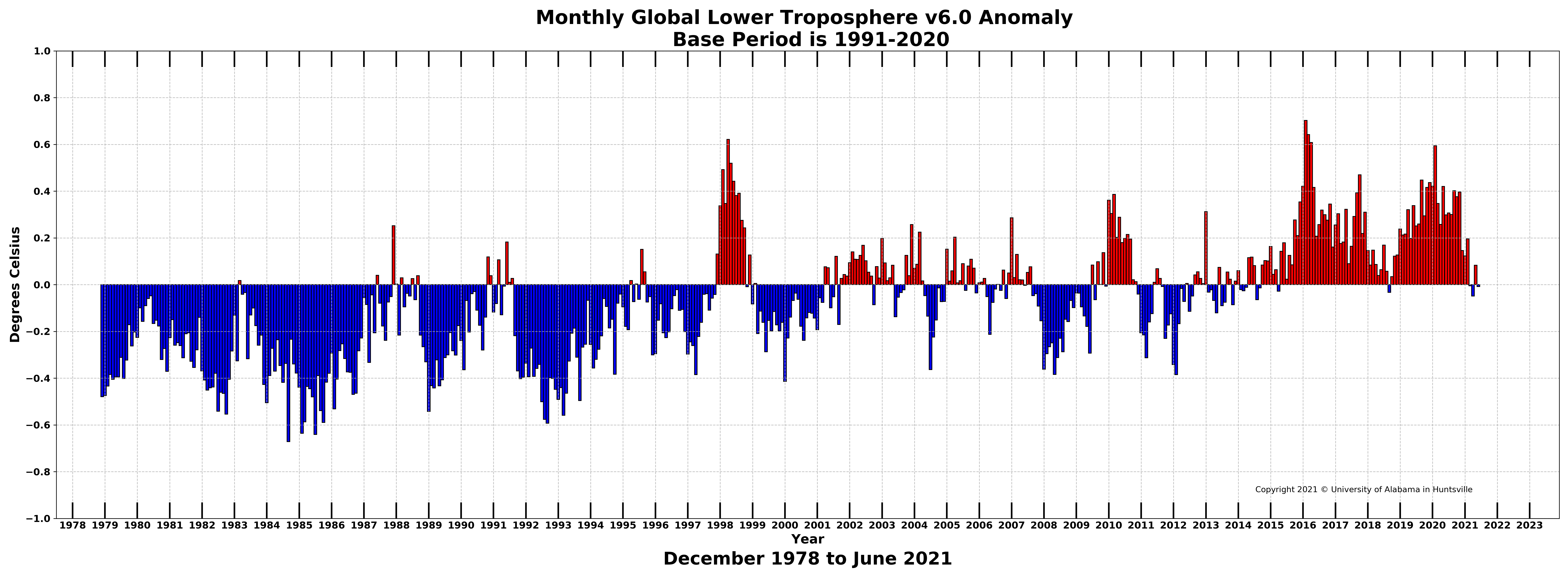
Interesting how only the satellite time series shows the global warming “pause” between 1998 and 2016 noticed by everyone in the climate science community, generating a great deal of hand-wringing commentary and spurious explanations by the faithful alarmists. I wonder why the satellite time series is so different from the terrestrial station time series? It couldn’t have anything to do with the fact that the satellites cover essentially the entire globe without having to extrapolate temperatures (make up fake temperatures) for large areas that have no measurements like the terrestrial station data does. Or the fact that the vast majority of terrestrial stations are biased by the urban heat island effect.
All 5 datasets (HadCRUT5.0, Cowtan & Way, NASA GISTEMP, NOAA GlobalTemp, BEST) used to derive the “other observations” don’t show the 17 year “pause” in warming between the spike in 1998 from an unusually large El Niño and the new temperature peak in 2016 from another large El Niño. But the satellite datasets, RSS and UAH, clearly show the pause.
So we’re left with the realization that with each passing year that the CMIP projections diverge further from observations (which they do), the more the planet will have to rapidly warm to catch up to the wild prognostications of the climate models. The models are spectacularly wrong. Anyone who has even a passing understanding of the complexity of Earth’s climate understands why, but I’ll let this statement from the glossary of IPCC AR5 explain it:
Because knowledge of the climate system’s past and current states is generally imperfect, as are the models that utilize this knowledge to produce a climate prediction, and because the climate system is inherently nonlinear and chaotic, predictability of the climate system is inherently limited. Even with arbitrarily accurate models and observations, there may still be limits to the predictability of such a nonlinear system (AMS, 2000).
“So your argument is that the climate models accurately depict global temperatures and precipitation?”
No, my argument is that the models versus observations charts you showed are 8 years out of date. When they are updated using the latest data, observations are much closer to model runs. I didn’t mention precipitation.
The charts showing observations end on 2018. The model outputs are from CMIP5 models. If one inputs the latest UHA6 data, which is about equal to 2018’s temperature, the discrepancy is more apparent.
Those UN IPCC CliSciFi CMIP5 models are the bases of current policies. They stand as prepared in 2013 to predict temperatures as are now extant; no do-overs allowed.
The charts I was responding to were those showing the IPCC 2013 surface observations. The data they show are full-year anomaly averages and they stop in 2012. When these are updated to 2020, observations are contained much further within the multi-model range.
My point is that you can’t draw conclusions about model skill by using data that is 8 years out of date and that only covers 6-7 years of the forecast period. When you include up-to-date data, including 14-15 years of the forecast period, you can see that that observations are now sitting quite close to the middle of the multi-model range. Stinkerp ignored this point and instead started talking about UAH. I never mentioned UAH.
Based on your graph we won’t know how good the model is until 2050 because it has a lot of fluctuation. In fact one could argue you could just dispense with all the model crap and project a straight line thru it to about 1.75 degrees by 2050. It probably has about the same level of skill as the models.
It’s all pretty academic nothing is going to happen with any action and what will be will be … roll on 2050 and let the comedy show play out.
And 8 years from now the current data will be out of date. I guess you are saying the accuracy of the models can be known only in hindsight.
That means they are worthless.
And it’s dishonest to say the entire range of the models must be considered and then to switch to pick a single model as being “predictive” after the fact.
So, some naive and gullible children have watched the TV news and seen a torrent of brown water. The newsreader used the word Climate Change, which everyone knows is ‘global’ – even and esp, children.
They know exactly that ‘rain’ causes floods – how could it not?
Off they go to program up a computer game based on what they think they saw and Lo and Behold, the all-powerful Computer agrees with them and in fact, tells them it is worse than they thought.
Aw wow, look Mummy, we dud dun sum Seicncce. Tell us we did good Mummy mummy, please say we did good.
Sorry kiddies, Mummies have to be bitches sometimes even tho it’s an awful thing to do to burst anybody’s bubble, but the clue you wanted was/is in the colour of the water you saw on TV.
Hint: Rain, as normally occurs, is not = Brown in colour.
Off you go Little Ones, that is today’s project/assignment/homework/fieldwork.
Come back and tell us your thoughts when you’ve worked out, ideally without using any computers, why the water on TV was the colour it was.
Or why it was any other colour than the colour of rain in fact..
TIA
In the first sentence/paragraph under the heading of “Why it matters” the author uses the term “climate events”. Weather is now “climate events”? Sure sign we’re reading propaganda and not science.
Regards,
Bob
To convince the fence sitters, invent a new phrase, preferably with one or more words that is/are commonly viewed as pejorative.
So the evidence is so nuanced that it could not be comprehended by humans. Then having great faith in a machine to produce something meaningful. What utter rubbish.
The climate will always change providing Earth Kees orbiting the sun; never in the same path and orientation.
These machines they are educating, using the most up to date and sophisticated educational methods could come back and surprise them. The leaders of the program should avoid revealing they are a Doctor….
Exterminate! Exterminate!
My first thought was, what would happen if the program’s “educators” got their instructions from a real climate scientist … you know … a skeptic.
How on Earth did this nonsense pass peer-review? “Our results indicate that, as a general rule, precipitation has become more extreme around the world in recent decades.”. No, their results did not and could not say that. Precipitation in recent decades was taken from named measurement datasets and fed into their analysis. As they say “Observations can then be fed to this trained ANN…”. It was an input, not an output.
I also wonder what kind of results they are reporting, when they say things like “areas of positive relevance can be interpreted as the regions with a positive contribution to the prediction (i.e., the year) and negative values are the regions with a negative contribution”. It reads like they are cherry-picking the regions that give the best results. Without spending a lot more time and effort on it, I can’t work out exactly what they are doing, but it looks like an example of how AI can allow them to add yet another level of impenetrability to their findings. In other words, the use of AI means that no-one will ever be able to see how their results were obtained, so no-one will ever be able to check them.
..We can take this up a notch by bringing climate physics into the algorithm. By doing that, the machine would learn the physical processes..etc.
This is exciting! It means that by analysing data from the past we can predict the future!
I can’t wait to test it at the Casino down the road, or am I missing someting?
Cheers
Mike
There is undoubtedly useful information in past data, but using it to predict the future is a big step. AI has done really well with chess and particularly with Go, but how good would AI be at chess or Go if there were a gazillion more rules and AI didn’t know what they were. That’s how climate is.
What disturbs me about this move into climatecAI is that none of it is checkable. Models on steroids.
But the hurricane graf looks rweely rweely scawy!
And yet we know it is, and must be, much better then all past analysis of historical records, because they say so. In what other field then CAGW is all past peer reviewed work thrown out with a casual indecipherable sentence? ( like Mann and the MWP)
As the available evidence continues not to support the AGW narrative, new areas of concern are needed. There’s a vast global machine out there wondering what to do now to maintain its grip on the gullible.
er… this clearly demonstrates a link between human CO2, warming and an increase in extreme precipitation.
So the available evidence CONTINUES to support the science of AGW
Strange that when Derek mentioned “the gullible” … you replied !!
Same thing happened to me recently. I mentioned Rotted Brain Syndrome and Boom! Mr. Rotted Brain himself appeared with some lamebrained comment. Spooky!
No griff. They’re lying to you.
griff, after this groundbreaking comment, in the future you will NEVER argue that AGW is the cause of hot, dry seasons in the SW USA and in Australia! … Were you aware of that? Were you aware that this pseudo-argument of yours will reduce the scope of future attribution of weather occurrences to AGW?
No no no! Not “weather occurrences”! They’re “climate events”. C’mon man!
More like “non-events!”
And yet you are totally incapable of producing that evidence.
Why would that be, griff
Speaking of the religious…
Show us the link you mention, can’t find it.
How come you ignored this blog post?
Where Is The “Climate Emergency”?
The one you didn’t even post a comment against it……
You use a ‘technical’ word, “link.” By that, do you mean correlation? Perhaps spurious?
The “available evidence” no more contributes to “support the science of AGW” than cherry picked random events support a superstition.
CO2 continued to rise in the 21st Century, but temperatures flattened. CO2 was not a factor in the early 20th Century, but temperatures went up. Could you please provide some correlation beyond the late 20th Century?
griff
In which time period would you prefer to live?
[__] Benign low CO2 1675-1750
[__] Dangerous CO2 1950-2025
This what? What did you understand?
You only have to look at UK weather records since 2000 to see an increase in extreme precipitation and severe flooding.
Utter codswallop.
I take due note: the world started (was created?) in 2000. At least for the purpose of this stupid argumentog griff’s.
That has been proven wrong so many times.
Give it up,
Stop your lies. !
griff meant, “you have to look only at the weather record since 2000″
Horrifying!
Why the alarm Griff? Your Hobby?
“Extreme”
A word used by the skateboard community
So, you don’t understand that if you flip a coin repeatedly, and get a run of heads, that doesn’t mean that you will forever continue to get heads and only heads.
In Griff’s mind it means the coin has two heads.
So you acknowledge that AGW doesn’t cause droughts, correct?
Btw
In which time period would you prefer to live?
[__] Benign low CO2 1675-1750
[__] Dangerous CO2 1950-2025
Since 2000??? Since way back then in the dark ages or maybe in the pre-21st century prehistoric times??? LOL!!!
Since a whole 21 years ago??? ROFL!!! Absolutely hilarious!!!
UK extreme events – Heavy rainfall and floods – Met Office
Are we experiencing more heavy rainfall and flooding events?
“Several indicators in the latest UK State of the Climate report show that the UK’s climate is becoming wetter. For example the highest rainfall totals over a five day period are 4% higher during the most recent decade (2008-2017) compared to 1961-1990. Furthermore, the amount of rain from extremely wet days has increased by 17% when comparing the same time periods. In addition, there is a slight increase in the longest sequence of consecutive wet days for the UK.
The change in rainfall depends on your location – for example, changes are largest for Scotland and not significant for most southern and eastern areas of England.
Is human influence on the climate increasing the chance of heavy rainfall events?
One study found that climate change has increased the risk of floods in England and Wales, such as those in Autumn 2000 (the wettest Autumn on record), by at least 20% and perhaps 90%*.
More recently winter 2013/14 and winter 2015/16 have been the two wettest on record, with widespread impacts during both seasons. A Met Office study has shown that an extended period of extreme winter rainfall in the UK, similar to that seen in winter 2013/14, is now about seven times more likely due to human-induced climate change.
December 2015 was the wettest December, and indeed any calendar month, in the UK series since 1910. Rainfall reached 2 to 4 times the average in the west and north, with severe flooding in Cumbria in particular. A recent study showed that the heavy rains associated with Storm Desmond has been made about 60% more likely due to human-induced climate change.”
“For example the highest rainfall totals over a five day period are 4% higher during the most recent decade (2008-2017) compared to 1961-1990.”
So they compared a 30 year period to 10 year period and concluded it was wetter? Fancy comparing climate to weather. 😉
See Clarences post above. A clear cherry puck of a dry period to an unremarkable moderate wet period.
Already debunked. See previous articles here, and elsewhere.
I take due note: the world started (was created?) in 1910. At least for the purpose of this stupid argumentog griff’s.
Nope, no trend in rainfall
So let’s assume a 1 degree increase in temperature implies a 7% increase in water vapor, therefore a possible 7% increase in rainfall since 1850. But the annual rainfall in most places varies +/- 50%. With the benefit of a couple of IPAs, I can clearly see that 7% in the foregoing chart……
One might argue (if their moniker was “griff) that there has been a slight increase over the past 40 years. But what is the importance? There was a longer period of increase starting about 1895. Funny how precipitation bounces around over time.
Or you could look at the UK Flood Index
Again proving griff’s comment as being diametrically opposed to reality
How about a 5 year running average from the UKMO with a y-axis that is readable + some statistics from their Blog.

https://blog.metoffice.gov.uk/2013/01/03/statistics-for-december-and-2012-is-the-uk-getting-wetter/
“The above graphic shows the frequency of what climate averages tell us should be roughly 1 in 100 day heavy rainfall events in each year. Over time, this gives a view of the frequency of ‘extreme’ rainfall.”
Annual average UK rainfall according to 30-year averages
1961-1990: 1100.6mm
1971-2000: 1126.1mm
1981-2010: 1154.0mm
Is that, or is it not getting wetter?
”Is that, or is it not getting wetter?”
Or – is a piece of string long or short?
”Is that, or is it not getting wetter?”
No. Given the observations of history, you are in a wet period.
Given the “observations of history”.
The current increasing wetness and extreme rainfall events correlates positively to temperature.
Correlation does not equal causation. Weak correlation plus exaggerations and hysteria-driven confabulations = Alarmist garbage. That is all you, and your fellow travelers have.
If you say so
@Anthony Banton
No science says so that is how it works .. prove it or take a walk.
Perhaps Anthony will answer since griff finds it inconvenient.
By making this claim, you are confirming that AGW doesn’t have anything to do with droughts, correct?
Shocking! No response from Anthony either.
Still all meaningless.
UK has four main “weather” regions and is impacted by at least four weather patterns/phenomena/air masses that battle each other.
Alarmists must provide a hypothesis how CO 2 warms the earth which in turn changes certain weather patterns/phenomena which then increase or reduce rainfall.
Tell me about it Waza.
I am a retired UKMO Meteorologist
LOL
I’ll double down your LOL.
Rain in UK comes from several phenomena including but not limited to North Atlantic DRift and Polar Maritime Air.
CO2 does not directly cause rain or even change the above phenomena, there must be a physical link.
Alarmists must provides a hypothesis for how a change in CO2 will change each of these phenomena.
So please enlighten me.
A retired UKMO Meteorologist … now that it explains it right there …. Double LOL
Another rweely rweely scawy graf!
If you say so
You are missing the point, there have been periodic drought and flooding booms since 1871, which is well shown using the ANNUAL mean flood chart, your chart is based on a FIVE year running mean….
LOL.
Draw a least squares linear trend though it then.

As I said, there is a wettening trend, as to be expected in a maritime climate with rising temperatures.
LOL
Thanks for showing us the warming from the Little Ice Age.
“there have been periodic drought and flooding booms since 1871,”
Sun:
So there’s not allowed to be weather to give variation rain trends?
Just as there’s not allowed to be an El Nino to give NV to the global temp trend ….
BUT La Ninas are just fine and dandy – then we have the start of the next major cooling event …. because -squirrels!.
LOL
Because – weather!
I’ve asked this question many times before, but maybe with your meteorological expertise you can enlighten me –
after ~40 years of intensive research + $billions of taxpayer funding, climate ‘scientists’ are unable to be any more precise about the projected ECS of 1.5C – 4.5C than they were at the start of all the AGW kerfuffle.
ECS is the very essence of what the whole CO2 = AGW conjecture is all about.
Anthony, this quest has been in play for all of your active career as a meteorologist.
Were you ever curious about the absolute failure of progress on this question by your fellow weather gurus?
They couldn’t even get the weather right for the next day or two and you expected them to have made progress on a bigger problem 🙂
Oh, yes, like the UK Met Office is a reliable honest source of data – I think not. They have achieved a great source of income from the global warming scam – 2 new super computers paid for by taxpayers in recent years – and a lot of ‘prestige’ so they can feel so important about themselves and their crusade – a noted religious term – to save the World.
“Oh, yes, like the UK Met Office is a reliable honest source of data – I think not. They have achieved a great source of income from the global warming scam “
Ah yes the “with one bound he was free defence”
Well done!
The griffter wants warming to be true….he really does….humor him…..NO!. tell him the TRUTH…..the UK is less than 1% of the earth’s surface….if it rains 24/7, you will be cooler – not warmer…..try to profit….sell umbrellas….not just those boring black ones….offer colors.
“A Met Office study has shown that an extended period of extreme winter rainfall in the UK, similar to that seen in winter 2013/14, is now about seven times more likely due to human-induced climate change”
Impossible, it was a combination of low solar and the Warm Blob. Dec 1876 and Jan 1877 had slightly more rain for England and Wales did in Jan-Feb 2014, while the northeast US had a very cold two months, so there would have been the same type of NE Pacific warm blob blocking pattern.
https://craigm350.wordpress.com/2014/03/18/the-great-global-weirding-of-18767/
“December 2015 was the wettest December, and indeed any calendar month, in the UK series since 1910.”
But October 1903 was wetter.
Wait a minute, wait a minute! You are saying there was a wetter month in 1910??? I thought things were way beyond anything that ever happened before! Apparently not. Maybe if you looked to any period before the 20th century you might find that current weather is not that drastically different.
This is Great News! Precipitation is a cooling event. If there is more precipitation, there is a natural, built-in modulating emergent behavior in the hydrological cycle as a response to warming. They’ve explained the pause: there was never any long-term warming.
Or they don’t know what they’re talking about, and machine learning models are simply computer software that do what its authors program it to do.
Either way, Great News. Pull the research grants and spend it on something useful.
So what.
This means nothing unless you quantitatively show results for each locality.
1.There are definitely locations that will benefit from extra rain.
2. There are definitely locations that are impacted by long duration low intensity rain events rather than short duration high intensity rain events.
3. It doesn’t matter if it rains more over ocean.
Confession:
“We can take this up a notch by bringing climate physics into the algorithm.”
That is to say, ALL the paper is based in statistical coincidences, correlations, etc. AND NOT BASED upon the natural laws of causation whose knowledge we call… science.
The omniscience ascribed to climate models by warmists is disturbing. The models are thought experiments based on incomplete knowledge and in this example massively skewed by the starting point. Neural nets are self adjusting weighted probability calculations that are highly influenced by the data fed into them. When the data is trending one way that’s what the probabilities will project. Basically this paper is advanced cherry picking. Junk. Self-reinforcing hysteria predicted by preset expectations.
It’s totally understandable why “the weather is worse, and getting worser” meme is such an attractive one for the Climate Liars. First, it’s an easy thing for gullible, dim-witted, and intellectually lazy or impaired people to believe. Weather has become news, blared 24/7, and is subject to the “if it bleeds it leads” rule. Everything gets amplified and exaggerated. It’s always “the worst ever” and, of course “it will only get worser” becuz “scientists say” it will. It’s a circle jerk. How convenient. Secondly, they know that, despite their best attempts with massaging and cherry-picking data, and despite a temperature record biased towards showing higher temperatures, the “global warming” meme isn’t working out for them. They latch onto the temperature rise since the end of the LIA, knowing full well that manmade CO2 couldn’t have been any more than a miniscule factor (essentially zero), and in fact, only since the end of WWII could man’s CO2 possibly been a factor. Except – oops, temperatures not only didn’t respond, they went the “wrong way”. Double-oops. So,they have to look at the period when temperatures started going the “right way”, somewhere around 1981. Aha! Temps were going up, and so was CO2. BINGO! Party time. Except,there’s that pesky MWP botching things. No prob, Bob, enter FraudyPants Mann with his hockey stick. Yesss! Hide the decline. Don’t let “the other side” see your work because they’ll just find something wrong with it, we have to choose between between lying and being effective. We know how that one went. But, all of their tactics still weren’t working out. Something else was needed. Enter “Extreme Weather”. Tailor made for Climate Liars, because it includes lies nested within lies, exaggerations, and confabulations, all rolled up and packaged neatly with Emotion. Because weather is an easy thing to frighten people with, and an easy thing to lie about without them noticing. It’s quite a gambit.
The people that write these fantasies are completely untethered from reality when it comes to weather.
A new technique is needed when the regular technique won’t attract money.
Or doesn’t give you the results you want.
How spooky that this post comes just as last night I was watching an episode of Massive Engineering Mistakes on Quest – possibly Discovery+ elsewhere – that just happened to feature flooding in Houston from Hurricane Harvey. And yes, they showed how much of the flooding was human-induced right from building a city – one of the largest in the USA – on a bayou, from building houses in bad locations, from making mistakes with the control of flood waters and one very interesting final point was that the building of high rise blocks helped cause the hurricane to stick in place and increase the amount of rain dumped on Houston. At NO point in the programme did they mention CO2.
Exactly. Whereas precipitation is a weather event, flooding is determined by how the human built environment manages precipitation. Detroit had a flood recently due to the failure of pumps for its below ground freeway system.
Build in the wrong place, with a wrong drainage system, poorly designed levees constricting flood waters, poorly maintained pumps are what cause floods, not “climate change”.