Guest Post by Willis Eschenbach
I keep reading about how offshore wind farms are the electricity generating method of the future, because they’re so darn inexpensive. Here’s the New York Times on the subject:

The Biden administration wants up to 2,000 turbines in the water in the next eight and a half years. Officials recently approved a project near Martha’s Vineyard that languished during the Trump administration and in May announced support for large wind farms off California’s coast. The $2 trillion infrastructure plan that Mr. Biden proposed in March would also increase incentives for renewable energy.”
The cost of offshore wind turbines has fallen about 80 percent over the last two decades, to as low as $50 a megawatt-hour. While more expensive per unit of energy than solar and wind farms on land, offshore turbines often make economic sense because of lower transmission costs.
So I thought I’d walk through the costs on one of the few US offshore wind farms, the Block Island Wind Farm.
First, where is Block Island when it’s at home? Well, it’s a small island off the coast of Rhode Island, not far from the tip of Long Island, New York.

Location of Block Island is shown by the red pin
And what are the economics of the Block Island Wind Farm? Well, it contains five 6-megawatt (MW, or 106 watts) giant wind turbines. Of course, on average they don’t put out 6 megawatts, because sometimes the wind doesn’t blow … in fact, on average they only put out about a third of that, about 2 megawatts. That works out to about 92 million kilowatt-hours (kWh) per year.
How much is that energy worth? Well, the nationwide average purchase cost for a kilowatt-hour (kWh) of electricity is around 4 cents … and it’s then resold to the customer at around 13 cents/kWh.
And how much is Rhode Island paying for this “inexpensive” wind energy? Hang on to your jaw so it doesn’t hit the floor … they’re paying 24.4 cents/kWh, six times the national average, and it’s going up by 3.5% per year … so in ten years it will be 34.4 cents/kWh.

The five wind turbines off of Block Island
But wait, there’s more. Because of Rhode Island’s insane “renewables mandate” forcing them to buy “inexpensive” renewable energy, yes, they’re paying the wind farm owners 24.4 cents/kWh to purchase the power … but the power company still needs to add another ten cents/kWh for transmission and maintenance and profit. So for this “inexpensive green wind power”, the poor schlubs in Rhode Island are paying the wind farm owners about 34 cents per kWh, and in a decade it will be 44 cents/kWh to the consumer. Oh, plus the surcharge to pay for the transmission cable as discussed below.
Why is the power cost so high? Because … well … not to put too fine a point on it, the idea that offshore wind power is inexpensive is a total myth. As a lifelong blue-water sailor I can attest to the truth of the old seadog’s maxim, which is “The wind is free … but everything else costs money”.
Plus the greed factor, of course …
Let’s start with the initial costs. The construction and installation of the wind farm cost $350 million. The transmission line from Block Island to the mainland was another $114 million, paid for separately by the mainland ratepayers.
Then you have to add in “O&M”, operation and maintenance costs, which are about 1-2 cents per kilowatt-hour generated per year for offshore wind, conservatively at least another million dollars per year at Block Island, perhaps more. At an average of 28.6 cents/kWh over the next ten years, power sales will net about $25 million per year … so the company owning the wind farm won’t even make a profit until 14 or so years down the line … and that’s not counting the “oops” factor.
What is the “oops” factor? Well, it’s unexpected maintenance, or a wind turbine that gets destroyed in a storm, or, well, something like the following:

Oops … in addition to paying $114 million for the transmission cable in the first place, the poor Rhode Island ratepayers are also on the hook for a portion of the $31 megabucks to pay to re-bury the power cable that got exposed by waves, wind, and currents. And to add insult to injury, the owners are saying it will cost more than the original estimate of $31 million to fix it … double oops.
And where does the greed factor fit in? Again from the Rhode Island “Providence Journal”:
National Grid reaps $46M in excess profits from RI wind surcharge
PROVIDENCE: More than a decade ago, when policymakers put Rhode Island on the path to hosting the first offshore wind farm in the nation, they made a bargain. They knew that power from the Block Island Wind Farm would be expensive but were willing to pay the price in the hopes that the project would spur creation of a new clean-energy industry in the state.
What they didn’t bargain for was that the wind farm would become a gold mine for an energy company that already had a dominant presence in Rhode Island: National Grid, the main electric utility in the state and the owner of the 20-mile undersea transmission cable that brings power generated by the project from a Block Island substation to the mainland power grid.
In the four years since the five wind turbines went into operation, National Grid has made $46 million in excess profits from delivering electricity through the cable, according to filings by the utility in response to questions by state regulators. That’s money coming into National Grid on top of what was estimated for operations and maintenance of the cable, taxes on it, and even how much the company calculated it needed to pay off its installation and construction costs over time while still earning a reasonable profit. And it’s money paid entirely by Rhode Islanders through a surcharge on their electric bills.
What’s more, even though a good portion of the money was designated for operations and maintenance of the cable, National Grid never set the profits aside in a reserve fund. So when the company agreed last year to rebury part of the cable after it became exposed by waves, National Grid decided to capitalize the $31 million in repairs. That pushed the total cost of the transmission project up to more than $145 million, and, as a result, the company is set to make electric customers pay even more for the cable’s use. Because the surcharge is based on the value of the cable, the rate is scheduled to increase in May, essentially rewarding National Grid with more money for fixing a problem that state coastal regulators, long before construction began, warned could arise. Meanwhile Ørsted, the Danish company that owns the wind farm and the portion of the cable that runs from the turbines to the Block Island substation, is paying out of pocket for its share of the reburial.
And I haven’t even gotten to the decommissioning costs for when the turbines die, and they have to be removed from way out in the middle of the ocean … oops.
So there you have it, folks—cheap, clean, green, inexpensive offshore wind. What’s not to like?
My best to all, even the fast-dwindling number of poor benighted folks who still believe that the sun and wind can power the planet …
w.
Da Usual: PLEASE QUOTE THE EXACT WORDS YOU ARE DISCUSSING. I can and am happy to defend what I wrote. I can’t defend what you think I meant when I wrote it.
Discover more from Watts Up With That?
Subscribe to get the latest posts sent to your email.
Again, Willis gives us a seriously flawed analysis. He asks, “How much is that energy worth?” then proceeds to compare the price to “the nationwide average purchase cost for a kilowatt-hour (kWh) of electricity is around 4 cents.”
.
What Mr. Eschenbach neglects to mention is that prior to Block Island getting the power from wind turbines, it was powered by diesel generators burning up to a million gallons of fuel per year. Burning all that diesel resulted in the electricity consumers on Block Island paying $0.50 per kilowatt hour.
.
As Willis writes: “so in ten years it will be 34.4 cents/kWh.” which will still be less expensive than what they were paying before the wind farm was installed.
.
https://www.pbs.org/wgbh/nova/article/block-island-wind/
they don’t just sell the electricity to Block island you silly person …
Again, Nicholas gives us a seriously flawed comment. He fails to mention that the wind turbines put out enough energy to power 17,000 households … and there are only 440 households on Block Island. So they’re using 2.5% of the power output. PLUS, the cable paid for by the mainlanders allows the islanders get to import energy from the mainland when there is no wind …
So 2.5% of the people benefit, 97.5% of the people suffer a huge loss, the Block Island residents are getting a huge subsidy paid for by mainland consumers … and without mentioning any of those kinda relevant facts, Nicholas is doing his utmost to stand on his tiptoes in a failed effort to try to bite my ankles …
Nice try.
w.
“Nicholas is doing his utmost to stand on his tiptoes in a failed effort to try to bite my ankles”
SCORE – Quote Of The Day.
Ask Willis about “5154”
…
A single counterexample proves him wrong
So when are you going to come up with that single counter example?
HUMOR, nicholas. Repeat after me. “Willis’s Rule Of Authors” is SATIRE. Every time I have posted it in the past, folks have understood that and laughed.
And the fact that you cannot see that, and you think it is so gosh-darned important, and that you think that your risible “counterexamples” prove something about it, is perhaps the funniest thing I’ve ever seen happen regarding the Rule.
So, keep it up. I can always use more laughter in my life.
w.
You forget that $$$ always trumps NIMBY. Once the first takes root, Cape Wind gets to proceed.
PS Willis, people in RI, CT and MA don’t care much about the price of electricity, because it’s a minuscule part of their budgets.
.
Keep on blogging for the folks in flyover country, and stay out of the politics.
.
You would know these sort of things if you visited the East Coast.
.
Like DJT cares about the price of a kilowatt hour in Trump Tower LMAO
Willis fails to account for the fact that the 440 “households” does not account for the summer tourist season on the island where electric consumption dramatically increases.
Are you claiming that the population increases by a factor of 40 over the summer?
Nicholas fails to account for the fact that overall, including the tourists, the estimates are that the electricity is going to provide cheaper energy for 2.5% of the users who are Block Island residents, 7.5% of the users who are tourists (10% usage on Block Island), and far, far more expensive energy for the other 90% of the users, including the poor people who are invisible to Nicholas’s eagle eyes …
Call me crazy, but providing cheap energy to wealthy Block Island tourists doesn’t score too high on my list of reasons to overcharge 90% of the users.
w.
“Call me crazy”
Yes you are !!
In your reply you use 97 words where just two would do-
‘Nicholas fails’.
Nick actually believes that everyone is rich. Either that or like most liberals, he doesn’t care how much the poor and middle class have to suffer. So long as he gets to feel self righteous.
nicholas tesdorf June 8, 2021 1:28 pm
Nicholas, it must be wonderful to live so far up in an ivory tower that you can’t even see the poor … in all three of those states, about 10% of the people are below the poverty line.
But heck, it’s just 102,083 children in poverty in Connecticut, and only 43,578 of them are in extreme poverty.
In Rhode Island it’s 36,135 in poverty and 16,505 in extreme poverty.
Maryland has the highest number,163,788 in poverty and 74,234 in extreme poverty.
So that’s only 300,000 children in poverty, and 135,000 in extreme poverty that either Nicholas can’t see from his ivory tower, or he’s just ignoring …
And he says that I should stay out of politics?
Nicholas, you would know these sort of things if you visited the real world …
w.
Let them eat cake?
All goods and services require electricity. Higher costs = higher prices for everyone.
Who’s money are you planning on spending?
You ought to go to the ER and get some bandages for those ankles since your “Willis’s Rule Of Authors”, got obliterated.
nicholas, you never heard about exceptions and rules?
This MAY be one of the exceptions … or it may be that they just included everyone within shouting distance.
In any case, the “rule” is HUMOR, not a law of physics. Google “humor”, there’s a good fellow, you might learn something. Heck … you might actually find yourself “laughing” … assuming you remember what that is from your youth.
w.
there are 1,000 residents on Block Island … so about 500 homes at best … are you claiming that each home burned 5.4 gallons of diesel for electricity per day 365 ? 1 million gallons translates to about 11 million kwh of electricity … which means Block Island residents use about 62 kwh per day 365 … which is over twice the national average … I don’t think so …
I see you’ve never visited Block Island. The folks there are not poor, so twice the national average sounds about right.
So why are the rest of us being forced to subsidize their electricity?
Beyond what the Dark Lord said, they now have a cable to the mainland, so they don’t need the diesel power either.
So, if the construction cost of the five turbines near Block Island was $350 million, that’s $70 million per turbine. If the Biden administration wants 2,000 “turbines in the water” in the next eight and a half years (by 2030), they would cost about $140 billion, not counting the underwater transmission cable. .
[QUOTE FROM ARTICLE]”Then you have to add in “O&M”, operation and maintenance costs, which are about $48,000 per megawatt per year for offshore wind, or about $290,000 per year at Block Island.”[END QUOTE]
If the O&M costs are $290,000 per year or $48,000 per MW per year, that would mean that the five turbines produce an average of 290 / 48 = 6.04 MW, or about 1.21 MW per turbine, or roughly 20% of their rated capacity. Over a 365-day (8,760 hr) year, that would work out to about 52.9 million kWh per year (not 92 kWh million as written in the article).
Of course, the clueless New York Times believes that “The cost of offshore wind turbines has fallen about 80 percent over the last two decades, to as low as $50 a megawatt-hour.”.
The O&M costs alone are $290,000 / 52.9 million = 0.548 cents per kWh. If we amortize $350 million in construction costs plus $114 million for the cable ($464 million total) over 10 years ($46.4 million per year), dividing by 52.9 million kWh/yr comes out to a cost of 87.7 cents per kWh ($877 per MWh), or over 17 times the cost estimate from the New York Times. Even if the turbines can produce 92 million kWh per year, the amortized cost would be 50.4 cents per kWh ($504 per MWh), or more than 10 times the New York Times estimate.
Is it any wonder that very few people believe “the paper of record” anymore?
There may be another wrinkle to this story. Although the power is sold to the state of Rhode Island, Block Island is officially part of New York State. Depending on where the turbines are located relative to the underwater state border, the transmission of electricity from the turbines to Rhode Island may be considered interstate commerce, and therefore regulated by the Federal government, not Rhode Island state law.
“ Block Island is officially part of New York State”
.
WRONG….first sentence: https://en.wikipedia.org/wiki/Block_Island
Ah, my bad. The costs for the maintenance are based on the nameplate capacity, and I made an error. I only figured the costs for one wind turbine, not for all six. A recalculation using the accurate numbers shows that the total O&M is going to be on the order of a megabuck per year.
I’ve edited the head post to reflect this slight increase in the overall costs.
w.
Steve,
The Empire and Sunrise offshore projects off New York State will have about 1,700 Mw nameplate which (using Orsted’s own 48% capacity factor) gives us under 850 Megawatts electricity.
The fact that the bulk of generation – by far – comes in the off peak nighttime hours in the low demand spring/autumn seasons is a true, yet seldom mentioned aspect.
Estimated cost to NYS ratepayers ranges from $8 to $10 BILLION (!!).
For comparison, the just opened Cricket Valley CCGP reliably puts out ~1,100 Mw on demand, 24/7/365, and costs ratepayers NOTHING as it was privately financed.
since the “greens” definition of renewable (that they apply to coal and oil) is that it will never run out then windmills are also not renewable … the materials needed to build them are finite and thus limited …
DL,
Onshore wind farms only last about 20 years, as well.
Nice takedown. Willis fails to mention the driving factor – RGGI.
RGGI is the Regional Greenhouse Gas Initiative. A consortium of several states in New England and the NE US. Rhode Island and the Block Island windfarm are both part and parcel of RGGI.
Willis seems puzzled that 32 cents/kWh is Cheaper than 8 cents/kWh.
Normally, one would agree that 8 cents/kWh is cheaper than 32 cents/kWh, but that is not what is going on here.
You just have to understand how Cheaper works in RGGI-Land. I shall elucidate.
The original RGGI proposal for Block Island was for power at 45 cents/kWh. This was nosebleed levels even for the PUCs involved. (PUC = Public Utilities Commission)
A plan was drafted. Using taxpayer subsidies, the selling price could be lowered from 45 cents/kWh down to 32 cents/kWh. Therefor 32 cents/kWh was the Cheaper option. Obviously the PUCs would not buy the more expensive plan, they sold the Cheaper plan to the ratepayers.
Some taxpayers questioned the savings. They noted that as they paid both taxes and electric utility bills, they were on the hook for the whole amount.
The response from the PUCs was short, direct, and to the point:
“Shut Up”, they explained.
Then it was administratively determined that 32 cents/kWh is Cheaper than any other option. The mainstream media in RGGI-Land is now full of stories about wind power is the Cheaper option.
And this is how 32 cents/kWh became Cheaper than 8 cents/kWh.
Honestly, I wish I was making all this up, but the truth is that this is exactly how Cape Wind, Nantucket Sound and Block Island were sold to the public in RGGI-Land.
As near as I can tell, there is some significant fraction of the populace who actually believe all this.
How does a “consortium of several states” operate the RGGI?
The webpage says:
“The Regional Greenhouse Gas Initiative (RGGI) is a cooperative effort among the states of Connecticut, Delaware, Maine, Maryland, Massachusetts, New Hampshire, New Jersey, New York, Rhode Island, Vermont, and Virginia to cap and reduce power sector CO2 emissions.
RGGI is the first mandatory, market-based CO2 emissions reduction program in the United States. Within the RGGI states, fossil-fuel-fired electric power generators with a capacity of 25 megawatts* or greater (“regulated sources”) are required to hold allowances equal to their CO2 emissions over a three-year control period.”
“Required” and “mandatory” sounds like “Force of Law” to me. That must mean that an agreement between the states was made as I seriously doubt that all the states came up with the same idea at the same time independently.
Of course, the US Constitution per article I Section 10 prohibits agreements between states, unless congress consents to such an agreement.
If someone could point me to the Federal legislation that permitted the RGGI, I would appreciate it. I cannot find it in a search of the Federal Register and it isn’t cited anywhere in the RGGI webpages.
Good find.
I cannot resist.
“RGGI is the first mandatory, market-based CO2 emissions reduction program in the United States.”
Don’t you just love how they use “mandatory” and “market based” in the same sentence?
What grates here is that these things are referred to as ‘Infrastructure’
Didn’t we just have a story about some onshore turbines being blown up (down?) – that were of 2004 vintage at best?
I think that pretty well fits with the general rule of thumb that their output drops to 50% of new after 15 years – do we say 15 years of life then 4 or 5 of dithering about what to do with them.
Can anyone seriously see offshore turbines lasting that long, in which case, how can anyone claim that such ephemeral things are ‘Infrastructure’
Good grief, many of us have gotten or seen 15+ years of life out of a bog-standard car and they have built-in obsolescence!!
And here in England, we’re still driving around on roads, set onto on foundations laid by The Romans over 2,000 years ago.
That’s ‘Infrastructure’ – these things are children toys
Peta,
Standard rate of operational decline of an onshore turbine is 1.6% per year.
I have never seen any study or even conjecture on the consequences of removing the energy from wind through the extensive use of wind turbines. I’m curious as to what those could be. It’s not free energy, you’re taking it from something.
Take a look here and here …
w.
No, no problem here, same as friction and turbulence cause by trees…
Red skies at night, sailors’ delight.
Red skies in morning, sailors take warning.
These red skies are cost overruns masking lies and deceit.
And what of the oceanic pelagics, mammals and migratory terrapins?
Blue water sailors know scuttlebutt when we hear it…
Looks from this description as though the big problem is greed and corruption. If that were removed, this might not be toooo bad a proposition. Certainly not the best and/or most economical way to generate electricity, but nowhere near the disaster it currently seems to be.
Welcome to climate scams.
I read an analysis of the cost of offshore wind in the UK that demonstrated credibly that electricity generated by offshore wind costs 18x that generated by CCGT.
Dunno. My own estimate posted upthread is ‘only’ 9x. But my estimate did not include backup since was based on ERCOT at 10 percent penetration in 2016. Backup might easily double UK wind, since penetration is higher and the CCGT investment is only used about 70% of the time UK onshore wind had a 28% capacity factor last I checked.
Keep telling a lie long enough………..
Re: Ørsted …
…
https://www.wsj.com/articles/one-oil-companys-rocky-path-to-renewable-energy-orsted-11623170953?
Willis,
Have you looked at NREL and other government/NGO data sets which supposedly show such low LCOE for solar PV and wind?
Every single project I’ve ever looked at – the costs were like what you note above yet the official orgs all show wind and solar PV being “competitive”.
Not Willis, but I have. Extensively. NREL is WORSE than EIA. One wind example given in CE guest post True Cost of Wind. Another given in CE guest post Grid Solar. Deliberate fabrications, not excused by simple ignorance.
There are other costs to be factored into the cost of electricity from windmills.
Firstly, with a nameplate capacity of 30 MW, the Block Island cable and the network must be able to accept nearly 30 MW supply from this source regardless of demand, despite an average genertion of just 10 MW, so other generators must reduce generation. Then when the wind doesn’t blow, there must be 100% backup available from dispatchable generators (gas or hydro) to keep the lights on. So the overall costs must include the Block Island costs plus the cost of the backups.
Good post Willis.
On a tech news announcement site, we have this monstrosity, proposed for Norway:
Designer/promoter company website link. Said to be more than 324M high!
I can’t stop laughng at it long enough to compose a “10 worst idea” reason list. But just imagine the shark fishing downwind, a seabird chum master!
global warming is fake
Global warming Disaster is fake. Global warming since the end of the Little Ice Age is great.
And the plants love the CO2
RI rate payers? Screw ’em. Progressive voters vote for progressive politicians. Progressive politicians appoint progressive public utility commissioners. Progressive politicians and public utility commissioners mandate unreliable and uneconomic renewables. For its part, National Grid is just following the path of least resistance to recover costs and maximize return on rate base. At some point customers’ bills become too high, at which point NG will be forced to cut back on O&M and investing in T&D to keep rates affordable. And then the whole system collapses.
So all of the poor people who get totally shafted like this, and all of the people who did NOT vote for the progressive politicians but have to pay anyhow … just “screw ’em”???
Gotta say, the depth of your compassion seems boundless …
w.
Agreed Willis. I have no idea how to stop these climate hucksters but this tax is very unfair.
Willis,
I greatly admire, respect and appreciate your efforts on WUWT to bring science to bear on the broad subject of climate. As someone who eschews the initiation of force or coercion in any sphere beyond what is needed to ensure private or public safety, I can ensure you that my use of the term “screw ’em” was not intended to imply the physical or economic harming of any person or group, and in agreement with your admonition, was ill advised. Unfortunately, there does not appear to be any commensurate hesitation to initiate force against, or bring economic harm to, the public on the part of the progressive left. Hence my frustration with the good people (not “poor schlubs”) of RI, who habitually re-elect science and economic illiterates such as Sheldon Whitehouse to the US Senate. And that’s an issue, because while the good people of RI are free to impose any costs they wish upon themselves at the local level, it turns out that a state that is smaller than the King Ranch in Texas, is acting to impose similar costs on the rest of us.
Frank, thanks for the clarification. I didn’t think you meant force. I assume you meant they deserved what they were getting … and my point was that there are a host of people there who don’t deserve it at all.
w.
A MUST READ: I’m reading this analysis of a recent Mark Carney’s Zoom call. It’s truly frightening.
Excerpt:
“The agenda’s objectives are in fact already being enforced, not primarily by legislation but by the application of non-governmental — that is, non-democratic — pressure on the corporate sector via the ever-expanding dictates of ESG (environmental, social and corporate governance) and by “sustainable finance,” which is designed to starve non-compliant companies of funds, thus rendering them, as Carney puts it, “climate roadkill.” What ESG actually represents is corporate ideological compulsion. It is a key instrument of “stakeholder capitalism.”
…Carney also commends the knowledge and wisdom of Swedish teenager Greta Thunberg: “The power of Greta Thunberg’s message lies in the way she drives home both the cold logic of climate physics and the fundamental unfairness of the climate crisis.”
https://share.postmedia.com/mQlCscI
This should be reprinted in the WSJ.
Wind farms off California – not likely
the Sierra Club would allow it
also the geography is not so good massive canyons and extremely deep water
add to that the difficulty of getting cables from the beach to the wind turbines
just another crazy California idea to follow the Concentrated Solar power station that blinded the train drivers and the solar panels etc
good luck
John,
Not likely?
In a state that is spending tens of billions to enable high speed rail from downtown Fresno to the outskirts of Merced?
What’s that saying about never under estimating the power of stoopid?
(I believe the location is something like 40 miles of Morro Bay in water over 1,000 feet deep. Anyone … say again ANYONE spending more than 60 seconds listening to this horse shit needs their head examined.)
Spencer caught Eschenbach plagiarizing: http://www.drroyspencer.com/2013/10/citizen-scientist-willis-and-the-cloud-radiative-effect/
.
.
Now Eschenbach plagiarizes Middleton: https://wattsupwiththat.com/2016/08/17/americas-first-offshore-wind-farm-is-nearly-ready-get-ready-for-euro-sized-electricity-bills/
I fear that once again, Nicholas hasn’t done his homework. Here’s the truth about Dr. Roy Spencer’s false claim, which Nicholas is mindlessly repeating. Nice try, Nicholas.
Dr. Roy Spencer’s Ill Considered Comments on Citizen Science
Like Nicholas, Dr. Roy hadn’t done his homework. He falsely accused me of plagiarizing Ramanathan. But as I detailed in the above post, I’d given Ramanathan full credit for his ideas, and I also pointed out that Ramanathan’s ideas were very different from mine, so no plagiarism at all. In fact, if Dr. Roy had taken the trouble to look, he would have found out that I had previously cited the exact study that Dr. Roy accused me of not giving credit to.
And predictably, Nicholas didn’t take the trouble to find out either …
Next, Nicholas accuses me of plagiarizing a post that I’ve never read. I’ll agree that Middleton and I have discussed the same subject, although from very different points of view.
I know it may be hard for Nicholas to believe, but I don’t read everything that gets posted on WUWT. There are six new posts per day on the site. I almost never read all six. I’ll generally read either one, or none … occasionally two … very rarely three … and almost never more.
This means that I do not read 70% or 80% of the posts that are published on WUWT. And despite Nicholas’s pathetically failed attempt at reading my mind, I never opened the post he references before today. And for that very reason, that I never read it, if you search that post you won’t find a single comment from me … hard to comment on a post you’ve never read.
w.
I really appreciate your work Willis, and I’m sorry you have to put up with mental-chihuahuas like ankle-biter Tesdorf. I’ve learned so much from your posts and comments, not just the science, but more importantly how to think logically and work methodically on analyzing an issue. Thank you.
Thanks for your kind words, PCman, much appreciated.
w.
Well that explains why you will never get beyond “amateur” status as a scientists. You don’t keep up with the articles published by your colleagues?
…
You get caught with 5154 and make a lame excuse.
…
You think your rebuttal post to Dr. Spencer is adequate? No wonder you can’t find a reputable journal, your work is sloppy because you don’t have the time to study prior work. Hey, you can always find a vanity journal to publish your thunderstorm thing.
nicholas tesdorf June 9, 2021 12:54 pm
Nicholas, you are hilarious. I have 5 articles in peer-reviewed scientific journals, including a peer-reviewed “Brief Communications Arising” in Nature Magazine.
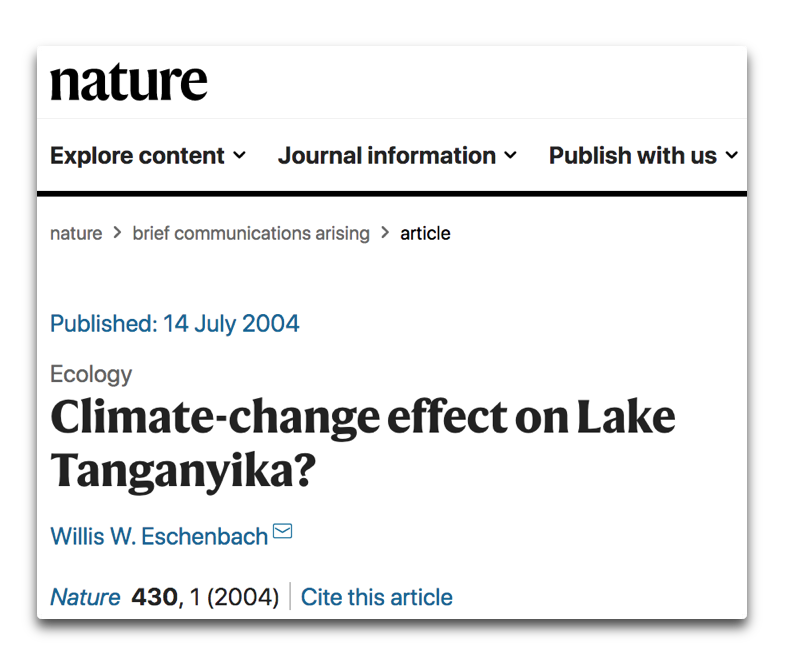
And guess what? Further scientific research on Lake Tanganyika showed I was correct.
My journal articles have gotten over 150 citations in other peer-reviewed journals. Not bad for an “amateur” … how about you?
As to not “keeping up with the articles published by my colleagues”, I have no “colleagues”. I work on my own. I read as much of the unending flood of articles about climate as I can, but nobody can read all of them and still do all the work that I do. There are literally dozens of climate journal articles and blog posts appearing every day, and your idea that I should be able to read all of them merely reveals your ignorance.
…
Humor, my friend. My law has equal status with Murphy’s Law, which has lots of exceptions, and not with the 2nd Law of Thermodynamics, which has none.
…
Nature magazine is not a “reputable journal”? Since when?
And considering that you haven’t found a single thing that you can falsify in my rebuttal post, yes, it seems to be more than adequate for your analysis. And considering that nobody else found anything falsifiable in my rebuttal, yes, it seems to be more than adequate in general. Dr. Roy mistakenly claimed I failed to cite Ramanathan. I had indeed cited him, and in my rebuttal post, I linked to where I’d cited him. Case closed.
Gotta say … I truly don’t understand your obsession with failing to bite my ankles. I have many faults, and I’ve posted about lots of them. When I’m wrong, I say so loud and clear … as in my posts “Wrong Again“, and “Wrong Again, Again” … how about you? Never been wrong?
My advice? Lead, follow, or get out of the way. Because your endless futile sniping at me is just making you look foolish, and it is leading people to point and laugh.
w.
Gubmint destroys everything it controls – why? – impervious to outside forces such as markets, real science, economics, voters – so Lysenkoism is a natural result of governance that mandates rather than serves. The root problem isn’t windmills – it’s windbags.
Shawn: Beautiful: “The root problem isn’t windmills – it’s windbags.”…
Here is an excerpt of an article regarding FLOATING wind turbines, such as off the coast of Maine, and off the cost of California.
The capital cost would be off-the charts expensive, $/MW,, plus the anchoring cables would greatly REDUCE commercial fishing in these areas.
Prices paid by UTILITIES to the owners of these plants would be at least 25 c/kWh, AFTER THE BENEFIT OF ALL SUBSIDIES.
That compares with an average wholesale price of about 5 c/kWh for nuclear, fossil and hydro.
Pro RE folks always point to the “price paid to owner” as the cost of wind and solar, purposely ignoring the other cost categories.
https://www.windtaskforce.org/profiles/blogs/high-costs-of-wind-solar-and-battery-systems
The all-in cost of wind and solar, c/kWh, includes:
1) Above-market-price paid to owners
2) Subsidies paid to owners
3) Owner return on invested capital
4) Grid extension/augmentation (not paid by owners)
5) Grid support services (not paid by owners)
6) Future battery systems (not paid by owners)
Of course, the Biden “RE/GW visionaries” do not have the slightest inkling of those costs, and if some of them do, whey would NEVER mention it.
Excerpt:
DEEP-WATER FLOATING OFFSHORE WIND TURBINES IN MAINE
http://www.windtaskforce.org/profiles/blogs/deep-water-floating-offshore-wind-turbines-in-maine
The Norwegians have about 60 years of experience building and servicing oil/gas rigs and laying undersea electric cables, gas lines and oil lines all over the world.
They have invested billions of dollars in specialized deep-water, Norwegian harbors and facilities for assembly of oil/gas rigs and invested in specialized sea-going heavy lifters, and specialized sea-going tugboats to tow the oil/gas rigs from Norwegian building sites to oil/gas production sites. The heavy lifters and other ships perform services all over the world.
Norway companies want to expand their business by building and servicing and providing spare parts for floating wind turbines for deep-water conditions all over the world
NOTE: Norwegians advocating expensive floating wind turbines that depend on the randomness of wind and produce high-cost, variable, intermittent electricity for other people, such as Jane and Joe Worker/Ratepayer, is highly hypocritical, because the Norwegians get 98% of their electricity from their own hydro plants, which produce low-cost, steady electricity (not variable, not intermittent). The Danes advocating wind turbines and boasting about their high percent of wind on their grid is similarly hypocritical, because the Danes have been increasingly using the storage reservoirs of Norway’s hydro plants for decades.
First Experimental Floating Wind Turbine in Norway
Equinor (formerly Statoil, a Norwegian government controlled company) launched the world’s first operational deep-water, floating large-capacity wind turbine in 2009. The turbine trade name is “Hywind”.
The wind turbine consists of a 120 m (390 ft) tall tower, above the sea water level, and a 60 m (195 ft) submerged extension below the sea water level, with a heavy weight at the bottom to keep the wind turbine steady and upright, even with very high waves and strong wind conditions. The design was tested and perfected under storm and wind conditions simulated in a laboratory.
The 2.3 MW wind turbine is mounted on top of the tower. It was fully assembled in a deep-water harbor near Stavanger, Norway.
It was towed to a site 10 km (6.2 mi) offshore into the Amoy Fjord in 220 m (720 ft) deep water, near Stavanger, Norway, on 9 June 2009, for a two-year test run, which turned out to be successful.
First Commercial Floating Wind Turbine Plant in Scotland
Hywind Scotland project is the world’s first commercial wind turbine plant using floating wind turbines.
It is located 29 km (EIGHTEEN MILES) off Peterhead, Scotland to minimize visual impacts from shore.
It has five Hywind floating turbines with a total capacity of 30 MW.
It is operated by Hywind (Scotland) Limited, a joint venture of Equinor, Norway (75%) and Masdar, Kuwait (25%).
In 2015, Equinor received permission to install 5 Hywind turbines in Scotland.
Manufacturing started in 2016 in Spain (wind turbine, rotor), Norway (tower, underwater base, assembly), and Scotland (various parts)
The turnkey capital cost was $263 million for five 6 MW turbines, or $8,767/kW.
They were designed to float on the surface, with about 180 m (600 ft) above the sea water level and 80 m (265 ft) submerged below the seawater level.
Total steel weight is about 2300 metric ton, total ballasted weight is about 20,000 metric ton.
Heavy weights in the bottom of the submerged parts serve to keep them steady and upright.
The turbines were assembled at Stord in Norway in the summer of 2017, using the specialized Saipem 7000 floating crane, and then towed to the north of Scotland by sea-going tugboats.
Make sure to see the videos showing the crane assembling the entire wind turbine.
Nothing like that exists in Maine, or in the rest of New England.
That means offshore wind turbine assembly and servicing would largely be performed by foreign companies, which already have built the infrastructures and other facilities during the past 25 years.
https://www.youtube.com/watch?v=PUlfvXaISvc
https://www.youtube.com/watch?v=bQVU7UaMuck
The huge, sea-going, specialized, crane (14,000-metric ton lifting capacity) is required for partial assembly on land and final assembly in an area close to shore with a very deep harbor, before towing, fully assembled, to the site.
The finished turbines were towed to Peterhead, Scotland.
Three cup anchors hold each turbine in place.
About 2400 meter of chain is required, weighing 400 metric ton, for each turbine.
The Hywind Scotland project was commissioned in October 2017.
Hywind Wind Turbines for Demonstration Purposes in Maine
Hannah Pingree and other Maine’s wind bureaucrats in state government are engaging in mindless prattle, eager to do the bidding of various multi-millionaires and foreign companies that may be providing some wining/dining boondoggle trips to “view the Hywind turbines” in Norway and Scotland.
The turnkey cost of those two Hywind turbines would be about $10,000 per kW, versus NE ridgeline wind at $2,000/kW, and regular offshore, south of Martha’s Vineyard, at $4,000/kW.
http://www.windtaskforce.org/profiles/blogs/iso-ne-study-of-1600-mw-of-future-offshore-wind-during-a-16-day
That would be at about $120 million for a two 6 MW Hywind wind turbines, plus whatever facilities would need to be built in Maine to support the project.
The turnkey capital cost of the wind turbine plant in Maine would be much higher, because Maine does not have the experience of the Norwegians and the specialized equipment and specialized ships, and other facilities. It would be very costly to build those facilities and ships in Maine, or elsewhere.
Boat: a hole in the water, into which you throw money.
Wind turbine: a hole in the air, into which you throw other people’s money.
I learned the hard way how much money you can throw into the hole of a 46′ sailboat.
Officials recently approved a project near Martha’s Vineyard that languished during the Trump administration …
Are they referring to that project that Ted Kennedy (died Aug-2009) blocked for years.
Why is free energy from the sun and wind so darn expensive?