Winter is supposed to be the best season for wind power – the winds are stronger, and since air density increases as the temperature drops, more force is pushing on the blades. But winter also comes with a problem: freezing weather.
Even light icing can produce enough surface roughness on wind turbine blades to reduce their aerodynamic efficiency, which reduces the amount of power they can produce, as Texas experienced in February.
Frequent severe icing can cut a wind farm’s annual energy production by over 20%, costing the industry hundreds of millions of dollars. Power loss isn’t the only problem from icing, either. The uneven way ice forms on blades can create imbalances, causing a turbine’s parts to wear out more quickly. It can also induce vibrations that cause the turbines to shut down. In the case of extreme icing, restarting turbines may not be possible for hours and potentially days.
The solution is obvious: de-ice the blades, or find a way to keep ice from forming in the first place. So far, however, most of the strategies for keeping ice off wind turbines blades come from aviation. And airplane wings and wind turbines are built differently and operate under very different conditions.
I am an aerospace and mechanical engineer, and my colleagues and I have been studying wind turbine icing physics over the past 10 years and exploring better solutions for turbine icing protection.
Not all ice is the same
Ice isn’t the same everywhere. It may come from precipitation, clouds or frost. It also freezes in different ways in different climates.
For example, rime icing, formed when tiny, supercooled water droplets hit the surface, usually occurs in regions with relative dry air and colder temperatures, under 20 F. That’s what we typically see in Iowa and other Midwest states in the winter.

Glaze icing is associated with much wetter air and warmer temperatures and is commonly seen on the Northeast coast. This is the worst type of ice for wind turbine blades. It forms complicated ice shapes because of its wet nature, which results in more power loss. It’s also likely what formed in Texas in February 2021 when the cold air from the north collided with the moist air from the Gulf Coast. While the majority of the power shut down by the storm was from natural gas, coal or nuclear, wind turbines also struggled.
Tempests in a wind tunnel
Building a wind power operation that can thrive in icy conditions requires a keen understanding of the underlying physics, both of how ice forms and the performance degradation that results from ice building up on turbine blades.
To explore those forces, we use a special wind tunnel that can demonstrate how ice forms on samples of turbine blades, and fly camera-equipped drones.
Using the Icing Research Tunnel at Iowa State University, my team has been replicating the complex 3D shapes of ice forming on turbine blade models in different environments to study how they affect the wind and the blades. Ice can create massive airflow separation. In airplanes, that’s a dangerous situation that can cause them to stall. In wind turbines, it reduces their rotation speed and the amount of power they can produce.

We also study wind turbines in operation around the country as they face some of their toughest conditions.
Using drones equipped with high-resolution digital cameras, we can hover in front of 80-meter-high wind turbines and take photos of the ice right after it forms on the blades. Pairing that with the turbine’s production data shows us how the ice influences power production.
While ice can form over the entire span of the blade, much more ice is found near the tips. After one 30-hour icing event, we found ice as much as a foot thick. Despite the high wind, the ice-heavy turbines rotated much slower and even shut down. The turbines produced only 20% of their normal power over that period.

Keeping ice off blades
There are a few reasons the strategies that effectively keep ice off aircraft wings aren’t as effective for wind turbine blades.
One is the materials they are made of. While aircraft wings are typically made of metals like aluminum alloy, utility-scale wind turbines are made of polymer-based composites. Metal conducts heat more effectively, so thermal-based systems that circulate heat are more effective in airplane wings. Polymer-based turbine blades are also more likely to get covered by dust and insect collisions, which can change the smoothness of the blade surface and slow water running off the blade, promoting ice formation.
Wind turbines are also more prone to encounters with freezing rain and other low-altitude, high-water-content environments, such as ocean spray for offshore wind turbines.
Most current wind turbine anti-icing and de-icing methods remove ice buildup through electric heating or blowing hot air inside. Heating these massive areas, which are many times larger than airplane wings, adds to the cost of the turbine and is inefficient and energy-consuming. Composite-based turbine blades can also be easily damaged by overheating. And there’s another problem: Water from melting ice may simply run back and refreeze elsewhere.
Another strategy in cold-weather regions is to use surface coatings that repel water or prevent ice from sticking. However, none of the coatings has been able to eliminate ice completely, especially in critical regions near the blades’ leading edges.
A better solution
My team has been developing a novel method that uses elements of both technologies. By heating just the critical regions – particularly the blades’ leading edges — and using water- and ice-repelling coatings, we were able to reduce the amount of heat needed and the risk of running back water to refreeze over the blade surfaces. The result effectively prevents ice from forming on the entire surfaces of turbine blades.
In comparison to the conventional brute-force surface-heating methods, our hybrid strategy also used much less power, resulting in up to 80% energy savings. Without ice to slow it down, the turbines can produce more power through the winter.
Worldwide, nearly 800 gigawatts of wind power have been installed so far, including over 110 gigawatts in the U.S. alone. As the market quickly grows and wind power supplants higher-polluting energy sources, de-icing and ice-proofing strategies are becoming essential.
Hui Hu, Professor of Aerospace Engineering, Iowa State University
This article is republished from The Conversation under a Creative Commons license. Read the original article.
On the Yale360 web site: “Is the ‘Legacy’ Carbon Credit Market a Climate Plus or Just Hype?”
subtitled:
“As major corporations look to buy carbon credits to offset emissions, critics are questioning the value of “legacy” credits from green projects that are a decade or more old. What’s needed, experts say, is to reform the credit system so it delivers actual carbon reductions.”
https://e360.yale.edu/features/is-the-legacy-carbon-credit-market-a-climate-plus-or-just-hype
Engineers .. gee. The obvious best solution is a thorium powered generator. 100% no issue with “icing”.
I haven’t been following that closely, but I know China has been working on it (they have a _lot_ of thorium sand frome their rare earth mining). Research must not be going well, as they’re building new coal fired power plants.
Updates welcome!
I stumbled across https://techxplore.com/news/2021-03-field-icing-turbines-power-production.html a couple days ago and was thinking of writing a post with it.
It has a nice photo of a rimed IWT blade,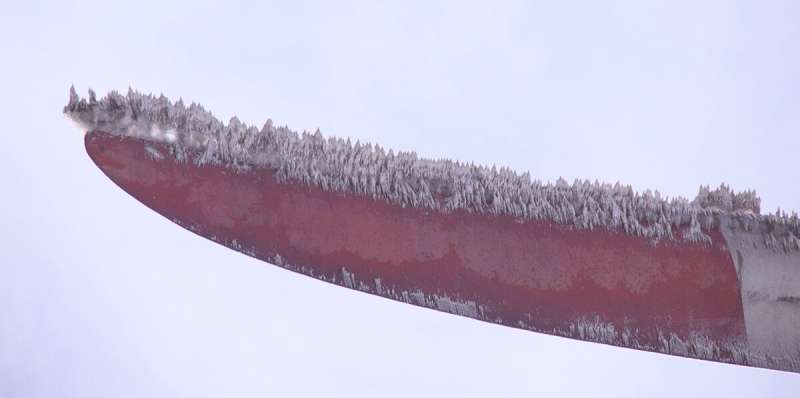
Incidentally, I found that page as a link from https://stopthesethings.com/2021/02/04/cruel-unusual-punishment-400-french-cows-succumb-to-low-frequency-wind-turbine-noise-vibration/ which refers to several other human and non-human impacts of infrasound and other evils.
I read this a few days ago. Dr. Hu is pimping his technique, which does sound better.
W.r.t. Texas, they need to stick practicality and discounted cash flows:
Or you could just let me turn all of the cards over:
Saved the state many $M in high cost consulting. They need to send me honorary license plates with any one of the 3 state mottos.
How is that “pimping?”
He’s pushing it, perhaps in the hope of rewards to him. NOTHING wrong with that. It’s the American Way and if the method proves economic for new builds in the right sites, then Mo’ Power To Him…
“Or you could just let me turn all of the cards over”
bob,
For sake of argument, I’ll assume you know everything there is to know about producing a gas well under sub-zero conditions – and while I’m at it, I’ll assume that some of your other ideas above might be reasonable under certain conditions. The issue you’re missing is that your top-down solution is doomed to fail when any aspects of the “regulations” become sub-optimal under time-varying conditions.
In other words, whatever top-down regs bigoilbob, bigpipelinebob, bigutilitybob, bigwindbob, bigsolarbob, biggreenbob, bigisobob, bigpoliticalbob, biggeneratorbob, etc. can agree to and impose will inevitably be a sub-optimal kluge of economic rent-seeking and cost shifting. Very much akin to having Hayek’s Fatal Conceipt meet Buchanan’s Public Choice Theory.
Assuming the PUCs (another political problem) can deal with the utilities, why are you afraid of having ERCOT establish consistent rules for the supply of energy to the grid, including make-whole penalties for non-performance? I’m pretty sure I know the answer – it’s because the bid-in cost of renewables will have to include the cost of non-performance, and these unreliable sources will become a much smaller factor in the daily dispatch, if they don’t disappear completely. Note, this is not to say that energy prices won’t increase under conditions of higher reliability – they have to because reliable energy is worth more than unreliable energy – but they’ll certainly be lower than those resulting from your top-down scheme.
Your faith based alternative apparently had some flaws.
“Assuming the PUCs (another political problem) can deal with the utilities, why are you afraid of having ERCOT establish consistent rules for the supply of energy to the grid, including make-whole penalties for non-performance?”
Not afraid of this at all. If the investigation concludes that it is the right way to go. However, I’ll bet you a coke that – if this investigation by competent businessmen and rtechnical pro’d actually get done – there will be NO push to make wind power peak under parts/ten thousand weather conditions. Rather, the plan which will cost WAY less in cumulative discounted cash flow, will (mostly) include 5 improvements I outlined.
FYI, your l your conflation of rules and regulations with “socialism” is both misplaced and selective. Pretty much a “GET THE GD GOVERNMENT OUT OF MY MEDICARE!!” rant
bob,
Let’s agree there that not all regs are bad e.g., don’t pass a school bus that’s picking up / discharging passengers.
Can you kindly translate this:
“if this investigation by competent businessmen and rtechnical pro’d actually get done – there will be NO push to make wind power peak under parts/ten thousand weather conditions”
Thanks!
Minus my usual typo’s and incomplete words, it’s my opinion. Wind should not be scapegoated for bad planning and 0.5 assed gas systems. But, I’m happy to await for an investigation by the pro’s to prove me right.
Apparently, everyone else in these fora want to ready, fire, aim at wind instead. There’s already enough in to see what REALLY happened, and it interferes with their prejudgments. So, instead they want to quash the presentation of the factual details. Kind of a Kris Kobach redux…
Ok – I don’t see the need to scapegoat wind either. But it should pull its own weight, in which case I’m willing to bet it becomes much less prominent in the energy mix. What we have now is a system where renewables are effectively off limits to criticism from the “pros” while the reliable sources take regulatory shots to beggar each other.
Over-indulgence in virtue-seeking wind …. Is the problem.
Wind is not the “scapegoat”
…. it is the ABSOLUTELY AND TOTAL BLAME for the problem.
You guys are Marxist crooks, and that’s that. You make us laugh with your self important 5 improvements plan and top down regulations for something that’s been done by coal power or nuclear plants for a century without your improvements.
Leftists and Greens are busy sabotaging a system which has provided electrical power unobtrusively, economically, and reliably to the World for decades.
WOW great to see big oily blob ADVOCATING COAL FIRED POWER. !
I’m not a fan of wind turbines but the article and solution presented makes for interesting reading. We can all learn from each other.
So tired of them being called wind “farms”… Like they are some sort of friendly place with cows and chickens and lovely crops growing… They blight the land in West TX like you would not believe.
https://media.istockphoto.com/photos/wind-power-pland-in-a-grassy-field-with-cows-grazing-picture-id585518028?k=6&m=585518028&s=170667a&w=0&h=V4fg_WcCvFA-aczR1yaBlZB-pdHg7R-V7TpdgR_rqW8=
https://www.newscientist.com/article/mg21628850-200-the-sickening-truth-about-wind-farm-syndrome/
http://www.windturbinesyndrome.com/category/what-effects-do-wind-turbines-have-on-domestic-animals-wildlife/?var=aa
https://www.sciencedaily.com/releases/2016/09/160929143808.htm
Live with your IGNORANCE brianless one !!
they are farming ratepayers money for sure
Well in South Oz we have them shutting down with high temperatures. So we’ll have to ensure they’re heat proofed as we’ll be needing a lot more of them sooner than planned for-
Victoria’s largest coal-fired power station to close four years early (msn.com)
The coal stations have been eking out the last of their revenues as fickle wind and solar dump on the grid as. They finished investing in their ongoing refurbishment some years ago so it’s only a matter of time before they pull the pin on them all one by one.
The exit from coal-fired power plants is taking shape, as are the associated problems. On January 1, 2021, eleven hard coal-fired power plants in Germany with a total capacity of 4700 megawatts were shut down and the operators paid € 317 million for the premature shutdown. As Daniel Wetzel reported in “Die Welt” , the most powerful German hard coal-fired power station, Heyden, was shut down on January 1, 2021 – five years before the planned shutdown. At the request of the network operator Tennet, the system had to be restarted six times since the turn of the year. The reasons for this were, on the one hand, disruptions in the European network (on January 8th and February 25th) and dark lulls in the course of January and February.
Two other plants that were shut down on January 1st must remain in operation for an indefinite period of time: The network operator Amprion applied to the Federal Network Agency to classify STEAG’s Walsum 9 power plant and RWE’s Hamm Westfalen E power plant as “systemically relevant” and the To oblige owners to continue operating as reserve power plants. The lack of electricity will become evident in the dark doldrums of next winter when another 3 nuclear power plants (Brokdorf, Grundremmingen, Grohnde) are to be shut down.
Source
I suspect the same will happen in Australia when it looks like rolling blackouts with the unreliables. The eastern seaboard grid (Qld, NSW, Vic, SA and Tas) are linked under control of the AEMO but here’s islanded WA going down the same path-
“Luring large-scale industry to town isn’t proving easy.
The state government redirected $60 million in funding from its last budget to that end, following stalled plans for the establishment of a biomass energy plant and solar farm in Collie which could have delivered up to 200 jobs.
It has so far cut a cheque for $2 million to part-fund a medicinal marijuana facility the government says will create 24 permanent jobs and a slew of “considerable flow-on effects for the Collie community”.
Between a black rock and a hard place (msn.com)
Our future lies with the dope heads and their needs it seems but sooner or later they’ll be going cold turkey.
When they say
and using water- and ice-repelling coatings, we were able to reduce the amount of heat needed and the risk of running back water to refreeze over the blade surfaces.
https://www.rainx.co.uk/
or some permanent paint or plastic coating? In my experience Rain-x has a fairly short life, perhaps a couple of years as just a coating. On a windscreenthe life is shorter thanks to the wiper blades
Does anyone know what the U, T, and LWC mentioned in the first two photos stand for?
T is probably temperature.
U might have something to do with wind speed.
LWC might have something to do with how much ice has accumulated.
U is the velocity of the air stream in their wind tunnel in metres/second: you have to think of the tip velocity of the blade in considering what might be relevant. At full power, a turbine typcially rotates at about 20 rpm. A 30m blade would have a tip speed of about 62m/sec at full power, but in lesser winds the 40m/secfigure is quite plausible – and in any event, at full speed, it applies about 2/3rd the way to the tip.
T is indeed the temperature of the air stream in Centigrade.
LWC is the water content of the air in grams per cubic metre. At their test temperatures dry air would be about 31 g/m^3, so water varies between about 1% and 10% by weight in their examples. It may effectively include fine ice crystals at the higher content in particular.
I have a couple of questions.
What is the cost of these heating elements?
What is the cost of these non-stick coatings?
How well do the heating elements and the non-stick coatings deal with the wear and tear from bugs and dust?
When I looked at the website of a Finnish company that specialise in ice prevention/deicing for turbines they indicated the starting point for economic viability was over 3% of time being subject to icing problems. I’d call that a fortnight a year in rounder numbers, and I’d want to take a close look at weather patterns around likely icing events: no return if like Texas the wind simply dies. Of course, it can be cold with no icing risk because the air is dry (cold air holds little moisture normally). It is extremely unlikely to make economic sense in Texas, but when has that ever stopped wind farm advocates?
YOU CANNOT BUILD A RELIABLE ENERGY SUPPLY FROM UNRELIABLE ENERGY SOURCES.
Unless, of course, your goal is to destabilize the energy supply and make it too expensive to use. AGENDA 21.
Building more than about 10% of wind and solar into a grid is…..
DELIBERATELY BUILDING IN UNRELIABILITY.
Take a look at the amount of wind and solar on the German, UK and Spanish grids and tell me if they are unreliable (or more unreliable than in the past)
Poor griff-tard
Data really is an enema to you isn’t it !
German wind BELOW 20% nameplate at least 60% of the time.
UK wind missing in action several days in a row.
TOTALLY UNRELIABLE.. and you know that, so WHY PRETEND ???
Only saved by GAS, COAL and NUCLEAR and via interconnects to NUCLEAR.
Your assertions will come as a big surprise to German industrialists, who are terrified by the prospect of the collapse of the German grid.
https://www.forbes.com/sites/michaelshellenberger/2019/09/05/renewables-threaten-german-economy-energy-supply-mckinsey-warns-in-new-report/?sh=5c6da8d18e48
griff is of the firm belief that anything that hasn’t happened, can’t happen.
They are definitely more unreliable in the past. If it weren’t for hydro from Norway, nuclear from France and coal from Poland, the German grid would have collapsed a number of times this past winter.
I thought it was agenda 31 now? anyway, you can’t make a reasoned argument on choice of energy sources based on conspiracy theory.
You mean on an UP-FRONT STATED AGENDA don’t you, griff-denier.
You don’t even know what your own far-left socialist totalitarian scammers are saying ……
Just do a google for “Agenda 30”
It is driving force of UN one-world dictatorship..
Are you just IGNORANT or deliberately LYING
But you are correct.. AGENDA DRIVEN energy infrastructure is sheer STUPIDITY
BUILT-IN UNRELIABILITY can never be RELIABLE.
Why are you SO STUPIDLY IGNORANT that you continue to post idiotic comments…
…. that are so easily proven TOTALLY AND COMPLETELY WRONG !!
Griff
4 words…
Stay away from “thought”
You don’t wear it well…
“While the majority of the power shut down by the storm was from natural gas, coal or nuclear, wind turbines also struggled.”
The fact is that the solutions to keeping gas, coal and nuclear power online in these conditions are known, they just did not put the money into it because they did not think it would happen. These were also brought back online very quickly while wind power remained offline until the conditions changed.
For wind power to remain online in these conditions, there are no known solutions that are economical.
A decrease of over 90% in power being delivered is merely “struggling”?
Good study.
“While ice can form over the entire span of the blade, much more ice is found near the tips. After one 30-hour icing event, we found ice as much as a foot thick. Despite the high wind, the ice-heavy turbines rotated much slower and even shut down. The turbines produced only 20% of their normal power over that period.”
This finding is not surprising as the water will undergo the effects of centripetal force, and the resulting ice build-up at the blade tips will be subject to the law of conservation of angular momentum.
i wonder if the is a solution to the uneven or unusually fast wearing out of the bearings in wind turbines due to uneven load distribution caused by having only three blades?
CO2 is not a pollutant.
Why study this when you have the NYT and NPR to declare all is well all the time with wind turbines? They never freeze up in la la land.
“While the majority of the power shut down by the storm was from natural gas, coal or nuclear, wind turbines also struggled.”
From the charts I saw, Gas was producing at the rate of +450% of normal, while Wind was doing almost the opposite, at -450%! Trying to make it appear that wind was affected not-so-much? It seems to me that trying to keep the ice melted would take up a LOT of whatever electrical power the windmill was able to generate, just trying to keep the blades ice free. In the end it sounds like a lose-lose situation!
A better solution to keeping ice off of the wind turbine blades is NOT TO BUILD THEM IN THE FIRST PLACE.
They serve no purpose other than consuming resources, money, and making rich people richer.
Tell you what.
Get Gates or some other Megamouthinaire (not Biden, NO Government funding or subsidies) to build a wind farm at McMurdo or above the Arctic Circle.
Get back with us about how well they preformed AND how much “extra” they cost.
Then build the same design on the Equator and do the same.
(Another suggestion would be to do the same with solar panels in “The Land of The Midnight Sun”.)
Ten years studying ice, a great contribution to our nation.
The storm in Texas covered more than a weeks time, involved two snow storms, and left most areas in single digit night temperatures in areas with a normal daily low in the 40s. By many assessments, it was the worst such storm since 1899. It would simply not be practical to install deicing equipment on wind turbine blades in a region where more than a half-dozen blade sets would need replacement before one set even required them.
The biggest problem was not technology, it was the incompetence of ERCOT in managing the disruptions, and government bureaucrats in not allowing some backup power generation to be used properly due to CO2 emissions. As many have already said, natural gas provided the bulk of the power generation replaced due to the wind turbine failures. Available natural gas was limited by rotating power cuts at natural gas compressing facilities and by output restrictions due to CO2 regulations.
In the area where I live, lack of snow plows prevented road clearing. This, combined with the rotating power outages meant that gas stations and food stores were not replenished, and store coolers were shut down spoiling all refrigerated items. This meant that gas ran out, food stores ran out of dry foods and could not sell any refrigerated items either. Such is life in a once per century storm. Even if the county had saved their snow plows after their last such storm, there wouldn’t have been any horse teams around to pull them. In the next such storm, all the wind turbine blades in the landfills shouldn’t have any unused de-icing equipment on them, either. Hopefully the bureaucrats will have learned how to deal with power shortages, but I doubt it.
I DO NOT WANT THEM SPINNING ALL WINTER.
If government hadn’t forced the utilities to build these monstrosities to begin with we wouldn’t have this problem to worry about. I love that part about 20% of output. 20% of nothing is still nothing.