By Christopher Monckton of Brenchley
The New Pause continues. To the end of December 2020, it was 5 years 4 months. To the end of January 2021, it was 5 years 6 months. To the end of February 2021, it is 5 years 7 months:

Up to December 2020, for which I have data for two satellite and two terrestrial datasets, UAH and RSS showed the shortest Pause, while HadCRUT4 shows the longest, at 6 years 6 months:


The difference between the lengths of the New Pause in versions 4 (6 years 6 months) and 5 (5 years 8 months) of the HadCRUT dataset to December 2020 is a whopping 10 months, which the newer version wipes off the New Pause. As Willis Eschenbach has recently pointed out, the tamperings between versions 4 and 5 chiefly affect recent years: for once, the earlier years of the HadCRUT dataset have been left comparatively unadjusted. Could it possibly be that the emergence of this new Pause is giving the usual suspects – er – pause for thought?
The two satellite datasets, UAH (trustworthy) and RSS (run by a “scientist” who resorts to hate speech, calling those of us whose research suggests small and harmless global warming “climate deniers”), continue to show very different warming trends. From 1979-2020, RSS, at 2.16 C°/century equivalent, shows 58% more warming than UAH. Settled? Schmettled.
Charts are below. For interest, I have also added the chart of the Central England Temperature Record from 1979-2020, which, being a regional record, shows how trivial the trend is when set against the annual winter-to-summer temperature cycle. It shows warming equivalent to almost 3 C°/century, but that is a regional and not a global mean, and the discrepancy between the regional and the global average is not entirely unexpected given poleward advection. The CETR showed warming at 4.33 C°/century equivalent over the 40 years 1694-1733, and has not shown warming at or above that rate in any 40-year period since then, so there is nothing unprecedented about the recent warming rate.
I’m taking bets on which of the various datasets will be the next to produce sophisticated excuses for the next tamper-tantrum, resulting in yet another hike in the apparent warming rate.


Finally, now that we have HadCRUT5, I have taken uncertainty intervals for each of the five mainstream climatological parameters (green) and added them to the table that shows how equilibrium doubled-CO2 sensitivity (ECS) is derived from them:

The current generation of models predicts ECS on 3.7 [2.0, 5.7] K. In reality, based on real-world observation rather than artfully profitable speculation, ECS will fall on 1.0 [0.8,1.4] K. And that is far too little to require any mitigation whatsoever. Cancel COP26! Shutter IPCC! Climatology’s predictions are about four times reality.
But can it really be as simple as this to derive ECS? Don’t we need complex models costing billions? Don’t we need multi-thousand-page IPCC reports every few years? Well, no, we don’t. The equations for the energy-imbalance factor Γ, for the implicit anthropogenic equilibrium sensitivity ΔE1 in the industrial era from 1850-2020 and then for ECS ΔE2, though very simple, are a reasonable and robust method of deriving ECS reliably from Their own recent, mainstream data, updated in a series of papers intended to be in time for IPCC’s Sixth Assessment Report.
The last line of the table is particularly interesting. It derives the unit feedback response –the response per degree of direct warming – from 1850-2020 (U1). Then it compares U1 with the feedback response U2 from 2020 to warming driven by a forcing equivalent to doubled CO2 compared with 2020.
U1, which at midrange is actually negative, at –0.06, indicating very slightly net-negative feedback in the industrial era, and not the grossly net-positive feedback imagined in the models, is 1 less than the industrial-era system-gain factor A1, the ratio of period equilibrium sensitivity ΔE1 to period reference sensitivity ΔR1, where ΔR1 is 0.3 times the period anthropogenic forcing ΔQ1.
There is little more than 2 degrees’ difference between temperatures in 1850 and at doubled CO2 compared with 2020. Therefore, U2, the post-2020 unit feedback response implicit in the model-projected ECS, ought to be about the same as U1.
At most, the ratio X = U2 / |U1| of the two unit feedback responses ought not to exceed about 1.1. But the interval of unit-feedback-response ratios X implicit in the models’ global warming predictions is an astonishing and manifestly untenable 39 [14, 69].
Just for fun, we calculated what X would be if the sillier and more extreme papers predicting 10 degrees’ ECS were true. Then X would exceed 130: that is, X would exceed any reasonable value by two orders of magnitude.
Couldn’t climatologists have done these simple sums for themselves and realized how grievously overblown their profitable but damaging predictions were? Why did they ever imagine that ECS would be anything like 3 or 4 degrees at midrange, when in reality it will be a harmless and beneficial 1 degree (and only that much on the generous assumption that the official estimates of greenhouse-gas forcings are not overstated)?
The reason is that they imagined that the 32-degree natural greenhouse effect comprised only two components: 8 degrees’ reference sensitivity to preindustrial noncondensing greenhouse gases and 24 degrees’ feedback response thereto (see e.g. Lacis et al., 2010). On that basis, they thought that 1 degree of doubled-CO2 reference sensitivity would become about 4 degrees’ ECS – and the current models’ midrange prediction is indeed close to 4 degrees.
They had forgotten that much of the 24 degrees’ total preindustrial feedback response was a response not to the preindustrial noncondensing greenhouse gases but to the 25-times-greater emission temperature that would prevail near the surface even if there were no greenhouse gases in the air at the outset. The larger the feedback response to the warmth from the Sun, the smaller the feedback response to the greenhouse gases.
Bless their little cotton socks, they had forgotten the Sun was shining. That strikingly elementary error is why the world is in a childish panic about global warming.
Poor, poor CO2 . . . it looks like it has once again (referencing the prior intervals of 1940-1975 and 1999-2015) forgot how to cause “global warming”, aka “climate change”.
More properly, as Wijngaarden and Happer (2020 preprint) have pointed out, CO2 has just became “saturated” in the cause.
Pity.
/sarc off
It’s not that CO2 itself is saturated. As they showed in their paper, adding more CO2 will increase its energy capture. What their paper didn’t show is that that energy simply came from other GHGs (water vapor primarily). It’s the total greenhouse effect that is saturated.
“Precision research by physicists William Happer and William van Wijngaarden has determined that the present levels of atmospheric carbon dioxide and water vapor are almost completely saturated. In radiation physics the technical term “saturated” implies that adding more molecules will not cause more warming.” (my bold emphasis added)
—source https://wattsupwiththat.com/2020/10/26/study-suggests-no-more-co2-warming/
Don’t you love it! Happer and van Wijngaarden’s research may upset the whole Human-caused climate change applecart. That’s what genuine science does all the time. And here we go again.
And all those alarmists will have to rethink what caused all that ancient warming which they attribute to CO2. If it can only get so warm with CO2, and Happer and van Wijngaarden say we are at about that level now, and no warmer, then something else is needed to explain the much higher temperatures of the ancient past. CO2 could not push the temperatures that high. CO2 is at its limit today, according to the research.
We should probably find out if this is true or not before we go spending $Trillions on windmills and solar. It’s its true, we don’t need to limit CO2 production.
Yes, Tom, I’m anxiously looking forward to widespread critical review of the Happer and van Wijngaarden paper following its formal publication.
If it withstands objective reviews, then most “alarmist” climate scientists should backdown their assertions re: increasing atmosphere warming, which has indisputably occurred over at least the last 200 years, being caused predominately—and, more importantly, continuing to be caused—by increases in atmospheric CO2 content.
I say that they should backdown, not believing that many actually will.
I don’t know what Monckton means by “the 25-times-greater emission temperature that would prevail near the surface even if there were no greenhouse gases in the air at the outset,” but the AGW modeling error is not in assuming only the two components, but in assuming the water vapor (condensing GHG) feedback response to non-condensing GHGs component is linear throughout its range. In reality, the feedback should be extremely large in the temperature range where most of the earth’s ocean surface is near 0C (i.e., much colder than the earth has been in hundreds of millions of years) because that is the range where additional non-condensing GHGs will cause the greatest logarithmic water vapor response (i.e., evaporation), and progressively smaller with increasing temperature above that level. Once the great majority of the ocean surface is well above 0C almost all year, as it has been for at least 650My, the equilibrium hydrological cycle is established, water vapor dominates the GHG effect on surface temperature, and non-condensing GHGs will have little effect on it. That is why the paleo proxy record shows little correlation between temperature and CO2 except to the extent that CO2 follows temperature because of the effect of temperature on its solubility in sea water.
Let me assist Mr Langston with his elementary arithmetic. Climatology (e.g. Lacis et al. 2010) considers that about one-quarter of the natural greenhouse effect – i.e. 8-10 K – is direct warming forced by the naturally-occurring, noncondensing greenhouse gases. And it foolishly imagines that all of the 24 K preindustrial feedback response is response to that 8-10 K – i.e., that feedback response multiplies the direct warming by 3.5-4 to give eventual equilibrium warming. Therefore, current models predict 3.7-3.9 K midrange equilibrium doubled-CO2 sensitivity (ECS) in response to little more than 1 K directly-forced warming by doubled CO2.
However, emission temperature is 255 K, and it too contributes to the 24 K preindustrial feedback response. Now, 255 K is about 25-30 times the 8-10 K direct warming forced by the preindustrial noncondensing greenhouse gases. Therefore, the larger the feedback response to emission temperature, the smaller the feedback response to the preindustrial noncondensing greenhouse gases.
Bottom line: there is no basis in the preindustrail record for the assumption, explicit in paper after paper throughout the climatological journals, that about three-quarters of the preindustrial equilibrium warming – the natural greenhouse effect – was feedback response to the preindustrial noncondensing greenhouse gases.
It was that erroneous assumption that misled climatologists into assuming that feedback processes today would multiply the directly-forced warming from 1 K direct warming from doubled CO2 by about 4. For various reasons, including the points raised by Mr Langston, one cannot legitimately draw any such conclusion from the preindustrial record.
Sure enough, calculation based on the industrial-era record shows that we should only expect about 1 K equilibrium warming in response to doubled CO2: i.e., that in modern conditions one can ignore feedback response altogether and not introduce much error thereby.
I fear I did not explain the physics of GHG feedback clearly enough. If we imagine an earth with no GHGs (just N2, O2 and a trace of Ar), it is pretty much frozen solid (the “snowball earth” condition thought to have obtained at various times >650Mya) with an average emission temperature measured from outside the atmosphere of 255K, or -18C, because that is the temperature at which solar heating is balanced by infrared radiation to the ~3K cold of outer space. If we add non-condensing GHGs (effectively, CO2) at a typical pre-industrial level, the resulting 8-10K of warming melts the oceans in the tropics, releasing water vapor, a powerful GHG which leads to more warming, more melting, more water vapor, etc. until an equilibrium is reached where the only remaining frozen areas are at very high altitude and latitude. This is a “runaway” feedback effect that, once initiated, no longer depends on the initial non-condensing GHGs because water vapor is more powerful, and quickly becomes far more abundant in the atmosphere. Once that happens, CO2 is only relevant to surface temperature above the lower troposphere and in winter at high latitudes, where the air is so cold that almost all the water vapor has condensed out.
There is therefore nothing foolish in ascribing the next 24C of warming to the initial 8-10C; rather, the foolishness comes in imagining that every additional increment of CO2 will have the same effect as every previous one: the assumed logarithmic ECS. It is more likely that the surface temperature response to CO2 will have a quasi-sigmoid form, where the first increments will have the near-linear effect predicted by the normal physics of radiative heat transfer under unsaturated absorption. Once enough CO2 is added to raise ocean surface temperature enough to release significant water vapor, the response is even steeper — perhaps near-vertical — until the high-latitude ice-albedo equilibrium is reached. The response then rapidly drops off to near-zero, as the GHG effect on surface temperature is dominated by water vapor. By assuming a logarithmic ECS over the whole range of both concentration and temperature, the AGW alarmists miss the fact that we are in the flat upper tail of the sigmoid, where additional CO2 will not only not show the ~1C ECS implied by the ordinary physics of absorption-saturated radiative heat transfer, but will have almost no effect on surface temperature at all.
Consider an analogous runaway feedback effect that reaches a limit: raising a sunken ship by attaching a balloon to the bow. At first, you inflate the balloon a bit and the bow of the ship starts to rise off the sea floor. You inflate it a little more, and the ship is standing on its stern. Inflate it a little more, and the stern comes off the sea floor. What happens next is a runaway feedback effect: as the ship rises, the pressure on the balloon decreases, it inflates even more, giving more buoyancy, and the ship rises even faster. This continues until the balloon reaches the surface. But then it stops. The ship being now just below the surface instead of on the bottom is indeed entirely due to the air you pumped into the balloon when it was on the bottom; but now, no matter how much more air you pump into the balloon, it will not pull the ship up more than microscopically farther. That is the situation with CO2: now that the oceans’ surface temperature is well above 0C almost everywhere and almost all year, GHG warming at the earth’s surface is totally dominated by water vapor, and adding more CO2 has no more effect on surface temperature than pumping more air into that balloon.
The most problematic statement in Lord Monckton’s response was: “Now, 255 K is about 25-30 times the 8-10 K direct warming forced by the preindustrial noncondensing greenhouse gases.” That is an invalid and meaningless comparison of an absolute temperature (255K) with a temperature increment (8-10K). The fact that it is meaningless can be proved by simply converting both numbers to the Celsius scale: compare -18C to 8-10C. That is why I could not figure out the meaning of Lord Monckton’s original statement about, “the 25-times-greater emission temperature that would prevail near the surface even if there were no greenhouse gases in the air at the outset.” To make another analogy, that makes no more sense than saying the 295K temperature in a hospital room is nearly 100 times greater than a COVID-19 patient’s 3K fever.
Here is something you missed. Nearly half the sun’s radiation is in the near infrared. H2O has big absorption bands at these wavelengths and they have more energy than 15 um. CO2 has nearly no absorption at these wavelengths. As water was added to the earth there would be more and more water vapor. You don’t even need CO2 to start it up.
I agree CO2 is not necessary to start the process; but the fact remains that “snowball” conditions prevailed at various times even WITH substantial CO2 in the atmosphere, so without CO2 it is difficult to see how a permanent snowball could have been avoided. In any case, the point of my post was that we are probably at the high tail of a sigmoid in CO2 sensitivity, so assuming the response is logarithmic throughout the range is wrong, and ECS might be far less than 1C.
Roy, methinks you have the cart before the horse re: “If we imagine an earth with no GHGs (just N2, O2 and a trace of Ar), it is pretty much frozen solid (the “snowball earth” condition . . .”
The highest probability is that the Earth formed in the presence of water, contained in the primordial cosmic dust that gravitationally was collected together to form a molten early planet and/or by water-bearing comets that simultaneous/subsequently impacted this developing planet (see https://eos.org/articles/earths-water-came-from-space-dust-during-planetary-formation ).
It is thus most probable that primordial Earth’s atmosphere was composed mostly of water vapor. Even today, “The principle components of volcanic gases are water vapor (H2O), carbon dioxide (CO2), sulfur either as sulfur dioxide (SO2) (high-temperature volcanic gases) or hydrogen sulfide (H2S) (low-temperature volcanic gases), nitrogen, argon, helium, neon, methane, carbon monoxide and hydrogen . . . The abundance of gases varies considerably from volcano to volcano, with volcanic activity and with tectonic setting. Water vapour is consistently the most abundant volcanic gas, normally comprising more than 60% of total emissions. Carbon dioxide typically accounts for 10 to 40% of emissions.” (my bold emphasis added) —source: https://en.wikipedia.org/wiki/Volcanic_gas#:~:text=10%20References-,Composition,methane%2C%20carbon%20monoxide%20and%20hydrogen.
Water vapor is a greenhouse gas, currently the predominant one in Earth’s atmosphere.
Thus, it becomes really hard to imagine—let alone argue from a starting position—that there ever was a condition on Earth with “no GHGs (just N2, O2 and a trace of Ar)”.
Note that a temperature of -109 °F (-78 °C) would be required to freeze CO2 out of the atmosphere . . . something never claimed or even realistically possible for “snowball Earth” conditions.
Obviously the hypothetical initial conditions are not close to the primeval reality; they are just for attribution purposes. The earth’s primordial atmosphere was almost all N2 and CO2, probably with some CH4 and NH3. It could never have been mostly water vapor as water vapor condenses out to the equilibrium partial pressure. We know there must have been lots of CO2 because of the amount of carbonate rock in the earth’s crust. We also know “snowball” conditions have prevailed from time to time, so it makes sense to analyze GHG temperature contributions on the hypothetical basis of that condition.
Roy, you posted: “It could never have been mostly water vapor as water vapor condenses out to the equilibrium partial pressure.”
That is absolutely incorrect.
Today we commonly have pre-condensation (99.9% relative humidity) water vapor at atmospheric pressures in the range of 15 to 10 psia, despite the “equilibrium partial pressure” of water vapor above liquid water (at 14.7 psia/77 °F) being only 0.46 psia.
Condensation, at any given pressure, is determined by the temperature of the vapor in question.
“Collisions between Earth and rocky debris in the early solar system would have kept the surface molten and surface temperatures blistering. Image courtesy NASA. Even after collisions stopped, and the planet had tens of millions of years to cool, surface temperatures were likely more than 400° Fahrenheit.”—source: https://www.climate.gov/news-features/climate-qa/whats-hottest-earths-ever-been
That being so, if we conservatively assume lower atmospheric temperatures were above 300 °F for surface temperatures of 400 °F, it would have been impossible for water vapor to “condense out” (your phrase) at atmospheric pressures below 67 psia. There is zero evidence that atmospheric pressure was ever that high at any time in Earth’s history.
Gordon Dressler wrote: “That is absolutely incorrect.”
Oh, dear…
“Today we commonly have pre-condensation (99.9% relative humidity) water vapor at atmospheric pressures in the range of 15 to 10 psia, despite the “equilibrium partial pressure” of water vapor above liquid water (at 14.7 psia/77 °F) being only 0.46 psia.”
Not sure what you think that means. “99.9% relative humidity” does not mean that 99.9% of the air is water vapor.
“Condensation, at any given pressure, is determined by the temperature of the vapor in question.”
Yes, temperature is a parameter of the equilibrium partial pressure.
“Collisions between Earth and rocky debris in the early solar system would have kept the surface molten and surface temperatures blistering. Image courtesy NASA. Even after collisions stopped, and the planet had tens of millions of years to cool, surface temperatures were likely more than 400° Fahrenheit.”—source: https://www.climate.gov/news-features/climate-qa/whats-hottest-earths-ever-been
That being so, if we conservatively assume lower atmospheric temperatures were above 300 °F for surface temperatures of 400 °F, it would have been impossible for water vapor to “condense out” (your phrase) at atmospheric pressures below 67 psia. There is zero evidence that atmospheric pressure was ever that high at any time in Earth’s history.”
If you are talking about the very earliest conditions in the earth’s atmosphere, CO2, CH4, N2, NH3 and Ne were also present in large enough quantities to exceed water vapor. In addition, you seem to have missed the fact that if the water now in the oceans was then in vapor form, that vapor pressure alone would be a large multiple of 67 psia. Water is basically unique in that it condenses at such high temperature relative to volatiles of similar molecular weight. That is why water vapor can never have constituted the majority of the earth’s atmosphere: if the atmosphere were that thick, water’s own vapor pressure would condense it out before any other gas.
Mr Langston finds it “problematic” that 255 is approximately equal to 25 x 10. Well, that’s mathematics. He had asked me why I had said that emission temperature was 25 times the direct warming by (or reference sensitivity to preindustrial noncondensing greenhouse gases. Now, when I tell him, he finds that surely elementary arithmetic “problematic”.
He also imagines that without noncondensing greenhouse gases the Earth would be an iceball. In this, he is at odds at once with mainstream science and with elementary arithmetic.
Assume ad argumentum an initially icebound Equator. The noonday surface temperature at the subsolar point would be [S (1 – a) / sigma] ^ 0.25 for total solar irradiance S = 1363.5, ice-albedo 0.7, the Stefan-Boltzmann constant sigma = 0.000000056704 Watts per square meter per (Kelvin to the fourth power). It is thus 331.15 K, or 58 Celsius degrees. So the ice would melt.
Then the albedo would fall to 0.06, the value for open water under direct sunlight. So the noonday surface temperature would rise to 387.74 K, or about 151 C. Were it not for conduction of the heat to neighboring seawater and convection to the atmosphere, the ocean would boil. The conduction, however, would melt still more of the ice until, even if there were no convection, the entire tropics would become ice-free. The global emission temperature would at that point be somewhere between 265 K (my estimate) and 274 K (Professor Lindzen’s estimate). This is known among climatologists as a waterbelt Earth (it used to be called a slushball, but that was not reverential enough).
Meanwhile, the convection, via evapotranspiration, would put ever-larger amounts of water vapor (a greenhouse gas) into the atmosphere, so that the water-vapor feedback would commence, vigorously. At the same time there would be an enormous ice-albedo feedback, so that, even in the absence of noncondensing greenhouse gases, the water-vapor and ice-albedo feedbacks would warm the Earth still further until the surface temperature was only 8-10 K below that which prevailed in 1850, leaving little or no room for net-positive feedback under anything like modern conditions.
That is why we were not surprised when we gathered all the latest data for anthropogenic forcing and energy imbalance in the industrial era and discovered that, at midrange, feedback is actually a little net-negative: the unit feedback response is -0.06.
And of course one cannot do these calculations in Celsius, as Mr Langston tries to do. That is an elementary error.
As already noted, the problematic part of Lord Monckton’s comparison of absolute temperature to temperature increase is the logic, not the arithmetic. It makes no more sense than comparing the Kelvin temperature in a hospital room to a patient’s fever measured in Kelvins.
Unfortunately, his logic is little better in his “analysis” of the heat regime of a snowball earth without non-condensing GHGs. First he ignores the fact that ice is transparent, and the 30% of incident solar radiation that is not reflected by ice penetrates rather than being absorbed at and heating the surface, as it would a layer of equally white but opaque paper. Second, he ignores the latent heat of fusion, which requires a much larger heat input before the ice could melt. Third, he ignores the fact that night follows day, so absent other GHGs, any water vapor released from a melted ice surface would quickly condense out again after sunset, and the water refreeze, through unimpeded loss of IR radiation to the ~3K cold of outer space. Fourth, he ignores the fact that open water is even more transparent than ice, and the 94% of incident sunlight it absorbs is distributed over a depth of many meters rather than raising the temperature of only the top millimeter to more than boiling. Fifth, he ignores the fact that ACTUAL ice close to the equator but at low temperature and lacking a thick atmospheric blanket of GHGs, such as the Chimborazo Glacier, does not in fact melt (never mind evaporate) in the daytime, let alone stay liquid at night.
The Romans discovered that they could make ice even in summertime in the Sahara desert because there is so little water vapor in the air that it gets that cold at night. They would cover a large flat area with a meter of straw just before dawn, then uncover it after sunset. After several days of this treatment, the ground in the middle of the covered area was so cold that a bowl of water left there overnight would freeze solid through infrared radiative heat loss. And that’s WITH ~280ppm of CO2 in the air. The idea that daytime sunlight and water vapor alone could overcome the nighttime loss of heat by unimpeded IR radiation to outer space in the absence of non-condensing GHGs does not hold up to actual scientific scrutiny.
Roy Langston posted: “. . . any water vapor released from a melted ice surface would quickly condense out again after sunset . . .”, thereby implying that there can never be nighttime clouds in Earth’s atmosphere. The phrase “condense out” taken logically to mean “fall as precipitation”.
I think personal observation is sufficient to show the fallacy in this statement.
As Nobel prize-winning physicist Richard Feynman advised:
“If it disagrees with experiment (observation), it’s wrong. In that simple statement is the key to science. It doesn’t make a difference how beautiful your guess is. It doesn’t make a difference how smart you are, who made the guess, or what his name is. If it disagrees with experiment, it’s wrong. That’s all there is to it.”
Mr Dressler is confused. The statement he quotes was about a snowball earth without non-condensing GHGs, not the earth as it is.
Roy Langston posted; “The idea that daytime sunlight and water vapor alone could overcome the nighttime loss of heat by unimpeded IR radiation to outer space in the absence of non-condensing GHGs does not hold up to actual scientific scrutiny.” (my bold emphasis added)
Well, it is a fact that that CO2, a non-condensing greenhouse gas does NOT disappear from Earth’s atmosphere at night and thus it continuously impedes IR radiation from Earth’s surface. There is simply no such thing as the absence of non-condensing greenhouse gases.
So, yes, it is true that that part of Roy’s post does not hold up to scientific scrutiny.
As to sunlight and water vapor alone overcoming “nighttime loss of heat”, that certainly appears to be false since Earth’s energy inflow is nearly totally balanced by Earth’s energy outflow, giving us the yearly-averaged, essentially-constant surface temperatures that we currently enjoy, and have enjoyed for the last 100 years of so.
Mr Dressler is confused again. The passage he quotes refers to a HYPOTHETICAL snowball earth without non-condensing GHGs, not the actual earth, as a way to analyze the effect of CO2 on temperature. No one seems to want to address or even consider my actual point: that the assumption of high ECS in typical climate models assumes a constant logarithmic response based on extremely (indeed absurdly) high water vapor feedback, when it is quite likely that the response is much greater at a much lower level of CO2 where a runaway positive water vapor feedback effect is triggered. But that feedback loop is limited by the declining ability of sunlight to melt ice and warm sea water at high latitude; ECS may consequently now be very low, corresponding to the relatively shallow slope at the end of a sigmoid curve.
A good analysis.
Your servant, m’lord.
Nice try, but there is a substantial literature on conditions at emission temperature. There is widespread support for the notion of what is now called a waterbelt Earth.
Besides, emission temperature may be as great as 274 K.
In any event, it is inappropriate for official climatology to imagine that because the unit feedback response averaged over the entire interval between emission and 1850 temperature is imagined to have a certain value something like that value will obtain today.
In his desperation to find fault, he suggests I had made no allowance for conduction of heat to neighbouring seawater, when I had expressly done so.
Sorry, this thread has gotten out of sequence.
But let us make matters simpler. Even if the planet were frozen solid until the preindustrial noncondensing greenhouse gases came along, the moment the feedback processes commenced they were necessarily responding not only to the reference sensitivity forced by those gases but also to emission temperature itself – and chiefly to the latter.
Again, the attribution analysis is not based on actual conditions because there was never a time when CO2 was below about 200ppm.
You wrote: “In any event, it is inappropriate for official climatology to imagine that because the unit feedback response averaged over the entire interval between emission and 1850 temperature is imagined to have a certain value something like that value will obtain today.”
It’s actually much worse than that. The officially approved estimate of positive water vapor feedback is not based on the 1850 temperature but on the presumed snowball earth temperature with no CO2 — and because it is presumed to have been so cold, no water vapor. I have explained why this assumption is likely to be wildly wrong under modern conditions: an unrepeatable runaway water vapor feedback that can only be triggered at a much lower temperature.
The emission temperature is a bit of a red herring because we know what it has to be to balance insolation based on the Stefan-Boltzmann equation. The key factor is rather the effective emission altitude. Adding CO2 increases the effective emission altitude and reduces the effective temperature, moving to a new equilibrium. But this new equilibrium cannot propagate any significant temperature increase back down to the surface because there is too much water vapor in the lower troposphere blocking the downward IR radiation: i.e., what happens in the upper troposphere stays in the upper troposphere.
Conduction of heat in seawater is also a red herring: the error is in the assumption that initial absorption is at the surface rather than distributed downward according to the usual logarithmic decay function.
La Niña will persist because the turning wave is weak.
http://www.bom.gov.au/archive/oceanography/ocean_anals/IDYOC007/IDYOC007.202103.gif
There is a noticeable decrease in Pacific temperature at 150 m depth compared to the winter months.
http://www.bom.gov.au/archive/oceanography/ocean_anals/IDYOC006/IDYOC006.202103.gif
To paraphrase Ronald Reagan, here we go again with the Arrhenius equation, which assumes that the radiative forcing due to a doubling of CO2 concentration is constant (dQ2 in the development above).
Zelinka might have calculated dQ2 = 3.52 W/m2 for a doubling from some baseline Co to 2*Co, but there is no assurance that going from 2*Co to 4*Co would result in the same dQ2.
As CO2 concentration increases, there is less and less IR radiation left (out of the initial IR emitted) for the additional CO2 to absorb. At some wavelengths, most of the IR radiation is absorbed by water vapor, with very little left for CO2 to absorb anyway.
The actual amount of IR radiation absorbed by CO2 in the atmosphere (assuming clear skies) follows de Beer’s law, of the form
dQ2 (z) = K Io [1 – exp(-ACz)]
where K is a constant
Io = intensity of emitted radiation from the earth’s surface (a function of temperature and wavelength
A = absorption coefficient, a function of wavelength
C = CO2 concentration
z = altitude
What happens to sensitivity depends on where the CO2 concentration is for the given wavelength.
For a wavelength with weak CO2 absorption, suppose ACz = 0.25 at present, for which dQ2 = 0.2212 K*Io. If C is doubled so that ACz = 0.5, the total heat absorbed is 0.3935 K*Io, so that doubling the CO2 concentration resulted in an increase in dQ2 of 0.1723 K*Io.
If C is re-doubled so that ACz = 1.0, the total heat absorbed is 0.6321 K*Io, so that the second doubling resulted in an increase in dQ2 of 0.2386 K*Io.
If C is doubled again so that ACz = 2.0, the total heat absorbed is 0.8647 K*Io, so that the third doubling resulted in an increase in dQ2 of 0.2326 K*Io.
If C is doubled again so that ACz = 4.0, the total heat absorbed is 0.98168 K*Io, so that the fourth doubling resulted in an increase in dQ2 of 0.1270 K*Io.
If C is doubled again so that ACz = 8.0, the total heat absorbed is 0.99967 K*Io, so that the fifth doubling resulted in an increase in dQ2 of 0.01799 K*Io.
If C is doubled again so that ACz = 16, the total heat absorbed is 0.999999887 K*Io, so that the sixth doubling resulted in an increase in dQ2 of 0.00033 K*Io.
Any further doublings beyond ACz = 16 would result in extremely small increases in dQ2, since the total heat absorbed cannot exceed K*Io.
The “sensitivity”, or change in heat absorption due to a doubling in CO2 concentrations, is roughly constant only for values of ACz between 0.5 and 2.0. For high values of the absorption coefficient, the “sensitivity” drops off rapidly with CO2 concentration, becoming essentially zero for ACz > 8.0.
However, it is at wavelengths with high absorption coefficients where the most IR energy is currently absorbed by CO2, so that adding more CO2 doesn’t absorb much additional energy (it only lowers the altitude at which the same energy is absorbed).
At wavelengths with lower absorption coefficients, sensitivity remains relatively constant, but the baseline energy absorbed at current CO2 concentrations is a small fraction of the total, and may also be reduced because some of the energy is already absorbed by water vapor, whose concentration tends to be about 10,000 to 20,000 ppm above tropical oceans.
The only correct way to calculate the true dependence of warming on CO2 concentration (dQ2 / dC) would be to integrate the above equation over wavelength, taking into account the variation of A (CO2 absorption spectrum) and Io (Planck function) as a function of wavelength, and subtract out water-vapor interference as a function of wavelength.
Of course, this would also depend on surface temperature and humidity, so we would then have to integrate over the Earth’s surface.
This becomes very complicated, but the point is, “sensitivity” to a doubling of CO2 concentration is NOT constant–it tends to decrease rapidly at higher CO2 concentrations. Physically, this is due to the “saturation” of the atmosphere, to the point where there is no additional IR energy at high-absorbing wavelengths left to be absorbed.
So, if the current “sensitivity” is about 1.0 C (for example, from 400 to 800 ppm), how much less would it be from 800 to 1600 ppm? If the “sensitivity” falls off rapidly with CO2 concentration, perhaps we will NEVER get to 2.0 C total warming, no matter how much CO2 is in the air.
Steve Z has missed the subtlety of the calculation of ECS in the head posting. Since the difference between the surface temperature in 1850 and at equilibrium following a forcing equivalent to doubled CO2 compared with 2020 is only a couple of degrees, any nonlinearity in the system will have very little effect on ECS. And we are not concerned with what might happen after two rather than one doublings compared with 2020, for two reasons. First, the supply of affordably accessible coal, oil and gas is finite; secondly, at any commercially viable intertemporal discount rate it is not worth doing anything about global warming that will arise more than 30 years from now.
Shouldn’t the CETS trend be computed with equal months at both ends, eg, Jan 1979 – Jan 2021?
If not, there is a warming bias with one additional cold month on the left side.
No: the linear trend is not derived solely from the endpoints, but from every month in the interval of interest.
This pause is just statistical noise. The El-Nino of 2015-2016 raised global temperatures for a year to about 0.5 degrees above the long term average. The current UAH linear trend is 0.14 degrees/ decade meaning it is likely to take several decades before Mr. Monckton will stop posting about the pause despite ongoing slow and steady global warming during that time. Exactly the same nonsense occured after the large El-Nino in 1998.
In contrast if you look at ocean heat content there is no pause, nor was there one after 1998. There is just a steady rise in temperature.
Where do you see this “steady rise in temperature”? It seems to me that it is very unsteady. Compare the UAH troposphere anomalies in the US (48) in January (0,36) and February 2021 (-0,66). Or do you see this steady temperature rise at the equator, or in Australia?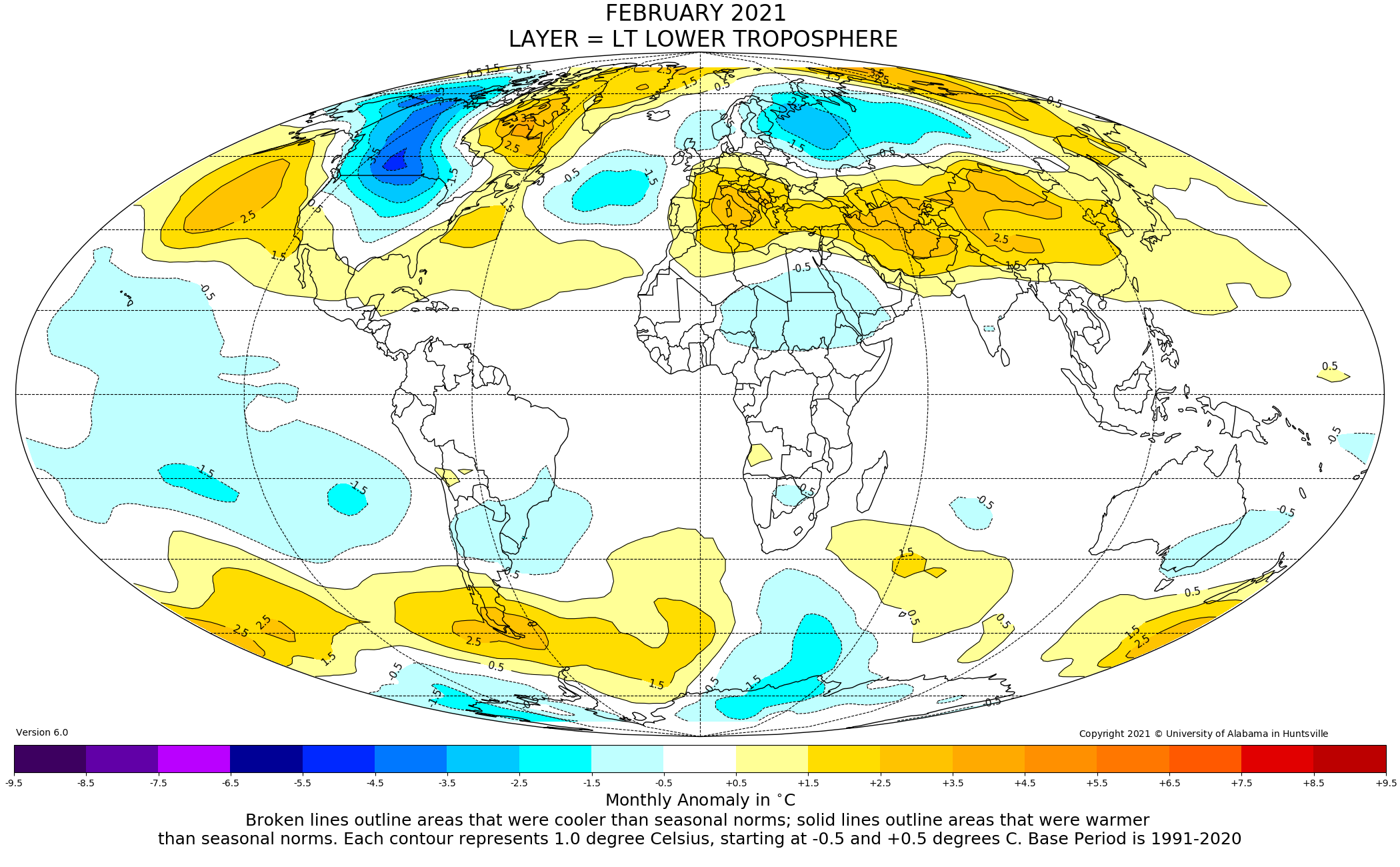
Do you think a decrease in ocean surface temperature at the equator will raise global temperature?
UAH shows that temperature trends in the troposphere are unstable.
The troposphere temperature distribution in the UAH diagram shows the importance of the Earth being closest to the Sun during winter in the Northern Hemisphere. At the same time, warmer oceans in the northern hemisphere in winter provide more snowfall.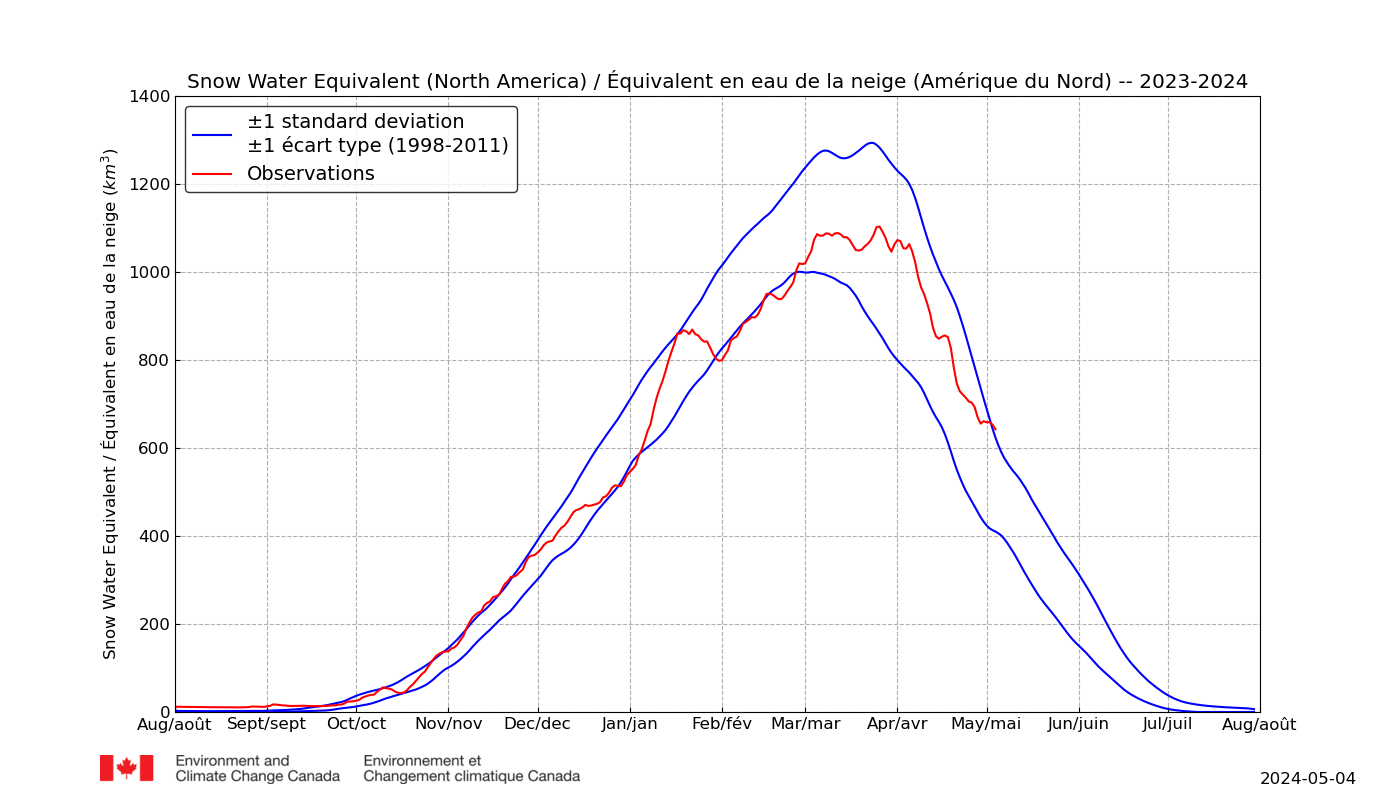
http://globalcryospherewatch.org/state_of_cryo/snow/fmi_swe_tracker.jpg
Izaak Walton has missed the point. Long Pauses with occasional el-Nino-driven sharp increases in temperature indicate an overall warming rate which (whether steady or not, for in truth we do not have enough observational capacity to know what is going on in the oceans, even with the ARGO network) is between one-third and one-half of the originally-predicted rate.
Monckton of Brenchley
A few years or perhaps decades of change in total solar radiation will cause ocean temperatures to drop.
Monckton of Brenchley
“… an overall warming rate which… is between one-third and one-half of the originally-predicted rate.”
_______________
Which prediction was this please? IPCC AR4 (2007) stated “For the next two decades, a warming of about 0.2°C per decade is projected for a range of SRES emission scenarios.” https://archive.ipcc.ch/publications_and_data/ar4/wg1/en/spmsspm-projections-of.html
The rate of warming in UAH since 2007 is currently +0.32 C per decade. Temperatures in UAH would need to fall between now and 2027 in order for the 2007 IPCC projection not to be wrong on the cool side.
IPCC’s original prediction was, of course, the prediction in its 1990 First Assessment Report.
A prediction which is spot on…
https://www.carbonbrief.org/analysis-how-well-have-climate-models-projected-global-warming
With the February data, the Pause in the RSS set is identical in length to that of UAH, starting in August 2015, though it is cooling at a slightly faster 0.26°C / century.
Main point is that a trend over a few years is not a very useful way of determining the overall warming rate. UAH is warming slowest, RSS fastest, yet both have identical “pauses”.
Bellman is well paid to whine, but his paymasters, who are not getting value for money, no doubt realise that long pauses are the inconvenient truth that climate extremists most fear. Foe it is clear from the industrial-era record to date that not much more than 1 degree of warming is to be expected this century – not enough to worry about.
does 1 degree Celsius make a difference in your body temperature? it is only ~3% of your average temperature…
an average annual global value of 1 degree means higher values over certain locations and shorter periods, did that cross your mind? Do you think people living in locations with temperatures reaching 50 degrees are happy?
What are your credentials again? Why should anyone take you seriously when you make such claims having no proper education?
The fact that you’ll be dead before climate change will have severe impacts on our lives justifies your position to say whatever rubbish you want. Scientists have ethics and don’t think in this stupid way as you. So what if (I’m humoring you here, I know you are wrong) you are wrong? Will you apologize? Or are you willing to have all that suffering in your hands?
Which brings me to another thing, you have claimed there is no scientific consensus about AGW. This is a rubbish statement proven wrong. Have you apologized for this lie?
“…long pauses are the inconvenient truth that climate extremists most fear.”
How long does a pause have to be before it’s considered long enough to be feared?
Does it worry you that whilst CET 1694-1733 was the fastest warming 40 year period in the record, that 40 year period contains a pause lasting 24 years?
Bellman:
The long “pause” in in the CET 1694-1733 period was due the absence of VEI4 and higher volcanic eruptions. The resultant cleaner air allowed sunshine to strike the Earth’s surface with greater intensity,causing increased warming.
Any pause in such eruptions greater than ~ 3 years will cause a temperature increase, and many instances can be found in the CET record..
,
With February’s data, GISTEMP’s “pause” now starts in May 2015, making it 5 years and 10 months old.
(Sits back and waits for another cheque to drop through the letterbox.)
So many years and you still do the same kind of rubbish…
Cherry picking data to show a so-called pause is meaningless and you obviously know it
Mr Reyman should perhaps get his Kindergarten mistress to explain that long pauses tend to indicate slower global warming than predicted.
Let me be clear. There are many factors affecting climate. Sun (please argue that it is only the sun.. it will be fun), volcanoes (not even you can argue it’s only volcanoes..), humans are just some of the major ones. Not all of those influences have the tendency to cause warming (or even warming everywhere), but they cause also cooling. Volcanoes for instance cause cooling…
Then there is El nino and La nina…
Not all of those have the same effect, some are short term others long term, semi-periodic etc etc. So you can find combinations of the above that over short periods it might seemingly appear there is no warming, but that doesn’t mean CO2 did not contribute to warming, only that the cooling factors played a very important factor over that period. The long term trend, I’m sorry to tell you, is a mean global annual temperature increase, which you show in your plots too.. but then choose to focus on the last 6 years.
To argue that there is a 6 year(!) pause in global warming is ignorant beyond belief.
What if I choose to focus between 2016-2019, very dishonest thing to do (like you are doing here…), but it would show a dramatic temperature increase. Obviously you won’t get this… I’m sure you’ve been told a million times before…
As for how well global warming has been predicted, maybe have a look at this one:
https://www.carbonbrief.org/analysis-how-well-have-climate-models-projected-global-warming
They don’t have your predictions in there, but how good have your prediction been?
Also you know that this is a scientific issue, this is discussed with peer-reviewed publications, which you know you have none and with your qualifications and “quality” of work, as the one presented here, you know you won’t be able to publish as it will not survive the scrutiny of actual scientists.
Why don’t you leave this to people that actually have the formal education and understanding of this topic?