Guest “The best laid plans of mice and men…” by David Middleton
Note: I had originally titled this post, The Day After Tomorrow: ERCOT Fail Edition, and ERCOT did fail. But I changed the title because, even though the failure was system-wide, wind power totally failed, solar never showed up, while natural gas, coal and nuclear power were all that prevented the entire State of Texas from freezing in the dark. Despite these facts, some in the media are reporting that wind power saved the day, while fossil fuels and nuclear power failed.
Reporting from Ice Station Dallas
Current weather conditions at 0630: 21 °F (-6 °) with about 3-6 inches of snow on the ground. The normal low temperature on 17 February is 40 °F (4 °C)… It’s now ~10 °C below normal. This is a huge improvement over my previous report. Both the weather and the power situations seem to be improving. The weather situation was unavoidable, however the the power situation was inexcusable. Almost all of the electrical grid in Texas is overseen by ERCOT, the Electric Reliability Council of Texas and ERCOT utterly failed in the “reliability” department.
Many on the right have been somewhat unfairly placing all of the blame on frozen wind turbines, many on the left have been idiotically placing the blame on natural gas & coal, and retardedly on nuclear power plants. The failures to deal with freezing weather were system-wide.
The power situation is disastrous, and it likely won’t be fixed tonight
February 15, 2021 at 2:50 pm by Eric BergerMillions of customers in the greater Houston region continue to experience some of our coldest weather in decades without the benefit of electricity to heat their homes. (Full disclosure, I am one of them, and have been since 2 am CT. I am typing this from my office, wearing a winter jacket).
To understand what is going on, and when the power might return, I spoke this afternoon with Kenny Mercado, CenterPoint Energy’s Executive Vice President for Electric Utility.
First, it is important to understand how power generation works in Texas. Power plants across the state generate electricity from natural gas, coal, wind, solar, and other sources. This is all put onto the grid, which is managed by the Electric Reliability Council of Texas. Then it is up to companies like CenterPoint to deliver electricity to your home through its network of lines and poles. (Reliant, the sponsor of Space City Weather, markets and sells electricity to the customer. They are not directly responsible for generation or delivery).
What happened
As of 2 pm on Monday, about 1.1 million of CenterPoint’s 2.6 million customers are without power in the greater Houston area. Mercado said customers without power are unlikely to get electricity back today, and quite possibly not tonight—when temperatures are forecast to reach near all-time record lows.Two things happened last night to contribute to these outages. First, demand was extraordinarily high across the state, Mercado said. And then, beginning at about 1 am, generating units started to shut down. This is almost certainly due to extremely cold conditions. Eventually about one-third of the anticipated capacity went offline. This included a handful of freezing wind turbines, but the majority of the volume losses were due to coal and natural gas plants going offline.
[…]
Space City Weather
This remark is moronic:
Eventually about one-third of the anticipated capacity went offline. This included a handful of freezing wind turbines, but the majority of the volume losses were due to coal and natural gas plants going offline.
Eric Berger, Space City Weather
“A handful of freezing wind turbines”? At least half of the wind generation capacity has been knocked offline since Sunday. It’s only a “handful” in the sense that wind power only accounts for 20-25% of Texas electricity generation. When you start with only two hands full of wind turbines and you lose one hand to frostbite, I suppose you’ve only lost a handful… [/SARC]
“The majority of the volume losses were due to coal and natural gas plants going offline”? Well, no schist Sherlock. About 70% of ERCOT’s generating capacity is comprised of natural gas and coal-fired power plants… So, of course, the majority of the volume losses have been among natural gas power plants. However, coal-fired and nuclear power plants (all two of them) have been relatively unaffected.
The fact is that almost all of the electricity currently being delivered to the ERCOT grid is coming from natural gas, coal-fired and nuclear power plants.

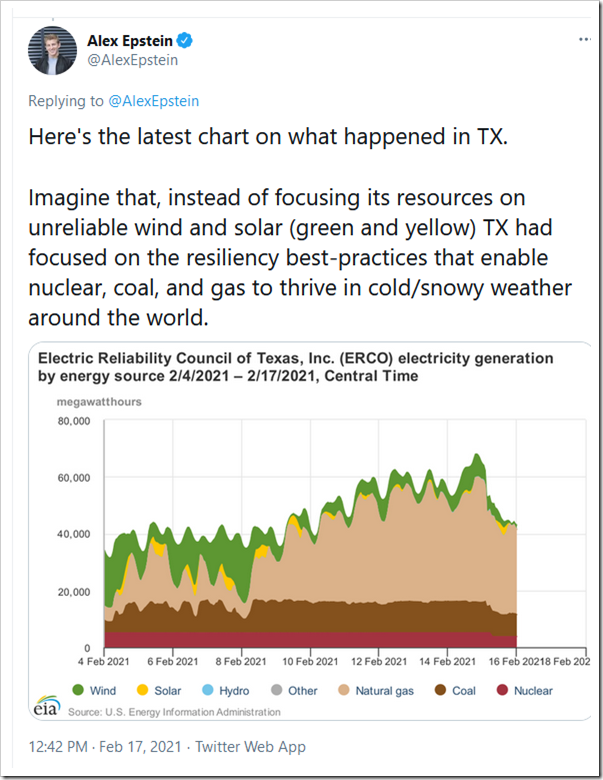
Here is the latest daily ERCOT capacity mix:

The breakdown for 16 February 2021:
| MWh | % | |
| Wind Generation | 73,395 | 6% |
| Solar Generation | 20,134 | 2% |
| Hydro Generation | 3,833 | 0% |
| Other Generation | 682 | 0% |
| Natural gas Generation | 759,708 | 65% |
| Coal Generation | 204,655 | 18% |
| Nuclear Generation | 98,394 | 8% |
| Total | 1,160,801 | 100% |
Fossil fuels accounted for 83% of our electricity generation yesterday. Fossil fuels + nuclear accounted for 92%.
While there is plenty of blame to go around, ERCOT had a “dress rehearsal” for this in 2011. At least back then, they successfully employed rotating outages. We haven’t lost power, while many of our friends have been without power since early Monday morning.
Texas has more wind power capacity and natural gas production than many, if not most, nations. This cluster frack is inexcusable and an embarrassment to the Great State of Texas. We now know that President Donald Trump and Energy Secretary Rick Perry were 100% correct when they asked FERC to ensure that our coal-fired and nuclear power plant fleets be kept in service.
Oct 2, 2017,05:11am EDT
Rick Perry Directs FERC To Complete Final Action On Resiliency Pricing Rule In 60 Days
Rod Adams Contributor
Energy[…]
Eligible grid reliability and resiliency resource is any resource that:
1. is an electric generation resource physically located within a Commission-approved independent system operator or regional transmission organization;
2. is able to provide essential energy and ancillary reliability services, including but not limited to voltage support, frequency services, operating reserves, and reactive power;
3. has a 90-day fuel supply on site enabling it to operate during an emergency, extreme weather conditions, or a natural or man-made disaster;
4. is compliant with all applicable federal, state, and local environmental laws, rules, and regulations; and
5. is not subject to cost of service rate regulation by any state or local regulatory authorityAll licensed nuclear power plants and a significant portion of existing coal plants can meet those requirements today.
[…]
Forbes

Natural gas is the only way forward. Its ready availability in Texas means no new nuclear reactors are going to built at Comanche Peak NP station. Coal in Texas is a dead-end, its all brown lignite coal, plenty of it, but the coming EPA crack down is going to make it even more non-viable.
What has to happen is to stop the wind turbines stupidity cold… dead in its tracks. No more wind power.. Texas allowed too much capacity to be filled with unreliable wind power, and it is now paying the price.
Then fill out needed capacity with fast spin-up gas turbines in urban areas with the pipes to bring the gas to meet the peak demands that these cold and hot spells bring.
That is the only way to reliability.
Texas has HEAPS of coal, and there is ZERO SCIENTIFIC REASON for them not to use it.
It’s all brown coal. Let’s be realistic here.
Lignite is a dead end in this anti-CO2 environment.
Yes, it’s a dead end in this “anti-CO2 environment.” The solution is to make anti-CO2 the dead end.
Gas has the problem it in not easily store in large amounts, did you not read the article power plants should have sixty days of fuel on hand. Rick Perry knew of the problem, if I remember right he was once governor of Texas.
There are lots and lots of unused underground salt domes suitable for nat gas storage in Texas and Louisiana. And I do mean “Lots”
Even at 3000PSI you ain’t going to store a 60 day supply of methane in salt domes. The only way a natural gas fueled thermal or gas turbine power plant can store a 60 day supply of fuel onsite is by converting them to dual fuel, gas primary fuel with fuel oil as secondary fuel. The problem with this is you sacrifice lowest emissions. To meet emissions on fuel oil requires larger SCR & ammonia slip catalyst as well as adding an oxidizing catalyst.
He was the longest-serving and best governor in the history of the State of Texas. He was also the only Secretary of Energy who approached the job pragmatically.
Holman Jenkins in yesterday’s WSJ, “Nine times Dallas has recorded daily snowfalls of 4 inches or more since 1940, but this week’s may be the first to be attributed to man-made climate change.”
WRT: “…no new nuclear reactors….”
Just eyeballing the eia graph, it looks like nuclear was the only energy source that performed without reductions.
No Sir, natural gas raised production substainaly, as this graphic showed, and if some of the compressors had not been tied into wind generated power, they could have increased production even more.
“Say Farewell To Windmills, No More Fair Weather Power”
Still too long for a bumper sticker.
Does anyone on here know how to generate those graphs directly from the EIA grid monitor site, i haven’t been able to figure it out yet and people question the graphs, i figure the best way is to point them in the right direction so they can find for themselves?
You can start here – may have to dig down a bit: https://www.eia.gov/beta/electricity/gridmonitor
David Middleton:
“But I changed the title because, even though the failure was system-wide, wind power totally failed, solar never showed up, while natural gas, coal and nuclear power were all that prevented the entire State of Texas from freezing in the dark. Despite these facts, some in the media are reporting that wind power saved the day, while fossil fuels and nuclear power failed.”
……
“However, coal-fired and nuclear power plants (all two of them) have been relatively unaffected.”
This is not accurate:
“One of the two reactors of the South Texas Nuclear Power Station in Matagorda County shut down, knocking out about half of its 2,700 megawatts of generating capacity. On Monday, Unit 1 went offline cold weather-related issues in the plant’s feedwater system, said Vicki Rowland, lead of internal communications at STP Nuclear Operating Co.”
Texas has four nuclear power plants (not two), two at Commanche Peak, and two at South Texas Project. Each produces approximately 1250 MW electric. The loss of 1 of the 4 resulted in a loss of 25% of the nuclear contribution. You can see this in the graph that David provides in the article.
Given the intrinsic unreliable nature of wind and solar power, any grid always will have either real time backup…usually gas…or forced load shedding. No amount of wishful thinking by AGW adherents will change this. This means that any grid with significant amounts of solar and or wind components will always have this as a basic operating requirement. Therefor the loss of most of the solar and wind due to the winter weather is, in and of itself, not unusual or unexpected. The problem with Texas is that the rest of the grid was ill prepared for the large scale, long duration winter weather. The South Texas Project plant should not have been affected by this kind of weather (the other unit at South Texas continues to operate). As I pointed out in another post, the problem is that the Texas grid was ill prepared for the winter weather. The existence of a relatively large component of wind (and solar) did not add any additional unreliability as noted above…they are inherently unreliable. Regardless of the proportion of wind and solar, the “conventional” elements of the grid must be hardened against this kind of weather…or Texas just needs to accept that every 5-10 years they will go a few days with limited power.
There are two nuclear power plants. Each has two units. I knew that one of the units dropped off. I didn’t know which one till this morning. South Texas is located between Houston and Corpus Christi. Freezing weather shouldn’t be an issue there… But it clearly is.
By relatively unaffected, I meant in comparison to wind and natural gas. With the STNGS problem, nuclear was still delivering 75% of capacity. Wind got down to something like 5% of capacity. I think natural gas may have been as low as 60% of capacity on Monday.
Hi David
Thanks for your post.
My overall comment is simply that solar and wind are and will continue to be inherently unreliable. What specifically caused that unreliability, ie a stationary high pressure system (low wind), snow, ice, night, cold, is irrelevant :). Texas failed, or planned..ie risk acceptance…to have overall poor winter weather performance for the rest of the system. A specific example from my own experience at a coastal nuclear power plant is that the plant would preemptively shutdown when threatened by a hurricane, as the plant was not designed to operate under those conditions. That would be a planned response to adverse weather. The assumption would be that other plants outside of the weather threat would continue or be available to operate. Texas obviously ran into problems with the large scale nature of the winter weather, and will either spend billions hardening the system, or more likely those involved will recognize that the next event will be long after their retirement. They will point fingers, yell at each other, write some ignored reports and hope that that something else will garner the publics attention…..which is a pretty safe assumption. In the meantime, Biden will help ensure that more wind turbines are built..:)
Regards,
Ethan Brand
David – a commenter on another article claimed that part of the problem in Texas was that by shutting down coal plants over the last few years in favor of wind, they reduced their reserve capacity, and because they did not have sufficient reserve capacity, frequency fluctuations on the grid tripped some number of nuclear, coal, and gas plants to go off-line. Do you know if that is true?
The last time something like this happened, 2011, we had less wind and more coal. There were some problems with spinning up coal-fired plants, but overall, it was far less of a cluster frack.
I don’t know if frequency fluctuations tripped off any power plants. I have found out that one of the two reactors at South Texas Nuclear Generating Station had to be taken off line due to water pump issues. STNGS is located between Houston and Corpus Christi, where freezing weather isn’t supposed to be a problem.
Thanks Dave.
Interesting ERCOT winter prediction here. Oh well, most predictions have zero consequences…most.
Seasonal Updates (ercot.com)
That article does not mention 2011 ice storm during the Superbowl week.
Eric Berger is refuting EIA data for that period.
Texans need to file for unemployment in time to the get the extra UI benefits from DC. Then add cash payments, waiver of rent, mortgages, and utilities with their tax refunds. Then they can all fly to Cancun like Cruz.
They caught him. He’s being remanded to custody.
What are the charges? Crossing a state line to watch immature gulls and immoral porpoises?
(Had to Google…)
Soliciting:
He’s back on cold cuts for now.
My favorite comment I’ve heard “Wind provided more than what was expected…” What was expected? Zero. they expected zero wind power, and ended up getting a couple of MW.
See, the problem is wind and solar are not dispatchable, meaning in a crises, you get what you get.
And no one discusses the demand spike caused by the winter storms. Most power outages are caused by both a spike and demand and a crimped supply. Demand spiked just as several power stations went of line due to unexpected icing caused by…global err.
This morning CNN interviewed the guy in charge of ERCOT. He was trying to give credit to themselves for giving a warning about rotating outages which he said saved the system from complete blackout.
He also tried to say that if they were connected to the national grid they would not have been able to get power as the other states had the same problem. He was countered on that. He never once mentioned windmills only “generators”. they never noted that the gas plants are electric powered.
How about a name change to EUCOT instead of ERCOT? The ‘R’ is downright comically inappropriate.
Don’t be so quick to say that ERCOT failed. Sure, as always, things could have been done better; but an event like this hasn’t happened in over a century. In that era may Texans didn’t even have electricity. Too many have never experienced nature up close and personal and have become complacent about their creature comforts. A little ‘suffering’ will do those folks good and maybe teach them something about strength of character.
It happed in 2011. Have you forgotten so soon?