Reposted from the Cliff Mass Weather Blog
Monday, September 21, 2020

A number of groups and individuals are claiming that the recent major wildfires in the Pacific Northwest are predominantly or significantly the result of climate change produced by increasing greenhouse gases.
In fact, many have called these conflagrations “climate fires.” Did global warming (a.k.a. climate change) have a significant impact on the Northwest wildfires of the past few weeks?

Consider the key fires in the Northwest U.S. this month: the huge, rapidly expanding fires on the western slopes of the Oregon Cascades.
The fires that not only burned hundreds of thousands of acres, but produced most of the smoke that engulfed the region for over a week. As I will demonstrate, the catastrophic Oregon Cascade fires of the past weeks were forced by strong easterly winds, and such winds may well weaken under global warming. And I will show that the weather of the past summer was relatively normal.
Thus, although global warming will undoubtedly produce substantial changes in our climate in the future, the impacts of global warming on the recent Oregon fires were probably quite small.

Smoke reaches Portland. Image by Tedder.I should note that BEFORE the recent fires I had been working on research and a paper on the meteorology of western Cascade fires and have a NSF grant to examine California wildfires. Furthermore, I have worked closely with the Washington State Departments of Ecology and Natural Resources, as well as the USDA Forest Service, on Northwest wildfire meteorology and prediction.
Fires on the Western Slopes of the Oregon Cascades and their Historical Context
A series of major fires exploded on September 7-8, 2020, ranging from the Big Hollow Fire northeast of Portland, the Riverside, Beach Creek and Lionshead Fires east of Salem, the Holiday Fire near Eugene, and the Archie Creek, South Obenchain and other fires to the south. Several of the western Cascade Range fires, which have spread over more than 350,000 acres, had been initiated by lightning in mid-August, smoldering until strong easterly winds caused rapid expansion.

Fires along the western slopes of the Cascades are infrequent but regular, with research studies using proxy information (such as charcoal remnants in the soil and tree ring/scaring data) finding stand-killing fires occur roughly every 250 years (e.g. this reference). Importantly, during the past century, few major fires has burned over western slopes of the Oregon Cascades, with the most prominent being the Yacolt Burn (1902, 500,000 acres) and the Eagle Creek Fire (2017, 50,000 acres), both near the Columbia Gorge east of Portland. Interestingly, there has been far more fire activity over the coastal mountains of Oregon than along the western slopes of the Cascades during the past 120 years. Thus, many of the recent fires along the western Cascades slopes were burning across terrain that had not experienced major fires in over a century.

Fires and their sizes since 1900 over Oregon. Image created by Lynne Palombo of the Oregonian.
Strong Easterly Winds Are Necessary for Major Wildfires on the Western Slopes of the Cascades
It has long been known that major wildfires over the western slopes of the Oregon Cascades have been limited to periods of sustained, strong easterly winds (from the east). To quote a classic paper (FREQUENCY of DRY EAST WINDS OVER NORTHWEST OREGON and SOUTHWEST WASHINGTON, Cramer 1957):
The history of forest conflagrations in the Northwest is, for the most part, a history of the simultaneous occurrence of small fires and severe east winds.
Most of the biggest fires along the crest and western slopes of the Oregon Cascades started with small fires, either natural or human-initiated, which without winds would smolder or very slowly grow. But add strong easterly winds and they can explode as seen on September 8th.
As part of my research, I determined every major fire on western side of the Oregon and Washington Cascades since 1900, and then examined the meteorology of each using observations, newspaper accounts, and the reanalysis grids (gridded analyses based on observation that go back to the 1860s). EVERY such major fire, without exception, was associated with strong easterly winds.

The Tillamook Burn included a series of fires starting in 1933 that torched over 350,000 acres
Why are strong easterly winds required for the megafires on the Oregon western slopes?
First, easterly winds tend to be very dry and usually warm, which helps desiccate surface fuels. Westerly winds off the ocean are generally cool and moist, not only bringing high relative humidity but often moving fog and low clouds over the western Cascade slopes, both negatives for fires. Easterly winds are from the dry, warm interior of the continent, and as the air sinks along the western slopes it is compressed and thus warmed as it moves to lower elevations (where pressure is higher). Because of the warming, the relatively humidity plummets as the air sinks. Very favorable for fires.
Furthermore, strong easterly winds not only facilitate warming and drying but also provides oxygen to fires, allowing them to expand rapidly. In addition, strong winds push superheated gases ahead of fires (which helps then move quickly) and strong winds loft firebrands and embers that produce spot fires ahead of the main fire line.
The bottom line: strong easterly winds are very important for starting fires on the western Cascade slopes, which are typically resistant to fire because of their relatively moist surfaces and extensive shading.

So the questions you must be asking at this point: were the recent Oregon wildfires associated with strong easterly winds? Is there a climate connection with such winds? Are easterly winds increasing as the earth has warmed the last 40 years? And do climate models suggest that global warming will increase easterly winds over the western slopes of the Cascades?
The answer to the first question is an emphatic YES. The September event was associated with powerful and sustained easterly winds over the Cascades, with some gusts reaching 50-70 mph (see map below of maximum gusts on September 8th in mph). Enough to cause large numbers of power outages in Oregon.

Maximum winds on September 8 over western Oregon
The balloon-launched sounding at Salem, Oregon for 5 AM Tuesday, September 8th showed strong northeasterly and easterly winds though the entire lower atmosphere (shown up to roughly 10,000 ft in the figure).

Bottom line: strong easterly winds occurred over the lower atmosphere of western Oregon from late on September 7, peaking on Sept 8th, and continuing in weakened form during the event.
Strong easterly winds are relatively unusual during the summer over western Oregon So how unusual was this easterly flow event? It turns out EXTREMELY unusual.
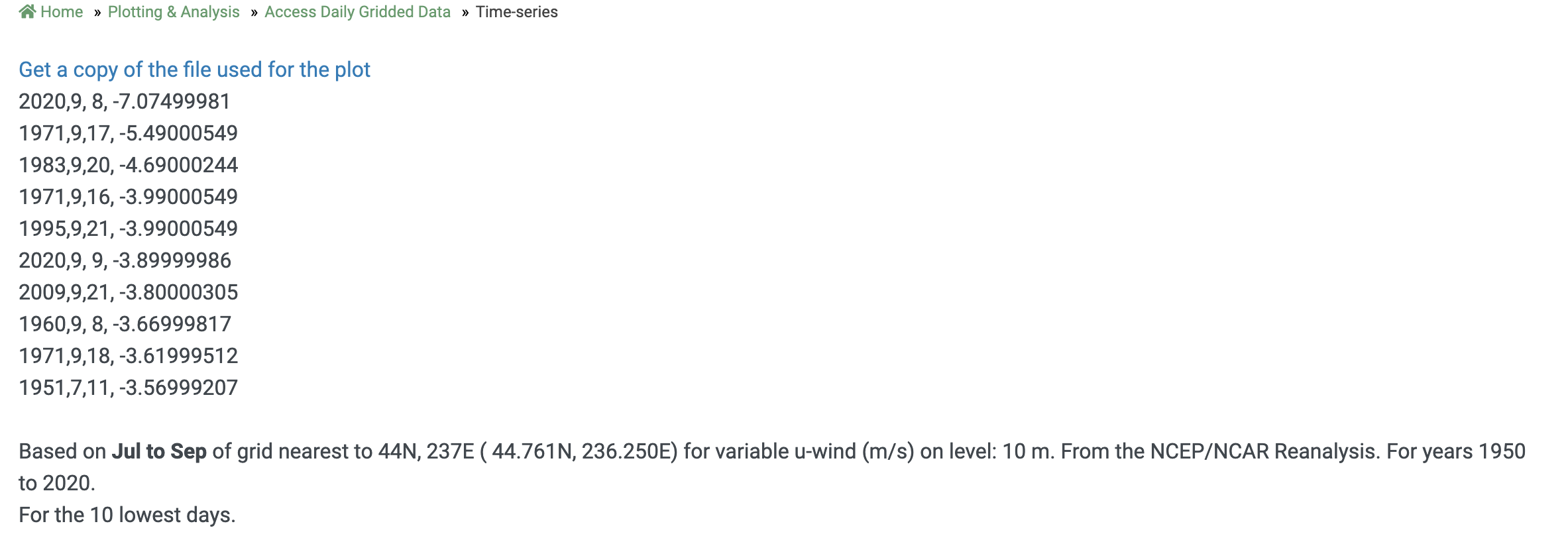
To examine this, I searched gridded weather data (the NCAR-NCEP reanalysis) for a grid point on the western slopes of the Oregon Cascades. Specifically, I examined the strength of the daily average zonal (east-west wind), looking for the days of strongest easterly wind. For example, I checked surface wind (10-m above the surface) from 1950 to today for July through September–the relevant months– and found the top ten cases.

The grid point I used for this analysis
The results show that September 8 had the strongest easterly surface wind over the period examined (more negative means more easterly), substantially exceeding second place (Sept 17, 1971). And Sept. 9 was also on the list. Only one other multi-day sequence was on the list (Sept. 16-18, 1971) and there were major fires that period as well.
Results of one of my analyses
What produced this record-breaking easterly wind event starting Sept. 7th? An extraordinarily area of COLD temperatures and associated high pressure area that moved southeastward to the east of our region, coupled with an unusual low pressure offshore.
Below is the pressure analysis at 5 AM on Sept. 8, with the solid lines indicating pressure (isobars) and the colors indicating differences from normal). Strong high pressure was over Montana, while a trough of low pressure was along the coast. Between these two features there was a large difference in pressure. The colors indicate that the high pressure, centered in Montana was very unusual, with the difference from normal (the anomaly) being very unusual (4-5 standard deviations from normal for those of you knowledgeable about statistics)


Looking at winds at 925 hPa (about 2500 ft above sea level) at the same time, the strongest winds were over western Oregon, reaching over 6 standard deviations from normal. Unprecedented conditions for this date.

Let me underline something I noted above: the anomalous high pressure was associated with very unusually cold air, air that would bring snow to Denver in the subsequent day.
Is there a trend of more easterly winds over Northwest Washington in the operational record?
If one is interested in climate change, one MUST look at trends over time. Below is a plot of the top 10 cases of easterly wind at the grid point noted above–there is no evidence of an upward trend over time. So with increasing temperatures as the planet has warmed, there is no apparent increase of easterly wind occurrence over the region. This is a serious strike against the global warming/wildfire contention.

But let’s not stop there. My group, in concert with Professor Eric Salathe of UW Bothell, are running a high-resolution climate model forced by increasing greenhouse gases–probably the most sophisticated local climate modeling in the country. And we are doing this with an ensemble of many ultra-high resolution climate runs. And we drove our regional climate model with global models forced with a very aggressive (and undoubtedly larger than expected) increase in CO2 (RCP 8.5).
In these model how did the easterly flow near the crest of the Cascades change over time (we picked a point near Washington’s Stampede Pass, but that is close enough)?
The answer is found below. The figure shows the number of days per year during July through September that the winds exceed a certain speed (6.6 knots) from the east. The simulations extend from 1970 through 2100 and the black line provides the mean of all the simulations.
Wow. The number of strong easterly events….the kind that start fires…DECLINES under global warming. Let me say that again, it declines.

This makes a lot of physical sense and is consistent with results found by others in California. As the planet warms, the interior of the continent warms more rapidly that the ocean. Warms results in less dense air and pressure falls. Thus, pressure falls more rapidly in the interior than on the coast, which increases westerly flow and decreases easterly flow. Warming would also lessen the amplitude of the cold highs, like the one that occurred two weeks ago.
So we have observational data that shows that summer easterly flow over the Cascades did not increase during the last 70 years as the planet started to warm. Furthermore, the gold standard in climate simulations shows late summer easterly flow declining under global warming. So the absolutely key driver of major west side of Cascades wildfires–strong easterly winds– does not appear to be strengthened by global warming. In fact, the OPPOSITE appears to be the case. It appears to weaken.
These findings profoundly undermines the hypothesis that the Oregon fires are “climate fires” forced by increasing greenhouse gases. As a popular TV series might say, this hypothesis is “busted.”

But let me take this one step further to completely address the “climate fire” claims. To put the proverbial “final nail” into the “climate fire” coffin.
How Unusual Were the Climate Conditions in the Months Before the Fire?
Were the weather conditions in the months leading the September fires highly unusual? And has there been a significant observed trend towards considerably worse (dry/hot) conditions as would be expected if climate change was contributing to the Oregon fires?
To answer these question, let’s examine the precipitation over crest and western slopes of the northern Oregon Cascades—the region where many of the big fires originated and grew. Below is a plot of the June to August precipitation over the region from the NOAA/NWS climate divisions data (Division 4 of Oregon) for 1900 to 2020. The summer 2020 values is not exceptional at all (indicated by small arrow and the horizontal dashed line). And there is little overall trend in the precipitation for that region.

Clearly, precipitation in this region does not appear to be changing much with global warming. Climate models suggests a small decline in summer precipitation (and an increase in overall precipitation) by the end of the century if we continue burning fossil fuels with abandon.
Temperature? As shown below, the summer 2020 temperature for the western slopes of the Oregon Cascades was neither a record nor even exceptional. One notes a modest upward trend during the past 30 years of approximately 1F. That could be the global warming signal. In any case, such a small warming hardly explains the catastrophic wildfires of this summer.

Finally, let me show you the Palmer Drought Severity Index (produced by NOAA) for September 12th. The Palmer Index combines temperature and precipitation to evaluate whether drying/drought conditions are present. This index indicates normal conditions over the western slopes of the north Cascades.


The bottom line: this summer was not one of significant drought or very unusual. Until the September 7-8 fire initiation by the strong winds, the area encompassing fire was below normal in both Oregon and Washington.
Thus, considering observations and modeling, both strongly supporting each other, the major fire/smoke outbreak this month was the result of very, very unusually strong easterly winds, NOT global warming or climate change.
Those pushing the climate change narrative, including some politicians, activist groups and media are simply misinforming the public.

Such deceptive information undermines society’s ability to deal with wildfires in an effective way, such as improved forecast management (e.g., thinning, proscribed fires), more aggressive extinguishing of fires before dangerous situations like this month, and better warnings to move people out of harm’s way.
Short Comment on Washington Fires and Global Warming
Some individuals and groups have suggested that the explosive fires in Washington State that proceeded the Oregon fires, were the result of climate change. This is also without any foundation. Nearly all of the Washington State fires were grass fires (e.g., Cold Springs Fire–190,000 acres, Pearl Hills Fire–224, 000 acres) that were spread by extreme and highly unusual northerly winds. Grass fires do NOT correlate well with climate, since grasses and small bushes inevitably dry out sufficiently to burn by early summer. Even if the grass was not initially dry, it would dry out within hours under strong winds. Such fires are controlled by the availability of ignition sources (often manmade) and strong winds and very powerful (50-70 mph) and unusual winds occurred on September 6th.

Grassland after fire in Eastern Washington this month.Courtesy WA State Department of Ecology
HT/Cam_S
No!
One might also ask why, if fire is so related to anthropogenic climate change, many Pacific Northwest ecosystems (which existed long before human activities were an issue) are so adapted to it. The California State Tree, the Giant Sequoia, has fire-resistant bark and is self-pruning (i.e. it drops its lower limbs so that fire has to somehow reach the crown to kill the tree), and needs the heat from fire to open its cones; this serves the purpose of dropping the seeds onto ground where the undergrowth is destroyed by the fire, giving the seeds a better chance of germinating. The Douglas Fir is similarly adapted to fire; here is a quote from the paper below: “Douglas-fir is more fire resistant than many of its associates because of it grows rapidly and is covered with a thick corklike bark along its stem and roots. In addition, the tall trees have their foliage concentrated on the upper bole, which makes it difficult for fire to reach the crown.
Regeneration of Douglas-fir is favored by fire. Since it is shade intolerant, new Douglas-fir trees are not established under current forests without fires to kill more shade tolerant competition. Forest fires therefore allow Douglas-fir to continue to be a dominant presence in the forest.”
https://ucanr.edu/sites/forestry/California_forests/http___ucanrorg_sites_forestry_California_forests_Tree_Identification_/Douglas-fir/
The common denominator between the horrendous Australian bushfire season and the American wildfires is a blocking high pressure caused by a meandering jet stream. A global cooling signal for sure.
Ten minutes on the back of a fire truck in a fire and you are left with no doubt that its the fuel loads that make them bad fires.
The reason and cause of the fires in the US and Australia are solely the responsibility of the greens labor democrats and other wierd socialists. They alone prohibited the one measure that would make the fires insignificant by preventing FUEL REDUCTION, the only factor we can control is the availability of fuel, we have no control of the oxygen in the air or the sources of ignition accidental , natural or arson.
Global Warming, Man Made Climate Change…etc…they are all scapegoats for everything that isn’t conforming to someone’s idea of the “perfect world”.
The rhetoric is littered with these terms to now include climate arson (how ridiculous is that). All in an attempt to blame something bigger than the people that ARE to blame.
CA forest management sucks, it has for decades. You don’t allow 40 years of detritus to dry out and become fuel due to mismanagement and ongoing pissing contests with the logging industry (unions and all) and then turn around and blame climate change for your state burning to the ground. The only truth is the term man made…because these fires ARE man made through negligence, avarice, and greed.
From the article: “Thus, although global warming will undoubtedly produce substantial changes in our climate in the future”
There is no evidence for that. The globe may start cooling, for all anyone knows.
Assuming warming will continue is an assumption too far. We are in fact cooling since 2016.
And if one goes by unmodified surface temperature charts, we have been in a temperature downtrend in the United States, including Oregon, since the 1930’s. If one is going to assume something about the temperatures, they would probably be more accurate to assume it will continue to cool, since that is the trend we are in.
1} All is within range of natural variation in fire, weather and climate.
2) Given the serious consequences of forest fires that are natural disasters, I need to know more about the arsons that accompany them. Who are these arsonists, what are their motives and what do they know about others like them? Call it a small, but necessary part of forest management.
“Unprecedented” must be most overworked term in the lexicon of climate catastrophists. The National Interagency Fire Center (https://www.nifc.gov/fireInfo/fireInfo_stats_histSigFires.html) documents 10 historically significant fires that occurred between 1825 and 1900 that totaled nearly 20 million acres, 3 of which occurred in western Oregon: the 1845 Great Fire (1,500,000 acres), the 1853 Yaquina Fire (450,000 acres) and the 1868 Coos Fire (300,000 acres). Since these fires all occurred near the end of the Little Ice Age, it would seem obvious that weather and not climate dominates the causes of conflagrations.
The Riverside Fire would have consumed my home of two decades is the east winds blew just a few more hours. When they blow into a fire you can’t fight them from the ground, it’s a blast furnace from the mouth of hell. These conditions are common enough like hurricanes are. This year they were Cat 5.
‘ Thus, although global warming will undoubtedly produce substantial changes in our climate in the future, ’”
Lost me at this point.