Effects of the pandemic will be detected in the atmosphere much later – To reach the Paris climate goals, decade-long measures are needed
KARLSRUHER INSTITUT FÜR TECHNOLOGIE (KIT)

Based on current data measured in the energy, industry, and mobility sectors, restrictions of social life during the corona pandemic can be predicted to lead to a reduction of worldwide carbon dioxide emissions by up to eight percent in 2020. According to the Intergovernmental Panel on Climate Change (IPCC), cumulative reductions of about this magnitude would be required every year to reach the goals of the Paris Agreement by 2030. Recent measurements by researchers of Karlsruhe Institute of Technology (KIT) revealed that concentration of carbon dioxide (CO2) in the atmosphere has not yet changed due to the estimated emission reductions. The results are reported in Remote Sensing (DOI: 10.3390/rs12152387).
The corona pandemic has changed both our working and our private lives. People increasingly work from home, have video conferences instead of business trips, and spend their holidays in their home country. The lower traffic volume also reduces CO2 emissions. Reductions of up to eight percent are estimated for 2020. “In spite of the reduced emissions, our measurements show that CO2 concentration in the atmosphere has not yet decreased,” says Ralf Sussmann from the Atmospheric Environmental Research Division of KIT’s Institute of Meteorology and Climate Research (IMK-IFU), KIT’s Campus Alpine, in Garmisch-Partenkirchen. “To reduce CO2 concentration in the atmosphere in the long run, restrictions imposed during the corona pandemic would have to be continued for decades. But even this would be far from being sufficient.”
To prove this, researchers additionally studied a long-term scenario that can be controlled well with atmospheric measurements: The goal of the Paris Climate Agreement to limit global warming to 1.5 degrees Celsius can only be reached by an immediate significant reduction of CO2 emissions and a further decrease down to zero by 2055. “The restrictions imposed during the corona crisis, however, are far from being sufficient. They have just resulted in a one-time reduction by eight percent. To reach zero emissions in the coming decades, cumulative reductions of the same magnitude would be required every year, i.e. 16 percent in 2021, 24 percent in 2022, and so on. For this, political measures have to be taken to directly initiate fundamental technological changes in the energy and transport sectors,” Sussmann says.
For the study, the team used data from the Total Carbon Column Observing Network (TCCON). It measured the concentrations in different layers of the atmosphere above Garmisch-Partenkirchen and at other places around the globe. “High-tech infrared spectrometers are applied, which use the sun as a light source. The measurement method is highly precise, uncertainties are in the range of a few thousandths,” Sussmann adds.Long Life of CO2 Prevents Early Detection
According to the researchers, the long life of CO2 and the high background concentrations that have accumulated since the start of industrialization prevent the changes in the atmosphere from being detected. “But also natural impacts make early detection difficult: Anthropogenic emissions, the main cause of the long-term increase in atmospheric CO2, are superposed by annual fluctuations of the growth rate due to natural climate variabilities of ocean sinks and land vegetation,” Sussmann says. Successful emission reduction, hence, is hard to detect by atmosphere measurements.
For their study, the researchers compared the TCCON measurements with the prognoses of the atmospheric growth rate for 2020 – with and without corona restrictions. “Precision analysis of atmosphere measurements revealed that the impacts of COVID-19 measures on the atmosphere might be measured after little more than six months, if the reference state without COVID-19 would be predicted precisely,” the climate researcher explains. “In any case, we would be able to find out within presumably two and half years, whether global political and social measures will help us find viable alternatives of fossil fuels and reach the goals of the Paris Climate Agreement.”
###
Original Publication:
Sussmann, R., and Rettinger, M.: Can We Measure a COVID-19-Related Slowdown in Atmospheric CO2 Growth? Sensitivity of Total Carbon Column Observations, Remote Sens., 12, 2387, 2020. doi:10.3390/rs12152387
More about the KIT Climate and Environment Center: http://www.klima-umwelt.kit.edu/english
Being “The Research University in the Helmholtz Association”, KIT creates and imparts knowledge for the society and the environment. It is the objective to make significant contributions to the global challenges in the fields of energy, mobility, and information. For this, about 9,300 employees cooperate in a broad range of disciplines in natural sciences, engineering sciences, economics, and the humanities and social sciences. KIT prepares its 24,400 students for responsible tasks in society, industry, and science by offering research-based study programs. Innovation efforts at KIT build a bridge between important scientific findings and their application for the benefit of society, economic prosperity, and the preservation of our natural basis of life. KIT is one of the German universities of excellence.
So its not possible that CO2 increases measured over the last 50 years is actually background natural variance then?
No
It due to rising temperature in the oceans.
Due to background natural variance….
#
Could be. What everyone ought to acknowledge is the carbon cycle is so complex we really, “don’t know”.
Like the virus that prompts this discussion: we don’t know enough about it (or viral contagion in general) to set public policy based on our knowledge.
Speaking of the oceans, viruses and the carbon cycle did you know… ? Every ounce of seawater contains approximately three billion viral particles! Their central function is controling phytoplankton, which is central to understanding Earth’s carbon cycle.
Which is part of the surface of what we don’t know. We observe much. If we divide our observations from the historical form of thought – we truly know nothing. Which is why no movement in atmospheric CO2 this year prompts cries of ignorance from the very people who are certain these input reductions are what is needed to save the world.
“we don’t know” but we still believe we know.
We do know. The increase in CO2 is due to us. No way around that.
Note from the graph at the link below:
About 350,000 years ago the atmospheric CO2 level was about 190 PPM. But by about 330,000 years ago it was up to 300 PPM. That’s an increase of 50%. Did mankind do that? Of course not. There were no coal fired power plants and no gas powered SUVs at that time. Mankind could not have had any effect on atmospheric CO2 levels at that time. It had to be natural. The current CO2 level is about 415 PPM. Maybe some of it is due to us, but you cannot discount the possibility that nature did some of it too.
Sometimes the correct answer is we “don’t know”.
Graph:

We don’t know what happened 350,000 years ago and we don’t know what were the levels then, because nobody was measuring and proxies are subject to lots of uncertainties and interpretation.
But we do know what has happened since 1960 because we have been measuring what we have put in the atmosphere and what is there. So we do know that the increase in CO2 levels since 1960 is due to us.
No point in denying something so obvious. Regardless of what nature has been doing, the increase is caused by us. We have added double the measured increase.
Just to be clear, that’s relative to natural increase, not total global C02 output, correct?
Of the ~ 100 ppm increase in CO2 levels since 1960 (315 to 415 ppm), ~ 100 ppm are due to human activities. The ocean should have released some CO2 due to the slight increase in temperature, but due to the increase in CO2 partial pressure in the atmosphere the ocean has been a net sink as per Henry’s law. And we know the biosphere is a net sink from oxygen measurements.
Javier
The graph I linked to was a key part of Al Gore’s famous PowerPoint presentation which started the Global Warming alarmism. Now you say it’s not accurate?
Another graph Al Gore presented was the temperature over the same time period also determined from Vostok ice cores. The two graphs showed a strong correlation. Al Gore said see when CO2 is high temperature is high. That was the most compelling part of his presentation. If your saying the CO2 graph is not accurate it blows his whole presentation out the window. Also Al Gore forgot to mention that the temperature changes first and then the CO2 follows.
The graph is internally consistent and primarily dependent on past CO2 levels, but not accurate. The CO2 in ice cores is dependent on a firning process to seal it that lasts decades during which diffusion takes place, and then is subject to a chemical modification over time depending on the abundance of certain ions, that made Greenland ice cores unsuitable for CO2 measurements, and also affect Antarctic ice cores but to a much lesser extent. The end result is a low-band filter of CO2 changes on a multidecadal timescale, and a slight alteration of the final amount of CO2 that is dependent on climate.
The result is that we can trust that Vostok, Law Dome, or EPICA CO2 levels represent what happened with CO2 in the past but don’t give us an accurate measurement of CO2 levels at the time and would not properly register a CO2 increase like the one we are living if it lasted less than a century.
Oceans could have been more of a net sink if they were not warming.
But Javier is correct, we have been emitting astrominical quantities of CO2. Obviously a lot of that is going to remain in the atmosphere.
Even if human emissions is only about 5% of the annual to and fro of the carbon cycle that cycle is a HUGE quantity and just 5% extra of that quantity each year is cumulative gain, not a cycle.
However, since plant life is CO2 starved in our current climate epoch and since the biggest climate threat to humanity is the next glaciation, we need a much more objective assessments of the costs and benefits of extra CO2 , not a mindless assertion that all CO2 is “toxic”.
That is misleading and dishonest. Maybe the IR measurement of radiation claims 0.1% but that does NOT mean that what they are concluding about CO2 carries the same uncertainty.
It is not even clear from this unscientific Urea Alert PR what exactly they claim they are measuring. AAAS is an appallingly politicised and activist group and there is very little science in what they are doing.
William, the increase of CO2 from a warming ocean is known from over 3 million samples of seawater taken over the past centuries.
At an average 15ºC for the global ocean surface, that gives an equilibrium with the atmosphere at around 290 ppmv. That changes with some 16 ppmv/ºC, that is all.
As we have about 415 ppmv in the atmosphere, the net direction of the CO2 flux is from the atmosphere into the oceans. That is about a quarter of our emissions, another quarter goes into vegetation and about half the emissions (as mass, not the individual molecules) remain temporarely in the atmosphere.
That the Corona impact is not (yet) measurable is a matter of accuracy and time: you need about a year or more of continuous reduction in emissions to measure a significant difference in increase rate…
No.
We have no more understanding of CO₂’s rise or fall in atmospheric levels now than we have of ‘why’ CO₂ changes 350,000 years ago.
Nor has anyone been accurately “measuring what we have put in the atmosphere and what is there”.
Estimating is the proper word. Estimates that are typical inaccurate government estimates from base assumptions and prejudices.
The OCO satellite measurements prove mankind is not a significant contributor.
Nature is.
ATheoK,
As the different governements needs lots of money, they bas a substantial part of their income on taxing the use of fossil fuels. Thus they now for sure how much fossil fuels are sold in each country. Maybe somewhat underestimated, because of the human nature to avoid taxes and underestimated by some countries (China…) to look better than they are.
The least one can say that CO2 emissions are known with reasonable accuracy and certainly not lower than what is known.
CO2 levels are monitored at over 70 places in the world deemed “background” by different people from different groups and different countries. Worldwide they don’t differ more than 2% of full scale from each other, despite the fact that some 25% of all CO2 each year is exchanged between atmosphere and oceans or vegetation. I call that well mixed.
Based on these two points, one can conclude that humans are the cause of the increase, as in the past 62 years, in every year, human emissions exceeded the increase in the atmosphere, with a few years borderline equal.
If you have an alternative explanation that includes where all the human emissions went, I am all ear…
BTW, OCO-2 doesn’t show anything of that kind. You need to add all emisisons and sinks at all points of the globe over a full year to know where the net sources and sinks are.
Yes it is possible and it is true. Natural CO2 outgassing is a function of the size of the ocean area above 25.6C, which has grown since the 1850s, the temperature within that area, and local dissolved inorganic carbon.
The climate changes 100% naturally, to this day. If anyone wishs to have a decent discussion about CO2, your first job is to define what natural outgassing is along with the threshold for it, and how that applies historically, as I have done, otherwise you have no basis for argument.
Javier likes to express doubt about my solar-ocean warming threshold work. Here I show the decadal ocean threshold of 95 v2 SN and the threshold for CO2 of 87 v2 SN:
CO2 on a detrended annualized basis will continue to decline as 30y sunspot average crosses below 87 in the near future:
Remember how the warmists get hyperventilated over the CO2 increase since the 1950s? It happened because the 30y sunspot average since then has exceeded 87, driving ocean warming and outgassing.
If Javier has competitive solar warming and outgassing thresholds and analysis I’d love to see it.
If you really dig into the chemistry of how CO2 enters and chemically reacts with sea water (understanding such things as the Revelle factor and, most importantly, the Bjerrum plot), you will find that CO2 gas “solubility” into the ocean is not a reversible process, independent of water temperature, as long as the water pH remains above 8 or so. At the current ocean average pH of 8.1-8.2, far less than 1% of the CO2 entering the ocean remains available as dissolved CO2 that might possibly come out of solution gradually with increasing ocean temperatures.
calcium carbon-ate buffers…..get them to figure out where the carbon comes from
Latitude,
Just so!
It is not that I deny solar activity has a direct effect on tropical water temperature. It is a lot more complex than that. It also has an effect on ozone formation, stratospheric warming, winter polar vortex, winter atmospheric patterns, polar night jet stream position, storm tracks in the North Atlantic, NAO, precipitation patterns, the temperature difference that drives the monsoons, ENSO, the speed of rotation of the planet, and many other phenomena. All these have been described in hundreds of studies. The effect is therefore highly variable over time depending on conditions, and has multiple lags some of which have been described. That is why the solar effect on climate is so difficult to pin down.
There is no way all that variability can be reduced to a constant sunspot threshold.
Too funny Javier. When you have to resort to rhetorically attempting to equate variability to a constant, you’re only describing your misconceptions. That isn’t what I said anyway and so your attempt at gaslighting me fails.
Our water/ice world operates on fixed principles. Ice melts/freezes at a temperature threshold. Our ocean warms/cools similarly in a tight range of solar activity level near my threshold at different lags depending on location.
It is a rare day when everything is in balance, such as in mid-March 2016 when the tropical ocean as I predicted reached the zero anomaly point as TSI fell through my threshold, confirming my threshold again.
That the sun has other effects is interesting but since you can’t decipher the main one you’re very much behind the eight-ball Javier.
Let’s agree to disagree. I find your hypothesis interesting and worthy of consideration but unconvincing. It is not up to me to decipher the effect of solar activity on climate, but up to the scientific community. Why I think or believe is of little importance except to me.
Javier
What on Earth (excuse the blasphemy) are you talking about??? We do NOT measure the amount of CO2 that humans put in the atmosphere each year. Those are only estimates regardless of which govt agency publishes them. We also have no way of precisely measuring the components of natural flux up and down (OCO-2 doesn’t do it).
I didn’t see any dip in the Keeling Curve ( global CO2 ) during the months of the industrial global lockdowns, due to the CO19. That would have been the ideal litmus test to end all arguments, on what portion is human induced. Negligible ?
So let’s just get this straight. Two non-believers whose work I follow quite closely, and whose judgement and opinions I value strongly, don’t agree on whether rising CO2 has a primary anthropogenic cause. Both can argue their positions at a level waaay above my pay-grade.
To summarise: Javier says we’ve emitted x which must be contained within measurable increase y. Bob says prior increases of y have in the past occurred naturally, so no anthro component is required to explain the change. Fair?
Both of these make sense on their own terms.
However, I note that Javier, author of the astonishing Nature Unbound series (best long-read scientific writing I’ve read IMO), dismisses Bob’s thesis in large part due to the unreliability of proxies.
I hate to do this, but I call foul: unless I misunderstood (possible!), the thesis underlying Nature Unbound rested very heavily on proxies. Can’t have that both ways Javier, sorry. That said, I’m sure you can explain this apparent contradiction, and apologies in advance if I’ve not summarised this accurately.
Anyway, if even this most fundamental of questions is in intelligent dispute, then truly the science is not settled.
JaneHM,
Yes, we do. Human emissions of CO2 come essentially from the burning of fossil fuels and the production of cement. We know how much fossil fuels we burn and how much cement we produce to a very high degree because it is linked to the payment of taxes, so it is followed and registered.
http://www.columbia.edu/~mhs119/CO2Emissions/Global_EC+emis.pdf
Peter K,
None was expected. Human addition is small compared to natural fluxes and annual variability, but large compared to net inter-annual fluxes. Think of a fish tank with a large water outlet to a filtering device that feeds back to the tank, with a large flux but a very small net effect due only to evaporation. If you add a small influx the tank will eventually overflow and it will be your fault.
Mr Julian Forbes-Laird,
Past occurrences were natural. At the end of a glacial period there is an increase of about 100 ppm. Half of it is due to warming of the ocean. It has been calculated an increase of 8-10 ppm/°C of surface warming. The other half is produced by increased volcanism associated to the melting of the ice sheets.
A 100 ppm increase during an interglacial cannot be natural. What is its source? The ocean could have released at most 8-10 ppm due to warming (less than 1 °C). It has actually not released it because it has been turned into a sink by the increase in atmospheric CO2. Volcanic activity for the past 100 years has been very low. And we know we have emitted double that during that time. Saying that the increase in CO2 is not due to humans is not only scientifically untenable, it is an absurd proposition. But people like to believe in all sort of impossible things.
Thank you Javier, that’s very clear.
Julian Forbes-Laird, thank you for your comments. Here I quote from Javier:
The evidence below emphatically shows MME and ML CO2 aren’t related, so the scientifically untenable absurd proposition is the idea that MME drives ML CO2:
*Nino1234 is an annual timeseries index of the ratio of the first half of the year to the second half of year of area-weighted Nino 1-4 monthly averages. CO2 is outgassed most when the early part of the year is warmest, which is tied to both the annual insolation cycle and solar activity.
What an absurd proposition. It obviously does not show such thing. It has been known for many decades (since 1976) that the annual variation in CO2 depends on temperature changes. It is the long term trend that depends on emissions. Apparently the news didn’t reach you, as by detrending the data you eliminate the dependency that you claim does not exist.
I suggest you start with Bacastow, R. B. “Modulation of atmospheric carbon dioxide by the Southern Oscillation.” Nature 261.5556 (1976): 116-118. in case you believe you are discovering something. It has been cited 316 times, so you do have some reading to catch up.
https://scholar.google.com/scholar?cites=2049571534079806178&as_sdt=2005&sciodt=0,5&hl=en
It is the long term trend that depends on emissions.
Bacastow, R. B. – So what about it? How does a 44yo paper like that help you?
Do you actually think your argument is bolstered by this obvious speculation?
Bob, correlation is not causation…
If the partial pressure of CO2 in solution (pCO2aq) is higher than in the atmosphere (pCO2atm), then CO2 will be released and reverse.
Indeed with higher seasonal temperatures more CO2 will be released by the oceans where the pCO2aq is over 415 μatm, thus higher than of the atmosphere at 415 ppmv (ppmv is ~μatm, ppmv is in dry air, μatm is as is in wet air).
That is continuously the case in the tropics and seasonally in the mid-latitudes.
But you forgot the other – larger – driving force for seasonal CO2 levels: the spring growth of new leaves and stems in the mid-latitudes of especially the NH.
That makes that the full seasonal CO2 cycle is dominated by vegetation, not the ocean surface, as CO2 in the atmopshere drops with higher temperatures…
The same for the influence of El Niño on CO2 levels: that is more reaction of drying out (Amazon) forests than of less solubility in seawater.
That can be easily shown bij looking at the simultaneous change in δ13C. If that is opposite to each other, then vegetation is dominant. If they parallel each other then the oceans are dominant.
Here for the seasonal swing at Mauna Loa and Barrow:
http://www.ferdinand-engelbeen.be/klimaat/klim_img/seasonal_CO2_d13C_MLO_BRW.jpg
Here for the period 1991-2012 at Mauna Loa, including the 1991 Pinatubo and 1998 El Niño:
http://www.ferdinand-engelbeen.be/klimaat/klim_img/temp_dco2_d13C_mlo.jpg
Thus while temperature is the common driver, it is vegetation that leads the show…
Ferdinand I didn’t forget anything, but you seem to be neglecting reality.
Your conception that the NH vegetation uptake is driving the ML CO2 annual downslope is largely wrong because the leaf area index and gross primary productivity shows a much higher CO2 uptake in the tropics. One must remember the size distortion of northern countries on these maps makes them appear much bigger than they really are when compared for true size to countries at the equator.
http://hydro.iis.u-tokyo.ac.jp/~sujan/simage/lutype/lai-wcrp.png
You’ve claimed atmosphere CO2 changes from MME are driving the carbon cycle, and the δ13C is responding to only or predominately NH annual vegetation.
I’m claiming these are independent systems from MME that happen to run concurrently while being driven by the annual seasonal cycle. The δ13C changes with vegetation are a fraction of the annual ML CO2 cycle downslope, not the whole amount, certainly when considering the much denser tropical LAI and forest CO2 uptake compared to the NH.
Are the NH and tropical vegetation synchronized wrt annual CO2 uptake? I doubt it. So what net effect might the tropical uptake be if it is different that the NH, and how can you claim with certainty the NH uptake explains the whole ML CO2 downslope? I think you are grossly exaggerating both MME and the NH uptake, while neglecting to account for the effect of the ocean changes over time wrt Henry’s Law outgassing/sinking, and tropical GPP CO2 uptake.
Bob Weber,
The main seasonal cycle is in the mid-latitudes, not the tropics. The tropics are responsible for the year by year variability (El Niño,…), in both cases vegetation is dominant.
Proof: the largest seasonal changes are in the NH, where there is more land than ocean and near none in the SH where there is more ocean than land. If the tropical forests were responsible, then there would be more equality in the seasonal cycles in the CO2 measurements.
Leaf area and NPP doesn’t say anything about the changes within a year, which are much larger in spring and fall for deciduous forests.
The same for the δ13C changes. If there is a net continuous production, that is reflected in a continuous δ13C change, but the seasonal δ13C change is much larger than from the NPP. The same for the opposite O2 change, which also is mainly in the NH. δ13C and O2 changes are directly connected to each other and to vegetation (fossil or not).
Based on these changes, the IPCC (and others) have made estimates of the natural fluxes:
– 60 GtC diurnal within vegetation
– 60 GtC in and out vegetation over the seasons
– 50 GtC out and in the ocean surface over the seasons, opposite to the vegetation flux
– 40 GtC continuously between upwelling zones at the equator and the uptake zones near the poles.
Neither the diurnal (too short), nor the continuous fluxes (no influence) are measurable in the CO2 levels. The opposite seasonal ocean and vegetation cycles are visible as a 10 GtC (5 ppmv) amplitude: near zero in the SH and +/- 10 ppmv in the NH.
The NPP of 2 GtC, if we assume that all uptake is in the tropics, has no measurable influence on the seasonal CO2 cycle, but is visible as a year-by-year change in net sink rate. In some (El Niño) years, the tropics are net producers of CO2, in others (Pinatubo) strong absorbers. That gives a year-by-year variability of +/- 1.5 ppmv.
You’ve inverted the message of the LAI and GPP plots I showed you, which are visual proof the largest uptake happens in the tropics, not the NH.
I didn’t say NPP, I said ‘GPP’. The LAI and GPP plots indicate the tropics consume more CO2 than the NH. It isn’t necessary to have a monthly timeseries of them to understand this derives from the annual CO2 cycle.
I made the point your model has no allowance for tropical CO2 uptake. Here you wave off it’s impact. You start with the wrong presumption that CO2 uptake drives the annual downslope. Once you realize it is the SST changes in Nino3 driving ML CO2 this self-deception disappears.
Your further explanation is really just handwaving. I believe you’re just not willing to say you don’t know.
That’s an unfounded assumption, based on what? CO2 responded without fail in the 1990s to SST changes. I agree Pinatubo played a role in affecting CO2 solubility because of SO2 and aerosols, but it didn’t stop the SST from controlling the 12mo change in ML CO2, it didn’t stop Henry’s Law from working.
Bob,
1. The influence of temperature over the seasons:
Of course it is important to know the monthly uptake of vegetation, as that shows that vegetation in the mid-latitudes has the largest uptake in spring and the largest release in fall. The tropics don’t influence the fact that CO2 levels, mainly in the NH, drop with higher temperatures (including the Nino3) in spring, thus their seasonal impact is much larger than that of the oceans or forests in the tropics.
2. The influence of temperature over short periods (1-3 years):
Over shorter periods ENSO (El Niño / La Niña) and large volcanic eruptions (Pinatubo) have a strong influence on the CO2 uptake/release of the oceans and vegetation.
Again it is vegetation and not the ocean release that has the largest impact. Not only visible in the opposite CO2 / δ13C rate of change changes, but also in the oxygen use/release. See Fig. 7 at the last page of:
http://www.bowdoin.edu/~mbattle/papers_posters_and_talks/BenderGBC2005.pdf
During months in 1996 and especially in 1998, (tropical) vegetation was a net emitter of CO2. In 1998, also the oceans were net emitters, whcih made that nature as a whole was a net emitter during several months.
3. The influence of temperature on longer term (over 3 years).
As already can be seen in the above Fig 7. of Bender e.a. despite a huge influence of temperature on short term variability, over that 10 years period, both oceans and vegetation were net sinks for CO2 except for a few months in 1998. As they were over the full period since 1958. Neither oceans or vegetation are the cause of the CO2 increase in the atmosphere.
As said before, you can’t deduce anything about the long term trend from short term variability.
The effect of the above seasonal and year by year temperature variability is not more than 4-5 ppmv/K with a maximum of 1.5 ppmv around the trend.
The trend itself is over 90 ppmv with a temperature increase of around 0.8 K. That means a temperature effect of over 100 ppmv/K, which is impossible from the same processes that cause the seasonal and year by year variability.
As an illustration that trend and variability have nothing in common, I combined a trend without any variability with a huge variability which has a small trend. There is a huge correlation between “temperature” and the combination and none between the “emissions” and the combination but still the “emissions” are largely responsible for the trend in the combination:
http://www.ferdinand-engelbeen.be/klimaat/co2_variability.html
It is very simple mathematics, about first grade. If we add every year double the amount the atmosphere increases, then everything else combined must take half of what we emit. No way around that.
Javier,
I don’t think you understand how complex feedback systems can be. In your example, doubling our output will cause an increase in the background level. Yet strangely, no matter how many people pee in the ocean, it still isn’t yellow. Maybe there is more to it, maybe you need to lift the blinkers and have a look for other causes/effects.
Spot on. Javier appears blinded by his own intelligence.
Then perhaps you can illustrate me how us adding twice the amount it increases, it can be explained by something different.
Even if something else was soaking up everything we add and then adding all that it shows, that something else would still be a net sink and we would still be responsible for all that ends in the atmosphere, as without us there would be a net decrease in CO2 not an increase.
Just waving your arms and saying “It’s complex!” doesn’t cut it. There is no denying we have added a humongous amount of CO2 to the atmosphere, enough to almost double its amount. Half of that has been retired by sinks. Saying we didn’t do it is infantile.
I have seen lots of comments on this topic in the past and even recently from Dr. Ed and discussed things out several times again…
The problem is that every single alternative explanation fails one or more observations, while a human source fits all observations… See:
http://www.ferdinand-engelbeen.be/klimaat/co2_origin.html
No matter how complex the feedbacks in reality are, in the past 60 years the total of all feedbacks is highly linear with the extra pressure of CO2 over the equilibrium with the ocean for the average ocean surface temperature.
That is about 1/50/year of the extra pressure or a tau of about 50 years or a half life time of around 35 years. One can calculate the theoretical increase of CO2 in the atmosphere, based on only total CO2 emissions and average ocean surface temperature:
http://www.ferdinand-engelbeen.be/klimaat/klim_img/dco2_em2B.jpg
Which is midst of the -temperature variability- caused natural variability in sink capacity.
Really???? I would ask you to support your assertion but i know you cant
If cutting back 8% has no effect at all you have to wonder if adding 8% does.
Eh?
And if thats the case how about adding 100%?
Fact is we just ran a ‘cut back CO2’ experiment and it has thrown us a curve ball.
There must be carbon sinks of CO2 (involving plants) that we dont know about. It is the only logical conclusion.
Yep. 8 % should show up, if the warmists are correct. It doesn’t.
A matter of accuracy and time…
You need 30 years of continuous tide gauge measurements to show a few mm of sea level rise/year midst of the meters of change by tides and waves…
You need at least several years of a continuous drop in emissions to get enough data to show the difference in increase…
Humans emit about 4.5 ppmv CO2/year of which about half temporarely remains in the atmosphere. 8% less is 0.2 ppmv/year in the atmosphere. The accuracy of CO2 measurements worldwide is around 0.2 ppmv and the natural year by year variability is +/- 1.5 ppmv (Pinatubo, El Niño).
If the drop in emissions is sustained (which you can better hope not to be the case), you need several years to show that in the data).
That is what they just admitted but will not say forthright.
The question revolves around CO2 residence time. If you say that every bit of CO2 emitted by humans stays in the atmosphere for decades (or even as much as 1000 years) then the arithmetic sort of agrees that humans are responsible for the increase in atmospheric CO2.
On the other hand, if the residence time of CO2 in the atmosphere is much shorter, then the human contribution is far to puny to explain the increase in atmospheric CO2.
A long residence time demands that all contributors to the CO2 budget remain the same over very long periods. That clearly is not the case. Exhibit ‘A’ would be the fact that the Earth has greened a lot due to CO2 fertilization. link Biomass is a major component of the CO2 budget therefore we do not have the static conditions that support the assumption that CO2 has long residence times.
So, it’s quite possible that CO2 increases measured over the last 50 years is the result of natural processes.
No. It is not possible. We have put double the amount it has increased. The rest combined is net negative. Otherwise the increase would have been bigger. No way around that simple fact.
Do math much?
Enough for that. And more importantly, people that know a lot more math and a lot more about the carbon cycle than you and me say the same. To disagree with the experts you have to know what they say and why they say it and have a better explanation supported on evidence. Those requisites are not present, and opinions are of little value. At two cents I think they are overpriced.
Plainly not.
Apparently not. There are an infinite number of ways changing sources and sinks would result in exactly the same thing.
But we are always the source of double the amount of the measured increase. All the rest of the infinite combinations don’t change that.
Go ahead, make a numerical example with three compartments, ocean, biosphere and atmosphere in which we add double what the atmosphere increases yet we are not responsible for the increase.
And by cutting back the increase would have been smaller.
It didnt change,
commiebob,
The residence time has nothing to do with how much the CO2 levels changes in a year.
Even if the full amount of CO2 in the atmosphere is twice a year exchanged with the oceans and vegetation (that is a “residence time” of 5 months…), that doesn’t change the amount of CO2 in the atmosphere with one gram…
If you add some CO2 from an external source to the atmosphere, the partial CO2 pressure in the atmosphere increases a little. That reduces the outgassing from the warm oceans and increases the uptake by the cold oceans and vegetation. That is a pressure dependent mechanism, while the largest natural fluxes are (seasonal) temperature dependent. Both are (near) completely independent of each other. Also in time period: the observed residence time is around 4 years, the observed decay rate for any extra CO2 in the atmosphere above the equilibruim is around 50 years…
See it as the difference of the throughput of goods (and thus capital) through a factory and the gain (or loss) that the same factory makes from that capital… They are related, but an increase in throughput doesn’t necessary lead to more gain, it can be just opposite…
Half a year seems to be 6 months…
1 – ““Residence time” is defined as as the time it takes for the fiftieth molecule in a pulse of 100 emitted CO2 molecules to be absorbed (in other words the half-life).” link
2 – Suppose that I dump a bunch of CO2 into the atmosphere. If the residence time is one year, half the extra CO2 will have been absorbed out of the atmosphere after one year. If the residence time is 100 years, the vast majority of the extra CO2 will still be in the atmosphere after one year.
Note that ‘residence time’ says nothing about mechanisms. In that way it neatly sidesteps around the facts you just raised.
Anyway, the reason the IPCC et al. postulate long residence times is that their arithmetic wouldn’t work otherwise. It’s the only way you can get the relatively small human contribution to add up over time.
Coomibob, that definition is not for the residence time, that is the definition for a half life decay rate.
The definition of residence time is:
Rt = mass/throughput
or if input = throughput = output:
Rt = mass/input or Rt = mass/output
The residence time only shows how much CO2 is EXchanged between reservoirs within a year, NOT how much CO2 has been changed within a year. That is only interesting to know how much human CO2 still is in the atmosphere as individual molecules, but says nothing about how fast an extra injection of CO2 is removed out of the atmosphere.
That indeed is the decay rate. For a linear process, the formula is:
tau = cause/effect
In 1959: 25 ppmv extra in the atmosphere, 0.5 ppmv/year net sink rate: tau = 50 years, half life time = 34.7 years
The figures for 1988 (from Peter Dietze):
60 ppmv, 1.13 ppmv/year, 53 years, half life time 36.8 years
In 2012:
110 ppmv / 2.15 ppmv/year = 51.2 years or a half life time of 35.5 years.
Seems quite linear to me at around 51 years decay rate or 35 years half life time.
Far longer than the residence time, which moves a lot of CO2 back and forth, but doesn’t change the CO2 content of the atmosphere and much shorter than de IPCC’s decay rate, which is based on the Bern and similar models, which assume a saturation of the sinks. That is only the case for the ocean surface, which has a limited capacity, but not in the foreseeable future for the deep ocean sinks or vegetation.
Fernando Engelhort
Here’s what the IPCC says:
It sounds to me like they’re talking about mean residence time. If we go by the textbook definition of residence time and consider the disappearance of 14CO2 from the atmosphere after the end of atmospheric bomb tests, it looks like the mean residence time is ten years. Naturally, the IPCC says that doesn’t count. link
What I’m trying to do is explain the IPCC’s position on residence times. I am not trying to defend that position.
commieBob,
I know, even the IPCC mixes the two definitions…
The residence time is completely based on CO2 fluxes driven by temperature changes, mainly over the seasons and partly between tropics and poles.
The “excess decay rate”, to make a differentiation, is completely based on the effect of the extra CO2 pressure in the atmosphere from the extra CO2 injection (Le Châtelier’s principle).
Thus two complete different times, based on two complete different mechanisms.
The long “residence time” of over 100 years of the IPCC is not the residence time, but the decay rate of extra CO2 in the atmosphere in their case based on the Bern or similar models, which assume a saturation of the deep oceans and vegetation, for which is not the slightest indication up to now. Only the ocean surface is rapidly saturated at about 10% of any change in the atmosphere.
The decay rate of 14CO2 spike from the atomic bomb tests is much faster than of a 12CO2 spike, because what goes into the polar deep waters is the momentary isotopic composition, while what comes out of the equatorial waters in the same year is the composition of ~1000 years ago. That makes for the year 1960 (the peak year for 14CO2), only 45% of all 14CO2 returned the same year but for 12CO2 some 97.5% returned.
http://www.ferdinand-engelbeen.be/klimaat/klim_img/14co2_distri_1960.jpg
That makes that the decay rate for an excess 14CO2 is much faster than for an excess 12CO2…
Half life and residence time are related simply by ln2 (the natural log of 2) which is 0.693. Residence time is the longer, such that
Half life = residence time x 0.693
Residence time = half life / 0.693
https://web.viu.ca/krogh/chem302/residence%20time.pdf
The amount of CO2 emitted by humans is greater than the increase seen in the atmosphere.
“The amount of CO2 emitted by humans is greater than the increase seen in the atmosphere.”
Not before 1960 and the atmospheric CO2 was increasing before then. CO2 from coal combustion is identical to CO2 you breath so it cannot be treated differently by nature. The increase is thus a mixture of natural sources and human sources and is in the ratio of those sources. The rise in atmospheric CO2 is about 15% from human sources (Harde 2017)
Harde was shown to be wrong.
Köhler, Peter, et al. “Comment on “Scrutinizing the carbon cycle and CO2 residence time in the atmosphere” by H. Harde.” Global and Planetary Change 164 (2018): 67-71.
Just the reverse. It was Kohler et al., who were sbown to be wrong – consistently. Therefore, they and the usual suspects adopted the usual weapon of cancel culture: They moved to have Harde gagged.
http://notrickszone.com/2018/08/27/agw-gatekeepers-censor-the-co2-climate-debate-by-refusing-to-publish-authors-response-to-criticism/
Quite the contrary.
“the journal asked three additional experts to review Köhler’s critical commentary; all three “supported the fundamental concerns raised,” noting that the 2017 paper “contains many mistakes, misconceptions and omissions and ignores a vast body of scholarly literature on the subject.”
https://retractionwatch.com/2018/04/23/flawed-climate-science-paper-exposed-potential-weaknesses-in-peer-review-process/
We are always complaining of pal review. Harde 2017 is a typical example of pal review. It is complete nonsense. As Gavin Cawley explains:
“The problem is demonstrated by Prof. Harde’s (and Prof. Salby’s) continued failure to distinguish between residence time (the average time a molecule of CO2 remains in the atmosphere before being taken up by another reservoir) and the adjustment time (the timescale on which the atmosphere responds to changes in the sources and sinks). The former is about 4 years, and depends on the rate at which CO2 is removed from the atmosphere, the adjustment time is about 50-200 years and depends on the DIFFERENCE between uptake of CO2 from the atmosphere and the emission of CO2 into it. These are not the same thing.”
It appears many of WUWT readers have not made their homework about CO2, as the same mistakes are posted over and over ad nauseam.
Ferdinand Engelbeen has a great series of articles here at WUWT that should be required reading for climate discussion 101. Here is the link to part 4, that contains links to the other 3:
https://wattsupwiththat.com/2010/09/24/engelbeen-on-why-he-thinks-the-co2-increase-is-man-made-part-4/
More info can be found at his home page:
http://www.ferdinand-engelbeen.be/klimaat/climate.html
Those were the days when lots of skeptics had a climate science in depth knowledge. Nowadays is all politics and slogans.
Jabber
Not sure what you are saying. Ferdinand writes good articles but he is a Sceptic.
Are you saying, like he does, that we do put this co2 into the atmosphere but it doesn’t have any great effect?
Tonyb
Javier
Sorry, my iPad has a mind of its own and changes your name
Tonyb
There’s no point in re-reading what is wrong and misleading.
Engelbeen doesn’t know the extent of how the annual ML CO2 cycle is regulated by SST and controlled by the annual insolation cycle. Like most everyone in climate science, he also thinks emissions drive the upslope and the seasonal NH uptake of CO2 controls the downslope of the annual cycle. He couldn’t be more wrong, and you with him.
A convenient subterfuge, Javier. The towering issue was the silencung of Harde’s response to Kohler’s criticism. The truth could then be judged from both sides.
Silencing one side of a debate is about as illegitimate as it gets. It’s equuvalent to holding a hearing with only one of the parties present. Kohler and the IPCC industry had to silence Harde’s reply (accessible at the above link) because it demolished Kohler’s claims and thereby the central premise of the IPCC.
As to Gavin Cawley’s expert analysis, which sought to justify the IPCC’s erroneous tratment of CO2, Hardde’s reply destroys it. On pp. 5-6, Harde shows that Cawley’s tratment is complete nonsense. It removes CO2 from the atmosphere even if there is no CO2 in the atmosphere.
So much for IPCC experts.
Tonyb,
Ferdinand knows very well what he writes about. The CO2 is ours and it has great effects. It has a modest effect on temperature, but it has a huge effect on the planet’s primary productivity. The global terrestrial gross
primary production (GPP) growth during the 20th century has been estimated at 30 % (Campbell et al., 2017).
Bob Weber,
Engelbeen knows very well what he writes about and has shown it. He understands what drives the annual cycle in CO2 and how that has nothing to do with the long-term increase in CO2.
http://www.ferdinand-engelbeen.be/klimaat/co2_variability.html
Alex,
There is no two sides on this issue. There is the position of 100 % of scientist believers and 99.9 % of scientist skeptics, and then there’s some very confused very wrong ones, mainly Salby and Harde. They have not been denied any opportunity. They have been allowed to give conferences and publish papers. The problem is they are wrong. Why would a scientific journal want to publish something that is wrong?
I am not about to discuss what is wrong with Kohler’s and Cawley’s position, because it has no bearing on Harde’s mistake. Cawley is correct in that Harde and Salby make the common mistake of confounding molecular replacement with adjustment time. It is not the time that a molecule of CO2 in the atmosphere is exchanged by another molecule in a different compartment what matters. It is the time that it takes a molecule or any of its replacements to disappear from the atmosphere what matters, and that is a much longer time. The basis of Harde’s and Salby’s position is a basic mistake.
Salby was very much discussed in 2013 for his conjectures on a natural origin of the CO2 increase. He said he was going to publish his views. He never did. He gave conferences until around 2017. I haven’t heard anything of him since. This is not suppressed knowledge. It has all the markings of a completely wrong hypothesis fading into obscurity.
Rud Istvan wrote an article reviewing why Salby was wrong and it applies to Harde:
https://wattsupwiththat.com/2017/05/13/is-murry-salby-right/
“There are no two sides on this issue.”
Thank you, Javier. A more definitive admission of scientific ignorance could not be imagined.
‘No amount of experimentation can prove me right. A single experiment can prove me wrong.’ Albert Einstein
Sure, go ahead. Prove Einstein wrong or Harde right.
Javier, I don’t use Salby or Harde. If you think there’s a similarity to what I present, perhaps you could explain what it is.
He [Engelbeen] understands what drives the annual cycle in CO2 and how that has nothing to do with the long-term increase in CO2.
If that’s what he understands then he doesn’t understand it.
The outgassing of CO2 today follows the same rules as ever, Henry’s Law. CO2 follows the Nino1234 index, which follows sunspot activity regulated TSI.
The key to understanding natural CO2 outgassing comes from understanding the warming/cooling effect of high/low irradiance during the first half of the year nearest the annual January perihelion, when higher irradiance enhances the peak annual insolation cycle warming.
I created the Nino1234 index to study the early-year long-term effect of solar activity on warming the tropics and CO2 outgassing. The 30y SN and 30y Nino1234 index correlate at R=.96 with a 13y lag, because using 30y averages significantly smooths out the variability, allowing for the determination of the 87 SN CO2 threshold.
The tropics are responding to today’s 30y SN of barely over 87, cooling accordingly:
You make one of the mistakes they made. It is a very common mistake that many people make. You mistake the temperature dependency of the yearly changes in CO2 with the long-term dependency of CO2 levels on human emissions. At any given time natural fluxes are huge, and they are temperature-dependent, while human emissions are much smaller and are not temperature dependent. But over the course of several years natural fluxes have a net change of zero or near zero, while the small human emissions flux accumulates.
Yes, and Le Chatelier’s principle, and since the partial pressure of atmospheric CO2 has increased greatly, while the temperature of the ocean has changed very little, the ocean has become a net sink. There is no net outgassing from the oceans of the planet. There may be on certain years, but not on average over time. Zero, nothing, nada.
Sure they do. You are rediscovering here the ~ 60-yr multidecadal oscillation discovered in 1994 by Schlessinger and Ramankutty. It is not by chance that you get a good result with a half of its periodicity. To any keen observer the multidecadal oscillation is synchronized to the secular cycles in solar activity such that some of the cold periods tend to coincide with the centennial or bicentennial extended minima in solar activity (1900s-1920s cold period, 2000s pause). By detrending and averaging CO2 you are showing its annual dependency on temperature variations, and therefore on ENSO, as Bacastow showed in 1976. I find nothing remarkable about the graph and it does not mean what you think it means.
Javier,
Thanks for remembering the discussions of already years ago here at WUWT. Unfortunately, we need to repeat them again and again as the same mistakes are made again and again…
What many sceptics don’t realise is that this is one of the few points where climate science is rock solid. If sceptics attack climate science at this point, they shoot in their own foot and make that any further arguments where climate science is far from solid (climate models…) are discarded as from someone who knows nothing about what science shows…
I didn’t make a mistake, you did.
This is how you gaslight me, by redefining what I say. I do not claim there is 60-70 oscillation so you are talking out your kiester again. Did they check the first half of year to the second, I doubt it. Apples to oranges Javier.
It means exactly what I said it means and not what you said. I see how desperate you’re getting, it’s palpable.
Sorry, my iPad has a mind of its own..
Javier the Hutt
DMA, the increase between 1900 and 1960 was also about half human emissions, be it with more uncertainty: that is based on a high resolution ice cores and firn, which still have an about 10-years smoothing, thus short, fast changes like during an El Niño are not noted in any CO2 variation. Here the full graph for the period 1900-2011 (needs some update…):
http://www.ferdinand-engelbeen.be/klimaat/klim_img/temp_emiss_increase.jpg
The relation with temperature is far more dubious…
It is not only possible, it is necessary. Changes of human CO2 emissions and their disconnect from observed changes of CO2 in the atmosphere now show finally that the removal time of atmospheric CO2 is short – only a couple of years. This is far shorter than the removal time assumed by the IPCC, a false assumption that would enable CO2 to build up in the atmosphere. Because of its fast removal from the real atmosphere, human CO2 cannot build up and therefore cannot account for more than a few percent of the observed increase of atmospheric CO2.
https://youtu.be/b1cGqL9y548?t=41m53s
Diagnosis of exclusion: The observed increase of atmospheric CO2 can follow only from changes of natural emission and removal. Even if a Corona restriction of human emissions lasted for decades, it would not produce a visible change of atmospheric CO2.
👍
Jakob, please…
There is no disconnect between human emissions and increase in the atmosphere. The first still are twice the observed increase. The only problem is that the difference in human emissions is too small to be measured with the current methods. You need at least a year and probably years of sustained change to show up in the data.
The removal time of that extra CO2 is not short. If that was the case, why is the increase in the atmosphere not (near) zero, instead of half the emissions, each year again?
The removal rate is around 35 years half life time, much longer than the residence time of 4 years (which doesn’t net remove anything at the end of a full cycle) or the centuries time of the IPCC. The latter is based on the Bern model and assumes a saturation of the deep oceans and vegetation, for which is not the slightest indication.
And don’t refer to Dr. Salby. His video’s were repeatedly discussed here at WUWT and grave errors were pointed to by me and others. He never responded here or anywhere else…
Yes. You cant say they are due to man if when man cuts 8%, and there is sod all change in the atmosphere, then you have to look elsewhere, even if the isotopic structure says the CO2 came from trees.
Perhaps it came from plankton in the ocean for example.
“In any case, we would be able to find out within presumably two and half years, whether global political and social measures will help us find viable alternatives of fossil fuels and reach the goals of the Paris Climate Agreement.”
So they want yet another 2.5 yrs of grant funding to research the ‘settled science’ !!
Did we expect any reduction? No.
But would it not be reasonable to expect that the steady increase would at least, pardon my French: pause?
Where is the missing pause?
Even when the whole world is effectively brought to its knees, we cannot make even a small dent? What does that say about the hypothesis that the increase in CO2 levels is all us?
The yearly/seasonal ebb and flow of CO2 from the natural world is detectable as it happens. Why would a reduction in human produced CO2 not show up until some time later?
Because otherwise its more evidence against Global Warning.
97% of CO2 emissions are natural so an 8% reduction of 3% anthropogenic is only a quarter percent. Hard but not impossible to see. Then there is accounting. Biofuels (mostly wood) are one of the biggest renewable energy portions in the renewable portfolio but their favorable treatment in CO2 accounting is not reflected in reality. Then there is the insistence that carbon emission burdens must be born by developed countries as developing countries rapidly expand their economies with low cost energy leading to CO2 leakage via off shoring. Elite green mandates are a house of cards built on a shell game.
You could approach it from another angle: 100% of CO2 increase is (supposedly) anthropogenic, i.e. the increase should decrease by 8%. The rate of increase was 2.40 ppm/year. The post lock-down rate of increase should thus be 2.208 ppm/year. However the rate has remained 2.4 ppm/year. Hence the assumption that 100% of the increase is due to humans is wrong.
You could approach it from another angle: 100% of CO2 increase is (supposedly) anthropogenic, i.e. the increase should decrease by 8%. The rate of increase was 2.40 ppm/year. The post lock-down rate of increase should thus be 2.208 ppm/year. However the rate has remained 2.4 ppm/year. Hence the assumption that 100% of the increase is due to humans is wrong.
Chris,
Your calculation shows the problem:
Human emissions were 4.5 ppmv/year, which dropped to 4.1 ppmv/year.
The resulting drop in increase would be from 2.4 ppmv/year to 2.2 ppmv/year.
The accuracy of CO2 level measurements (NDIR method) is about 0.2 ppmv.
The year by year natural variability is +/- 1.5 ppmv
You need several years to show a sustained change in increase rate…
You mistake emissions with fluxes. Fluxes in and out of carbon compartments are large, but net flux is actually smaller than human emissions.
Because the seasonal ebb and flow of CO2 is several magnitudes greater than the COVID drop.
Absolutely. Man-made emissions can’t put a dent in the predictable annual cycle:
In one year, no. In 10 years, yes.
In 10 years, yes.
Nope, while it’s popular to think so, ML and MME don’t match up:
*Nino1234 is an annual timeseries index of the ratio of the first half of the year to the second half of year of area-weighted Nino 1-4 monthly averages. CO2 is outgassed most when the early part of the year is warmest, which is tied to both the annual insolation cycle and solar activity.
Bob Weber,
Short term changes and long term changes have nothing to do with each other.
Short term temperature variability causes short term variability in CO2 sink rate (NOT source rate!) of +/- 1.5 ppmv/K
Long term temperature increase caused and causes an increase of ~16 ppmv/K. Thus maybe 13 ppmv may be the result of warming oceans since the LIA.
Humans emitted over 200 ppmv CO2 in a period of 170 years
CO2 increased in the atmosphere with 120 ppmv over the same period.
Thus sorry, temperature is not the cause of the bulk of the increase…
Ferdinand apparantly you didn’t look at those graphics to understand there is no significant connection between MME and ML CO2, whereas the long-term connection between tropical temperature and ML CO2 can be and was established easily.
All the blather in the world won’t change those FACTS.
Isn’t it about time you acknowledge the supposed connection isn’t there?
Short term changes and long term changes have everything to do with each other.
Your maths and ideas about ‘equilibrium’ are false.
Bob Weber,
The short time connection between temperature changes and CO2 rate of change changes are well known by the scientific community. See the speech of Pieter Tans at the 50th anniversity of measurements at Mauna Loa (from slide 11 on):
https://esrl.noaa.gov/gmd/co2conference/pdfs/tans.pdf
Slide 12 shows that the growth rate of CO2 and the decline rate of δ13C are exactly opposite to each other, what I have shown to you too.
That proves beyond doubt that the reaction of vegetation to temperature changes is the dominant reaction for both CO2 and δ13C rates of change.
That is for short term changes, as good as for seasonal as for year by year changes.
Everybody agrees with you that the short term variability is caused by temperature variability, no matter if that are the oceans or vegetation or both.
Very few people (warmists and sceptics alike) agree with you that any short term variability influences the long term changes.
1. The oceans are a proven sink for CO2.
The amount of CO2 in the ocean surface is measured as DIC (dissolved inorganic carbon) in several stations over a few decades. That shows an increase of DIC with about 10% of the increase in the atmosphere (Fig. 3):
https://tos.org/oceanography/assets/docs/27-1_bates.pdf
The oceans as a whole are a net sink for CO2, not a source thus can’t be the cause of the increase in the atmosphere.
2. Vegetation is a proven sink for CO2.
That is based on the O2 balance:
http://www.bowdoin.edu/~mbattle/papers_posters_and_talks/BenderGBC2005.pdf
Again: a proven sink is not responsible for the CO2 increase in the atmosphere.
Other sources are either too small (volcanoes) or too slow (rock weathering).
Even if there were other sources, human emissions don’t disappear in space and are not magically replaced with some other unknown source at average half the emissions for at leats 60 years or even 120 years…
The oceans are a proven sink for CO2.
Ferdinand there is a misunderstanding about the source of the increase in DIC.
The solar-warmed ocean provided a better growing environment for coral reefs, which increased in base size long before MME started in earnest, indicating the increase in DIC started a long time ago, and is still natural albeit with a touch of MME included over time.
It’s not just the temperature it’s the effect of warmth and sunshine on biological productivity. The higher irradiance through the modern maximum provided the energy for increasing DIC, on top of the CO2 venting from seamounts and fissues and sinking at the surface.
Thanks for the links; the Bates paper author thanks Dave Keeling on page 139, who told me 2 years ago rather assertively that CO2 was 100x more powerful than solar irradiance.
Bob Weber,
As said far below,
Higher temperatures give more CO2 loss to the atmosphere (if the pCO2 gets higher than in the atmosphere) and more biological productivity uses bicarbonates to build the skeletons of carbonate bearing plankton (coccoliths) and the growth of reefs. That would decrease DIC, but we measure an increase…
Of course is not detectable. We emit about 5 ppm of CO2 every year and the atmosphere increases on average about 2.5 ppm its CO2 level (it varies from year to year). An 8 % reduction of 5 is 4.6 ppm. A 50 % of that is 2.3 ppm, so the difference due to the coronavirus is expected to be just a 0.2 ppm reduction in the 2020 expected increase of 2.5 ppm. The annual variability in CO2 levels between October and June is of 10 ppm.
https://www.esrl.noaa.gov/gmd/ccgg/trends/weekly.html
Try to detect a 0.2 ppm reduction in a 10 ppm yearly noise. Thinking that it should be detectable is nuts.
We would need corona lockdowns every year for 10 years to start detecting a reduction in the increase in CO2.
I guess if people start to think about this numbers they will understand why despite all the talk since 1988 there hasn’t been any global reductions in CO2 emissions for the past three decades until the corona. Countries that have reduce their emissions have accomplished it by moving their CO2 production to other countries that have increased theirs by a lot more.
Yes. It seems that people, including many researchers, have difficulty comprehending basic principles of signal vs noise. That lack of understanding is evident in atmospheric CO2 variation, weather events in climate change and even in COVID-19 cases vs. positive test results.
“Try to detect a 0.2 ppm reduction in a 10 ppm yearly noise. Thinking that it should be detectable is nuts.”
The satellite sea level people do that daily with sea level measurements and don’t think it is nuts.
Exactly, so do the the climate ‘scientists’. They want their cake and eat it.
Are you arguing that it’s nuts for the sea level people to do this, but not nuts for people who are looking for a human signal in the CO2 data to do it?
I seem to remember that when this scare first started there was more recognition of the fact that absorbance of IR by co2 followed a logarithmic relationship, in other words, the first doubling of concentration had the greatest effect and after that the effect diminished substantially. The alarmists seemed to accept that but were not deterred by it. They claimed that the warming increased water vapour in the atmosphere and being a potent greenhouse gas, this is what would drive massive warming that could run out of control.
Since then, we have had evidence that humidity has not increased, there is no hot spot, warming has not accelerated, there is no tipping point and so on, yet the alarmism continues. Is it not time for a review of the scientific arguments? Today, the so called science seems to consist of endless claims of ice melting, sea rise, record temperatures and wild fires most of which are unconvincing as evidence when properly examined. Lots of new papers make wild claims that are based on worthless models.
Do the alarmists have any scientific arguments left? Is the alarmism now proceeding under its own momentum? It seems to me that society has accepted the entire can of worms and the science is no longer relevant.
Schrodinger’s Cat.
“How dare you” have you not realised the absolute authority of ignorance overwhelms any scientific knowledge?
Proof positive of this new all powerful phenomena, operating in the world of celebrity and media projection, was our very own super know nothing Prince Charles, taking time out from chatting to the trees, to inform everyone, there is only a very short time left to save the world. Il Tampone should know, he has been there, he has even spoken to Sir David Attenborough about such things. What greater authority do we need? Other than the elders of the oak forest uprooting themselves to demonstrate their dismay in Mordor….
Yep, shut up and clap, pleb!
“Successful emission reduction, hence, is hard to detect by atmosphere measurements”. Yet the only objective of CO2 emissions reduction is a reduction in atmospheric CO2 concentration. If this can’t be measured, what is the point?
Nothing new:
https://www.drroyspencer.com/2020/06/covid-19-global-economic-downturn-not-affecting-co2-rise-may-2020-update/
The atmospheric content of CO2 is increasing (actual monitors, like on Mauna Loa) and the earth is getting greener (actual satellite measurements of chlorophyll wavelength spectra). These two are for sure. Some cult members want to cripple our economy (restrict the point of origin of carbon-based energy while denying nuclear power) for what, exactly? Alex, I’ll take “What ended the Roman Culture” for a thousand, please.
Of course there’s no change, most if not all, of the CO2 is coming from soil erosion and forest clearance.
Being a totally heartless and horrible Malthusian c**t, or Devil’s Avocado – take your choice, the only thing that would slow the CO2 increase would be a (large) reduction in the number of people.
The CO2 curve is following population rise (= food production) – just as it has it has done since the end of WW2 – when nitrate was repurposed from explosive to fertiliser.
Therein lies one of THE biggest oxymoronic phrases of recent history – Nitrogen Fertiliser is NOT= Fertiliser
Yes it makes things grow like fook but it comes at a cost -soil erosion = the removal of organic material from the world’s farmlands.
Not just organics – all the trace/micro nutrients that critters like us need/use to remain healthy with strong immune systems.
Because dirt, unlike oil, gas and coal as we’re repeatedly told, is NOT an infinite resource. (The trace elements & micro nutrients in same especially)
So, despite us all recently marvelling at the beauty of a fire-induced Cumbulowninbumbilusspyroflastic Cloud flying over California, it is in fact more hideous sight than a real Thermonuclear Cloud.
The nuke kills you quickly and blows your house down.
The ClumboLimbo is starving you, slowly, to death, burning your house down and leaving you wide open to any opportunistic little bug/microbe/germ/virus that might happen along
It is also what flies over deserts as they’re being created
Go figure
BTW. As per weekly roundup – what exactly is ‘saturation’ inside this thermodynamic garbage that is the GHGE?
Is it actually saying that as the concentration of (lets say) black ink in a glass of water increases, the water starts to become transparent (again)
Or does it say that increasing the strength of a light shining on an opaque material, the material becomes transparent at high light levels?
The Emperor is naked.
sorry
” Anthropogenic emmissions, the main cause of the long-term increase of atmospheric CO2 …… ”
Please supply proof.
Can’t?
Thought not.
Carbon isotopes
QED
If you read Thomas Gold, you may have the idea, it’s not QED.
“The measurement method is highly precise, uncertainties are in the range of a few thousandths,” Sussmann adds.”
Meaningless statement. A few thousandths of what?
Normally a few thousandths of the measured quantity.
The accuracy of the NDIR method is within 0.2 ppmv. At 415 ppmv, that is a few thousandths…
lets see, 70% of the surface is occupied by the Oceans which dominate the CO2 levels. Case closed.
Plants live on CO2 and sunlight. We live on plants and some animals. MORE CO2 GOOD. Less CO2 Bad!
Heretic! Burn the witch! 😎
Dennis H Cowdrick
Correction: …by the oceans which dominated the CO2 levels until about 1850. After that, humans did take over by emitting increasing amounts of CO2, which removal needs some 35 years half life time. As humans continued to add – until recently – increasing amounts of CO2, part of the extra CO2 accumulated in the atmosphere.
Fascinating. So they can measure CO2 to “within a few Thousandths”, but just in one or a handful of places, acting as a proxy for the whole world. What accuracy would a scientist or engineer not addled by climate orthodoxy infer for this proxy? Then any long term changes are masked by natural variability, so they say, so what would the non-addled engineer say about the accuracy of any inferred long-term value?
If you then started to collect the inaccuracies in climate prediction in an organised fashion, as engineers do in many other fields, what value would you put on the accuracy of any climate prediction?
Uncertainty is the Achilles heel of warmism. It amazes me that no one attacks it.
Therein lies the problem. Worse, are temperature measurements. With models, the data can be spun to support any so desired narrative.
That’s exactly why ‘they’ claim ‘the science is settled’, and ‘there is no room for uncertainty.’ Precisely to avoid scrutiny in an area where there’s obvious uncertainties!
If the world’s CO2 levels were rock solid steady, it would be trivial to detect the change.
The problem is that the noise in the system is orders of magnitude greater than the signal being searched for, and the nature of the noise is not well enough understood to subtract it from the signal.
They say they can eliminate the uncertainty by making fancy statistical calculations.
Dr. Andy Edmonds,
Co2 is measured at over 70 places deemed “background”, as far away from local sources and sinks as possible. In general on islands or coastal where is measured with the wind from the seaside.
https://www.esrl.noaa.gov/gmd/dv/iadv/
As CO2 is a well mixed gas, one well sited station would be sufficient, if there there were not that much fast changes. In the case of CO2, about 25% of all CO2 is exchanged between the atmosphere and oceans and vegetation over the seasons within a year. That results in small differences of maximum 2% of full scale over all stations in the world. Due to 90% human emissions in the NH at the surface there is a small gradient between surface and high level stations and between NH and SH. That is all difference there is.
Here the result for several stations over the years:
https://scrippsco2.ucsd.edu/graphics_gallery/other_stations/global_stations_co2_concentration_trends.html
The measurments worldwide use very stringent calibration procedures. One can only hope that one day the temperature measurements would be of the same quality…
There should be no “r” at the end of Karlsruhe. https://www.kit.edu/english/index.php
For the town, you’re right, but see
https://www.facebook.com/KIT.Karlsruhe.Official/
Grammatical it’s right with the ending “r” view the circumstances.
Someone livig, being situated in Karlsruhe is Karlsruher.
Someone from Berlin is a Berliner (Kennedy knew that 😀 )
Actually when Kennedy said “Ich bin ein Berliner” many Berliners laughed because they heard “I am a small cream or jam filled doughnut-like puff pastry”
And what is the information from the OCO2 satellite saying. Are there detectable decreases in CO2 emissions from the major emitter countries? There is a remarkable absence of information on the web about OCO2 info.
Apparently a new release of the reprocessed data has been released.
https://disc.gsfc.nasa.gov/datasets?keywords=OCO-2%20v10r&page=1
This the time of year when N Hemisphere CO2 is falling anyway, current values are ~2.5 ppm above the same date last year.
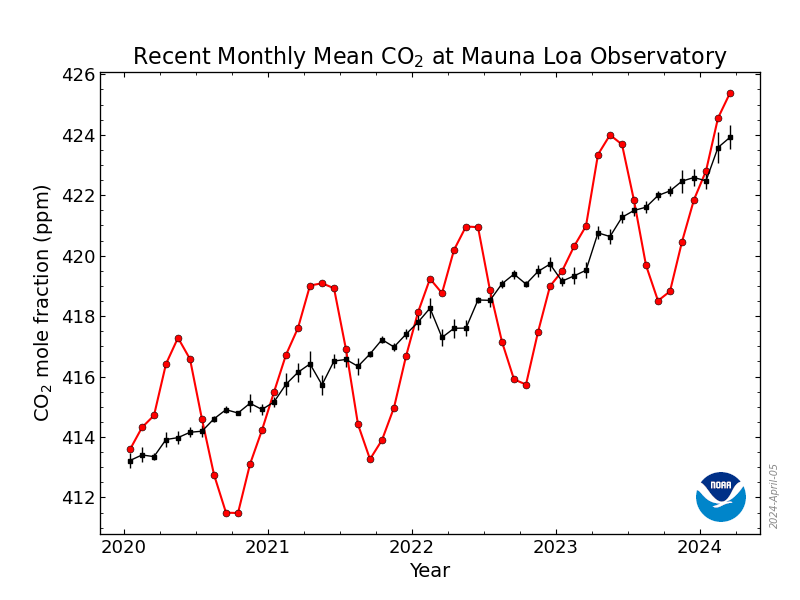
So …. If you think the Corona virus lockdowns in the name of “public safety” were something, you ain’t seen nothing yet.
The rise in CO2 concentrations is directly caused by Human burning of fossil fuels!
We cut back on our burning of fossil fuels, so that should change the rate of change in the atmosphere!
We checked, and the rate of change is no different now.
So, Humans are not really the cause of the rise in CO2 emissions?
No no, humans are!
How?
SHUT UP!
I did a write up a while back on this. The Oceans hold over 90% of the carbon that is circulated on the Earth’s surface zone. The Atmosphere is a tiny bit of that, and plant life is the bulk of the remainder. 92% in ocean, 6% in biomass, 2% in the atmosphere.
The amount of carbon dioxide that is passed back and forth between the ocean surface and the atmosphere in any given year is greater than the entire amount that is in the atmosphere at any given point in time.
Basically, the only CO2 that is in the atmosphere is what ever the ocean is incapable of holding due to temperature. Humans have no real influence here.
There is a world of difference between not being able to detect a tiny signal in a noisy environment, and there being no signal at all.
This was the largest industrial shutdown real-world experiment in human history, and the results are in.
Human emissions dwarfed into irrelevance against natural variation.
No human signal.
No lockdown signal.
How can human CO2 emissions be so small that they don’t show up anywhere during the greatest industrial lockdown in history, while simultaneously being so large as to be driving the greatest threat to the planet in history?
It cannot be both.
CheshireRed
As I understand the theory, the recent drop in human CO2 emissions is relatively small and they remain more that high enough to push natural CO2 sinks beyond their absorption capacity.
Human emissions of CO2 are a relatively small fraction of total CO2 emissions, about 29Gt annually, or ~4%. As some have mentioned already, an 8% reduction of the human component amounts to -1.2Gt per year, which is just 0.15% of total CO2 emissions. We’re still producing ~28Gt of CO2, adding to the 771Gt produced naturally.
This, the theory goes, pushes atmospheric CO2 concentrations beyond the absorption capacity of natural CO2 sinks, which is estimated to be ~881Gt per year. The bath is still overflowing, so to speak.
I guess the KIT researchers (as well as many other “scientists”) are so enamored with their specialized instruments for CO2 measurements, their field work, and their speculations on the possible significance of such that they overlook the “experimental” facts that nature has already provided.
Examine the periods of MEASURED overall global cooling that occurred from about 1940 to 1975 and the documented hiatus (aka “pause”) in global warming that occurred from about 1988-2015, and compare these long intervals against the constantly-increasing rate of rise is atmospheric CO2 that was MEASURED over these same time spans (the Keeling curve). These observations are clearly contrary to the speculation that increasing atmospheric CO2 concentration is the major driver of global atmospheric warming. And that is true if the ever-increasing atmospheric CO2 concentration—well, at least over the last 250 years—is due to human emissions, natural emissions, or a combination of both.
Note that nature’s “experimental” data is the best possible: it includes all the detailed factors in play and forcings/feedback loops necessary to obtain REALISTIC (duh, isn’t that obvious) data over a significantly long continuous time interval and with a very significant signal-to-noise ratio.
As Nobel-prize winning physicist Richard Feynman advised:
“If it disagrees with experiment (observation), it’s wrong. In that simple statement is the key to science. It doesn’t make a difference how beautiful your guess is. It doesn’t make a difference how smart you are, who made the guess, or what his name is. If it disagrees with experiment, it’s wrong. That’s all there is to it.”
Nothing can be detectet when it goes down, therefore nothing can be detected when it goes up, so where is our influence? – at least it can not be proved. The year to year variation for change in concentration is too big. 1998: 3 ppm up. The year after only 1 ppm up – was that caused by human influence? What we can see, is that it goes up from year to year – that’s the naked observation, but correlation to human influence ? none.
Bjarne Bisballe,
Human emissions increased a fourfold since 1958 when the first accurate measurements at the South Pole were done, followed by similar measurements at Mauna Loa.
The increase in the atmosphere also was a fourfold at average half human emissions.
What natural temperature variability does is changing the net sink rate from year to year, but in near all years less than what humans emit. That simply proves that the variability is caused by temperature, but the slope by human emissions…
http://www.ferdinand-engelbeen.be/klimaat/klim_img/dco2_em2.jpg
Something that I have seen neither alarmist or skeptic address is the role of bacteria in CO2 increases. Bacteria are more active when it warms. It is generally acknowledged that most of the measured atmospheric warming is at night and in the Winter. There is a strong increase in measured atmospheric CO2 in Fall, Winter, and Spring, before photosynthesis resumes on land in the Spring, which is the result of the decomposition of perennial and annual detritus . So, it should be expected that if there is some exogenous force increasing temperatures on Earth, it would be expressed as increased production of CO2 by bacteria. While the oceans are a major sink for CO2, it might well be that even in the absence of anthropogenic CO2, the oceans would absorb a similar quantity of CO2 to the claimed approximately half of human production. That is, the anthropogenic production is so low (~5% of total carbon cycle) that the influence is essentially negligible and easily swamped by natural variation.
“According to the …(IPCC), cumulative reductions of about this magnitude would be required every year to reach the goals of the Paris Agreement by 2030. Recent measurements by researchers of …(KIT) revealed that concentration of carbon dioxide (CO2) in the atmosphere has not yet changed due to the estimated emission reductions.”
What is wrong with this picture? Ten times zero is still zero. If there was no detectable reduction in CO2 during the initial severe lock-downs, or six months later, what sort of convoluted logic leads the authors to believe that it will show up after a longer period of time? CO2 is considered to be a well-mixed gas, with lag times between photosynthesis reductions and measured reductions being apparently a couple of weeks. With something like an initial 15% reduction in anthropogenic emissions over a three-month period, prior to trees leafing out, when the annual CO2 cycle was increasing, one would expect to see a 15% reduction almost immediately. It is not detectable. The alternative hypothesis is that the annual year-to-year increases are natural and the anthropogenic contributions are negligible (~5%). Therefore, 15% of 5% (0.8%) IS down at the noise level.
Clyde,
You make an excellent point!
Even the Keeling curve (Mauna Loa Observatory CO2 measurements) shows the regular seasonal variations of about ±4 ppm about the trend line, with an indicated data plotting resolution of about 0.3 ppm CO2 (see detailed plots at: https://www.esrl.noaa.gov/gmd/ccgg/trends/index.html )
Heck, that referenced NOAA website in now reporting atmospheric CO2 concentration values to the second decimal place (e.g., 412.55 ppm for August 2020), equivalent to a precision of .002%. This, of course, is ridiculous and one would think NOAA scientists would know better. Nevertheless, even at the plotting-indicated level of precision of 0.3 ppm, the impact from the COVID-19 responses (i.e., reductions in mankind’s CO2 emissions) around the world should clearly be evident by now, assuming of course that mankind’s CO2 emissions into the atmosphere ever reached a level of significance in the first place.
I taught a chemistry class for non science majors many years and most of them would know better how to use significant figures.
Then a few years ago, I met a scientist that spent time in Antarctica and he was handing out vials of air that were labelled with a CO2 concentration to hundredths of ppmv. Whatever happened to close enough for government work?
Clyde and Gordon, they are playing the “reduction” gambit. Get the gaze on “no reduction visible” to keep everyone from spotting what you just did, that there should be at least some ding in the sawtooth.
May I add, the phrase “The Keeling Curve” is a sophisticated lie. “Curve” means the change in gain is accelerating, it’s curving so it is getting worse, this is an exponential explosion.”
No, it is not a curve. It is only a slope.
I don’t know where you get the idea that a curve means it’s accelerating. A curve is just a line that isn’t straight. Nothing more, nothing less.
As to that saw tooth, given the fact that the height of the saw tooth varies tremendously from year to year and always has, why do you believe a tiny “ding” in that saw tooth must be visible?
A curve means acceleration. Keeling’s data plots a slope, only – its rate of change is zero. Didn’t you study calculus?
That varying you cite has nothing to do with my claim. My claim is: the large reduction in human emissions ought to be reflected – even with a tiny indication – in the hyper-accurate, hyper-decimal-place measurements.
Since there is absolutely nothing, just the normal (tremedosus, if you insist!) sawtooth we have been seeing for 60 years, the conclusion is inescapable: human release has zero effect on the amount of CO2 in the atmosphere. The sloped increase is steady, and due to other natural impetus.
windlord-sun, you posted: “Keeling’s data plots a slope, only – its rate of change is zero. Didn’t you study calculus?”
I can only gently suggest that you consult the Keeling curve as presented by NOAA at https://www.esrl.noaa.gov/gmd/ccgg/trends/index.html
You will find that it is a curve with slight, but ever increasing SLOPE. Trust you eyes.
BTW, one does not need calculus to understanding the difference between a straight line and a curved line . . . geometry and algebra are sufficient. But maybe you missed those classes.
Do you always get this sensitive whenever your mistakes are pointed out?
@Gordon Oehler A. Dressler
That is very snarky. Fine.
1) The use of “curve” when – upon serious optical examination – it is clearly a slope with the tiniest smallest immaterial bend, is propaganda. What is your motive for spinning up an acceleration of gain? Do you want to terrorize people, rather than recognize that there are no straight lines in nature? It is a slope.
2) it is problematic enough for Alarmists to make hay out of the facts of Keeling since the “rise” in the raw number is from 300 to 400 Parts Per Million [0.0001] over sixty years. If you are ambitious to additionally make hay out of the increase/acceleration of the rate of change, given the even more nearly-undetectable eyeballing, you are very brave. {What is your calculation of the rate of change, by the way?}
3) My calculus comment was intended to counter the person claiming there is no difference between a curve and a straight line. If I overshot, I deserve to be kidded about that, but not pilloried with your snark. If, in your opinion, that target ought to have a double-down slap from you to wit: “you should have known you only need Alg/Geo” then please redirect your intent to him.
@MarkW
You are the one who made the mistake that “A curve is just a line that isn’t straight. Nothing more, nothing less.”
Straight lines chart increase on a steady basis. Curves chart increase that is accelerating. There is a tremendous difference in the implication.
If my tone when posting against this seemed over-sensitive to you, I apologize and withdraw that emotion. There. Now the way is clear for you to correct your error.
windlord-sun posted on September 22, 2020 at 6:30 pm, obviously in reply to MarkW :
“A curve means acceleration. Keeling’s data plots a slope, only – its rate of change is zero. Didn’t you study calculus?”
If that’s not snarky, I don’t know what is.
Old saying: “If you can’t stand the heat, stay out of the kitchen.”
I agree my comment to MarkW was snarky. His claim was off-color in tone, but I admit I escalated. My apologies, MarkW.
Meanwhile, the actual important point remains standing: “Keeling Curve” is an erroneous formulation, and, I submit, a deliberate spin. The amount of CO2 is increasing at a steady rate, which charts as a straight slope. That rate is not changing. Therefore, calling it a “curve” is misleading.
You hear the results in the panic of both activists and innocent dupes of activists, “The CO2 problem is accelerating at a terrifying rate.”
Clyde Spencer, the alternative explanation is that the small change in human emissions (0.2 ppmv/year) is too small to be measurable with a method accurate to 0.2 ppmv in less than 6 months and in year by year natural variability of +/- 1.5 ppmv…
it’s very … unwelcome no, this story of CO2 curve that reproduces from one year to another, we would be unable to detect the slightest fluctuation, despite the covid crisis
It should still be noted a certain bad faith: it is an 8% reduction in emissions, if we spread this over the year, but the reduction was indeed 20% at least, for at least 4 months, It’s not the same thing at all
Yet they measure with diabolical precision, don’t they?
and nothing, nada?
Curious to say the least, no? Oh of course, the residence time … from 5 to 1000, for thousandth precision …
Natural variability … about which we know absolutely nothing, but who did the job well, since, if we follow this lead, it has compensated to the thousandth?
In short, they know absolutely nothing, but they insist that we do more, much more
Will they commit to having their arm cut off if, after having reduced our emissions by 40%, things do not change?
I have a hypothesis that I like.
The rise in CO2 levels, due to a period of natural and inexplicable warming, as there have been many, follows the slow and continuous warming of the ocean.
Trade depends on partial air-ocean pressures,
If we inject CO2 into the atmosphere, the concentration of course changes, but also the value of the degassing of the oceans, which will be less than without our contribution. And if our emissions decrease, the effect is the opposite, and the curve follows its progression without any variation. And of course, the natural and anthropic convcentrations have changed.
Must calculate all this to 3 decimal places
I told my dog about it, he seems to approve, he wags his tail.
Will it be the same … with our scientists
joletaxi,
The difference in emissions results in a change of 0.2 ppmv over a year.
The accuracy of the measurements is 0.2 ppmv (that is a few thousandths of 415 ppmv)
The natural year by year variability is +/- 1.5 ppmv
Thus you need several years of measurements to detect the change…
The natural equilibrium between the ocean surface and the atmosphere at the current average sea surface temperature is around 290 ppmv. Even if the human emissions are reduced, they still are larger than the net sinks and the CO2 levels in the atmosphere still go up, now at 415 ppmv, thus more CO2 is pressed into the ocean surface.