

Guest essay by Eric Worrall
Perennial revolutionary Jane Fonda has predicted that unless society acts to reduce CO2 emissions, democracy will become impossible.
‘Civil Disobedience Has to Become the New Norm.’ Jane Fonda on the Fight Against Climate Change
BY JUSTIN WORLAND UPDATED: SEPTEMBER 3, 2020 4:28 PM EDT | ORIGINALLY PUBLISHED: SEPTEMBER 3, 2020 7:00 AM EDT
Jane Fonda wants to teach you about climate change. In the fall of 2019, Fonda regularly convened with fellow climate activists—and some of her Hollywood friends—on the steps of the U.S. Capitol Building to call for a Green New Deal and other government action on climate change. The protests, which she called “Fire Drill Fridays,” deliberately ended in arrest.
…
Do you think your book will get older voters to think about climate change and affect the way they vote?
They’re already thinking about it! The young climate strikers globally have had a lot to do with that. I’m targeting the people who notice the climate crisis and don’t know what to do about it. I’m teaching them more and then giving people things to do… Civil disobedience has to become the new norm. No matter who is elected in November.
Because of climate or everything else going on in the world?
Because of everything—and out of everything, what looms is the climate crisis. If we don’t cut our fossil fuel emissions in half by 2030, everything will not only become much, much harder, but a lot of things—equality, democracy, stability in our society—will become impossible. What I want to tell voters who say, “I can’t decide who to vote for. I don’t really believe in Joe Biden,” is, “Hey, I’d rather push a moderate than fight a fascist.”
…
Read more: https://time.com/5885452/jane-fonda-climate-change-what-can-i-do/
Greens like Fonda completely fail to explain why life would become so much harder so quickly if the world warmed by a few degrees. Every degree of warming is like moving a bit closer to the equator – just not that big a deal.
Discover more from Watts Up With That?
Subscribe to get the latest posts sent to your email.
If we don’t cut our fossil fuel emissions in half by 2030, . . .
Reminds me of an old joke:
Doctor advised me to cut out half my sex life.
Only problem is, I don’t know which half I should cut out.
The half I spend talking about, or the half I spend thinking about.
This is just more of the Mob Style Threats from the Left.
“Hey that’s pretty nice Democracy ya’ have there. Be a shame if something were to happen to it.”
– “Bugsy” Hanoi Jane, ATB.
more Bugsy Hanoi Jane, the ATB: “Just hand over the keys to Treasury and we’ll leave you alone. Capeesh?”
Latest OT. COVID-19 has been found in waste water in South Australia!
Therein, is it deadly or dead?
I do have a tendency to stay away from “waste water” — so not a big deal.
I know. Just the latest Australian media BS!
That the virus can be excreted by those who are infected has been known since March.
In the early days testing waste water was proposed as a way of measuring the level of infection in a community.
Jane Fonda who thinks she is presently living in Hell, says:
“If we don’t cut our fossil fuel emissions in half by 2030, everything will not only become much, much harder, but a lot of things—equality, democracy, stability in our society—will become impossible.”
What she actually means is:
“If we don’t cut our fossil fuel emissions in half by 2030…tyranny…will become impossible”
She must be getting close to living in hell, how old is she anyway?
82. According to a life expectancy calculator based on WHO data, she could be expected to live another 9.7 years before she gets to see what hell is really like.
“If we don’t cut our fossil fuel emissions in half by 2030, … democracy … will become impossible.”
That’s just wishful thinking on the part of Jane Fonda and her Marxist friends.
Keep the republic, dispel the democracy. Keep the hydrocarbons, cut the emissions. Whack the wind turbines, save the birds, right? Remove the Green Blight. Baby Lives Matter.
I thought Trump was the greatest threat to democracy.
That’s just the progressives projecting again.
Bless her little heart. Jane must have dissociative identity disorder.
One person couldn’t be so stupid.
Dissociative identity disorder (DID), previously known as multiple personality disorder (MPD), is a mental disorder characterized by the maintenance of at least two distinct and relatively enduring personality states.
That’s very good! Made me laugh.
Another factless, emotive, subjective statement attached with moveable goal posts.
“Greens like Fonda completely fail to explain why life would become so much harder so quickly if the world warmed by a few degrees. Every degree of warming is like moving a bit closer to the equator – just not that big a deal.”
Sorry but have to disagree.
Pls see item#10 at the linked document below.
https://tambonthongchai.com/2019/04/17/abs-temp/
In fact the same degree of warming as has been measured in the last 40 years would have been achieved by the reduction in altitude of every Green stepping down off his or her high horse…
Fonda is only a useful idiot. It is best to go after the organ grinder, not the dancing monkey. The West is supposed to cut its fossil use by half – which leaves all the oil in the ME to the Chicoms. Who coincidentally will sell us solar panels and wind turbines. Are you getting it (as the late Steve Jobs might say)? Who is benefiting here. Follow the money. The Soviets had the nuclear disarmament and environmental groups well infiltrated. They probably set up the Club of Rome. Now the Chinese have hitched their caboose to the disinformation train, and their booming economy incredibly is using almost half of the world’s resources. They plan to keep on buying SUVs and building condo towers and triple-story wedding-cake mansions and eating lots more meat. Seemingly WE are the only ones who must cut back.
Zane,
Don’t forget Coronaviruses! They’re really good at developing new Coronaviruses and convincing others to commit economic suicide by shutting down their countries!
Do you think the DemoKKKrats do all the ChiCom’s propaganda work pro bono, or are they well remunerated for their efforts!
Jane Fonda seems to have had some pretty good acting chops, but a deep thinker she’s not! Deep or thinker!
Barbarella was acting? I thought it was type-casting. Or casting couch?
Hanoi Jane strikes again.
“Much of the social history of the Western world, over the past three decades, has been a history of replacing what worked with what sounded good.” – T. Sowell
“The problem isn’t that Johnny can’t read. The problem isn’t even that Johnny can’t think. The problem is that Johnny doesn’t know what thinking is; he confuses it with feeling” – T.Sowell
“The most effective way to destroy people is to deny and obliterate their own understanding of their history” – G. Orwell
“A system of morality which is based on relative emotional values is a mere illusion, a thoroughly vulgar conception which has nothing sound in it and nothing true” – Aristotle
To Dr. Sowell’s point a recent video shows a BLM criminally harrassing a US Congressman by yelling in his face “How do you FEEL about… (police murdering Blacks)”.
It made me extraordinarily uncomfortable that the focus of this useful idiot was on “feelings”.
She would not accept rational answers from her “victim” who agreed any murder is wrong and just kept shouting “how do you FEEL…”
Aside from starting from a false premise, she phrased her shout in the classic “When did you stop beating your wife?” model, where NO satisfactory answer to the accusation exists.
I would have replied “If it were happening, I would be upset about it.”
Great quotes, Stephen. Thanks for posting them.
“The object of life is not to be on the side of the majority, but to escape finding yourself in the ranks of the insane.” – Marcus Aurelius
I pledge to never have a “Carbon footprint” larger than Jane Fonda’s, or Al Gore’s, or Obama’s, or Clinton’s, or Bill Gates’…
One of Jane Fonda’s best Green friends is Emma Thompson. I will be happy to restrict my energy footprint to that of our Emma’s. I am also willing to fry half way across the world to advocate for moderation of air travel like Emma does, and I promise not to arrange any hen party in NY that can be organised in Estonia as an alternative venue to reduce air miles, just like Emma has asked.
There that should allow me to be a good Fonda type buddy person. Shouldn’t it?
NB My hen party organisation is not very developed….
Test
I had a patient in the 80’s who was a personal trainer. Jane was one of his clients. She was with Tom Hayden at the time. They lived very nicely in Santa Monica near the beach . He of course was a “revolutionary” so they shared the same ideas. My patient observed that Tom was very often intoxicated.
If I was married to Jane, I suspect that I would keep myself intoxicated most of the time as well.
Remind Greens that “Extraordinary claims require extraordinary evidence”.
Eric wrote, “Every degree of warming is like moving a bit closer to the equator – just not that big a deal.”
True, and it is easy to quantify what “a bit closer” means, by looking at an agricultural growing zone map. Here’s one, shared by permission from the Arbor Day Foundation:
From eyeballing the map, it looks to me like 1°C (1.8°F) = about 50-70 miles latitude change.
Here’s James Hansen and his GISS friends reporting a similar figure:
(100 to 175 km = 62 to 93 miles.)
Source: https://pubs.giss.nasa.gov/abs/ha02700w.html
So, the 0.4 to 0.9 °C of warming which we’ve seen since 1958 (when Mauna Loa CO2 measurements began) has caused, on average, a growing zone shift of only about 40 to 135 km (24 – 84 miles).
Ho hum. 🥱
In most places climate changes can be compensated to by farmers, simply by adjusting planting dates.
For example, in Kansas, 0.4 to 0.9 °C of warming can be compensated for by planting 2 to 6 days earlier in springtime:
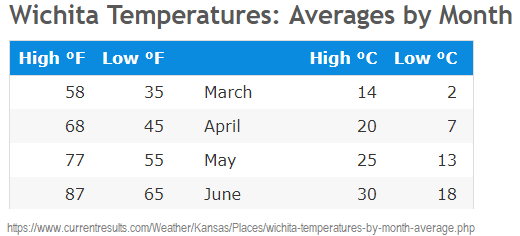
In order to find a result in which warmer temperatures cause significant crop damage, you either have to use wildly unrealistic tests (like the Jasper Ridge wild grass study, which used heat lamps outputting 20 times the IR radiation that would be caused by a doubling of CO2), or else assume that farmers are too stupid to adjust their planting dates (like PNAS’s Zhao C, et al. 2017 did). The claim that temperature increases from manmade global warming are significantly damaging to agriculture is crackpot nonsense.
That’s important to know, because the most important effects of climate, weather & CO2 are on agriculture.
At high latitudes, a slightly longer growing season reduces risk of frost damage to crops, and may enable use of high-yielding, slower-maturing cultivars, in some cases. But that’s minor compared to the large benefits of “CO2 fertilization.”
Fortunately, those effects have been heavily studied. The best place to look for such references is in the agronomy literature (which most so-called “climate scientists” apparently never read).
Here’s what eCO2 does for wheat:
https://www.ncbi.nlm.nih.gov/pubmed/26929390
Here’s what it does for corn:
https://www.tandfonline.com/doi/abs/10.1080/00103624.2018.1448413
eCO2 is especially beneficial for legumes, like beans, peas, and alfalfa, which are grown for their protein content. So eCO2 helps mitigate protein shortages in poor countries. Here’s a paper:
https://www.frontiersin.org/articles/10.3389/fpls.2017.01546/full
Hundreds of studies show that eCO2 is very beneficial for all major crops.
eCO2 also enables plants to use water more efficiently. It does so by increasing carbon uptake relative to transpiration. In other words, when grown with higher CO2 levels, plants need less water to get the carbon they need from CO2 in the atmosphere. That is especially helpful in arid regions, and during droughts. Here’s a paper:
http://www.sciencedirect.com/science/article/pii/S0168192310003163
Excerpt:
That’s one of the reasons that eCO2 has contributed to the sharp decline in famines, especially drought-driven famines, which is documented here:
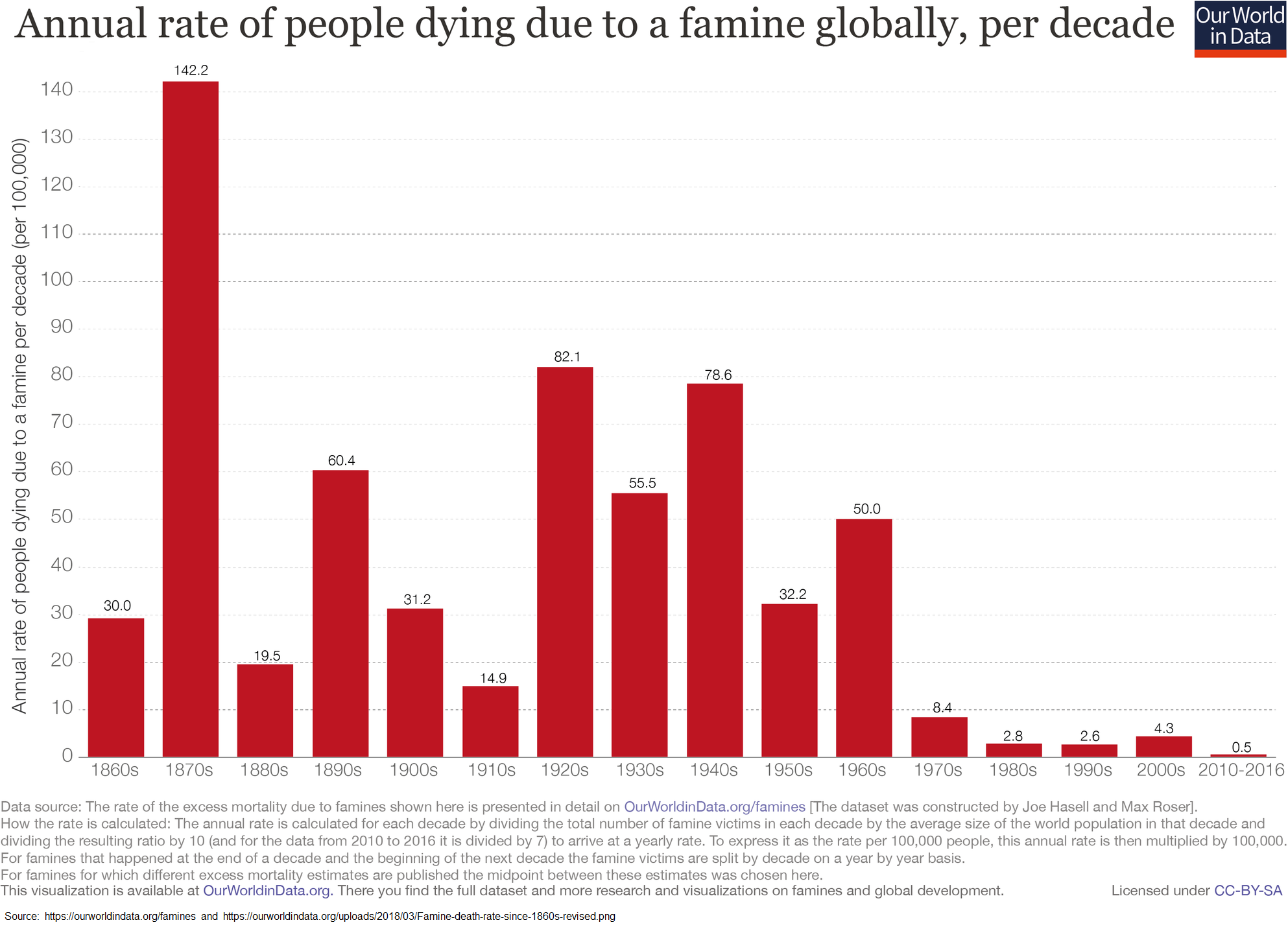
https://ourworldindata.org/famines
Graph:
To make the case that eCO2 is net-harmful, you would need to show that it has had measurable harmful effects which exceed the value of those measured benefits. Of course there are many modeling studies which speculate about a wide variety of climate-related calamities in the future. But, in science, measurements trump predictions, and it would be very difficult to make a case, on the basis of actual measurements, that manmade climate change has been net-harmful.
Secondary effects on other things, like sea-level, hurricanes & tornadoes, droughts, etc., are also well measured. None of them have significantly worsened, due to the last six decades of rising CO2 levels.
Sea-level trends have been substantially linear since the 1920s. Here’s the best Pacific measurement record, from NOAA. It’s trend is very typical:
https://tidesandcurrents.noaa.gov/sltrends/sltrends_station.shtml?id=1612340
Here’s the same data, with quadratic regression analysis, and contrasted with CO2 levels:
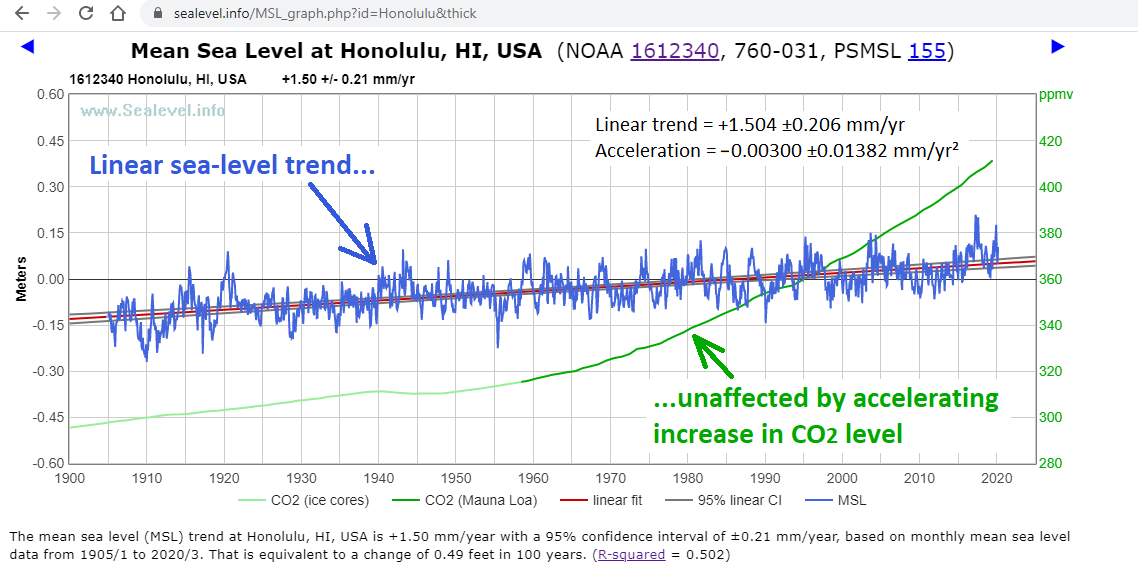
Interactive version:
https://sealevel.info/MSL_graph.php?id=Honolulu
Hurricanes have not worsened, either. Here’s a paper:
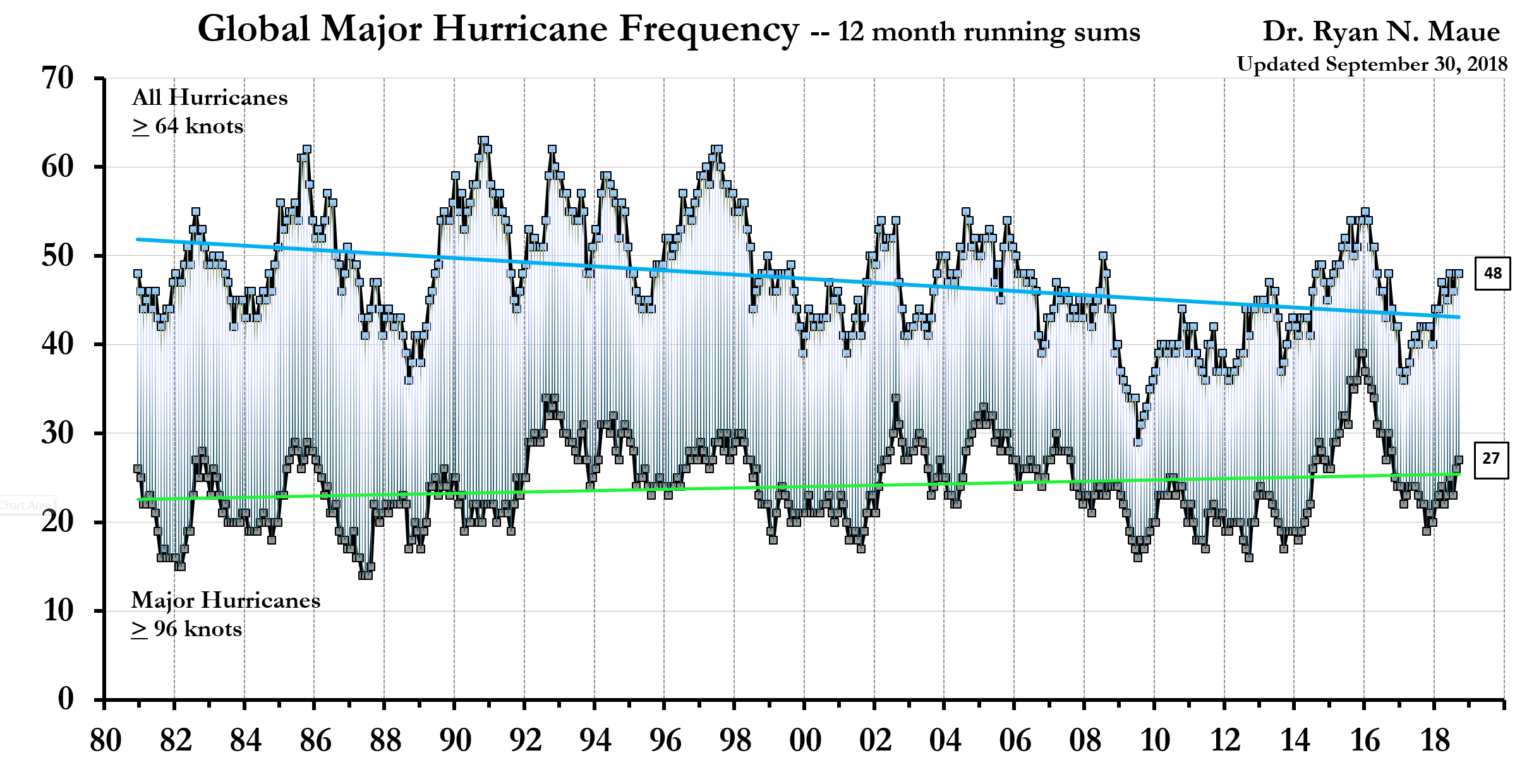
https://www.nature.com/articles/ncomms8182
Graph:
The frequency of large tornadoes has declined. Here’s a graph, from NOAA:

Here’s an article:
https://web.archive.org/web/20190331105309/https://www.woodtv.com/weather/bill-s-blog/strong-to-violent-tornadoes-in-the-us-trending-downward/1148127409
Lately, I’ve seen people like Michael Mann blame forest fires on climate change. But they haven’t worsened, either. NASA measures such things:
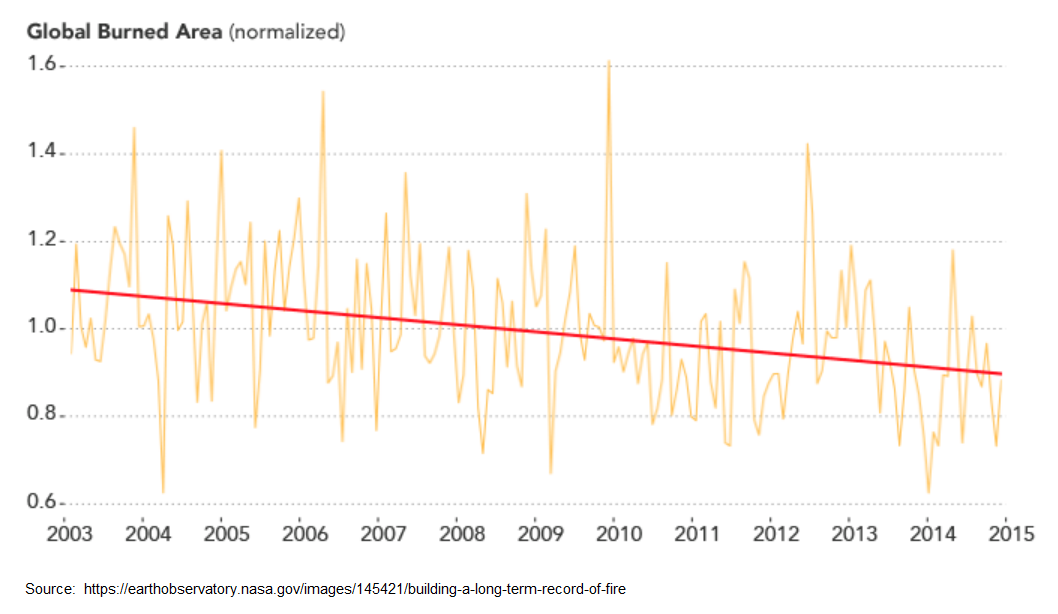
https://earthobservatory.nasa.gov/images/145421/building-a-long-term-record-of-fire
https://earthobservatory.nasa.gov/images/90493/researchers-detect-a-global-drop-in-fires
Graph:
There’s no evidence that warmer temperatures worsen forest fires. In the United States, the worst fires have mostly been at chilly high latitudes. Here’s a list of the deadliest US fires:
1,200+ dead, 1871 (Peshtigo Fire, WI)
453+ dead, 1918 (Cloquet Fire, MN)
418+ dead, 1894 (Hinkley Fire, MN)
282 dead, 1882 (Thumb Fire, MI)
87 dead, 1910 (Great Fire of 1910, ID & MT)
85 dead, 2018 (Camp Fire, Paradise, CA)
65 dead, 1902 (Yacolt Burn, OR & WA)
Droughts haven’t worsened, either. In fact, they’ve declined slightly. Here’s a paper:
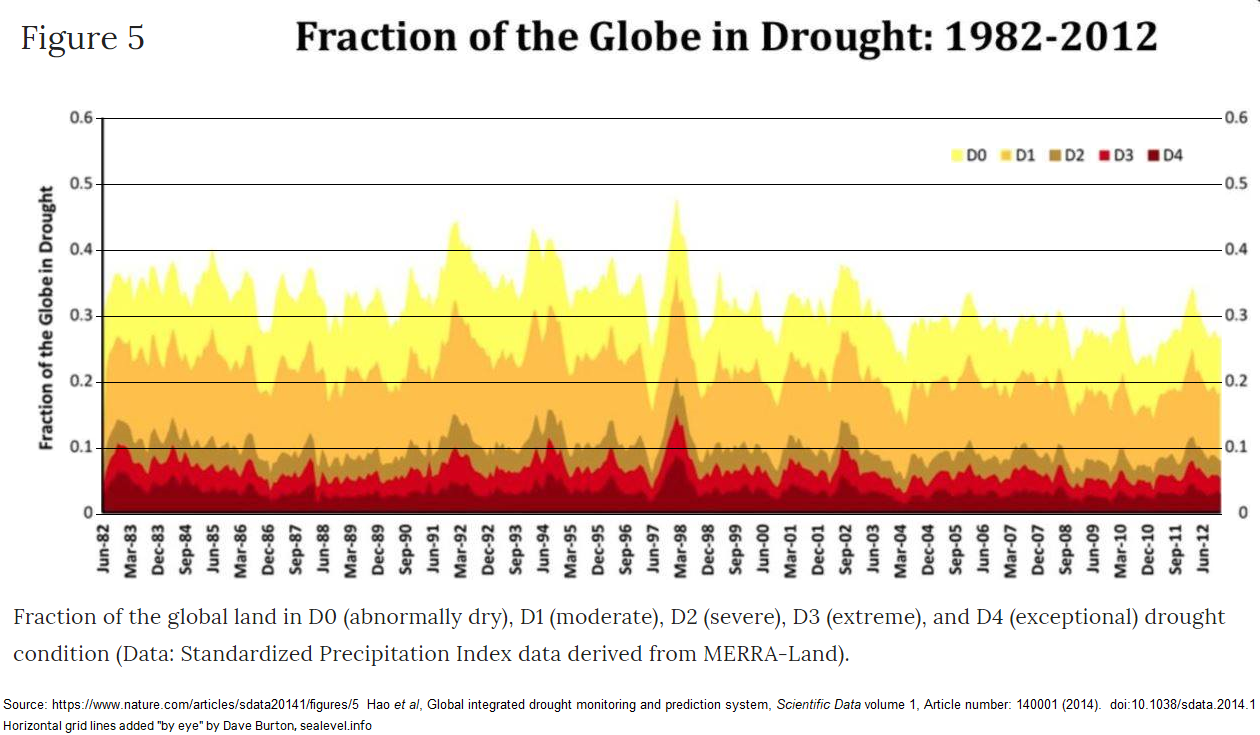
https://www.nature.com/articles/sdata20141
Graph:
Way back in 1908, Arrhenius predicted that CO2 emissions and rising CO2 levels would be very beneficial, rather than harmful.
Excerpt:
https://tinyurl.com/arrhenius1908p63
On the basis of measured evidence, the case is compelling that Arrhenius was exactly right
Dave, the truth is Arrhenius got half of it right. What he couldn’t have known from the sparse data in hand then was CO2 is a by-product of ocean warming driven by the sun.
In the above image, the CO2 plot (circled #17) peaks in the 1990s, at the same time of peak uptake.
From Asynchronous carbon sink saturation in African and Amazonian tropical forests “Overall, the uptake of carbon into Earth’s intact tropical forests peaked in the 1990s. ”
Nature is finely tuned. The outgassing temperature for CO2 is 25.6°C, which is near the mean ideal temperature for subtropical ‘carbon’ uptake vis photosynthesis, 24.1°C to 27.4°C.
Climate change, rainfall/drought cycles, and CO2 are naturally solar-driven.
Bob, that is incorrect. Arrhenius got it right. The oceans are removing CO2 from the atmosphere, not adding it.
CO2 has not peaked. Annually averaged atmospheric CO2 concentration has risen every year since precise measurements began.
You might have been listening to Dr. Murry Salby, who claims that atmospheric CO2 levels are rising, not because of anthropogenic CO2 emissions, but because global warming is causing the oceans to outgas CO2. It’s not, and they aren’t. He is confused.
As CO2 levels climb, the rate at which nature (mainly oceans & biosphere) removes CO2 from the air increases.
The rate of CO2 absorption by water is controlled mainly by atmospheric CO2 partial pressure, per Henry’s Law. It’s a bit more complicated than that, but not much. The CO2 levels in ocean and air are far from equilibrium. The atmospheric CO2 partial pressure has increased by nearly 50%, and the dissolved CO2 concentration in the ocean has increased only slightly. The ocean’s carbon storage reservoir is vast, compared to the atmosphere, and calcifying coccolithophores transport carbonates from surface water, where the CO2 dissolves, to the ocean depths. So return of that carbon to the atmosphere would take a very, very long time, and some of it will never return.
The terrestrial biosphere’s removal of CO2 from the atmosphere is more complicated, but that rate also increases as CO2 levels rise:
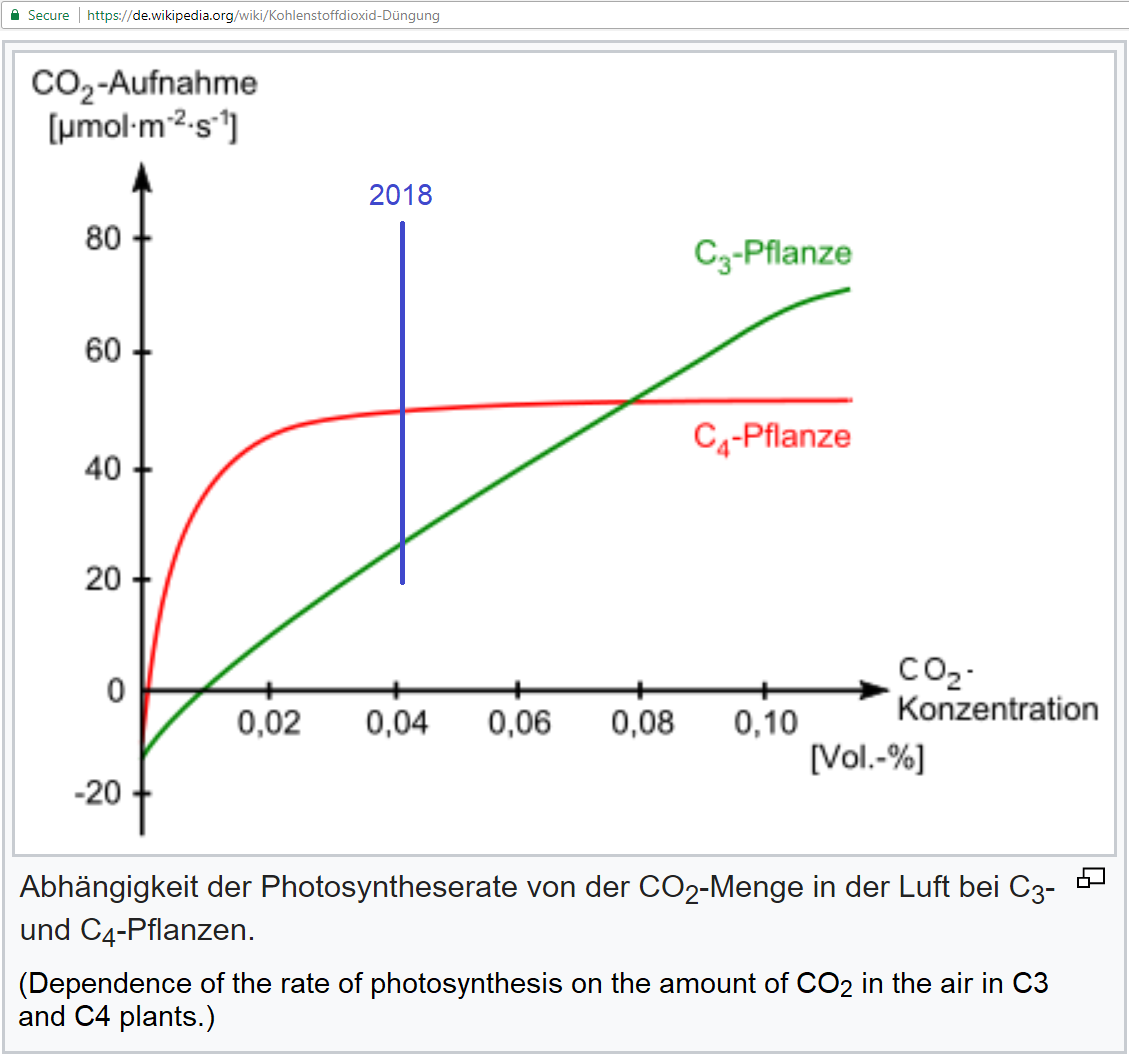
The difference between the amount of anthropogenic CO2 emitted, and the amount by which CO2 level increases year-to-year, is the “CO2 removal rate.” That’s the rate at which negative feedback mechanisms, like terrestrial “greening” and dissolution into the oceans, remove CO2 from the atmosphere. It has been greater than zero every year since precise atmospheric CO2 level measurements began.
The CO2 removal rate is affected by many factors, but principally by the atmospheric CO2 level. Dr. Roy Spencer examined it, and found that it is closely approximated by a very simple function:
(co2level – 295.1) × 0.0233
(units are ppmv CO2)
Mankind is currently adding about 5 ppmv of CO2 (about 10½ PgC) to the atmosphere each year, but the atmospheric CO2 level is only rising at a rate of about 2.5 ppmv per year. The difference is the rate at which natural negative feedbacks (mainly terrestrial greening and absorption by the oceans) remove CO2 from the air: currently about 2.5 ppmv per year.
When Salby claims that nature is raising the atmospheric CO2 level, it makes me wonder how he can be incapable of subtracting 2.5 from 5.
The solubility of gases like CO2 (or CH4) in water does decrease as the water gets warmer (per the temperature dependence of Henry’s law), so as the oceans warm they would outgas CO2, if nothing else changed. The capacity of the water to hold dissolved CO2 decreases by about 3% per 1°C by which the water warms.
The measly 3% per °C, by which CO2 solubility in water decreases as the water warms, is dwarfed by the 48% by which solubility increased as atmospheric CO2 concentration rose by 48% (from 280 ppmv to 414 ppmv). As the atmospheric CO2 level continues to rise, the rate at which the oceans remove CO2 from the air will continue to accelerate.
So, when the oceans are absorbing CO2, as is currently the case in most places other than the tropics, if the water warms then the oceans absorb CO2 just a little more slowly.
The CO2, in turn, works as a GHG to cause warming, which is one of the reasons that atmospheric CO2 levels swing up & down by about 90 ppmv over glaciation/deglaciation cycles. (There are almost certainly also biological [2] and/or ice sheet burial mechanisms at work, which increase the magnitude of glacial-interglacial CO2 swings.) That’s a slight positive feedback mechanism.
That positive feedback loop is undoubtedly one of the causes for the apparent hysteresis [2] in the temperature and CO2 records: Over the last million years, the Earth’s climate has tended to be either mild, as in our current interglacial (the Holocene), or, more of the time, heavily glaciated and cold, with relatively brief, unstable transitions between. (But see also: Deglaciation / Volcanism / CO2 Feedback.)
In paleoclimate reconstructions from ice cores, CO2 level changes generally lag temperature changes by hundreds of years, which is consistent with the fact that higher CO2 levels not only cause higher temperatures, but are also caused by higher ocean temperatures, and ocean temperature is slow to respond to air temperature changes.
BTW, you don’t need Henry’s Law to understand, intuitively, why the rate at which the ocean absorbs CO2 from the air increases with CO2’s partial pressure in the air. Just remember that the concentration of CO2 in the air determines the rate at which CO2 molecules collide with and are absorbed by the surface of the ocean, and falling raindrops.
For a more complete treatment of this issue, I strongly recommend this essay by Ferdinand Engelbeen:
http://www.ferdinand-engelbeen.be/klimaat/co2_origin.html
I botched one of the links in that long comment. Here’s the corrected sentence:
The capacity of the water to hold dissolved CO2 decreases by about 3% per 1°C by which the water warms.
Dave I have told you before I do my own work. If there’s a similarity to Salby maybe you can tell me what it is.
Dave you said, “CO2 has not peaked.” – False. Didn’t you see 1997 CO2 peak?
I know outgassing better than you or Ferdinand. You’re both off in some la-la land.
Bob Weber wrote, “Didn’t you see 1997 CO2 peak?”
Here’s a graph:
https://sealevel.info/co2.html
Here are the CO2 concentration numbers (Mauna Loa annual averages), for 1990 – 2019:
year CO2 (ppmv)
1990 354.39
1991 355.61
1992 356.45
1993 357.10
1994 358.83
1995 360.82
1996 362.61
1997 363.73 ⟸ does this look like a peak?
1998 366.70
1999 368.38
2000 369.55
2001 371.14
2002 373.28
2003 375.80
2004 377.52
2005 379.80
2006 381.90
2007 383.79
2008 385.60
2009 387.43
2010 389.90
2011 391.65
2012 393.85
2013 396.52
2014 398.65
2015 400.83
2016 404.24
2017 406.55
2018 408.52
2019 411.44
If you see a 1997 CO2 peak, Bob, this might help:
https://www.zennioptical.com/
I’m sorry my explanation wasn’t clear enough. Please tell me what part was confusing?
https://sealevel.info/atmospheric_co2_increase_is_not_from_ocean_outgassing.html
Ferdinand Engelbeen did a better job. I encourage you to study it:
http://www.ferdinand-engelbeen.be/klimaat/co2_origin.html
Dave if you can’t figure out how to replicate this plot from Mauna Loa data and show me you did it yourself, you’re flat out incompetent and have no business scolding anybody.
On an annualized basis adjusted for the trend, 1997 was the peak year for CO2.
I also suggest you know nothing about CO2 outgassing.
What is confusing is how you can fool yourself for so long.
Bob Weber wrote, “…adjusted for the trend, 1997 was the peak year for CO2.”
Translation: “If you ignore the increase in CO2 level, 1997 was the peak year for CO2 level.” Or something like that.
Perhaps you’re trying to say that the rate of increase in CO2 level peaked in 1997? That would be irrelevant, even if it were true, but it’s not true, anyhow. Note the slight upward-curve in this plot of annually-averaged CO2 concentrations; concave-upward means accelerating:
https://www.sealevel.info/co2.html
There was a spike in the rate of CO2 increase in 1998 (not 1997), due to the El Niño. 1998’s average CO2 level at Mauna Loa was 2.97 ppmv higher than 1997’s. Maybe that’s what you’re talking about?
But so what? That’s what happens during El Niños. The 2016 El Niño was accompanied by an even larger 3.41 ppmv CO2 level increase.
In 1997, the average CO2 level for the year increased by 1.12 ppmv over 1996’s average level, at Mauna Loa.
In 1998, the average CO2 level increased again, this time by 2.97 ppmv over 1997.
In 1999, the average CO2 level increased again, this time by 1.58 ppmv over 1998.
In 2000, the average CO2 level increased again, this time by 1.17 ppmv over 1999.
Etc.
The annually-averaged atmospheric CO2 concentration has continued to increase, every year since 1958, when precise measurements began at Mauna Loa. More recently:
In 2018, the average CO2 level increased again, to 408.52 ppmv, which was an increase of 1.97 ppmv over 2017.
In 2019, the average CO2 level increased again, by 2.92 ppmv ppmv over 2018.
Because CO2’s warming effect is logarithmically diminishing, the climate forcing trend from rising CO2 level has been close to linear for the last forty years or so, as you can see in this log-scale plot:
https://www.sealevel.info/co2.html?co2scale=2
Bob previously asked, “…I do my own work. If there’s a similarity to Salby maybe you can tell me what it is.”
You both think that when mankind adds CO2 to the atmosphere it doesn’t increase the amount of CO2 in the atmosphere. Or something like that. 🤔
Bob also boasted, “I know outgassing better than you or Ferdinand.”
You have my sympathy. I’ve found that switching to lactose-free dairy products helps.
Ocean carbon sink processes not understood and driven by natural variability
McKinley et al. (2017) analyzed ocean carbon sink estimates and was willing to admit that due to a lack of observation, we lack a “detailed, quantitative, and mechanistic understanding of how the ocean carbon sink works…”
In addition, because internal variability in oceanic carbon uptake is so massive and largely unobserved, we cannot yet detect an anthropogenic influence.
McKinley and co-authors go so far as to acknowledge the “change in CO2 flux over 10 years (1995-2005)…is due almost entirely to the internal variability” because in most ocean regions “the forced [human-induced] trends in CO2 flux are too small to be statistically significant” and the “variability in CO2 flux is large and sufficient to prevent detection of anthropogenic trends in ocean carbon uptake on decadal timescales.”
from <a href=https://notrickszone.com/2020/09/07/scientists-just-discovered-our-past-carbon-budget-guesses-have-all-along-been-twice-as-wrong-as-we-thought/?utm_source=feedly&utm_medium=rss&utm_campaign=scientists-just-discovered-our-past-carbon-budget-guesses-have-all-along-been-twice-as-wrong-as-we-thought<NoTricksZone
You have a major gaslighting problem Dave Burton, aside from your inability to so science.
Bob Weber wrote, “McKinley et al. (2017) analyzed ocean carbon sink estimates and was willing to admit that due to a lack of observation, we lack a ‘detailed, quantitative, and mechanistic understanding of how the ocean carbon sink works…'”
Thank you, Bob for at least admitting that the ocean IS a carbon sink, rather than a net source of atmospheric CO2. I’ll take that as your acknowledgment that “The oceans are removing CO2 from the atmosphere, not adding it,” and that, therefore, the ongoing rise in atmospheric CO2 levels is not due to outgassing from the oceans.
Thanks, too, for the link and quotes from McKinley et al.
I wonder, though, why you didn’t quote the very first sentence of the McKinley’s abstract, since it directly addresses this topic:
Sorry about the botched </blockquote> tag in my last comment.
Correction: “175 km” should have been “150 km”.
I remember citrus groves in north Florida in the 50’s. And I don’t notice it being appreciably warmer today. However it was cold enough during the 70’s and 80’s to regularly kill citrus. Funny thing about climate. It changes.
Jane has it backwards. If she and her fellow travellers don’t stop demanding the end of fossil fuel use, democracy will become increasingly impossible by 2030, so it looks like we’ll get ten more years of their whining to look forward to since their real goal is the elimination of our freedom, democracy and republican form of government.
She’s still alive?
WOW.
Guess that’s all this was–a publicity stunt to say, “Hey, I’m still breathing over here!”.
She pops up whenever she thinks the public has forgotten about her……it’s nothing more than that. She normally has nothing of substance to say–and gets arrested. I think her goal is to be arrested more times than any “activist” (in quotes for a reason….people that really don’t believe what they are shilling but want the press for it).
+97(at least)
So if half is cut by Dec 31, 2029, OK, but if not until Jan 2, 2030, democracy dissolves. Notice that Jane does not even begin to provide any logical reasons for her bizarre prediction. N one will be able to notice any changes between now and 2030, so why will anything as ridiculous as “democracy dissolution” occur?
…..I’m gonna just hold my tongue.