
Guest essay by Eric Worrall
According to New Scientist, places which can’t afford air conditioning are in real trouble.
Climate change has already made parts of the world too hot for humans
ENVIRONMENT 8 May 2020
By Adam VaughanGlobal warming has already made parts of the world hotter than the human body can withstand, decades earlier than climate models expected this to happen.
…
Wet bulb temperature (TW) is a measure of heat and humidity, taken from a thermometer covered in a water-soaked cloth. Beyond a threshold of 35°C TW the body is unable to cool itself by sweating, but lower levels can still be deadly, as was seen in the 2003 European heatwave that killed thousands without passing 28°C TW.
…
“The crossings of all of these thresholds imply greater risk to human health – we can say we are universally creeping close to this magic threshold of 35°C. The tantalising conclusion is it looks like, in some cases for a brief period of the day, we have exceeded this value,” says Tom Matthews at Loughborough University in the UK.
..;
Clare Heaviside at University College London says the work is broadly in line with existing research, but cautioned against the focus on the threshold of 35°C TW. “It is difficult to link a wet bulb temperature threshold to specific health outcomes, and for different population groups,” she says.
…
Read more: https://www.newscientist.com/article/2242855-climate-change-has-already-made-parts-of-the-world-too-hot-for-humans/
The abstract of the study;
The emergence of heat and humidity too severe for human tolerance
Colin Raymond1,2,*, Tom Matthews3 and Radley M. Horton2,4
See all authors and affiliationsScience Advances 08 May 2020:
Vol. 6, no. 19, eaaw1838
DOI: 10.1126/sciadv.aaw1838Humans’ ability to efficiently shed heat has enabled us to range over every continent, but a wet-bulb temperature (TW) of 35°C marks our upper physiological limit, and much lower values have serious health and productivity impacts. Climate models project the first 35°C TW occurrences by the mid-21st century. However, a comprehensive evaluation of weather station data shows that some coastal subtropical locations have already reported a TW of 35°C and that extreme humid heat overall has more than doubled in frequency since 1979. Recent exceedances of 35°C in global maximum sea surface temperature provide further support for the validity of these dangerously high TW values. We find the most extreme humid heat is highly localized in both space and time and is correspondingly substantially underestimated in reanalysis products. Our findings thus underscore the serious challenge posed by humid heat that is more intense than previously reported and increasingly severe.
Read more: https://advances.sciencemag.org/content/6/19/eaaw1838
“It is difficult to link a wet bulb temperature threshold to specific health outcomes, and for different population groups,”
Smart advice. Hard wet bulb limits are the fantasy invention of people who have worked all their lives in comfortable air conditioned offices in temperate countries.
A long time ago I had job operating a hydraulic hot press in a poorly ventilated chemical factory. On the very hottest days the indoor temperature hit 55C / 130F, according to the thermometer next to my station, with visible lingering clouds of mostly water steam from polymerisation of the material being pressed.
The management used to look concerned when temperatures peaked, made sure we drank a cup of rehydration fluid every 5 minutes, but otherwise we just carried on.
Plenty of blue collar workers, such as miners, bakers and foundry workers, endure similar conditions on a regular basis.
A fair skinned relative of mine lived and survived Dubai for around 20 years. These ivory tower academics should go and live in places like this before pontificating on where it is unsurvivably hot.
At 50 Celsius dry bulb (temperature not that unusual in desserts or deep mines) and 35 C wet bulb the relative humidity is only approximately 40%. Very hot but not exactly feeling humid. Just shows what you can do with half the data.
wiki tells 41°C and 50% rel.Hum. = 35°C WT
That’s why the most popular tourist and retirement destinations are in warm to hot, humid areas. Now it all makes sense!
nicholas
Are you saying that they are nice places to visit, but you wouldn’t want to live there? 🙂
From the article:
The don’t tell who and why.
Most were elderly people, often in nursery homes, if I remeber well.
Later it was detected, most of them didn’t drink enough.
If an heatwave occurs, most meds, politicians, scientists advise to close windows, don’t let the heat come in !
That’s the best and quickest way to kill people.
No air exchange, no air move, increasing humidity from breathing, heating from walls, and often no fans, of course.
We live under the roof, windows to SE and NW. If it’s hot, we have night and day all doors and all windows open, the fans are runnig full power, and we never had the one or the other problem, even with wished and appreciated draught.
That’s the second ironic story in this context, in sommer, at the beach, hot weather, and everybody is happy about some little wind blow.
The problem with wind is, if it’s blowing trough a door or a window, it’s called draught and makes supposedly ill. 😀 That makes head shaking 😀
Let me see if I have this straight. Going from 34.5C to 35.0C over 150 years, takes a place from survivable, to unsurvivable?
Really?
Let’s not forget a fact that even the IPCC acknowledges. The more water vapor in the air, the less influence CO2 has.
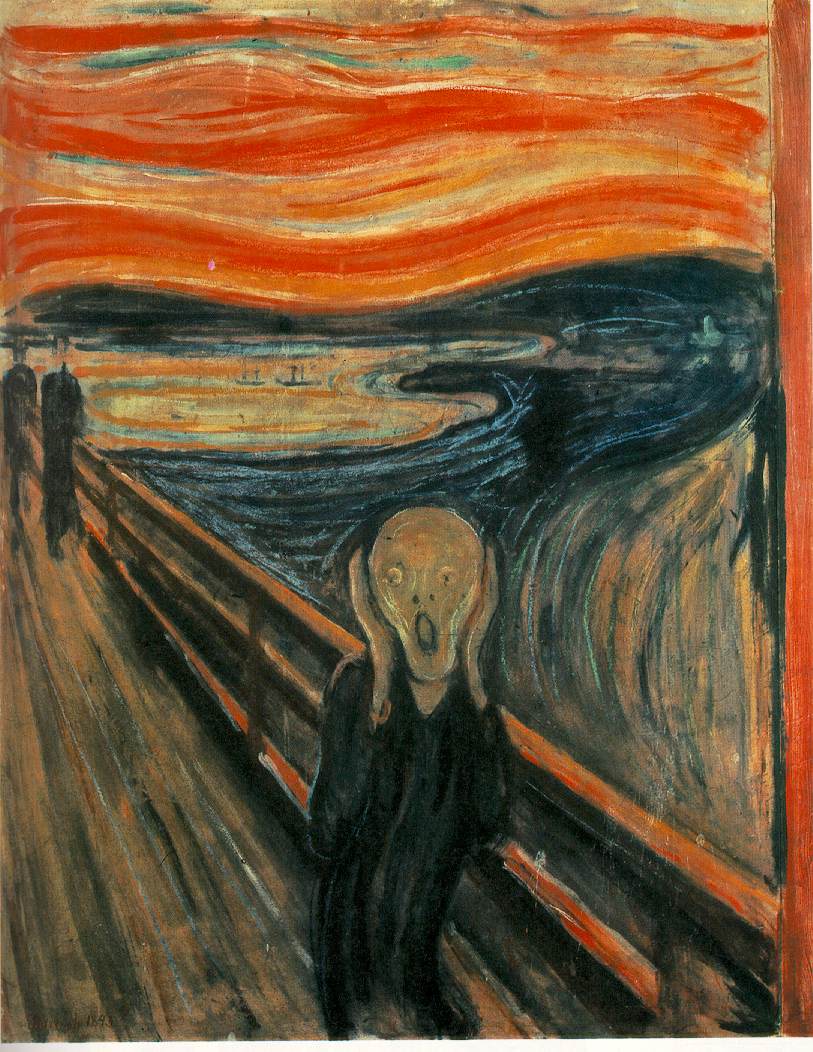
Edvard Munch’s bad picture of a dog …
look …
You can’t unsee it ….
The highest wet bulb temperature I have endured was 64C, in Jubail, KSA (the “Official Temp” never exceeded 50C but, the black flags were flying at 0700) . It was God awful miserable. I was outside for about an hour and a half. I drank 2 liters of water in that period of time. It took another 2 liters of water and a little over 2 hours in the AC before I had to pee… and I kept drinking water. A wet bulb temp of 35C stinks but, it’s easily survivable.
I too lived in Saudi for a couple of years and can attest that the official temp never went over 50C in Riyadh because if it exceeded 52C all the Korean outside workers had to be stood down. It used to be pretty warm walking to the shop from the office at midday in July.
The temperature in Riyadh was bearable because the humidity was always low but Jeddah and Dubai could get unbearable. We used to play tennis at 35C with bottles of water at the net. The pool in my compound used to lose 2 inches a day.
I recall driving in Dubai at sundown and the whole car was covered in condensation and I had to use the wipers.
So I say bah humbug to the study.
Blah, blah, blah! BS and more BS!
You dimwit have zero, zip clue! It’s called weather and we were mortals have no control over it! Anyone who thinks we can are beyond stupid or just digging into your wallet to make us poorer than we already are!
Living on Luzon where the average high in April is 35C. Babies popping out everywhere. What frauds! New Scientist – “People Magazine” for progressive morons.
These blokes are right on the money.
It’s only 3 years ago that I was snow skiing in Agadez, Mali and now it is so hot that all the ski resorts have gone out of business.
Due to a one degree rise (possibly)? They must be joking or desperate or true believers. It reminds me of an old Peanuts cartoon where Linus wrote in his letter to Father Christmas: “Everyone tells me you are a fake, BUT I BELIEVE IN YOU.”
Eric Worrall: “can’t they bake cake”.
That’s pretty hot/humid but who knew that humans had this magic maximum threshold of 35 degrees.
Get above that, and we all die. Stay below that and we live.
We should not be surprised that it’s worse than predicted. It’s always worse than predicted, even when it’s the opposite of what was expected.
They forgot to tell us that its the coldest places during the coldest times of year and coldest times of day(night time) on this planet that are warming the most and many of these hotter places are not warming as fast.
OK, maybe they knew and thought that it wasn’t important.
OK, maybe they knew, realized that it was important but decided it would mess up the narrative/weaken the sensationalism to state that.
Climate change rule of thumb: cold “things” warming faster than warm things
https://www.climate.gov/news-features/blogs/beyond-data/climate-change-rule-thumb-cold-things-warming-faster-warm-things
I have lived in the tropics in Malaysia and in the 18months that I was there, the nighttime temperature was never below 22C (~72F). Daytime temperatures were usually over 30C but rarely over 35 or 36C. Malaysia is a peninsula between the Malacca Straight and the Gulf of Thailand so the humidity is constantly high, so much so that there is rain almost every day of the year (and twice as much in the wet season). I also lived in Texas near Dallas where on the day that I chose to clean out my garage it was 114F (~46C) although it was dry. I have also been in Saudi Arabia where the daily temperatures are usually in the high 40sC and I was told that during a few days the temperature actually reached 55C (131F). So there are many parts of the world mostly around the equator where the daily temperatures are well in excess of this so called maximum where literally millions of people live and the New Scientist article is quite ludicrous to suggest that humans cannot live there because of an apparent rise of 1 or 2C in global temperature. I have subscribed to NS for some 40 odd years and I have read it since the early 1960s but recently it has become infected with the Climate alarmist craziness. This has meant that it has gone from being a reputable popular science journal to one that is becoming difficult to read because of this obsession which parrots all the excesses attributing just about any obervational change to “climate change”.
While consulting for a foundry suffering investment casting issues, I spent entire days in temps between 120-130°F. We drank lots of Gatorade and took breaks, but it was just plain hot.
The Afar region in Ethiopia *IS* the hottest, habitable, place on earth today. People live there and have been for thousands of years. That’s not going to change with a 2c rise in global averages.
“Beyond a threshold of 35°C TW the body is unable to cool itself by sweating”
1. That’s a bald faced lie.
2. Lots of parts of the world routinely go above 35°C in the summer.
3. Looking at pictures of people in the UK and America protesting against “global warming”, one is struck by how much clothing they have to wear, just to protect themselves against the cold.
Grew up on the equator ( PNG) and took the kids to the Equator (Indonesia) to grow up. Bush walking, push bike riding in humid 35deg heat. Open air dining and theatre. Long drives in the country.
These authors haven’t lived. Personally, I cannot understand how people can live in North America or Europe. It gets so cold it kills people.
In inland Australia, 35 degrees Celsius during summer is nothing unusual.
There are days when that feels like a cool change.
I worked on a mining railway in the north west of Australia where temperatures reached about 47C fairly often. The diesel locos were maintained in a workshop that was not air conditioned. You could plot the relationship between loco availability and maximum ambient temperature. But we all survived.
These scientists appear to have forgotten what has been known for thousands of years , namely that TW is as much a function of temperature as it is of air movement. Hence the use of fans, puncka* wallahs etc. (*sorry can’t spell). prior to air conditioning. Where does the wind chill factor come in here? Best be careful what you measure before jumping to conclusions.
and there lot of places unsurvivably cold.
When I was younger I worked at a remote community and at lunch time I would nude up and go jogging and it was over 50 deg C some days.I am an Englishman living in Australia.Mad dogs and English men go out in the mid day sun
Duncan John Grey Was that Marble Bar? From Wikipaedia:
“Marble Bar has a hot desert climate (Köppen BWh) with sweltering summers and warm winters. Most of the annual rainfall occurs in the summer. The town set a world record of most consecutive days of 100 °F (37.8 °C) or above, during a period of 160 days from 31 October 1923 to 7 April 1924.[9] Although annual temperatures indicate Marble Bar should be within the tropics, with a July (winter) mean of 19 °C (66 °F), it does not have the high precipitation requirements for hot-weather climates to sustain tropical vegetation.
During December and January, temperatures in excess of 45 °C (113 °F) are common, and the average maximum temperature exceeds normal human body temperature for six months each year. Marble Bar receives 159.6 clear days annually. Dewpoint in the summers is between 10 and 15 °C (50 and 59 °F). In contrast to most of the year, winters are warm, with days averaging 27 °C (81 °F), low humidity and clear skies. Nights from June to August can be chilly, occasionally as low as 5 °C (41 °F) but frost is unknown. Even in mid winter however, brief bursts of heat can result in the temperature rising to as high as 35 °C (95 °F) for a few days before dropping back to normal.”
Somehow I survived working as a roofer in New Orleans during the summer while in high school. Yes, it was hot. I really hated when I had to work with melted tar. Just wore light colored clothes and drank a lot of water.