Guest Post by Willis Eschenbach
Some days I learn a lot. Today was one of them. Let me start at the start. Back in 1987 in a paper entitled ‘The Role of Earth Radiation Budget Studies in Climate and General Circulation Research“, a prescient climate scientist yclept Veerabhadran Ramanathan pointed out that the poorly-named “greenhouse effect” can be measured as the amount of longwave energy radiated upwards at the surface minus the upwelling longwave radiation at the top of the atmosphere, viz:
The greenhouse effect. The estimates of the outgoing longwave radiation also lead to quantitative inferences about the atmospheric greenhouse effect. At a globally averaged temperature of 15°C the surface emits about 390 W m -2, while according to satellites, the long-wave radiation escaping to space is only 237 W m -2. Thus the absorption and emission of long-wave radiation by the intervening atmospheric gases and clouds cause a net reduction of about 150 W m -2 in the radiation emitted to space. This trapping effect of radiation, referred to as the greenhouse effect, plays a dominant role in governing the temperature of the planet.
And here is what Ramanathan was talking about:

Figure 1. All-sky (both cloudy and clear) greenhouse effect. In climate science, “upwelling” means headed for space, “downwelling” means headed for the surface, “forcing” means a change in downwelling radiation, “LW” is thermal longwave radiation, and “SW” is solar shortwave radiation.
The best modern information about this question comes from the CERES Energy Balanced and Filled (EBAF) dataset that I used to make Figure 1. It combines a number of satellite and other measurements into a single coherent group of individual datasets. Interestingly, Ramanathan’s estimate of the size of the greenhouse effect was “about 150 W/m2” and modern CERES data shows a number very close to that, 158 W/m2. Well done, that man!
Today, a chance comment got me thinking about top-of-atmosphere (TOA) downwelling longwave radiation versus what happens at the surface. A doubling of CO2 is supposed to lead to a 3.7 W/m2 increase in downwelling TOA longwave radiation … but what does that do to downwelling LW at the surface?
So what I did was to calculate on a monthly basis, the change in downwelling longwave radiation at the surface for each one W/m2 change in TOA greenhouse radiation. Figure 2 shows that result.

Figure 2. Change in downwelling radiation at the surface for each 1 W/m2 change in downwelling TOA radiation.
Now, this is curious. On average the change at the surface is a little less than half the TOA greenhouse effect change. So an increase of 3.7 W/m2 at the TOA from a doubling of CO2 becomes a 1.8 W/m2 increase at the surface. I would note that this value of 0.46 agrees in general with the published study of Feldman et al. in Nature magazine who found (from observations, not models) that surface forcing is 0.43 times the TOA forcing, quite near to the above figure.
Next, I got to wondering about something I’d never looked at—just how large an additional energy flux in watts per square metre of energy is needed to increase the surface temperature by 1°C. This is a simple calculation using the Stefan-Boltzmann equation, but I’d never done it for the entire globe. Figure 3 shows that result.

Figure 3. Increase in ongoing downwelling energy flux needed to increase the surface temperature by 1°C with everything else unchanged.
In Figure 3 you can see that as Stefan-Boltzmann says, it takes more energy to raise a hot surface by 1°C than to raise a cold surface by 1°C. And for the globe, the average is about 5.5 W/m2 per degree. That was a surprise to me, I didn’t expect it to be quite that large … but then as I said, I’d never calculated it.
So here’s the summary of today’s wanderings in CERESville.
• The long-accepted value for a doubling of CO2 gives a theoretical 3.7 W/m2 increase in downwelling TOA radiation. However, because of all of the factors that affect downwelling TOA radiation (changes in clouds, temperature, water vapor, eruptions, aerosols, etc.) and the fact that the log of CO2 is essentially a straight line, it’s not possible to determine that value experimentally. Here’s the problem:

Figure 4. Ramanathan’s greenhouse radiation, along with the change in CO2 radiation over the period. The CO2 radiation change has been set to the average of the greenhouse radiation for easy comparison.
Using that accepted 3.7 W/m2 figure for a doubling of CO2, that would give an increase in downwelling surface radiation of 1.8 W/m2.
• This doubling of CO2, in turn, would warm the surface by:
1.8 watts per square metre CO2 surface forcing / 5.5 watts per square metre per degree C ≈ 0.3°C …
By comparison, the IPCC says that a doubling of CO2 would increase the surface temperature by 1.5°C to 4.5°C. If we take the midrange value of 3°C, this would imply that there is some mysterious feedback increasing the CO2-caused surface temperature change by a factor of about ten …
The general view seems to be that this mysterious ten-fold increase is somehow the result of feedback from water vapor and clouds. The problem with that theory is that the CERES measurements I’ve used above include all of those feedbacks. That is to say, the GHE value includes the feedback effects of clouds and water vapor, and the surface downwelling radiation also includes those feedbacks.
Answers gladly accepted. Here on the northern California coast, despite the screaming about “PERPETUAL CALIFORNIA DROUGHT! CLIMATE EMERGENCY!” … it’s raining again, the trees are happy, and the cat is not.
My best regards to all,
w.
NOTES: For those unclear on the physics behind the poorly-named “greenhouse effect”, it works because a sphere only has one surface, and a shell has two surfaces, inside and outside. See “The Steel Greenhouse“, “People Living In Glass Planets“, and “The R. W. Wood Experiment” for further discussion.
MY USUAL REQUEST: When you comment please quote the exact words you are discussing, so we can all be clear on your exact subject.
“. Here’s my diagram of the simplified energy budget. Unlike Trenberths similar diagram, this one actually balances, with equal amounts radiated up and down from the two atmospheric levels.“
As said missed that attribution totally at the time.
Would never be deliberately that rude.
No problem, angech, your apology is most gracious and gladly accepted.
w.
Interesting post and comments!
Something that always bothers me is when discussions surround surface temperatures and radiation and no mention is made of convection.
Here is a paper that looks at the radiation budget at the earth’s surface. The bottom line is that they didn’t find temperature changes that correlated with increases in surface radiation. Why? They give several reasons but advection and convection are among them.
Doesn’t the abstract below support Stephen Wilde’s idea as well as Willis’s.
I had never looked at the Baseline Surface Radiation Network until recently. There is lots of interesting data that should be right in Willis’s wheelhouse.
https://agupubs.onlinelibrary.wiley.com/doi/full/10.1029/2012JD018551
Abstract
[1] Sixteen years of high‐quality surface radiation budget (SRB) measurements over seven U.S. stations are summarized. The network average total surface net radiation increases by +8.2 Wm−2 per decade from 1996 to 2011. A significant upward trend in downwelling shortwave (SW‐down) of +6.6 Wm−2 per decade dominates the total surface net radiation signal. This SW brightening is attributed to a decrease in cloud coverage, and aerosols have only a minor effect. Increasing downwelling longwave (LW‐down) of +1.5 Wm−2 per decade and decreasing upwelling LW (LW‐up) of −0.9 Wm−2 per decade produce a +2.3 Wm−2 per decade increase in surface net‐LW, which dwarfs the expected contribution to LW‐down from the 30 ppm increase of CO2 during the analysis period. The dramatic surface net radiation excess should have stimulated surface energy fluxes, but, oddly, the temperature trend is flat, and specific humidity decreases. The enigmatic nature of LW‐down, temperature, and moisture may be a chaotic result of their large interannual variations. Interannual variation of the El Niño/Southern Oscillation (ENSO) ONI index is shown to be moderately correlated with temperature, moisture, and LW‐down. Thus, circulations associated with ENSO events may be responsible for manipulating (e.g., by advection or convection) the excess surface energy available from the SRB increase. It is clear that continued monitoring is necessary to separate the SRB’s response to long‐term climate processes from natural variability and that collocated surface energy flux measurements at the SRB stations would be beneficial.
From what I remember, the paper by Legates, Monckton and Soon in Science Bulletin calculated climate sensitivity as 0.6 degrees C. Interesting!
Mind you, I no longer accept the ‘greenhouse effect’ as temperature is not affected by CO2, not even by a little bit. The governor of temperature seems to be atmospheric pressure.
I do have two questions if someone has the time to address them:
1. What’s the difference between upwelling and surface temperature? Are they not the same thing?
2. The difference between the 390 and 237 W/m^2 could be due to the larger surface area of the TOA, right? Or is that naive reasoning? (I wanted to calculate the difference in surface area but my geometry is a bit rough, and I am not sure where TOA is supposed to be for this argument).
“First let us denote the solar radiative flux at the top of the planets atmosphere by So (for solar constant) and the albedo of the planet by a. Then let us figure out the total amount of radiation absorbed by the planet. the amount distributed over the sphere is equal the amount that would be collected on the planets surface if it was a disk (with the same radius as the sphere), placed perpendicular to the sunlight. If the planet’s radius is R the area of that disk is πR2. Thus:
heat absorbed by planet = (1 – a) πR2So
The total heat radiated from the planet is equal to the energy flux implied by its temperature, Te(from the Stefan-Boltzman law) times the entire surface of the planet or:
heat radiated from planet = (4πR2) σT4
In radiative balance we thus have:
(4πR2 ) σTe4 = (1 – a) πR2So
Solving this equation for temperature we obtain:
Te = [(1-Aa)So / 4σ] 1/4
We have added a subscript e to the temperature to emphasize that this would be the temperature at the surface of the planet if it had no atmosphere. It is referred to as the effective temperature of the planet. According to this calculation, the effective temperature of Earth is about 255 K (or -18 °C). With this temperature the Earth radiation will be centered on a wavelength of about 11 μm, well within the range of infrared (IR) radiation.“
–
The TOA seems to be defined as the radius that gives a temp of 255 K.
I would imagine this is 100 Km out.
It is defined as the boundary where incoming and outgoing energies match so is not a sphere at all.
Close to earth on the night side and far away on the hot side
There is a SB factor of 4 for the temp which means it drops off very quickly as the surface area expands .
This means that the 390 W/m2 emitted at the surface is exactly the same as the 237 W/m2 escaping to space at the TOA .
There is no 150 W/m2 being trapped in the atmosphere at all.
There is no difference in the energy leaving the earth surface to that going into space.
One cannot take 237 away from 390 because they are the same figure
– some confusion comes in because the energy comes in from one direction only but goes out from all sides of the TOA simultaneously.
One thinks of the temp decreasing by the square root of the distance but this is only in a straight line. From a sphere the total energy decreases by the fourth root.
There is a GHG effect but this is pretty instantaneous otherwise the atmosphere could not heat up and down through 30 C in every 24 hours.
It’s a shame that geothermal is neglected for a completely invalid reason.
https://phzoe.wordpress.com/2019/12/04/the-case-of-two-different-fluxes/
Unfortuanetely this post is a little confused.
The sun delivers ~240 W/m^2. Holding 150 W/m^2 back would cause the earth to emit only 90 W/m^2.
Secondly in Planck’s radiation oven, he did not have two way photon streams flowing between two opposing walls. There was only one standing wave per frequency between two walls.
Boltzmann and Planck debunked Clausius, but it seems like climate scientists didn’t get the memo.
What I mean is, you can’t start with 390 W/m^2 as a given, you need to prove an addition of 150 from the sun’s 240.
I explain this here:
https://phzoe.wordpress.com/2019/11/01/why-the-greenhouse-effect-is-a-fraud-p1/
https://phzoe.wordpress.com/2019/11/04/why-the-greenhouse-effect-is-a-fraud-part-2/
Maybe I’m wrong, but I don’t think so. Convince me that I am.
ZOE, I get lost when people divide by 4 to get an “average” It seems to me that a realistic model would capture the fact that at 0 latitude at noon the surface gets about 800 w/m2 (see Willis’s Tao buoy data) and as you move away toward the poles the amount of radiation received drops. As the earth spins radiation drops until at night the sun provides zero.
All of the convective forces that are important for heat transfer in the Troposphere are generated by the spinning globe that creates changing levels of radiation by time-of-day and latitude.
I think all of the average radiation stuff is basically fake physics.
Why do people present it the way they do? It makes things easy.
Zoe
“The sun delivers ~240 W/m^2. Holding 150 W/m^2 back would cause the earth to emit only 90 W/m^2.”
–
Exactly.
Not sure why this is hard to see
Exactly!
I do however know where the extra 150 W/m^2 comes from … and it ain’t GHGs.
https://phzoe.wordpress.com/2019/12/24/hot-plate-heat-lamp-and-gases-in-between/
Last summer there was an article from two Finnish physicists who calculated CO2 doubling sensitivity around 0.24 C, here: https://arxiv.org/pdf/1907.00165.pdf
Ramanathan does say that as Willis quoted.
There seems some important kind of disconnect here.
The TOA EEI is poorly known, calculated in par from models ,adjusted the heck out because it does not fit the warming narrative and presented as a real figure in the rampage of < 2 MW a year with an error range much greater .
The 150 MW figure is taken as a constant warming when at any given time it is not storing any extra energy the atmosphere is at that energy purely because that is how hot is has to be to radiate out the heat that comes in .
No storage.
The energy diagram suffers from being an average not a day night picture showing the tremendous outpouring of heat during the day
Where is this mysterious 150 MW on the night side?
Not there at all because now their is no input.
Where is this 600 MW on the day sidearm midday directly underneath?
Forget the eggs cooking on the footpath.
With all that energy roaring through the CO2 we should have an oven melting cars and burning houses.
But we don’t.
The temperature of the air is controlled by the level of GHG.
There is no storage cooking us.
What comes in goes out.
The TOA goes much higher in the day so we do not cook and comes in to probably 10 km in the cold bits at night.
Nobody measures a TOA boundary by satellite.
They calculate the heat in find where it matches heat out.
Both difficult for different reasons, atmospheric water at low levels wrecks satellite assessments as do clouds.
Then they add in ocean heat, the models add in a CO2 rise adjustment factor and they calculate it all into one unreal average boundary distance or radius.
Which not surprisingly is the distance from the earth ( on average) that a hot body radiating back the energy of the sun that was absorbed and reemmitted was.
You do not need any of that.
You just put in the energy received sun.
Size of sphere to radiate it out.
Bingo TOA
100 km out from earth.
–
If this is the science Ramanathan is doing there are a lot of Emperors out there without clothes.
–
Nice to have a rant
While appealing to primitive intuition, the mere arithmetic difference between LWIR radiating upwards from the surface and from TOA cannot characterize the GHE thermodynamically. Lacking any specification of downwelling LWIR, it fails to define the NET radiative transfer and totally ignores the dominant role of LATENT heat transfer from surface to atmosphere on an aqueous planet. It provides, however, a springboard for confusing the unsophisticated mind.
1sky1, it is you that is confused about DWIR “totally ignores the dominant role of LATENT heat transfer from surface to atmosphere”.
See Willis’ chart where both LH and SH upwelling from, AND downwelling to, surface are included: add up the components of the 321 total DWIR shown & as shown in Trenberth’s paper(s). LH and SH are found balanced, up and down, for no meaningful net energy flow to/from surface over the several annual periods observed.
https://wattsupwiththat.com/2020/01/20/top-and-bottom-of-the-atmosphere/#comment-2899126
The issue in this thread is the arithmetic difference between surface and TOA LWIR emissions, not what you reference. Nor is it true that “LH and SH are found balanced, up and down, for no meaningful net energy flow…” in Willis’ cartoon. There’s a 76 W/m^2 upward flow of LH shown at the surface and only 392 – 321= 71 W/m^2 of NET radiative cooling along with 22 W/m^2 attributed to thermals. In reality, we have closer to 98 W^/m^2 of moist convection, which rises not because of surface thermalization per se, but because water vapor is lighter than air. You’ve managed to trick yourself into believing a fiction.
1sky1 January 25, 2020 at 1:28 pm Edit
The surface is indeed balanced in my global energy budget diagram. There’s 490 W/m2 absorbed by the surface, 169 W/m2 from shortwave and 321 from longwave.
The surface loses the same amount, 490 W/m2. It has to or the earth would be continually heating or cooling. In this case, it lose 392 W/m2 by radiation, 76 W/m2 by latent heat, and 22 W/m2 by sensible heat.
Not sure why this is even a question.
And if we actually had 98 W/m2 of evaporation as you claim, we should have a global average rainfall of 1.25 metres per year … but we don’t. We have about one metre per year, which means that the latent heat loss has to be around the 76 W/m2 shown in my graphic.
w.
1sky1 claims: “Nor is it true that “LH and SH are found balanced, up and down, for no meaningful net energy flow…” in Willis’ cartoon.”
1sky1’s claim is false:
Upwards LW power flux from SH + LH = 22 + 76 “absorbed by troposphere”
Downwards LW power flux from troposphere = 321 = (LH + SH) + 58 + (339-321) + 147
Where LH + SH = 22 + 76 = 98 up and 98 down. Balanced.
LH is part of the water cycle; called a cycle because it cycles up and down moving energy around within the system thus nil system temperature change due LH or SH processes as observed over enough multiannual periods.
Am reposting this at Climate etc to find out where I am going wrong.
Must be a simple explanation I am missing.
Ramanathan’s estimate of the size of the greenhouse effect was “about 150 W/m2” and modern CERES data shows a number very close to that, 158 W/m2″
At a globally averaged temperature of 15°C the surface emits about 390 W m -2, while according to satellites, the long-wave radiation escaping to space is only 237 W m -2. Thus the absorption and emission of long-wave radiation by the intervening atmospheric gases and clouds cause a net reduction of about 150 W m -2 in the radiation emitted to space.
–
the absorbed SW, energy in, is 238. or 237
the 237, energy out,
So how does Ramanathan claim
“a net reduction of about 150 W m -2 in the radiation emitted to space”
–
If it is all going back out how can he constantly chip off 150 MW per second, minute hour day or year and claim it is all going to the atmosphere when it is gong back into space.
–
Note what happens when the sun comes up.
Basic physics says C02 level X gives Y warming and it heats up instantly.
Some energy absorption.
But then it sits there all day not gaining any more energy. Not needing it to keep warm. It is quite happy at this new radiating temp as long as energy goes in and out.
Night comes and it almost instantly drops as the energy suppl disappears for 12 hours.
It is not like it is a battery retaining 150 MW during the night as the lesser but still real fluxes pass through it.
He seems to have confused energy flow with an energy state.
Bingo!
Yeah, that Ramanathan, he’s an idiot …
angech, something on the order of 390 W/m2 is radiated by the surface. We know that it’s about that because the average global temperature is about 15° C, which by S-B gives a radiation of about 391 W/m2.
But when we measure that same radiation at the TOA it’s only, as you point out, about 237 W/m2. I and Ramanathan both say that the difference is absorbed by the atmosphere and radiated downwards to the surface.
Where do you say it goes?
w.
I’ll give angech first crack at explaining to the confused the key difference between heat transport and incompletely specified radiative intensity.
Ramanathan is much brighter than I will ever be.
Energy flows are very complex
OK.
What I am trying to say is that the 390 emitted at the surface is being double counted.
It is being double counted because you cannot make energy out of nothing.
There is only, repeat only 237 coming in all the time.
There is only 237 going out, all the time.
You and he know that
–
Take a step back.
Where is this 390 being emitted From the surface come from in the first place?
Not a new source.
Only partly from the 169 of shortwave energy that Directly hits the ground.
–
Note that even that 169 does not leave as infrared energy 22, is sensible heat and and 76 is latent heat.
That leaves 71 Mw only to radiate back the atmosphere as IR.
(Of which 10 % goes straight through to the TOA without touching the sides)
–
How do we turn 64 MW into 390?
–
The answer is the Greenhouse effect, using a combination of the actual energy, latent energy sensible energy In the system = 169, plus IR components absorbed in the atmosphere already.
10 strat, 58 troposphere, obviously 237*.
( note some not contributing to GHG as goes direct back to space)
We have 237* in the atmosphere causing back radiation of 319 to add to the 71 giving a total of 390 being emitted as radiation. 498 total energy reaching the ground when you consider latent and sensible heat losses.
This back radiation of 319 is not new energy.
It is just fairly instantaneous heating up of the surface to the right heat level to radiate enough heat to keep it at that level.
It is not 150 MW being permanently trapped in the system.
It is a description of the energy transfers from atmosphere to ground and ground to atmosphere as the 237 works its way Down through the atmosphere and back out.
You could even describe it as a delay in the energy getting to the real surface rather than as a buildup of energy in the system, and a delay getting back out again.
–
Let’s go through it.
Earth surface temperature now 288 C. Check.
Emissions at this temp 390. Check.
New energy into the system to keep it stable 237. Check.
Energy emitted at (contrived) TOA 237 check.
Temperature TOA 254 C. Check.
–
Which is of course the black body minus 0.29 albedo of the temperature at the earth surface.
–
The back radiation to earth from the atmosphere in your diagram is not 150.
Forgetting the Stratosphere the Troposphere to earth Surface is 319 (321 in diagram)
This implies the atmosphere absorbs much more than 150 in total.
angech January 25, 2020 at 6:59 pm
You don’t know a damn thing about what I know and don’t know, and you can stuff your arrogance where the TSI is zero. I don’t play that kind of fake mind-reading game, and I don’t discuss science with anyone who does. You just totally canceled your vote with me. Go try your playground mind-reading nonsense on someone else. I’m done with you now and forever.
w.
1sky1 January 25, 2020 at 4:58 pm
“I’ll give angech first crack at explaining the key difference between heat transport and incompletely specified radiative intensity.“
–
Not sure if I can.
–
I am trying to make a valid point on Ramanathan’s assumption that the energy at the TOA and the surface can be considered equivalent and subtracted Because he says so.
–
The TOA is an idea, an artificial construct, like the average solar irradiance of the earth.
It is a needed but artificial mathematical model to help understand heat transfers.
As such it is defined for any planet with an atmosphere as that radius where the incoming solar energy balances the outgoing solar energy.
It represents but is not a sphere. On the night side with lower temps it could be as close as 10 Km in.
During the day under the midnight sun it could be 140 Km away.
A key point is that the surface area at the TOA is larger than that at the earth surface and variable depending on the distance from the sun.
–
The surface long wave emission is a totally different energy
There is only 1 semisperical surface area to consider which is smaller than the TOA.
–
Problems.
1. Not apples to oranges.
The figures applies to energy flux over 2 different surface area sizes but treats them as being of the same area.
The total energy of the 150 Mw close but not right.
Ramanathan is remiss in not pointing this out if trying to do any energy budget.
Close enough is not good enough.
2. No energy is gained or lost from the system as described other than a very small quantum to adjust any forcing changes
A very important point.
If we just looked at the world going from late night to midday at one point in isolation at the equator we would have a template of a massive forcing increase 0 to 360 Wm ^2 Approx.
20C of atmospheric warming and1C of ocean warming in 8 hours!
Yet it all goes away and comes back again the next day. So much energy.
Now look at a knife blade in a steady fire constant heat in, constant heat out what amount of energy is going into the knife blade to keep it at that temperature.
None.
The energy flow in equals that out the nature of the substrate is unimportant.
3 Not sure if that helps explain incompletely specified radiative intensity or not.
The knife is hot, the greenhouse effect is real but the energy required to maintain the heat emitting state is not the same as that to set it up in the first place.
angech January 25, 2020 at 8:25 pm
It is just the height above the surface where all radiation from earth is coming from below 😉
This means radiation directly from the surface (atmospheric window), from clouds and from all layers in the entire atmosphere that radiate directly to space.
This ensemble of radiation amounts to ~240 W/m^2 and resembles a SB curve for a body radiating at ~255K.
Problem with all the GHE believers is that they fail to understand that Earth has a temperature from itself. Just 10-20 m below our feet the temperature is equal to the average surface temperature, going deeper it increases, in spite of the low flux.
Same for the oceans. Solar just slightly increases the temperature of a shallow surface layer. The bulk of the oceans temperature (heat content) is from geothermal origin, again in spite of the low flux.
Accepting this makes it possible for the ~169 W/m^2 (more relevant ~14,6 MJ/m^2/day) to increase the surface temperatures to the observed values.
In the energy budget diagrams you can leave out the back radiation and replace the outgoing ~390 W/m^2 with the NET energy loss by radiation, and have a neatly balanced energy budget.
Now the surface is warmed by the sun, and loses this energy again either directly or through the atmosphere to space.
The backradiation that opposes the energy loss to space comes mostly from the first 1-2 km of the atmosphere. Higher up the atmosphere does hardly react to the temperature fluctuations at the surface.
See http://weather.uwyo.edu/cgi-bin/sounding?region=africa&TYPE=GIF%3ASKEWT&YEAR=2019&MONTH=08&FROM=1400&TO=1412&STNM=40437
Made at this site: http://weather.uwyo.edu/upperair/sounding.html
This is what everybody with an open mind can observe on a daily basis.
While the somewhat differing diameters of Earth and TOA present a source of inaccuracy in estimating the areal density of energy fluxes, that is not the fundamental thermodynamic problem in accounting for terrestrial LWIR backscattered by a semi-absorbent “greenhouse” atmosphere. The real key is that
Indeed, thermodynamics is concerned with energy in transit, not with that stored internally by thermalized matter.
That crucial distinction is greatly confounded by cartoon presentations that portray the coupled LWIR exchange between surface and atmosphere as if the large, oppositely directed components were independent heat transfers, with DLWIR acting along with insolation as a “forcing.” In reality, the NET LWIR effect is simply a highly reduced radiative COOLING of the surface, which is overshadowed by the dominant role of moist convection. Without a complete specification of these demonstrable heat transfers, the mere arithmetic difference between surface and TOA radiation intensity means little. There’s conservation of energy but no conservation of radiative intensity in physics.
To physically astute minds, the notion that any passive system can sustain power fluxes exceeding that of the input is absurd on the face of it. Yet in “climate science,” with only ~340 W/m^2 of TSI available, one routinely encounters such claims that “[t]here’s 490 W/m2 absorbed by the surface, 169 W/m2 from shortwave and 321 from longwave.” The atmosphere thus is tacitly treated as an external power generator, like another star, instead of a passive system reservoir. As angech correctly recognizes, only a balance between TOA input and TOA output fluxes is needed to maintain whatever regime of temperatures our aqueous Earth sustains–largely through non-radiative mechanisms. The anthropogenic components of the water-vapor dominated GHE are but a minor player in that.
1sky1 January 26, 2020 at 3:37 pm
Wonder how long it will take before GHE believers will begin to recognize this simple truth, and we are discussing the details in realistic energy budget diagrams like this one:
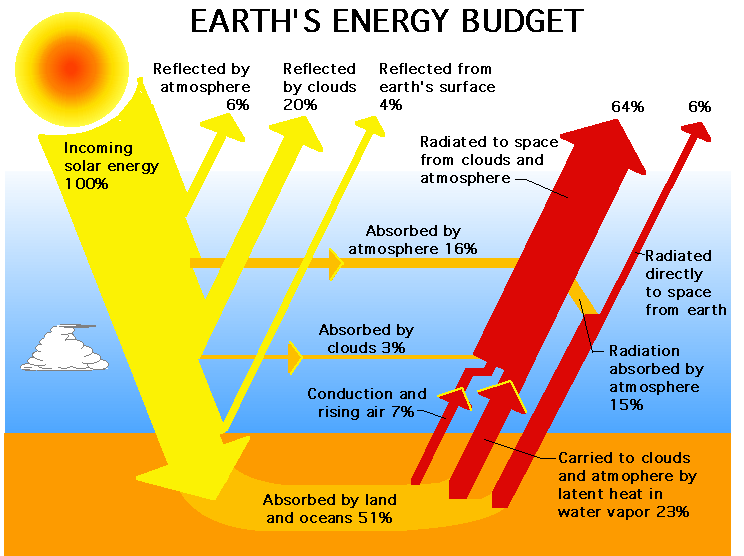
This will also mean that the ideas of basic meteorology will be recognized again:
– sun heats the surface
– surface heats the (lower) atmosphere
These two effects create all our interesting weather.
Sadly, multi-factor heating of the atmosphere and realistic energy flux budgets are destined to remain terra incognita in minds that fail to grasp the implications of phase changes and of adiabatic heating. They cling to the illusion that LH convection is a component of LW radiation (sic!) and, being part of the hydrologic cycle, has a downward component, producing “nil system temperature change…”
1sky1: apparently your life experience does not include rain (virga) or snow or even downdrafts. You have lived a sheltered life thinking there is only LH+SH up arrows. Time to crack open a text on meteorology, try to identify the down arrow components hidden in the ~321 totals. Then you can knowingly smile at those that simply write catch-all “backradiation”. Stephens 2012 improved with: “all-sky emission to surface” but didn’t quite get as close as those that show E up and P down in addition to radiation.
“adiabatic heating”?? Ha. Try to figure out on your own what you fail to grasp using those words together.
It’s astonishing how those who speculate blindly about the “life experience” of mature scientists fail to grasp their own physical ill-logic while doing schoolboy arithmetic. The “down-arrow components” of precipitation and downdrafts are transfers of mass, rather than of heat. Rain is usually cooler than the surface. And so are downdrafts, which are indeed subject to the seemingly self-contradictory process of adiabatic heating. See:
https://www.encyclopedia.com/science/encyclopedias-almanacs-transcripts-and-maps/adiabatic-heating
Bona fide heat transfer from the surface on climatic scales is almost always a one-way street.
Interesting to see people actually believing that atmospheric convection is driven by the lower density of water vapor iso the release of latent heat during condensation
Actually, it’s driven by both, but in different locations. At the surface, increased evaporation at the base of thunderstorms due to the storm generated winds adds additional water vapor to the air. And this increases the uptake of air by the thunderstorm.
On the other hand, condensation at the LCL drives the further upward development of the cumulonimbus tower and propels the air in the tower upwards.
Nature is more complex than generally imagined … go figure.
w.
Start of convection is most often driven by local differences in solar heating. Differences in local Relative Humidity are usually small.
If convection makes jt to the LCL the release of latent heat drives convection all the way to the top of the cloud, untill all latent heat is used up.
Ben, please, read what I wrote. I didn’t say that differences in local RH are usually large. And I didn’t say that local RH starts the convection.
I said:
Evaporation is roughly linearly proportional to the local wind speed. Under the base of the thunderstorm, this is often 10X what’s happening outside the thunderstorm. This, curiously, makes the thunderstorm a dual-fuel heat engine, and in turn it allows the thunderstorm to cool the surface below the initiation temperature.
And this “overshoot” is crucial in controlling any lagged system like the surface temperature.
w.
Willis Eschenbach January 29, 2020 at 9:23 am
That’s fine, but the “carrying capacity” of a volume of air is limited to 100% RH. This translates into eg 15g/1000g at 20 C.

Since the cloudbase of a CB is almost never on the surface, this means that the air that rises and forms a CB is not fully saturated when leaving the surface.
The best way to increase the amount of WV in a volume of air is to make sure the air has a high temperature.
So what? How does any of that change in any significant manner what I’ve said? You’re just arguing to argue at this point. I’ll let you do it with someone else, your style of discussion goes retrograde …
Regards and regrets,
w.
Willis Eschenbach January 31, 2020 at 12:58 am
If evaparoration increases 10x as you state in air that already has a high RH, this means that condensation also must go up dramatically. Not a reason for extra WV in the rising air.
Furthermore I don’t see the air rushing in when a CB begins to form being very dramatic.
High winds under a mature CB are the downbursts that come together with the falling rain or hail.
Ben Wouters February 1, 2020 at 12:13 am Edit
Willis Eschenbach January 31, 2020 at 12:58 am
Ah. I see the problem. Descending air around a thunderstorm has a low relative humidity, not high. This is because the air has been stripped of water by condensation at the LCL, followed by a trip up the thunderstorm tower where remaining water is frozen out. As a result, thunderstorms are surrounded by descending dry air.
Sometimes the air is rushing in, sometimes it is moving slowly, but my point is simple.
The air rising up to the LCL is MOIST, otherwise we wouldn’t get rain.
The air surrounding that is DRY, because we get rain.
As a result, the thunderstorm is driven both by heat from the sun, and by the increased water vapor in the air from the action of the thunderstorm itself. This makes it a dual-fuel engine that allows it to continue to exist at a surface temperature below that necessary for thunderstorm initiation.
Regards,
w.
Willis Eschenbach February 1, 2020 at 9:52 am
After a career as airlinepilot plus gliderflying and paragliding I feel I know a thing or two about thermals and CB’s. When avoiding a CB, it is possible to stay pretty close to the cloud. It is pretty quit there. Most action is INSIDE the cloud.

Have to disagree with your description of convection.
Rising (non condensing) air cools at the DALR until the LCL is reached. Now condensation starts, lowering the cooling rate from DALR to MALR (or SALR)
While rising eventually all WV is turned into droplets. When all WV is “squeezed” out of the air the rising air again cools according the DALR.
The falling rate of the droplets, drops, hail etc. determines whether they will still be carried up by the rising air.
see https://www.atmos.illinois.edu/~snesbitt/ATMS505/stuff/09%20Convective%20forecasting.pdf
and notice the spectacular difference between the DALR and MALR that start at the same temperature.
Obviously. My point is that this air wasn’t at 100% RH, otherwise it would start condensing at the surface.
Interested in your thoughts on the Convective Forecasting PDF., since it covers (almost) all relevant factors in atmospheric convection.
Ben, once again your style of discussion is very frustrating. I say, and you quote:
I said this because you’d stated, incorrectly, that the descending air was moist, viz (emphasis mine):
In response, you go on about gliding and being a pilot and how the slowly descending air around a thunderstorm is slowly descending, but NONE of it either supports, opposes, or has anything to do with what I said.
Next, I’d said and you quoted:
To which you reply
I didn’t say it was at 100% RH, I didn’t think it was at 100% RH, so once again, you’re talking past me.
Thanks for the pdf about convective forecasting, most interesting.
I’ll leave it there.
Regards,
w.
Wiilis Esschenbach February 2, 2020 at 8:49 am
It seems you confuse yourself.
Where you state that the winds at the base of the CB’s increase evaporation often 10x, this can only apply to air moving over a wet surface/water. That air already has a high RH, so increasing evaporation can not add much more WV to that air before it is fully saturated. Yet this air does not start to condense immediately after leaving the surface, since the LCL is some distance above the surface.
Air descending around a CB just isn’t there. Almost all action is inside the CB.
Ben Wouters February 2, 2020 at 12:40 pm Edit
I see. There’s lots and lots of air moving upwards inside the CB … but there is no air descending around it to replace the air moving upwards. It’s all just going up. Nothing going down to replace it. The air going up just piles up in the upper troposphere and doesn’t come down. Got it.
I give up. If you believe that, I can’t help you.
w.
The distinction between moist convection and dry thermals is sketched reasonably well here:
https://www.meteo.physik.uni-muenchen.de/~roger/Lectures/Tropical_Meteorology/Tropical_08.pdf
Thanks, Sky, very informative.
w.
1sky1 January 29, 2020 at 2:48 pm
I’m not convinced the Rayleigh-Benard convection is very relevant for our atmosphere.
Maybe in the surface layer (a few meters) but not for higher up.
The buoyant convection model is adequate imo for thermals, CB’s etc.
For the large scale circulation (cells Hadley etc.) R-B is irrelevant.
see eg.
http://maxwell.ucsc.edu/~drip/talks/lorenz/comment.html
https://blogs.egu.eu/divisions/as/2019/09/20/a-simple-model-of-convection-to-study-the-atmospheric-surface-layer/
1sky1 January 29, 2020 at 2:48 pm
I prefer this text for a good summary of the buoyant convective process:
https://www.atmos.illinois.edu/~snesbitt/ATMS505/stuff/09%20Convective%20forecasting.pdf
Observation often contradicts conviction. Benard cells and the popcorn clouds they produce a few HUNDRED meters above the surface are almost daily occurrences in coastal zones throughout the globe. On the other hand, deep convection leading to severe thunderstorms–especially in the tropics–is critically dependent upon additional buoyancy supplied by water vapor.
BTW, in the real world, Hadley cells are more a climatic abstraction than an observable process.
1sky1 February 1, 2020 at 1:11 pm
Correct, and exactly the reason why I don’t see R-B like patterns in the formation of the nice thermals with cumuli on top.
This is simple buoyant convection. The thermals start at surfaces that easily heat under solar warming. These places are placed totally random relative to each other. What you may see are eg cloud streets, cumuli that all started at the same spot, and are blown downwind while rising. These “streets” are great for gliding, since you can maintain altitude or even climb without having to circle to stay within a rising thermal.
Agree, without WV condensing we wouldn’t see much convection a all.
The DALR is just to steep to allow dry air to rise much.
Wow. The air flowing at altitude from the (thermal) Equator towards the poles is very real. Just as the low pressure it leaves at the surface and the high pressure it creates when this air accumulates in the Subtropical jets.
The Tradewinds these surface pressures create are also very real.
Curious what makes you think otherwise.
What is seen in the atmosphere is a strong tendency for the formation of Benard cells as a result of “simple buoyant convection.” A clear example is shown in Fig.1 of:
http://bibliotheek.knmi.nl/stageverslagen/stageverslag_Noteboom.pdf
These cells can exist without any WV, being an example of “dry” convection.
[W]ithout WV condensing we wouldn’t see much convection a all.
It’s primarily the evaporation at the surface–not the condensation aloft–that supplies the critical additional buoyancy for deep, moist convection.
While undeniably real, at such large spatial scales the Coriolis effect and planetary waves tend to make the Hadley cell a feature difficult to detect without averaging over climatic time-scales. Unlike Benard cells, there’s no emergent self-organization and no spatially coherent ferris-wheel of circulation.
Ben Wouters February 2, 2020 at 3:45 am
1sky1 February 2, 2020 at 4:04 pm
Sky, you’re wasting your breath. Ben knows everything there is to know about the atmosphere because he’s a PILOT!!! He knows there’s no R-B circulation in the atmosphere. He knows there’s no descending air around thunderstorms. You’ll never change his mind because HE FLIES GLIDERS! He doesn’t care if us poor earthbound folks are deluded by dozens of scientific studies showing R-B circulation in the lower troposphere, he knows far better than that.
w.
PS—If you’d like to know just how arrogant and unwilling to be shown to be wrong many pilots are, just ask any stewardess …
1sky1 February 2, 2020 at 4:04 pm
I don’t see how convection can exist without the release of latent heat keeping the rising air warmer (= less dense) than the surrounding air.
All the calculations of CAPE made worldwide everyday are showing just that.
To me the subtropical jets are proof that the upper air flow from tropics to poles is real.
Around 30 N/S is just the latitude were the pressure gradient force and the Coriolis effect balance for the first time.
(I’ll be travelling today, to a place without internet probably.)
Willis Eschenbach February 2, 2020 at 4:31 pm
Apparently you’re afraid that your Thermostat theory will turn out to be a non-starter, and you have to become your unpleasant self again attacking the messenger.
You never answered some simple questions on how the atmosphere can overheat the oceans, or why sand heats up so much more than oceanwater during a day while receiving the same solar energy.
Ben Wouters February 3, 2020 at 12:06 am
Ben, your mind-reading skills are as bad as your ability to hold a discussion.
And I don’t recall your questions about “how the atmosphere can overheat the oceans, or why sand heats up so much more than oceanwater during a day while receiving the same solar energy.” As I requested, please QUOTE MY EXACT WORDS where I made some kind of claim about either of those.
I just did a quick search for “sand”. Other than a note that the albedo of sand is 0.35, the only place it appears is in your question. And the same is true about the word “overheat”, the first time it’s appeared in this thread is in your question above … so WTF are you raving about?
THIS is exactly why discussing things with you sucks so badly.
w.
Wow. Yclept.
https://www.google.com/search?q=yclept&client=ms-android-huawei&sourceid=chrome-mobile&ie=UTF-8
No “yclept” here:
Journal of Geophysical Research:
AtmospheresVolume 92, Issue D4
The role of earth radiation budget studies in climate and general circulation research
V. Ramanathan
First published:20 April 1987
Two decades of near‐continuous measurements of earth radiation budget data from satellites have made significant contributions to our understanding of the global mean climate, the greenhouse effect, the meridional radiative heating that drives the general circulation, the influence of radiative heating on regional climate, and climate feedback processes. The remaining outstanding problems largely concern the role of clouds in governing climate, in influencing the general circulation, and in determining the sensitivity of climate to external perturbations, i.e., the so‐called cloud feedback problem. In this paper a remarkably simple and effective approach is proposed to address these problems, with the aid of the comprehensive radiation budget data collected by the Earth Radiation Budget Experiment (ERBE). ERBE is a multisatellite experiment which began collecting data in November 1984. The simple approach calls for the estimation of clear‐sky fluxes from the high spatial resolution scanner measurements. A cloud‐radiative forcing (or simply cloud forcing) is defined which is the difference between clear‐sky and cloudy‐sky (clear plus overcast skies) fluxes. The global average of the sum of the solar and long‐wave cloud forcing yields directly the net radiative effect (i.e., cooling or warming) of clouds on climate. Furthermore, analyses of variations in clear‐sky fluxes and the cloud forcing in terms of temperature variations would yield the radiation‐temperature feedbacks, including the mysterious cloud feedback, that are needed to verify present theories of climate. Finally, general circulation model results are used to discuss the nature of the cloud radiative forcing. It is shown that the long‐wave effect of clouds is to enhance the meridional heating gradient in the troposphere, while the albedo or solar effect of clouds is largely to reduce the available solar energy at the surface. The long‐wave cloud‐induced drive for the circulation is particularly large in the monsoon regions. Thus it is concluded that analyses of ERBE data in terms of cloud forcing would add much needed insights into the role of clouds in the general circulation. With respect to the future, the scientific need is discussed for continuing broadband measurements of earth radiation budget data into the next century in order to understand the processes that govern interannual and decadal climate trends. Finally, the spectral variations in clear‐sky fluxes and cloud forcing and the need for broadband data to obtain the desired accuracies are described.
PUBLICATION Info © 2020 American Geophysical Union
Copyright © 1999-2019 John Wiley & Sons, Inc. All rights reserved
____________________________________
Anyway – including the mysterious cloud feedback!
The problem with “The general view seems to be that this mysterious ten-fold increase is somehow the result of feedback from water vapor and clouds”
is that feedbacks, as anyhow other “mechanical” phenomena,
never “produce” energy.
Sure they can gather, withhold, and redistribute energy.
Full stop.
– what’s missing again: the energy produced via pressure by the weight of Earth’s atmosphere.