Biofuels are unsustainable in every way, but still demand – and get – preferential treatment
Guest post by Paul Driessen,
The Big Oil-Big Biofuel wars rage on. From my perch, ethanol, biodiesel and “advanced biofuels” make about zero energy, economic or environmental sense. They make little political sense either, until you recognize that politics is largely driven by crony-capitalism, campaign contributions and vote hustling.
Even now, once again, as you read this, White House, EPA, Energy, Agriculture and corporate factions are battling it out, trying to get President Trump to sign off on their preferred “compromise” – over how much ethanol must be blended into gasoline, how many small refiners should be exempted, et cetera.
This all got started in the 1970s, when publicly spirited citizens persuaded Congress that “growing our own energy” would safeguard the USA against oil embargoes and price gouging by OPEC and other unfriendly nations, especially as our own petroleum reserves rapidly dwindled into oblivion. Congress then instituted the Renewable Fuels Standard in 2005, when the Iraq War triggered renewed fears of global oil supply disruptions. The RFS requires that almost all gasoline sold in the USA must contain 10% ethanol – which gets a third fewer miles per gallon than gasoline and damages small engines.
But, we were told, these fuels are renewable, sustainable, a way to prevent “dangerous climate change.”
It’s all bunk. In recent years, the horizontal drilling and hydraulic fracturing (fracking) revolution has given America and the world at least a century of new oil and natural gas reserves. America has become the world’s largest oil and gas producer and within five years could be producing far more oil and gas than any other country in the world. Terminals built years ago to import fuel from distant lands are being reconfigured to export abundant US oil, liquefied natural gas and refined products to distant lands.
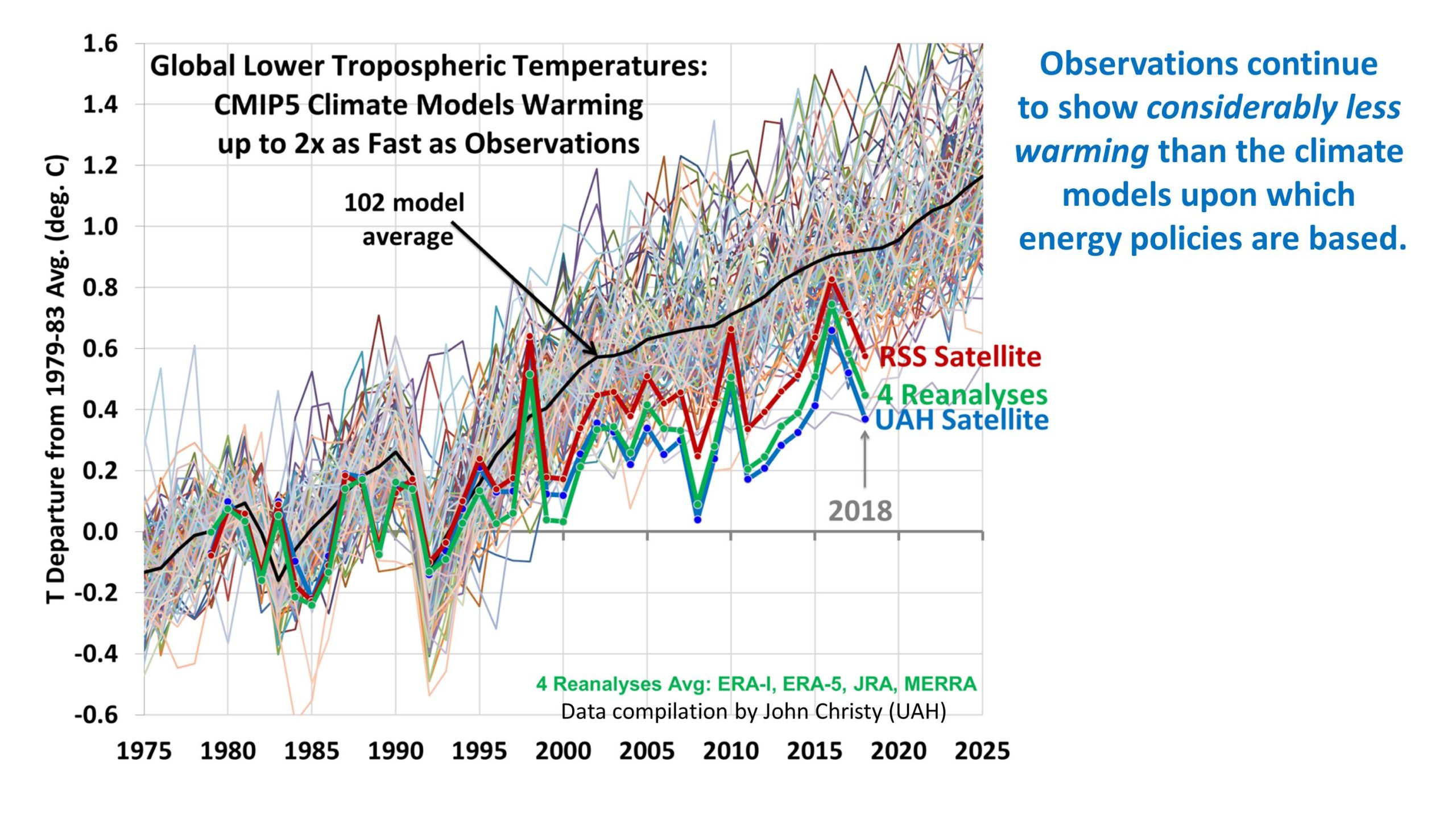
Average global temperatures – as actually measured by satellites and weather balloons – are now almost a full degree Fahrenheit lower than predicted by climate models (the average of 102 IPCC computer model forecasts) that also foretell the daily litany of climate and weather cataclysms. However, hurricanes are less frequent and intense than a half-century ago, and Harvey was the first Category 3-5 hurricane to make US landfall in a record 12 years. Violent F4-5 tornadoes have also been less frequent over the past 34 years than during the 35 years before that, and not one F4-5 tornado hit the USA in 2018.
Over their full life cycle (from planting, growing and harvesting crops, to converting them to fuel, to transporting them by truck or rail car, to blending and burning them), biofuels emit just as much (plant-fertilizing) carbon dioxide as oil-based gasoline and diesel. Those biofuels also require enormous amounts of land, water, fertilizer, insecticides and energy. None of this is renewable or sustainable.
In fact, corn turned into E85 fuel (85% ethanol/15% gasoline) and grown where rainfall is insufficient requires irrigation – and up to 28 gallons of water from rivers or groundwater supplies per mile traveled!
US ethanol production utilizes 38% of America’s corn and 27% of its sorghum – grown on cropland the size of Iowa: 36 million acres, much of which would otherwise be wildlife habitat. And the fertilizers used to grow those crops, especially the corn, result in nutrient-rich runoff that increases nitrogen levels in the Gulf of Mexico, causing deadly algal blooms. When the algae die and decompose, they create low and no-oxygen zones the size of Delaware – killing marine life that can’t swim away quickly enough.
In short, biofuels have huge downsides and do nothing to address the scary scenarios that have either shriveled amid the winds of history – or were wildly exaggerated or imaginary to begin with.
But once these biofuel programs were launched, they became permanent. They created a biofuel industry that wants to get bigger every year, and supports politicians who want to get reelected year after year. That brings us back to the Executive Branch biofuel battles – and to issues that I myself struggle to comprehend, amid the morass of acronyms and conflicting policies and mandates.
Congress and the Environmental Protection Agency require that refiners blend “conventional biofuel” (mostly ethanol) into gasoline – and also meet various “advanced biofuel” and biomass-based diesel requirements. However, too much ethanol in gasoline damages engines in older cars, generators, garden equipment and boats; that puts a limit on how much ethanol can actually go in the fuel supply (the “blend wall”). As a result, while ethanol blending continues to increase gradually, American motorists have never been able to consume enough ethanol to satisfy applicable Renewable Fuel Standards.
However, biofuel interests want the government to keep mandating even more ethanol – a desire that faces multiple problems. Gasoline demand is decreasing, as people drive less, in more fuel-efficient cars, and in electric and hybrid vehicles (that are heavily subsidized under other laws).
Tariff wars with China and other countries have hurt corn and sorghum farmers, who want to be “compensated” via more biofuel mandates under the Renewable Fuels Standard – even though beef, pork and poultry farmers get hurt by higher grain prices resulting from so much corn devoted to ethanol.
Declining fuel demand and the blend wall mean refiners cannot mix all the mandated 15 billion annual gallons of ethanol into gasoline. They are thus forced to over-comply with the “advanced biofuel” part of the RFS mandate by buying expensive foreign biodiesel and “renewable” diesel. Refiners that do not control the point where biofuel can be blended into gasoline (eg, large distribution terminals or local gas stations) must buy “credits” called Renewable Identification Numbers (RINs) that show (or pretend to show) the required (foreign) biofuels were mixed with the gasoline they make domestically.
This all gets really expensive, really fast, which is why the law allows exemptions to small refiners that face “disproportionate economic hardship” from costs that have gotten so high that courts have ordered the EPA to grant more “small refinery exemptions” (SREs) – waivers from the RFS mandates.
However, biofuel has been blended into the fuel small refiners make anyway. This situation resulted in ample supplies of RFS compliance credits, and RIN prices have dropped from over 90 cents apiece to 12 or 20 cents over the past two years or even lower at times. Of course, this all angered the biofuel lobby, which has attacked the Administration for issuing SREs, falsely claiming the exemptions are “destroying demand” for biofuel and “hurting American farmers.”
They levied these attacks on EPA, despite the fact that the Trump Administration granted the biofuel industry its biggest request in 20 years: an air quality waiver that allows E15 to be sold year round. So some in the Administration have proposed to “reallocate lost biofuel gallons” the biofuel industry says were caused by SREs. But there’s nothing to reallocate, since ethanol is being blended despite the SREs.
The reallocation proposal thus has the practical effect of increasing the biofuel mandate by over 700 million gallons above the 15-billion-gallon statutory ceiling on ethanol. That brings us back to the fact that America is not producing enough advanced biofuels, biodiesel or renewable diesel. That means refiners have to buy more foreign supplies of these fuels, from Argentina, Brazil, Indonesia, et cetera.
Of course, that does nothing to help American farmers. It just turns the Renewable Fuel Standard into a big foreign biofuel mandate. It also means President Trump is caught between trying to placate two of his core constituencies: farmers, primarily in the Midwest, and the oil and refining industry with all its jobs.
This is mind-numbingly complicated. But the bottom line is pretty simple: Every time Congress gets involved in trying to fix complex energy and economic problems – instead of letting free market industries and innovators sort things out – it creates a legislative, regulatory, legal and lobbying mess. Every attempted additional fix makes things worse. And trying to justify all the meddling, by claiming we’re running out of oil or face manmade climate cataclysms, just makes things worse.
We should end this crazy-quilt biofuel program. But anyone who thinks that will happen in Washington, DC or Des Moines, Iowa is smoking that stuff that’s now legal and widespread in Boulder, Colorado. But President Trump and his EPA should at least reduce – and certainly not increase – any biofuel quotas.
Paul Driessen is senior policy analyst for the Committee For A Constructive Tomorrow (www.CFACT.org) and author of books and articles on energy and environmental policy.
Discover more from Watts Up With That?
Subscribe to get the latest posts sent to your email.
I agree w Paul Driessen and CFACT on many issues – but his fixation on repeating the many falsehoods about clean, renewable biofuels is getting old.
I support continued, smart use of fossil fuels as does Driessen …but his claims and attacks on biofuels are not supported by a close review of the facts or data.
There is no real “Big Oil-Big Biofuel war” – they are complimentary.
Neither the availability and increased reserves of fossil fuels or the falsity of Catastrophic Anthropogenic Global Warming claims have a single thing to do with the viability of biofuels.
Biofuels however, do represent a constant pressure – a control – on the ability of oil producers to escalate prices … and therein lies the motivation for these attacks …
Pretty much each of Driessen’s regularly recycled claims are demonstrably inaccurate and/or outright false:
“Over their full life cycle (from planting, growing and harvesting crops, to converting them to fuel, to transporting them by truck or rail car, to blending and burning them), biofuels emit just as much (plant-fertilizing) carbon dioxide as oil-based gasoline and diesel. Those biofuels also require enormous amounts of land, water, fertilizer, insecticides and energy. None of this is renewable or sustainable.”
And:
“.. corn turned into E85 fuel (85% ethanol/15% gasoline) and grown where rainfall is insufficient requires irrigation – and up to 28 gallons of water from rivers or groundwater supplies per mile traveled!”
Driessen carefully crafts these claims – cherry picking to portray facts in the most negative, biased and out of context light.
Pay attention to his exact wording – the Narrows focus of his claims.
Yes. Corn grown for ANY PURPOSE – be it food, feed or fuel – in places without sufficient rainfall, must be irrigated.
The facts however, are the majority of corn grown for ethanol is grown in regions that DO have sufficient rainfall and do not require irrigation on the whole.
And his claim that lifecycle water use requires 28 gallons per mile driven is simple ridiculous.
Numerous studies track detailed lifecycle inputs of ethanol. They show average water use in production now averages less than 3 gals per gallon of ethanol produced – nearly identical or less than gasoline – and that number continues to fall significantly. If you get just 15mpg using ethanol and it takes 3 gals of water to produce that ethanol – the facts are it takes 0.2 gals – not 28 – per mile driven.
Dreissen claims the RFS “does nothing to help American farmers.”
Yet reading his prior paragraph tells the real story … despite US ethanol production utilizing 38% of America’s corn and 27% of its sorghum crops … they are currently still not producing enough to fill market demand.
Driessen’s claims are not fact based – he offers no sources or references supporting any of his claims. His claims are not science or fact based … they are political commentary in support of the fossil fuel industry. I also support our continued smart use of fossil fuels – but using fossil fuels does not in any way preclude the use of bio-fuels and taking advantage of their significant real benefits.
The SCIENCE on ethanol … by highly experienced scientists:
https://www.usda.gov/oce/reports/energy/2015EnergyBalanceCornEthanol.pdf
https://www.tandfonline.com/doi/full/10.1080/17597269.2018.1546488
https://fixourfuel.com/wp-content/uploads/2018/04/NCSU-Study.pdf
One of the several nearly identical commentary’s by Paul Driessen attacking ethanol, posted here at WUWT … this one from 2018…
https://wattsupwiththat.com/2018/05/14/the-ethanol-gravy-train-rolls-on/
I and others thouroughly refuted the many false and inaccurate claims in that thread and others. Rather than repost yet again – the comments from this old thread are even more accurate today.
In Oregon, they sell “B-20” diesel, i.e. 20% biodiesel. Dirty little secrets: 1) The fuel economy is much lower, on the order of about 20%, and 2) Biodiesel has a higher “gel” point than the real thing, which is a problem in winter. After one tankful several years ago, I now avoid B-20.
Paul, a better rant on biofuels, including burning Carolina hardwood in a British themoelectric plant is this: the entire sustainability argument to rationalize use of biofuels to save the planet, is logically an even better rationale for raising animals for meat which is under attack.
Carolina hardwood trees probably take over 50 years to sequester the carbon from one year’s burning (nevermind the CO2 of harvesting, chipping, shipping and handling). Corn ethanol burning takes a year to recover the CO2 emissions.
For grazing meat animals, the instant they snip off a mouthful of grass, weeds and/or shrubs, the plant immediately begins reclaiming the carbon from the atmosphere in advance of their emissions! These quadruped”vegans” are the most sustainable product on earth. Moreover, if we retired the grazing lands cropped by domestic animals, wild grazers would expand to fill the vacuum! This is already happening as crop harvests are rapidly increasing on less and less acreage, the retired land becoming expanded, forested habitat.
Given hysteria over meat eaters destroying the climate and the planet, I would like to see this alternative analysis pushed hard and repeated.
A. Scott, are you kidding? Bio-fuels are a total waste. You must have a personal vested interest to suggest otherwise. When all the energy inputs are included the net energy gain is either slightly negative or slightly positive depending on who”s numbers you want to believe. Gasoline from crude oil, depending on how prolific the formation is, produces several times the energy input.
There is no “demand” for bio-fuels anymore than there is a “demand” for wind power. It’s politically mandated compliance requirements that has nothing to do with economics or science.
=
A. Scott,
Hard to believe you are still suggesting ethanol has any economic value. Any thought of the validity of that claim was put to death years ago. I don’t have the source, but here’s a couple clips from my files:
That is one of Roberts main points. He is rightly pointing out that the efficiency of gasoline is being compared to the (slightly positive) energy balance of ethanol. To start from the stuff in the ground, oil/gasoline beats ethanol by a factor of 20 (or more)times, depending on boundaries.
Ethanol does in fact transform some solar energy into usable fuel. But its replacing something that is millions of years of stored solar energy that is more energy dense and of higher quality. To reiterate, if ethanol has an EROI of 1.3:1 and the entire find/refine/distribute oil/gasoline cycle has an EROI of 8:1, then gasoline, from a societal perspective, has 7/.3 =23.33 times more energy return than corn ethanol.
A. Scott you report
“Neither the availability and increased reserves of fossil fuels or the falsity of Catastrophic Anthropogenic Global Warming claims have a single thing to do with the viability of biofuels”. (OK so far).
“Biofuels however, do represent a constant pressure – a control – on the ability of oil producers to escalate prices … and therein lies the motivation for these attacks …” (not OK. How can you be so knowledgeable to understand the falsity of CAGW and so ill-informed to think that ethanol at anytime under any plausible scenario could possibly compete with gasoline in a free market? Help, I really want to know, this is a new mix of beliefs.
A, Scott,
As I’ve stated earlier, I’m surprised you missed the ethanol vs reality debate from 10 plus years ago. Here’s a good place to start: (Dr. Plumentel has a lot more to say about ethanol but his abbreviated clip is the key.
copy?
David Pimentel, PhD, Professor Emeritus of Ecology and Evolutionary Biology at Cornell University, et al., wrote the following in their Sep. 2008 article titled “Biofuel Impacts on World Food Supply: Use of Fossil Fuel, Land and Water Resources,” published in Energies:
“Manufacture of a liter of 99.5% ethanol uses 46% more fossil energy than it produces and costs $1.05 per liter ($3.97 per gallon). The corn feedstock alone requires more than 33% of the total energy input.
I usually let the bs about biofuels that some here tend to spew go, but after reading enough of the comments I just can’t any longer. First things first the SRE’s granted by the trump admin have led to less than the 15 billion gallons of convention ethanol mandated by the law. This has led to the collapse of the RIN market. That is where the discussion ends on that front. As for the comments about nutrient leaching and algal blooms. The real place to look when you want a cause, is the sewage treatment (or lack thereof) of cities. There is no farmer that puts down one extra dollar of nitrogen than they need. That would be like lighting up 20 dollar bills to light your cigar with. Also, ethanol is in most cases a better fuel than standard unleaded gas. Whether the engine is old or new, it has its problems, someone alluded to it causing gumming in small carb engines, but that is a very very small percentage of the fuel used. The blend wall is a complete farce. You can run e85 in anything. So that everyone know where I’m coming from, I farm, I also work in the oil field. I dont advocate for increasing ethanol, but follow the damn laws as they are written. All the farmers want is some stability to their decision making.