Guest essay by Eric Worrall
Aussie Climate Scientists are rushing to fill the breach caused by Professor Andy Pitman’s stunning admission there is no long term drying trend in drought prone Australia.
The science of drought is complex but the message on climate change is clear
October 31, 2019 2.40pm AEDTBen Henley Research Fellow in Climate and Water Resources, University of Melbourne
Andrew King ARC DECRA fellow, University of Melbourne
Anna Ukkola Research Fellow, Australian National University
Murray Peel Senior lecturer, University of Melbourne
Q J Wang Professor, University of Melbourne
Rory Nathan Associate Professor Hydrology and Water Resources, University of MelbourneThe issue of whether Australia’s current drought is caused by climate change has been seized on by some media commentators, with debate raging over a remark from eminent scientist Andy Pitman that “there is no link between climate change and drought”. Professor Pitman has since qualified, he meant to say “there is no direct link between climate change and drought”.
A highly politicised debate that tries to corner scientists will not do much to help rural communities struggling with the ongoing dry. But it is still worthwhile understanding the complexity of how climate change relates to drought.
…
Is climate change affecting Australian droughts?
Climate change may affect drought metrics and types of drought differently, so it can be hard to make general statements about the links between human-induced climate change and all types of drought, in all locations, on all timescales.
…
But the role of climate change in extended drought periods is difficult to discern from normal variations in weather and climate. This is particularly true in Australia, which has a much more variable climate than many other parts of the world.
…
What does the future hold?
Climate models project increasing temperature across Australia and a continuing decline in cool-season rainfall over southern Australia over the next century. This will lead to more pressure on water supplies for agriculture, the environment, and cities such as Melbourne at the Paris Agreement’s target of 2℃, relative to the more ambitious target of 1.5℃ of global warming.
Rainfall is projected to become more extreme, with more intense rain events and fewer light rain days. Declining overall rainfall is predicted to reduce river flows in southeastern Australia. While we can expect the largest floods to increase with climate change, smaller floods are decreasing due to drier soils, and it is these smaller floods that top up our water supply systems.…
Read more: https://theconversation.com/the-science-of-drought-is-complex-but-the-message-on-climate-change-is-clear-125941
In other words, they’ve got nothing.
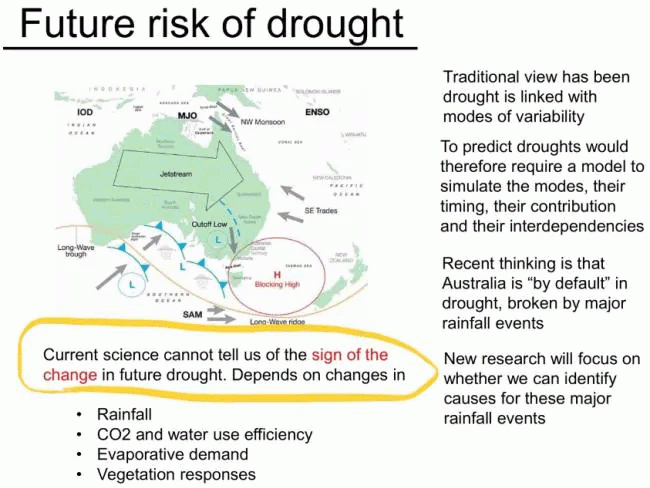
Did Andy Pitman also misspeak, when he admitted climate science cannot tell us whether global warming will make droughts worse, or improve rainfall? (see the image at the top of the page).
The only “links” between climate change and drought are an attempt to link short term drying trends, which scientists admit could be natural variation, and a model based belief that climate change might be making droughts worse, based on their defective climate models – a belief not rooted in observational evidence.
But why not cut back on fossil fuel anyway, just in case?
The only reason farmers in the worst drought afflicted regions of Australia have any water and feed is because of fossil fuel. Fossil fuel gives us the economic capacity to respond to droughts – it powers vast trucking operations happening right now in Australia, transporting feed and water to farmers and towns stricken by drought.
Fossil fuel prosperity means we can afford major water schemes to redistribute water to where it is needed.
To abandon all that would mean going back to the 1800s, leaving farmers at the mercy of whatever nature throws at them; and in arid Australia, nature does not deliver a lot of mercy.
The current drought disaster did not occur because Australia has a shortage of water, it happened because our politicians are idiots. For example, a few months ago they tried to limit truck access to rural roads, right in the middle of the ongoing drought relief operation, a measure which would have eliminated the ability of said trucks to carry meaningful amounts of feed and water to large numbers of desperate farmers.
Aussie Politicians have left major water projects on the shelf for decades, frittering away taxpayers money on pointless obstruction, useless solar projects and other vanity boondoggles, instead of delivering infrastructure people actually need.
h/t Neville: Australian rainfall anomaly 1900-2008.

On another forum I noted the ABC’s Media Watch and the transcript.
“In some regions, this increases the risk of drought, in other regions it decreases the risk. ”
– Email, Professor Andrew Pitman, University of NSW, 10 October, 2019
https://www.abc.net.au/mediawatch/episodes/pitman/11601084
So as an “indirect link” it is very iffy. The old two bob each way.
Australian rainfall has always been variable http://www.bom.gov.au/climate/history/rainfall/ and there have been many worse droughts than todays
I don’t understand the phrase “climate change causes drought”. As if climate change was some defined entity sitting in the sky, pouring disaster down on us. There is no such thing as climate change per se, only effects that in sum are called climate change. Drought IS climate change, so is flood and rising temperatures. Next thing, they’ll be building temples to the demi-god Climate Change and offer sacrifices. Well they sacrifice already, though only other peoples’ comfort and wealth, I would be more impressed if they sacrificed their own.
Having seen what the Israelis have done in the Negev desert with berms around plants to capture the erratic rains, I have always wondered why no-one else in a dry climate has picked up those tricks. After all, the Israelis learned from the Nabateans, who lived in the desert about 2000 years ago – so it’s nothing new!
As I grew up in SE England in the 1980s I remember the stories, every summer, of the long-term drought that the UK was suffering, how we were having to pull more water from the aquifers than was going back in, how in the long run there would not be enough rain and SE England would dry out. How this was going to be a serious problem in the future.
In 2015 I owned a Mazda MX-5, so I knew when it rained and did not. The car did not leak, but was far from ideal for rainy conditions. And that autumn, just north of London, it literally rained for 3 months. Every day. Not all day every day, but all day on many days and at some point on every day.
Now I have a garden and a dog (hence no MX-5; the dog, not the garden). I know that in the autumn and winter the ground never dries out completely, because I have to wash the dog’s paws every day over those seasons. We are not on a flood plain, insurance costs mean I avoid that when buying a house, it just rains enough that the ground soaks and does not have time to dry. Even in the summer it rains enough for the garden on many days.
Most notably, I have not seen a hosepipe ban in years. I re-laid the lawn last year, and my wife insisted on doing it in August. I was wary of a ban preventing me watering it, as one was predicted for that year. But there was no ban, and several days when I had no need to water due to rain. That was the hot, dry summer we were forecast by the UK Met Office from their models. The months of hot weather forecast for this year were, once again, a myth.
So much prediction by extrapolating short-term trends. So little predictive success.
We can relate to that experience as every year in OZ about October we get solemnly warned that the forthcoming summer will be very hot ( some are some aren’t ) resulting in bad bushfires -again some are some are not
If there has been a wet Winter plus Spring we get told that means lots of undergrowth which when it dries out in Summer will provide a lot of fuel for the fires, but if it has been a dry Winter and Spring then the bush will have become tinder dry which again will fuel big fires