GUEST: HENRIK SVENSMARK
By bombarding the Earth with cosmic rays and being a driving force behind cloud formations, the sun plays a much larger role on climate than “consensus scientists” care to admit.

The Danish National Space Institute’s Dr. Henrik Svensmark has assembled a powerful array of data and evidence in his recent study, Force Majeure the Sun’s Large Role in Climate Change.
The study shows that throughout history and now, the sun plays a powerful role in climate change. Solar activity impacts cosmic rays which are tied to cloud formation. Clouds, their abundance or dearth, directly affects the earth’s climate.
Climate models don’t accurately account for the role of clouds or solar activity in climate change, with the result they assume the earth is much more sensitive to greenhouse gas levels than it is. Unfortunately, the impact of clouds and the sun on climate are understudied because climate science has become so politicized.
Full audio interview here:
H. Sterling Burnett, Ph.D. is a Heartland senior fellow on environmental policy and the managing editor of Environment & Climate News.
Discover more from Watts Up With That?
Subscribe to get the latest posts sent to your email.
Well something is happening –
Unusual cold in Italy – Even snowfall in the deep south
May 7, 2019 by Robert
Heavy snowfall in #Calabria, south Italy Monday morning, May 6th.
Read moreUnusual cold in Italy – Even snowfall in the deep south
Categories Archives, Global Warming Hoax, World News & Records
Leave a comment
Italy – Snow and cold could cause 50 percent agricultural losses
May 7, 2019 by Robert
Damages in the millions with the potential for far more.
Read moreItaly – Snow and cold could cause 50 percent agricultural losses
Categories Archives, Global Warming Hoax, World News & Records
2 Comments
Germany – Most snow in 20 years and more on the way
May 7, 2019 by Robert
80 cm (32 inches) of snow since yesterday.
Read moreGermany – Most snow in 20 years and more on the way
Categories Archives, Global Warming Hoax, World News & Records
Leave a comment
Rave-goers get hypothermia after unexpected snow and cold in France
May 7, 2019 by Robert
About 10,000 people gathered at Teknival, a techno music festival in the central Creuse region, were surprised
Read moreRave-goers get hypothermia after unexpected snow and cold in France
Categories Archives, Global Warming Hoax, World News & Records
4 Comments
Italy – Half a meter of snow and a blackout in Cansiglio and Valsalega
May 7, 2019 by Robert
“Here we go again, in less than a week,” says Italian geologist Dr Mirco Poletto.
Read moreItaly – Half a meter of snow and a blackout in Cansiglio and Valsalega
Categories Archives, Global Warming Hoax, World News & Records
Leave a comment
Record coldest ever May day in Denmark
May 7, 2019 by Robert
Beats record set in 1941. Also, snowfall reported around the country.
Read moreRecord coldest ever May day in Denmark
Categories Archives, Global Warming Hoax, World News & Records
2 Comments
Italy – “Hasn’t snowed like this May for 70 years!!”
May 6, 2019 by Robert
“Here in Italy it hasn’t snowed like this in May for 70 years !!” says reader.
Read moreItaly – “Hasn’t snowed like this May for 70 years!!”
Categories Archives, Global Warming Hoax, World News & Records
6 Comments
Record May snowfall in Switzerland
May 6, 2019 by Robert
Breaks May snowfall record set more than 70 years ago. Also, unseasonal cold threatens vineyards and the strawberry crop.
Read moreRecord May snowfall in Switzerland
Categories Archives, Global Warming Hoax, World News & Records
1 Comment
Austria “Day of Sun” called off because of bad weather
May 5, 2019 by Robert
Yesterday’s “Day of the Sun & World Loading Day” was CANCELED due to bad weather,”
Read moreAustria “Day of Sun” called off because of bad weather
Categories Archives, Global Warming Hoax, World News & Records
1 Comment
Snowing in Belgium – In May
May 5, 2019 by Robert
Winter has made a comeback in the Belgian Ardennes.
Read more
It’s called weather, and yes there has recently been a notable cold plunge over much of Europe.
But, there was some equally extreme warmth about the NH as well, in fact more extreme as an anomaly above the norm than NH cold has been below the norm (apart from the mid-west.) ….
But OK, lets look a little closer at some of your references ….
You:
“Germany – Most snow in 20 years and more on the way
May 7, 2019 by Robert
80 cm (32 inches) of snow since yesterday.”
Reality:
“Since yesterday, 80 cm (32 inches) of snow has been added at GERMANY’S HIGHEST PEAK. In the next few days it will snow there again and again. It is possible that by the middle of the month significantly more than six meters of snow will lie on the Zugspitze.” (my caps)
Zugspitze has it’s peak at 2,962m (9,700ft)
You:
“Heavy snowfall in #Calabria, south Italy Monday morning, May 6th.”
Reality:
“Pretty heavy snowfall on Monte Scuro (max. 1633 m), Calabria, south Italy this morning, May 6th. The cold airmass has reached south Italy. Report: @meteocalabria.net”
That’s at 5,360ft or with a DALR lapse rate ~15C colder than air at sea level.
Using an SALR ~10C colder than air at sea level.
Snow does not equate to extreme cold – it equates to temps near or below freezing with the presence of WV.
http://www.severe-weather.eu/mcd/extreme-temperature-anomaly-contrast-central-europe-vs-nw-russia/
“A new outbreak of cold Arctic maritime airmass will push across central into southern and southeastern Europe this weekend and early next week. Temperature anomalies along the cold front and behind it will be up to 10-15 °C below average for this time, very cold indeed. Meanwhile, a strong ridge builds up over extreme NW Russia. Temperatures in this region will be up to 20-25 °C above average for this time.”
https://www.thestar.com/vancouver/2019/05/10/bc-heat-wave-sets-15-temperature-records-thursday-more-set-to-fall.html
“The mercury hit 29.5 C in Squamish, breaking the old record of 26.1 set 51 years ago, while a 141-year-old record toppled in Pitt Meadows as the Vancouver suburb reached 28, edging the old mark of 27.8 set in 1878.
The weather office predicts the Fraser Canyon community of Lytton will reach 32 Friday, while a high of 28 is forecast in the north coast city of Terrace and the southeastern B.C. town of Creston is forecast to reach 30 by Sunday.”
Where in the world is Al Gore? Big May snows in Colorado and early snow in Australia. He has been busy.
I’m not impressed, just bad weather, a few records were broken. You shoulda been in New England this date in 1977. I was in Marlboro Massachusetts. I was gobsmacked. My sister lost power for a week. (Snow on maple leaves is a very bad thing for the trees and power lines under them!)
From the Blue Hill Observatory, a little ways south of Boston:
The storm helped fuel the concerns that we were entering a new ice age. The climate started warming a year or two later.
Carbon-14 is produced in the upper layers of the troposphere and the stratosphere by thermal neutrons absorbed by nitrogen atoms. When cosmic rays enter the atmosphere, they undergo various transformations, including the production of neutrons.
The highest rate of carbon-14 production takes place at altitudes of 9 to 15 km (30,000 to 49,000 ft) and at high geomagnetic latitudes.
The rate of 14C production can be modelled, yielding values of 16,400 or 18,800 atoms of 14C per second per square meter of the Earth’s surface, which agrees with the global carbon budget that can be used to backtrack, but attempts to measure the production rate directly in situ were not very successful. Production rates vary because of changes to the cosmic ray flux caused by the heliospheric modulation (solar wind and solar magnetic field), and due to variations in the Earth’s magnetic field. The latter can create significant variations in 14C production rates, although the changes of the carbon cycle can make these effects difficult to tease out.
https://en.wikipedia.org/wiki/Carbon-14
The NAIRAS model predicts atmospheric radiation exposure from galactic cosmic rays (GCR) and solar energetic particle (SEP) events.
http://sol.spacenvironment.net/nairas/Dose_Rates.html
http://sol.spacenvironment.net/raps_ops/current_files/Cutoff.html
The relationship between climatic parameters and the Earth’s magnetic field has been reported by many authors. However, the absence of a feasible mechanism accounting for this relationship has impeded progress in this research field. Based on the instrumental observations, we reveal the spatio-temporal relation ship between the key structures in the geomagnetic field, surface air temperature and pressure fields, ozone, and the specific humidity near the tropopause. As one of the probable explanations of these correlations, we suggest the following chain of the causal relations:
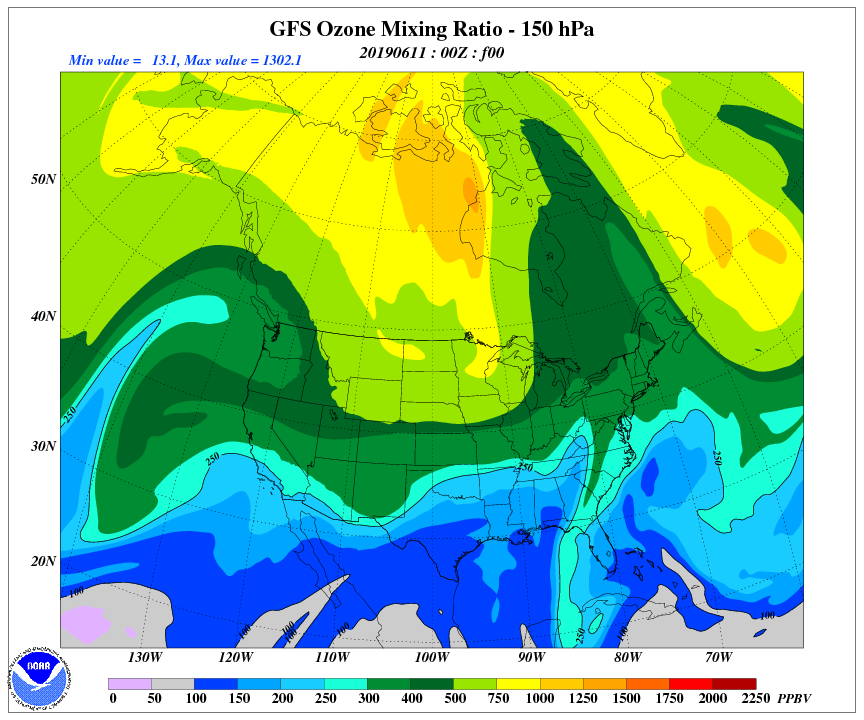
(1) modulation of the intensity and penetration depth of energetic particles (galactic cosmic rays (GCRs)) in the Earth’s atmosphere by the geomagnetic field;
(2) the distortion of the ozone density near the tropopause under the action of GCRs;
(3) the change in temperature near the tropopause due to the high absorbing capacity of ozone;
(4) the adjustment of the extra tropical upper tropospheric static stability and, consequently, specific humidity, to the modified tropopause temperature; and (5) the change in the surface air temperature due to the increase/decrease of the water vapor green house effect.
https://www.researchgate.net/publication/281441974_Geomagnetic_Field_and_Climate_Causal_Relations_with_Some_Atmospheric_Variables
How would GCRs affect the ozone density near the tropopause? Such an effect would be distinct from cloud creation by condensation nuclei so Svensmark falls by the wayside.
One really needs changes in particles and wavelengths that can directly affect the ozone creation / destruction balance which leaves us with my hypothesis.
The blockage of circulation over the Northeast Pacific is primarily visible in the stratosphere.
http://oi66.tinypic.com/vf8gg6.jpg
http://oi66.tinypic.com/be9fr9.jpg
The blockade over the Northeast Pacific was visible in the lower stratosphere throughout the winter.
http://oi63.tinypic.com/so8f8m.jpg
Galactic cosmic rays (GCR) creates ions in the atmosphere. The amount of ions in the atmosphere changes cloud properties and cloud duration.
Solar wind bursts also appear to be an important effect on planetary clouds particularly in the 40 to 60 degree region.
Solar wind bursts (primarily from coronal holes) create a space charge differential in the ionosphere which removes ions for 5 to 10 days which causes a reduction in cloud cover in high latitude regions and change in cloud properties in the tropical region.
Solar wind bursts can inhibit the effect of high GCR as the solar wind burst will remove ions which reduces cloudiness. Solar wind bursts are primarily caused by coronal holes on the sun. For some unexplained reason there was a large number of coronal holes late in the solar cycle when the solar heliosphere is weak and GCR is strong.
This review paper by Tinsley explains how solar wind bursts effect the global electric circuit. Eric Palle’s cloud research paper found evidence of cloud modulation in the 40 to 60 degree region which where the solar wind bursts have the most effect.
See section 5a) Modulation of the global electrical circuit in this review paper, by solar wind bursts and the process electroscavenging. Solar wind bursts create a space charge differential in the ionosphere which removes cloud forming ions. As the electroscavenging mechanism removes ions even when GCR is high, electroscavenging can make it appear that GCR does not modulate planetary cloud if the electroscavenging mechanism is not taken into account.
http://www.utdallas.edu/physics/pdf/Atmos_060302.pdf
http://sait.oat.ts.astro.it/MmSAI/76/PDF/969.pdf
Once again about global warming and solar activity
Solar activity, together with human activity, is considered a possible factor for the global warming observed in the last century. However, in the last decades solar activity has remained more or less constant while surface air temperature has continued to increase, which is interpreted as an evidence that in this period human activity is the main factor for global warming.
We show that the index commonly used for quantifying long-term changes in solar activity, the sunspot number, accounts for only one part of solar activity (William: Closed magnetic field) and using this index leads to the underestimation of the role of solar activity in the global warming in the recent decades. A more suitable index is the geomagnetic activity (William: Short term abrupt changes to the geomagnetic field caused by solar wind bursts, which are measured by the short term geomagnetic field change parameter Ak.
Note the parameter is Ak rather than the month average with Leif provides a graph for. The effect is determined by the number of short term wind bursts. A single very large event has less affect than a number of events. As Coronal holes can persist for months and years and as the solar wind burst affect lasts for roughly week, a coronal hole has a significant effect on planetary temperature) which reflects all solar activity, and it is highly correlated to global temperature variations in the whole period for which we have data. ….
…The geomagnetic activity reflects the impact of solar activity originating from both closed and open magnetic field regions, so it is a better indicator of solar activity than the sunspot number which is related to only closed magnetic field regions. It has been noted that in the last century the correlation between sunspot number and geomagnetic activity has been steadily decreasing from – 0.76 in the period 1868- 1890, to 0.35 in the period 1960-1982, while the lag has increased from 0 to 3 years (Vieira et al. 2001).
…In Figure 6 the long-term variations in global temperature are compared to the long-term variations in geomagnetic activity as expressed by the ak-index (Nevanlinna and Kataja 2003). The correlation between the two quantities is 0.85 with p<0.01 for the whole period studied. It could therefore be concluded that both the decreasing correlation between sunspot number and geomagnetic activity, and the deviation of the global temperature long-term trend from solar activity as expressed by sunspot index are due to the increased number of high-speed streams of solar wind on the declining phase and in the minimum of sunspot cycle in the last decades.
“Galactic cosmic rays (GCR) creates ions in the atmosphere. The amount of ions in the atmosphere changes cloud properties and cloud duration.”
I suspect that this is due to coagulation effect. In wastewater treatment and air purification (or so the theory goes in the latter; I speak from experience in the former) electrically charged molecules (positive or negative) attract and bind together suspended or atmospheric solids. In the latter case, that would be CCN upon which water vapor condenses forming clouds.
The CLOUD experiment at CERN has discounted the role of cosmic rays in climate change.
See my comment below.
The CLOUD experiment at CERN has discounted the role of cosmic rays in climate change.
Global atmospheric particle formation from CERN CLOUD measurements
Eimear M. Dunne1,*,†, Hamish Gordon2,*,‡, Andreas Kürten3, João Almeida2,3, Jonathan Duplissy4, Christina Williamson3,§, Ismael K. Ortega5,||, Kirsty J. Pringle1, Alexey Adamov6, Urs Baltensperger7, Peter Barmet7, Francois Benduhn8, Federico Bianchi6,7, Martin Breitenlechner9,¶, Antony Clarke10, Joachim Curtius3, Josef Dommen7, Neil M. Donahue11,6, Sebastian Ehrhart2,3, Richard C. Flagan12, Alessandro Franchin6, Roberto Guida2, Jani Hakala6, Armin Hansel9,13, Martin Heinritzi3, Tuija Jokinen6,#, Juha Kangasluoma6, Jasper Kirkby2,3, Markku Kulmala6, Agnieszka Kupc14,§, Michael J. Lawler15,#, Katrianne Lehtipalo6,7, Vladimir Makhmutov16, Graham Mann1, Serge Mathot2, Joonas Merikanto6, Pasi Miettinen15, Athanasios Nenes17,18,19, Antti Onnela2, Alexandru Rap1, Carly L. S. Reddington1, Francesco Riccobono7, Nigel A. D. Richards1, Matti P. Rissanen6, Linda Rondo3, Nina Sarnela6, Siegfried Schobesberger6,**, Kamalika Sengupta1, Mario Simon3, Mikko Sipilä6, James N. Smith15,#, Yuri Stozkhov16, Antonio Tomé20, Jasmin Tröstl7, Paul E. Wagner14, Daniela Wimmer3,6, Paul M. Winkler14, Douglas R. Worsnop6,21, Kenneth S. Carslaw1,‡
Science 02 Dec 2016:
Vol. 354, Issue 6316, pp. 1119-1124
DOI: 10.1126/science.aaf2649
How new particles form
New particle formation in the atmosphere produces around half of the cloud condensation nuclei that seed cloud droplets. Such particles have a pivotal role in determining the properties of clouds and the global radiation balance. Dunne et al. used the CLOUD (Cosmics Leaving Outdoor Droplets) chamber at CERN to construct a model of aerosol formation based on laboratory-measured nucleation rates. They found that nearly all nucleation involves either ammonia or biogenic organic compounds. Furthermore, in the present-day atmosphere, cosmic ray intensity cannot meaningfully affect climate via nucleation.
Science, this issue p. 1119
Abstract
Fundamental questions remain about the origin of newly formed atmospheric aerosol particles because data from laboratory measurements have been insufficient to build global models. In contrast, gas-phase chemistry models have been based on laboratory kinetics measurements for decades. We built a global model of aerosol formation by using extensive laboratory measurements of rates of nucleation involving sulfuric acid, ammonia, ions, and organic compounds conducted in the CERN CLOUD (Cosmics Leaving Outdoor Droplets) chamber. The simulations and a comparison with atmospheric observations show that nearly all nucleation throughout the present-day atmosphere involves ammonia or biogenic organic compounds, in addition to sulfuric acid. A considerable fraction of nucleation involves ions, but the relatively weak dependence on ion concentrations indicates that for the processes studied, variations in cosmic ray intensity do not appreciably affect climate through nucleation in the present-day atmosphere.
Further evidence for early nucleation
Andreas Kürten (2019) New particle formation from sulfuric acid and ammonia: nucleation and growth model based on thermodynamics derived from CLOUD measurements for a wide range of conditions Atmos. Chem. Phys., 19, 5033–5050, 2019
https://doi.org/10.5194/acp-19-5033-2019
The article says nothing about cosmic rays.
“A considerable fraction of nucleation involves ions, but the relatively weak dependence on ion concentrations indicates that for the processes studied, variations in cosmic ray intensity do not appreciably affect climate through nucleation in the present-day.”
In law, this statement is known as a conlusory argument. That is, it portends to be more definitive and categorical than available evidence indicates. Note the time frame claim: “climate nucleation through the the present day” which in traditional time frames is 30 years. Really? This process of CCN and it’s impact over decades is not only known but observed and we’ll measured enough to EXCLUDE cosmogenesis as a factor?
That’s a large claim with a large number of wholes, rushing to a weakly supported and more likely polemical claim than one firmly supported by actual science.
How about the 100 years of the 20th century?
Cosmic rays, solar activity and the climate
T Sloan1 and A W Wolfendale2
Published 7 November 2013 • 2013 IOP Publishing Ltd
Environmental Research Letters, Volume 8, Number 4
Abstract
Although it is generally believed that the increase in the mean global surface temperature since industrialization is caused by the increase in green house gases in the atmosphere, some people cite solar activity, either directly or through its effect on cosmic rays, as an underestimated contributor to such global warming. In this letter a simplified version of the standard picture of the role of greenhouse gases in causing the global warming since industrialization is described. The conditions necessary for this picture to be wholly or partially wrong are then introduced. Evidence is presented from which the contributions of either cosmic rays or solar activity to this warming is deduced. The contribution is shown to be less than 10% of the warming seen in the twentieth century.
Check what Svensmark says on this here : https://wattsupwiththat.com/2018/11/01/data-global-temperatures-rose-as-cloud-cover-fell-in-the-1980s-and-90s/#comment-2507868
Important to hear Svensmark’s comment on Kirkby’s CLOUD Cern experiment : they physically simulated initial aerosol production, and using their hpc cloud simulated the growth for their results.
Contrast is , Svensmark physically followed the process.
So again like the IPCC, computer models were foisted.
Svensmark here from 03.2018 : https://www.youtube.com/watch?v=iFlNS2PX4yI
from 47:50 . Models v. Physics.
How #FakeNew about CERN continues to be broadcast reminds me of CNN.
Come on man. This is science not fight.
What is the problem that we are trying to solve? What are the alternatives? Observations?
There is cyclic high latitude warming always followed by cooling in the paleo record. What the heck caused the cyclic warming that was always followed by cooling in the paleo record?
The warming in the last 30 years has been high latitude warming not global warming.
The AGW mechanism is a global warming mechanism with most of the warming predicted in the tropics. This is not observed. The latitudinal pattern of warming in the last 30 years does not match a AGW forcing mechanism and for some unexplained reason the warming stopped.
http://www.drroyspencer.com/wp-content/uploads/TMI-SST-MEI-adj-vs-CMIP5-20N-20S-thru-2015.png
http://www.physicalgeography.net/fundamentals/images/rad_balance_ERBE_1987.jpg
P.S. It is possible to use physical observations to unequivocally prove that humans caused no more than 5% of the recent rise in atmospheric CO2. If that assertion is correct, there is a large missing source of CO2 coming into the biosphere along with large sinks and the majority of the increase in atmospheric CO2 was due to the increase in temperature.
Observations confirm there is a GCR and planetary cloud cover correlation and there is correlation with solar wind bursts and planetary cloud cover changes.
There is something incorrect with the above experiment.
https://www.semanticscholar.org/paper/The-possible-connection-between-ionization-in-the-Pall%C3%A9a-Butlerb/4ad159e3523889be89dce82297271472d4c024bc
The possible connection between ionization in the atmosphere
by cosmic rays and low level clouds
We use a simple model to calculate the climatic impact should the correlation be confirmed. We show that, under the most favorable conditions, a reduction in low cloud cover since the late 19th century, combined with the direct forcing by solar irradiance can explain a significant part of the global warming over the past century, but not all. However, this computation assumes that there is no feedback or changes in cloud at other levels.
Nonetheless they appear to be marginally field significant over broad latitude and longitude bands with a peak positive correlation at 50 degrees North and South and a tendency to negative correlation at lower latitudes. The correlation is strongest over the North and South Atlantic. Several of these features are consistent with the predictions of the electroscavenging process.
However, the symmetry in the significance distribution over the northern and southern hemispheres (see next section) points to a physical mechanism behind the correlation. The correlation distribution does become field significant if one looks only at the latitude bands 40–60_ in both hemispheres. Moreover if detrended low cloud data is used, the significances for all cells increase and the correlation becomes field significant (although marginally) over the whole earth.
The second process, considered by Tinsley and Yu (2003), namely electroscavenging, depends on the action of the global electrical circuit (see review by Rycroft et al. (2000)). The transport of charge by rapidly rising convective currents in the tropics and over continental land masses leads to a _200 kV positive charge of the ionosphere compared to Earth.
This large voltage difference, in turn, necessitates a return current which must pass through the regions of the atmosphere where clouds are formed. As cosmic rays are the principal agent of ionization in the atmosphere above 1 km altitude, any modulation of the GCR flux due to solar activity is likely to affect the transport of charge to complete the global electrical circuit.
Tinsley and Yu (2003) discuss how the build up of electrostatic charge at the tops and bottoms of clouds could affect the scavenging of ice forming nuclei (IFN) and cloud condensation nuclei (CCN) by droplets, and how this can lead to greater rates of precipitation and a reduction in cloud cover. They find that the electroscavenging process is likely to be more important over oceanic rather than continental regions and that it leads to a positive correlation between clouds and cosmic rays at higher latitudes and a negative correlation at low latitudes.
Thus the electroscavenging process can explain several of the most striking features of Fig. 5, namely: (1) the peak in significant positive correlations at latitudes around 50 degrees North and South (Fig. 5a); (2) the tendency for a less significant but nonetheless evident trend to negative correlation coefficients at low latitudes (Fig. 5a); and (3) the location of the peak in correlation over one of the principal oceans, namely over the North and South Atlantic (Fig. 5c).
William.
Strong powerful explosions, like volcanic or thermonuclear, show huge build up of electrostatic charge in the atmosphere at the place, followed by electrostatic discharges, if I am not wrong.
The catch phrase there I think is “thermal”, not GCR.
(making sound a bit more sciency, “thermodynamic” electrostatic charge, or simply a heat transfer electrostatic charge).
oh well, just saying…
cheers
“The AGW mechanism is a global warming mechanism with most of the warming predicted in the tropics”
No, Hansen 1981 noted “it can be anticipated that average high-latitude warming will be a few times greater than the global mean effect” (observed arctic warming 3x faster since 1970?) Models continue to project that afaik.
“for some unexplained reason the warming stopped”
This is obviously untrue according to all data sets.
Arrhenius (1896) on Polar Amplification
https://www.sealevel.info/Arrhenius_polar_amplification.html
Autocorrect is your enema!!
The bottom line is that more research is needed in areas OTHER that CO2. the AGW supporters are not really interested as it will spoil their “theory” which they assume to be fact, so they say there is no other alternative.
I think one of the problems is it would not take much solar, cosmic, etc variation to cause a change in temperatures.
Climate science is the worst ever scientific field to exist in a mainstream way.
It is also the worst ever field of mainstream science in terms of actual evidence for anything claimed.
I’m glad we’ve not met intelligent life, because they’d be laughing at clisci, on both sides of the aisle, it’s rather pathetic
“By bombarding the Earth with cosmic rays … the sun ”
Is this a correct statement?
What is the source of cosmic rays and why do they vary?
Hmm?
There are two sources of cosmic rays, galactic cosmic rays and solar cosmic rays.
A large drop in the global sea surface temperature.
 ?fbclid=IwAR3S3I2eW_kPmcWmx_Xrm_RGNxVBCFlBx9eave-X_VT5V–zI0kH-PYeuXU
Oh well, time for people to accept the power and magic of CO2 molecule.
Is not only significantly tied to Earth system, by the incredible influence of this feed back in climate by the CO2.,
but also it, consist with this indisputable feedback in the means of universal and Milky Way CR intensity and variability….
magic of the first degree and higher order there, as per means of silly simple feed backs….of CO2.
CO2 the higher entity or substance, on the celestial order….of things….
where is the next stop of stupidity,,, I can no tell….
and maybe there will not be any such stops there, anymore!
cheers
SC24 is still live and kicking, or is this a dead cat bounce?
2019 05 01 2019.330 0
2019 05 02 2019.333 0
2019 05 03 2019.336 0
2019 05 04 2019.338 12
2019 05 05 2019.341 13
2019 05 06 2019.344 15
2019 05 07 2019.347 27
2019 05 08 2019.349 25
2019 05 09 2019.352 27
2019 05 10 2019.355 28
2019 05 11 2019.358 29
🐈
The start of SC25
The recent sunspots I’ve noticed are close to the equator and hence should be SC24 sunspots. While I haven’t checked out the magnetic polarity of these spots, that changes with every cycle. If there were new spots much closer to the poles, and of SC25’s polarity, I think we all would have heard the news.
What are your references to the start of SC25?
Common sense. Anything that can give you a bad burn from 93 million miles away probably has a large impact on the Earth. “Consensus Science” won’t stop until they realize the goal of Socialism in the US. The “Consensus” scientists themselves are the real Anthropogenic component of climate change.
Yes- the sun does provide the Earth with most it energy. Since solar activity varies about 0.1%, common sense tells us that it will have little effect on climate change, especially when compared to 47% increase in CO2. a known greenhouse gas. over the past 2.5 centuries.
CO2 makes up only about 5% of greenhouse gases, and man contributes only about 3% of the CO2 budget (And keep in mind CO2 is losing it’s ability to have much of an effect at current saturations, which is why modelers invented positive feedback loops). This means that you believe that a .0015% change in greenhouse gasses is a greater climate driver than a .1 % change in solar output.
How much warming would we see with a 500% increase in CO2, and no solar input at all?
You guys really have an interesting delusion.
“no solar input at all?” monster strawman.
Using carbon isotope analysis the 47% increase in atmospheric CO2 over the past 2.5 centuries can be directly attributed to the burning of fossil fuels.
In science mechanism = correlation = evidence of a causal relation.
The mechanism of CO2 as a GHG has been known for 2 centuries.
https://history.aip.org/history/climate/index.htm
A 250 year correlation between CO2 and temperature has been demonstrated by the BEST study.
http://berkeleyearth.org/wp-content/uploads/2015/02/decadal-with-forcing-small.png
No Jack, that is not a straw man. The Sun is the largest driver of climate. Period. You can tilt the planet all you want or even make the atmosphere 100% CO2, but without the input of the Sun you get no change. The seasons are not caused by tilt, they are caused by a minor change in the angle of the Sun.
You guys have really strayed from basic science, and reality.
You might wish to talk to the solar scientists are the Solar Center at Stanford University
During the initial discovery period of global climate change, the magnitude of the influence of the Sun on Earth’s climate was not well understood. Since the early 1990s, however, extensive research was put into determining what role, if any, the Sun has in global warming or climate change.
A recent review paper, put together by both solar and climate scientists, details these studies: Solar Influences on Climate ( http://solar-center.stanford.edu/sun-on-earth/2009RG000282.pdf ). Their bottom line: though the Sun may play some small role, “it is nevertheless much smaller than the estimated radiative forcing due to anthropogenic changes.” That is, human activities are the primary factor in global climate change.
http://solar-center.stanford.edu/sun-on-earth/glob-warm.html
No one denies that sun provides the Earth with most of its energy. No denies the existence of the sun. It just does not contribute much to climate.
BTW – In 2019 the sun was closest to the Earth on January 2, during winter in the Northern Hemisphere. It is farthest from the Earth on July 4, during summer. How much different does that make?
le, “it is nevertheless much smaller than the estimated radiative forcing due to anthropogenic changes
Yes Jack, we all know what the failed hypothesis team has said, but that does not alter the fact that the Sun drives our climate. Period. Now go find a new hobby. I hear fantasy football is a hoot.
Milankovitch cycles were the main driver of climate change.
http://ossfoundation.us/projects/environment/global-warming/milankovitch-cycles
No, the Sun is the main driver of climate. The tilt changes the angle of solar input, without the Sun the tilt would be meaningless. It is all about solar input, and dismissing the Sun is madness of the highest order. But that is what we see in post modern climate science.
I know you will continue to deny the truth because you are hardheaded and can never admit you said something really stupid. But please, go on denying basic science and physics, it makes you look smarter.
And BTW, your attempts to make me unlearn what I was taught as a climatology student at a major university are very amusing. I have been studying Milankovitch Cycles (Glaciations and interglacials) for forty plus years.
If your house gets cold, just tilt it a bit til it warms.
Hello, new to this forum, seems very lively, as any discussion of science ought to be.
All of the above is fascinating and requires a lot of more of the layman than the average “discussion” in the mainstream media. Not surprising, but it is very welcome.
However, it would be greatly appreciated by layman like me if posters only used acronyms after the first usage of a term in a post. If you want laymen to keep reading, don’t sling acronyms until you’ve used the full term. Thanks!
All that being said, my layman mind cannot get past the fact that water vapor makes up literally thousands of times more particles of the atmosphere compared to CO2 molecules. And considering that the evaporation cycle is not easily modeled nor understood, nor is the role of the magnetic poles, chemical reactions of gases to ionization and radiation, isn’t this a good reason to look for alternative explanations for climactic fluctuations? Is my layman mind missing something obvious, or is this just an expression of reasonable doubt?
Never mind the inexactitude of measurement standards and equipment throughout the last 50 years, much less the times before scientific measurements were a concern at all.
Thanks for your patience!
I’m interested in any comments, on this video titled, (Fatal) Flaw in Climate Change Science.
[Spelling error fixed. Mod]
The TSI model of solar forcing ignores nearly all climate forcing aspects of space weather AND applies that forcing to the human total. This video shows that fact in a way that anyone can understand.
After reading the byline above from his YT vid, I don’t have to waste 40 minutes to know Ben Davidson doesn’t know what TSI does, and that he grossly overstates the case for ‘space weather forcing’.
Svensmark’s cosmic ray cloud theory claims are easily disproved by knowing that his ‘cosmic ray clouds’ (see his Fig 10) are actually El Nino produced clouds that he ignores or doesn’t know about. His TSI statements sound more like wishful thinking than actually data-based findings, ie his claim that TSI only provides about 0.2W/m2 instead of the 1-1.5W/m2 needed to warm the ocean during a solar cycle. Svensmark doesn’t understand TSI data if that’s what he thinks, as even weak cycle SC24 delivered above a 1.5W/m2 peak in 2015 vs the 2008 minimum monthly, and he isn’t taking into account the cumulative solar cycle TSI effect on ocean warming/cooling.
Many of the more general findings in his document specific to solar warming are covered in my TSI-ocean climate work, such as the sea level link. So I can agree with some of his statements, but all the main solar influence he claims for cosmic rays and clouds are patently false: truly owed to TSI. Forbush decreases don’t happen often enough to cause cooling during different times of the solar cycle like low TSI does.
Svensmark’s theory is junk science along with CO2 theory. Just about every document and presentation about his theory carefully coaches how TSI correlates with climate highs and lows too, even though it’s variation is claimed to be too small, so he and his supporters are always just hedging their bets covering all the bases. I call this the ‘solar scattershot approach’ – throw everything the sun does at climate change, so you’ve covered all the solar mechanisms.
If TSI isn’t the main mechanism in that mix it’s because they don’t know what they’re doing, they don’t know how to evaluate it, and therefore imo they shouldn’t be strongly promoting another false and distorted climate theory, even if it glorifies the sun’s influence.