Solar experts predict the Sun’s activity in Solar Cycle 25 to be below average, similar to Solar Cycle 24
April 5, 2019 – Scientists charged with predicting the Sun’s activity for the next 11-year solar cycle say that it’s likely to be weak, much like the current one. The current solar cycle, Cycle 24, is declining and predicted to reach solar minimum – the period when the Sun is least active – late in 2019 or 2020.
Solar Cycle 25 Prediction Panel experts said Solar Cycle 25 may have a slow start, but is anticipated to peak with solar maximum occurring between 2023 and 2026, and a sunspot range of 95 to 130. This is well below the average number of sunspots, which typically ranges from 140 to 220 sunspots per solar cycle.

NOAA’s Space Weather Workshop
The panel has high confidence that the coming cycle should break the trend of weakening solar activity seen over the past four cycles.
“We expect Solar Cycle 25 will be very similar to Cycle 24: another fairly weak cycle, preceded by a long, deep minimum,” said panel co-chair Lisa Upton, Ph.D., solar physicist with Space Systems Research Corp. “The expectation that Cycle 25 will be comparable in size to Cycle 24 means that the steady decline in solar cycle amplitude, seen from cycles 21-24, has come to an end and that there is no indication that we are currently approaching a Maunder-type minimum in solar activity.”
The solar cycle prediction gives a rough idea of the frequency of space weather storms of all types, from radio blackouts to geomagnetic storms and solar radiation storms. It is used by many industries to gauge the potential impact of space weather in the coming years. Space weather can affect power grids, critical military, airline, and shipping communications, satellites and Global Positioning System (GPS) signals, and can even threaten astronauts by exposure to harmful radiation doses.
Solar Cycle 24 reached its maximum – the period when the Sun is most active – in April 2014 with a peak average of 82 sunspots. The Sun’s Northern Hemisphere led the sunspot cycle, peaking over two years ahead of the Southern Hemisphere sunspot peak.
Solar cycle forecasting is a new science
While daily weather forecasts are the most widely used type of scientific information in the U.S., solar forecasting is relatively new. Given that the Sun takes 11 years to complete one solar cycle, this is only the fourth time a solar cycle prediction has been issued by U.S. scientists. The first panel convened in 1989 for Cycle 22.
For Solar Cycle 25, the panel hopes for the first time to predict the presence, amplitude, and timing of any differences between the northern and southern hemispheres on the Sun, known as Hemispheric Asymmetry. Later this year, the Panel will release an official Sunspot Number curve which shows the predicted number of sunspots during any given year and any expected asymmetry. The panel will also look into the possibility of providing a Solar Flare Probability Forecast.
“While we are not predicting a particularly active Solar Cycle 25, violent eruptions from the sun can occur at any time,” said Doug Biesecker, Ph.D., panel co-chair and a solar physicist at NOAA’s Space Weather Prediction Center.
An example of this occurred on July 23, 2012 when a powerful coronal mass ejection (CME) eruption missed the Earth but enveloped NASA’s STEREO-A satellite.

A 2013 study estimated that the U.S. would have suffered between $600 billion and $2.6 trillion in damages, particularly to electrical infrastructure, such as power grid, if this CME had been directed toward Earth. The strength of the 2012 eruption was comparable to the famous 1859 Carrington event that caused widespread damage to telegraph stations around the world and produced aurora displays as far south as the Caribbean.
The Solar Cycle Prediction Panel forecasts the number of sunspots expected for solar maximum, along with the timing of the peak and minimum solar activity levels for the cycle. It is comprised of scientists representing NOAA, NASA, the International Space Environment Services, and other U.S. and international scientists. The outlook was presented on April 5 at the 2019 NOAA Space Weather Workshop in Boulder, Colo.
For the latest space weather forecast, visit https://www.swpc.noaa.gov/
Well if there 25 prediction is correct, then there will no longer be support for an oncoming Maunder type minimum from a series of declining cycles.
That’s not really the same thing as saying that there is ‘no indication’ of on oncoming Maunder type minimum.
Hoping it ain’t so not the same as knowing it ain’t so.
Disclaimer, I neither hope nor expect an oncoming Maunder type minimum. We will not handle it well.
================================
Dang, ‘their 25 prediction’.
==================
Another way of saying this is that right now we are still in a series of declining cycles. How that ends, and how that effects climate, nobody knows, not even kim.
==================================
I say lets get past Dalton before we start considering Maunder.
I do not see the reason why a tendency to diminish by half a century must be reversed only now.
The maximum peak of the cycles was reached in the 60s, since then it is decreasing again to levels as before.
It doesn’t seem to me that NOAA knows more than before.
SC25 start will be January 2020 +/-1 month if the South polar field continues to behaves as it has for the past 40 years of accurate readings.
The city of Redding to the west of Chico is getting worried about the steady incoming storms. Shasta Dam is currently 89% full, and the release at Shasta has been raised to 30,000 cfs. The rains coming in are warmer now, and the mountains through out the region all have above average snow levels. … https://www.redding.com/story/news/local/2019/04/04/more-rain-means-more-water-being-released-lake-shasta/3365047002/
And now a Pineapple Express is setting up just north of Hawaii. So far the winds have pushed this latest storm system to the north, and into Northern California up to Washington. Oregon should feel the brunt of that. … https://earth.nullschool.net/#current/wind/surface/level/overlay=total_cloud_water/orthographic=-128.04,36.41,672/loc=-129.443,42.984
Most likely there will be a number of sunspot predictions. One of these will be closer to what happens than all the others. The author of that prediction will be hailed as the new solar guru until the following cycle where in all likelihood we will hail a new guru.
If I continually predict the “next month” will be the start of SC25, eventually I’ll hit it and be correct. That method has zero skill though. As that is SILSO’s current method : Zero skill.
Predictions of the coming solar cycle (hereafter referred to as ‘the next solar cycle’) will be exactly like the current cycle, except where it is not.
Or to expand on the minutia of the ‘the next solar cycle’ —
1) The peak level and the timing of that peak level of solar activity shall be within ‘normal’ prediction error bands.
B) Inasmuch as the cycle will be exactly the same as this current cycle’s activity, is known with a confidence level of B+ (± 2.5).
ix) ‘the next solar cycle’ can refer to any solar cycle including the present one, in statistically probability terms. Note: Thus far ‘the next solar cycle’ being this solar cycle has failed statistical confidence tests (Þ= 0.2 ± 0.218892).
NASA will be employing OUI←→JA© software utilities packages from RUNIC Labs™, for further solar prediction analysis. Standard data homogenization using CHIKEN EN-trails© software from B.S.ware will continue to be used for catastrophic climate adjustments and predictions.
I am betting it’s going to do what’s it’s going to do…….
let’s run a citizen science prediction contest.
predict the next cycle?
it’s easy to criticize, hard to do better.
As a layperson in these matters I just want the sun to hang around a bit longer.
Disclaimer: I am on the original largesse Solar FIT Scheme in South Australia and as such have a vested interest
It is comprised of scientists representing NOAA, NASA, the International Space Environment Services.
Do scientists still work at the places? I think not.
Well, I’ll be Hathawayed!
Prior to SC24 Hathaway from NASA kept desperately trying to persuade the Sun to start SC24 to his schedule and to make it big like he wanted.
Prophesy after prophesy appeared, all with high confidence levels.
He was wrong on the start by almost 2 years and WAY wrong on all the prophesies from prior to the arrival of SC24. I think in the end he bowed to the inevitable and agreed it would be a low-activity cycle but he was still above what it turned out to be.
Personally I think I’ll stick to Zharkova’s schedule – her team at least can do accurate predictions of the past that match the data we have across millennia.
SC25 will be almost non-existent.
Which nicely confirms this 2011 puzzle… where is the precursor to SC25?
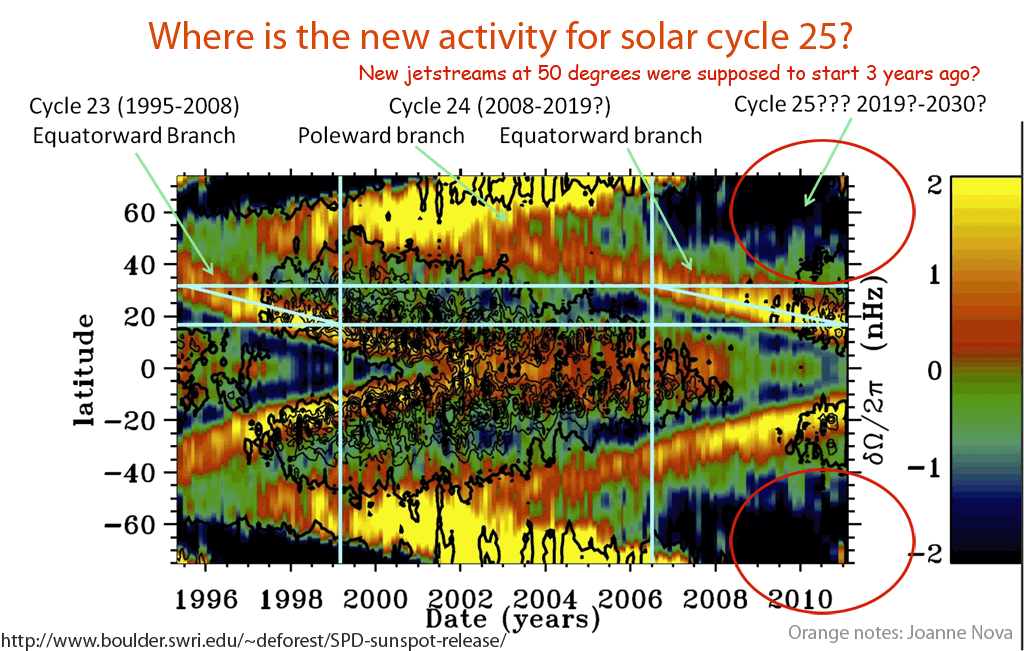
Personally I think I’ll stick to Zharkova’s schedule – her team at least can do accurate predictions of the past that match the data we have across millennia.
No, she is totally wrong.: https://arxiv.org/pdf/1512.05516.pdf
“the Zh15 model fails to reproduce the well-established features of the solar activity evolution during the last millennium. This means that the predictive part for the future is not reliable either.”
Found in the comments of WUWT “Solar physicist sees global cooling ahead”
August 9, 2016
Extract :
Bindidon August 19, 2016 at 2:38 pm
Just seen in the science subset of a french newspaper:
http://www.uwosh.edu/faculty_staff/hiatt/Images/Sun_activity_correlation.gif
Exactly.
HenryP August 19, 2016 at 3:00 pm
That result makes sense to you?
lsvalgaard August 19, 2016 at 6:11 pm
Absolutely. It shows [as is otherwise also evident] that solar activity is not the cause of recent warming.
My comment :
Why would someone (and specially a scientist) endorse without any scientific reservation a graph showing fraudulent temperatures (see many references on WUWT on this fact) and controversial, dubious solar activity measurements (see https://www.hindawi.com/journals/aa/2019/1214896/) ?
Moreover, what does “recent” mean ?
– The last 3 centuries of warming while the sun’s activity has been recovering from the Maunder Minimum ?
– The 1980-2000 warming period (followed by the last 20 years pause) ?
Are you arguing :
– that the Maunder Minimum never existed nor the LIA ?
– Or that the Sun activity has never had any effect on climate ?
– Or that – as stated in Gray & all 2010 – the Sun suddenly stopped having any actual effect on climate since the 1950s because AGW wiped out any Solar impact on Climate ?
Strangely, Gray & all 2010 paper gives a very good insight on the multiple Solar impacts on Climate but boldly concludes all that that has been presented in the paper no more stands because AGW wiped out Solar impact after the 1950s.
So when did the Sun actually lose any effect (be it direct or indirect with time lag or not – e.g. via Oceans Heat Content variations, oceanic and/or atmospheric circulations, cloudiness variations) on Earth climate because of AGW (2, 3 centuries ago ? In the 1950s ?) and how can this comply with the observed 20 last years pause ?
Thank you for the paper link. I do note some disconnect in the Zh15 title…”Millennial time scale…model” vice the Usoskin paper which compares the model to decadal reconstructed data. The Usoskin paper did not comment on this. No judgement here, just noting that…and that the Usoskin paper notes that the did not (could not) get some data which Zh15 uses (seemingly an all too familiar story).
My real comment/question is centered on the objective evaluated accuracy/skill of any solar activity predictions. I note that the NASA panel had made previous predictions…yet their comments had no comments about whether they had any predictive skill. Many of the comments on the subject note different predictions…including yours?….
I would ask, then, what is the actual state of any solar cycle prediction skill? Many here at WUWT rely on certain commenters (you, Eshenback, Middleton, Watts, etc to name a few) to cut through the mountain of BS and provide a bit of sanity….so what is the bottom line on solar activity predictive skill?….is there is any useful predictive capability on any time scale?, and if so, what is that demonstrated skill based on.
Thank you very much for any insight,
Ethan Brand
“We confronted the results of the Zh15 “prediction” of the past solar activity with available data obtained either directly from sunspot observations for the last 400 years or from cosmogenic radionuclide (14C in tree rings and 10Be in ice cores) data, which form a direct proxy for cosmic rays
variability and thus for solar magnetic activity [2, 3]”
“Cosmogenic data, particularly radiocarbon 14C, cannot reproduce the 11-year cycle.”
You do not see an issue here between using data and then stating it cannot provide the relevant cycles?
“Since we focus here on the centennial variability, we further discuss decadal data which is the time resolution of many cosmogenic nuclide series (e.g.,[4]).
Accordingly, the data from Zh15 and all other data with sub-decadal time resolution were resampled to become 10-year averages. F”
Re-sampling is highly suspect when one then publishes a claim someone is wrong. You can re-sample to provide any data-set you want and the AGW priests do it a LOT.
Near as I can tell, Zharkova’s estimates of dates are not far enough ‘out’ (which depends entirely on just whose figures are being seen as accurate) to be cast aside as ‘wrong.’
He also makes a claim of ” Here we confront the backward predictions for the last 800 years with known variability of solar activity, using both direct sunspot observations since 1610 and reconstructions based on cosmogenic nuclide data”
1. Sunspots are at best, a ‘spotty’ 😀 evidence of far more nuanced activity. Those magnetic engines do not vanish when there are no sunspots.
2. Cosmogenic data – as above, he clearly states this doesn’t even reproduce the 11 year cycle so why we should accept it as evidence is a moot point. If that data cannot show the 22 year cycle it would seem rather useless in any discussion of the causes of said cycle.
3. I’m always suss about so-called scientists who talk about an 11 year cycle.
It isn’t… That’s HALF a cycle. If he knows so little, chances are all he’s doing is academic masturbation in attacking a widely accepted paper. (accepted by real people, not academics reliant on destroying papers to gain kudos)
It seems clear we are heading into a Grand Solar Minimum. Unless Usoskin & Kovaltsov can provide data showing a prediction to match reality, academic attacks mean little to the real world.
It’s no good simply attacking others, particularly when one makes up… sorry, ‘re-samples’ the data to match one’s hypothesis. One needs to provide an alternative which matches the data BETTER.
And the data for the periods shown on Fig 3 are vague enough in the best of data that Zharkova’s figures are certainly not bad enough to be called wrong. With the vagaries of a chaotic system and the unknowns of ocean cycles and a whole lot MORE that we do not understand about climate and Earth systems, I think the ‘twin heartbeat’ idea is the most accurate model we have so far.
Prior to SC24 Hathaway from NASA kept desperately trying to persuade the Sun to start SC24 to his schedule and to make it big like he wanted.
15 years ago I devised three equations with the aim of improvising the solar quasi-periodic oscillations (periodicity, amplitude envelope and grand minima). Once Dr. Hathaway published his prediction for SC24, I said that he might be wrong. He actually went to reproduce periodicity equation as you can see here
http://www.vukcevic.co.uk/H-V.gif
(the Hathaway original graph)
and concluded that ‘a low SC24 is impossible’. How all this did work out you can see in the link I posted earlier at April 5, 2019 at 1:46 pm .
As going on the historical record is probably a lot more accurate than the various so called scientific bodies, just what does the historical record tell us.
From the time that the Sunspots started to slow down, to when they finally stopped. how long was it before the weather started to change. ?
MJE VK5ELL
I made an important update for the start of Solar Cycle 25:
Our formula covers the period September 2018–February 2019.
However, after analyzing the lowest adjusted 10.7cm solar flux values in combination with the lowest sunspot values, our latest indicators narrowed this time period to September-November 2018.
https://www.researchgate.net/publication/332241346_Update_Start_Solar_Cycle_25_September-November_2018
We will know in a few weeks if my markers, that were right 6 times, will do it again!
In this image, the cycles 18-24 in adjusted solar flux are lined up for comparison in time at the start of the first three months going into the next minimum when the subsequent three month average is below 72 sfu as a reference point.
March for SC24 was on the outside edge of the 5-14 month solar minimum window of cycles 18-23. The minimum adjusted solar flux so far for the end of this cycle occurred in Nov 2018. We’ll see how long monthly flux stays below 72 sfu and whether SC25 will start out slow like SC24, or average, or hot and fast.
Wonder what happened to my comment?
??
Sometimes they just get lost. I suspect a race involving someone else posting a comment at the same time.
The predictions of SC24 maximum based on different analyses are given here:
https://agupubs.onlinelibrary.wiley.com/doi/pdf/10.1002/2015SW001304
Seems to me that they were all a bit on the high side, with the exception of the polar fields precursor whose central estimate was fairly close to the actual peak sunspot number occurring in 2014. The mean sunspot number of all predictions was 106. The actual SC24 max was 80.
Why all the talk that SC 25 should be similar to SC 24 because its the 2nd half of the 22 year cycle. Is there any real trend of that? I see SC 5 fell off a cliff from SC 4 and that would be part of that 22 year cucle if SC25 is the 2nd half of this one.
‘2nd half’?
The start of the cycles was arbitrary – it could as easily be the first half of the next 22 year swing from north to south.
Man’s labels don’t mean anything except, “I say we start here!” 😀
Endless predictions from people who have yet to prove an ability t predict much of anything.
But that doesn’t stop them.
As a meteorologist, I liked thee comment by R Moore, 4/5 2.22 pm, page 22. Here is a copy
If the Next solar cycle is weak it will coincide with the cool phase of the AMO. In last two years there has been an increase in glacial ice on Greenland and Iceland. The Northwest passage was transited by only 3 boats last summer due to persistent ice. One boat was sunk by ice. No new warmest year ever even with higher CO2 levels. These may be indications that time is running out on linking CO2 levels to catastrophic climate change and thus the volume of claims of crisis and pressure to institute policies to limit economic use of carbon can be counted on to crescendo. The level of ignorance of real world data makes discussions difficult. If the trend remains colder then perhaps a re-evaluation on the hypothetical relationship of CO2 as a GHG with climate can occur.
Ah, but natural fluctuations see, that’s their get-out-of-jail, kick-it-down-the-road card.
A meteorologist who doesn’t believe the planet is warming. I bet you get a lot of questions.
http://www.leif.org/research/Solar-Polar-Fields-1966-now.png
A careful look at the above solar polar field strengths shows you the two Hale cycles from 1971 until ca. 2014 and of course the GB half cycle from same period.
We had the double pole switch on the sun just before 2014, signalling the start of the new GB cycle. There are some of us who believe that it is indeed the pulling weight of the planets that are involved in the switch, or at the very least, that there is correlation between the planets’ position and the start of the new GB cycle. Thank God all planets arrived in time and I think we can safely assume there is not an extended minimum on the cards, as the title of the post eventually did suggest [apology accepted]. It seems very logical to expect this graph to further develop as a mirror image of the previous 43-44 years, hence we will see SC25 similar in strength to SC24. Thereafter we will SC26 increasing again to the same strength as SC23, etc, etc
Everybody agrees now with me on this?
How much is the pull of the planets?
Of course not. That is pseudo-science…
Science is a method for determining what’s real (reality (if we’re up to it!)). Totally apart from what humans guess about, which is always in some way the direct result of survival perspectives.
“There are some of us who believe that it is indeed the pulling weight of the planets that are involved in the switch, or at the very least, that there is correlation between the planets’ position and the start of the new GB cycle.’
Sorry, I know, sadly, it does not include Dr. S
Planets’ positions, e.g. http://oi64.tinypic.com/5yxjyu.jpg
It was in fact not me who found the above mentioned correlation first. I followed the report from William Arnold from 1983, before they started with the carbon dioxide nonsense. I also had a careful look at my own results, of course.
https://documentcloud.adobe.com/link/track?uri=urn:aaid:scds:US:42f86fb5-bd3a-4bce-a1d2-2e33fe3fa66b
I take this opportunity to again warn you all about the big drought times coming to the great plains of America. You can see what the reason is: the continued lower solar polar magnetic field strengths allow more of the most energetic particles to be released from the sun. On earth, we are protected from these particles as they are involved in the creation of ozone, peroxides and N-oxides [hence , do not go to to Mars before you have created an atmosphere].
However, more ozone & others mean less UV (i.e. less heat) going into the oceans.
We clearly see the repetitiveness of the coming droughts, namely every 87-90 years,
2019\ possible start of the coming drought / we already had a very dry summer 2018 in Europe/
1932-1939 Dust Bowl drought. This was one of the biggest disasters in the history of the USA…
1845-1856 Apparently the drought times were so severe that it seriously affected the Bison population..
1755 – There is evidence of special tax concessions made in Virginia due to the drought…
Again, I am not the first person who figured out the periodicity of the coming drought times. Before they started with the CO2 nonsense there were at least two reports who also found the 90 year periodicity of drought times in the USA.
See here:
https://documentcloud.adobe.com/link/track?uri=urn:aaid:scds:US:d6ec23b0-6f50-4758-b93f-80dfdbe4e289