By Bob Irvine
Darwin Australia is one of only two temperature stations in an entire NASA grid and, therefore, has a disproportionate influence on the NASA-GISS global temperature reconstruction. The other station used by NASA in this grid is Gove (Stn. # 014508). Gove only goes back to 1985 which leaves Darwin as the only station in this grid that dates back to the early part of the 20th century.
Jennifer Marohasy has been an absolute warrior in pursuit of the Australian Bureau of Meteorology (BOM). She has doggedly confronted their bureaucratic maze and called out their consistent and brazen manipulation of Australian temperature data. Her blog post on the recent changes to historical Darwin temperatures is copied below.
https://jennifermarohasy.com/2019/02/changes-to-darwins-climate-history-are-not-logical/
I have used a couple of her plots and added a few of my own in this post.

Apart from the obvious mismatch with the early Post Office data, the period from about 1940 to the late 1070’s has also been lowered by about half a degree.
The difference between the raw Darwin temperatures and the official BOM temperature in Fig. 1 is quite stark and clearly needs to be looked at.
There are only three series that extend from 1910 to the present that are anywhere near Darwin.
They are Richmond which is about 1800km away. Marble Bar about 1800 km away and Alice Springs about 1400 km away. Minimally homogenized Darwin raw temperatures, that allow for the station move, have been overlaid on the raw Richmond series and this is followed by the other two series below.


Presumably these three series were used to homogenize Acorn-Sat version 2 (Darwin) to now show nearly 2.0C warming from 1910 to the present. They are the nearest series to Darwin that cover this period. It is simply inconceivable that Marble Bar and Richmond temperatures could have fallen slightly over this period while Darwin temperatures rose by an astounding 2.0C as BOM are now saying. This is especially true when we consider that Darwin raw temperatures also show a small decline in temperature over 100 years or more.
AUSTRALIAN ADJUSTMENTS
There are 62 Australian locations that have raw temperature data going back to or close to 1910. The station data can be found at; http://www.bom.gov.au/climate/data/
Most of these locations have continuous station numbers and should, therefore, be a valid record for the period and place specified. To quote the BOM;
“The Bureau of Meteorology station number uniquely specifies a station and is not intended to change over time, although on very rare occasions a station number may change or be deleted from the record (usually to correct an error). Generally, a new station number is established if an existing station changes in a way that would affect the climate data record for that site (measured in terms of air temperature and precipitation). Significant station moves are an example of this.”
1. Out of these 62 locations there are 25 locations that strictly cover the period 1910 to 2010.
a. Their station #s are; 015540/015590, 38003 R, 9510 R, 031010/031011, 9518 R, 90015 R, 048030/048027, 9534 R, 55023 R, 94029, 012039/012038, 10579 R, 10073, 86071, 076077/076031, 9581, 10111 R, 28004, 30045 R, 26026 R, 66062, 33047 R.
Their average Max. trend is 0.07C/Decade. Their average Min. trend is 0.09/Decade. Total average trend 0.08C/Decade.
2. A subgroup of these 25 stations are 11 rural stations. They are marked “R” above.
Their average Max. trend is 0.04C/Decade. Their average Min. trend is 0.09C/Decade. Total average trend 0.065/Decade.
In 2012 the BOM homogenised this data and added approximately 50 shorter more recent homogenised series to these to come up with an increase in the mean temperature for Australia since 1910 of 0.95°C or 0.095°C/Decade. This was calculated as the mean of the increase in maximum temperature of 0.8°C and the increase of 1.1°C in the minimum temperature. This homogenised data set is known as Acorn-Sat 1.
It can be seen that the BOM homogenisation process and the addition of the extra series has increased this raw trend.
When data that strictly covers 1910 to 2010 is used then this increase is from 0.8 to 0.95.
When rural data that does not include a UHI affect is used then this increase is from 0.65 to 0.95.
These figures from the raw data are very close to the global averages.
In January 2019 the BOM increased their increase from 1910 to 2018 for Australia from 0.95 to 1.23C. This is nearly double the rural raw data figure to 2010 above. This is an outlier when compared to global trends and is known as Acorn-Sat 2.
In June 2015 the Acorn-Sat Report of the Technical Advisory Forum explained these changes as follows;
The effect of homogenisation
The chart below (Fig 4.1) shows the difference in mean temperature anomalies between the homogenised ACORN-SAT and unadjusted AWAP datasets for Australia. Since 1960, there is a noticeable convergence between the raw and adjusted datasets, which most likely reflects the relative increase in the observing station network density over time.
The Forum considers that its own recommendations will deliver improvements to the management and communication of the ACORN-SAT dataset. There is a clear trend increase in both the raw and homogenised temperature data, and the temperature patterns exhibited in a variety of other datasets have a similar character. It is not currently possible to determine whether these improvements will be reflected in an increased or decreased warming trend that has been broadly observed across a range of different datasets.
7 
Fig 4.1: Scatter plot of the difference between ACORN-SAT and AWAP mean temperature anomalies
http://www.bom.gov.au/climate/change/acorn-sat/documents/2015_TAF_report.pdf
Australian Climate Observations Network (Acorn-Sat)
Report of the Technical Advisory Forum. June 2015
It is clear from their Fig, 4.1 that they have artificially cooled temperatures significantly before 1960. This report was done in 2015 and comments on Acorn-Sat version 1 from 2012. Acorn-Sat 2 has doubled this artificial cooling of historical temperatures.
The “Forum” commentary does not attempt to discuss this artificial historical cooling and focuses entirely on the post 1960 period that matches reasonably well. This appears to be a little disingenuous. It is also clear that the measured temperature since 1980 has been artificially warmed slightly. The overall affect of these adjustments is exaggerated 20th century warming that suspiciously gives support to the global warming meme.
P.S. Confirmation bias at its very best (or worst).
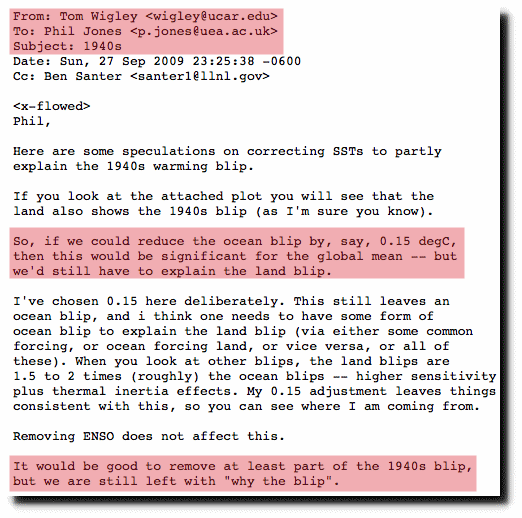
Fig. 4, Climategate email di2.nu/foia/1254108338.txt
Bob Irvine.
Discover more from Watts Up With That?
Subscribe to get the latest posts sent to your email.
O/T …the new MEI came out today, … https://www.esrl.noaa.gov/psd/enso/mei/
In his book 1984, George Orwell says: “He who controls the past, controls the future; and he who controls the present, controls the past.”
I go back to basic logic. If I have a very large data set with random errors in it, then I would expect that the errors would cancel each other out in producing an average. That’s one of the reasons for using averages, and why taking lots of measurement of something and averaging them gives you a better result. So if I try and adjust the errors, the average SHOULD NOT CHANGE, if the errors are random.
The average should only change if there are systemic errors that mean the data errors are more often in one direction than the other.
So if these are random errors, there is no point in undertaking this exercise. If they are systemic errors, you should show the problem. And if you find your error corrections of random errors are moving the average, then you know either you are biased or you have a systemic error.
Well put and I agree.
Mike
you can easily pick up the change when measuring and recording was physical observation as opposed to when it became automatic.
Australia: continuing record temperatures, continuing droughts – interrupted by truly exceptional extreme weather events such as recently in Queensland.
bush fires in Tasmania and a complete change to Tasmanian climate.
This is just an attempted distraction from a plainly obvious climate shift across Australia.
It is? I’d like to see this shift because it suggests to me you know what that shift is. Looks like Australian climate to me!
There is one thing, I know what the climate is like here. You have never lived here.
“This is just an attempted distraction from a plainly obvious …” data manipulation farce.
most of which seems to be occurring the in past which does indeed seem to experience ‘climate shift ‘ !
I live in Melbourne – the climate is currently cooling – in fact we have an early autumn after a dry cool summer – gee – get over it – the Queensland weather events were not exceptional – for Queensland – go read Nevil Shute – and that was in the 1950s
Oh noes it’s a climate shift across Australia and yet we have more issues with real problems that even in an election cycle no-one except a few Greenies and the leftist media cares. The only two parties that can form government in Labour and Liberal both have token climate action policies and the Green vote will make up around 10-11% if they are lucky.
Griff,
Stop lying.
“Half a century on from Tasmania’s worst natural disaster, what have we learned from Black Tuesday?
About Black Tuesday:
110 separate fires were burning in south-east Tasmania
It was 39 degrees Celsius
Throughout the day winds reached 110kph
Using today’s rating, the fire warning was “catastrophic”
On February 7, 1967, dozens of fires across south-east Tasmania developed into a firestorm, and within a few hours 64 people were dead, 900 injured, 7,000 homeless and tens of thousands of hectares burnt.
The spring of 1966 in Tasmania had brought with it heavy rainfall and “prolific vegetative growth” followed by “abnormally dry conditions”, according to a report from the committee tasked with investigating the fire and its causes.
The summer of 1966-67 was the driest since 1885″
“Who controls the past controls the future; who controls the present controls the past,” in George Orwell’s 1984?
A warning for some , ‘instructions’ for others .
Who needs global averages?
All you have to do is look at unmodified local and regional temperature charts and you will see that the 1930’s were just as warm as today. And this shows up on every continent and both hemispheres.
That’s all we need to know to understand that the Earth is not experiencing unprecedented warming which means the CAGW narrative is a fiction.
People in the 1930’s could read a thermometer. Massaging these figures with a computer just gives data manipulators the chance to change the historical record and make a new record that supports the CAGW fraud.
We have two sets of records: the unmodified temperature records, and the bastardized, computer verions of these records.
Let’s go with the Old School records. The new computer-manipulated records are not fit for the purpose.
This will have the added benefit of relieving us of having to hear how legitimate all these changes to the temperature record are.
“All you have to do is look at unmodified local and regional temperature charts and you will see that the 1930’s were just as warm as today. And this shows up on every continent and both hemispheres.”
You keep saying this, as though magically it will become true.
It wont …..
http://www.realclimate.org/images//GISS-adjustments.jpg
http://www-users.york.ac.uk/~kdc3/papers/homogenization2015/temps_by_adj.png
According to Tony Hellers work, the 1930’s were indeed warmer for the continental USA. If you disagree, please go and correct him on his blog.
What BS that GISS is. Where do they magically find the ocean temperatures going back in time? As Phil Jones said “we made it up”.
As an observant old Aussie scientist, I can claim to observe only two signs from climate change in the last 50 years.
1. We have breed, collected overseas and exhibited species of the flowering genus Camellia. Fifty years ago, it was less common so see the abundance of large, dark green leaves that we see today ceteris paribus.
2. The formerly-mentioned Sherrington teeth hypothesis indicates enlargement and whitening of human teeth, specially front, top teeth, of those now aged 30 or under. Geoff
Tom,
Sadly, I am finding more indications that some quality control and adjustments were made by supervisors after the original observers inked in their numbers. Not hard to find the occasional cross out with new number. Also, there are maybe too many cases where several Australian stations show sharp daily data break points on the last couple of days of the calendar year – try Dec 1956 for Charleville, Longreach, Gayndah, Bourketown, Normanton, Bourke, Cobar. I use first differences of daily Tmax raw data. But this might be weather, hard to tell. Also, the formal Cwth Year Books and CSIR reports of the 1950s have temperature summaries so different to raw that some form of early adjustment to one or the other is a logical first explanation.
So, treat raw with a sceptical eye until the above oddities are explained. Geoff
https://documentcloud.adobe.com/link/track?uri=urn:aaid:scds:US:42f86fb5-bd3a-4bce-a1d2-2e33fe3fa66b
ja, ja.
You got it all wrong: it is globally cooling.
At least that is what I found in 2015
Tom Abbott
“All you have to do is look at unmodified local and regional temperature charts and you will see that the 1930’s were just as warm as today. And this shows up on every continent and both hemispheres.”
“We have two sets of records: the unmodified temperature records, and the bastardized, computer versions of these records.”
This is not correct. And as the head posts talks about Australia, here is the top 30 list of a descending sort of the daily temperatures for Australia
ASN00076077 MILDURA POST OFFICE 1906 1 7 50.7
ASN00017043 OODNADATTA AIRPORT 1960 1 2 50.7
ASN00005008 MARDIE 1998 2 19 50.5
ASN00017043 OODNADATTA AIRPORT 1960 1 3 50.3
ASN00076077 MILDURA POST OFFICE 1906 1 6 50.1
ASN00078077 WARRACKNABEAL MUSEUM 2018 1 19 50.0
ASN00011008 MUNDRABILLA STATION 1979 1 3 49.8
ASN00011004 FORREST AERO 1979 1 13 49.8
ASN00006072 EMU CREEK STATION 1998 2 21 49.8
ASN00048013 BOURKE POST OFFICE 1903 1 4 49.7
ASN00048013 BOURKE POST OFFICE 1878 1 13 49.7
ASN00074128 DENILIQUIN (WILKINSON ST) 1878 1 12 49.6
ASN00017123 MOOMBA AIRPORT 2013 1 12 49.6
ASN00038002 BIRDSVILLE POLICE STATION 1972 12 24 49.5
ASN00018201 PORT AUGUSTA AERO 2019 1 24 49.5
ASN00076077 MILDURA POST OFFICE 1906 1 24 49.4
ASN00076077 MILDURA POST OFFICE 1904 12 31 49.4
ASN00074128 DENILIQUIN (WILKINSON ST) 1863 1 5 49.4
ASN00018103 WHYALLA (NORRIE) 1960 1 2 49.4
ASN00017031 MARREE COMPARISON 1960 1 2 49.4
ASN00011016 MADURA STATION 1971 1 7 49.4
ASN00006072 EMU CREEK STATION 1998 2 16 49.4
ASN00004035 ROEBOURNE 2011 12 21 49.4
ASN00018044 KYANCUTTA 1939 1 9 49.3
ASN00017123 MOOMBA AIRPORT 2014 1 2 49.3
ASN00004106 MARBLE BAR 2018 12 27 49.3
ASN00052026 WALGETT COUNCIL DEPOT 1903 1 3 49.2
ASN00048013 BOURKE POST OFFICE 1878 1 19 49.2
ASN00018044 KYANCUTTA 2019 1 24 49.2
ASN00017043 OODNADATTA AIRPORT 1960 1 1 49.2
Anybody can find this data in the GHCN daily dataset:
ftp://ftp.ncdc.noaa.gov/pub/data/ghcn/daily/
but it is not quite easy to process :-(.
As you can see, Tom Abbott, there is no visible predominance of the 1930’s in this top30: 1939 occurs at position 24, and the next appearances of any year of that decade are at positions 68, 153, 154, 194 and so on.
Conversely, years after 1999 appear 7 times in the list (and 45 times within the top 100).
This is raw, raw data. No adjustments were made, only suppressions due for example to incorrect handling of Fahrenheit temperature measurements in the USA (and in very early Australian records) which were silently transmitted as Celsius. You can detect them through sudden bumps in the daily data (unless you are at -40).
No: I’m not a warmist.
I like to keep a correct look at data sets.
Hi Bindidon!
Remember me from discussions over at Roy’s before X-MAS?
Here is where I am at with the project.
Plan is to do the same for all major countries starting with US, Australia, UK and Germany
http://cfys.nu/videos/Overview.avi
Hi MrZ
Of course I do… I’ll look at your video as soon as I have time to do.
Actually I’m working on sea levels…
Regards
J.-P. D.
This is why many of us claim the Earth is already cooling. Australia isn’t the only place where the raw data of the early 20th century data is magically cooled to fit the politically correct trend.
I feel sorry for our Canadian friends. They need the world to warm by a few deg C in order to enjoy the magnificent outdoors they own. Cabin fever beyond the few months summer months when the snow has finally melted can be a real problem.
Now the world is in a cooling phase, as evidenced by all un-adjusted monitoring stations, the natural cyclical warming that has taken place over the past 35 years will be reversed and Canada will have even shorter summers. Roll on 2055 when the next warming cycle should come along….if we are lucky.
There’s this idea that scientists are on a quest to find truth. Well, it’s true. They are. But when their academic status and prestige become dependent on their publicly stated position being right, then they work to defend their position.
Is anyone on the alarmist side is criticizing Tom Wigley and Phil Jones for trying to fit the data to their theory rather than the other way around? If they believe that the data is unreliable enough such that impactful adjustments are justified, then the data is unreliable enough that spending trillions of dollars is not justified,no matter what the conclusions.
Looking at data from more than 50 years ago and comparing it with data from now is like comparing apples with pears.
for the following reasons, i.e how they worked 50 years ago:
1) the accuracy of the thermometer was at best 0.5 degrees but probably worse than that at many stations.
2) physical observation, a few times a day (what happened if someone got sick?), versus continuous automatic observation now
3) physical writing/ reporting of results, a few times a day, versus continuous recording by a computer now,
4) mercury thermometers were not re-calibrated every year, as they should have been as per current protocol, versus thermo couples that are calibrated every year. The error due to this is in fact quite substantial.
There is something else that is wrong with all current data sets, namely they are biased towards the NH and nobody thought of establishing a good balance between Nh and Sh.
If everyone did it right, taking into account a few basic principles in the sampling of weather stations they all should in fact get the same result as I got, at least for the past 45 years…
https://wattsupwiththat.com/2019/04/02/darwin-temperatures-what-is-going-on/#comment-2671568
Yes, but the True Believers will counter with: “but we have SO much data that over time, all these small discrepancies will be evened out…”
There are numerous charities concerning illiteracy. Very many public services concerning reading. Libraries. Etc.
Serious question: has anyone every even heard of such resources being put into learning MATH?
As I keep saying, people are almost proud of innumeracy (in the old days, it was “hehe, I can’t even balance a checkbook” – do they still have those). They would never admit to being illiterate. Although “being dyslexic” is as overused as “on the autism spectrum” is now…
Cal
If they did it right they would find it is globally cooling. And it is quit simple really.
Click on my name to read my report.
Much of the historic data and some of the current data in this area is of the type ‘better than nothing ‘ and that is before we get to magic tree rings and other proxies which are ‘a little better than nothing ‘
Its one of the reason that today despite of the amount of computing power they throw at the tasks , they still get weather forecasts wrong on a regular basis .
If you where consider what the experimental design would look like, to take these measurements in a scientifically valid manner, and then compare that to what is actual done , just how big a gap would there be?
Bob Irvine
“Darwin Australia is one of only two temperature stations in an entire NASA grid and, therefore, has a disproportionate influence on the NASA-GISS global temperature reconstruction.”
Sorry, your attitude is not quite correct.
Simply because you underestimate the major role of the grid mechanism, which is to attenuate unduly dominance of those corners in the Globe where stations are historically overrepresented: the USA, and to a somewhat lesser extent, Europe and Japan.
When gridding, you move from a situation where 18000 US stations compete with 18000 stations outside of the US and therefore 6 % of land surface are represented by 50% of the stations, to a situation where 200 US grids compete with 2000 grids outside of it. The same holds of course when looking at other overrepresented places.
But even locally, this has the advantage that in a grid, even a station or two in Darwin will be better represented in that grid than if they had to compete with all Australian stations and the grid interpolations all around.
The difference in the US is visible: look at two graphs showing the averaged daily maxima per station per year in the CONUS,
– without gridding
https://drive.google.com/file/d/1qGV5LfKw_lFKNdZMlq15ZHz6sA1CA294/view
and
– with gridding
https://drive.google.com/file/d/16XwogXkjltMuSzCdC5mPKqC1KNev4ayy/view
Bindidon,
Please watch the video when you have time. It is about gridding and other things. Dealing with official data.
so by your own charts, gridding is making the results warmer and actual data shows cooling. Gridding is the same as guessing. 1 station cannot represent 1/2000 of the earth in an equation. There is often a 10-15 degree difference from one side of my town to the other. Do you propose that the high for the town for that day is the average between the 2 spots? or do you keep the warmer temperature produced inland just a few miles? Its all guesswork , infilling and very unscientific. Gridding is garbage. 1 station = 1 station and the records shall remain untouched. but that’s not how warmunist operate. when historical records are adjusted to fit a theory its fraud.
The fantastic notion that poorly coherent records from stations considerably more than 1000 km apart can be used effectively to “homogenize” any data series is a staggering example of analytic nonsense. It’s even more egregious than calling the time-series of discrepancies shown in Figure 4.1 a “scatter plot.” Who can take such sorry incompetence seriously?
henryp
I read your comments above.
1. “You got it all wrong: it is globally cooling.”
From your personal standpoint, using no more than a few dozens of arbitrarily chosen stations: no wonder!
But… there are quite a lot more of them on Earth.
GHCN daily for example has nearly 36000. Even if we would take out all located in the US, there would still remain 18000 outside of that country.
2. “There is something else that is wrong with all current data sets, namely they are biased towards the NH and nobody thought of establishing a good balance between Nh and Sh”
No: it is not wrong. You are measuring land temperatures, and that NH has more of them than the SH doesn’t play any role because the SH has an enormous sea surface overhead.
If you wanted to equilibrate NH and SH at land level, you then would have to do the same job for SST: this is nonsense.
Here is a graph showing, for all available stations, TMAX and TMIN temperature anomalies wrt the mean of the reference period 1981-2010:
https://drive.google.com/file/d/1ESDd0LROc53jvSm1rZFhjkaQqif7tZ5R/view
Trends as usual in °C / decade.
1. 1895-2018
— tmax 0.06 ± 0.003
— tmin 0.11 ± 0.003
2.1980-2018
— tmax 0.30 ± 0.01
— tmin 0.20 ± 0.01
3. 1990-2018
— tmax 0.26 ± 0.01
— tmin 0.20 ± 0.01
4. 2000-2018
— tmax 0.32 ± 0.02
— tmin 0.22 ± 0.03
What we see here is what many bloggers and commenters have explained ad nauseam: the long term trends for minima are higher than that for maxima. This is even more visible when looking at absolute value plots: the minima plots often cross the maxima plots in recent periods.
*
I have nothing against a moderate global cooling: excessive global warming clould lead in a more or less near future to considerable temperature drops where I live.
But.. as opposed to yours, the data I present here does not show cooling at all.
What about using many many more samples, henryp?
What about the fact that we are not warmer now than the 1930’s?
http://notrickszone.com/2018/03/23/uncertainty-mounts-global-temperature-data-presentation-flat-wrong-new-danish-findings-show/
Who would ever trust in what appears on one of the web’s most tricky pages?
You?
But coming back to your question without the underlying polemic concerning Pierre Gosselin, I can only say you:
– look at hte worldwide maxima in the chart above, there are peaks in the 1930’s but the 1920’s were warmer;
– what you expected to see you will rather find when you look at the yearly maxima averages in the US. Then you see 1934 and 1936 at the top, if I well remember.
Bob Irvine
Below the plot you pasted from Dr Mahorasy’s February guest post, I read:
“Mean maximum annual temperatures as measured at the Darwin Post Office (014016) and airport (014015) shown with the new remodeled ACORN-SAT Version 2, which is the new official record for Australia.”
Would it be possible to obtain links to the ACORN-SAT data (V1 and V2) for the two Darwin stations?
I did not see any link to such data, and would like to compare it with the raw GHCN daily data:
https://drive.google.com/file/d/162erQtCxHaXR3FaPKZqSR5mMSL1ceh_P/view
Thanks in advance.
Ooops!
I suppose the data might be in
http://lab.environment.data.gov.au/dumps/release/observations.zip
Bureau Of Mendacity up to its usual tricks. They seem to me to have a compulsion to “homogenise” data from one weather station with data from another one hundreds of miles away in a very different climatic area. One that comes to mind was data from somewhere in the Victorian ski country being ‘homogenised’ by data from a hot, dry, area a few hundred kms away. Cold, wet area vs hot, dry area. That will work.
I’m also disturbed by their utter contempt for the early weather people that were dedicated to measuring the temperature accurately. Their thermometers might not have been able to read the temperature every millisecond to a millionth of a degree, but their readings are the most accurate raw data we have. Dismissing their data is a very ignorant act. Most scientists I’ve spent time with have a very strong respect for their forbears. Not the BoM.
dave the ‘realist’
A. The grid average data shows for the US, in comparison with the direct station average,
– a big decrease of maxima above 35 °C per station per year;
– a small increase above 40 °C.
You claim exactly about the inverse of what I have shown.
B. That worldwide an increase is shown that is not visible in a direct station average is evident: it is due to the fact that the direct average is entirely dominated by the 18000 US stations.
1. US without gridding
https://drive.google.com/file/d/1qGV5LfKw_lFKNdZMlq15ZHz6sA1CA294/view
2. Globe without gridding
https://drive.google.com/file/d/1GMuNs9ptRzDd7KxFQbKv0o5ySR5VNc9b/view
(1) and (2) look nearly identical, what is completely wrong. The Globe does NOT show like little 6 % of its land surfaces!
3. Globe without gridding, but without the US stations
https://drive.google.com/file/d/1UcLK3usYjICeHeAsAb5ivcusW0Y0EdNe/view
4. Globe with the US stations, but with gridding
https://drive.google.com/file/d/1TFdltVVFSyDLPM4ftZUCEl33GmjJnasT/view
Now you have a situation where 200 US grids are compared with 2000 Globe grids: that is 10 % instead of 50 %.
Is that SO DIFFICULT to understand, dave?
Maybe you should learn to read charts correctly, and to think a bit before writing agressive replies having nothing to do with what I wrote? Thanks in advance.
Bindidon says
But.. as opposed to yours, the data I present here does not show cooling at all.
https://drive.google.com/file/d/1ESDd0LROc53jvSm1rZFhjkaQqif7tZ5R/view
Henry says
You are [still] wrong because you are sampling the weather stations the wrong way….
you are also looking at results from the wrong time…you cannot compare apples with pears?
i.e.
https://wattsupwiththat.com/2019/04/02/darwin-temperatures-what-is-going-on/#comment-2671741
Now, I am willing to lead you in the right direction, but I m sure I have tried this before but you are not interested.
If you did it right you should get something like this.
https://documentcloud.adobe.com/link/track?uri=urn:aaid:scds:US:42f86fb5-bd3a-4bce-a1d2-2e33fe3fa66b
at least, that is what it looked like in 2015.
Why don’t you duplicate my results and let me know what it looks like now?
On a side note,
must say that your graph does not really prove man made global warming.
You tell me why?
henryp
“You are [still] wrong because you are sampling the weather stations the wrong way….”
Which wrong way?
*
“you are also looking at results from the wrong time…you cannot compare apples with pears?”
Which wrong time? I published above the trend for the same periods as you did:
2.1980-2018
— tmax 0.30 ± 0.01
— tmin 0.20 ± 0.01
3. 1990-2018
— tmax 0.26 ± 0.01
— tmin 0.20 ± 0.01
4. 2000-2018
— tmax 0.32 ± 0.02
— tmin 0.22 ± 0.03
Which apples and pears do you mean?
The only difference between us is that
– while you deliberately have picked a little set of stations (less than 100 worldwide!!!)
– I preferred to take more data, namely out of 9500 stations located in about 1800 grid cells of 2.5 degree each.
*
“On a side note, must say that your graph does not really prove man made global warming. ”
I never pretended that this graph would show man made warming.
You were the one who pretended the world to be cooling, and I contradicted your opinion because from my point of view it was based on a too small sampling set.
bindidon says
1) Which wrong way?
2) Which wrong time?
3) Which apples and pears do you mean?
Henry
1) the right way is [and I repeat]
a) equal stations nh and sh
b) all stations balanced to 0 latitude [or as close as possible]
c) all stations 70% at sea and 30% inland
d) to avoid bringing in longitude as a variable (why?) , rather look at the derivatives of the least square equations giving you the speed of warming/ cooling
e) setting out the speed of warming against time gives you the acceleration of warming/ cooling
if you did it right you should get the same result as I did?
2) not before 1970’s
3) https://wattsupwiththat.com/2019/04/02/darwin-temperatures-what-is-going-on/#comment-2671741
Good luck!
Let me know what you find?
BW
Henry
here is what you should find
as it stood in 2015
https://documentcloud.adobe.com/link/track?uri=urn:aaid:scds:US:42f86fb5-bd3a-4bce-a1d2-2e33fe3fa66b
Bob Irvine: A belated comment: Temperature change since about 1970 is critical. Temperature change before then is fairly irrelevant, because it wasn’t driven by forcing from rising GHGs. A good chunk of the warming from 1920-1945 is assumed to be unforced/internal variability. Net forcing gradually rises to about 0.7 W/m2 over almost a century by 1970 and the another 1.6 W/m2 over the next 40 years (and probably 2.0 by the end of the current decade). The CAGW is all about climate sensitivity – how much warming is being produced by how much forcing. That’s transient climate sensitivity. When ocean heat uptake is subtracted from forcing, you can get ECS.
Is the temperature in Darwin before 1950 going to make a big difference? Maybe. If the planet were 1.0 degC warmer (or cooler) sometime before 1970 than it was in 1970, then our ideas about the major drivers of climate change will need to include unforced variability as well as well as anthropogenic forcing. If the planet were 0.5 degC warmer (or cooler) sometime before 1970 than it was in 1970, then forced warming since 1970 could be anywhere between 0.4 and 1.4 degC, and not the 0.9 degC that goes into calculations of climate sensitivity.