How does the Sun drive climate change?
Guest Post by Javier
The dispute between scholars that favor a periodical interpretation of climate changes, mostly based on astronomical causes, and those that prefer non-periodical Earth-based explanations has a long tradition that can be traced to the catastrophism-uniformitarianism dispute and how the theory of ice ages (now termed glaciations) fitted in.
Prior to the scientific proposal of ice ages in 1834, most scholars that cared about the issue believed that the Earth had been progressively cooling from a hot start, as tropical fossils at high latitudes appeared to support. By 1860 scholars had been convinced by evidence that not one but several glaciations had taken place in the distant past. By then scientists trying to explain the cause of past glaciations were split in two. Those following Joseph Adhémar, who had already proposed orbital variations in 1842, and those following John Tyndall, who proposed that they were due to changes in GHGs (greenhouse gases) in 1859, particularly water vapor.
For a time, the anti-cyclical, pro-GHG camp had the advantage, after James Croll’s hypothesis was rejected, and Svante Arrhenius in 1894 proposed CO2 as the responsible GHG. But then, doubts about the CO2 effect and a new formulation of the cyclical astronomical hypothesis by Milankovitch appeared that fit popular geological reconstructions of past glaciations. This swung the field again.
By the late 1940’s Milankovitch theory was well established, particularly in Europe, but not so much in America where reconstruction of Laurentide ice-sheet changes did not match the theory very well. But in the 1950’s a new consensus formed. The GHG theory was reinforced by Suess, Revelle, and Keeling’s work, while carbon dating led to glacial reconstructions at odds with Milankovitch theory.
In the 1960’s and early 70’s Milankovitch theory was discredited with only a handful of followers left. The anti-cyclical, GHG explanation enjoyed wide consensus, but due to the cooling at the time, scholars believed other factors must be at play. Then disaster struck for the anti-cyclical camp. In 1976, Hays, Imbrie, and Shackleton, analyzing Indian Ocean benthic cores for the past 450,000 years and showed that glaciations followed some of Milankovitch frequencies within 5% error. A 140-year quest had ended, and the cyclical orbital supporters had won.
Of course, GHG supporters are bad players and did not accept the defeat graciously. Since it was soon discovered in ice cores that GHGs followed orbital changes (as they should), it was soon proposed (and accepted without evidence) that they were required to amplify the orbital changes and to maintain inter-hemispheric synchroneity. Trying to turn the defeat into a victory, they claim that the frequency is set by Milankovitch but a great deal of glacial-interglacial climate changes are due to GHG changes.
You would think that after showing that climate was cyclical and astronomically based, propositions that other astronomical phenomena (like lunar periodicities or solar variability periodicities), might affect climate would at least be given the benefit of doubt. But no. The anti-cyclical camp enjoys centennial beatings by the cyclical mavericks, so they are building up for the next one by flatly rejecting any significant climatic effect from periodical solar changes. Apparently, they are undeterred by the evidence showing most periods of low solar activity during the Holocene are associated with cooling and atmospheric circulation and precipitation changes, like the LIA. There are about 10 abrupt climate events (ACEs) associated with low solar activity during the Holocene. Some have names like the pre-boreal and boreal oscillations, or the 9.3 or 2.7 kyr events, showing that the most frequent cause for ACEs is prolonged low solar activity.
I have already shown some evidence for that in my previous articles:
Do-It-Yourself: The solar variability effect on climate
Do-It-Yourself: Solar variability effect on climate. Part II
I have also shown that ENSO is under solar control:
Solar minimum and ENSO prediction
Yet the anti-cyclical crowd (IPCC included) takes refuge in the bean-counting argument that solar variability is only 0.1% and therefore too small to produce much of a change. This only shows how narrowly focused their view of climate is. They think that Earth’s climate can be explained solely with terms of W/m2 and after all 0.1% is only 1.4 W/m2 over the 11-yr cycle (solar irradiation), adjusted to only 0.34 W/m2 annual average insolation change at top-of-the-atmosphere (TOA) at 1 AU. However, the Earth received the same TOA insolation during the Last Glacial Maximum as now, so climate is clearly not a case of bean-counting Watts.
Today I am going to show you how solar variability affects Earth’s rotation speed, and why it is important. This issue was raised several times in 2010, but it is not understood by most:
https://wattsupwiththat.com/2010/10/03/length-of-day-correlated-to-cosmic-rays-and-sunspots/
Changes in the rotation speed of the Earth are measured as variations in the length of day (ΔLOD) defined as the difference between the astronomically determined duration of the day and 86,400 Standard International (SI) seconds. ΔLOD has been measured daily down to a 20 microsecond (µs) precision by interferometry since 1962. Annual changes at 1 millisecond (ms) precision have been reconstructed for the telescope era from astronomical observations. Variations in ΔLOD on annual and seasonal (semi-annual) time scales are highly correlated with angular momentum fluctuations within the atmosphere, mainly due to changes in zonal winds. The averaged annual and semi-annual oscillations in ΔLOD feature almost equal amplitudes of approximately 0.36 ms.
The semi-annual oscillation in ΔLOD has the following characteristics:
From November to January the Earth accelerates to ~ 0.2 ms-day (ΔLOD changes by -0.2 ms). Then it decelerates by nearly the same amount by April. Afterwards it accelerates to ~ 1 ms-day by July (ΔLOD change of -1 ms), before decelerating back to the initial value by the next November. The average amplitude is ~ 0.35 ms, but the NH winter component is much smaller than the SH winter component (see figure 1, inset).
This change is caused by the angular momentum of the atmosphere being higher in winter because the meridional circulation is much stronger during that season. This is the result of the winter pole receiving very little insolation as the Sun is above the opposite hemisphere. The dark pole becomes colder and the latitudinal temperature gradient steeper, and as a result more heat needs to be transported poleward, activating the meridional circulation in that hemisphere. The asymmetry of the NH (Northern Hemisphere) winter and SH (Southern Hemisphere) winter components of ΔLOD is due to the asymmetry in land masses between hemispheres having a strong effect on wind circulation.
Le Mouël et al., 2010 showed that the semi-annual component of ΔLOD responds to solar variability. This is an extremely important result highlighted only by a few skeptics and ignored by everybody else. Part of the problem is that the article’s method to show it is quite complicated, and most people did not understand the article or its implications. Let’s try a simpler way.
Let’s concentrate only on the NH winter acceleration (ΔLOD decrease) that by being smaller, more clearly shows the effect. We start with LOD data from the International Earth Rotation and Reference System Service EOP C04 IAU2000A file:
https://datacenter.iers.org/data/latestVersion/224_EOP_C04_14.62-NOW.IAU2000A224.txt
This is a 20,700 data point file with daily ΔLOD values since 1962. It is converted to monthly values to work with only 680 points and eliminate all the oceanic and atmospheric tidal higher frequencies. The result is shown in figure 1.

Figure 1. Monthly ΔLOD. The inset shows two years of data with four semi-annual components. What I am going to measure every year is the acceleration (ΔLOD decrease) of the NH-winter component.
The NH winter trough in ΔLOD might take place in Dec-Jan-Feb (DJF), so for every year I select the lowest value among those three months, and then subtract from that value the highest value (ΔLOD fall peak) within the four prior months to the one selected. If there is no peak value in the 4 prior months this means there was no ΔLOD decrease the prior fall and I introduce a zero (it happened in 1983 and 1993, see figure 1). The result is a number for every year measuring the Earth’s acceleration from Oct-Nov to DJF in milliseconds, that varies between 0 and -0.9 ms.
As ΔLOD is affected by anything that affects the angular momentum of the atmosphere, like ENSO, the obtained NH winter acceleration yearly dataset is noisy, so we smooth it with a triangular filter (ΔLODsm[t] = 0.5*ΔLOD[t] + 0.25*ΔLOD[t-1] + 0.25*ΔLOD[t+1]). The result is then compared to solar activity, in this case monthly 10.7 cm flux smoothed with a gaussian filter. It is shown in figure 2.

Figure 2. NH winter ΔLOD vs. Solar activity
This is a simpler way to look at the dependence of the speed of rotation of the Earth on solar variability. Let’s remember that Le Mouël et al., 2010, and Paul Vaughan here at WUWT, showed that both semi-annual components respond to solar variability, and not only the NH winter one that I have shown. The agreement with solar data is even better using both components (see Le Mouël et al., 2010 or the WUWT links above).
Now we know how solar variability affects climate despite being only a 0.1% change in TSI. But before explaining that, let me explain why ΔLOD is so important for climate.
Changes in Earth’s rotation speed act as a climate integrator, reflecting changes in atmospheric circulation that then cause changes in temperature. ΔLOD is not known to be a cause for climate change, but a way of measuring it that responds in real time to changes in the angular momentum of the atmosphere. It is therefore a leading indicator of climate change. It is not known to respond to radiative changes and therefore to CO2, and thus it does not appear in the IPCC reports. I searched the WG1 AR5 report and could not find any mention of it. Yet, in 1976 Kurt Lambeck and Anny Cazenave reported that changes in ΔLOD for the past 150 years correlate well to a variety of climate indices, and they produced one of the few trend-change climate predictions that have proven accurate. They indicated that since ΔLOD had started accelerating in 1972 (see figure 1) the observed cooling trend was about to end. 1976 was the exact year when that happened.
Adriano Mazzarella in 2013, and Mazzarella and Scafetta in 2018 showed the good correlation between several climate indices and ΔLOD. In figure 3 I compare, as he did, yearly NH SST from HadSST3.1 and yearly ΔLOD (both linearly detrended for the period shown).

Figure 3. Detrended changes in Northern Hemisphere Sea Surface Temperature and detrended changes in Earth’s rotation speed (ΔLOD inverted).
On average changes in ΔLOD precede changes in SST by 4 years, indicating that atmospheric changes affecting ΔLOD are also responsible for cooling or warming the ocean surface.
So, how does the Sun affect ΔLOD? As figure 2 shows, when solar activity is high the winter NH acceleration does not take place, and when solar activity is low the winter NH acceleration is greater. So, the winter NH atmospheric circulation suffers more profound changes when solar activity is low. Low solar activity is also associated with a stronger activation of the winter meridional circulation that causes stronger meridional heat transport towards the poles and more frequent winter blocking. Further, low solar activity is associated with persistent winter negative NAO (North Atlantic Oscillation) conditions over high latitudes. The subpolar oceanic gyre then becomes weaker. A warmer North Atlantic current feeds more snow to Scandinavia (remember the great 2010 snowstorm that blanketed Great Britain and several other European countries), while weaker Westerlies result in a more southward winter storm track that dries Northern Europe and wets the Mediterranean.
During the LIA (Little Ice Age) the planet got stuck in this situation during years and decades of low solar activity. And every 200 years there was a Grand Solar Minimum that lasted for 80-150 years, so it got cooler and cooler and glaciers grew and grew, until solar activity returned to normal and there was a recovery. It was a slow cooling and it is a slow warming. Long-term solar activity has been growing to the late 20th century (figure 4). According to my calculations of solar periodicities, long-term solar activity should continue being high for at least another 100 years, but it won’t increase much more over the levels seen in the second half of the 20th-century. So, it should not significantly contribute to additional global warming.
Because of the land mass asymmetry between hemispheres, the atmospheric circulation changes caused by solar variability are proportionally smaller in the Southern Hemisphere. Although the effect is global it is stronger in the Northern Hemisphere, providing an explanation for the unexplained fact that climate change is more intense in that hemisphere. LIA effects were also stronger in the Northern Hemisphere, to the point of some suggesting it was a regional phenomenon. It is a feature of asymmetric solar variability effect on hemispheric atmospheric circulation, and the reason I selected NH-winter acceleration to show the effect.
Figure 4 shows how solar activity changed during the LIA and how it has been increasing since. Temperature has been trailing the recovery in solar activity with a delay. While solar activity started recovering after ~ 1700, temperature bottomed a second time in 1810-1840 and only started recovering after the cluster of large volcanic eruptions during the Dalton period (~1790-1840) ended. Temperature is affected by more things than just solar activity.

Figure 4. a) Solar activity reconstruction from 14C record (Muscheler et al., 2007), with a 2nd degree polynomial showing the long-term trend. b) Total solar irradiation reconstruction (Vieira et al., 2011) compared to Northern Hemisphere summer temperature reconstruction (Anchukaitis et al., 2017).
The planet’s climate is determined by the latitudinal temperature gradient, not the average global temperature. The poles are energy sinks to space (particularly in winter) and the efficiency of the poleward heat transport determines how much energy the planet retains, not the amount of CO2 in the atmosphere, which has a much smaller effect. We are studying the thickness of the glass in the windows, when it is the open door to the poles that matters regarding warming. The door has been closing, so the Earth has been warming, and solar variability is responsible, while CO2is just contributing. Zonal wind vertical strength is proportional to the latitudinal temperature gradient and inversely proportional to the Coriolis factor. Solar variability, despite being only 0.1%, shows a demonstrable capacity to affect the zonal/meridional wind balance during winters. There are several possible mechanisms, but a strong possibility is through stratospheric latitudinal temperature gradients due to winter ozone distribution and UV changes with solar variability. These gradients could affect tropospheric wind circulation through changes in geopotential height. Alternatively, the atmosphere is known to expand and contract with solar activity, but this effect is dominated by the rarefied outer atmosphere that has very little mass, and the atmospheric angular momentum changes that affect Earth’s rotation are dominated by the effect of tropospheric winds in the lower 30 km. It could be a combination of solar variability effects over the entire atmosphere acting in the same direction and affecting zonal wind circulation.
The importance of the latitudinal temperature gradient cannot be overstated. Christopher Scotese has been reconstructing the climate of the distant past by reconstructing changes in the latitudinal temperature gradient on a 10-million-year scale over the Phanerozoic. The main difference between a hothouse climate and an icehouse climate is in the gradient, and the average temperature of the planet is just the result of how much energy is moved through the gradient.
When this is sufficiently researched, once again the cyclical climate camp will have given a sound beating to the GHG crowd, let’s hope that this time is for good. And the TSI bean counters will discover that the climate of the planet is a lot more complex than they think and it is not only a matter of W/m2. Simple answers are satisfying, but rarely solve complex questions.
And if you want to know how climate change is going to evolve over the next 4 years, you only have to look at how ΔLOD is evolving now. You will know more about it than the IPCC, Gavin Schmidt, and all the consensus builders looking at their models based on an incorrect paradigm.
I leave for another day how the Moon produces some of the most abrupt cyclical climate change events of the past.
References
Hays, J. D., Imbrie, J. and Nicholas J. Shackleton. 1976. Variations in the Earth’s orbit: pacemaker of the ice ages. Science 194 (4270), 1121-1132. Link.
Le Mouël, J. L., Blanter, E., Shnirman, M., & Courtillot, V. (2010). Solar forcing of the semi‐annual variation of length‐of‐day. Geophysical Research Letters, 37(15). Link.
Na, S. H., Kwak, Y., Cho, J. H., Yoo, S. M., & Cho, S. (2013). Characteristics of perturbations in recent length of day and polar motion. Journal of Astronomy and Space Sciences, 30, 33-41. Link.
Lambeck, K., & Cazenave, A. (1976). Long term variations in the length of day and climatic change. Geophysical Journal of the Royal Astronomical Society, 46(3), 555-573. Link.
Mazzarella, A. (2013). Time-integrated North Atlantic Oscillation as a proxy for climatic change. Natural Science, 5(01), 149. Link.
Mazzarella, A., & Scafetta, N. (2018). The Little Ice Age was 1.0–1.5° C cooler than current warm period according to LOD and NAO. Climate Dynamics, 1-12. Link.
Muscheler, R., Joos, F., Beer, J., Müller, S. A., Vonmoos, M., & Snowball, I. (2007). Solar activity during the last 1000 yr inferred from radionuclide records. Quaternary Science Reviews, 26(1-2), 82-97. Link.
Anchukaitis, K. J., Wilson, R., Briffa, K. R., Büntgen, U., Cook, E. R., D’Arrigo, R., … & Hegerl, G. (2017). Last millennium Northern Hemisphere summer temperatures from tree rings: Part II, spatially resolved reconstructions. Quaternary Science Reviews, 163, 1-22. Link.
Vieira, L. E. A., Solanki, S. K., Krivova, N. A., & Usoskin, I. (2011). Evolution of the solar irradiance during the Holocene. Astronomy & Astrophysics, 531, A6. Link.
[Update, because of some rogue code that made it into this post, it may appear on your device that you can edit it. Just refresh to undo any edits you think you’ve made. No harm. No foul..~ctm]
Thanks Javier for another well researched informative article.
The intro about the history of competition between orbital forcing and ghg forcing is remarkable – Milankovich only accepted in the 70’s – 80’s. Reminds me of another east European scientist who never lived to see his theory vindicated – Boris Pavlovich Belousov. He is the discoverer of what became known only after his death (suicide) as the Belousov-Zhabotinsky reaction, a periodically self-reversing chemical oxidation reaction, also called the BZ oscillator. A system oscillating from internal chaotic-nonlinear dynamics. Only just learned of it? My point exactly. Belousov is still firmly shut out by the gatekeepers of the eternal sunshine of our spotless minds.
Sometimes in a fight between A and B, the winner ends up being C. Two colossal bulls fight to the death over a dame to the crooning voice of David Attenborough, while another scrawny adolescent male sneaks in and does the deed. Another good example is the English civil war. The houses of Lancaster and York devour hundreds of thousands of lives in their fight for the throne, which ends up in the hands of the house of Henry Tudor, a Frenchman. (The Brexit debacle will have a similar ending.)
Thus, in my view, neither ghg forcing nor purely astrophysical forcing are the main explanation of climate and climate change. It is internal chaotic-nonlinear oscillatory dynamics, sometimes with periodic forcing from orbital cycles such as the Croll-Milankovitch cycles pacing the glacial cycle. And on shorter time scales it has been shown that the annual cycle and the sunspot cycle can influence ENSO timing. Ulrich Lyons has also pointed to a solar signature of decadal oceanic cycles such as the AMO.
Talk of climate “forcing” means that you’re wrong before you’ve even started, that you’re in the wrong fight. The climate needs no forcing to change. Like a dame not needing too much persuasion (to return to that analogy hopefully without sexism!) Climate is only too willing to follow the cue of external influences such as solar and orbital. An internal energy and turbulence is always there under the surface, waiting to be entrained. Atmosphere and ocean are both excitable media. So is WUWT sometimes.
Tasfay,
While the Wars of the Roses could indeed be considered a civil rather than a dynastic war, the English Civil War generally refers to the crown vs Parliament conflict of the 17th century.
Henry VII wasn’t French, but he did lay low in Britanny for most of 14 years, aged ~14 to 28, during Yorkist rule.
Indeed the House of Tudor was Welsh, descended from Rhys ap Tewdwr (hence the surname).
The age old search for a sexy cause somewhere in the heavens. The mundaneness of intrinsic factors don’t titillate the senses. Yet any ear doctor knows that the first encountered pathology MUST be eliminated as a probable cause before anything sexier can be proposed.
None of the solar enthusiasts (and none of the CO2 enthusiasts either) have been able to reasonably dismiss Earth’s highly variable intrinsic factors as the primary cause of both short and long term climate change. Instead they sail right over due diligence to hawk some tiny little pea under the mattress as the MOST powerful, logical catalyst for why we have climate change.
For people who hate the CO2 meme (that proposes a teeny tiny change in parts per million as the driver of Earth’s, EARTH’S climate change), it never fails to impress me that solar enthusiasts make EXACTLY the same mistake made by the opposite CO2 crowd.
Sometimes the smartest man in the room is a woman!
Except that tiny changes in insolation do make a huge difference in Earth’s climate system. The tilt (obliquity) of our planet’s axis of rotation gives us not only seasons but ice sheet advances and retreats, combined with other such Milankovitch cycles.
Earth’s obliquity ranges only from 22.2 to 24.5 degrees, in a cycle that lasts approximately 41,000 years. This small change makes the difference between Canada’s being covered in two miles of ice, or being mostly ice-free. We’re currently at about 23.5 degrees, thus past the midpoint of the cycle and headed toward another glaciation.
A couple of degrees a axis tilt bulks quite large relative to fractions of seconds in rotation period.
Unless I missed something, Javier’s post was relegated to climate changed induced by tiny delta’s in rotation speed.
Which is an intrinsic factor assigned to Earth’s wobbly orbit around the Sun and its tilted axis spin.
Quote “Earth’s obliquity ranges only from 22.2 to 24.5 degrees”. That applies only for the secular variations as of Stockwell and Newcomb; but they did not bother about the abrupt larger changes, and no one else did after them either. However the evidence says otherwise.
Changes to LOD are more likely from change in Iz – moment of inertia in ‘Z’ axis – , a twice yearly shift of water mass from equator to polar cap. A constancy of momentum rather than change. The ballerina effect.
a twice yearly shift of water mass from equator to polar cap
What facilitates such a shift, exactly?
moon?
Same thing that makes polar caps wax and wane seasonally. See https://en.wikipedia.org/wiki/Polar_ice_cap
Ice cap ice/water increase is at cost of ocean water. Centrifugal effect at pole is much smaller than the part removed from equator, so speeding up rotation, thus preserving angular momentum
Hi Pamela, did you ever build the trout rod we discussed some years back?
Pamela
Exactly – the central issue of the climate system is, is it passive, only changed by “forcing” from outside, or active, with strong internal dynamic (primarily ocean driven) able to change by itself. It is better to refer to outside influences not as “forcing” (implying dragging against inertia) but “entraining” or “pacing”.
Javier, many thanks for a great article.
LONG paragraphs…
Because people usually don’t bother to go to the article and read it. The quote gives a good overview of the ‘state of the art’.
You also pontificated with “It is the mark of bad science to postulate an effect that cannot be reliably measured.” Einstein theorized about the effects of relativity before they were measured
No, he didn’t. Both the Michelson-Morley experiment [for special relativity] and the perihelion advance of Mercury [for general relativity] were known long before Einstein.
My comment was [obviously] directed at the notion that the effect of solar activity on earthquakes was already well-known and established. It is not.
Length of Day varies less than four milliseconds, runs the climate.
Of course it does.
OK…
I am kind of in agreement that the LOD change is not significant when it comes to the climate
You people need to stay within the bounds of plausibility, else we will all be mocked. Four milliseconds? Shall I point out what fraction of a day that is, OK, 24 x 60 x 60 x 1000, Buehler, Anyone, finish that off.
Let us not, ever again…
Moon
Rotation variation is 1 / 86.4 million. Atmospheric mass to total planet mass 1 / 1.2 million.
Rather fuzzy brain this morning, so I’m not going to attempt the exact calculation – but that does work out to a rather large percentage of the atmosphere being redistributed to cause that much change in the rotation. Although not nearly as large as a naive calculation would show anyway; it would have to take into account the shift in the other fluid components, water and magma. I hopefully will be able to follow up Javier’s links this weekend, if holiday tasks allow…
“after showing that climate was cyclical and astronomically”
I just love the absolute certainties that non scientists attach to theories. Chickens and eggs!
Any engineer knows if you redistribute mass on a rotating object you cause its rotation to change.
Did the rotation cause the ice or the ice cause the rotation change?
As a result of low solar activity and the increase of ionizing radiation in the stratosphere, there will still be an excess of ozone over eastern Siberia and the Bering Sea. Then ozone will flow to North America. The polar vortex will be divided into two parts, one of which will be over Canada.
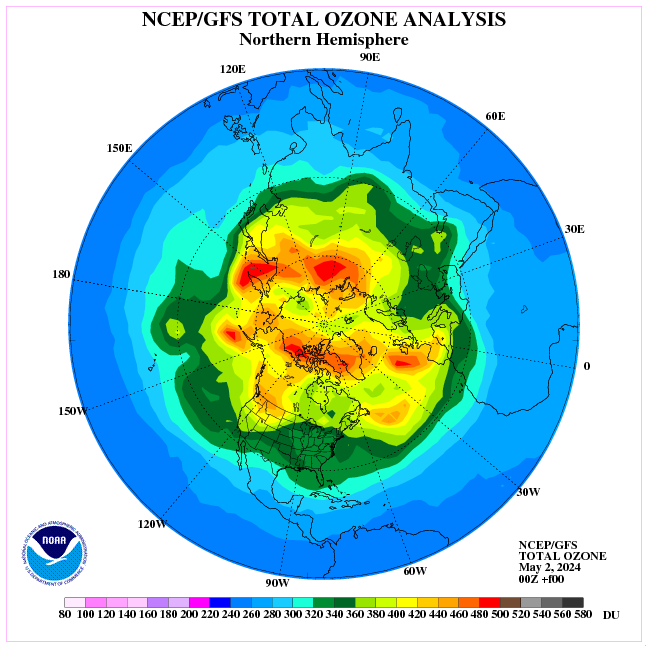
Forecast of the stratospheric polar vortex.
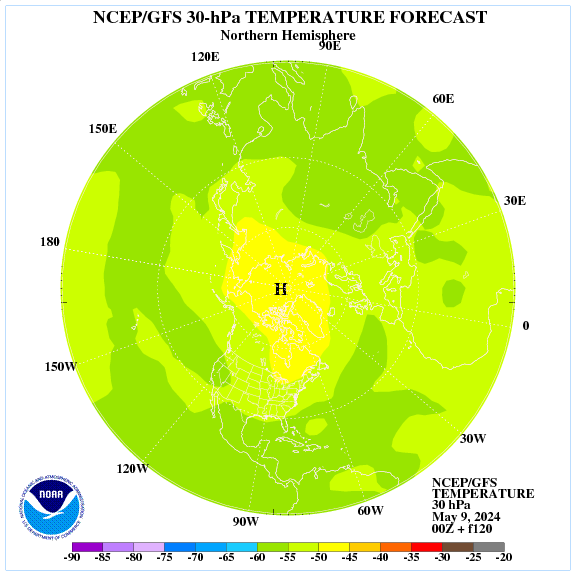
Model simulations cover the 2002-2010 period for which ionization rates from the AIMOS dataset and atmospheric composition observations from MIPAS are available. Results show that during geomagnetically active periods MEE significantly increase the amount of NOy and HOx in the polar winter mesosphere, in addition to other particles and sources, resulting in local ozone decreases of up to 35%. These changes are followed by an intensification of the polar night jet, as well as mesospheric warming and stratospheric cooling.
https://www.sciencedirect.com/science/article/pii/S1364682616301080
On the bright side, today is the day of the earliest sunset time. Starting tomorrow, sunset will be later each day. A sure sign that Spring is only 3 months away.
Wait, Tom; I thought that was at the solstice, around the 21st or 22nd of December?
Most people do but just check the charts. Most people also think that sunrise starts to come earlier the day after the solstice but it doesn’t. That comes later in January. However, the net gain in daylight minutes does start on the day after the solstice.
Specifically, which “charts” are you (Tom in Florida) are you using, and – more to the point of “changes in solar radiation received on the earth’s surface” which specific change are you referring to?
That is, the TOA solar radiation does reach a peak January 5 each year.
The rotational (23.45 axis tilt) length-of-day reaches a minimum December 21-22 each year – depending on Leap Year, time of the solstice, etc.
Are you using the “length of day” based on sunrise hour-minute-second change? If so, what part of the solar disk are using for sunrise and sunset? And, what air mass refraction definition are you working with for that level of accuracy?
Solar radiation on the earth’s surface starts with the assumed “TOA” value.
But total received energy from the sun is a function of latitude and day-of-year. All the rest are calculated FROM those two things. TOA radiation levels, length of exposure over the 24 hour “day”, angle of the sun above the horizon each minute of the day (and thus Air Mass), and thus attenuation through even a “perfect atmosphere”. Every surface’s albedo changes with one or more of these: solar elevation angle, with time-of-day, with day-of-year, and/or angle of the surface to the incoming rays.
The sun is 1/2 degree across (as is the moon of course), so changing the definition of “sunrise” or “sunset” matters when you could use “top of the disk goes below horizon” or “bottom of the disk touches the horizon” or “astronomical “middle of the refracted disk touches the horizon” – and all assume some perfect horizon with the observer, but seldom clarify at what height of eye is used.
This chart: https://www.timeanddate.com/sun/usa/sarasota
“Are you using the “length of day” based on sunrise hour-minute-second change?”
I didn’t say anything about length of day, I simply referred to the net change in daylight minutes, and that was from the chart.
You also said : “more to the point of “changes in solar radiation received on the earth’s surface” which specific change are you referring to?”
I didn’t refer to any solar radiation received in my comment. Where did you read that?
Then you go into some lengthy discourse on TOA peak radiation which has nothing to do with my comment. Then you go off into some cockeyed minutia about horizons and eye level. There is an official time of sunrise and sunset, it is as simple as that. If you want to complain about that go to the source and complain to them about how they calculate those times.
Yes, sunset here was about a minute or so later than only a few days ago. I have the exact times, but the horizon is ‘bumpy’.
I thought it might be a slight elevation in the land, but then I remembered about the earliest sunsets this many days before the solstice.
Correlations of global sea surface temperatures with the solar wind speed
‘Responses of sea-surface temperature to solar wind speed on
the seasonal timescale have been found, and in the North Atlantic
region in winter they resemble the North Atlantic Oscillation. At
the locations of the peak (negative) response in the North Atlantic
the SST decreases by approximately 1°C for 100 km s increase in solar wind speed.’
https://www.sciencedirect.com/science/article/pii/S1364682616300360
https://sci-hub.tw/10.1016/j.jastp.2016.02.010
Abstract
In this work we study links between low cloud anomalies (LCA) at middle latitudes of the Northern and Southern hemispheres and galactic cosmic ray (GCR) variations used as a proxy of solar variability on the decadal time scale. It was shown that these links are not direct, but realized through GCR/solar activity phenomena influence on the development of extratropical baric systems (cyclones and troughs) which form cloud field. The violation of a positive correlation between LCA and GCR intensity which was observed in the 1980s–1990s occurred simultaneously in the Northern and Southern hemispheres in the early 2000s and coincided with the sign reversal of GCR effects on troposphere circulation. It was suggested that a possible reason for the correlation reversal between cyclonic activity at middle latitudes and GCR fluxes is the change of the stratospheric polar vortex intensity which influences significantly the troposphere-stratosphere coupling. The evidences for a noticeable weakening of the polar vortices in the Arctic and Antarctic stratosphere in the early 2000s are provided. The results obtained suggest an important role of the polar vortex evolution as a reason for a temporal variability of solar activity effects on the lower atmosphere.
https://www.sciencedirect.com/science/article/pii/S1364682616300979
https://watchers.news/2015/06/09/cosmic-solar-radiation-as-the-cause-of-earthquakes-and-volcanic-eruptions/
In response to the very low solar activity a major explosive volcanic eruption or two will be taking place.
This is a very good article and it confirms that which I have long suspected, namely that climate change simply depends on the length of day/month/year…..and that this has not been constant over the history of earth, due to solar activity.
In any case: man made climate change does not exist , as a simple empirical experiment that I did will explain
(just click on my name to read my report on that).
I think I will bookmark this article in my report, is that OK?
I am pretty sure that looking at the variability of time is the right direction to look for any change in climate.
Perhaps a good summary of this post is:
Climate change is due to change in time.
….good slogan as well…
@ur momisugly Andy May
“The apparent LOD variability at the same rate or close to the
solar cycles, as inferred from
the geomagnetic or the astronomical
observations, is unlikely to be a coincidence.
Alternatives for a viable mechanism could
be:
1. it is caused by solar activity
a) directly or b) indirectly.
2. solar cycles and the LOD oscillations have
a common origin.
Direct solar effect
1a)
After considering known physical properties
of the solar periodic oscillations (TSI cyclical
variability and intensity of the heliospheric
magnetic field at the Earth’s orbit), initial
calculations could not conclusively
demonstrate the existence of the viable
forcing due to insufficient energy available.
Similarly for
case 2
the known facts related to the generation of the solar
cycles and the changes in the Earth’s
rotation, do not revel existence of a clear
common external driving mechanism.
1b. Indirect solar effect
At the current state of knowledge, the most
realistic alternative is the indirect solar effect,
whereby a possible mechanism could be
postulated along line:
Solar activity – ocean & atmospheric temperatures –
oceanic and atmospheric circulation – angular momentum exchange
– Earth’s rate of rotation (LOD).
https://hal.archives-ouvertes.fr/hal-01071375v2/document
M. A. Vukcevic, thanks. Very few comments address the point of the post. Yours is welcomed. Yes, the integrating effect of the change in LOD is important. As Javier points out, daily (or monthly or yearly) changes in incoming or outgoing radiation probably don’t matter much. But, mechanisms for accumulating small changes in radiation at critical latitudes matter.
Details about measuring TSI are far less important to climate than long term accumulators and processes.
But, mechanisms for accumulating small changes in radiation at critical latitudes matter.
No, because the Earth is radiating away what comes in. No accumulation of small changes. A large change will matter because of the local effect of a growing ice sheet.
Leif,
“No, because the Earth is radiating away what comes in.”
This is total BS. The major difference between the Earth and a blackbody is the Earth’s surface can store a great deal of thermal energy for a very long period of time (over a thousand years). The average ocean temperature varies a lot over the Earth’s history, now it is very low, about 4C. It has been much higher in the past and the heat capacity of the oceans is huge. Further energy is stored in the ice caps and having ice caps on both poles is rare in the Earth’s history.
Ultimately, the energy absorbed on the Earth’s surface is radiated away, but the amount of time it is stored (especially in the oceans) is important, further the length of time required for the oceans to change temperature (system inertia) is important. As Javier notes, you are oversimplifying a complex problem.
Finally, sorry, I’m still not convinced the data supports your assertions, you are clearly overstepping the available TSI data in my opinion. And, my assumptions about the curves on your plot were correct.
The major difference between the Earth and a blackbody is the Earth’s surface can store a great deal of thermal energy for a very long period of time
Which also means that it takes a very long period of time to change that thermal energy, meaning that any short time variation [e.g. solar cycles] is completely washed out. And the cause of glaciations is the local cooling effect of accumulated snow and ice on landmasses. The oceans and their heat capacity have nothing to do with that.
Finally, sorry, I’m still not convinced the data supports your assertions, you are clearly overstepping the available TSI data in my opinion. And, my assumptions about the curves on your plot were correct.
That you are not convinced just shows your lack of understanding and knowledge. Your assumptions about the plot were wrong: no ‘raw’ data were shown. The plot showed the repeatability to within 0.1 W/m2 of TSI measurements by two different instruments. The absolute combined long-term uncertainty is below 0.5 W/m2 for the whole space age:
https://leif.org/research/Uncertainty-TSI-png
The sure mark of an activist is that he is never wrong and claims always to be correct [ my assumptions about the curves on your plot were correct ], even in the face of evidence to the contrary.
although I doubt you would even care to look.
Hold on dr S, Andy is correct.
Earth radiates from the surface, not from dept of the oceans.
It is indisputable fact that global temperature contains what appears to be an AMO component. It is also indisputable fact that warm surface waters due to increased salinity continuosly down well north-west of Iceland and any energy reminder is stored for about thousand or more years in the return leg of the ‘global conwayer belt’ . Part of that energy warms up ocean depths slowly perchlorating to the surface and part upwells south of the Aleutian archipelago, where it may re-radiate back, but both process have a millenal time constant.
Velocity and consequently volume of oceanic transport are dependent on the initial surface temperature, therefore they are time variant.
On the other hand, direct atmospheric circulation is subject to much shorter time constant measured in months or perhaps a bit longer.
As stated further above the logical conclusion is:
“Solar activity – ocean & atmospheric temperatures –
oceanic and atmospheric circulation – angular momentum exchange
– Earth’s rate of rotation (LOD).”
(posted from mobile/cell phone hence possible spelling etc errors)
Earth radiates from the surface, not from dept of the oceans.
The Earth warms at the surface and radiates [cools] from the surface.
That is where the balance between incoming and outgoing energy takes place.
Small changes in the incoming lead to similar small changes in the outgoing flux.
The notion that small changes get stored instead of leading to similar small changes in the outgoing is false.
Leif: “The notion that small changes get stored instead of leading to similar small changes in the outgoing is false.”
WR: Oceans do store energy. Look at the development of deep ocean temperatures:
Source: https://royalsocietypublishing.org/doi/full/10.1098/rsta.2012.0294
The change in stored energy causes different periods of glaciation:
http://wattsupwiththat.files.wordpress.com/2017/08/081217_1723_coolingdeep5.png
From: https://wattsupwiththat.com/2017/08/13/cooling-deep-oceans-and-the-earths-general-background-temperature/
Perhaps the quantity of stored energy is very small, but [at least] over longer time periods it matters.
Oceans do store energy
Of course they do, but they don’t vary much on time scales of years, decades, or even centuries, precisely because of their large heat capacity.
Do your think that the variation your plots show are caused by solar activity?
Leif: “Do your think that the variation your plots show are caused by solar activity?”
WR: Interesting question.
I read about the increasing luminosity of the Sun: estimated at 1% rise in a hundred million years. Quite a bit of warming. Looking at the graphics above, this did not result in rising surface temperatures during the last 100 million years: on the contrary, surface temperatures (that followed deep ocean temperatures) went down. On the time scale of millions of years other systems than the Sun’s irradiance showed to be dominant.
The total H2O temperature stabilizing system keeps temperatures within limits around what I called the General Background Temperature (see link above). The colder, the wider the limits, as is shown for our cold Quaternary period.
The H2O cooling/warming system (warming for the part that is caused by absorption of radiation by water vapor) reacts on any (!) change in temperature. Whatever the reason.
The temperature variation in the plots shown are dominated (!) by other factors (plate tectonics and their consequences). But this does not exclude influences by changes in the Sun’s irradiation during those periods, nor influences on smaller time scales. Not knowing all mechanisms involved I follow (from some distance) the discussions.
For now, given the complexity of the Earth’s climate systems, a linear result for changes in the Sun’s irradiance is not easy to see, which however does not exclude influences. On a time scale of century’s, millennia and in case we will have fully reliable data for those and longer periods we will know more.
But the present search for mechanisms is interesting. We don’t know what we are going to find.
a linear result for changes in the Sun’s irradiance is not easy to see
When changes are small they are all linear. If they are not easy to see it simply means that they are not significant, otherwise we would see them.
The large changes are due to astronomical changes of Earth’s ‘orientation parameters’ coupled with favorable distributions of landmasses, and at times helped along by extremes of CO2. None of this is of any interest for the current debate [food fight] about contemporary forcings and ‘global warming’.
EXACTLY – it is the long term accumulators and processes which so many can not grasp.
Nice article Javier. I want to address Leif’s SORCE opinions.
I spoke with Greg Kopp yesterday here at the AGU meeting, and he informed me SORCE has had 200ppm degradation since 2003, about 13ppm/year, or 0.2653 W/m2 in 15 years. He said it is far and away lower than the same parameter of the other instruments, and he gave some numbers that I didn’t write down.
I told him the following:
In my work I did long-term correlations of SORCE to F10.7 for the time of the last minimum, and in order to do the type solar-climate forecasting with TSI that I do, I have to know how well TSI is doing now (since 2014 when I started), and one metric I’ve used for this is the daily % difference between the current F10.7cm-SORCE TSI correlation and the prior correlation they had together during the last minimum.
Since 2014 the correlation difference exceeded 20% a few times, 18% some, 15% quite a bit, then under 10%, but now it’s down to 5-8% regularly, which only a few months ago is what I told Leif it would do going into the minimum, that is get closer to it’s prior correlation, meaning the current data is not so bad as Leif implies.
The annual approx 13ppm degradation equates to about 0.018 W/m2/year. How would this affect my SST forecasting method? My HadSST3 factor is 0.5C/W/yr based on the annual TSI change. So the degradation in one year, let’s say 2016, the year for which in Dec 2015 I had predicted SST3 would cool from the SWPC predicted drop in solar activity using this method, would affect my forecast to the tune of 0.009C for the year.
The HadSST3 high-end uncertainty is 0.03C, so the effect of the SORCE TSI degradation for the year 2016 on the performance of my TSI-SST3 sensitivity factor was over three times less than the actual SST3 uncertainty, in other words, it really didn’t matter, it was insignificant.
I’ve evaluated all the TSI data. They all operate within a very narrow range in cross-correlation with F10.7.
Further, Greg Kopp announced in his presentation that all the players in the TSI field have come together, including the RMIB, to produce a new CDR TSI record that everyone agrees on. After I return home I’ll be replacing the PMOD section of my work with this new composite data.
RMIB has trended higher than it should relative to other solar indices, moreso than SORCE, whereas PMOD was trending below the last solar minimum, so those two are out of the question. I have a nice graphic to show that but it’s on my other computer.
I talked to Bob Leamon and Scott McIntosh here, and earlier this year at the LASP Sun-Climate symposium. At the symposium I told Bob I had discovered the same thing they did in 2014, what I call a ‘cycle onset El Nino’, depicted in this graphic I made for my poster:
It’s getting late here in DC, and I have sessions to attend and posters to judge tomorrow before leaving, so I’ll wait to say more until Sat or Sunday.
Bob Weber:
However, what I have never seen corrected is the theoretical IPCC corrections need in their models for the reported TSI changes between 1988 and today.
Thus, everything the IPCC-CAGW models predict are based strictly on the radiation models they use.
In 1988, everybody “knew” TSI = 1372 watt/m^2. And the IPCC-Hansen CAGW models predicted +3 watts/m^2 based on a doubling of CO2, using a theoretical top of atmosphere radiation level of 1372 watts/m^2.
In 2005, the measured TSI was lowered (due to reported calibration errors in the sensors) to 1367 watts/m^2. And the IPCC-Hansen CAGW models predicted +3 watts/m^2 based on a doubling of CO2, using a theoretical top of atmosphere radiation level of 1367 watts/m^2.
In 2010, the measured TSI was reduced again to its latest value of 1362 watts/m^2 by the solar community. And the IPCC-Hansen CAGW models predicted +3 watts/m^2 based on a doubling of CO2, using a theoretical top of atmosphere radiation level of 1362 watts/m^2.
OK, fine. Their solar measurement business, not mine.
If the actual radiation emitted from the sun has not changed, which is what Lief has claimed has happened, then the value used in the computers for CAGW prediction MUST change as well, right? But the earth’s physical systems have NOT changed during the interval (except CO2 levels) so the predicted end result of increasing CO2 MUST change as well, right? That is, if their calculations were correct in 1988 for 1372 watts/^2, then using today’s radiation input of 1362 watts/M^2 , those same calculations MUST show a loss of energy of 10 watts/m^2 in received radiation for the next 80 years, and a resulting cooling effect over the next 100 years of 7 watts/M^2.
But the REPORTED TSI has been lowered 10 watts/m^2 – three times the calculated total influence of man’s release of CO2 – and three times the reported theoretical influence of CO2 has been “kept” at 3 watts/m^2 per doubling by the IPCC. Which tells me that their computer calculations have NOTHING to do with the actual radiation received from the sun, but only what they want reported out due to CO2 changing.
those same calculations MUST show a loss of energy of 10 watts/m^2 in received radiation for the next 80 years, and a resulting cooling effect over the next 100 years of 7 watts/M^2.
The cooling effect of 7 [or 10] W/m2 is about a third of a degree, but since we deal with anomalies that would be invisible as the base level would change by the same amount.
I spoke with Greg Kopp yesterday here at the AGU meeting, and he informed me SORCE has had 200ppm degradation since 2003, about 13ppm/year, or 0.2653 W/m2 in 15 years
The problem with SORCE is not that they have had too much degradation. In fact SORCE, measures MORE than expected [from RMIB and the SATIRE model and F10.7], so they have overcorrected for degradation.
The principal investigator [Tom Woods] agree with me. Here is an email exchange about this:
Leif Svalgaard
Sat, Apr 28, 6:36 AM
to Tom
Hi Tom,
I read with interest your newest paper on SSI, TSI trends and want to draw attention to my earlier analysis, that I presented at HAO:
http://www.leif.org/research/EUV-F107-and-TSI-CDR-HAO.pdf
I found a 22 ppm uncorrected trend.
============
Tom Woods
Sat, Apr 28, 11:41 AM
to leif@leif.org
Hi Leif,
Indeed – now there are 3 analyses that have found similar trend for the SORCE TSI record.
Greg Kopp may not update SORCE TIM data product though, at least not until there is more overlap with the new TSIS-1 TIM observations.
Tom Woods
===============
The consensus TSI have been promised for a couple of years now, but nothing has been released [as far as I know]. Greg is pussyfooting around the issue.
Further, Greg Kopp announced in his presentation that all the players in the TSI field have come together, including the RMIB, to produce a new CDR TSI record that everyone agrees on


A preliminary version may be found on Greg’s website https://spot.colorado.edu/~koppg/TSI/#TSI_data_record
Unfortunately it only goes up through 2015. Hopefully the final version will be up-to-date.
Anyway, the preliminary version goes a long way to resolve the calibration problem. I have for several years been telling Kopp that SORCE had a calibration problem [see e.g. Slide 61 of https://leif.org/research/EUV-F107-and-TSI-CDR-HAO.pdf ]. The ratio between the published SORCE TSI and the new preliminary version clearly shows that the original data is drifting upwards [i.e. overcorrected for degradation]:
The drift being of the order of 0.02 W/m^2 per year.
If I overplot the preliminary corrected values the fit to F10.7 and the sunspot number improves a lot [although 2015 still is anomalous (see slide 6 of https://leif.org/research/New-Group-Number-and-TSI.pdf )).
It is, of course, somewhat painful to admit that there was a problem, so Greg’s reluctance to come clean is understandable. Let us hope that the final consensus dataset will be out shortly. And let us hope that it is not extended back in time using the outdated Group Sunspot Number as time-varying ‘background’.
‘I leave for another day how the Moon produces some of the most abrupt cyclical climate change events of the past.’
I cannot wait for that!! Hope it will be soon?
Amazing is it not? It is the sun, the moon and most probably all the planets that are the cause of climate change….
Philip Mulholland says:
The direction of flow rule for the northern hemisphere is that if you stand with your back to the cold airmass, then the jet stream above you will be flowing from right to left. While this typically means an eastward airflow aloft, it is also possible, particularly in late winter, to have a westward flowing Arctic jet.
Henry says
Interesting choice of words. It was the same choice of words that Joseph used, but he went predicting the coming of the [dry] eastern wind
{click on my name to read my report]
indeed, by my calculations, drought time coming up, every 87 years, i.e. just about now, possibly starting 2019.
similar to dust bowl drought (1932-1939)
Henry
I always prefer to use toward because it unambiguously defines a direction of motion.
Hence a westward current flows towards the west.
By contrast a westerly wind is a wind coming from the west. The opportunities for confusion arising from using what is essentially a naval convention, useful for the time of sailing ships, means that I prefer to state the down-flow direction, hence my use of the ward suffix.
Philip
I am sure your choice of words is correct.
I was merely thinking about Joseph who was quite specific in his prediction that the change of direction of wind to the east that would bring [too] much heat and dryness.
Obviously there was no major ‘miracle’ in the story of Joseph because of the specifics. Most probably, the prison was on the Nile and Joseph was also in charge of observing the height of the Nile, whilst at the same time someone in the same office was also looking at the direction of the wind. Somehow, Joseph must have had access to these records and when he heard the dream of the Pharao he just put 2 and 2 together?
Remember that from our deliberations here about natural climate change all of us should be able to predict what will happen in the near future?
Can you?
If yes, what are your predictions?
@Leif
I like the science that has been posed here, namely that ‘climate change’ is due to change in time.
That would fit in with most theories, would it not? I mean you and I know there is no man made climate change. (click on my name to read my report on that).
But now how to explain that the sea water level here was at one stage 30 meters higher than what it is today? Can you give me a simple answer to that question?
Another question that I would like to ask you/anyone: as the sun burns up [for a million years or more] and as the earth cools down [for a million years or more] would you not naturally expect a variation of the time of the [earth] year, compared to the time of the [earth] year we have at the moment> due to the change in gravity??
Let me have your thoughts on that idea.
Great exploratory article Javier. I agree with your thesis that: “the efficiency of the poleward heat transport determines how much energy the planet retains, not the amount of CO2 in the atmosphere, which has a much smaller effect. ”
I did a search on the words ‘poleward heat transport’. Looks like all the commentators, with the exception of Macca, failed to appreciate the importance of this fundamental proposition.
The atmosphere rotates in the same direction as the earth but, at the winter pole it rotates much faster, atmospheric drag acting to speed up the rotation of the Earth so reducing the length of day.
You confirm this point when you write: From November to January the Earth accelerates to ~ 0.2 ms-day (ΔLOD changes by -0.2 ms). Then it decelerates by nearly the same amount by April. Afterwards it accelerates to ~ 1 ms-day by July (ΔLOD change of -1 ms), before decelerating back to the initial value by the next November. The average amplitude is ~ 0.35 ms, but the NH winter component is much smaller than the SH winter component (see figure 1, inset).From November to January the Earth accelerates to ~ 0.2 ms-day (ΔLOD changes by -0.2 ms). Then it decelerates by nearly the same amount by April. Afterwards it accelerates to ~ 1 ms-day by July (ΔLOD change of -1 ms), before decelerating back to the initial value by the next November. The average amplitude is ~ 0.35 ms, but the NH winter component is much smaller than the SH winter component (see figure 1, inset).
However, I think the motive force is electromagnetic in nature rather than being driven by ‘a need to transport heat’ as you suggest.
It has long been known that there is a correlation between the aa index of geomagnetic activity and the ‘Arctic Oscillation’, a measure of the differential in atmospheric pressure that determines whether the warm westerlies or the cold polar easterlies prevail in the mid latitudes.
What we experience as the ‘temperature of the day’ is the temperature of the air on that day. It simply depends on where the air comes from.
All this concern and irrelevant chatter about ‘total solar irradiance’ is a complete waste of time. There are more influential forces at work. People who insist on introducing irrelevancies should get short shrift. The word ‘malevolent’ springs to mind.
Phillip Mulholland’s contributions are apt.
Incidentally, notice the dominance of the southern hemisphere in determining LOD. The ocean is dominant in mid to high latitudes. The only landmass, Antarctica is located at the pole where air pressure reaches a global peak in mid-winter. On the margins of Antarctica atmospheric pressure is always at a resounding planetary low. The zone of low surface pressure surrounding the Antarctic continent expands markedly in winter and begins to affect mid and low latitudes where cold conditions tend to persist until November at which time the Arctic circulation kicks in with a vengeance.
The oscillations of the planetary winds that determine the rate and extent of heat transfer from warm to cold places is the essence of weather and climate. Climate studies have to start by appreciating this reality and endeavouring to explain the changes that occur on short and long-time scales. It’s the electromagnetic environment of the Earth in space that needs to be appreciated.
If one wants to understand the forces at work look at the southern hemisphere. All that land in the northern hemisphere complicates the issue. The highest surface pressures occur not in the Arctic but in Siberia.
Sorry, but I didn’t make the time to read all the comments.
This oceanography paper posted at Judith Curry’s site assesses the cause recent variation of North Atlantic Ocean circulation:
https://agupubs.onlinelibrary.wiley.com/doi/abs/10.1029/2018GL080474
Their study comes down on the side of internal variability, not external forcing.
All internal variation is due to external forces.
Salvatore says
All internal variation is due to external forces.
HENRY SAYS
funny thing that happened to me today:
A storm was brewing and I decided to have a quick swim before the rain…
…lying on my back as I looked up in the clouds I saw a fuzzy figure similar to that of God..
Amazing, is it not, to think that all good things ultimately depend on the weather!
May God bless you all!
https://breadonthewater.co.za/2017/02/20/if-god-exists-why-cannot-we-see-him/