
Guest essay by Eric Worrall
According to NASA, the increased rate of thickening of sea ice in the Arctic is due to Global Warming.
Wintertime Arctic Sea Ice Growth Slows Long-term Decline: NASA
Dec. 7, 2018
New NASA research has found that increases in the rate at which Arctic sea ice grows in the winter may have partially slowed down the decline of the Arctic sea ice cover.
As temperatures in the Arctic have warmed at double the pace of the rest of the planet, the expanse of frozen seawater that blankets the Arctic Ocean and neighboring seas has shrunk and thinned over the past three decades. The end-of-summer Arctic sea ice extent has almost halved since the early 1980s. A recent NASA study found that since 1958, the Arctic sea ice cover has lost on average around two-thirds of its thickness and now 70 percent of the sea ice cap is made of seasonal ice, or ice that forms and melts within a single year.
But at the same time that sea ice is vanishing quicker than it has ever been observed in the satellite record, it is also thickening at a faster rate during winter. This increase in growth rate might last for decades, a new study accepted for publication in Geophysical Research Letters found.
This does not mean that the ice cover is recovering, though. Just delaying its demise.
“This increase in the amount of sea ice growing in winter doesn’t overcome the large increase in melting we’ve observed in recent decades,” said Alek Petty, a sea ice scientist at NASA’s Goddard Space Flight Center in Greenbelt, Maryland, and lead author of the study. “Overall, thickness is decreasing. Arctic sea ice is still very much in decline across all seasons and is projected to continue its decline over the coming decades. ”
…
It seems counterintuitive: how does a weakening ice cover manage to grow at a faster rate during the winter than it did when the Arctic was colder and the ice was thicker and stronger?
“Our findings highlight some resilience of the Arctic sea ice cover,” Petty said. “If we didn’t have this negative feedback, the ice would be declining even faster than it currently is. Unfortunately, the positive feedback loop of summer ice melt and increased solar absorption associated with summer ice melting still appears to be dominant and continue to drive overall sea ice declines.”
…
The abstract of the study;
Warm Arctic, Increased Winter Sea Ice Growth?
Alek A. Petty Marika M. Holland David A. Bailey Nathan T. Kurtz
First published: 04 October 2018We explore current variability and future projections of winter Arctic sea ice thickness and growth using data from climate models and satellite observations. Winter ice thickness in the Community Earth System Model’s Large Ensemble compares well against thickness estimates from the Pan‐Arctic Ice Ocean Modeling and Assimilation System and CryoSat‐2, despite some significant regional differences—for example, a high thickness bias in Community Earth System Model’s Large Ensemble in the western Arctic. Differences across the available CryoSat‐2 thickness products hinder more robust validation efforts. We assess the importance of the negative conductive feedback of sea ice growth (thinner ice grows faster) by regressing October atmosphere/ice/ocean conditions against winter ice growth. Our regressions demonstrate the importance of a strong negative conductive feedback process in our current climate, which increases winter growth for thinner initial ice, but indicate that later in the 21st century this negative feedback is overwhelmed by variations in the fall atmosphere/ocean state.
Read more: https://agupubs.onlinelibrary.wiley.com/doi/10.1029/2018GL079223
I guess we should count ourselves lucky the world isn’t currently in a cooling phase, otherwise we might lose the Arctic icepack altogether.
In honour of the impending “Winterval” Festival, we should celebrate with some music
What’s that Magic Molecule doing now? Thickening ice?…. Is there no end to the devious deeds that CO2 can do?
And up is down, left is right, white is black… Whatever happened to real science?
The most simple Logic continues to be missing from NASA
This increase in the amount of sea ice growing in winter doesn’t overcome the large increase in melting we’ve observed in recent decades,”
“Arctic sea ice is still very much in decline across all seasons and is projected to continue its decline over the coming decades. ”
There is a logical explanation for this. “If the sea ice layer floating over the ocean thins, the upper ocean is less insulated from the very cold Arctic winter atmosphere. That lowers ocean temperatures and builds more ice from below.”
Last paragraph, Oldbrew’s article on the same study, Tallbloke’s blog, with link to Jonathan Griffin’s piece on it.
Indeed. And as the ice gets thicker the insulation gets better and less ice builds below. This is the reason the Arctic ocean doesn’t freeze right to the bottom.
So if the ice becomes thicker it can be because:
1. The Arctic winter atmosphere has become colder and/or less cloudy
2. The Arctic Ocean beneath the ice has become colder
3. The insulation has become less effective (=less snow on the ice)
1. Is almost certainly not true, so it will presumably be 2. or 3., or a combination.
This is not true. In winter the temperature in the Arctic depends strongly on the condition and pattern of stratospheric polar vortex.
http://ds.data.jma.go.jp/tcc/tcc/products/clisys/STRAT/gif/zu_nh.gif
Stratospheric Intrusions are when stratospheric air dynamically decends into the troposphere and may reach the surface, bringing with it high concentrations of ozone which may be harmful to some people. Stratospheric Intrusions are identified by very low tropopause heights, low heights of the 2 potential vorticity unit (PVU) surface, very low relative and specific humidity concentrations, and high concentrations of ozone.
https://www.cpc.ncep.noaa.gov/products/stratosphere/strat_int/
I rather fail to see the connection to the posts above.
Ren: “This is not true.” What’s not true?
The distribution of ice thickness in the Arctic is highly uneven.
http://polarportal.dk/fileadmin/polarportal/sea/CICE_map_thick_LA_EN_20181211.png
Indeed. The multi-year ice is much thicker. However I recommend using the only site that gives actual measured thickness, not modeled:
http://www.cpom.ucl.ac.uk/csopr/seaice.html
Below you can see how in winter the temperature in the stratosphere affects the temperature in the troposphere.
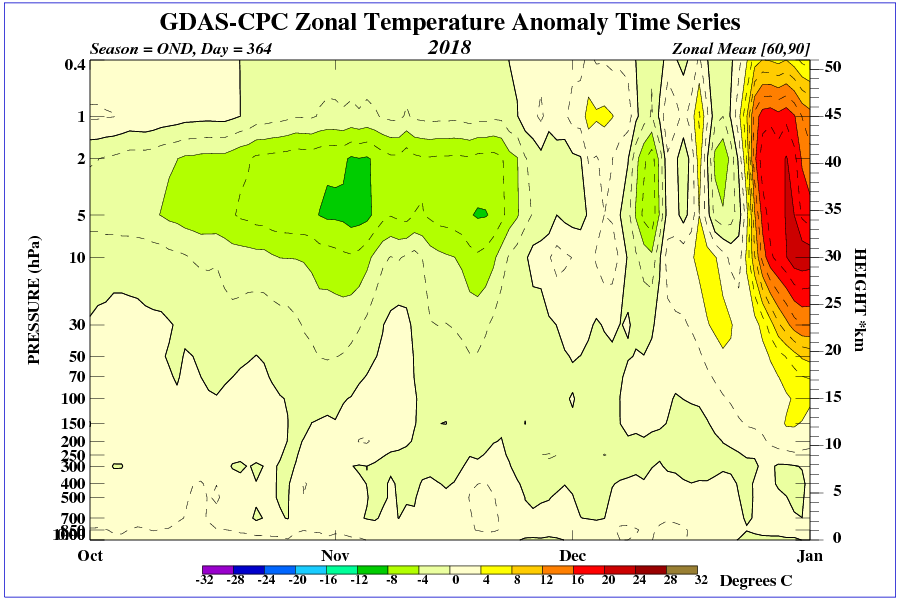
More likely 2 and 3 as you say, tty, plus, significantly, for the long term, probably less melting during the summer “melt” phase, when the air and/or ocean are cooler, which fosters increasing depth over time. . .
“If we didn’t have this negative feedback, the ice would be declining even faster than it currently is. Unfortunately, the positive feedback loop of summer ice melt and increased solar absorption associated with summer ice melting still appears to be dominant and continue to drive overall sea ice declines.”
Yet the years since 2007 with less sea ice extent in September have a stronger rebound by the following March.
All of this just proves that man has no clue about what is going on. The planet has balancing that man cannot comprehend and does not understand. The true science is so far beyond our imagination……
It is truly astounding to see buffoonery raised to an art form, and yet, here we are.
Warmistas reach new heights of stupidity with every word and utterance.
It is a wonder to behold.
As temperatures in the Arctic have warmed at double the pace of the rest of the planet,…
And how did that happen since fossil fuel use there is not high and fossil fuel causes this warming beyond question to the extent that the name denier otherwise only used in association with Nazi extremism is justified according to the BBC. Since the region is bounded very clearly it cannot be heat flow from the fossil fuel using Europe and America.
Are the UN leaders really dense as they even put up the map of temperature anomalies in the Mail article on the subject as proof we need to be taxed into abject fuel poverty or are they knowingly defrauding us?
The title of every NASA news release should be: “This may sound counterintuitive”