
Guest essay by Eric Worrall
According to NASA, the increased rate of thickening of sea ice in the Arctic is due to Global Warming.
Wintertime Arctic Sea Ice Growth Slows Long-term Decline: NASA
Dec. 7, 2018
New NASA research has found that increases in the rate at which Arctic sea ice grows in the winter may have partially slowed down the decline of the Arctic sea ice cover.
As temperatures in the Arctic have warmed at double the pace of the rest of the planet, the expanse of frozen seawater that blankets the Arctic Ocean and neighboring seas has shrunk and thinned over the past three decades. The end-of-summer Arctic sea ice extent has almost halved since the early 1980s. A recent NASA study found that since 1958, the Arctic sea ice cover has lost on average around two-thirds of its thickness and now 70 percent of the sea ice cap is made of seasonal ice, or ice that forms and melts within a single year.
But at the same time that sea ice is vanishing quicker than it has ever been observed in the satellite record, it is also thickening at a faster rate during winter. This increase in growth rate might last for decades, a new study accepted for publication in Geophysical Research Letters found.
This does not mean that the ice cover is recovering, though. Just delaying its demise.
“This increase in the amount of sea ice growing in winter doesn’t overcome the large increase in melting we’ve observed in recent decades,” said Alek Petty, a sea ice scientist at NASA’s Goddard Space Flight Center in Greenbelt, Maryland, and lead author of the study. “Overall, thickness is decreasing. Arctic sea ice is still very much in decline across all seasons and is projected to continue its decline over the coming decades. ”
…
It seems counterintuitive: how does a weakening ice cover manage to grow at a faster rate during the winter than it did when the Arctic was colder and the ice was thicker and stronger?
“Our findings highlight some resilience of the Arctic sea ice cover,” Petty said. “If we didn’t have this negative feedback, the ice would be declining even faster than it currently is. Unfortunately, the positive feedback loop of summer ice melt and increased solar absorption associated with summer ice melting still appears to be dominant and continue to drive overall sea ice declines.”
…
The abstract of the study;
Warm Arctic, Increased Winter Sea Ice Growth?
Alek A. Petty Marika M. Holland David A. Bailey Nathan T. Kurtz
First published: 04 October 2018We explore current variability and future projections of winter Arctic sea ice thickness and growth using data from climate models and satellite observations. Winter ice thickness in the Community Earth System Model’s Large Ensemble compares well against thickness estimates from the Pan‐Arctic Ice Ocean Modeling and Assimilation System and CryoSat‐2, despite some significant regional differences—for example, a high thickness bias in Community Earth System Model’s Large Ensemble in the western Arctic. Differences across the available CryoSat‐2 thickness products hinder more robust validation efforts. We assess the importance of the negative conductive feedback of sea ice growth (thinner ice grows faster) by regressing October atmosphere/ice/ocean conditions against winter ice growth. Our regressions demonstrate the importance of a strong negative conductive feedback process in our current climate, which increases winter growth for thinner initial ice, but indicate that later in the 21st century this negative feedback is overwhelmed by variations in the fall atmosphere/ocean state.
Read more: https://agupubs.onlinelibrary.wiley.com/doi/10.1029/2018GL079223
I guess we should count ourselves lucky the world isn’t currently in a cooling phase, otherwise we might lose the Arctic icepack altogether.
NASA are truly unhinged. This once venerable organisation has devolved into a political puppet, a moronic marionette with not even a hint of its original values anywhere to be found. There is no saving this absolute DISGRACE of a pseudo-scientific organisation. Nothing they say any longer should be given credence, no matter how “seemingly” credible, because it has an agenda which is not in the interests of the wellbeing of humanity. The lie is not necessarily in the words but it is ALWAYS found in the motive.
When I hear these people speak about arctic sea ice loss there are things I never hear. No one ever says that the sea ice acts as insulation in the winter to keep heat loss from happening. They fixate only on the positive feedback of decreased ice coverage in the summer and never on the negative feedback in the fall. Even if the arctic became ice free in the summer it would still freeze over every winter. At least in this article they admit to the decreased ice coverage in fall and early winter being a negative feedback.
I am not sure who “these people” are that you are complaining about but they are clearly not the
authors of this paper. They state explicitly that “thinner ice grows faster than thicker ice due to its decreased insulation” not to mention the fact that the entire article is about understanding the
negative feedback that you claim is never mentioned.
“No one ever says that the sea ice acts as insulation in the winter to keep heat loss from happening.”
If there were less sea ICE in the winter, and more heat loss to space, that would be another negative feedback. Nature seems to have a few such feedbacks up its sleeve. Warmists should take a hint and start looking for such second-order effects.
Roger Knight, quoting Lowell
Well, I’ve been reading about Arctic Sea Ice since 2004, and did find two articles (papers) that did mention the “insulation” effect of Arctic sea ice. Out of some 320 paper that I’ve kept copies of the full article.
SO, technically, in the hundreds of thousands of words and on-line sources discussing “arctic amplification” and “sea ice feedback” and “arctic death spirals” you can find two items that use that phrase.
Yes, the Arctic sea ice anomaly DOES remain near-constant over the entire year: It is not significantly higher winter, spring maximum, summer melt season, September minimum nor fall freeze-up. Over the course of the entire year, more heat is lost from the newly exposed Arctic Ocean than is gained in the short April-August sunshine into the Arctic Ocean.
“Over the course of the entire year, more heat is lost from the newly exposed Arctic Ocean than is gained in the short April-August sunshine into the Arctic Ocean.”
Not true:
http://www.cgd.ucar.edu/staff/trenbert/trenberth.papers/2006JD008230.pdf
(See Fig 10).
During winter the Arctic loses 58 W/m^2 of heat.
During Summer it gains 105 W/m^2
Net +48 Wm/^2 absorbed over the year.
And as a consequence the less summer sea-ice the greater the net +ve heat flux.
(decreased albedo and insulation)
Obviously this increase in sea ice due to global warming is the same physics that explains why the USA and Canada and most of the Northern hemisphere are experiencing massive snow fall and very cold temperatures this year, on top of the extreme cold and snow fall of last winter. It is all due to that global warming effect. Makes you wonder what we would experience if the world was cooling down….?
I suddenly feel another researchy ‘CAGW literature referenced’ guest post gestating. Something along the lines of five or ten biggest AGW researchy yin/yang ‘contradictions’. This thread is one. Another easy cheap shot is AGW means UK children won’t know snow, then when there were record snows, AGW causes more snow. And so on. Perhaps a nice glass of bourbon will illuminate the other three or hopefully eight from a vast sea of already evident possibilities, ten being a nice round number of decimal digits both mathematically and handedly.
Will confer soon with CtM, as is a permutation on his overarching Texas sharpshooter theme.
Please do it, Rud
Interesting but pointless in that melting or freezing sea ice has no affect on sea levels.
Interesting theory. Surely it could be tested.
Does this mean the summer melting is due to Global Cooling?
“But at the same time that sea ice is vanishing quicker than it has ever been observed in the satellite record, it is also thickening at a faster rate during winter. ”
As the tailors of old might have said “mind the quality and feel the width”.
Is there any artic ice ?
I read, Artic will be ice free 2013.
The polar bear went extinct also. Any polar bear pictures you might see to the contrary of that have been photoshopped by Big Oil-paid interests.
Ah that big oil money…
Sales of ski-doo ad other snow-machines have collapsed.
Electric bikes are most appropriate to discover the breathtaking beauty Alaskan cactus varieties and their smokable by-products.
No,No,No it was ice free in 2008!
The official projection is after 2040
Obviously they are nuts . . but, it would seem to me that their opening premise is backwards, as it seems that it’s that the loss of summer sea ice extent has slowed down (last 12 yrs to ‘no trend’ at all) more so than it’s growth in the winter has increased.
Very droll, your last sentence in the article
Gee, negative feedback; how is that even possible?
Sorry to spoil the party, but what they say is pretty obvious. I already researched this issue here at WUWT over a year ago, before these guys sat down to write their article:
https://wattsupwiththat.com/2017/10/05/arctic-ice-natural-variability/
The point is that the lower the Arctic sea-ice extent in September the more the ice will grow over the winter. Essentially the more it melts the more it refreezes:
http://wattsupwiththat.files.wordpress.com/2017/10/100517_1140_arcticicena2.png
Melting is unpredictable, but refreezing is reactive and predictable, because it depends on the exposed surface.
This is just normal behavior in a planet dominated by negative feedbacks. Sea ice is the way the planet has to limit the heat loss of the polar oceans during icehouse periods like the present one. As sea ice recedes the planet will cool down more efficiently the extra heat it has gained and will reduce the rate of warming.
We are just seeing the planet adjusting to its changing conditions, auto-regulating according to physical principles mainly based on water molecule changes of state. So yes, global warming is causing less summer ice and faster and more extensive winter re-freezing. There are no tipping points.
I think that as there are so many climate scientists these days, the average climate scientist is dumber than it should. It is just too easy to become a climate scientist. Things that are this basic that even a scientist from a completely unrelated field like me can see so clearly should not be surprising to climate scientists, should not be the main point of a new article, and should not produce a press release. It casts a bad image on the field (if that is still possible at this point).
Yep pretty straight forward
Though unlike the article statement arctic sea ice has not changed at all in the last 10 years
They are saying that the increasing WARMING allows increasing FREEZING even as the increasing warming also allows increasing MELTING. But still, increasing COOLING will also allow increasing FREEZING, so that means that sea ice can thicken either way, which is just 100% malarkey…
In case I didn’t make myself clear (happens too often), sea ice acts as an insulator limiting the heat loss by the polar oceans during the 6-month long polar night. The less sea ice, the more energy the planet loses and the less it warms. When I say this to believers, they refuse to believe it even after providing bibliography. Arctic sea ice is there to protect us for as long as we are in an ice age. If we lose it, it is because we no longer need it.
Javier, Eric Worrall
7 months. Less Arctic sea ice means greater cooling 7 months of the year (from mid-August through mid-April). It is only those few weeks between mid-April and mid-August that enough sun penetrates the atmosphere at high enough solar elevation angles long enough each day that the newly-exposed Arctic Ocean absorbs more heat energy than it loses through increased convection, evaporation, conduction, and LW radiation losses. Further, increased heat losses from the “warm” open ocean water at 2-4 degrees C continue every day, every hour, every month around the clock.
Mid-summer, as you imply, the thermal losses from the open Arctic waters to the Arctic air are low, and the heat gains are much greater. But increased losses from open water are a year-round effect. Solar energy gains are very limited in time: By mid-September the difference in energy absorbed in open water and new sea ice are only a few watts/m^2. Total, over the entire day, only a few dozen watts. Mid-summer (May, June, July)? Several thousands watt-hours/m^2 .
But that heat gain only happens mid-summer. By 12 August at latitude 78 north, Dr Curry reported that overnight heat losses from melt ponds were enough to freeze overnight. So, total heat losses over 24 hours exceeded the solar energy gained in the 24 hours of daylight at 78 north latitude on 12 August. Plus the extra heat energy required to freeze at least 1 mm of water over that square meter!
You’re not spoiling the party Javier, and thank you for the link. I’m aware ice is a good insulator. What I’m mocking is that NASA are still making it up as they go, yet they regularly reassure us that what they are doing is “settled science”.
“You’re not spoiling the party Javier”
No, just the opposite, Javier is adding value to the discussion. And it is appreciated.
Well, you write, “So yes, global warming is causing less summer ice and faster and more extensive winter re-freezing.” Shouldn’t that read, ” So yes, arctic warming is causing less summer ice and faster and more extensive winter re-freezing.”
And yes, I agree,”There are no tipping points.”
Shelly, quoting Javier
Well, no.
Arctic sea ice anomalies are generally constant over the entire year. Spring melt difference, summer difference, fall and winter have remained near-constant over each year since measurements began. The anomaly has increased: Arctic sea ice was highest in 82-83-84, then lowered until its 2006-07-08-09-10-11-12-13-14-15-16-17-18 “minimum” … And, in fact, 2018 has generally been higher than many (not all!) of the recent twelve years, so Arctic sea ice may be starting its recovery from the minimum. (When nearly 1/3 of the recorded sea ice extents are the same, you really cannot claim “Arctic ice is declining!” can you? )
Hahahahahahaha!
As noted in Salby’s recent lecture in Hamburg:
“More snow… Less snow!”,
followed by a great clip from Richard Feynman:
“If the process of computing a consequence is indefinite,
then with a little skill any experimental result
can be made to look like an expected consequence.”
The best science taxpayer dollars can buy.
This division of NASA apparently isn’t involved with sending rockets to pre-determined targets in space. Their M.O. seems to be “Ready, shoot, aim.”
Only if they remember to “aim” using the same coordinate system as the rest of the satellite/rocket/orbital team.
“According to NASA, the increased rate of thickening of sea ice in the Arctic is due to Global Warming.”
Hahahahahahahahaha…………
Jones,
😀 🤣
It’s obvious really, I just watch the ice in my drink getting thicker and thicker as it melts! 😕 🤣
Cheers NASA, I enjoy your larks now please get back to space exploration and reality.
Ahaaa……. Is that why, when I run a really hot bath, it’s a block of ice when I go to get in?……
It’s all so clear to me now…
Ta…. 🙂
Well, maybe. A hot bath does lose heat faster to the room and walls and tub surroundings much faster than a cool bath, and a room temperature bath loses no heat at all to the rest of the room except evaporation losses. /and you thought you were being sarcastic!
Hmm….. rubs chin in a professorial manner…..
This reminds me: Is drinking coffee good for us or bad for us now? I can’t always remember where we are in the cycle.
Whatever the study says, it will be reversed in 4 years.
Breaking Alert!!
NASA falls off the deep end!!
This just in! NASA researchers coerce gullible models to allow absurd results!
NASA researchers should be investigated and stripped of grants, titles and advanced degrees. Any funds for misconducted or misreported research should be recovered.
Way back like the 1950 tes NASA was a highly respected US agency. Back then it was concerned with the exploration of Space.
So what is it doing commention on planet Earth, rather than all of the other plaanets, we do have many other agencies to do that.
How is it that Pres. TRUMP does not put a stop to this nondence ?
As for the .5 of one Celsius we are told to fear, when I wish to travel from the City of Hobart in Tasmanias far South, to the City of Cairns which is close to the Equater, should I ask the IPCC for permission to subject my body to such a massive change in the temperature which I will be subject too.
MJE
Actually you should be very careful about going up Mount Wellington, since the difference between Hobart and the top is almost a whole degree C.
Imagine the catastrophic effects if it became as hot there as e. g. in Fern Tree or Ridgway
“the difference between Hobart and the top is almost a whole degree C”
??? Currently, it is 11.4°C on the mountain; 18.3 in Hobart, by the sea. Mt Wellington top is 1271 m ASL.
Sorry, I fubbed a decimal point it should be about nine degrees C. One degree C only equals about 140 meters in altitude. Michael had better stay close to Hobart city center to avoid climate catastrophe since it is a hilly place.
Funny, I accidentally put an ice cube tray full of water in the oven on the ‘warm’ setting. An hour or so later when I realized my mistake I ran to the kitchen, opened the oven, and to my surprise if found that the water had frozen and I had a fresh batch of ice cubes.
Its just amazing what warming can do to water these days……
as a former research scientist I am sitting at my PC thinking, how the hell could anyone, let alone a scientist, write such lies.
I am astounded
Don’t we have Arctic sea ice extent for 1935?
No. It is possible to get a fairly good idea about ice conditions in the Atlantic sector and there are at least some data for Siberia, but Northern Canada is a blank.
There are probably some data in RCMP and Hudson Bay Company archives, but nobody has looked for it. For example, how many people are aware that Hudson Bay Company vessels actually traversed the complete Northwest passage in 1937?
“Don’t we have Arctic sea ice extent for 1935?”
There are many newspaper accounts of the state of the artic in the 1930’s. Serious melting was reported at the time.
It’s not true that we don’t have data before the 1950’s. We have plenty of datat available in newspaper accounts and records and they cover the entire world, more or less. We should search out this data more often and get some real perspective on the past with regard to the state of the climate at those times. Much more accurate than tree rings, I would say..
Here is the Hansen 1999 US surface temperature chart. I think the lows and highs of artic sea ice correspond with the lows and highs of this temperature chart.
Arctic ice grows depending on the pattern of the winter polar stratospheric vortex.
http://masie_web.apps.nsidc.org/pub/DATASETS/NOAA/G02186/latest/4km/masie_all_zoom_4km.png
When the polar vortex falls over the Hudson Bay, circulation over the North Atlantic causes the growth of water vapor over the Norwegian Sea.

Water vapor.
It has a cooling and warming effect depending on season.
Usually it is very dry above 80 deg N except during summer.
Oden was up there during Summer 2018 and noticed this with a remark: -At last we can observe a sunset-when returning to Svalbard.
Normal temperatures(green curve: http://ocean.dmi.dk/arctic/meant80n.php
The stratospheric polar vortex works in the troposphere in the winter only.
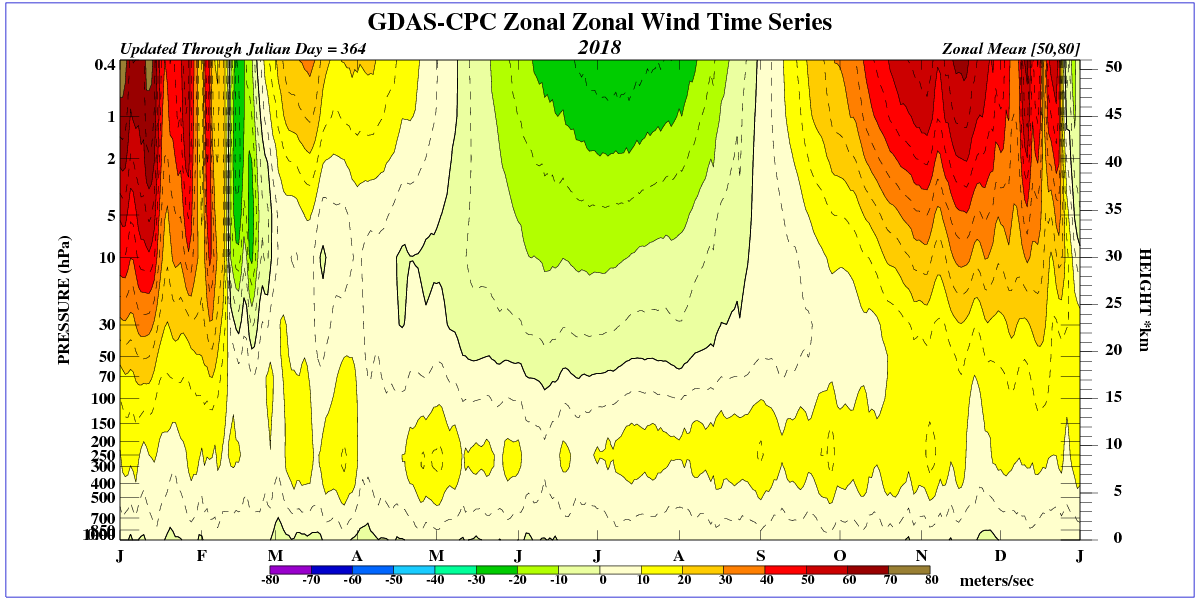
The proof of how important the polar vortex pattern is is the current temperature in the east of the US.

This was utterly foreseeable. Arctic (not Antarctic) sea-ice decreased from 1979 to 2007, but has been essentially flat for the last 11 years, and has started to increase slightly the last few years.
The same for the Greenland ice-cap, but glaciers react slowly so the flattening there didn’t happen until about 2012, but there too, the glaciers have now started readvancing:
http://www.polarportal.dk/en/news/2018-season-report/
It is getting impossible to conceal this much longer, so it is time for Plan B: “Warming causes cooling”. Forget all about arctic amplification, canaries in coal mines etc.
Meh, they just decided to throw doomsday several decades into the future, and scream about it louder than ever.
NOAA has not the same view:
https://www.sciencedaily.com/releases/2018/12/181211121107.htm
“This year’s report shows that the Arctic region experienced the second-warmest air temperatures ever recorded; the second-lowest overall sea-ice coverage..”
NOAA lives in another universe. The lowest sea-ice minimum was in 2012, the second lowest in 2007. I would guess “overall” means some kind of statistical shenanigan where 2018 somehow manages to come out low though neither maximum or minimum were exceptional.
And when it comes to Greenland I trust DMI a lot more than NOAA.