Guest Essay by Kip Hansen
 Science, as a whole, advances or fails to advance in large part in a direct relationship to the presence or absence of bias in its research efforts. There are many types of bias, and these have been discussed in the pages of various Climate Science blogs and publications over the years. [ see the short list at the end of the essay ].
One of the most common biases that skew research and slow or even stop the progress of science is Confirmation Bias:
“A distinguishing feature of scientific thinking is the search for falsifying as well as confirming evidence. However, many times in the history of science, scientists have resisted new discoveries by selectively interpreting or ignoring unfavorable data. Previous research has shown that the assessment of the quality of scientific studies seems to be particularly vulnerable to confirmation bias. It has been found several times that scientists rate studies that report findings consistent with their prior beliefs more favorably than studies reporting findings inconsistent with their previous beliefs.
Confirmation bias may thus be especially harmful to objective evaluations regarding nonconforming results since biased individuals may regard opposing evidence to be weak in principle and give little serious thought to revising their beliefs. Scientific innovators often meet with resistance from the scientific community, and research presenting controversial results frequently receives harsh peer review.” — Wiki
Confirmation Bias itself is a special form of apophenia: there are varying definitions, but generally: ”Apophenia (/æpoʊˈfiːniə/) is the tendency to mistakenly perceive connections and meaning between unrelated things.” And in more recent times “Apophenia has come to imply a universal human tendency to seek patterns in random information”. In the present instance, I will be looking at the concept: Scientific Apophenia.
The concept is discussed in some detail in the paper Scientific Apophenia in Strategic Management Research — Goldfarb & King (2013), leading with this explanation:
Scientific Apophenia: “The term apophenia has been used in clinical psychology to mean the “perception of connections and meaningfulness of unrelated phenomena.” In our context, we use it to define not a type of cognitive disorder but a potential dysfunction in the way scientists find meaning in data. We define “scientific apophenia” as the assigning of inferential meaning when limited statistical power should prevent such a conclusion or when the data are actually random.”
Not long ago, I wrote a two-part essay titled Why I Don’t Deny: Confessions of a Climate Skeptic — Part 1 and Part 2. After confessing that I accepted [almost] all of the proofs and evidence presented by the IPCC in support of the anthropogenic global warming hypothesis, I found that I still was left with this conclusion:
“I would … say that the evidence offered up by the IPCC, in their hundreds of pages of painstakingly reviewed and re-reviewed reports, does nothing more than present a case for the possibility that the hypothesis could be true. “
“The IPCC and the Climate Science community have, so far, failed to rule out the CO2 driven global warming hypothesis — nothing more.”
And thus, we find that we have a rather odd scientific situation surfacing in this month’s news about climate science: the IPCC has issued a new report which says “Governments around the world must take ‘rapid, far-reaching and unprecedented changes in all aspects of society’ to avoid disastrous levels of and global warming” and warns that we have only 12 years to massively change the way human populations power their societies. The general public reaction? “Ah, yes, well, thank you. We’ll take that under advisement. [stifled yawn]”.
What is the problem here? When the world realized that it had only ten years to fix a serious problem in much of the world’s software that ran in banks and stock exchanges and routed airplanes and almost everything, the Y2K problem, we buckled down, hired back a lot of retired and laid-off COBOL programmers and fixed the code.
Why aren’t the governments of nations calling out the National Guards to build millions of acres of solar-panel power stations, erecting millions of wind turbines, dismantling coal fired power plants, re-fitting abandoned hydropower stations, restricting the sale of gasoline-powered autos — all in a last ditch effort to save the planet and all of humanity?
I posit that it is because, as a whole, we don’t believe them. We don’t believe the IPCC as a body of experts, we don’t believe Climate Science as a purveyor of physical truth.
There are a lot of theories as to why “we don’t believe them”. My opinion is that the general public looks around and sees that things are as they always have been, as far as the weather and the climate are concerned. People in New Orleans know they got flooded badly by Hurricane Katrina, but haven’t forgotten their grandparents telling them about the biggest flood of them all, Great Mississippi Flood of 1927. Houston residents bemoan the floods caused by Hurricane Harvey, but know that they have built their homes on flood plains and are thankful that they were spared the destruction of the great Galveston Hurricane of 1900.
The Climate Scientists try to tell the people that their present day problems — hurricanes and floods, wild fires, heat waves — are caused by Anthropogenic Climate Change [caused by humans burning fossil fuels]. Why?
Because, this is how the Climate Scientists see it:
We’re scientists. We know the climate’s changing. And we know why.
Now, the question being debated is why the climate is changing. … Though there may be a public debate, there’s no debate among scientists like us — decades of research have demonstrated that human activities, primarily the emission of carbon dioxide from the combustion of fossil fuels, are driving the climate change we are experiencing.”
— Andrew Dessler and Daniel Cohan
Reading Dessler and Cohan’s article in the Houston Chronicle will not tell you anymore than is contained in the paragraph above — the “decades of research” they detail to support their conclusion is [with apologies for bluntness] scientifically infantile:
“If the Sun has been getting brighter, then that could explain the warming. The Sun, however, has an airtight alibi — we have direct measurements of the output of the Sun from satellites, and we observe that the Sun has not gotten any brighter. One suspect down.”
“Another possibility is the orbit of the Earth. We know that ice ages are paced by small wobbles in the Earth’s orbit, …Earth’s orbit changes too slowly and is now in a phase that should be slowly cooling temperatures. Another suspect down.”
“Volcanoes can cool the atmosphere for a year or two. But that can’t explain decades of warming. Another suspect down.”
“There is an entire list of suspects that scientists have looked at, and they have not identified a single viable one. With one exception — greenhouse gases.”
That’s it — that’s their scientific evidence for greenhouse gas driven warming. Two of the items proffered are cooling effects and would be unlikely to be causing warming. Dessler and Cohan casually dismiss hundreds of journal papers implicating the Sun in climate change and contradict the IPCC statement in AR4.
How is it that these two Climate Scientists see “proof” of Anthropogenic Global Warming and Climate Change in those simplistic statements? That is the question we’re looking at in this essay.
The “Experts” see AGW, the general public, however, just sees what is in front of them and what has gone on in the past.
Scientific Apophenia:
The Climate Scientists are looking for evidence that supports the AGW hypothesis — and because they are looking for it, they see it in everything.
It was the same for my Great-Aunt Mildred, who saw evidence of spiritualist phenomena in the daily events in her life — ghosts, haunting spirits, and friendly garden pixies. A vase falling off the mantel was proof positive of poltergeists (and not the fault of the minor earthquakes experienced nearly daily in southern California).
Both Great-Aunt Mildred and the Climate Scientists “mistakenly perceive connections and meaning between unrelated things.”
Let’s suppose for a moment that the AGW Hypothesis had never captured the minds of atmospheric and oceanographic scientists, meteorologists, and those studying the Earth’s various Koppen Climate regions.
These men and women, at a great gathering of the world’s geophysical scientists, attend a lecture on past and present climate and see a PowerPoint slide of generalized temperatures over the last 2,000 years. It might look like this:
 Image Source: See End Note.
Do you think that these brilliant minds would arise as one and shout for immediate and drastic changes to human society, demanding that energy production, civil and social organization and even economic systems must change immediately in order to prevent global disaster?
Would they see catastrophic anthropogenic global warming in that graphic?
Or would they see that the Northern Hemisphere, at least, is finally warming back up from an unusually cool period to a more comfortable and sustainable level for human society? — a temperature almost up to the idealized expected average surface temperature for an Earth-like planet, 15°C.
If they had not convinced themselves in advance that rising CO2 concentrations would cause run-away dangerous warming, would they see that danger in the chaotic climate data of today?
If today’s IPCC Climate Scientists were not looking for impending climate disaster, would they see it in any of the following climate metrics?


Honestly, I wouldn’t see existential climate change disaster in any of these, the most-commonly-used measures touted to illustrate what is characterized as a planet threatening problem.
The problem arises when Climate Scientists, who are predisposed to, and trained to, accept the CO2 Global Warming Hypothesis as fact, see all climate metrics through the lens of:

Rather than this:

This graph of geological-time CO2 Concentrations and Global Temperatures shows a non-linear (possibly chaotic) relationship that does not support the CO2-driven Global Warming Hypothesis.
The question then arises:
Is the whole field of IPCC Climate Science suffering from Scientific Apophenia?—is the field collectively “assigning … inferential meaning when limited statistical power should prevent such a conclusion or when the data are actually random.”
Clearly, the world is generally warming, apparently coming up out of the Little Ice Age that ended in the mid-1800s (possibly a bit earlier) and entering a generally (but not spatially universal) warmer phase, but it is only dangerously warming if one already believes it to be so.
Some climate measures are changing but they are only look to be dangerously changing if one already believes it to be so. (In fact, for mankind, many are actually getting better.)
The evidence, so far, simply does not support the inference that the Earth’s climate is changing dangerously. Only persons suffering from Scientific Apophenia see dangerous climate change in the chaotic, random patterns of long-term climate metrics.
# # # # #
Note: The first temperature graph is adopted from Mann et al. (2008). It is meant to be illustrative. It depicts a series of temperature reconstructions. IPCC projections of future temperature have been removed, along with y-axis degrees (as 0.1°C ticks are not appropriate for reconstructions). On the far right, UAH NH Lower Trop. (red trace) has been added as a proxy of present temperatures. The 15°C line (yellow) has been added for reference.
# # # # #
Some Links on Bias in Science:
Tackling human biases in science
Contradiction on emotional bias in the climate domain
Is federal funding biasing climate research?
Playing the Cognitive Game – The Climate Skeptic’s Guide to Cognitive Biases
Lewandowsky’s Competing Theories for Source of Bias in Scientific Research
On the Biases Caused by Omissions in the 2014 NOAA State of the Climate Report
The lure of incredible certitude
# # # # #
Author’s Comment Policy:
Yes, thanks for asking. I do believe that CliSci’s Scientific Apophenia is self-induced — through a Feynmanian self-delusion that necessitates fooling one’s self in order to be accepted in the field of Climate Science. There are many brave exceptions, and many more joining the ranks of Climate Science Pragmatists every day.
Nearly 15 years ago I told one of my children, then a brand-new parent of a lovely little baby girl, that we’d have to wait another 10 years or more to let science get done before we started worrying about global warming destroying the planet (which was their fear). The more time that passes, the less likely it is that dangerous climate change will take place during the next century.
Climates will surely change on a regional basis as they have always done. Florida, the Gulf Coast and the Caribbean will continue to have hurricanes; California and the American Southwest will experience droughts; and elsewhere major rivers will overflow their banks flooding foolishly located and under-protected modern cities. That’s the old normal and the new normal — nothing major has changed, just the details.
Let me see your opinions on “assigning … inferential meaning when limited statistical power should prevent such a conclusion or when the data are actually random.”
If you start your comment with “Kip…” I’ll know you expect a response.
# # # # #
“Apophenia?”
Had to look it up, still not sure it is a thing….
And still waiting to hear from Steven Mosher concerning the basic physics of the radiation which has caused the Greenhouse Effect to begin to do something it cannot do.
Any time now….
And still waiting for Mosher to reply to me about how LWIR from the surface does not get thermalised in less than 10 meters from the surface, despite “pressure broadening” and despite the “Shoulders” of the Physics of the radiation from the surface of the Earth.
I hope I am not the only one here who knows about this. Effect of CO2 close to the surface of the Earth has been saturated for millenia. Increasing CO2 can only raise the altitude at which the Atmosphere radiates freely to space, which lowers the temperature at which the atmosphere can radiate to space, increasing the amount of energy retained in the Atmosphere. Minor effect, incaluable, I tried, can someone else try?
Not the first time I have explained this. Someone does not follow???
We follow Michael. Just gave up trying to explain to you why you are wrong. That you try to make your case yet again on a thread about apophenia is… ironic.
” Increasing CO2 can only raise the altitude at which the Atmosphere radiates freely to space, which lowers the temperature at which the atmosphere can radiate to space, increasing the amount of energy retained in the Atmosphere. “
I know that this is the standard analysis, but, sorry, I don’t accept it as valid.
There is NOT one altitude at which the atmosphere radiates freely to space. This seems like some sort of fallacy of bad averaging. Even if there were an “average height of emission”, I am not convinced that more radiating gas would “raise” that “average height”. Rather, I think that more radiating gas would distribute within the entire volume of the atmosphere, hence it would distribute, theoretically, around the same center of mass of the atmosphere, at exactly the same height as before. Only difference would be that there would be more radiating gas (theoretically) above this “emission height” and more below it, as the atmosphere, as a whole, continued to radiate from all levels (in reality).
There would be a greater volume of radiating gas too, which would increase the overall volumetric mass of atmosphere radiating. Hence, I’m still not convinced that there is any warming effect whatsoever. Cooling maybe. Or sometimes warming, and sometimes cooling, maybe — I don’t know for sure. I just think that the reverse engineering of warming from a theoretical black-body calculation is a cheap sophistic trick.
Moon ==> If you wish to expound a unique personal theory and have the readers here discuss it, you should write an original essay, submit it via the
Submit A Story link, and then, if Anthony Watts publishes it, you will be free to discuss it with readers in comments.
Alternatively, find an Open Thread post, and try comments there.
Here it is Off Topic.
The reduction in mean free path and subsequent thermalization happens all the way up. Yes, it slows the CO2 radiative transport but in the end convection rules anyway. The tiny difference in retained heat might cause convection to start earlier in the day by 3 minutes. No big deal. The daily maximum temperature need not change at all. Can we measure it by satellite of any other method? No. The heat radiated from the earth is an integral of daily/hourly/minute temperature curves and cloud changes, over the entire globe. Within the models it has to be all paramaterized guesses.
This search for a CO2 warming effect in the most sensitive locations did not find it:
http://notrickszone.com/2018/03/23/uncertainty-mounts-global-temperature-data-presentation-flat-wrong-new-danish-findings-show/
… looks like the name of a Greek goddess, or maybe an ancient Egyptian princess. (^_^)
… which, by the way, seems somehow fitting, since climate “science” seems to be a form of mythology.
“There is an entire list of suspects that scientists have looked at, and they have not identified a single viable one. With one exception — greenhouse gases.”
Perhaps they need to start looking at multiple causal phenomena.;)
Also note they never mention oceans. They consistently ignore the most likely driver of climate change.
Richard M ==> Oceans have to receive energy from somewhere if they are to add it to the atmospheric climate system to produce warming. “Oceans” is not an answer to perceived recent warming — it is an element of the puzzle.
Thank you: apophenia is a wonderful concept that I realize I have observed many times in my own field, medicine eg the cholesterol hypothesis, dietetics, type two diabetes, usually fields attracting large sums of money, whereas those fields which don’t attract funding tend to stay humble and open to differences.
Interesting that you mention cholesterol. There is a wonderful example of how bad science becomes entrenched and enforced.
The crap about cholesterol and dietary fat are the results of one man’s work. Ancel Keys thought he noticed a correlation.
He and his henchmen ruined the careers of those who disagreed with his hypothesis. The parallels with climate science are pretty direct. The orthodoxy is enforced and the only scientists who can resist are in their late careers. For all the others, it is career suicide.
Ljh ==> How true — medical nutrition science is riff with apophenia — once the field starts collectively looking for “a link” between X and Y, it appears to be everywhere — until someone finally demonstrates with a double-blinded clinical trial that it was physiologically nonsense in the first place.
Thanks for your “true in another field” view point.
And I forgot to mention, again, that this altitude is less than 10 meters.
Moon,
I’d be interested in reading a detailed defense of your hypothesis — but not in this thread.
CO2 Apophenia, Global Warming Apophenia, Climate Change Apophenia, I like the sound of those phrases.
I went to the U of M, number 2 engineering school in the World, on an academic scholarship. ME, all classes except 2 or 3, were technical. Mechanical Engineering includes an involved study of heat, which generally requires money to generate, so, one would want someone who had studied it to be involved, sco, we DO.
And then, I got curious about this so-called Global Warming thing. So, as a technically trained individual, I looked it up, and evaluated AGW following my technical training.
“Climate Scientists” may have been Scientists as recently as the 70’s, when there were almost none. Since then, they just are not scientists. They are advocates, hoping to reduce if not destroy the use of anything mined from the Earth. They hate Mining! Pretty much all comes down to that. Oil, Gas, and Coal, how do we get them? They hate it, want the Earth to remain undisturbed, and could not care less what this does to prosperity.
Strange individuals…
Hey Mooney
I’ve been a Michigan resident since 1977.
The U of M does NOT automatically become the
“number 2 engineering school in the world”
just because you went there !
Why start off a comment
bragging about yourself like that?
You forgot to tell us whether
or not you graduated, and became
a professional engineer for many
decades — that would mean something !
Although the rest of what you wrote makes some sense
… that first sentence is self-serving, and NOT TRUE.
U of M is not even in the Top 5 of all US engineering schools,
although might be in a US Top 5 list or two, specifically for
mechanical, and manufacturing engineering.
Did you ever consider that money / grants / jobs available
determine what “climate scientists” believe in?
The cigarette companies paid scientists to prove that
smoking their product was safe, and got the junk science
they paid for.
We get the “climate junk science” that governments pay for.
“That’s it — that’s their scientific evidence for greenhouse gas driven warming.”
A bit of apophenia there. No, it’s not. Arrhenius showed in 1896 that putting a lot of CO2 in the air would cause warming. He calculated how much. There was argument for some years, but his argument carried the day. Then we did it. Then it warmed.
It isn’t just an argument from observation.
Wilfully ignoring the fact that he recanted a few years later and reckoned it was about half his original estimate. Still an estimate, mind.
Wilfully ignoring the fact that he reckoned any eventual warming would be quite beneficial (just like historical warming periods).
I know I said I wouldn’t bother reading your comments any more after your ludicrous comment yesterday, but I read this by mistake and this particular claim always gets my goat due to wilful ignorance aka plain lying. I’ll try not to in future.
“Wilfully ignoring the fact that he recanted a few years later”
Not true.
Nick,
read Arrhenius 1906
Here is a translation –
https://www.friendsofscience.org/assets/documents/Arrhenius%201906,%20final.pdf
At least he was man enough to admit mistakes, shame we see little of that 100yrs later.
“read Arrhenius 1906”
I have, many times. You haven’t. Try quoting the supposed “recantation”.
Here is just one quote from the document you linked:
“For this disclosure, one could calculate that the corresponding secondary temperature change, on a 50% fluctuation of CO2 in the air, is approximately 1.8 degrees C, such that the total temperature change induced by a decrease in CO2 in the air by 50% is 3.9 degrees (rounded to 4 degrees C). “
4°C per doubling (or halving).
If the ECS was anything close to “4 °C per doubling (or halving),” there would be more similarity between these curves…
Circular reasoning not withstanding, back in 2003, Dana Royer “corrected” Veizer’s reconstruction for pH and got a better match…
A crossplot of Royer’s temperatures vs GEOCARB gets you 1.28 °C per doubling (or halving), very much inline with most of the recent observation-based ECS estimates…
Hansen et al., 1988 reflected a climate sensitivity of 4.2 °C per doubling (or halving)…
Reality reflects about 1/4 of 4.2 °C per doubling (or halving).
Here’s the really funny bit: In the unicorn-filled fantasy world of climate modelers, we would be back in an ice age without SUV’s…
The models fail because climate modelers are the sort of folks who, if they dropped their car keys at night, they would only look under streetlights, because that’s where they could see.
That being your stated case is 4C per doubling, back in 1900 co2 was at 300ppm. Doubling that would be 600ppm for 4C warming. We are currently at 410(ish) with 450 being half way between 300 & 600, so we are almost 1/2 way to doubling since 1900. Temperatures are currently measured at just over 1C increase since 1850 and the start of the industrial revolution. That being the case, we should already be approaching 2C for Half way to doubling shouldn’t we? Or is the 4C per doubling incorrect??
saveenergy,
Thanks for the link. I’ve been looking for that paper for a long time.
There are all kinds of graphs out there one can choose from in order to make a point – all kinds of opportunities for confirmation bias.
For instance, here’s a graph that looks at BOTH CO2 and solar effects:
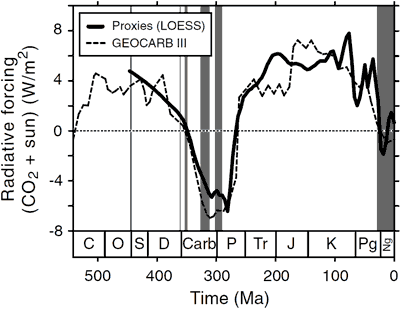
–> NO ONE IS ARGUING THAT CO2 IS THE ONLY MECHANISM OF CLIMATE CHANGE. Duh.
So let’s look at the data – what are other likely candidates?
Huh.
Then there’s Kip’s “adoption” of the Mann 2008 graph. “IPCC projections of future temperature have been removed, along with y-axis degrees (as 0.1°C ticks are not appropriate for reconstructions). On the far right, UAH NH Lower Trop. (red trace) has been added as a proxy of present temperatures. The 15°C line (yellow) has been added for reference.”
Why isn’t the temperature scale appropriate for reconstructions? That makes no sense whatever. Then Kip removes the original instrumental record of HAD and CRU and adds UAH lower troposphere data, without giving any justification for doing so. He apparently simply erased the original data and drew in the new, conveniently covering it with huge words (besides, the graph only goes to 2010 – he could at least have continued it to “current temperatures”). Why isn’t this an instance of confirmation bias?
Not only that, but the UAH record should go higher, up to 0.4 C above the dotted line.
http://upload.wikimedia.org/wikipedia/commons/7/7e/Satellite_Temperatures.png
(Oh, except this is global, and the graph is for NH. So where did he get his UAH data?)And what is “Earth’s idealized temperature”? The original graph:
http://www.pnas.org/content/pnas/105/36/13252/F3.medium.gif
Nick Stokes, poster child of Apophenia.
Nick Stokes;
Then we did it. Then it warmed.
Except we also know there is a great deal of natural variation. Unless we can quantify how much of the warming (if any) is natural, we don’t know how much (if any) is anthropogenic.
While we don’t know the above, we do know that the climate models have run hot, sea level rise hasn’t accelerated, hurricanes and tornadoes have been trending down in frequency and intensity, sea ice has slightly declined (not collapsed), ice mass in the antarctic and greenland is hardly changed (and in fact may be increasing), palmer draught index has remained pretty much flat…. Not only do we not know how much of the warming is because “Then we did it”, but none of the things that were supposed to happen when it warmed did. “Then it warmed.” is a complete cop out.
That is a very glib remark from someone I generally regard as serious.
The early 20th c. warming cannot be accounted for by CO2, and models fail to reproduce it, so until that is explained there is no reason to attribute later warming to CO2.
The early 20th c. warming could be resumed as : it warmed , then we did it.
“so until that is explained there is no reason to attribute later “
No, that doesn’t make sense. The original proposition still holds. A mechanism was shown that would mean extra CO2 in the air would cause warming. The CO2 increased, and it warmed.
Now you may well say that the warming in early 20C was more than might be expected, though CO2 was increasing then too. The excess may have been caused by something else.
If you smoke a lot, you’ll damage your blood vessels. Non-smokers die of heart disease too. That doesn’t mean smoking is OK.
Here’s another funny one Nick.
From about 1940 through 1955, approximately 24 billion tons of carbon went straight from the exhaust pipes into the oceans and/or biosphere.
If oceanic uptake of CO2 caused ocean acidification, shouldn’t we see some evidence of it? Shouldn’t “a large additional sink of ~3.0 PgC yr-1” (or more) from ~1940–1955 have left a mark somewhere in the oceans? Maybe dissolved some snails or a reef?
Had atmospheric CO2 simply followed the preindustrial trajectory, it very likely would have reached 315-345 ppmv by 2010…
Natural sources and land use changes probably accounted for 40-60% of the rise in atmospheric CO2 since 1750.
Oddly enough, plant stomata-derived CO2 reconstructions indicate that CO2 levels of 315-345 ppmv have not been uncommon throughout the Holocene..
CO2 from plant stomata: Northern Sweden (Finsinger et al., 2009), Northern Spain (Garcia-Amorena, 2008), Southern Sweden (Jessen, 2005), Washington State USA (Kouwenberg, 2004), Netherlands (Wagner et al., 1999), Denmark (Wagner et al., 2002).
So, what on Earth could have driven all of that CO2 variability before humans started burning fossil fuels? Could it possibly have been temperature changes?
Nick Stokes. You are making the presumption that the only significant thing going on with climate change is CO2 because it does have some effect. As the correlation with temperature over the long term is very low, clearly other things are also involved. Explain the LIA using only CO2 levels.
“If you smoke a lot, you’ll damage your blood vessels. Non-smokers die of heart disease too. That doesn’t mean smoking is OK.”
Not a valid analogy since smoking has little benefit that can’t be achieved more safely(e.g. the nootropic impact of nicotine) whereas CO2-emitting activities and moderate warming from any cause have vast benefits. Also, the downside of quitting smoking is small whereas the cultural damage alone from increased state control is huge.
A mechanism was shown that would mean extra CO2 in the air would cause warming. The CO2 increased, and it warmed.
No, a mechanism was shown that would mean extra CO2 in the air would have a forcing effect. The effect on global temperatures however was not known. Its like, we discover the hob control knob. We turn it up. We measure heat emitted, and we know that we are applying increased forcing to the water in our pan.
But whether it gets any hotter is another question, and if its boiling already it will not.
The question is not about the forcing effect, whether there is one, and its magnitude. We all agree that other things being equal, if the only thing that changes is the rise in CO2, temperatures will rise.
The argument is over whether other things are equal. Over the famous feedbacks, whether there are any and whether they are positive or negative. It is entirely possible for a rise in CO2 to produce no increase in global temperatures, because the warming impulse is compensated by negative feedback. Clouds and weather and ocean behaviors for instance.
As when the water in our pan gets no hotter, but loses the heat by evaporation.
It is very annoying when people who know better pretend this is a matter of simple physics. Its not about the warming effect of the CO2, which is simple physics. Its about the behaviour of a complex and chaotic system in response to it.
michel ==> It IS about “the behaviour of a complex and chaotic system”.
“The effect on global temperatures however was not known.”
Well, Arrhenius said 4°C per doubling, and while some might think that too high, his reasoning and result are not far from modern thinking.
But yes, it’s a forcing, and might conceivably lead to a range of temperature rise. But if you turn on the gas under the saucepan and the water warms, it isn’t post hoc thinking to say that it might be because of the gas flame. It’s why you turned it on when the water was cold.
Here’s another take on things I just ran across. Can’t vouch for the methods, but I’ll quote the abstract in full..
“We use a newly developed technique that is based on the information flow concept to investigate the causal structure between the global radiative forcing and the annual global mean surface temperature anomalies (GMTA) since 1850. Our study unambiguously shows one-way causality between the total Greenhouse Gases and GMTA. Specifically, it is confirmed that the former, especially CO2, are the main causal drivers of the recent warming. A significant but smaller information flow comes from aerosol direct and indirect forcing, and on short time periods, volcanic forcings. In contrast the causality contribution from natural forcings (solar irradiance and volcanic forcing) to the long term trend is not significant. The spatial explicit analysis reveals that the anthropogenic forcing fingerprint is significantly regionally varying in both hemispheres. On paleoclimate time scales, however, the cause-effect direction is reversed: temperature changes cause subsequent CO2/CH4 changes.”
https://www.nature.com/articles/srep21691
The last sentence is particularly interesting. I supports an argument often used by skeptics…and yet the same method supports the consensus view. I wonder if the method is capable of picking up a feedback mechanism.
David – stomatal density is not a very good proxy for prehistoric CO2 levels; they can vary for other reasons, such as moisture levels. They also don’t generally agree with other proxies, as you should know from the graphs you’ve posted in the past.
What “solar indirect effects” do you mean? Have underwater volcanoes been known to cause temperature changes at the surface in multiple regions at once? What kind of long-term ocean oscillations might be showing the pattern of climate change we are seeing?
And what about the theory? What is wrong with the theory of AGW that would make it irrelevant that CO2 is rapidly increasing?
Nick,
Its actually not at all clear that CO2 increases warm the planet at all. What is clear is that they are a source of added heat. But whether adding heat, from this or other sources, produces a net warming, and if so how much, is a quite different issue.
It is, as Kip says, a chaotic and complex system. It is entirely possible for the addition of heat to such a system to produce no increase in temperature.
This is why continually talking about the absoption spectrum of CO2 or the simple physics showing that increased CO2 has a certain warming impulse (by people who know a lot better) is so misleading and disingenous.
The problem is the nature of the system and its reaction to inputs.
michel,
“We all agree that other things being equal, if the only thing that changes is the rise in CO2, temperatures will rise.”
No, some don’t agree.
“It is entirely possible for a rise in CO2 to produce no increase in global temperatures, because the warming impulse is compensated by negative feedback. Clouds and weather and ocean behaviors for instance.”
This is a disingenuous argument. You say that heat is being added to the system. The surface temperatures are warming, largely as predicted. Yet you suggest that maybe the added heat due to CO2 is not actually making the temperature rise, instead some other (unnamed) influence is doing it?
It’s as if some skeptics want to make the whole question much more convoluted than it is in order to deny the evidence. “Scientists have not PROVEN anything!” “There could be other, unknown factors involved!” “The evidence is not conclusive, merely circumstantial!” And, of course, “Models are worthless!”
Meanwhile, people like Kip and many others accuse scientists of bias and try their utmost to find the lowest measures of “consensus” possible.
CO2 went up, and so did temperatures.
That’s the only fact that Nick and his fellow travelers are interested in.
Trying to explain to him about all the other things that impact climate fall on willfully deaf ears.
Nick,
Didn’t you mean to say that Arrhenius postulated in 1896?
“Then we did it. Then it warmed.”
https://en.wikipedia.org/wiki/Post_hoc_ergo_propter_hoc
A prediction in 1896 is not post hoc.
The lack of pirates is what causes global warming … the prediction has been around a very long time if you know the history of the joke. Bobby Henderson had it as one of his central science principles that he asked the courts to enforce if they were going to mandate scientists teach Intelligent Design.
So it is a prediction that has been around a long time and apparently that makes it true 🙂
Nick being obtuse again.
From wikipedia:
Post hoc ergo propter hoc (Latin: “after this, therefore because of this”) is a logical fallacy that states “Since event Y followed event X, event Y must have been caused by event X.
You stated,
The post hoc event (Y) is, “it warmed.” The propter hoc event (X) is “CO2 increased.” The fallacy you’re stating is, because it warmed after CO2 increased, the increase in temperature must have been caused by the increase in CO2. Correlation does not imply causation.
“The fallacy you’re stating is, because it warmed after CO2 increased, the increase in temperature must have been caused”
No. I’m pointing out that the explanation of the cause was given, and well accepted, long before the warming was actually observed. That cannot be post hoc, ergo non propter hoc.
Pray tell, by whom was “the explanation of the cause was given, and well accepted, long before the warming was actually observed[?]” Certainly by no geophysicist well grounded in thermodynamics!
“Certainly by no geophysicist well grounded in thermodynamics!”
Arrhenius was not a geophysicist. He was a physical chemist, who won the Nobel Prize in 1907 for his work on ionic dissociation. And he was a major figure in thermodynamics. He introduced the concept of activation energy, His work on ionic dissociation led him to propound the first organised theory of acidity.
His work came after a low point in the Little Ice Age. It already warmed before his ‘prediction’. But the mere fact that somebody looks into a crystal globe then guesses right once, does not prove that the crystal globe is working. It can be a coincidence (especially if the prediction is vague).
And as usual, Nick got that very wrong. The fallacy remains a fallacy no matter if somebody guessed or not guessed something ‘before’. The ‘post hoc’ has nothing to do with that, but with the conclusion based on the sequence.
The scientific method needs more than a single coincidence, even if guessed previously. If I say ‘the devil exists and it will turn the coin toss tails this time’ then I throw a coin and it gets ‘tails’, it doesn’t mean my theory is true. It’s very similar with a warming/cooling situation, it’s basically heads or tails.
Now, since it’s a prediction, according to Nick, how well was that realized? To be scientific, must be definite. To be pseudo-scientific, must be Nick style: “warmed” (that is, vague). So, how exact was the prediction? How exactly was the real world behaving compared with that? From Wikipedia, this was Arrhenius ‘pseudo-prediction’: “any doubling of the percentage of carbon dioxide in the air would raise the temperature of the earth’s surface by 4C”. Now, they say it is known how much the CO2 increased and also how much it warmed. Easy to check if the accuracy was good or the prediction was wrong and the theory falsified. Now, Nick, show us that you at least have the kindergarten knowledge to compute the consequences of your pseudo-theory. What’s the prediction, what’s the reality? They say that at 1900, around the ‘prediction’ time, there were about 300 ppm of CO2 in the atmosphere. Now there are about 400. Good luck with the computations, Nick. Don’t forget to show them to us, Nick, let us be amazed of the power of prediction of the pseudo-theory, Nick.
“Easy to check if the accuracy was good or the prediction was wrong and the theory falsified. “
Not at all. Time is a factor. It takes time to boil a kettle, and it takes much longer for the Earth to warm. It is now well established that there are century timescales important in warming. Arrhenius did an equilibrium calculation.
So Arrhenius did a pseudo-scientific calculation, claimed (but unverifiable, ergo anti-scientific) for a state never realizable in the real world. It was not a prediction as you lied, but a pseudo scientific bullshit.
The true giants of thermodynamics do not include Arrhenius. Activation energy in chemical reactions is more a matter of kinetics, rather than of thermodynamics. His in vitro equation plays no major role in the determination of in situ air or water temperature. Indeed, he was no geophysicist!
Phil R,
Apart from the argument about the earlier prediction, the simple statement, “CO2 increased, and it warmed” does not imply causation. Your whole logical argument amounts to nothing.
Phil R,
Sorry, I just read the context of Nick’s quote, and there is an implication of causal association. However, it’s only a logical fallacy if it’s not true.
“Human’s added CO2 to the atmosphere, therefore the planet warmed” is not in itself a logical problem unless you can show that it’s not true, post hoc or not.
“Arrhenius showed in 1896 that putting a lot of CO2 in the air would cause warming”
It seems that Nick Stokes lives in a glass jar.
It warmed out of the COLD anomaly of the LIA.
Be very thankful.
There is ZERO scientific evidence it had anything to do with atmospheric CO2.
There is a lot of evidence of that. What we still don’t know, is the amount of warming.
IPCC says 1.5K to 4.5 K per doubling.
Observational evidence suggests it is less than 3K.
Observational evidence shows its less than 0.5°K
Nick
“His argument carried the day.”
You misrepresent what actually happened. He over-claimed the warming by a lot, and he also believed that water vapour would remain constant in terms of relative humidity.
Arrhenius was wrong about the ECS, by a lot and grudgingly admitted it 20 years of bitter-ending it later. Everyone was wrong about the humidity, a hypothesis disproven by millions of readings from radiosonde.
His was an argument from hypothesis. It was defective to the point of being wrong. The ECS to CO2 is low.
Personally, I think Nils Ekholm, 1901 improved on Arrhenius’s work.
So how do you explain the Moore 2016 graph then, Nick? The temperstures are the lowest they have been since the Permian; the CO2 levels are also low and over millennia show no correlation with temperatures, and ice cores have demonstrated that where there is a correlation CO2 increases lag temperature increases by the best part of a millienium.
Which at the very least could indicate that current increases in CO2 levels are an effect of the MWP.
Arrhenius posited a 1°C rise per doubling of CO2. Anything beyond that is climate scientists and activists heaping a Pelion of wishful thinking on an Ossa of unproven hypothesis. The bottom line is “this global warming period is down to CO2 because we want it to be”.
Beyond that, a second doubling of CO2 would only result in a warming of 0.5C.
So even if everything assumed is correct, taking CO2 from 280ppm to 1120ppm would result in a warming of 1.5C. Not only is this not a problem, it is probably entirely beneficial.
“Arrhenius posited a 1°C rise per doubling of CO2.”
He could “posit” anything
— that doesn’t make it correct.
He could change his numbers.
There was no way to measure
warming in the troposphere,
globally, at the time,
so it was unprovable speculation,
… much like all of modern climate “science”.
Newminster,
“Moore 2016” (not his graph; it’s been around for years – it was even posted on WUWT in 2013), and graphs like it, only look at CO2. That’s just daft over that time period. No one argues that CO2 is the only thing to affect climate.
Kristi ==> Nick Stokes in comments here?
Kip, I doubt Nick is talking about the Phanerozoic. And I doubt whether he would say, if asked, that CO2 is always the only thing that ever affects the planet’s temperature.
Kip,
” in comments here?”
Well, to quote my comments here:
“Now you may well say that the warming in early 20C was more than might be expected, though CO2 was increasing then too. The excess may have been caused by something else.
If you smoke a lot, you’ll damage your blood vessels. Non-smokers die of heart disease too. That doesn’t mean smoking is OK.”
In fact no-one is claiming that CO2 is the only thing that affects climate, or causes warming. The issue is that if you put a whole lot of CO2 in the air, it will cause warming. Past warming was not caused by that; no-one has done it before. But we’re doing it now.
Nick ==> You can’t really be claiming that atmospheric CO2 concentrations are at the highest ever in Earth;s history…..the paleo-record does not support that view.
So when CO2 was high or rising in the past, in some periods, temperatures dropped instead of rising.
I quote yours above “Arrhenius showed in 1896 that putting a lot of CO2 in the air would cause warming. He calculated how much. There was argument for some years, but his argument carried the day. Then we did it. Then it warmed.”
and here: ” I’m pointing out that the explanation of the cause was given, and well accepted, long before the warming was actually observed.”
But I will accept that you realize and admit that CO2 may not be the (or even a major) cause of warming since the 1850s.
Kip and Nick,
” The issue is that if you put a whole lot of CO2 in the air, it will cause warming. Past warming was not caused by that; no-one has done it before.”
I might clarify here that people have not put a lot of CO2 into the air, but that doesn’t mean that CO2 hasn’t played a role in temperature before. If one looks at the Phanerozoic and instead of plotting just CO2 vs temp, one looks at the combination of CO2 and solar, there’s a good fit to temp.
“But I will accept that you realize and admit that CO2 may not be the (or even a major) cause of warming since the 1850s.”
This is putting words into Nick’s mouth.
There seems to be a movement away from the claim that temps have been driven >primarily< by CO2 since the 1850s to the claim that it's the major cause of warming since around mid-20th C. Aerosols also played a cooling role starting in mid-century, counteracting the effects of CO2, but this effect diminished starting in the '80s.
"Arrhenius showed in 1896 that putting a lot of CO2 in the air would cause warming." …all other things being equal.
(Kip and Nick edit)
“I might clarify here that people have not put a lot of CO2 into the air” …before the industrial revolution.
Nick Stokes: Correct. CO2 does indeed cause warming. We get the equation. A doubling causes about 3 watts. Plug that into Stephan Boltzmann at the current levels of radiation and you get 1 Celsius degree of warming per CO2 doubling, not 3, 5 or 7 degrees as the various paramaterize models predict.
Just because something happens in a test tube is not evidence that the exact same thing will happen in the real world.
Even you should be capable of realizing that.
To Mr. Nick Stroker:
You conveniently forgot, as usual, to mention
the claimed warming from 1910 to 1940
happened with little CO2 added to the atmosphere.
Meaning a weak CO2 level – average temperature correlation,
that you ignore.
,
,
,
And the global cooling from 1945 to 1975
happened with lots of CO2 added.
A negative CO2 – temperature correlation,
that you ignore.
,
,
,
The global warming from 1975 to 2003
happened with lots of CO2 added.
A strong positive CO2 – temperature correlation
that you love !
,
,
,
The flat temperature trend from 2003 to mid-2015
happened with lots of CO2 added.
A weak CO2 – temperature correlation,
that you ignore.
.
.
.
I suppose in your fairy tale ‘CO2 is evil’ world,
Mr. Stroker, only the period from 1975 to 2003 matters,
and we should just ignore all other
“inconveniently different” data ?
I suppose since you already “know the truth”
about exactly what CO2 does to the temperature,
as a member of the “CO2 is Evil Cult”,
all that other contradictory data must be wrong !
Just ignore it, and maybe it will eventually
be “adjusted” away !
Come on, he invested 25 years working through climate science output. Why would he look at your data and fancy charts when your aim is to show…
Nick,
A properly conducted experiment holds all variables constant except one, and then it is repeated with another variable held constant, etc. From that, one (hopefully) comes up with a multi-variable description of how everything interacts. That is what is missing from Arrhenius’ lab’ experiments. He wasn’t able to observe all the other variables (like clouds) even if he was aware of them. All he was able to demonstrate was that in a closed-system, in a laboratory setting, CO2 is able to absorb IR and be warmed. It is interesting, and could be useful, but it does not come close to fully explaining what happens on the Earth. It is not unlike an early experimenter observing that a pot of boiling water does not exceed 100 deg C, and pronouncing that is is impossible for water to exceed that temperature. And then someone discovered how to make steam engines.
It’s a post I could have written myself as my view is similar and summed up by:
https://en.wikipedia.org/wiki/List_of_cognitive_biases
The majority of us are totally unaware we do it to some small degree all the time and one of the methods how we’ve survived as a species.
I recall a well known BBC scientist presenter pointing out Confirmation Bias on someone, but then goes and does it himself; another trait of homo sapiens – hypocrisy.
The there’s Confabulation (a bit of poetic licence on the definition) as I don’t believe many of the ‘climate scientists’ think they are doing any of this or in the midst of a scam, but genuinely believe they are doing the correct thing; we must be careful of almost using Halon’s razor.
So in summary CAGW may well just be Confabulatory Confirmation Bias.
And I am discombobulated by it!
I may be wrong, but I’d guess – from the rest of your comment – that your final line was ironic . . .
Kim, there are two ways of looking at the matter of Climate chaange, aka Global warming.
One, we have always had persons who are convinced that the world is about to end. The Bible and no doubt other ancient documents are full of such tales, and we used to see the odd male carrying a board stating Repent before it is too lat”e. But Two, we also have the rather sinister possibility that a person, or group, even the heads of a country y want to destroy the Western way of life.
So a bit like “Follow the money trail”, what country does not believe in all this to us Nonsence, and would benifit by a decrease of the Western Worlds prosperity.
One might point the finger at say China, but it deepends on its present prosperity by being the world biggest exporter of goods, so very unlikely. Russia ? again very unlikely, so who ?
There is of course another possibility, th e output of the Wests Unerversities conssist of somewhat brain washed graduates, who have to make a living in the hard real world. So if they can persuaad a govermnment to pay therm a comfortble living, via the taxpayers largess, then they will do whatever is necessary to keep hat income stream coming.
Only two things will stop this nonsence , nature not co-operating, and the lights going out.
But could it be as simple as that ?
MJE
Michael ==> In Science, the truth usually wins, but it may be a long time coming. First one has Confirmation Bias rampant in a field — then it becomes “enforced conformity” (many fields experience this on one scientific aspect or another). Once a “consensus” becomes enforced, the field is doomed to struggle to keep confirming the consensus almost ad infinitum until someone or some group of scientists breaks the strangle-hold.
See my essays on salt. Despite absolutely totally debinked by Mente’s work, the American Heart Assoc. and almost all MDs still parrot the consensus policy “mandatory dietary salt reduction for all.”
— I don’t think “debinked” is a word — maybe I meant debunked.
In the famous words of the accordion player ‘interrogated’ by Inspector Clouseau, “No, that is not my binky.”
The similarity between the Y2K problem and AGW is that both problems involve extreme exaggeration of possible consequences to pry open the government coffers. Y2K demonstrated the profit to be made in fixing a problem that goes away no matter how inept the solution. Others on WUWT have previously leapt to the defense of the Y2K rescue mission but businesses, school boards and entire countries who did nothing to deal with Y2K had no more issues than those who spent vast sums to fix the “problem” https://en.m.wikipedia.org/wiki/Year_2000_problem False crises, like zika, swine flu and West Nile virus, have become huge business. AGW is the science of false crises taken to a whole new level. Warmistas probably learned a lot from Y2K including how to take credit for nothing (BC’s carbon tax is saving the world-‘the experts who implemented it have proved that, doncha know).
True.
But for the purposes of this discussion it is worth noticing that actions were taken. Even if the risks were mis-calculated.
There is a contrast with AGW where no-one thinks the risks are credible enough to take action. No Government. No corporation. No stock market investor.
The problems didn’t go away, they could be managed until a fix is implemented.
The leading fix was setting each affected computer’s clock back to Jan 1, 1999 instead of Jan 1, 2000.
The other solution was to wait until 2030, when all the date calculations would start working properly again.
The claims that power plants would blow up and such were total nonsense. The worst that was likely to happen was the equipment would safe itself until a human could intervene.
For example, elevator control software would conclude that no maintenance had been done in 70 years, so they would send all elevators to the basement to wait for maintenance. Inconvenient, yes. Catastrophic, no.
The code that needed to be fixed was fixed.
The code that needed to be replaced was replaced.
The fact that reporters over hyped things in order to sell papers was to be expected.
APOPHINITIONS
Sleep Apophneia. Transition between dream and doom states.
Apophacary. 1. Trading post for potions and hexes of doom. 2. Websites of doom.
Anthroapologist. Those who attempt to unearth evidence of something not our fault.
Apophlexy. Condition where the blood boils due to Global Warming.
Hypophysis. Scientific assertion using falsifiable evidence claiming it’s worse than we thought.
Sociopoph. One who ascribes not a single solitary noble attribute to one’s own kind.
Poph-Tart. Pastry that causes depression.
Pophalactic Birth control method administered to a large group; possibly violent.
Pophacampus 1. Part of the brain the excretes doom. 2. A University that does the same.
Apophasis. Mentioning something by saying it will not be mentioned. BONUS: real word!
LOL! They go into my spell-checker.
The IPCC error bounds in climate sensitivity have not tightened in the quarter century since their first report. Climatology is field that has made No Progress in the last 25 years.
How is that possible?
Computers have improved so their models should have improved. Observations have improved (satellites and buoys, if not land observations) so their inputs should have improved. The sheer number of people researching the climate has increased so their insights should be greater. But no progress has been made.
Seriously, how is that possible?
The answer comes when you look at what other fields have failed to make any progress over that time. There aren’t many but I can think of two-
Cryptozoology and Ufology.
Despite smart phones and Google Earth no Yetis or Flying Saucers have been found. That doesn’t mean they aren’t there (it might be a clue, of course) but it does mean that the “experts” have failed to narrow down where they aren’t.
Real science looks for evidence of what isn’t true to eliminate error. Then speculation can lead to things that might be right.
Pseudoscience looks for evidence of what is. Then speculation allows anything to be believed and cannot be corrected.
Climatology looks for evidence that is consistent with AGW. That isn’t science.
M Courtney,
Amen. Well said!
The BBC has been saturating the news each day with dire predictions of future climate.
The latest this morning seems to be a bit of comparison by the Met Office which apparently shows that there are more extreme temperatures leading to hotter weather and tropical nights.
http://www.bbc.co.uk/news/science-environment-46064266
Is this correct or a result of cherry picking data?
It’s probably correct. There is no reason to expect the climate to stay constant. It’s a chaotic system.
The question is why the climate has changed. Betting that the change since 1950 is manmade while the change in the first half of the 20th century is natural is…
Well, it makes an exciting news story so by journalistic standards that also passes for correct.
StephenP ==> The BBC claims:
“The hottest days have become almost 1C hotter, warm spells have increased, while the coldest days are not as cold. The number of so-called tropical nights – when temperatures stay above 20C – is increasing. ”
Isn’t that nice? 1C is not alarming — and for most of England — a treat. Warmer nights — 68F — are pleasant and not oppressive at all.
So where’s the downside? we know things are getting better — warmer than a frozen Thames.
Good job (as usual), Kip.
I have a simpler explanation.
It is a church. The would-be climate experts are the clergy.
The politicians are the deacons.
The general public are the parishioners.
All of the above practice virtue-signaling.
The politicians are the ushers … passing the plate … taking ” their share ” …
More like Business are the ushers, doing the collecting for the politicians and clergy on everything that is bought and sold with ‘carbon’ in it. The poor general public (parishioners/congregation) just pay the entire bill. Very good analogy. Gonna remember this one for repeating since average folk who don’t keep up with this but know something don’t add up will really understand.
I thought it worth mentioning.
Detectives are conspiracy theorists. They often have to concoct initial theories with little information, most of these theories turn out to be wrong, often utterly wrong.
It’s the claims you make off the back of these theories that matter, not the fact the theory has been put together.
Mark – Helsinki ==> Yes, quite so. Take Nick Stokes’ response to this essay — a defense of Arrhenius …. [almost] no one refutes or discounts Arrhenius. But the long-term CO2/Temperature records shows that CO2 and Temperature are not linearly related — they are chaotically related. this fact does not reject Arrhenius — it just shows that the one — CO2 — does not dictate the other — temperature.
Arrhenius is no defense of the CO2 AGW Hypothesis against the long-term data. No claim it is is scientifically infantile.
….To claim it is ….
What Arrhenius claimed in 1896
was rejected, by him, in 1906,
when he reduced his guess
about the potential warming effect of CO2.
What people today should not ignore
is the primary wisdom from Arrhenius:
He suggested that the human emissions
of CO2 would be strong enough
to stop the world from entering a new ice age,
and that a warmer Earth would be needed
to feed the rapidly increasing population:
““A distinguishing feature of scientific thinking is the search for falsifying as well as confirming evidence. However, many times in the history of science, scientists have resisted new discoveries by selectively interpreting or ignoring unfavorable data.”
It’s like this was written to describe Astronomy.
Though there is another factor, when a group of scientists have spent 20 million dollars and 5 years on something.. they are driven to not accept fail because of ego
Some climate measures are changing but they are only look to be dangerously changing if one already believes it to be so. (In fact, for mankind, many are actually getting better. –>
Some climate measures are changing but they only look to be dangerously changing if one already believes it to be so. (In fact, for mankind, many are actually getting better.
Johann ==> Thanks — fixed. Good eye!
Seriously Kip, do you really believe that the key protagonists of AGW actually believe their own – er – pronunciations?
I am not talking about your average run of the mill scientist, who gets a grant because ‘climate change’ abd zips his lip..or the average person who simply believes scientists are incorruptible and wise…
…The people who can take a bunch of research which, taken all together says ‘climate change, really not as bad as we thought, and possibly not human generated’ and turn into a summary that reads ‘Climate Doom If You Don’t Destroy Yourselves and Give Us All Your Money’ are not suffering from – er apophenia
Its a far more common complaint of basic greed, envy, resentment, low cunning and utter incompetent stupidity, total lack of honour, and absolutely no sense of history or indeed any responsibility whatsoever towards the human race.
Summoned up succinctly by ‘The Liberal Mindset’.
You don’t believe anyone could be doing this deliberately. That’s because you are probably a decent honest nice guy who takes responsibility and has a time span of discretion slightly longer than an amoebas.
The person I am afraid with apophenia, is you. You assume that other people are basically as honest well meaning intelligent and nice as you are.
You should get out more, cross the tracks sometimes, and see life at the survival level, and then get yourself invited to some big money events. Same people, same motivators. Money and survival.
Not everyone can earn a living like you do, honestly. Let’s face it. if it’s a dumpster on main street, or politics and the White House, which would you pick?
Climate change, like politics, and dumpsters, is for failures who haven’t found anything better to do.
All it requires is low cunning, a sociopathic inclination and a bit of narcissism thrown in and the ability to live, talk, and even believe a complete lie.
Yes, people are really that bad. And just as primary schools attract paedophiles like dung attracts files, so politics and political science, journalism and the media attracts cheats frauds liars and above all psychopaths.
The common feature is they attract people who like power over other people, which they gain by spinning plausible narratives, and those narratives are used to manipulate the opinions beliefs and decisions of others. Once they were called agents of the devil, or witches. Today we revere them, as Lawyers, PR men and ‘marketing’.
These people live in a world of human conflict, matching one narrative against another narrative. They do not care what the truth is, they may even believe that there is no truth, that ‘truth is a cultural construct’ or some such. Liberated from adherence to Truth, they are simply trying to win . Because winning is the only thing their empty lives contain, because they are, after all, in every other respect empty hearted losers.
You may feel sorry for them. I did. I do. It makes no difference to them. Your empathy and sympathy is simply another tool they can use against you. They note that people care about their offspring. They don’t. But they note that others do. ‘Protecting the Planet For Your Children’ becomes their slogan.
They are criminals who never get caught. And they end up running things, because that’s the biggest win they know how to have.
Remenber. Government controls science, the internet, media and as much of everything else as it can, and all government is best understood as a self-legalising protection racket.
Its the legalised Mob.
Now an again you get to change teh Godfather, that’s all.
The only antidote is to realise that, and not personally be taken in by their narratives. If you don’t believe their nonsense, their power over you is reduced to physical coercion, and that’s a bit too obvious even for them.
A fair description of the liberal mindset. It is a shock to face that squarely – most today are simply unprepared for that, naive. Boomers are notoriously unable to fight, and millenials, x generation head for safe-places.
But, look at Brexit, Trump, Italy … Something is going on , apparently popping up randomly, no discernible pattern – and that liberal mindset, which does not tarry at physical coercion, knows nameless fear of what Percy Shelley wrote – The Mask of Anarchy: Written on the Occasion of the Massacre at Manchester
http://knarf.english.upenn.edu/PShelley/anarchy.html
Trump is a Baby Boomer. He’s a pretty good fighter
I’m not sure what you mean by “notoriously unable to fight”. Perhaps you are thinking of the Vietam war protestors. Well, just remember that millions of other Baby Boomers went to fight the war in South Vietnam, and many of them volunteered to do so, and fought very well, defeating the enemy on the field of battle.. The enemy didn’t think they were unable to fight.
The Boomers saw president JFK murdered in broad daylight, ended up because of that in Vietnam after Bob Kennedy and MLK were also murdered. They also lived through the Cuban missile crisis . They then got into power with policies that ruined the US, and Trump put all of that on the table. The entire Cold War caper that Trump wants to end with good relations with Russia, China is driving the Brits (London and DC) insane.
Trump, a real fighter, will meet Putin and Xi in Beuenos Aires. Like JFK and Reagan, who also bucked the Brits, every kind of filthy trick in the Brit arsenal is unleashed against them.
The decisive battle is the midterms – the issue of war or peace.
bonbon ==> You must have this blog confused with a blog on US and International politics. It is not — it is about CliSci, Weather, Science and interesting things. please try to keep comments On Topic.
I happen to agree with Leo on this one.
Leo Smith ==> You don’t need to be so reticent — let it all hang out and give us your honest opinion…..don’t be shy.
“Is the whole field of IPCC Climate Science suffering from Scientific Apophenia?”
Yes.
It is not so, basically because their objective is political and not science.
When I started my work relating climate change in 1970s and continued to date, there were change in my perception on climate change. IPCC defines the climate change, UNFCCC defines the climate change; but both of them do not adhere to the definition but talk only on global warming but shy of using this term and instead use climate change. Here there is no bias, but it has a political agenda. Theyt adhere to that only.
Dr. S. Jeevananda Reddy
sorry missing no before change: no change
sjreddy
Marijuana causes people to see things that aren’t there. I wonder if anyone has done a study to find out what percentage of climate scientists smoke dope. My very short Google search doesn’t find an answer to that question.
Everything you can not put in to “bias” basket. In climate, based on the period selected for the study may give different results. This is not a bias. If the data series ppresent a cyclic pattern, if you select the data of below the average, the result is different from the data of above the average period. Hundreds of such papers were seen in different journals on different subjects. I presented this type in early 1990s relating energy “over-emphasis of energy terms in crop yield models” relating articles by eminent meteorologists — Agricultural and Forest Meteorology, 77(1995):113-120 & 68(1994):213-242. Here, all are correct in his own way but never tried to look at integrated way of others results. This I did.
Dr. S. Jeevananda Reddy
Reddy ==> It is the “the assigning of inferential meaning when limited statistical power should prevent such a conclusion or when the data are actually random.” that is in question. This is a particular kind of confirmation bias.
In CliSci, CO2 is seen as rising steadily since 1956….temperatures fall gently for another 20 years, but then begin to rise sharply til the 2000s. The inference is made for CO2 driven Global Warming — because it was expected, but it is not really supported by the data.
On our side, there are those who take the statement that the changes caused by CO (if any) are too small to be discerned from the background noise caused by normal climatic variations, as a claim that CO2 has no impact on climate.
That tendency to see patterns, that’s a survival characteristic. Selected for in the most brutal way. We can’t help it. But often there is no pattern, no connection, no link.
Rhoda ==> Yes — and this aspect of human nature (apparently, anyway) can cause a lot of trouble! social, political, etc.
Kip,
There are a lot of theories as to why “we don’t believe them”. My opinion is that the general public looks around and sees that things are as they always have been, as far as the weather and the climate are concerned.
This may a secondary reason, but primarily people are not willing to give up their comforts and necessities unless the danger is very clear and present. In general we’re very bad at remembering and assessing risk so unless it’s right in our faces we dismiss it. But even then some are obstinate. Some home owners will stay with their property as certain destruction by hurricanes and wildfires approaches. Y2K was obvious to the programmers because they could test the code with a 01/01/2000 date and watch it blow up. Their bosses believed them because they could see the results. There’s no appropriate and conclusive way to test the CO2 hypothesis on a global scale. Only the deluded will give up their conveniences for a vague fear.
Gary ==> A strong argument for “why they don’t act” but not for “why they don’t believe”. These are two very different questions and must be considered separately.
Even the most convinced “AGW enthusiast”often still drives his Cadillac SUV, flys all over the world attending conferences, eats the best cuts of red meat, lives in a modern all-electric house with every tech gadget imaginable — in other words, a higher than normal CO2 “footprint”. acting and believing are not in the same realm.
This comment from Freeman Dyson came to mind.
“I consider myself an unprejudiced person and to me these facts are obvious. But
the same facts are not obvious to the majority of scientists and politicians who consider
carbon dioxide to be evil and dangerous. The people who are supposed to be
experts and who claim to understand the science are precisely the people who are
blind to the evidence. Those of my scientific colleagues who believe the prevailing
dogma about carbon dioxide will not find Goklany’s evidence convincing. I hope that
a few of them will make the effort to examine the evidence in detail and see how
it contradicts the prevailing dogma, but I know that the majority will remain blind.
That is to me the central mystery of climate science. It is not a scientific mystery but a
human mystery. How does it happen that a whole generation of scientific experts is
blind to obvious facts? In this foreword I offer a tentative solution of the mystery.
From Dyson’s introduction to Goklany’s paper Carbon Dioxide: The Good News
https://www.thegwpf.org/content/uploads/2015/10/benefits1.pdf
Ron ==> Thanks for the quote and the link.
Freeman Dyson has a well-deserved reputation for clear thinking. And to the point:
We continue these long complicated threads about whether or not CO2 is responsible for the globe warming. But……
The problem is a political problem, started intentionally in the early 1970’s and fed into the United Nations Environmental Program conceived by the oil oligarch Maurice Strong who was the first Executive Director. All the other programs targeting CO2 proceeded from this because CO2 was seen as an ideal source for coordinating and controlling international politics. The Rio conference, the United Nations Framework Convention on Climate Change, the IPCC and all the following apocalyptic forecasts were aimed at taking control of a large part of the world economy through energy. The idea of CO2 contributing to global warming was taken as a given. The only environmental changes studied were “human-caused” from the beginning. The only question was how to justify using the political hype for political reasons.
Nothing has changed in nearly 40 years.
If we start by assuming that no (living) man/woman, including FD, is immune to confirmation bias then we’re probably better placed to make sense of his position vis a vis that “whole generation of scientific experts [ . . .] blind to obvious facts”.
They’re all blind but I can see, may be a very fine example of confirmation (or other biases at work or perhaps plain arrogance – even though he may be right – or both) especially following his view of himself that he’s “unprejudiced”.
Surely it’s better to start off from the assumption that we are, in truth, all prejudiced, in the sense he means (ie vulnerable to biases), and work carefully from there. Such a starting position helps us to treat the work of others with due respect, and perhaps obliges us to understand it better and thus be more capable of countering it if appropriate.
I may be an idealistic fool for dreaming of the day when all of us who seek understanding and knowledge, apply to ourselves effectively Feynman’s crucial, and very difficult to heed, warning about how easy it is to fool ourselves. It looks like a very simple and obvious proposition, but building it solidly into our analytical equipment and processes is exceedingly difficult, and very firmly resisted by our egos. . . Anyone who thinks it’s easy probably isn’t doing it right!
A very fine posting Mr Hansen. Thank you.
Jim Hogg ==> Certainly true that we are all prone to bias — prone to accepting data that confirms our existing opinions and views and resistant to contrary data.
As Scientists (or persons interested in learning from science), we must guard and defend ourselves from our natural inclinations and do our best to evaluate information at its face value (after discriminating between spurious data and solid, scientifically sound data).
Thank you for your kind words.
This article was
unusually interesting
and easy to read.
For some reason that has
not been the norm here
in the past month.
How can one not like an article
that includes the word “poltergeists” ?
Readability was helped
by lots of spaces
between sentences,
and lots of easy to read charts.
The only problem
I found: Many sentences
were too long.
Using lots of commas
helps that problem,
but doesn’t fix it.
Read the sentences out loud.
Then write them to match
how you said them.
They will be shorter sentences!
Reading
THE ART OF PLAIN TALK
by Rudolf Flesch,
would be helpful.
Of course even if your article was perfect,
I’d come here to accuse you of having
a ghost writer.
heh heh
Richard ==> Actually, I write the way I talk. That is, I write in a narrative style, as if story telling or speaking. Thus, not all my writing looks or acts like solid academic prose. Others tell me I am an accomplished public speaker — I am not able to judge such things for myself, but I have done a lot of public speaking and have given a lecture on the subject to a Public Speaking course at our local University. So, just imagine a speaker at a podium and it should go easier. I use a lot of –s to indicate a pause in the spoken flow of words.
Neither Einstein nor Kepler would have passed peer review. Both noted data that no-one else noticed. The breakthroughs did not come from the data, random or apparently not. Planck’s “h” (hilfe) is not from data.
Then Bohr declared nature is fundamentally random, closing the case on further inquiry, or so he thought. von Newmann then proved further inquiry was impossible, mathematically, and is now totally discredited.
That natural scientific process is under direct attack with “climate” – really nothing about the data, rather an attempt to make sure no Kepler, Leibniz, Einstein, Planck, deBroglie ever appears again. The liberal imperial mob rightly fears what Percy Shelley, only a poet can do this, beckoned :
http://knarf.english.upenn.edu/PShelley/anarchy.html
I mention this because most of the great scientists refer to poetry, music as the well-spring of ideas which tends to be forgotten in the ferocious battle: Shelley :
…
With step as soft as wind it passed
O’er the heads of men—so fast
That they knew the presence there,
And looked,—but all was empty air.
As flowers beneath May’s footstep waken,
As stars from Night’s loose hair are shaken,
As waves arise when loud winds call,
Thoughts sprung where’er that step did fall.
…
That’s why science is never settled. We are not pattern matchers, nor conditioned reflexes.
Probably my favourite Shelley poem – which reflects a particularly emphatic “liberal” position against entrenched power. Nice to be reminded of it again. Thank you. . .
We know less than we think, for sure, but the identification of patterns matters (for they appear to be everywhere), as do reflexes (biases),though, yes, we are much more – at least in our own minds. . . Apophenia might be an affliction but the pursuit (a fine biography of Shelley by Richard Holmes) of connections is probably key to scientific progress, for everything is connected, I believe (hopefully not apophenically) however tenuously.