Wet southern states to contrast drought in West – weak El Nino expected
A mild winter could be in store for much of the United States this winter according to NOAA’s Climate Prediction Center. In the U.S. Winter Outlook for December through February, above-average temperatures are most likely across the northern and western U.S., Alaska and Hawaii.
Additionally, El Nino has a 70 to 75 percent chance of developing. “We expect El Nino to be in place in late fall to early winter,” said Mike Halpert, deputy director of NOAA’s Climate Prediction Center. “Although a weak El Nino is expected, it may still influence the winter season by bringing wetter conditions across the southern United States, and warmer, drier conditions to parts of the North.”
El Nino is an ocean-atmosphere climate interaction that is linked to periodic warming in sea surface temperatures in the central and eastern equatorial Pacific. During the winter, typical El Nino conditions in the U.S. can include wetter-than-average precipitation in the South and drier conditions in parts of the North.
Other climate patterns that can affect winter weather are challenging to predict on a seasonal time scale. The Arctic Oscillation influences the number of arctic air masses that penetrate into the South and could result in below-average temperatures in the eastern part of the U.S. The Madden-Julian Oscillation can contribute to heavy precipitation events along the West Coast – which could play a large role in shaping the upcoming winter, especially if El Nino is weak, as forecasters predict.
The 2018 U.S. Winter Outlook (December through February):
Temperature
- Warmer-than-normal conditions are anticipated across much of the northern and western U.S., with the greatest likelihood in Alaska and from the Pacific Northwest to the Northern Plains.
- The Southeast, Tennessee Valley, Ohio Valley and Mid-Atlantic all have equal chances for below-, near- or above-average temperatures.
- No part of the U.S. is favored to have below-average temperatures.

Precipitation
- Wetter-than-average conditions are favored across the southern tier of the U.S., and up into the Mid-Atlantic. Northern Florida and southern Georgia have the greatest odds for above-average precipitation this winter.
- Drier-than-average conditions are most likely in parts of the northern Rockies and Northern Plains, as well as in the Great Lakes and northern Ohio Valley.

- Drought conditions are likely to persist across portions of the Southwest, Southern California, the central Great Basin, central Rockies, Northern Plains and portions of the interior Pacific Northwest.
- Drought conditions are anticipated to improve in areas throughout Arizona and New Mexico, southern sections of Utah and Colorado, the coastal Pacific Northwest and the Central Plains.
NOAA’s seasonal outlooks give the likelihood that temperatures and precipitation will be above-, near- or below-average, and how drought conditions are expected to change, but the outlook does not project seasonal snowfall accumulations. Snow forecasts are generally not predictable more than a week in advance. Even during a warmer-than-average winter, periods of cold temperatures and snowfall are still likely to occur.
NOAA’s Climate Prediction Center updates the three-month outlook each month. The next update will be available on Nov. 15.
###
Just received the email notice. Sunday River ski resort opens tomorrow for the season.
thought it was gonna be Nov 9 for the 2018-2019 season
Wow, that’s pretty amazing – skiing in the Northeast on October 19. For those who don’t know, Sunday River is a bit north and east of the White Mountains in New Hampshire (I had to look myself). It’s a testament to some colder air that has moved in, with no real warm weather in sight, meaning snowmaking can continue, especially at night.
Killington Vermont is opening tomorrow too.
In the early 1960’s there was an article in the Naval Institute Journal titled “The Blessing of Colonialism.” It was referring only to the British system of colonialism where the army had British officers, but native non-coms and troops. Same with the civil service, the Department Heads were British, but the clerks were native. When the colony was given it’s independence, it already had a cadre of professionals trained in western style administration.
We need to try that with some of these South American Countries.
Sorry. my computer hiccupped. the above comment belong on a different thread
It works no matter where you put it.
If you’re the NOAA you can predict future temperatures with 100% accuracy and confidence.
The current IMS Snow and Ice Chart shows how snow cover is spreading rapidly across both Canada and Siberia. Dr. Judah Cohen comments on this aspect at his AER blog Arctic Oscillation and Polar Vortex Analysis and Forecasts https://www.aer.com/science-research/climate-weather/arctic-oscillation/
“I present what is I believe is the latest European Centre for Medium Range Weather Forecasts (ECMWF) winter forecast in Figure i taken from climate.copernicus.eu. The ECMWF model is generally considered the best forecast model on the planet. The first thing that jumps out at me is the predicted classic or text book positive Pacific North American (PNA) pattern with a deep Aleutian Low, ridging or elevated heights across northwestern North America including Alaska and troughing or low heights in the Southeastern US. The ECMWF model is also predicting a quasi-negative NAO with the southern pole or center of action more classically represented than the northern pole. But in regards to the US winter this represents a suppressed storm track along the Eastern Seaboard. A positive PNA should yield an overall cold winter to the Eastern US. The ECMWF model is most confident in a relatively cold winter in the Southeastern US with greater uncertainty in the Northeastern US while the suppressed storm track will bring elevated risks of East Coast snowstorms. And El Niño does tend to focus the greatest snow threat, at least relative to normal, in the Mid-Atlantic. If you are a winter weather enthusiast especially a snow lover living in the Mid-Atlantic this ECMWF winter forecast should have you very excited.”
“The other feature that jumps out at me is high latitude blocking. I already mentioned the blocking near Alaska but there is a second center near Scandinavia that extends eastward into the Barents-Kara Seas. If the ECMWF was predicting a textbook negative NAO this block would be closer to Greenland. I believe that if the ECMWF forecast is correct and the block sets up near Scandinavia this is not as cold for Europe as the classic negative NAO but would instead focus the cold more in Asia. However I do think some of that cold would likely be drawn eastward underneath the blocking high and could result in a cold, possibly snowy winter for Central and/or Southeastern Europe. The other thing to watch is that a blocking high near Scandinavia and the Barents-Kara Seas coupled with a deep Aleutian Low is ideal for transferring energy from the troposphere into the stratosphere forcing a PV disruption. Now I don’t believe the ECMWF forecast is a consequence of a polar vortex disruption but is strongly suggestive of one. And if one does occur, then I would expect an increased probability of a more classic negative NAO to follow.”
Yes, the observations are at odds with the official forecast, thus far, more consistent with what you’d expect from a snowy and cold winter’s onset.
That’s Joe Bastardi’s map, but they got the colors wrong.
The trades have just strengthened.
This in response to the renewed Peruvian upwelling.
So much for el Nino.
It’ll be the warmest La Nada on record
By the (il-)logic employed by the Left, if you disagree with NOAA’s winter forecast based on other reasons analyses then you probably deny the Apollo moon landings too.
Does anyone regularly compare NOAA’s 3 month outlooks with outcomes? Isn’t it amazing that models can calculate temperatures and climate for the next 100 years, but they can’t say with more than 75% probability that a mild winter might be in store and an El Nino might develop by the end of this year.
Numerous teleconnections at the moment and predicted developments into winter look similar to 2009/10 for USA and Europe.
One difference being Nino3.4 not at levels back then, although may still reach weak El Niño during first part of winter.
Reason being the sea temperatures down to 200m have been rising and will reach the surface over the next few weeks.
http://www.bom.gov.au/cgi-bin/wrap_fwo.pl?IDYOC007.gif
SST’s favour high pressure semi-permanently positioning around Alaska/NW Canada and NW USA.
This would of course lead to milder air over western and southern parts with higher rainfall further south. For central and eastern parts of the USA with high pressure in that position would lead to more frequent Arctic blasts south leading to bitter cold and snowy periods at times.
I still think it is little early at this time because some of teleconnections may still change by time the winter starts for real.
“milder air over western and southern parts”
This should read, milder air over western and south western parts”
I think if the SOI index stays in positive territory from here on out that El Nino will be short circuited . I do not think that the warm sub- surface water will reach the surface if the SOI stays positive. Only once has the warm sub-surface water over the past 6 months been able to reach the surface and that was about 2 or 3 weeks ago.
Unless I’ve missed it, I don’t hear Bastardi equivocating about the el nino. I know him through years of subscriptions. if he were worried he’d let it be known to get out in front of it. My money’s on WeatherBell. Expect the el nino. Might even be a two year event (according to Joe)
Prediction means before the event as on forecasting, weatherbell put out winter forecast back on August and it looks spot on.
A “winter” forecast is “spot on” eh?
When today’s date is 20th October.
Truly alternate reality is this Blog.
Therefore we would be expecting something more like this below, than the temperature map shown at the top of this article.
https://www.weatherbell.com/winter-2018-19-august-outlook
I think Joe Bastardi will fare much better with his forecast. Let’s see what happens…
I predict with high confidence that 2018 temperatures will be lower in 2019 and 2019 temperatures will be lower in 2020. No computer models required.
Roger that, it’s the quiet sun, stupid.
The bluer this image gets, the lower the TSI goes, and the colder it gets:
What does that mean Bob? How can you possibly think very tiny changes in TSI alone governs the whole climatic system? This is almost as bad as CO2.
By the way I sent the latest SOI 30 day data in response to your last post. -2.8. Check it out.
How many times and ways have I said TSI warming/cooling is a cumulative process?
I did refer to the exact same data, and also the two other sources for SOI, from BOM and NOAA, for the monthlies. We are both right. You can’t tell me I’m wrong for using the latest monthly data. You’re jumping on a short-term SOI change that may or may not hold.
I watch the daily TSI data, and it varies through the month during a solar rotation from a high point to a low point and I really can’t be sure what the month’s data or the 30d average is going to be halfway or less into the month, like you are sorta doing here with 30d SOI. Maybe at month’s end you’ll be right if it doesn’t go down again.
The recent bump in ocean temperatures followed the sub-solar point’s excursion over the equator at the equinox, where insolation (purple curve) maximized for the second time in the year:
http://www.physicalgeography.net/fundamentals/images/insolation_latitude.gif
As we get closer to the solstice under low TSI the El Nino could fizzle away from low energy because that little bump wasn’t a very strong or long push:
The central pacific ocean outgoing longwave radiation for Sept is still positive, meaning it’s cooling, not warming, as it did during the 2006 El Nino, the analog year I’m using.
SOI is neutral and ENSO will remain neutral. Surface temperature changes are too weak.

The Peruvian Current remains strong.
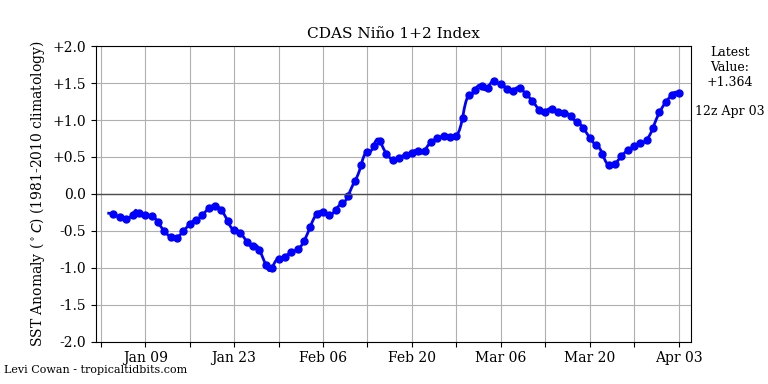
Whew!!! Just in time to save AGW. And if it doesn’t happen, no big deal. It’s 5 o’clock somewhere.
I find these forecast maps to be very confusing. The temperature map shows much of the country to be in area “40 to 50% likely to be warmer than normal”. That means the same to me as predicting these areas have a 50% or better chance of be at or below normal. Kinda seems like a heads I win, tails you lose prediction.
Excessive snowfall in the mid to high alpine mountains in the West on tap. Glaciers growing on the volcanoes in the Pacific Northwest. Snow, snow, and more snow. Skiers delight. Southwest Colorado will have an excellent ski season as will the Chugach, Teton, Wasatch and yes the Sierra. Cascades will be wet low and puking snow up high. Care to wager?
Above, near or below average!
I predict that the wind will come from the south, the east, the north or the west or somewhere in between tomorrow.
The next waves of Arctic air will reach the central US.
http://tropic.ssec.wisc.edu/real-time/mtpw2/product.php?color_type=tpw_nrl_colors&prod=epac×pan=24hrs&anim=html5
Bob Weber October 18, 2018 at 8:28 pm
How many times and ways have I said TSI warming/cooling is a cumulative process?
My reply
Yes you did say that which makes it more meaningful. I never said this is not a contributing factor . I just think there is more at work here then just TSI.
Where do you get the data for out going radiation ? Thanks
What I am seeing so far is that the jet stream is doing very deep loops and that will lead to both very cold temperatures and very warm temperatures and a miserable winter.
You are wrong, the pattern is as below.
https://earth.nullschool.net/#2018/10/21/1200Z/wind/isobaric/70hPa/orthographic=-114.43,52.65,515
See what’s happening in Hudson Bay.
http://masie_web.apps.nsidc.org/pub/DATASETS/NOAA/G02186/plots/4km/r10_Hudson_Bay_ts_4km.png
‘A mild winter could be in store for much of the United States this winter according to NOAA’s Climate Prediction Center.’
A weather forecast. From a “climate prediction center.” Do they ever make any climate predictions? Do they even know what climate means?
It is a climate propaganda center.
According to the JB gospel (and the MJO) it will indeed be very cold winter for about 50% of US with warmth in NW. I know who I believe.
“No part of the U.S. is favored to have below-average temperatures.”
— Brace yourselves. Global Warming articles and blurbs are coming!
For several days the solar activity is extremely low.
 ?time=1539972964000