Greg Goodman writes in to WUWT tips and notes:
Arctic sea ice minimum – this years 19/20th Sept at 4.594 million sq/km

Source: http://nsidc.org/arcticseaicenews/charctic-interactive-sea-ice-graph/
Not surprising that MSM has gone schtum about the remarkable persistence of their favorite “canary” not being dead yet.
This year’s min is greater then 2007 when AR4 was getting major push in MSM and Al Gore was trying to BS us all with his climate disinformation.
2018.2017,2015 and 2011 are indistinguishable.
2018>2016>2007>>2012.
The alleged ‘death spiral’ and ‘runaway melting’ has been essentially not going anywhere for over a decade now. Why isn’t this great climate news being told to the world?
More in the WUWT sea ice page.
I’ll be honest, the Arctic minimum has become so passe in the era of ever shrill pronouncements about “ice free Arctic”, “Arctic death spiral” etc, I forgot all about it. As a metric for global warming, it certainly hasn’t lived up to predictions from 10 years ago., much less recent ones, such as this one from Peter Wadhams – Anthony
Apocalypse postponed again? Damn it!
8 out of 11 Arctic Summer Minimums have been higher than the 2007 Summer Minimum.
The 2012 record low Arctic Summer Minimum was caused by the longest and strongest Arctic cyclone event in 50 years, not CO2-induced Global Warming….
Arctic Ice Extents follow the 30-year PDO/AMO/NAO ocean warm/cool cycles, and when all three are in their respective 30-year cool cycles from the early 2020’s, we’ll see Arctic Summer Munimums continue to recover at an accelerated pace, and Greenland’s Ice Mass will also show yearly net gains.
CAGW advocates will not be able to logically explain this Arctic Ice Extent recovery, but I’m sure they’ll come up with some lame “Global Warming is causing Global Cooling” illogical excuse..
A 50-year Grand Solar Minimum event will also start around 2021, which will likely add to global cooling.
The next 5 years should be very interesting to watch, especially if the current El Niño event turns out to be a weak one, followed by a stong La Niña cycle, which is likely.
Samurai,
All of the past twelve Arctic summer minima have been higher than 2007 but for one, 2012.
Ranked from highest to lowest, they are, as per NSIDC (negligible differences among the six middling figures):
2009
2013
2014
2017
2010
2018
2008
2015
2011
2016
2007
2012.
The trend since 2012 has been up, and since 2007 flat.
John, just in case anyone accuses of cherry picking, it is worth adding 2006 to that list, it was close to the average, rather than being a low point.
Greg,
IMO 2006 was the last year of the prior trend, and that the big breakdowns of 2007 and 2012, due to cyclones, set the trend since then, followed by 2016. That year, with two storms, arguably would have set a new low record were the ice not in recovery mode.
samurai, i would argue the possibility the wax and wane of arctic sea ice is the driver of the amo.
“The 2012 record low Arctic Summer Minimum was caused by the longest and strongest Arctic cyclone event in 50 years, not CO2-induced Global Warming….”
OO-err . longest and strongest , that sounds like it was unprecedented then ! Don’t you know that more frequent and more powerful storms is “exactly what climate models predicted”? This must be “mostly ” caused by CO2, “what else could it be”? [ Rhetorical proof, not a science question .]
You seem to be new at this game. Don’t you know how climate communication works?
Greg-san:
久しぶりですね!
You need to stop with your silly post hoc ergo prompter hoc logical fallacies…
If CO2 is responsible for every weather event, it’s not a scientific hypothesis but rather religious dogma…
Strange natural weather events happen all the time; i.e. shit happens…
Empirical evidence show no global increasing trends of frequency nor severity of: hurricanes, cyclones or typhoons over the past 100 years…
sarc 第三ダン
😉
Your Japanese is as bad as your logic…
Auto translation programs don’t work very well, Greg-san… They just make you look ridiculous…
It was a bit of fun, like the prior comment. The logic was a satirical parody of climatologists’ logic. Don’t get too upset by it.
Samurai,
+100!
Go Baby Ice, go. And away she went, and all grown up now.
=========================
Where are Griff and Tony McLeod when we need someone to laugh at and ridicule?!
Patrick,
We still have Keith, who apparently thinks that you can’t “splice” naked eyeball observations of Mars onto telescopic observations, when studying orbital variations for the Red Planet, which was so beautifully visible this summer, with its close approach and global storm, enhancing its ruddiness.
Plus other wonderful conjunctions.
I have stopped posting here, except to post I have stopped posting.
That’s for bringing us up to date. It seems that you have made such an impression that even when you don’t post many still have to talk about you. Fame at last.
He was just really funny in his posts all backed up by science from The Gaurdian etc etc.
Was hoping you’d post something to support all your predictions of a sped up death spiral in ice which have proven to be completely wrong!
Patrick,
Griff conveniently disappeared after predicting a record low summer minimum for 2017, because its winter maximum had been low. His betters here told him that wouldn’t happen, but he was adamant.
It’s OK of course to be wrong with a prediction, even if your reason for making it was clearly inadequate.
It’s not OK however to cast personal aspersions on such a fine scientist and person as Dr. Susan Crockford, without ever apologizing.
Two days ago I wrote on the Mailing List of our Belgian astronomical association (VVS) that the arctic sea ice minimum of 2018 was higher than in 2012 and 2016. A Mr Jacob Kuiper replied that, nevertheless, the downward trend continues. I replied that, even if at the end of the summer the arctic sea ice completely disapeared for some time, what would be the problem? Why would we need arctic sea ice? The man replied that he fears that later even during the winter the arctic sea will be ice free…!
— By the way, Jacob Kuiper is working at the KNMI, the Royal Meteorological Institute of the Netherlands.
Hi, Jean Meeus. I have some ( probably ) unrelated lunar periodicity questions I’d like to ask your advice on.
If you would kind enough to help with that , could you please drop a message on the About page of my wordpress blog.
https://climategrog.wordpress.com/about/
It’s been a number of years I have been trying to find a way of contacting you.
Thanks, Greg.
” the downward trend continues.”
With that kind of logic they will happily sit through 35 years of continued sea ice increase before acknowledging that a straight line may not be the best way to characterise the data.
Reducing a complex system to a single scalar quantity ( mean rate of change) is childishly naive, if not obtuse. We have daily data for almost 40y , it cost billions to collect. Is a single figure with something like 10% uncertainty really the most we can get from that?
Arctic Sea Ice ==> I’ve just been re-reading William Brigg’s “Do not smooth times series, you hockey puck! ” , in which he reminds us that The Data is The Data.
We do not need to, and should` not, be smoothing, averaging, krigging, and other nonsense-ing data sets is his basic point.
The other important point is that annual Arctic Sea Ice (ASI) minimums and maximums are just physical facts turned into numbers — our data sets on Arctic Sea Ice extent. The numbers tell us something about Arctic Sea Ice.
I’ll repeat that in case you missed it: The numbers tell us something about Arctic Sea Ice.
What the numbers don’t tell us about is ANYTHING ELSE — at least not necessarily. They certainly don’t tell us about Global Warming, Climate Change (except in Arctic Sea Ice regions), Madonna’s latest boyfriend, or whether the Russians are interfering in in the elections of my local school board.
There may be (and almost certainly are) relationships between ASI and other planetary climatic factors — but it is obvious from the literature that we understand very little about what those relationships are.
We can know that we are in a period of rather low ASI summer minimums — that’s important if your are an Arctic explorer or have far north shipping interests or like an acquaintance are solo sailing around the Americas.
But ASI extent is just data and is not proof of something else. It is not even proof that the Arctic is warmer…..
Thanks Kip, I read that article years ago. It is the kind of extreme , dogmatic position that usually indicates a lack of depth of knowledge. The sort of over-confident statement which comes from a freshman student who suddenly thinks he knows it all and is ready to teach the world. It does have some useful points though and is worth a read.
Firstly, I did not “smooth” the data. Smoothing is a poorly defined visual effect.
Secondly, what statisticians usually call ” a smooth” is a crappy running mean, which does a particularly bad job of “smoothing” and introduces significant unintentional distortion of the data. Please don’t accuse me of “smoothing”, it’s one of my trigger words 😉
I applied a carefully selected low-pass frequency filter for a specific reason. To remove short term weather effects, like storms, winds, lunar tidal effects, etc. with the criterion of obtaining a single change in sign of the derivative for min and max. each year.
This was applied to sea ice extent , rather than area, since it is reckoned to be less sensitive to the presence of surface melt pools on the ice, which satellites can not distinguish from open water.
It is note worthy that the venerable Dr Pielke Sr. had published a paper a few years earlier and had not been able to establish a significant trend in either direction in the date of annual minimum. I think part of the reason for that may have been that he used sea ice area. Also that I had a few more years of data and his significance tests may have been affected by the change in direction before it was evident there was one. He was only testing for the presence of single direction trend.
I don’t know what the change of the drift in date of min “means” but analyzing the data comes before explaining the effect. It could be coincidental or it could be a result of the larger expanse of open water and may contain information about the results of feedback processes.
Greg ==> Certaintly wasn’t accusing you of smoothing….this essay contains only the NSIDC graph and no original work that I can see. So, you’re off the hook there. My point is that ASI measurements are just measurement of ASI — not measurements of Global Warming (or Al Gore’s bank account totals) and do not need to be manipulated in order to mean something.
Re: William Briggs — either you are kidding or just ill-informed. Briggs is the guy who wrote the book that your “freshman student who suddenly thinks he knows it all and is ready to teach the world” is attempting to understand.
Hi Kip, in fact it was out host who inserted the NSIDC graph , I just posted a very brief comment to flag the minimum seemed to have occurred including figures showing that it has not gone anywhere for over a decade.
When you started saying ” … should` not, be smoothing, averaging, krigging, ” which no one was discussing and was not in the brief article Anthony posted, I thought your comment related to the article which I linked to a few comments from the top, which does do data processing and shows the drift in the timing of annual minimum which reversed around 2007.
You will not get far in science if you follow Briggs’ simplistic advice and “just look at the data”, which of course is itself a kind of filter and may not be the best .
If he is saying don’t apply crappy running averages, I’m with him 100%.
Greg ==> All I can add about Briggs is that he is an absolutely brilliant statistician, with very strong opinions. Here is an example of not doing as he suggests:

The data (red bars) is clear, simple, and straight forward. The black trace — smoothing — tells us nothing new and is “artificial data” — totally extraneous and hides the variability of the real data.
MASIE Time Series Plots
http://masie_web.apps.nsidc.org/pub/DATASETS/NOAA/G02186/plots/4km/r00_Northern_Hemisphere_ts_4km.png
The smoke from the Scandinavian forest fires saved a lot of ice this year.
This is only the beginning of a new “trend” in a nonlinear world and apart from advocacy science.
1) Pacific
http://climate4you.com/images/PDO%20MonthlyIndexSince1979%20With37monthRunningAverage.gif
2) Atlantic
http://www.climate4you.com/images/NOAA%20SST-NorthAtlantic%20GlobalMonthlyTempSince1979%20With37monthRunningAverage.gif
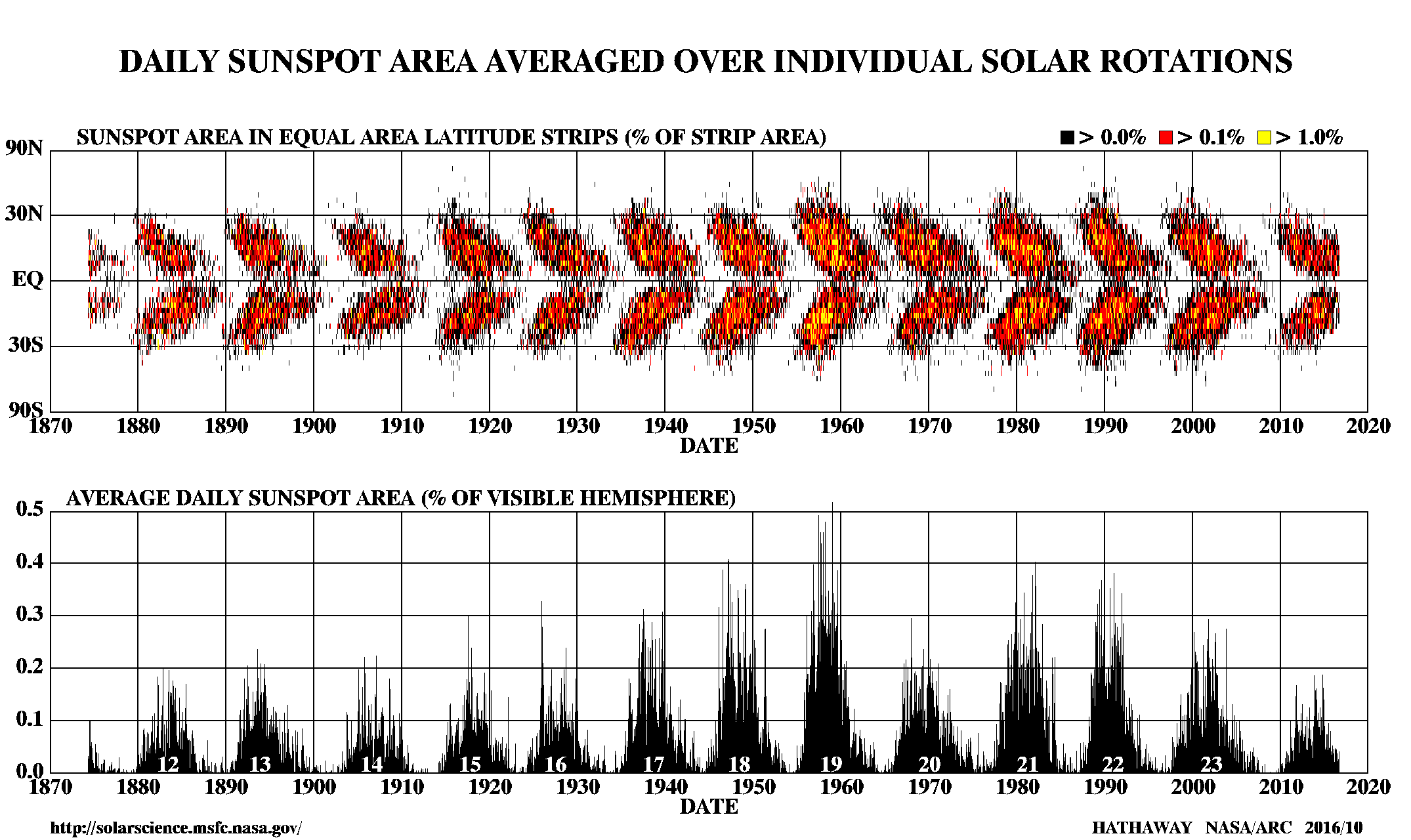
3) and that insignificant fusion ball in space at the bottom of our local gravity well
It would be considerably more instructive to begin the calibration period at 1998 instead of 1981 because the latter start date includes most of the dramatic warming of 1975 to 1998. Starting at 1998 would tell more about whether sea ice loss has occurred during the so-called “global warming hiatus” since 1998, which I feel is the “new normal” (i.e., elevated but non-increasing temperature). If you wish to respond to this, please do so through my email address: davidlaing(at)aol(dot)com, as checking either box below only loads up my inbox with irrelevant commentary.