News Brief by Kip Hansen

Plastics are as much in the news as climate change, and hold the same honored place as a universal scapegoat — an item so odious that all are welcome to blame it for a host of ills environmental and social, real or imagined.
The media has recently highlighted a few stories that shed some light on the question of plastics as a dilemma of modern societies.
Before turning your wrath and scorn on this well-meaning author, please review my personal stance on the question of plastics in the environment in my previous essays: Plastics Yet Again; An Ocean of Plastic; Contrary to the NY Times, The DR Has Lots of Clean Beautiful Beaches.
A good summary of my position on plastics is: “We each need to do all we can to keep every sort of trash and plastic contained and disposed of in a responsible manner – this keeps it out of the oceans (and the rest of the natural environment).”
Plastic is a controversial issue for the very reasons that so many modern goods (and their packaging) are made from plastic: it is malleable, it is moldable, it can be both stiff and strong and flexible and bendable, most plastics stand up well to sunshine, it is impervious to water and many strong bases and acids, it can be clear as pure water or totally opaque and can be made in every color imaginable. In short, it is a miracle class of materials. One side effect is that it tends to persist when allowed to enter the environment.
It is not, however, “forever”: despite reams and reels of propaganda aimed mostly at school-children, especially in the United States. You can see the incredible mass of sheer nonsense using any internet search engine on the phrase “Plastic is Forever”.
PLASTICS DEGRADE
One latest bits of news is that plastics degrade both in open air exposed to sunlight and in water. Of course, given that plastics are bad, even their natural degradation must be served up as a bad thing.
In contrast to actual science, the propaganda meme “Plastic is forever” is simply not true. Anyone, like myself, who has lived at sea in the tropics knows that plastic containers of almost all types rapidly degrade in the sunlight. Plastic coolers, plastic bottles, plastic handles on boat hooks, plastic clothespins and plastic clamps and even plastic zippers and plastic buttons on your favorite swimsuit.
In An Ocean of Plastic I detailed how pelagic plastic (plastic floating in the oceans) is broken down by exposure to sunlight and the motion of the water, into smaller and smaller pieces. At the same time, microbes of all types make their homes on the surface of the plastic pieces and begin to eat the plastic, wearing away at the surface, opening cracks, and contributing to the breaking of the pieces into smaller and tinier pieces. Eventually, like small chips of ice in glass of ice water, the surface area becomes so large in relation to the volume that the pieces simply disappear, having been eaten entirely by the microbes on the surface.
Although the study highlighted by ScienceDaily was produced by researchers at the Daniel K. Inouye Center for Microbial Oceanography at the University of Hawaii at Manoa in Honolulu, Hawaii, nothing in the paper “Production of methane and ethylene from plastic in the environment” has anything to do with microbes and does not even mention the fact that microbes are busy eating all that environmental plastic.
What it does do is attempt to raise the alarm that when plastics (which are not “forever”) degrade in the open air exposed to sunlight or in water, the plastics, like all hydrocarbon compounds, break down into simpler hydrocarbons, particularly the gases methane (CH4) and ethylene (C2H4 or H2C=CH2).
Methane, they point out, is a greenhouse gas. It is fairly short-lived in the atmosphere, with a half-life of about seven years, readily oxidizing to CO2 and water – the same result seen when it is burned as natural gas. Ethylene (or ethene) is a naturally produced plant hormone that promotes ripening of many fruits. Hydrated ethylene is alcohol — grain alcohol — and is naturally produced by the fermentation of sugars by yeasts. Both gases are extremely abundant in the natural world and are important products of biological chemistry.
Tip to Homemakers: Ethylene is the gas emitted by ripening fruit. Apples, for instance, can be used in the kitchen to hasten the ripening of fruits by placing an apple along with the unripe fruit in a brown paper bag where the ethylene from the apple will collect and chemically signal ripening of the other fruit.
The researchers in Hawaii draw the following conclusions:
“While serving many applications because of their durability, stability and low cost, plastics have deleterious effects on the environment. Plastic is known to release a variety of chemicals during degradation, which has a negative impact on biota. …. Our results show that plastics represent a heretofore unrecognized source of climate-relevant trace gases that are expected to increase as more plastic is produced and accumulated in the environment.”
The claimed “deleterious effects” of plastics “on the environment” — besides the obvious negatives of litter and erroneous ingestion by birds and animals — are all in the category of “might” and “could” — and almost all concerns about degradation products of plastics deal not with the plastic itself, but with additives in the particular plastic product. As for being a “source of climate-relevant trace gases”, I am afraid the authors have the arrow of cause backwards. The plastics that they are worried about have been manufactured mostly from petrochemicals in the first instance….petrochemicals that are not being immediately burned to produce GHGs, but rather sequestering those potential GHGs in solid materials for slow release at some time in the future, rather like the growing of trees sequesters CO2 for release when the wood eventually decomposes.
The misguided authors have missed the boat on this one — they had a:
Good News Story: Plastic is Not Forever! It naturally degrades into common, every day, generally-considered-safe biological gases — gases produced by plants and animals in the normal processes of life.
* * * * *
IN MUSEUMS, WHERE OBJECTS ARE MEANT TO LAST FOREVER, PLASTICS ARE FAILING THE TEST OF TIME
If you are not yet convinced that plastic is not forever, consider the story from the New York Times “These Cultural Treasures Are Made of Plastic. Now They’re Falling Apart.”
“The custodians of Neil Armstrong’s spacesuit at the National Air and Space Museum saw it coming. A marvel of human engineering, the suit is made of 21 layers of various plastics: nylon, neoprene, Mylar, Dacron, Kapton and Teflon.
The rubbery neoprene layer would pose the biggest problem. Although invisible, buried deep between the other layers, the suit’s caretakers knew the neoprene would harden and become brittle with age, eventually making the suit stiff as a board. In January 2006, the Armstrong suit, a national treasure, was taken off display and stored to slow the degradation.”
It is not just technological marvels that have a degrading problem — Art is also in trouble. Over at Harvard:
“Claes Oldenburg’s False Food Selection (1966) consists of a wooden box containing readymade plastic food items, such as a banana and a tomato. Made of isoprene rubber, the objects were originally rather realistic in appearance; today, they look deflated and somewhat unappetizing. …. Their altered appearance, which was not the artist’s intent, provides a startling lesson that plastic isn’t nearly as stable an artistic material as wood, metal, or clay, for example”
“A lot of people think plastic is going to last forever, when, in fact, it may be one of the most fragile materials you can use,” said Georgina Rayner, an associate conservation scientist in the Straus Center for Conservation and Technical Studies. “Plastics degrade more quickly than probably anything in a museum collection, and by the time you start to notice the degradation, it’s almost too late. You can really only slow it down.”
Plastic is so not forever that even in a near perfect conservation environment – a modern climate-controlled museum — plastic items degrade faster than paints, canvas, stone, glass, wood, metal, or even clay.
* * * * *
BEFORE YOU FLUSH YOUR CONTACT LENSES, YOU MIGHT WANT TO KNOW THIS
In the rush not to be left out of the rising concern over plastic in the environment, research presented at the American Chemical Society’s August meeting in Boston revealed the shocking news that 20% of all disposable plastic contact lenses were “flushed … down the toilet or washed … down the sink, rather than [being] put…in the garbage.”
“When the lenses make their way to a wastewater treatment facility, they do not biodegrade easily, the researchers report, and they may fragment and make their way into surface water. There, they can cause environmental damage and may add to the growing problem of microplastic pollution.”
“Filters keep some nonbiological waste out of wastewater treatment plants, said Rolf Halden, the director of the Center for Environmental Health Engineering at Arizona State University, and Charles Rolsky, a graduate student and the study’s lead author. … But contacts are so flexible that they can fold up and make their way through. The researchers interviewed workers at such facilities, who confirmed that they had spotted lenses in the waste.”
“Then, going through about nine pounds of treated waste, Mr. Rolsky and a colleague found two fragments of contact lens, implying that while microorganisms might not make much of a mark, physical processing might break them into pieces.”
“After processing, treated waste is often spread on fields. If fragments of contacts are in the mixture, they or the substances they’ve picked up may be washed by rain into surface water, the researchers conjecture.”
Contact lenses are made to be worn on the human eye — and thus have a requirement to be sterile and not prone to degradation by light, warmth, body fluids (such as tears) and have surfaces that are not convenient microbial habitat.
In my area, treated waste from waste water plants is not spread on fields — things may be different in Arizona. The researchers conjecture (gotta love the science value of that verb) that if waste water treated solids are spread on fields, and if the waste contains as many as two fragments of contact lenses per nine pounds of waste material, then those two fragments or the substances that the fragments may have picked up in your toilet water or at the waste water treatment plant may be washed into surface water…. May the gods of conjecture have pity on us all!
This all seems way too much like the epidemiologist’s nightmare that if infinitesimal quantities of something exist on a per person basis, then, since there are billions of people, then there exists a lot of that something [infinitesimal times billions = a lot — epidemiological arithmetic] therefore it must be a huge risk to human health.
That said — Throw your disposable contacts in the trash, please. Don’t flush them (or any other rubber and plastic personal products).
* * * * *
One last item:
The obvious solution to the problem of feral plastic (plastic that has gotten loose in the wild environment) is to manufacture plastic that conveniently decomposes into simpler organic compounds that can easily be dealt with by the natural process that is biological entropy — the processes that turn dead animals and plants into soil and gases like CO2.
There has been news on this front as well.
Designing the Death of a Plastic appeared also in the venerable New York Times which announces that:
“The latest villains in environmental campaigns are disposable plastic products formed from synthetic polymers — straws, cigarette filters, coffee cup lids, etc. Over the past few decades, this mismatch between material and product life span has built up plastic waste in landfills and natural environments, some drifting in oceans until mounds and mounds have reached the ends of the world and bits have been ingested by marine life.”
A bit of truth with a throw-away false talking point — “mounds and mounds have reached the ends of the world” — attached at the end. The “mounds and mounds” of plastic being spoken of originate at the ends of the world where waste management is still something to be achieved in the distant future. It is true that bits of plastic have been ingested by marine life…score one for accuracy in reporting.
Plastics are, for the most part, polymers: long chains of identical (or very similar) organic chemicals (hydrocarbons). To turn a plastic into goo or dust, it is only necessary to get the chains to spontaneously break apart. There have been some advances along the lines of using starches as part of the polymer chains. The starches, when exposed to moisture and microbes, dissolve and the plastic breaks into tiny, molecular-sized pieces. Other sorts of solutions have been used to make “compostable” plastic bags — which in reality means that if you send them to a commercial municipal composting plant, it will break down into component parts — but it will not do so in your home compost pile.
There have been advances in designing “death” into plastics — but don’t hold your breath waiting for these new plastics to show up in your homeowner products or packaging materials.
“Economically speaking, replacing the most widely used polymers like polyethylene (grocery bags), polypropylene (fishing nets) or polyterephthalate (single-use bottles) with unzipping polymers is not feasible.”
For most of the developing world, simply collecting and landfilling municipal waste, including the plastic, would be a major improvement. In the developed world, if we want to keep plastic out of the environment and the oceans, we need real recycling programs that actually do something other than landfill the used plastic. Even burning it to make electricity or produce heat would be preferable to landfilling — but this must be done in a properly designed high-temperature clean-coal-type plant or a municipal waste fueled power plant. Again, most of the problems with burning plastic is not the plastic itself, but additives in the plastic products. High-temperature incineration coupled with flue gas treatments to reduce pollutants is a reasonable and efficient approach.
Turning recycled plastic soda and water bottles into plastic lumber for outdoor use is also an approach that is comparatively inexpensive and sensible. In the United States, outdoor decks are all the rage, being almost a requirement for modern living and must be fitted with an outdoor gas grill and outdoor furniture. The outdoor furniture too can be made out of recycled plastic bottles of all types.
The Bottom Line:
We each need to do all we can to keep every sort of trash and plastic contained and disposed of in a responsible manner – this keeps it out of the oceans and the rest of the natural environment.
# # # # #
Author’s Comment Policy:
I was interested to find that all the articles on plastics contained nearly identical wordage along the lines of “A majority of the world’s plastic waste ends up in the sea, where, because of currents, it often becomes concentrated in subtropical gyres or ‘ocean garbage patches.’ This pollution is often ingested by marine life and can find its way into the human food chain.” [ quote source: New York Times] This is blatantly false. When journalists repeat these obvious falsehoods, it is a sign that Editorial Narratives are at work and that mandated propaganda has outshouted reason and truth.
Self-destructing plastic — the Magical Plastic of today’s title — is not going to arrive in time to obviate the need for proper handling of mankind’s trash. We have to see that our own communities and nations adhere to basic kindergarten rules: Pick up after yourself — don’t litter — put your trash in the trash bin.
I’d love to hear your local stories about how your community is (or isn’t) doing its part.
# # # # #
Only greenies could posit that something designed to be put in your eye becomes a significant hazard if you flush in down the toilet instead.
It’s a sign of the times, I guess.
Hart ==> Very Good! I only really got your comment after reading it on my fifth pass through the comment section….kh
Ah yes!
It’s the theory and practice of contagion.
Echoes of the days when cooties and a boy’s touch were deadly to all involved.
You have to love the physical evidence; “fragments” of contacts. From “fragments” they extrapolate vast dangers of alleged potential contagion…
Bureaucrats rewrite regulations, until they reach an optimum regulation that prevents all possibility whether in the past, the present or the future. That it is possible and might happen somehow, is sufficient cause for them to drag civilization down.
Sunlight, oxygen, bacteria, and erosion all degrade plastics.
Even the high density high quality long lived plastics will degrade into dust. As dust it forms a fairly neutral substrate excellent for soil aeration and drainage.
Eventually, as most surface materials on Earth, it will be tectonically recycled. Who knows, those contact pieces might be formed into diamonds in the mantle.
Defund those researchers that produced this trash idea, “research presented at the American Chemical Society’s August meeting in Boston.
Fire the bureaucrats producing regulations about this nonsense and delete anything that regulates precautionary potential possible maybe contagion.
ATheoK ==> The researchers did supply a photo of the two fragments….
I have always said let’s net together all the plastics we can and set it a drift in the ocean. With in months you would have every form of life growing living and thriving on these floating islands and before to long we could be booking wildlife get always to millions on these islands. Of course that would only last until they degraded to the point that totally fall apart.
Bob boder ==> It has been my experience that everything solid(-ish) thing that ends up in the seas becomes a home or food for something (sometimes both, for the same or different life forms).
If you want to see tropical fish, just sunk a boat or a used tank, or a battleship, or old cars in water less than100 feet and “Instant Reef!”. Even isolated rocks the size of a football collect a school of fish.
My brother has a 57 Ford Thunderbird which he bought in 57. He will attest to the fact that plastics do not last forever. He has replaced many pieces several times. And it is in a garage more than 90% of the time.
usurbrain ==> If he is tired of fussing with it, I’ll take it if he can ship it to me in New York.
You do know what is among Earth’s first plastics happens to be, don’t you? ;p Hint … the polymer has ‘sugar’ units and its binder is an aromatic resin. The common name for it starts with “w”.
cd ==> For ten points — would that be wood?
Plastics make a good media for aquarium filters, hosting necessary microbes while being nontixic.
I’m going to try and find the link to a story I read yesterday concerning mosquitoes and either micro beads or degraded plastics. The overall concern is the larvae ingest the small particles which don’t leave their stomachs. Eventually, the plastic gets transferred from the grown mosquito into a victim where it stays FOREVER because plastic lives forever. I thought it was cheap entertainment for a non problem.
RHS ==> One of many echo chamber stories here.
Hi Kip, Thanks, good post. My community in Texas has had single line recycling for over 30 years. We used to have a large recycling center that sorted everything and sold or gave away the sorted materials to companies that actually used them. We all knew to clean our plastic, paper, etc. or it would go in the landfill, as well as anything touching the dirty recyclables. Good system.
Then we started exporting our recyclables, as did most cities, to the third world. They paid a good price and had fewer restrictions, dirty recyclables were OK. What we didn’t know, was that the third world countries (mostly China and Vietnam) were dumping the dirty stuff into rivers and the ocean. They only attempt to recycle the good stuff. In the meantime the dirty portion of the recyclables (including dirty diapers) increased to over 25% of the total, by volume.
I vote for properly designed incinerators (as they use in Europe) and that we go back to taking care of our own trash.
Andy ==> Me too (sarc)…. incineration leaves us with only the ash problem. Ashes to concrete building blocks?
I thought automobiles might be incinerated whole….and the metals collected at the end of the cycle.
Some of the metals may burn. Aluminum tends to burn. I guess the temperature would need to be controlled
Anyone who has watched the movie “Toy Story” knows about the problem of plastic corrosion.
https://getyarn.io/yarn-clip/64a5589c-7ebd-4088-8ae4-33a7593e7a9e
D Andersen ==> Poor Woody et al…..
In contrast, the dolly I made for my first child, out of a bit of cloth left over from my wife’s making her first dress, is still like news (except for child-wear….).
“Even burning it to make electricity or produce heat would be preferable to landfilling — but this must be done in a properly designed high-temperature clean-coal-type plant or a municipal waste fueled power plant. Again, most of the problems with burning plastic is not the plastic itself, but additives in the plastic products. High-temperature incineration coupled with flue gas treatments to reduce pollutants is a reasonable and efficient approach.”
Plastics are energy dense sources to fuel municipal waste to electricity. Environmental activists lawsuits bogged down the planning and funding for such electricity generation. Nagging whittling away at the timely implementation dragged out the financing of these projects such that municipal governments abandoned them altogether. The problem that the waste to electricity programs were to solve now accumulate with land fill space becoming scarce.
Has environmental activism been harmful to cities? In this case…yes.
RiHo08 ==> The anti-science left is astonishing in its stupidity ….
Some artists don’t like the modern acrylic paints, referring to them as a “plastic”. Are they?
As for degrading, it is said acrylics do stand the test of time until now. They are there for about 70 yrs now. Testing in the laboratory even promises possible durability for centuries.
Jurgen ==> Read the links to the stories about museum conservationist problems with acrylics….
So far I see 3 links here that give a reference to texts in which the word “acrylic” can be found, all be it just sporadic or just once. Apart from the general context that places the acrylics in the plastic realm in these links, they don’t offer offer any specifics about acrylics themselves. So for me the question remains, is acrylic really a plastic in the sense of this post? Googling learns me acrylics belong in the broad category of plastics. But that doesn’t tell me a lot about its stability over time. I would think not all “plastics” are equal in durability.
I do know very traditional and/or very professional producers of top-class artist paints that do offer acrylics in their assortment, and the high pigmented ones may be very expensive indeed (Golden comes to mind). And a lot of professional artists do use them and trust them.
As for myself, I use acrylics now for say 20 years, and I am not aware of any deteriorating as can be easily observed in other “household” plastics.
This link is more specific about “acrylic polymers” being used by artists such as Andy Warhol, David Hockney, and Mark Rothko. This leaves me the task finding out more about this. I do remember an early batch of acrylic paint by Talens also called “polymers” they stopped producing. So I guess there is not just one kind of “acrylic”. The problem being of course the producers keep their secrets.
see links in:
tom0mason September 20, 2018 at 2:51 am
Per Shel Silverstein —
https://youtu.be/kcONTxqKh8w
Bill ==> Good old Shel — a Nashville hack songwriter — him and a hundred others — like Kris Kristofferson. Also a passable comic and writer of children’s books — and not unfamiliar to readers of Playboy magazine style comic essays.
The common packaging material that lasts the longest in the environment is glass.
Rich Lambert ==> Absolutely correct! Glass is forever!
I have glass samples that are millions of years old in my rock and mineral collection — volcanic obsidian picked up off the ground in California — much of it black, some brown and some clear as a crystal wine glass. As shiny as the day it hardened.
We all have seen pictures of wine bottles recovered from sunken ships hundreds of years old.
Best for beer!
Waxworms eat plastics —
“In 2014, Wu and colleagues at Stanford University found that a gut bacterium in another species of wax worm could break down polyethylene, although it had different byproducts. A 2016 study identified the enzymes in a species of bacteria that could break down a type of plastic called (polyethylene terephthalate).
“There are probably lots of other worm species out there that can degrade plastics,” he said.”
https://news.nationalgeographic.com/2017/04/wax-worms-eat-plastic-polyethylene-trash-pollution-cleanup/
Yeast consume plastics —
https://www.ibtimes.com/yeast-breaks-down-biodegradable-plastic-research-376872
Scientists Just Discovered Plastic-Eating Bacteria That Can Break Down PET (polyethylene terephthalate)
https://www.sciencealert.com/new-plastic-munching-bacteria-could-fuel-a-recycling-revolution
But unlike natural polymers (such as cellulose in plants) plastics aren’t generally biodegradable. Bacteria and fungi co-evolved with natural materials, all the while coming up with new biochemical methods to harness the resources from dead matter.
But plastics have only been around for about 70 years. So microorganisms simply haven’t had much time to evolve the necessary biochemical tool kit to latch onto the plastic fibers, break them up into the constituent parts and then utilize the resulting chemicals as a source of energy and carbon that they need to grow.
I do know from bitter experience that termites WILL all manner of construction plastics — from PVC and HD-polyethene, to Acrylics. I suspect they’ll have a go at just about anything.
However nature being nature it will not allow a high calorie meal like plastics go to waste, I predict that in a few years (probably less than a decade) with a little help from man, plastic eating critters will be gorging themselves on our piles of plastic trash.
Left alone they’d probably get there by themselves it just would take longer and subjected to the usual normal hit and miss approach that nature tends to take.
By the way is the any evidence that the macro-micro-nano particles of plastic in the oceans are actually harming anything? I suspect, just like the bacteria that flourished during an oil spill, there are probably something (bacteria, algae, diatoms, etc.) in the oceans proliferating now as these plastic particles rain down on them.
Our landfill uses all of that stuff to generate electricity. The municipal landfill folks pile it hundreds of feet high and then harvest the gases in the base of the pile to run turbines. The turbines run 24/7. They used to just burn it off but now it’s fuel. Plastics, garbage, wood, etc. Everything I suppose excepts for metals? I drive right by the hum of the generators when I go to the brush pile to dump my palmetto fronds and other limbs and leaves.
Larry ==> Where do you live? What landfill is this, I’d like to check it out.
“That said — Throw your disposable contacts in the trash, please. Don’t flush them (or any other rubber and plastic personal products). ” No you should not flus them but when you throw then in the trash most trash end up in a landfill. Landfill are the stupidest piece of environment destruction man has ever come up with, burying biodegradable mater and metal denies them oxygen and when the cannot degrade and oxidize quickly the migrate to ground water making a manageable problem into an unmanageable problem. Landfill will be and are the next great man made environment disaster.
Mark Luhman ==> Landfills are an improvement over what my Grandfather had — which was a dump in a ravine behind the barn on his farm. Every farm had a dump or tip site — better one managed landfill than a million little open air dumps and trash all over the landscape.
When I was a lad in the 1950s, living in Los Angeles, all the backyards still had incinerators — a burning barrel or a proper brick incinerator with a ten foot chimney. Everything that would burn was burnt in it, then the ashes were placed on the curb for pickup in small special ash cans. Hence, the 1950s/1960s LA SMOG.
Better a proper full-sized waste-fuel municipal incinerator/power plant than a million back-yard incinerators.
There are few, if any, perfect solutions to modern problems.
No you should not flus them but when you throw then in the trash most trash end up in a landfill. Landfill are the stupidest piece of environment destruction man has ever come up with, burying biodegradable mater and metal denies them oxygen and when the cannot degrade and oxidize quickly the migrate to ground water making a manageable problem into an unmanageable problem. Landfill will be and are the next great man made environment disaster.
No! Third-World “solutions” (throwing wastes away in trash dumps and discharging sewer into the rivers and bays) and Third World landfills ARE the CURRENT man-made environmental disaster. But US-UK landfills ARE NOT Third World open-air sewers and trash piles.
To repeat:
ANY mass put into a landfill can be recycled later when time, money, energy, material cost, recycling costs or need require the masses to be recycled!
ANY mass (garbage) thrown in the oceans is effectively lost forever.
Beautiful article and beautiful discussion.
The basic question is “what is responsible manner?”; has anybody seen the plastic degrade in open? How many years it take to degrade in open?
Re-use and recycle adds up the waste but incineration reduces the waste accumulation. Biomedical waste is disposed using incineration. Hazardous industrial waste [high TDS] is disposed using incineration. In power production waste production could be reduced [domestic waste that includes plastics].
Dr. S. Jeevananda Reddy
Dr. S. Jeevananda Reddy ==> “has anybody seen the plastic degrade in open?” We certainly have….anyone who gets outside, volunteers to pick up trash on the roadside or the beaches, anyone that has lived extensively on the sea or in tropical climates especially.
Single-use shopping bags break down in a single year if in the sunshine, a little longer if partially buried or under brush — soda/water bottles take only a little longer before they break apart when picked up. Once the plastic is either exposed to sunlight or soil microbes, is begins its organic demise.
Landfilling, re-use/recycling, and incineration are all appropriate under the right circumstances. Managing these types of problems is not easy — but actually doing something — any of the three — is far better than the massive neglect seen in some poorer nations — who, granted, have far bigger problems that need their attention.
Kip Hansen — I lived for several years by the side of sea [Visakhapatnam in India, Maputo in Mozambique] and I am living [born also] in tropical climates.
I am one of the main environmental activists in Hyderabad where the plastic menace is severe. Aerial survey show all around the city plastics along with garbage. For years we have not seen plasic degrading. Same is the case in landfill sites.
Some states in India are laying plastic roads.
Dr. S. Jeevananda Reddy
Dr. Reddy ==> You need to investigate the obvious disconnect between what your personal experience is telling you and the experience of others and the findings of so many well-done scientific studies.
I doubt very much that physics and chemistry is different in Hyderabad.
Keep in mind that not all “plastic” is the same– there are many general types and they all have different physical characteristics. Nonetheless, I don’t think there is anything special about Indian plastic that protects it some its many enemies — UV, heat, microbes, etc.
What I did to educate myself is I went out on the sea and the beaches in tropical and semi-tropical climes and picked up and looked at stuff. I have been out on the roadsides of North America and picked up and collected plastic litter. Some of my observations are written up in An Ocean of Plastic including photos of degrading and degraded plastic.
If you find that plastic litter in Hyderabad does not begin degrade somewhat in the Sun after a year or so — samples should be taken and sent to a lab — you have found everlasting magical plastic!
Seriously, what I suspect is that the plastic litter is “self-replacing” — so much new plastic litter shows up that there is always new looking plastic laying around — this is common to many countries I have visited. Even here in the more northerly latitudes of New York state, when my volunteer group does roadside cleanups, we find the plastic litter often breaks apart as we try to pick it up — as the sun has had its way with it. We cleanup the same roadside twice a year, so the plastic that we find crumbling in our hands has only been out there six months to a year — no more than that. Some types of plastic last longer — but it all shows some degradation.
Even my UV-protected HDPE fuel jerrycans show some degradation after a number of years — not a lot, but some.
When you present a report, your replies to comments follows the Warmists on global warming and denigrates commenter’s views. It is a bad practice.
Road sweepers burnt the garbage that includes plastics. This gives obnoxious odour as plastics release “Dioxin” a health hazardous gas;
When plastics mix with domestic garbage, at dump sites the new always overlaps the old. It is natural system. If you dig, you find no change in plastics. If the plastics are in the soil, it affects the infiltration of rainwater. When they are dumped into nalas they create flood problems in heavy rainfall. When we remove silt from the nalas, the plastics are intact while the other wastes become compost. In the ocean, also follow this, as above the sea water relative humidity is high and water waves will deflect the Sun rays and Sun’s energy reflected back by the white surface of the plastics like in the case of ice. Energy available to burn plastics is reduced.
When my grandson visits me [he lives in San Francisco], he tries to burn the paper using magnifying glass. It burns the paper because the Sun’s rays are concentrated with more energy. When paper is put on open surface exposed to direct Sun Rays present no burning action for days/years. When the paper is put in the garbage it turns in to compost as it degrades.
Because of these practical problems, to reduce the accumulation of plastics in the environment: (1) some companies encouraging students to collect the plastics in their neighbourhood and in turn they get money by weight. These are used in laying roads. Some are recycled and re-used, biomedical waste that includes plastics is incinerated.
Hotfoods are carried in plasic bags — some suggested not to use plastic below certain microns as they release certain gases. Here the heat is different from Sun’s energy.
Dr. S. Jeevananda Reddy
Dr. Reddy ==> Plastic does degrade slower in dark anaerobic conditions — such as when it is buried in landfills. You mustn’t be impatient. Nature has its way and will deal with it.
It is far better to recycle or burn plastic waste than to landfill it — but also far better to landfill than to let it escape into the natural environment.
For the most part, all large plastic items that float on the sea degrade into small plastic bits which are subsequently eaten entirely by microbials. Not floating items sink to the bottom of the sea and become part of the environment — slowly being attacked by natural processes and critters — the same as every other fairly long-lasting material — they cause no known harm there despite the fact that they do not belong there.
Bottom Line: collect and recycle plastic (and all other reusable materials)…if that is not possible, burn the waste in a proper high-temp power plant with flue stack gas washing….if that is not possible, landfill in a properly engineered landfill.
Back in the late 1990s, our state merged two of its three environmental agencies. The new management came from our agency and had a lot to learn about how the other agency had operated for years. The other agency had always acted like liberal elitists and the rest of the world was beneath them. For over a decade much of the state outside the Capitol and rural counties had mandatory curbside recycling. It had been a bit of a stink between local governments and this environmental state agency over the years. Well at the first senior management meeting after the merger one of the primary topics of discussion was what to do with the recycled materials. It turns out that state had been paying millions to store the stuff even though the law said, and the agency had promised, there were “really good markets” for all recycles, especially plastic.
Wind turbines and solar arrays have killed and will kill way, way more birds and other wildlife than all the plastics.
Edwin ==> Thanks for the local story and personal experience. It is a complicated problem for a lot of localities.
Epilogue:
Very interesting discussion on some of the related topics. Waste Management is a big issue and a big problem in many parts of the world. Feral plastic — pelagic plastic — originates mostly in the poorer countries of Africa and Southeast Asia, where municipal waste management must stand line behind many other higher priorities for funding. The richer nations should direct their funding for plastic pollution to preventing it at the source rather than spending millions on mad-cap schemes to retrieve pelagic plastic.
There is some conflation of “plastic pollution” with the problem of nano-particle pollution. My view is that nano-particles of plastic, when found in the wild (oceans, lakes) are microbe food and quickly consumed by hydrocarbon-eating microbes, which have been found to be eating the plastic in the oceans. Nano-particles of plastic will have very high surface area to volume ratios and thus be quickly reduced entirely. There are photos of the microbes at work on plastic surfaces in my previous essay “An Ocean of Plastic“. The same essay shows the research that indicates that very small particles of plastic, so far, have not been recovered from the oceans — when when specifically looked for. I think they have been eaten.
I appreciate the interest shown in this issue — if you live near beaches, a pleasant morning or afternoon can be spent walking the beach with a bag into which you can place any plastic bits you find in it and drop it in the rubbish bin at the parking lot. Same if hiking a mountain or park trail, a single-use shopping bag fits easily in the tiniest place in your backpack or pocket, and can be filled with litter as you go.
Thanks for reading.
Years ago I worked for a company the produced equipment that used drilling fluid. There were problems in some areas with the disposal of the excess fluid. As a result I talked to a landfill manager in California. I don’t remember exactly what we talked about, but he said, “You have to remember that what I deal with is 90% politics and 10% science.”
Rich ==> Yeah — I bet he was overestimating the percentage of Science in that….
“Goddess of Kip” is running at Arlington Park in about 6 minutes, current odds 4-1.
uk(us) ==> Did I win????
A hard fought victory at 7/2, the horse could use a break, it seems like they’ve been running the hell out of it lately.
Ownership: Lone Pirate Racing, LLC (Charles Johnsen)
90% of all plastic in the oceans comes from 10 major rivers: 8 in Asia and 2 in Africa.
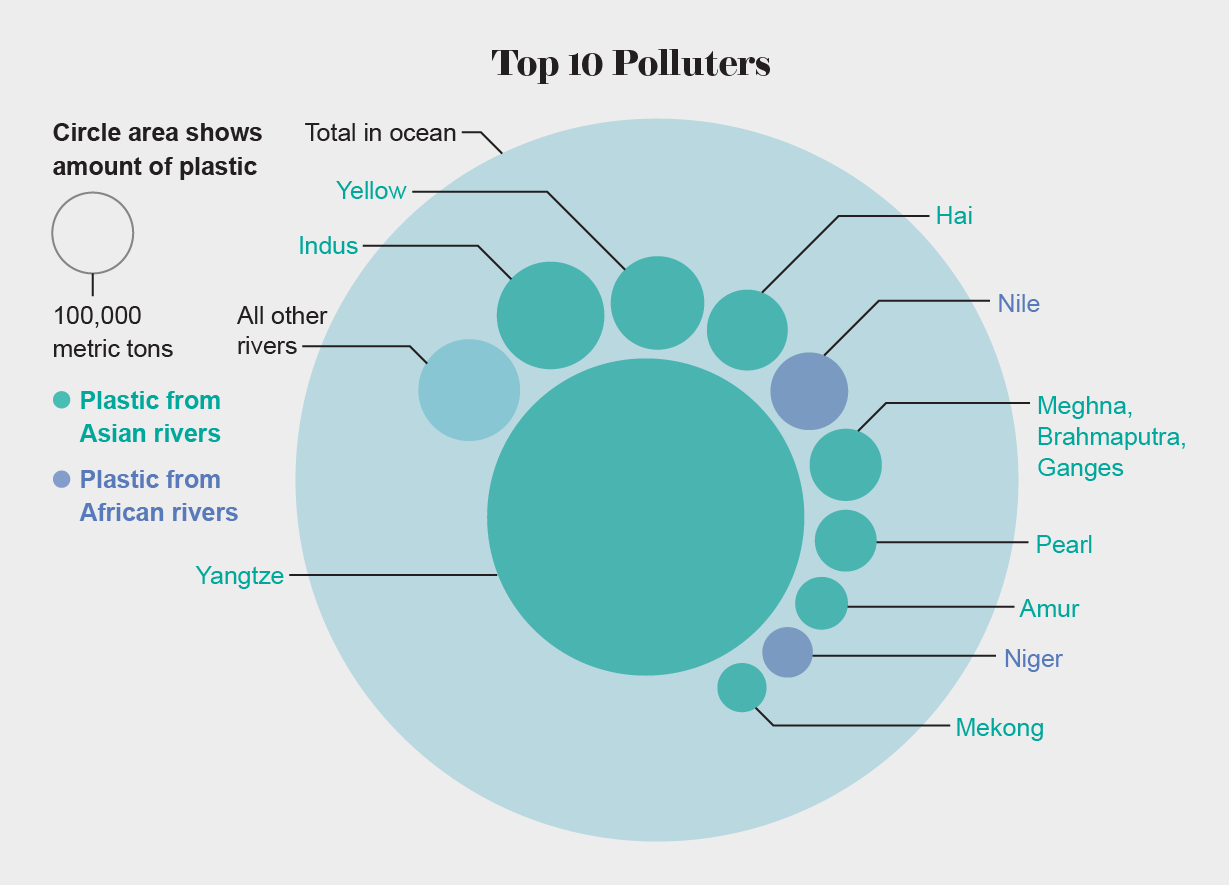
Cleaning up those rivers would remove 90% off plastic pollution in the oceans.
What is being done to address this problem? Nothing, just virtue signaling in Europe.
http://notrickszone.com/2018/05/29/latest-euro-delusion-eu-wants-us-to-believe-it-can-rescue-oceans-by-removing-less-than-0-01-of-the-plastic/
Lars ==> Yes….those are the hard facts. Aid money being spent to “remove” plastic from the oceans is wasted — as existing plastic will soon get eaten up. Tracking and removing masses of old fishing nets, if they can be spotted by satellite, is not a terrible idea, they are a threat to shipping.
All aid money on this issue should go to stopping plastic at the known hot spot inputs — upstream at the source in your 10 ten major rivers.
TY Kip
A reasonable perspective and a well written piece.
Takeaways :
Plastics are NOT forever
Pick up your trash
Perhaps find a useful repurpose for it
As usual RESIST the hoi polloi’s desire to have us REACT to their stimulus without evidence.