From the UNIVERSITY OF VERMONT and the “plague of locusts” department
Global warming: More insects, eating more crops
Global loss of wheat, rice and maize projected to rise 10-25 percent per degree of warming
Crop losses for critical food grains will increase substantially as the climate warms, as rising temperatures increase the metabolic rate and population growth of insect pests, according to new research.
“Climate change will have a negative impact on crops,” said Scott Merrill of the University of Vermont, a co-author of the study published today in Science. “We’re going to see increased pest pressure with climate change.”
The research team looked at how the insect pests that attack three staple crops – rice, maize and wheat – would respond under a variety of climate scenarios. They found that rising global temperatures would lead to an increase in crop losses from insects, especially in temperate regions. Losses are projected to rise by 10 to 25% per degree of warming.
Just a 2-degree rise in global average temperature will result in total crop losses of approximately 213 million tons for the three grains, the researchers say.
Insects like it hotter – up to a point
The losses will come from an increase in insect metabolism, and from faster insect population growth rates. The link with metabolism is straightforward. “When the temperature increases, the insects’ metabolism increases so they have to eat more,” said Merrill, a researcher in UVM’s Dept. of Plant and Soil Science and Gund Institute for Environment. “That’s not good for crops.”
The link with population growth, however, is more complex. Insects have an optimal temperature where their population grows best. If the temperature is too cold or too hot, the population will grow more slowly. That is why the losses will be greatest in temperate regions, but less severe in the tropics.
“Temperate regions are not at that optimal temperature, so if the temperature increases there, populations will grow faster,” said Merrill, an ecologist who studies plant-crop interactions. “But insects in the tropics are already close to their optimal temperature, so the populations will actually grow slower. It’s just too hot for them.”
Key grain crops to take a hit
According to the study, wheat, which is typically grown in cool climates, will suffer the most, as increased temperatures will lead to greater insect metabolism, as well as increased pest populations and survival rates over the winter. Maize, which is grown in some areas where population rates will increase and others where they will decline, will face a more uneven future.
In rice, which is mostly grown in warm tropical environments, crop losses will actually stabilize if average temperatures rise above 3°C, as population growth drops, counteracting the effect of increased metabolism in the pests. “Rice losses will taper off as the temperature rises above a certain point,” said Merrill.
That means that the most substantial yield declines will happen in some of the world’s most productive agricultural regions. “The overall picture is, if you’re growing a lot of food in a temperate region, you’re going to be hit hardest,” said Merrill.
“I hope our results demonstrate the importance of collecting more data on how pests will impact crop losses in a warming world — because collectively, our choice now is not whether or not we will allow warming to occur, but how much warming we’re willing to tolerate,” said Curtis Deutsch of the University of Washington, who co-led the study with Joshua Tewksbury, director of Future Earth at the University of Colorado, Boulder.
France, China and the United States, which produce most of the world’s maize, are among the countries that are expected to experience the largest increases in crop losses from insect pests. France and China, as major producers of wheat and rice, respectively, are also expected to face large increases in losses of those grains as well. “The areas that produce the most grain, especially wheat and corn – the US, France and China – are going to be hit hardest,” said Merrill.
Reduced yields in these three staple crops are a particular concern, because so many people around the world rely on them. Together they account for 42% of direct calories consumed by humans worldwide. Increased crop losses will result in a rise in food insecurity, especially in those parts of the world where it is already rife, and could lead to conflict.
As farmers adapt to a changing climate by shifting planting dates or switching to new cultivars, they will also have to find ways to deal with pests, by introducing new crop rotations, or using more pesticides. But not all of these strategies will be available to all farmers. “There are a lot of things richer countries can do to reduce the effect, by increasing pesticide use or expanding integrated pest management strategies,” said Merrill. “But poorer countries that rely on these crops as staple grains will have a harder time.”
###
Of course, the press release and study apparently assumes static pest management practices. Meanwhile yields don’t seem to be affected by bugs:

And won’t the birds be happy.
Yeah, u.k.(us). Maybe they should have correlated the increase of insects with the increase in avian obesity.
They picked the wrong hill to die on. All those fat little birdies would be a catastrophe they could blame on CAGW.
(I call dibs on that grant!)
Here’s a screen shot of this research’s group 3rd paragraph of their Science magazine (toilet)paper:
The Plague of Locusts are the rent-seeking scientists who use the phony BAU RCP8.5 scenario around which to build their “research.”
Furthermore, there are inconvenient things in the Supplement to their (toilet)paper that they don’t allude to in the main paper. Probably realizing that few people read beyond the Abstract and the main conclusions.
This is from their Supplement:
Another inconvenient graphic they produced was hidden in the Supplement:
(also note the change in color scale between the center panels and the right-side panels. The right side panels are the money panels, that show the modlled additional crop loss due to increased/decrease insect damage.)
A careful study of these sets of panels shows that the additional crop yield losses (note they do not show crop yield increases that occurs to 20N to 25S insect decreases in their model) are in areas where current yield in generally low (left-side panels).
They bury lots of inconvenient results to their alarmist narrative in the Supplement.
Even the IPCC says that the most warming will be happening where the fewest crops are grown, and the least warming will be in those areas where the most crops are grown.
Has there ever been one benefit to warming???
Even though my cat has free run of an air-conditioned house, she frequently prefers to spend the day out in the humid, 90-degree heat. I guess from her point of view heat is good. But then, I can dump a load of laundry fresh from the dryer on my bed for sorting, and she detects the heat from two rooms away and settles in before I can even start sorting and folding!
2c is the difference between the current flood of biome production and lasting famine with ground frozen too long for timely tilling and planting
More people die of cold than die from it being too warm.
A warmer world means longer growing seasons and more acres where farming is possible.
The week in review. Monarch butterflies to die off due to… Locusts to thrive due to…
When biologists and agronomists are waxing strongly on demise of food, habitat, diversity, bacterium, insects … re global warming, there are no atmospheric physicists in the klatch to tell them it is totally impossible for the tropics to heat up much at all, let alone 3C. This is one climate zone that doesnt change. Seawater in the open ocean can’t exceed 31C.
The tropics can cool a bit from where it is now, but even with the glacial maximum remain pleasantly warm. Arctic, yeah there you can get +3C or more, but the temperate zone, somewhere in between. Researchers peer reviewers, editors should police at least the more solid aspects of global warming.
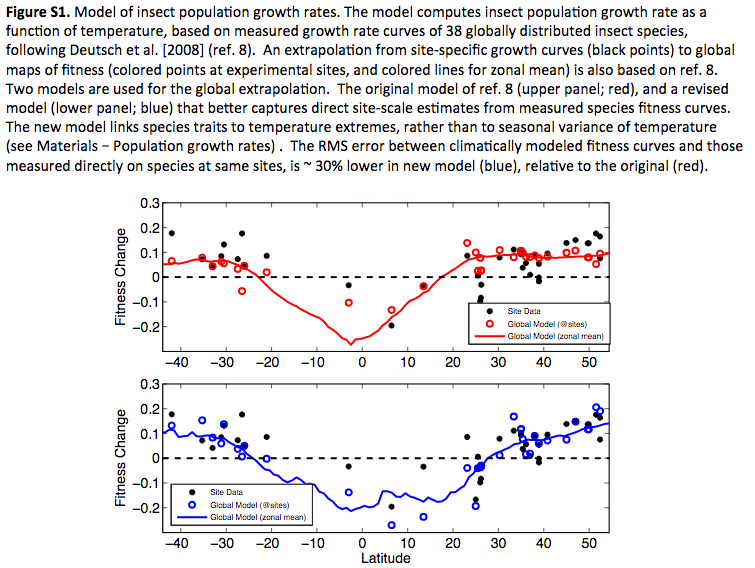
Indeed, they do not focus on the decrease in insect fitness in the tropics under their marginally warmer climate scenario for the tropics, but they show it in their Supplement.
Supp Fig 1.
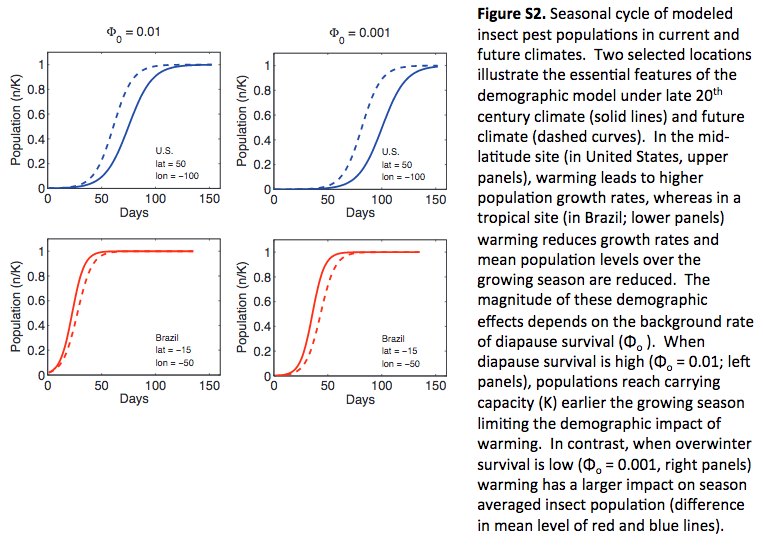
Supp Fig 2.
In their published manuscript, they do make this statement about the tropics:
You won’t find them discussing that tropical crop yields increase in their modeled scenarios. They focus exclusively in the main manuscript on how “robust” their results are. Utter nonsense.
Time to go short on honey futures. There will be so many bees that honey will be running across the roadways. Go long on producers of windshield washer fluid as there will be so many more butterflies.
Or go nuts laughing at all these predictions!
No, no, no – only the bad insects – pests will be increased. The good ones will die by the hordes and go extinct. ‘Cause that’s how the evil magic “carbon” poison works.
Because it is the bees and butterflies who are being threatened by climate change!
Monsanto has our backs and you can take it to the bank that green whining will be drowned out by crop duster engines.
Seems like no projections would be needed to gauge crop production vs annual average temperature. You should be able to see the adverse impact on yields on todays crops across the various specific crop’s growing range.
Breathless, hyper-ventilated and superlative riddled.
That’s all you need to see.
I got a headache trying to plough through it.
Would you send your child, at a (UK) cost of £9,000 per year tuition fees plus same again living costs, to That University and be fed sensationalist *junk* like that for 3 consecutive years?
Stay home, watch the BBC and read the Guardian – much cheaper.
Now we see why Matt Ridley wrote about the confused, guilt-ridden and hence Censorious Age – hapless brats have been through that horrible mill.
Pink Floyd got it right with ‘The Wall’ – remember the video with the walking (red coloured) hammers?
They don’t even realise what they’re saying – the offending critters will simply move to higher latitudes and Climate Change is (simply) adding an offset to an existing stable system. .
Doing so won’t affect its operation – as Monkton could have told us with his little amplifier circuit. What are the odds a component was in there to cancel the offset – most op-amps give the facility but not normally used unless you are in-among high precision DC electronics.
Which climate is *not* and why the Bastid Screeching Child that is Climate Science (adding a temperature offset as it is proposed to do) should have been strangled at the moment of its birth
Did you say “biblical”?
Peter Venkman: …or you could accept the fact that this city is headed for a disaster of biblical proportions.
Mayor Lenny: What do you mean, “biblical”?
Ray Stantz: What he means is Old Testament, Mr. Mayor. Real Wrath-of-God type stuff!
Peter Venkman: Exactly.
Ray Stantz: Fire and brimstone coming down from the skies! Rivers and seas boiling!
Egon Spengler: 40 years of darkness! Earthquakes, volcanoes!
Winston Zeddemore: The dead rising from the grave!
Peter Venkman: Human sacrifice, dogs and cats living together, mass hysteria!
As usual, their hype does not match the facts. Story closed.
Just eat the insects. Lots of protein and tastes like chicken I hear.
Rustle Upsomegrub
Back To the Future:
Locusts and land use. https://www.nytimes.com/2002/04/23/science/looking-back-at-the-days-of-the-locust.html
Note the date of the post.
“…rising temperatures increase the metabolic rate and population growth of insect pests, according to new research.”
What about the creatures who prey on insects? Doesn’t temperature increase their metabolic rate and population growth, as well? If insect pests increase, won’t the numbers of bats, birds, spiders, preying mantises, etc. also increase accordingly? These blind researchers are examining one limb of an elephant and extrapolating what the entire elephant looks like from their limited data. You have to look at the whole picture.
Plagiarism!
or is it Plague-arism?
or Plague-of-locusts-arism?
Whatever!
These clowns at U of Vermont are stealing my material! I just wrote this five days ago, on August 26, 2018 at 12:24 pm!
AND IT WAS SUPPOSED TO BE SATIRE!
https://wattsupwiththat.com/2018/08/26/climate-change-variability-recurrent-frequencies-and-planning/#comment-2439541
[excerpt]
God forbid that university professors should actually do anything that is of practical importance.
“The universities’ primary function, at least in climate and related biological and social sciences, is the raising of false alarm – such as “WE’RE ALL GONNA BURN!”, and “A BIBLICAL PLAGUE OF LOCUSTS WILL BE UNLEASHED UPON THE LAND!”
– UNLESS you give us a whole lot more grant money to study something so obscure and irrelevant that it has absolutely nothing to do with anything!”
Global Warming to bring biblical insect plague
May I suggest that the cause of insect plagues is the environmentalists banning just about any insecticides that actually work. In spite of that we have a record crop in our garden this year and I am giving away as much as I am using.
Well, you know the old expression: “Insects is best.”
they forget that birds and predator pests will ALSO breed up, not all bugs are pests.
another steaming pile to add to the compost of climate claim cons
If it we get a plague that is characterized as biblical then it’s happened before? Can something be unprecedented repeatedly?
When do we get the frogs?????
What happened to the healthy and nutritious grasshopper milk? Don’t we need more babies for a steady supply of baby poop that we can eat ?
IF their theory is correct then shouldn’t we have already seen the effects due to the temperature increase since the mid-1700’s?
Also the major producers of maize of the USA, Brazil, and India. France is #9 on the list with barely 5% of the USA production. Why did the pull France into their rant? Maybe because Brazil and India are in the region where THEY predict an actual decrease or leveling off of pest damage?
Lastly, isn’t it probably that IF temperatures rise the areas of crop production will shift poleward to stay in the temperature range appropriate to the crop? Meaning the pests will be dealing with the roughly same temperatures are they currently do.
This is, of course, why stuff like glyphosate…
Most insects have a life expectancy of one year. In 10 years, 10 new generations and thus 10 adaptations to new environmental conditions can be expected.
That’s at least 6 times the adaptive potential of humans.
Who fears that once it comes to the disappearance of the insects doesn’t have his 7 senses in a row.
Insects are the preferred prey of birds, small rodents, amphibians and certain fish.
Who believes that once it could come to a constant surplus of insects doesn’t have his 7 senses in a row.
And who believes that sometimes insectivores e.g. birds are threatened with extinction by “climate change” doesn’t have his 7 senses in a row.
difficult to understand why these simple truths are not pronounced and constantly further alarm “studies” on insects and insectivores e.g. Birds are published.